P R E S E N T E D B Y :
D R . N . B E N T H U N G O T U N G O E
P . G , M S ( O R T H O P E D I C S )
C E N T R A L I N S T I T U T E O F O R T H O P E D I C S
V M M C & S A F D A R J U N G H O S P I T A L
N E W D E L H I
SNAC & SLAC WRIST
INTRODUCTION
 Scapholunate advanced collapse (SLAC) and
scaphoid nonunion advanced collapse (SNAC) are
the two most common patterns of post-traumatic
wrist arthritis.
ETIOLOGY OF SLAC
 TRAUMATIC CAUSES:
 Scaphoid fracture non union,
 Scapholunate ligament dissosciation
 ATRAUMATIC CAUSES:
 CPPD(calcium pyro phosphate dehydrate) diseases
 Rheumatoid arthritis
 Neuropathic diseases
 Beta 2 microglobulin assosciated amyloid deposition disease
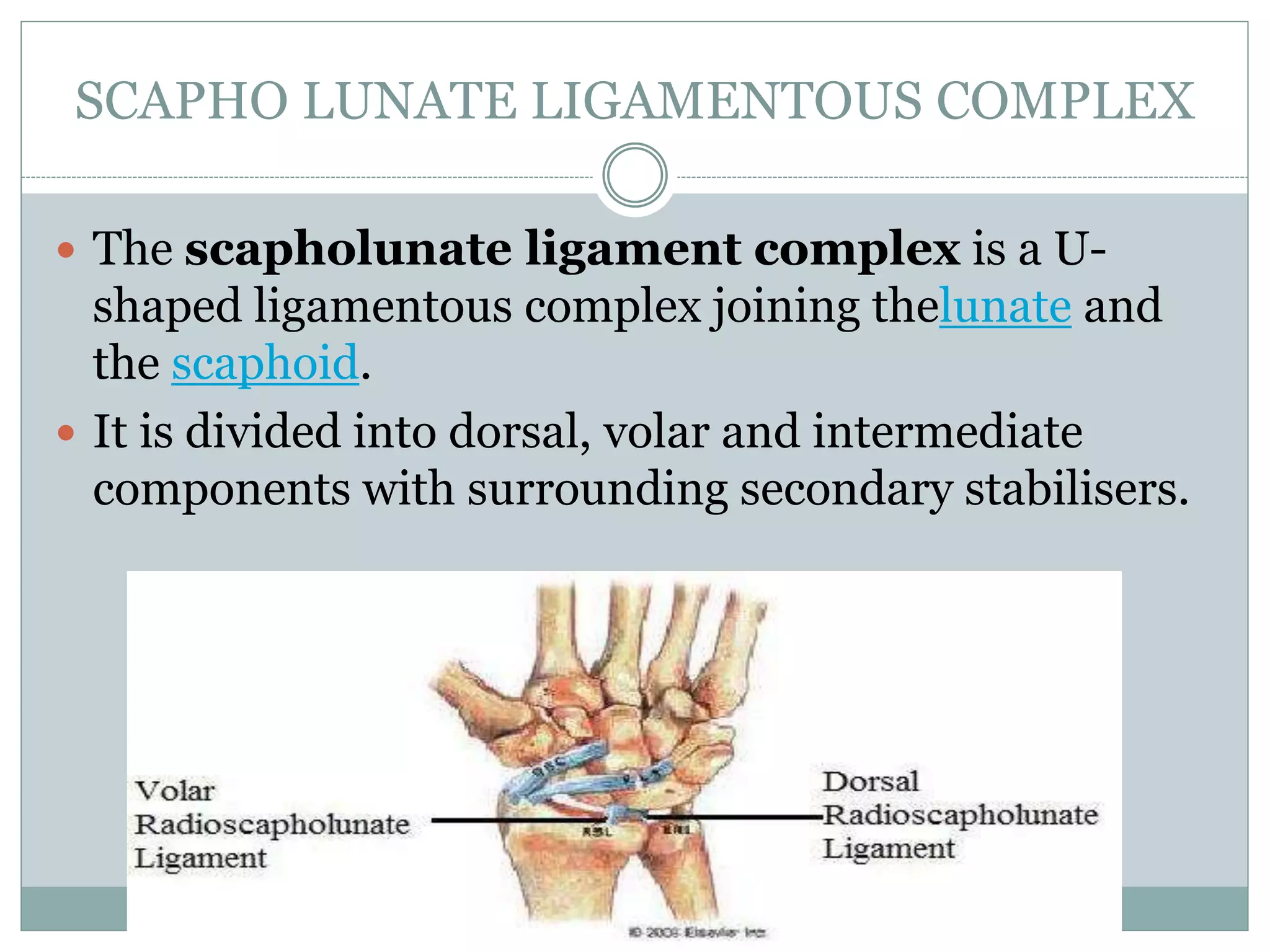
SCAPHO LUNATE LIGAMENTOUS COMPLEX
 The scapholunate ligament complex is a U-
shaped ligamentous complex joining thelunate and
the scaphoid.
 It is divided into dorsal, volar and intermediate
components with surrounding secondary stabilisers.
 Dorsal component
 blends with joint capsule, scaphotriquetral and intercarpal
ligaments
 strongest portion of the complex
 controls flexion/extension
 Volar component
 oblique collagen fibres
 blends with extrinsic volar radioscapholunate ligament
 controls rotational motion
 major proprioceptive role
 Intermediate/interosseous component
 located proximally and centrally and therefore may be
referred to as the central or proximal component
 fibrocartilage
 weakest portion of the complex
 extends a few millimeters into the joint, akin to a
meniscus
 Secondary stabilisers
 scapho-trapezial-trapezoidal ligament
 radio-scapho-capitiate ligament
RADIOGRAPHIC FEATURES
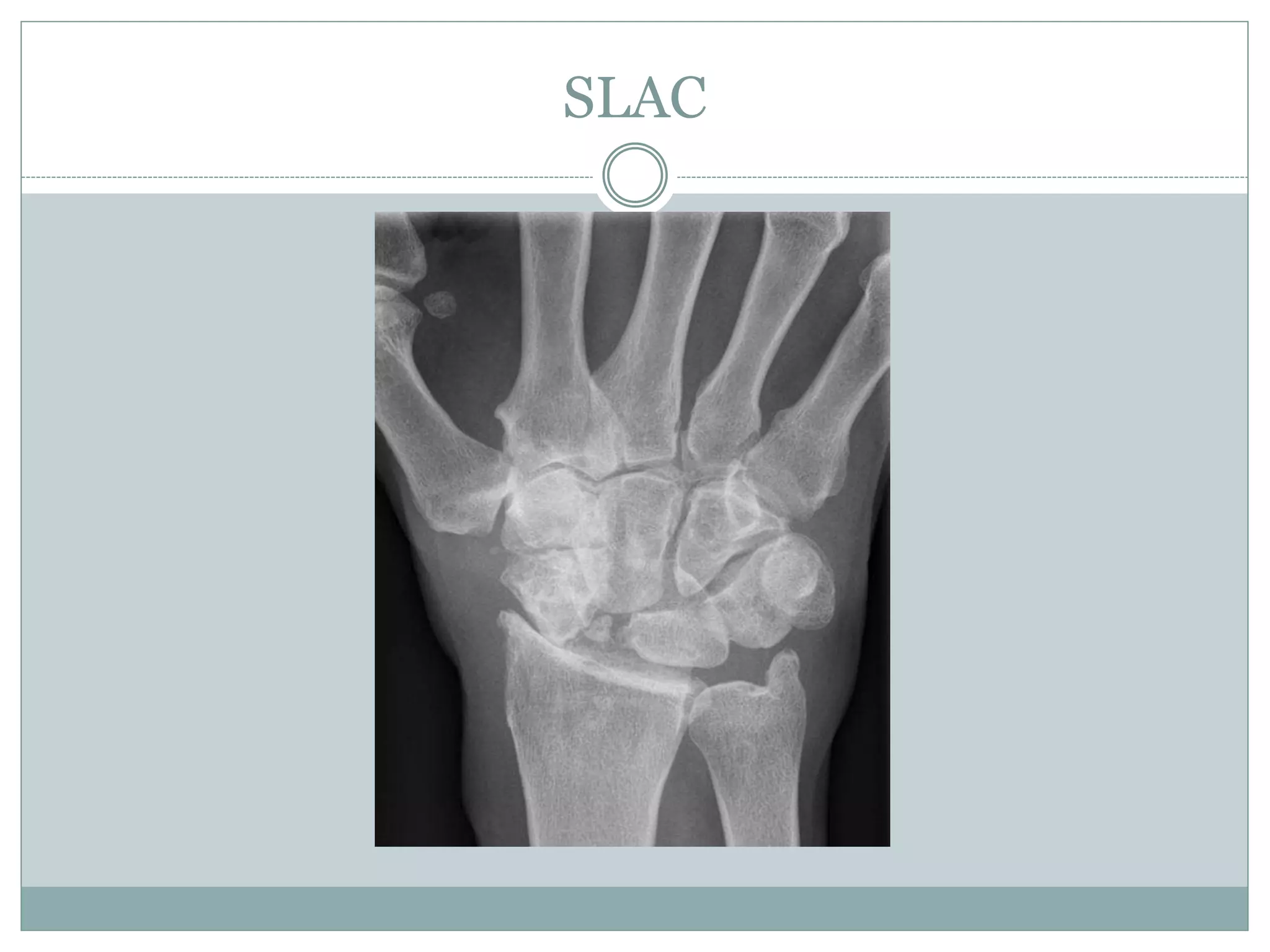
 The pattern is that of a progressive osteoarthritis
affecting initially the articulation between the radial
styloid and the scaphoid. In later stages of the disease,
osteoarthritis affects the whole radioscaphoid
articulation, then the articulation
between lunate and capitate. Finally it may involve other
intercarpal joints. In addition there is widening of the
space between scaphoid and lunate as well as proximal
migration of the scaphoid and the capitate
 CT FINDINGS: angulations of the scaphoid and lunate
bones (increased scapholunate angle and dorsal or volar
intercalated segment instability deformity),
radioscaphoid incongruity, cartilage loss, and
subchondral bone degenerative changes.
SCAPHOLUNATE DISSOSCIATION(TERRY
THOMAS SIGN)
SLAC
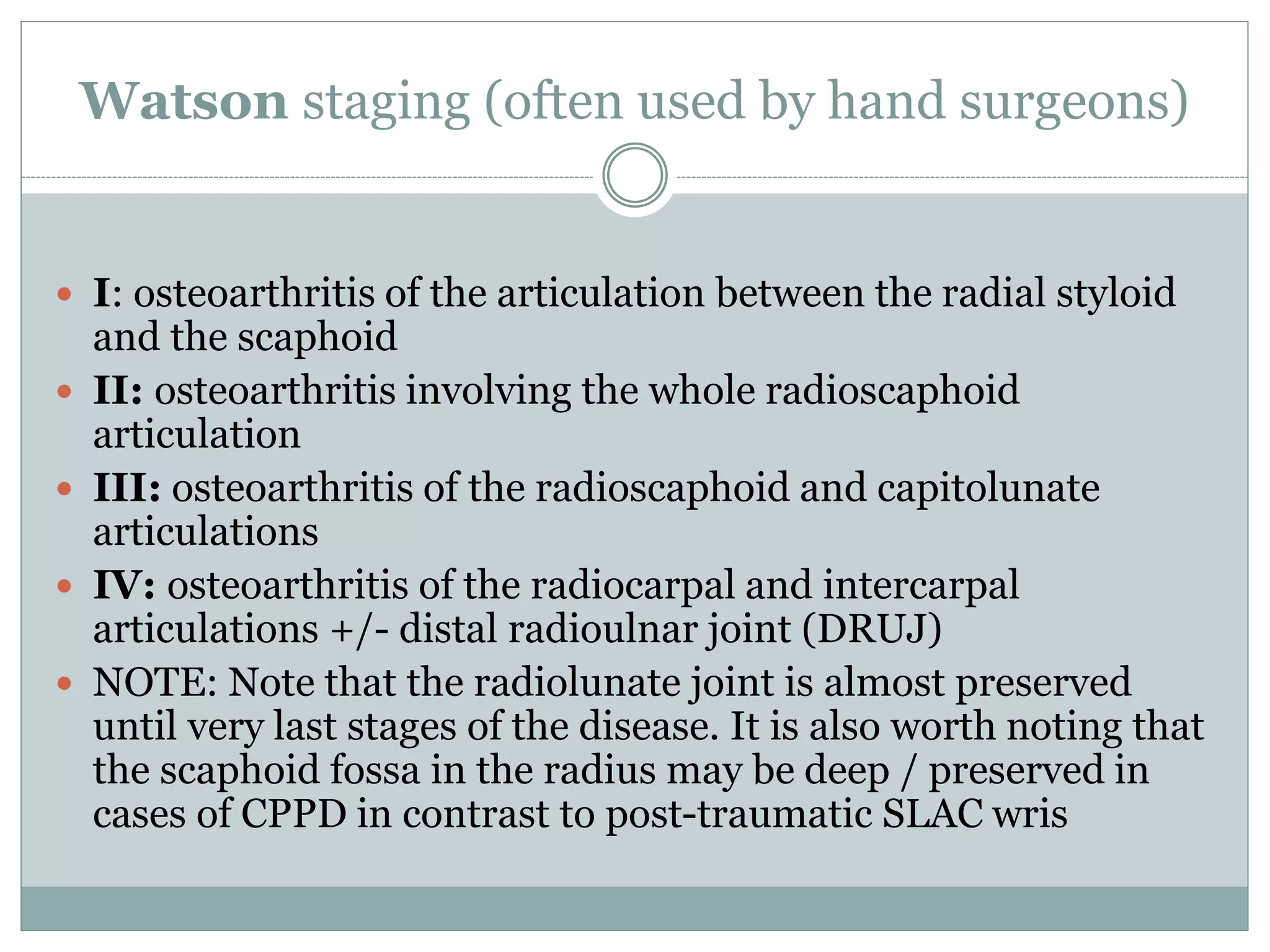
Watson staging (often used by hand surgeons)
 I: osteoarthritis of the articulation between the radial styloid
and the scaphoid
 II: osteoarthritis involving the whole radioscaphoid
articulation
 III: osteoarthritis of the radioscaphoid and capitolunate
articulations
 IV: osteoarthritis of the radiocarpal and intercarpal
articulations +/- distal radioulnar joint (DRUJ)
 NOTE: Note that the radiolunate joint is almost preserved
until very last stages of the disease. It is also worth noting that
the scaphoid fossa in the radius may be deep / preserved in
cases of CPPD in contrast to post-traumatic SLAC wris
SURGICAL TREATMENT
 Surgical treatment for SLAC wrist includes
 four-corner arthrodesis,
 capitolunate arthrodesis,
 complete wrist arthrodesis, scaphoidectomy,
 proximal row carpectomy (PRC),
 denervation,
 radial styloidectomy
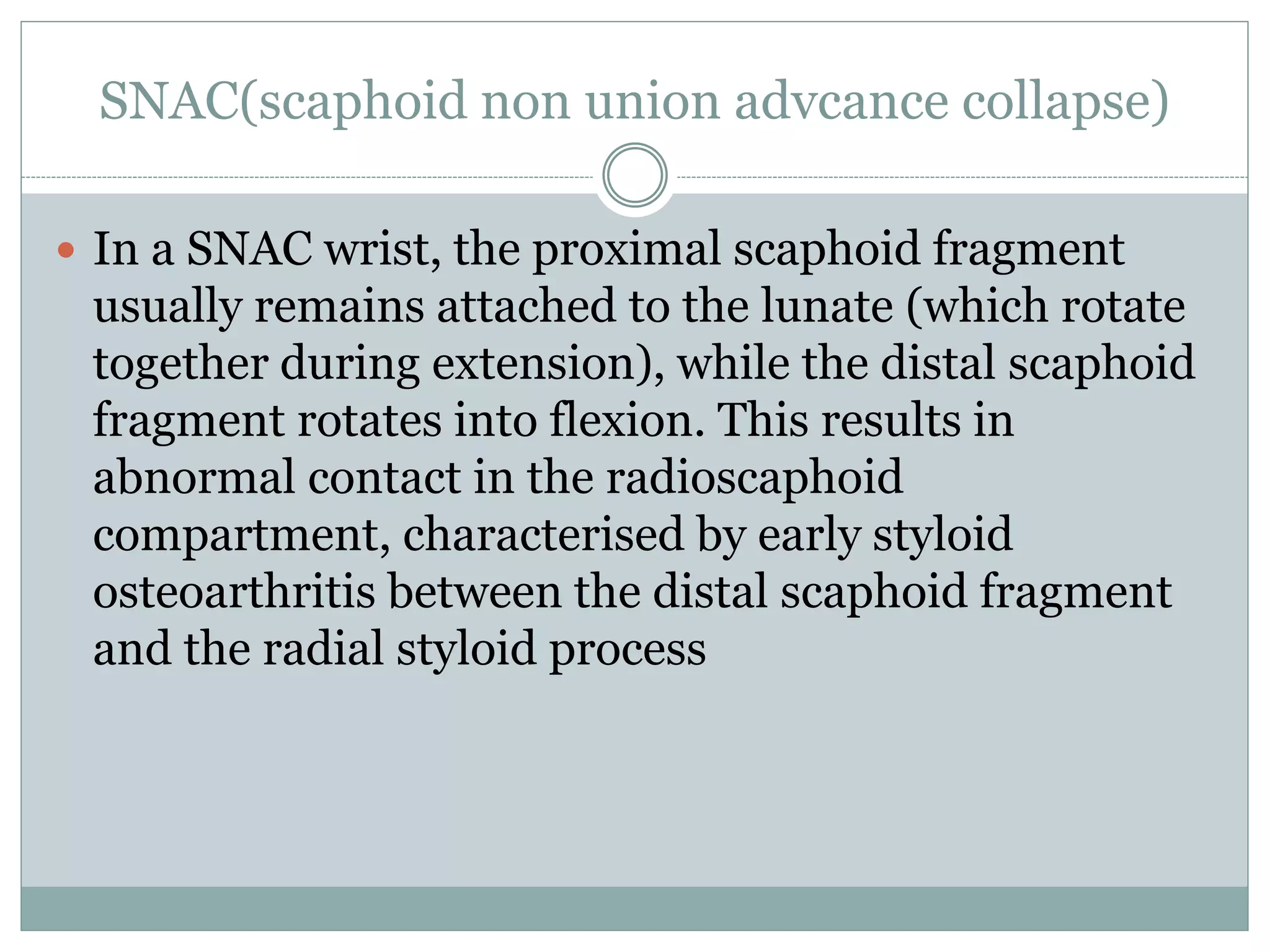
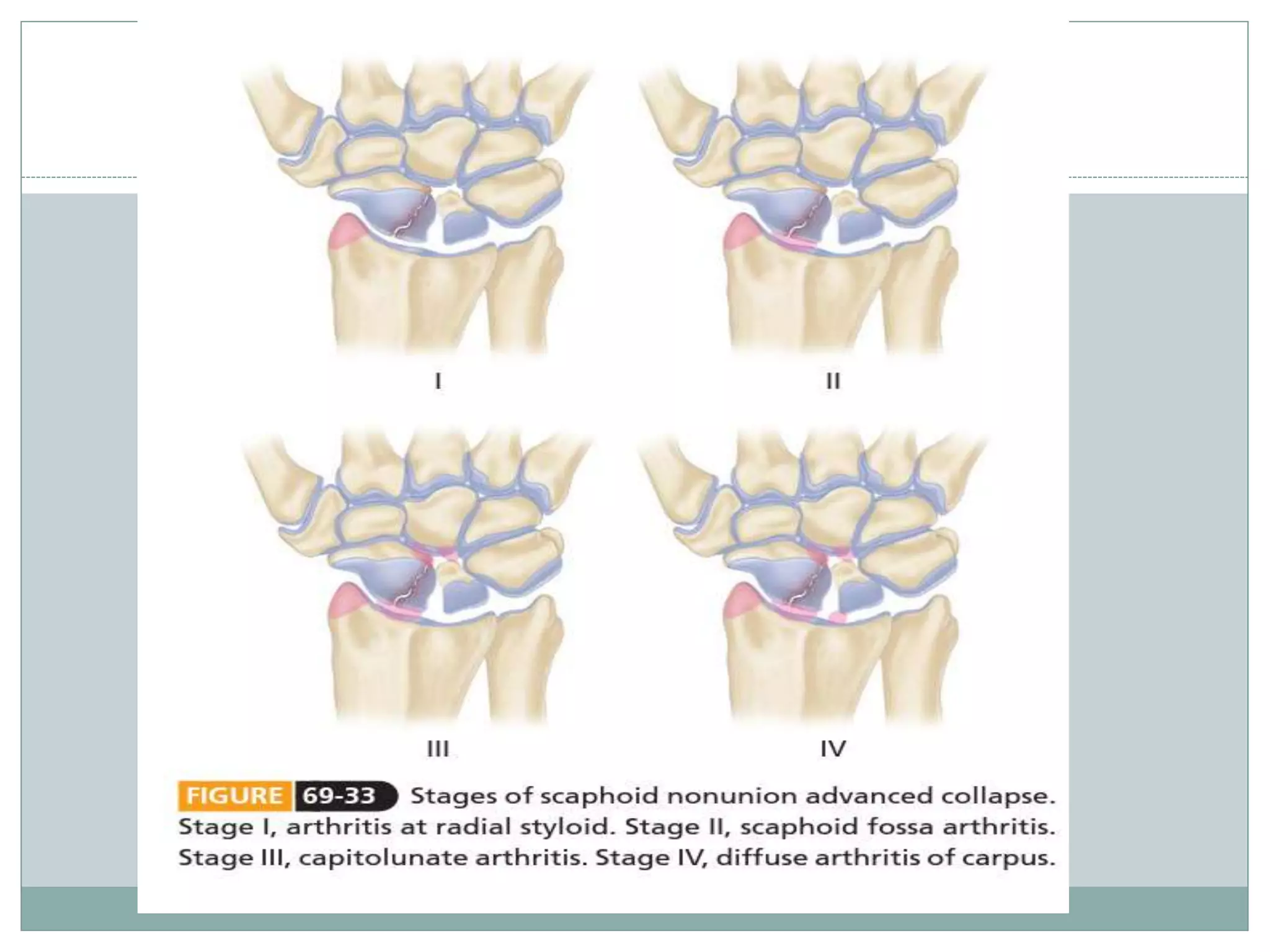
SNAC(scaphoid non union advcance collapse)
 In a SNAC wrist, the proximal scaphoid fragment
usually remains attached to the lunate (which rotate
together during extension), while the distal scaphoid
fragment rotates into flexion. This results in
abnormal contact in the radioscaphoid
compartment, characterised by early styloid
osteoarthritis between the distal scaphoid fragment
and the radial styloid process
Jupiter et al classification of non union
based on the extent of arthosis:
1. nonunions without arthrosis,
2. nonunions with radiocarpal arthrosis,
3. nonunions with advanced radiocarpal and
intercarpal arthrosis
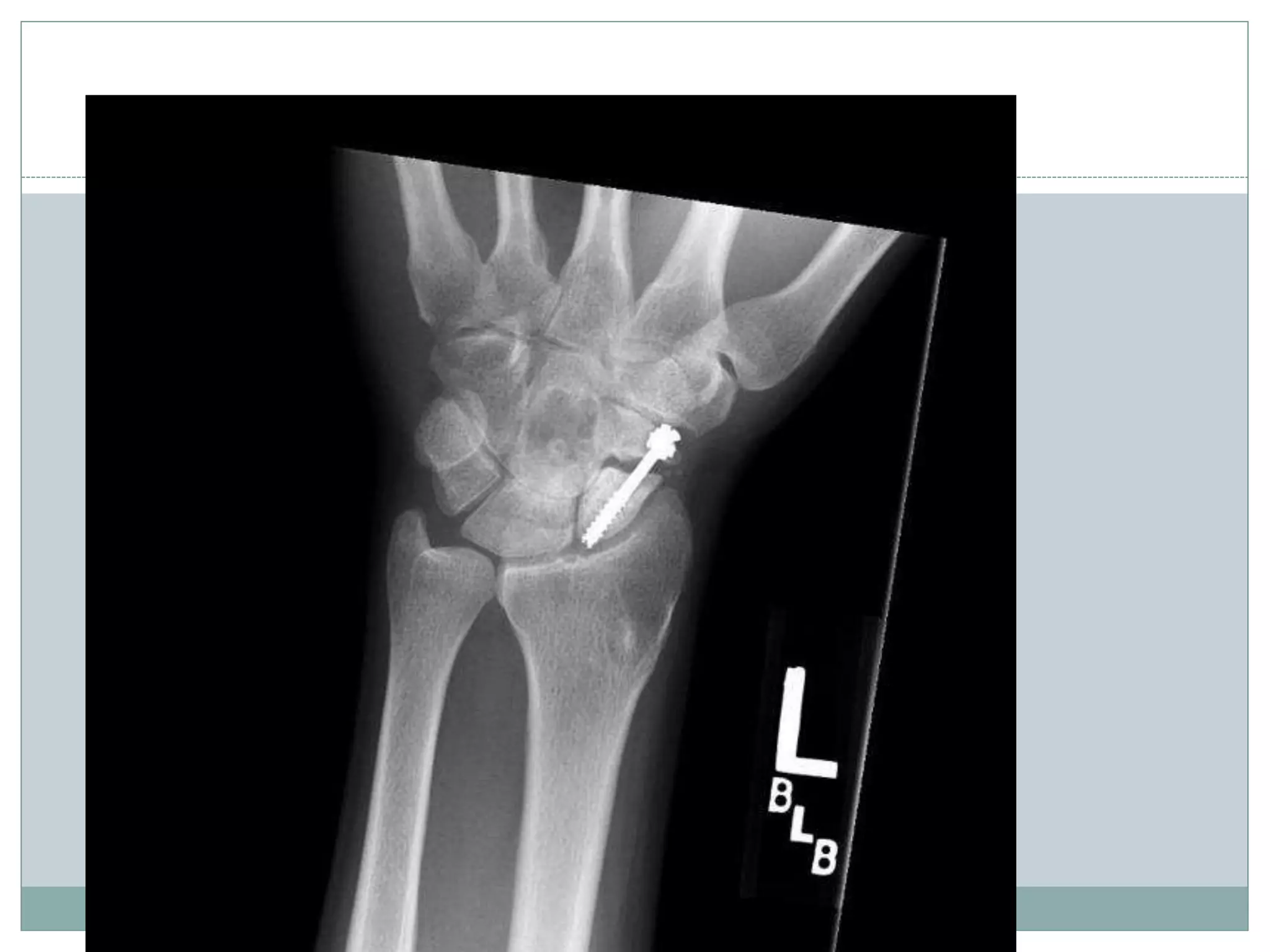
Radiographic findings of SNAC
 radioscaphoid narrowing,
 capitolunate narrowing,
 cyst formation,
 pronounced dorsal intercalated segment
instability(DISI)
 Note: The radiolunate joint usually is spared in early
stages but may show degenerative changes as the
arthritis becomes more diffuse.
Effect of SLAC & SNAC ON JOINT
KINEMATICS:
 Both of these processes lead to abnormal joint
kinematics, since the lunate is unrestrained by the
distal scaphoid and, therefore, assumes an extended
posture.
 Over time, this may result in a dorsal intercalated
segment instability (DISI) deformity, which
invariably progresses to degenerative arthritis at the
radioscaphoid articulation, followed by carpal
collapse and midcarpal arthritis
DISI(dorsal intercalated segment instability )
CAUSES:
1. wrist trauma +/- fracture
 Scaphoid fracture: bony DISI
 distal radius fracture: compensatory DISI
 radius malunion: adaptive DISI
2.Scapholunate ligament sissosciation: ligamentous DISI
Radiographic features
 On an AP view the normal trapezoidal configuration
of the scaphoid may be lost and it may appear
triangular.
 On lateral plain film typically shows a dorsal tilt of
the lunate:
 scapholunate angle > 60º: sign of scapholunate
ligament dissociation
 capitolunate angle > 30º: the capitate is displaced
posteriorly compared to the distal radius
DIFFERENTIAL DIAGNOSIS
 CARPAL TUNNEL SYNDROME
 TRIGGER FINGER
 DE QUERVANS TENOSYNOVITIS
 FCR TENDONITIS
NON OPERATIVE MANAGEMENT
 WRIST IMMOBILIZATION WITH SPLINTS
 NSAIDS
 CORTICO STEROIDS INJECTIONS
OPERATIVE MANAGEMENT
 RADIAL STYLOIDECTOMY
 WRIST DENERVATION
 SCAPHOID EXCISION
 PROXIMAL ROW CARPECTOMY
 ARTHODESIS
 Four corner arthodesis
 Capito-lunate arthodesis
 Wrist arthodesis
Four corner arthodesis
THANK YOU

SLAC & SNAC WRIST

  • 1.
    P R ES E N T E D B Y : D R . N . B E N T H U N G O T U N G O E P . G , M S ( O R T H O P E D I C S ) C E N T R A L I N S T I T U T E O F O R T H O P E D I C S V M M C & S A F D A R J U N G H O S P I T A L N E W D E L H I SNAC & SLAC WRIST
  • 2.
    INTRODUCTION  Scapholunate advancedcollapse (SLAC) and scaphoid nonunion advanced collapse (SNAC) are the two most common patterns of post-traumatic wrist arthritis.
  • 3.
    ETIOLOGY OF SLAC TRAUMATIC CAUSES:  Scaphoid fracture non union,  Scapholunate ligament dissosciation  ATRAUMATIC CAUSES:  CPPD(calcium pyro phosphate dehydrate) diseases  Rheumatoid arthritis  Neuropathic diseases  Beta 2 microglobulin assosciated amyloid deposition disease
  • 4.
    SCAPHO LUNATE LIGAMENTOUSCOMPLEX  The scapholunate ligament complex is a U- shaped ligamentous complex joining thelunate and the scaphoid.  It is divided into dorsal, volar and intermediate components with surrounding secondary stabilisers.
  • 5.
     Dorsal component blends with joint capsule, scaphotriquetral and intercarpal ligaments  strongest portion of the complex  controls flexion/extension  Volar component  oblique collagen fibres  blends with extrinsic volar radioscapholunate ligament  controls rotational motion  major proprioceptive role
  • 6.
     Intermediate/interosseous component located proximally and centrally and therefore may be referred to as the central or proximal component  fibrocartilage  weakest portion of the complex  extends a few millimeters into the joint, akin to a meniscus  Secondary stabilisers  scapho-trapezial-trapezoidal ligament  radio-scapho-capitiate ligament
  • 7.
    RADIOGRAPHIC FEATURES  Thepattern is that of a progressive osteoarthritis affecting initially the articulation between the radial styloid and the scaphoid. In later stages of the disease, osteoarthritis affects the whole radioscaphoid articulation, then the articulation between lunate and capitate. Finally it may involve other intercarpal joints. In addition there is widening of the space between scaphoid and lunate as well as proximal migration of the scaphoid and the capitate  CT FINDINGS: angulations of the scaphoid and lunate bones (increased scapholunate angle and dorsal or volar intercalated segment instability deformity), radioscaphoid incongruity, cartilage loss, and subchondral bone degenerative changes.
  • 8.
  • 9.
  • 10.
    Watson staging (oftenused by hand surgeons)  I: osteoarthritis of the articulation between the radial styloid and the scaphoid  II: osteoarthritis involving the whole radioscaphoid articulation  III: osteoarthritis of the radioscaphoid and capitolunate articulations  IV: osteoarthritis of the radiocarpal and intercarpal articulations +/- distal radioulnar joint (DRUJ)  NOTE: Note that the radiolunate joint is almost preserved until very last stages of the disease. It is also worth noting that the scaphoid fossa in the radius may be deep / preserved in cases of CPPD in contrast to post-traumatic SLAC wris
  • 11.
    SURGICAL TREATMENT  Surgicaltreatment for SLAC wrist includes  four-corner arthrodesis,  capitolunate arthrodesis,  complete wrist arthrodesis, scaphoidectomy,  proximal row carpectomy (PRC),  denervation,  radial styloidectomy
  • 12.
    SNAC(scaphoid non unionadvcance collapse)  In a SNAC wrist, the proximal scaphoid fragment usually remains attached to the lunate (which rotate together during extension), while the distal scaphoid fragment rotates into flexion. This results in abnormal contact in the radioscaphoid compartment, characterised by early styloid osteoarthritis between the distal scaphoid fragment and the radial styloid process
  • 14.
    Jupiter et alclassification of non union based on the extent of arthosis: 1. nonunions without arthrosis, 2. nonunions with radiocarpal arthrosis, 3. nonunions with advanced radiocarpal and intercarpal arthrosis
  • 15.
    Radiographic findings ofSNAC  radioscaphoid narrowing,  capitolunate narrowing,  cyst formation,  pronounced dorsal intercalated segment instability(DISI)  Note: The radiolunate joint usually is spared in early stages but may show degenerative changes as the arthritis becomes more diffuse.
  • 17.
    Effect of SLAC& SNAC ON JOINT KINEMATICS:  Both of these processes lead to abnormal joint kinematics, since the lunate is unrestrained by the distal scaphoid and, therefore, assumes an extended posture.  Over time, this may result in a dorsal intercalated segment instability (DISI) deformity, which invariably progresses to degenerative arthritis at the radioscaphoid articulation, followed by carpal collapse and midcarpal arthritis
  • 18.
    DISI(dorsal intercalated segmentinstability ) CAUSES: 1. wrist trauma +/- fracture  Scaphoid fracture: bony DISI  distal radius fracture: compensatory DISI  radius malunion: adaptive DISI 2.Scapholunate ligament sissosciation: ligamentous DISI
  • 19.
    Radiographic features  Onan AP view the normal trapezoidal configuration of the scaphoid may be lost and it may appear triangular.  On lateral plain film typically shows a dorsal tilt of the lunate:  scapholunate angle > 60º: sign of scapholunate ligament dissociation  capitolunate angle > 30º: the capitate is displaced posteriorly compared to the distal radius
  • 21.
    DIFFERENTIAL DIAGNOSIS  CARPALTUNNEL SYNDROME  TRIGGER FINGER  DE QUERVANS TENOSYNOVITIS  FCR TENDONITIS
  • 22.
    NON OPERATIVE MANAGEMENT WRIST IMMOBILIZATION WITH SPLINTS  NSAIDS  CORTICO STEROIDS INJECTIONS
  • 23.
    OPERATIVE MANAGEMENT  RADIALSTYLOIDECTOMY  WRIST DENERVATION  SCAPHOID EXCISION  PROXIMAL ROW CARPECTOMY  ARTHODESIS  Four corner arthodesis  Capito-lunate arthodesis  Wrist arthodesis
  • 24.
  • 25.