Good to Great
Chapter 8

The Flywheel & the Doom Loop
Mohamed Azmi Taufik
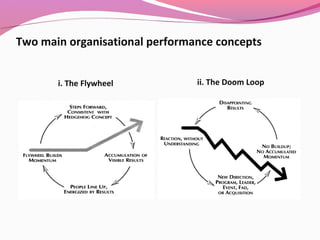
Two main organisational performance concepts
i. The Flywheel

ii. The Doom Loop
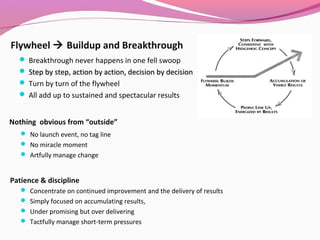
Flywheel  Buildup and Breakthrough
 Breakthrough never happens in one fell swoop
 Step by step, action by action, decision by decision
 Turn by turn of the flywheel
 All add up to sustained and spectacular results

Nothing obvious from “outside”
 No launch event, no tag line
 No miracle moment
 Artfully manage change

Patience & discipline
 Concentrate on continued improvement and the delivery of results
 Simply focused on accumulating results,
 Under promising but over delivering
 Tactfully manage short-term pressures
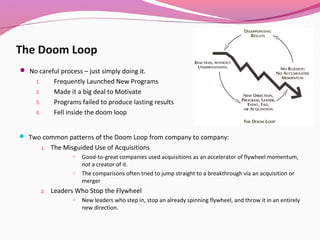
The Doom Loop
 No careful process – just simply doing it.

Frequently Launched New Programs
Made it a big deal to Motivate
Programs failed to produce lasting results
Fell inside the doom loop

1.
2.
3.
4.

 Two common patterns of the Doom Loop from company to company:
1.

The Misguided Use of Acquisitions
o
o

2.

Good-to-great companies used acquisitions as an accelerator of flywheel momentum,
not a creator of it.
The comparisons often tried to jump straight to a breakthrough via an acquisition or
merger

Leaders Who Stop the Flywheel
o

New leaders who step in, stop an already spinning flywheel, and throw it in an entirely
new direction.
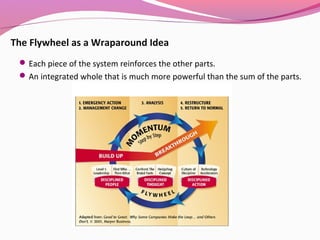
The Flywheel as a Wraparound Idea
 Each piece of the system reinforces the other parts.
 An integrated whole that is much more powerful than the sum of the parts.
Key Takeaways

 Level 5 Leaders
 Getting the right people on the bus.
 Completely understand the three circles of your Hedgehog Concept
 Follow the flywheel model regardless of the short-term consequences.
 The most successful companies evolve over time, and do not dramatically change.

Thank you
Are you on the Flywheel or in the Doom Loop?
Flywheel

Doom Loop

 Follow a pattern of buildup leading to

 Skip buildup and jump right to

breakthrough.
 Reach breakthrough by an
accumulation of steps, one after the
other, turn by turn of the flywheel;
feels like an organic evolutionary
process.
 Confront the brutal facts to see clearly
what steps must be taken to build
momentum.
 Attain consistency with clear
Hedgehog Concept, resolutely staying
within the three circles.

breakthrough.
 Implement big programs, radical
change efforts, dramatic revolutions;
chronic restructuring-always looking
for a miracle moment or new savior.
 Embrace fads and engage in
management hoopla, rather than
confront the brutal facts.
 Demonstrate chronic inconsistencylurching back and forth and out of the
three circles.
Are you on the Flywheel or in the Doom Loop?
Flywheel

Doom Loop

 Follow the pattern of disciplined

 Jump right to action, without

people (“first who”), disciplined
thought, disciplined action.
 Harness appropriate technologies to
your Hedgehog Concept, to accelerate
momentum.
 Make major acquisitions after
breakthrough (if at all)
 Spend little energy trying to motivate
or align people.
 Let results do the most of the talking.
 Maintain consistency over time.

disciplined though and without first
getting the right people on the bus.
 Run about like Chicken Little in
reaction to technology.
 Make major acquisitions before
breakthrough.
 Spend a lot of energy trying to align
and motivate people.
 Sell the future.
 Inconsistency over time.

The Flywheel and The Doom Loop

  • 1.
    Good to Great Chapter8 The Flywheel & the Doom Loop Mohamed Azmi Taufik
  • 2.
    Two main organisationalperformance concepts i. The Flywheel ii. The Doom Loop
  • 3.
    Flywheel  Buildupand Breakthrough  Breakthrough never happens in one fell swoop  Step by step, action by action, decision by decision  Turn by turn of the flywheel  All add up to sustained and spectacular results Nothing obvious from “outside”  No launch event, no tag line  No miracle moment  Artfully manage change Patience & discipline  Concentrate on continued improvement and the delivery of results  Simply focused on accumulating results,  Under promising but over delivering  Tactfully manage short-term pressures
  • 4.
    The Doom Loop No careful process – just simply doing it. Frequently Launched New Programs Made it a big deal to Motivate Programs failed to produce lasting results Fell inside the doom loop 1. 2. 3. 4.  Two common patterns of the Doom Loop from company to company: 1. The Misguided Use of Acquisitions o o 2. Good-to-great companies used acquisitions as an accelerator of flywheel momentum, not a creator of it. The comparisons often tried to jump straight to a breakthrough via an acquisition or merger Leaders Who Stop the Flywheel o New leaders who step in, stop an already spinning flywheel, and throw it in an entirely new direction.
  • 5.
    The Flywheel asa Wraparound Idea  Each piece of the system reinforces the other parts.  An integrated whole that is much more powerful than the sum of the parts.
  • 6.
    Key Takeaways  Level5 Leaders  Getting the right people on the bus.  Completely understand the three circles of your Hedgehog Concept  Follow the flywheel model regardless of the short-term consequences.  The most successful companies evolve over time, and do not dramatically change. Thank you
  • 7.
    Are you onthe Flywheel or in the Doom Loop? Flywheel Doom Loop  Follow a pattern of buildup leading to  Skip buildup and jump right to breakthrough.  Reach breakthrough by an accumulation of steps, one after the other, turn by turn of the flywheel; feels like an organic evolutionary process.  Confront the brutal facts to see clearly what steps must be taken to build momentum.  Attain consistency with clear Hedgehog Concept, resolutely staying within the three circles. breakthrough.  Implement big programs, radical change efforts, dramatic revolutions; chronic restructuring-always looking for a miracle moment or new savior.  Embrace fads and engage in management hoopla, rather than confront the brutal facts.  Demonstrate chronic inconsistencylurching back and forth and out of the three circles.
  • 8.
    Are you onthe Flywheel or in the Doom Loop? Flywheel Doom Loop  Follow the pattern of disciplined  Jump right to action, without people (“first who”), disciplined thought, disciplined action.  Harness appropriate technologies to your Hedgehog Concept, to accelerate momentum.  Make major acquisitions after breakthrough (if at all)  Spend little energy trying to motivate or align people.  Let results do the most of the talking.  Maintain consistency over time. disciplined though and without first getting the right people on the bus.  Run about like Chicken Little in reaction to technology.  Make major acquisitions before breakthrough.  Spend a lot of energy trying to align and motivate people.  Sell the future.  Inconsistency over time.