
AIRPORT PLANNING & MANAGEMENT
Ahsan Khan BAM11332
Airfield Imaginary Surfaces
Joy
•A/C landing to or taking off from a R/W need an
area free of obstructions to safely operate.
•Aircraft manoeuvres
•To assure the most efficient use of the airport
• The safety of the airport users
•Volume of Airspaces invisible to human eye
3
Why do we need them?
FAR Part 77
“that area above which objects on the ground
cannot protrude without constituting
an obstruction”
•Defines the maximum allowable height of any
structures that may be placed in the vicinity of an
active runway by defining Dimensions
•Category of Runway
•Type of Approach Available/planned
Size depends upon
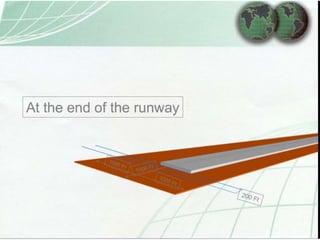
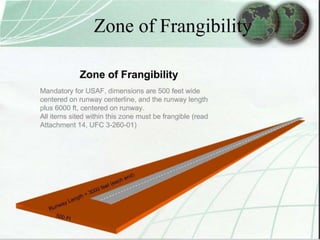
• Aligned (longitudinally) with each runway and extends
200 ft from each runway end
• Same elevation as RW
• Only the surface having same elevation
• Centered on the RW
• 200ft beyond each RW end
• Clear of all obstructions, heights
• Signs/Nav-aids/Markings allowed
Primary Surfaces
Utility Runways (Prop)
• 250 ft (RW having visual approaches only)
• 500 ft (R/Ws having non-precision instrument approaches
only)
Non Utility Runways
• 500 ft
• 500 ft (visibility minimums > than 3/4 of a mile)
• 1,000 ft instrument approach with visibility minimums as
low as 3/4 of a mile
Dependent upon type of Approaches
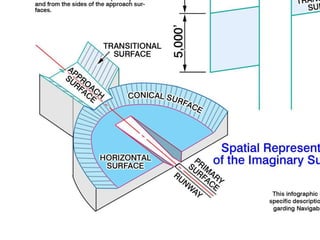
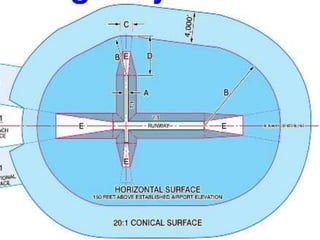
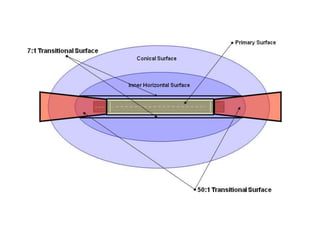
Horizontal Surface
• Flat surface 150ft above RW elevation
• Shape determined by swinging arcs from centre end of
Primary surface of each RW end
• Radius 5000 ft
• Radius of each arc is:
• 5,000 ft for all runways designated as utility or visual
• 10,000 ft for all other runways
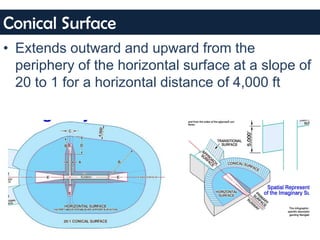
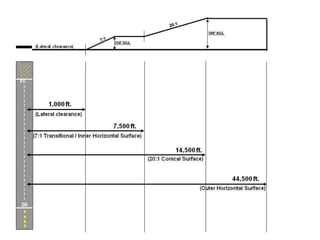
Conical Surface
• Extends outward and upward from the
periphery of the horizontal surface at a slope of
20 to 1 for a horizontal distance of 4,000 ft
• Starts at the edge of the horizontal surface
• Extends outward /upward standard 20:1 slope
• Outer edge 200 ft above horizontal surface
• Horizontal 4000ft, vertical 200 ft above
horizontal surface
• Horizontal distance 4000 ft, Vertical Rise
2000 ft, Outer edge 350 ft above airport
elevation
Approach Surface
• Critical landing (appr dependent)
• Degree (20:1), (34:1), (50:1)
• For precision instrument
• 20ft outward
• 1ft upward
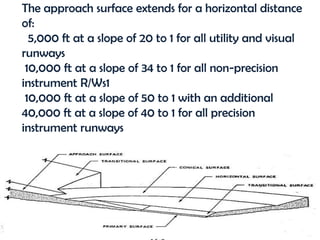
• The approach surface extends for a horizontal distance of:
• 5,000 ft at a slope of 20 to 1 for all utility and visual runways
• 10,000 ft at a slope of 34 to 1 for all non-precision instrument
R/Ws
• 10,000 ft at a slope of 50 to 1 with an additional 40,000 ft at
a slope of 40 to 1 for all precision instrument runways
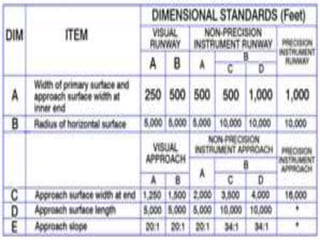
The inner edge of the approach surface is the same width
as the primary surface and it expands uniformly to an
outer edge width of: 1,250 ft for that end of a utility
runway with only visual approaches
• 1,500 ft for R/W other than a utility R/W with only
visual approaches
• 2,000 ft for utility R/W with a non-precision
instrument approach
• 3,500 ft for non-precision instrument R/W
other than utility, having vis mins > than 3/4 of
a mile
• 4,000 ft for non-precision instrument
R/W, other than utility, having a non-precision
instrument approach with vis mins as low as
3/4 of a mile
• 16,000 ft for precision instrument runways
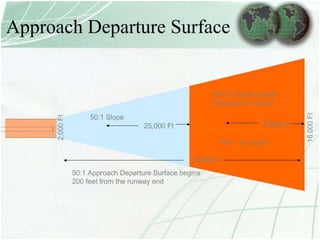
The approach surface extends for a horizontal distance
of:
5,000 ft at a slope of 20 to 1 for all utility and visual
runways
10,000 ft at a slope of 34 to 1 for all non-precision
instrument R/Ws1
10,000 ft at a slope of 50 to 1 with an additional
40,000 ft at a slope of 40 to 1 for all precision
instrument runways
Transitional Surface
• Transitional surfaces extend outward and upward at right
angles to the R/W centerline and the R/W centerline extends
at a slope of 7 to 1 from the sides of the primary surface and
from the sides of the approach surfaces
• A distance of 5,000 ft measured horizontally from the edge
of the approach surface and at right angles to the runway
centerline
• 7:1 slope (Rises) standard slope
• Exerts outward and upward from the R/W sides
• Starts at the edge of Primary Surfaces
A Concise Summary
• Primary = aligned (longitudinally) with each
runway and extends 200 ft from each runway
end
• Horizontal = horizontal plane 150 ft. above the
established airport elevation. Constructed by
swinging arcs around the end of the primary
surface
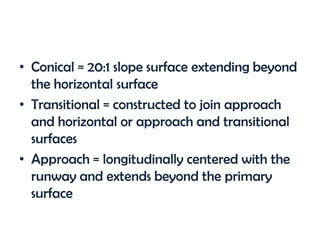
• Conical = 20:1 slope surface extending beyond
the horizontal surface
• Transitional = constructed to join approach
and horizontal or approach and transitional
surfaces
• Approach = longitudinally centered with the
runway and extends beyond the primary
surface
Citation
• USAF Manuals
• Study Pack AP&M
• FAR 77
ASK ME

Airfield Imaginary Surfaces

  • 1.
    AIRPORT PLANNING &MANAGEMENT Ahsan Khan BAM11332 Airfield Imaginary Surfaces Joy
  • 3.
    •A/C landing toor taking off from a R/W need an area free of obstructions to safely operate. •Aircraft manoeuvres •To assure the most efficient use of the airport • The safety of the airport users •Volume of Airspaces invisible to human eye 3 Why do we need them?
  • 4.
    FAR Part 77 “thatarea above which objects on the ground cannot protrude without constituting an obstruction” •Defines the maximum allowable height of any structures that may be placed in the vicinity of an active runway by defining Dimensions
  • 5.
    •Category of Runway •Typeof Approach Available/planned Size depends upon
  • 8.
    • Aligned (longitudinally)with each runway and extends 200 ft from each runway end • Same elevation as RW • Only the surface having same elevation • Centered on the RW • 200ft beyond each RW end • Clear of all obstructions, heights • Signs/Nav-aids/Markings allowed Primary Surfaces
  • 12.
    Utility Runways (Prop) •250 ft (RW having visual approaches only) • 500 ft (R/Ws having non-precision instrument approaches only) Non Utility Runways • 500 ft • 500 ft (visibility minimums > than 3/4 of a mile) • 1,000 ft instrument approach with visibility minimums as low as 3/4 of a mile Dependent upon type of Approaches
  • 13.
    Horizontal Surface • Flatsurface 150ft above RW elevation • Shape determined by swinging arcs from centre end of Primary surface of each RW end • Radius 5000 ft • Radius of each arc is: • 5,000 ft for all runways designated as utility or visual • 10,000 ft for all other runways
  • 15.
    Conical Surface • Extendsoutward and upward from the periphery of the horizontal surface at a slope of 20 to 1 for a horizontal distance of 4,000 ft
  • 16.
    • Starts atthe edge of the horizontal surface • Extends outward /upward standard 20:1 slope • Outer edge 200 ft above horizontal surface • Horizontal 4000ft, vertical 200 ft above horizontal surface • Horizontal distance 4000 ft, Vertical Rise 2000 ft, Outer edge 350 ft above airport elevation
  • 17.
    Approach Surface • Criticallanding (appr dependent) • Degree (20:1), (34:1), (50:1) • For precision instrument • 20ft outward • 1ft upward • The approach surface extends for a horizontal distance of: • 5,000 ft at a slope of 20 to 1 for all utility and visual runways • 10,000 ft at a slope of 34 to 1 for all non-precision instrument R/Ws • 10,000 ft at a slope of 50 to 1 with an additional 40,000 ft at a slope of 40 to 1 for all precision instrument runways
  • 21.
    The inner edgeof the approach surface is the same width as the primary surface and it expands uniformly to an outer edge width of: 1,250 ft for that end of a utility runway with only visual approaches • 1,500 ft for R/W other than a utility R/W with only visual approaches • 2,000 ft for utility R/W with a non-precision instrument approach
  • 22.
    • 3,500 ftfor non-precision instrument R/W other than utility, having vis mins > than 3/4 of a mile • 4,000 ft for non-precision instrument R/W, other than utility, having a non-precision instrument approach with vis mins as low as 3/4 of a mile • 16,000 ft for precision instrument runways
  • 23.
    The approach surfaceextends for a horizontal distance of: 5,000 ft at a slope of 20 to 1 for all utility and visual runways 10,000 ft at a slope of 34 to 1 for all non-precision instrument R/Ws1 10,000 ft at a slope of 50 to 1 with an additional 40,000 ft at a slope of 40 to 1 for all precision instrument runways
  • 24.
    Transitional Surface • Transitionalsurfaces extend outward and upward at right angles to the R/W centerline and the R/W centerline extends at a slope of 7 to 1 from the sides of the primary surface and from the sides of the approach surfaces • A distance of 5,000 ft measured horizontally from the edge of the approach surface and at right angles to the runway centerline • 7:1 slope (Rises) standard slope • Exerts outward and upward from the R/W sides • Starts at the edge of Primary Surfaces
  • 26.
    A Concise Summary •Primary = aligned (longitudinally) with each runway and extends 200 ft from each runway end • Horizontal = horizontal plane 150 ft. above the established airport elevation. Constructed by swinging arcs around the end of the primary surface
  • 27.
    • Conical =20:1 slope surface extending beyond the horizontal surface • Transitional = constructed to join approach and horizontal or approach and transitional surfaces • Approach = longitudinally centered with the runway and extends beyond the primary surface
  • 30.
    Citation • USAF Manuals •Study Pack AP&M • FAR 77
  • 31.