1
GUIDELINE ON ASSIGNMENT SUBMISSION
1. Assignments
The assignments are an integral part of your learning experience.
The purpose of giving assignments to students is to provide them with off-work experiences
in using the theories, procedures and experiences they learnt to solve real life work problems.
The resource persons provide you with feedback on your assignments in order for you to
improve your problem solving capacity. The weight AeU places on assignments in
distribution of marks, allocating 30% each for two assignments itself is an indicator of the
criticality of assignments.
Your Session Plan indicates the type of assignments you should undertake for each subject
and the submission dates for the assignment.
Please read through the following sections and feel free to make inquiries, if any.
2. Types of Assignments
First, assignments are classified under two different bases. They are indicated in the Session
Plan as Individual Assignments and Group assignments depending on the number of
individuals involved in the task.
Secondly, based on the place of completing the assignments are categorized as;
i. Take home assignments: The student is given the assignment and he/she has to write
it up at home and submit at a given date and time.
ii. In –class assignments: basic information required to familiarize with the problem or
task that need to be done is given and the student is expected to be ready for the
assignment and do it in the class.
Both these types of assignments could be either individual or group. The specific details are
given in the assignment.
3. Procedure for Submitting Assignments
i. Commencing the Task of Doing an Assignments
It is essential that an assignment is written and presented within the guidelines given
regarding all aspects of the assignment. The outcome of such work practices is known
as “Academic Rigour”. In this process following are emphasized:
2
ii. Preparatory Stage:
a. Understanding the problem and analyzing it in a manner appropriate for the
problem.
b. Collecting primary data if necessary (from humans involved in the problem
and secondary data (from documented sources such as Annual Reports,
previous survey findings etc.)
c. Review literature relevant to the problem studied.
d. Analyze data
iii. Writing Stage
As an MBA/EMBA student, your writing is expected to be academic in nature.
Therefore following are expected:
a. The arrangement of the assignment:
i. Introduction
ii. Body of the presentation
iii. Conclusions/Summary
iv. List of References
v. Annexes and/or Appendices
b. Logical flow in writing
c. Include Tables and Figures where necessary.
d. Provide in-text references using Harvard Method of Referencing.
e. Edit the document.
f. Make sure you have not exceeded more than 10% of word count given in the
assignment.
iv. Formatting of the Assignments
a. Papers & Margins
A4 size white papers
Margins: Left 1.2” and Top, Bottom & Right 1.0”
Fonts : Times New Roman 16, Bold: Assignment Heading
Times New Roman 12, Bold: Subtopics
Times New Roman 12 : text
Spacing: Line spacing 1.5 spaces
Paragraph spacing before/after each paragraph
3
Tables : To be numbered Table 1: (& Title of the table) – top.
Figures: To be numbered Figure1: (& Title of the Figure) - bottom
Reference should be indicated under the last line of each Table or Figure.
Colours could be used for tables and figures.
Pages should be numbered
Page numbers on the footer center, Font Size 12, Times New Roman
b. Order of Binding of the Assignment
i. Cover page
ii. Title Page
iii. Text of the Assignment
iv. Feedback form
Please refer the Appendices of this document for the relevant formats.
Binding of the assignment
Staple along the left margin and attach a blue color tape along the margin
v. Submission of Assignments
a. Students should submit a Hard Copy on the due date at the time prescribed to
the Office and it is considered as the formal submission.
Receipt issued by Asian College of Management will be your only proof of
assignment submission.
b. The soft copy should be forwarded as an attachment to
assignments@academy.lk with the following header:
For Individual Assignments
(i subject) Marketing Management (ii Code) (MKM 607) ( iii Intake ) Intake 08 ( iv
Type) Individual (Name with initials) ABC De Silva
For Group Assignments
(i subject)Marketing Management (ii Code)(MBA2023) ( iii Intake )Intake 05-(iv
Type) Group (First Names) Aruna/Buddhi/Christy
Give the full names of group members in the body of the email.
c. Procedure for dealing with resubmission and re-presentations
4
If a resource person decides that the material submitted as an assignment is:
i. plagiarised (from internet or books)
ii. copied from another student
iii. slightly modified from another student’s work
iv. considered as out of focus or very weak,
Then the student could be asked to resubmit (a written assignment) or redo a
presentation. Such resubmissions and/or re-doings should be submitted to
ACM Lanka within the time period allowed by the management.
d. Procedure for dealing with non-submission and late submission of assignments
Failure of a student to submit an assignment within the stipulated period or non
– submission after corrections/ upgrades advised by the resource person is
considered as dropping out of that particular subject in his/her batch. Such a
student could re-submit the assignment or presentation when the same subject
is repeated for the next batch.
Any delay in submission of assignment/s is treated as indicated in the
following Table.
Penalty for Delay in Submission of Assignments
Time lapsed
Penalty
% Reduction of
marks earned
Reduction of
marks earned
out of 30%
Monetary
Penalty
(Rs)
Within 24 hrs. from
due time of the day 0.5 0.15
Nil
Day 2 1.0 0.30 Nil
Day 3 1.5 0.45 Nil
Day 4 2.0 0.60 Nil
Day 5 2.5 0.75 Nil
Day 6 3.0 0.90 Nil
Day 7 4.0 1.20 Nil
Day 8 4.3 1.29 1,000/-
Day 9 4.6 1.38 1,300/-
Day 10 4.9 1.47 1,600/-
Day 11 5.2 1.56 1,900/-
Day 12 5.5 1.65 2,200/-
Day 13 5.8 1.74 2,500/-
Day 14 6.0 1.80 3,000/-
After 14th Day No submission will be accepted
without prior approval
5
vi. Presentations
Presentations are required when doing the group assignments. The time allocated for the
Presentation in the class is given in the assignment. The students are expected to time the
presentations based on the time limits. Power Point Presentations too could be used for this
purpose. Please attach a copy of the slides to the written assignment.
vii. In-class Activities
When carrying out in-class activities such as assignments or presentations, the students are
expected to prepare before hand and also keep their lap tops also ready to display.
During these activities, it is necessary to ensure that no disturbances are made to another
individual or a group.
Appendix 1: Formats for Assignments
Instructions: Please use the appropriate formats.
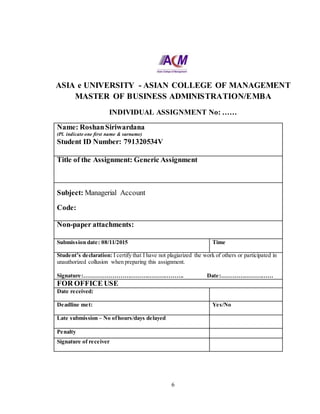
Format 1 : Cover page for Individual Assignments
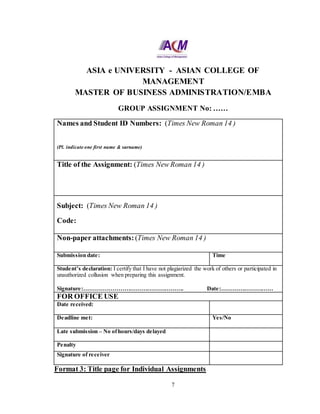
Format 2 : Cover page for Group Assignments
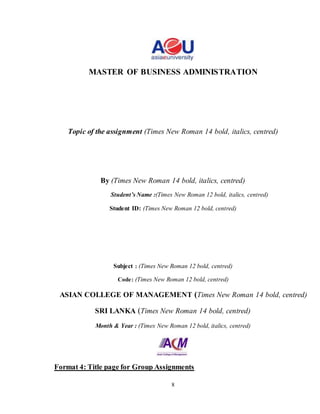
Format 3 : Title page for Individual Assignments
Format 4 : Title page for Group Assignments
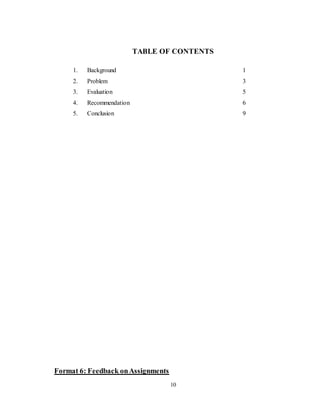
Format 5 : Content page (if required)
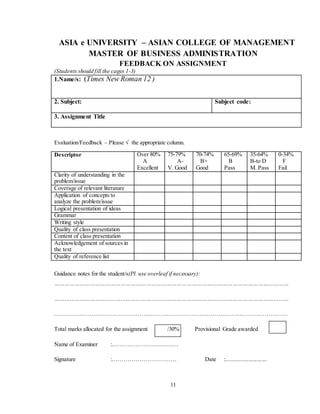
Format 6 : Feedback format- Please attach after the body of the text before the back cover.
Format 7: Report of an External Consultant
Format 8: Internal Company Report
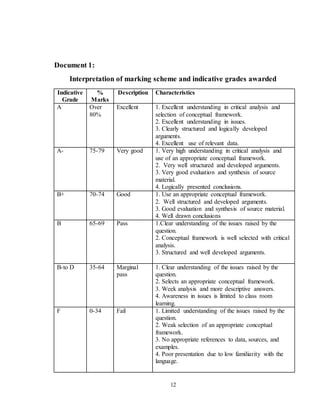
Document 1: Interpretation of marking scheme and indicative grades awarded
Please read this document and learn how you should perform in order to achieve
your targets in acquiring your MBA/EMBA
Appendix 2: Sample Assignment
6
ASIA e UNIVERSITY - ASIAN COLLEGE OF MANAGEMENT
MASTER OF BUSINESS ADMINISTRATION/EMBA
INDIVIDUAL ASSIGNMENT No: ……
Name: RoshanSiriwardana
(Pl. indicate one first name & surname)
Student ID Number: 791320534V
Title of the Assignment: Generic Assignment
Subject: Managerial Account
Code:
Non-paper attachments:
Submission date: 08/11/2015 Time
Student’s declaration: I certify that I have not plagiarized the work of others or participated in
unauthorized collusion when preparing this assignment.
Signature:……………………………………………. Date:………………………
FOR OFFICE USE
Date received:
Deadline met: Yes/No
Late submission – No ofhours/days delayed
Penalty
Signature of receiver
7
ASIA e UNIVERSITY - ASIAN COLLEGE OF
MANAGEMENT
MASTER OF BUSINESS ADMINISTRATION/EMBA
GROUP ASSIGNMENT No: ……
Names and Student ID Numbers: (Times New Roman 14 )
(Pl. indicate one first name & surname)
Title of the Assignment: (Times New Roman 14 )
Subject: (Times New Roman 14 )
Code:
Non-paper attachments: (Times New Roman 14 )
Submission date: Time
Student’s declaration: I certify that I have not plagiarized the work of others or participated in
unauthorized collusion when preparing this assignment.
Signature:……………………………………………. Date:………………………
FOR OFFICE USE
Date received:
Deadline met: Yes/No
Late submission – No ofhours/days delayed
Penalty
Signature of receiver
Format 3: Title page for Individual Assignments
8
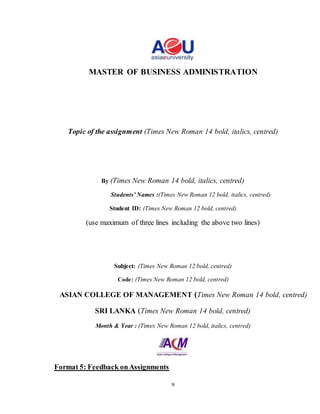
MASTER OF BUSINESS ADMINISTRATION
Topic of the assignment (Times New Roman 14 bold, italics, centred)
By (Times New Roman 14 bold, italics, centred)
Student’s Name :(Times New Roman 12 bold, italics, centred)
Student ID: (Times New Roman 12 bold, centred)
Subject : (Times New Roman 12 bold, centred)
Code: (Times New Roman 12 bold, centred)
ASIAN COLLEGE OF MANAGEMENT (Times New Roman 14 bold, centred)
SRI LANKA (Times New Roman 14 bold, centred)
Month & Year : (Times New Roman 12 bold, italics, centred)
Format 4: Title page for Group Assignments
9
MASTER OF BUSINESS ADMINISTRATION
Topic of the assignment (Times New Roman 14 bold, italics, centred)
By (Times New Roman 14 bold, italics, centred)
Students’ Names :(Times New Roman 12 bold, italics, centred)
Student ID: (Times New Roman 12 bold, centred)
(use maximum of three lines including the above two lines)
Subject: (Times New Roman 12 bold, centred)
Code: (Times New Roman 12 bold, centred)
ASIAN COLLEGE OF MANAGEMENT (Times New Roman 14 bold, centred)
SRI LANKA (Times New Roman 14 bold, centred)
Month & Year : (Times New Roman 12 bold, italics, centred)
Format 5: Feedback onAssignments
10
TABLE OF CONTENTS
1. Background 1
2. Problem 3
3. Evaluation 5
4. Recommendation 6
5. Conclusion 9
Format 6: Feedback onAssignments
11
ASIA e UNIVERSITY – ASIAN COLLEGE OF MANAGEMENT
MASTER OF BUSINESS ADMINISTRATION
FEEDBACK ON ASSIGNMENT
(Students should fill the cages 1-3)
1.Name/s: (Times New Roman 12 )
2. Subject: Subject code:
3. Assignment Title
Evaluation/Feedback – Please √ the appropriate column.
Descriptor Over 80%
A
Excellent
75-79%
A-
V. Good
70-74%
B+
Good
65-69%
B
Pass
35-64%
B-to D
M. Pass
0-34%
F
Fail
Clarity of understanding in the
problem/issue
Coverage of relevant literature
Application of concepts to
analyze the problem/issue
Logical presentation of ideas
Grammar
Writing style
Quality of class presentation
Content of class presentation
Acknowledgement of sources in
the text
Quality of reference list
Guidance notes for the student/s(Pl. use overleaf if necessary):
…………………………………………………………………………………………………………………………
…………………………………………………………………………………………………………………………
………………….………………………………………………………………………………………
Total marks allocated for the assignment /30% Provisional Grade awarded
Name of Examiner :…………………………….
Signature :…………………………… Date :............................
12
Document 1:
Interpretation of marking scheme and indicative grades awarded
Indicative
Grade
%
Marks
Description Characteristics
A Over
80%
Excellent 1. Excellent understanding in critical analysis and
selection of conceptual framework.
2. Excellent understanding in issues.
3. Clearly structured and logically developed
arguments.
4. Excellent use of relevant data.
A- 75-79 Very good 1. Very high understanding in critical analysis and
use of an appropriate conceptual framework.
2. Very well structured and developed arguments.
3. Very good evaluation and synthesis of source
material.
4. Logically presented conclusions.
B+ 70-74 Good 1. Use an appropriate conceptual framework.
2. Well structured and developed arguments.
3. Good evaluation and synthesis of source material.
4. Well drawn conclusions
B 65-69 Pass 1.Clear understanding of the issues raised by the
question.
2. Conceptual framework is well selected with critical
analysis.
3. Structured and well developed arguments.
B-to D 35-64 Marginal
pass
1. Clear understanding of the issues raised by the
question.
2. Selects an appropriate conceptual framework.
3. Week analysis and more descriptive answers.
4. Awareness in issues is limited to class room
learning.
F 0-34 Fail 1. Limited understanding of the issues raised by the
question.
2. Weak selection of an appropriate conceptual
framework.
3. No appropriate references to data, sources, and
examples.
4. Poor presentation due to low familiarity with the
language.
13
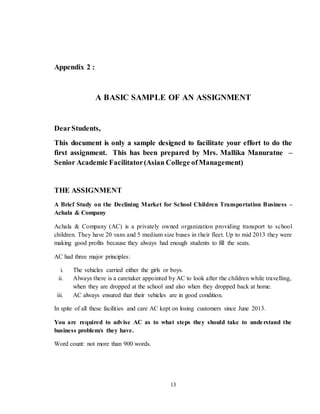
Appendix 2 :
A BASIC SAMPLE OF AN ASSIGNMENT
DearStudents,
This document is only a sample designed to facilitate your effort to do the
first assignment. This has been prepared by Mrs. Mallika Manuratne –
Senior Academic Facilitator(Asian College ofManagement)
THE ASSIGNMENT
A Brief Study on the Declining Market for School Children Transportation Business –
Achala & Company
Achala & Company (AC) is a privately owned organization providing transport to school
children. They have 20 vans and 5 medium size buses in their fleet. Up to mid 2013 they were
making good profits because they always had enough students to fill the seats.
AC had three major principles:
i. The vehicles carried either the girls or boys.
ii. Always there is a caretaker appointed by AC to look after the children while travelling,
when they are dropped at the school and also when they dropped back at home.
iii. AC always ensured that their vehicles are in good condition.
In spite of all these facilities and care AC kept on losing customers since June 2013.
You are required to advise AC as to what steps they should take to understand the
business problem/s they have.
Word count: not more than 900 words.
14
SAMPLE ASSIGNMENT
1. Introduction
The purpose of this assignment is to advise a company named Achala & Company (AC) on the steps it
should take to understand the business problem/s it has faced since June 2012. AC is a provider of
transport services for school children with a fleet of vehicles consisted of 20 vans and 05 medium
sized busses. In the recent past the number of customers has reduced drastically and management of
AC is unable to find reasons for this drop of business.
In order to advise AC, information is collected from the literature on marketing and also from
10 school van owners and 10 parents whose children used to go by school vans. Based on
these sources of knowledge the steps AC should take are recommended.
2. Literature on drop of business of small timers
The factors that affect the drop of business of AC could be understood using literature on this
subject as a basis.
Kotalavala (2005) has stated that the small & medium sized businesses in Sri Lanka tend to
lose their clients for three main reasons:
i. Even though they have a good product, they take their customers for granted and
do not emphasize on continuous quality in service delivery.
ii. The competition in the market too is taken for granted with a view “business is
going on well and need not worry about competitors. What we earn now is enough
for us”.
iii. They take it for granted their product as well, and do not improve it.
Wijayathilaka (2003: 79) pointed out “small businesses lose the market because they do not
perceive the changing needs of customers”. Bandara (2006:235) states “the employees of
small companies make a major impact on growth of business depending on their commitment
level, some by giving their best and others doing the least.” James(2000) is of the view that
15
when the ultimate user of a product is a child it is his/her liking and preferences that determine
the market demand. Further, he states that the parents are most concerned about the health and
well being of their kids in selecting a product. Narendrasing( Mychild.org) indicates that the
price is a major factor for most parents when selecting a product for a child, since middle
class parents are pushed to count every rupee in the current economic scenario.
3. View of others in the same business
Ten business owners engaged in the same business of AC were interviewed and they pointed
out following:
i. The parents are money conscious and they change the van even for a small reduction
in price offered by another van.
ii. The economic conditions are such that some parents can’t afford to send their kids in a
van. The van owners too charge even for the holiday months.
iii. In some vans the caretakers do a shoddy job and ignore the kids’ requirements.
Sometimes they leave behind the kid in the school due to the negligence of the
caretaker.
iv. Unless the van is driven by the owner there is no way of maintaining high standards
the kids deserve. If one tries to expand too much, should also expect business losses in
the long run.
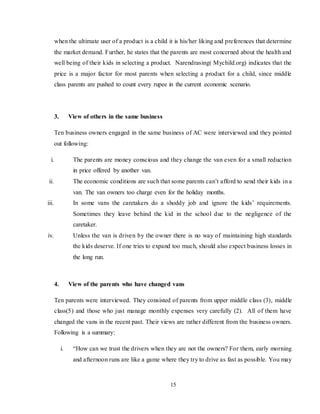
4. View of the parents who have changed vans
Ten parents were interviewed. They consisted of parents from upper middle class (3), middle
class(5) and those who just manage monthly expenses very carefully (2). All of them have
changed the vans in the recent past. Their views are rather different from the business owners.
Following is a summary:
i. “How can we trust the drivers when they are not the owners? For them, early morning
and afternoon runs are like a game where they try to drive as fast as possible. You may
16
have read the recent accidents that killed or disabled the kids. They are hardly
concerned about the kids.”
ii. “Some drivers shout at children if they eat or drink in the van, because they have to
clean the van then. They do not take into account that the kids leave as early as 5.30
and they are hungry in the morning. My two kids were really suffering and developing
gastritis in spite of our giving them two packets of food one to eat in the van and the
other at the interval. Moment I learnt that the driver does not allow to eat I changed the
van.”
iii. “We as parents should understand that the kids do not know much about their own
bodies and any uncalled for touching by the caretaker or the driver is not reported by
them, unless someone notices it. My 5 year old son has told my wife while she was
washing him that the caretaker too touches his private areas. The next day we removed
the child from the van and now my wife takes him by bus.” Another parent
commented in the same line and said “the kids who get in first and get off last are
always at danger in the hands of drivers and caretakers.”
iv. Another father said that it is better to take the child by bus, rather than letting them go
by the van. He made this decision when he noticed that the driver is drunk in the mid
afternoon while driving the van. Inquiries made revealed that the drivers who stay
back until the school is over do drink in groups to get over their boredom.
v. Most vans take kids of different ages. One mother commented that the kids are bullied
by the elder ones in the van. Referring to her son’s experience, she said that they used
to take all his sandwiches leaving only one for him. He was only 7 years and had to sit
with boys he referred to as big elder brothers. Then she removed her child from that
van.
vi. A father said “we are not rich, yet we consider the van fee of our two sons as an
essential item in our budget. Yet, one day my elder son who is ten years old
complained that the caretaker always ask the younger brother to sit at a corner where
there is a hole in the roof of the van and he gets wet when it rains. Then we changed
the van, yet we do not know what other calamities are in line for the kids travelling in
vans.”
17
5. Analysis
The literature on small business and the drivers paid more attention to the prices of the
product sold by the van owners. However, the parents’ responses were very different. They
did not mind the price but what bothered them is the behaviour of the drivers, caretakers and
the bullies. The points raised in literature discussed above indicate the importance of quality
of service, a factor that has not taken into account by the owners. The risks are high for the
kids unless the owner himself drives the van.
It is left to AC to figure out points where the company make mistakes, and in order to make
their search systematic following steps are proposed.
6. Recommendations
i. Carry out a survey of customer satisfaction by talking (interviews) to the parents of
current clients and establish the difficulties they have if any with regard to the staff
and also the other logistics.
ii. Carry out a similar dialog with those who have moved out and understand the reason
for leaving.
iii. Survey the prices offered by others, particularly single van owners who are the drives
as well.
iv. Carry out periodical checks on the drivers and caretakers.
This information, once collected and analysed, should help AC to determine the reasons for
the drop of business in the recent past.
18
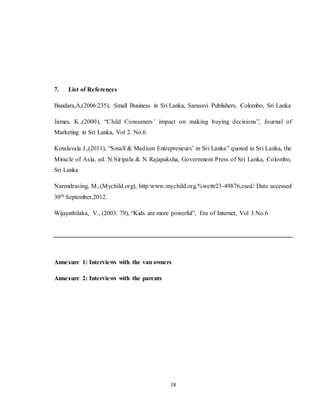
7. List of References
Bandara,A,(2006:235), Small Business in Sri Lanka, Sarasavi Publishers, Colombo, Sri Lanka
James. K.,(2000), “Child Consumers’ impact on making buying decisions”, Journal of
Marketing in Sri Lanka, Vol 2. No.6
Kotalavala J.,(2011), “Small & Medium Entrepreneurs’ in Sri Lanka” quoted in Sri Lanka, the
Miracle of Asia, ed. N.Siripala & N Rajapaksha, Government Press of Sri Lanka, Colombo,
Sri Lanka
Narendrasing, M.,(Mychild.org), http/www.mychild.org.%wettr23-49876,csed/ Date accessed
30th September,2012.
Wijayathilaka, V., (2003: 79), “Kids are more powerful”, Era of Internet, Vol 3.No.6
Annexure 1: Interviews with the van owners
Annexure 2: Interviews with the parents
19
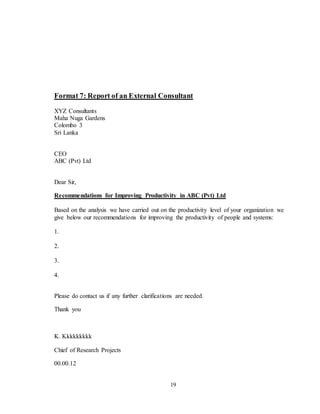
Format 7: Report of an External Consultant
XYZ Consultants
Maha Nuga Gardens
Colombo 3
Sri Lanka
CEO
ABC (Pvt) Ltd
Dear Sir,
Recommendations for Improving Productivity in ABC (Pvt) Ltd
Based on the analysis we have carried out on the productivity level of your organization we
give below our recommendations for improving the productivity of people and systems:
1.
2.
3.
4.
Please do contact us if any further clarifications are needed.
Thank you
K. Kkkkkkkkk
Chief of Research Projects
00.00.12
20
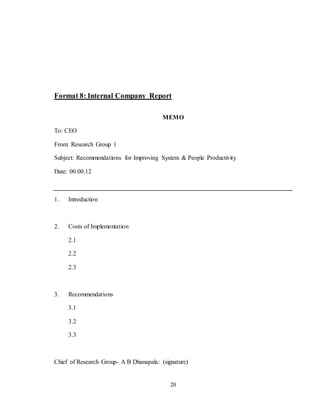
Format 8: Internal Company Report
MEMO
To: CEO
From: Research Group 1
Subject: Recommendations for Improving System & People Productivity
Date: 00.00.12
1. Introduction
2. Costs of Implementation
2.1
2.2
2.3
3. Recommendations
3.1
3.2
3.3
Chief of Research Group- A B Dhanapala: (signature)
21
Research Group Members: K Kaputa: (signature)
B Bamuna: (signature)
C Cricket Pissa: (signature)
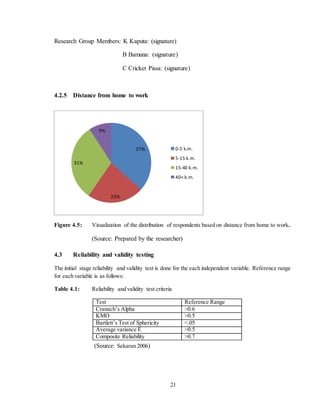
4.2.5 Distance from home to work
Figure 4.5: Visualization of the distribution of respondents based on distance from home to work.
(Source: Prepared by the researcher)
4.3 Reliability and validity testing
The initial stage reliability and validity test is done for the each independent variable. Reference range
for each variable is as follows:
Table 4.1: Reliability and validity test criteria
(Source: Sekaran 2006)
37%
23%
31%
9%
0-5 k.m.
5-15 k.m.
15-40 k.m.
40< k.m.
Test Reference Range
Cranach’s Alpha >0.6
KMO >0.5
Bartlett’s Test of Sphericity <.05
Average variance E >0.5
Composite Reliability >0.7

Assignment format for MBA Students

  • 1.
    1 GUIDELINE ON ASSIGNMENTSUBMISSION 1. Assignments The assignments are an integral part of your learning experience. The purpose of giving assignments to students is to provide them with off-work experiences in using the theories, procedures and experiences they learnt to solve real life work problems. The resource persons provide you with feedback on your assignments in order for you to improve your problem solving capacity. The weight AeU places on assignments in distribution of marks, allocating 30% each for two assignments itself is an indicator of the criticality of assignments. Your Session Plan indicates the type of assignments you should undertake for each subject and the submission dates for the assignment. Please read through the following sections and feel free to make inquiries, if any. 2. Types of Assignments First, assignments are classified under two different bases. They are indicated in the Session Plan as Individual Assignments and Group assignments depending on the number of individuals involved in the task. Secondly, based on the place of completing the assignments are categorized as; i. Take home assignments: The student is given the assignment and he/she has to write it up at home and submit at a given date and time. ii. In –class assignments: basic information required to familiarize with the problem or task that need to be done is given and the student is expected to be ready for the assignment and do it in the class. Both these types of assignments could be either individual or group. The specific details are given in the assignment. 3. Procedure for Submitting Assignments i. Commencing the Task of Doing an Assignments It is essential that an assignment is written and presented within the guidelines given regarding all aspects of the assignment. The outcome of such work practices is known as “Academic Rigour”. In this process following are emphasized:
  • 2.
    2 ii. Preparatory Stage: a.Understanding the problem and analyzing it in a manner appropriate for the problem. b. Collecting primary data if necessary (from humans involved in the problem and secondary data (from documented sources such as Annual Reports, previous survey findings etc.) c. Review literature relevant to the problem studied. d. Analyze data iii. Writing Stage As an MBA/EMBA student, your writing is expected to be academic in nature. Therefore following are expected: a. The arrangement of the assignment: i. Introduction ii. Body of the presentation iii. Conclusions/Summary iv. List of References v. Annexes and/or Appendices b. Logical flow in writing c. Include Tables and Figures where necessary. d. Provide in-text references using Harvard Method of Referencing. e. Edit the document. f. Make sure you have not exceeded more than 10% of word count given in the assignment. iv. Formatting of the Assignments a. Papers & Margins A4 size white papers Margins: Left 1.2” and Top, Bottom & Right 1.0” Fonts : Times New Roman 16, Bold: Assignment Heading Times New Roman 12, Bold: Subtopics Times New Roman 12 : text Spacing: Line spacing 1.5 spaces Paragraph spacing before/after each paragraph
  • 3.
    3 Tables : Tobe numbered Table 1: (& Title of the table) – top. Figures: To be numbered Figure1: (& Title of the Figure) - bottom Reference should be indicated under the last line of each Table or Figure. Colours could be used for tables and figures. Pages should be numbered Page numbers on the footer center, Font Size 12, Times New Roman b. Order of Binding of the Assignment i. Cover page ii. Title Page iii. Text of the Assignment iv. Feedback form Please refer the Appendices of this document for the relevant formats. Binding of the assignment Staple along the left margin and attach a blue color tape along the margin v. Submission of Assignments a. Students should submit a Hard Copy on the due date at the time prescribed to the Office and it is considered as the formal submission. Receipt issued by Asian College of Management will be your only proof of assignment submission. b. The soft copy should be forwarded as an attachment to assignments@academy.lk with the following header: For Individual Assignments (i subject) Marketing Management (ii Code) (MKM 607) ( iii Intake ) Intake 08 ( iv Type) Individual (Name with initials) ABC De Silva For Group Assignments (i subject)Marketing Management (ii Code)(MBA2023) ( iii Intake )Intake 05-(iv Type) Group (First Names) Aruna/Buddhi/Christy Give the full names of group members in the body of the email. c. Procedure for dealing with resubmission and re-presentations
  • 4.
    4 If a resourceperson decides that the material submitted as an assignment is: i. plagiarised (from internet or books) ii. copied from another student iii. slightly modified from another student’s work iv. considered as out of focus or very weak, Then the student could be asked to resubmit (a written assignment) or redo a presentation. Such resubmissions and/or re-doings should be submitted to ACM Lanka within the time period allowed by the management. d. Procedure for dealing with non-submission and late submission of assignments Failure of a student to submit an assignment within the stipulated period or non – submission after corrections/ upgrades advised by the resource person is considered as dropping out of that particular subject in his/her batch. Such a student could re-submit the assignment or presentation when the same subject is repeated for the next batch. Any delay in submission of assignment/s is treated as indicated in the following Table. Penalty for Delay in Submission of Assignments Time lapsed Penalty % Reduction of marks earned Reduction of marks earned out of 30% Monetary Penalty (Rs) Within 24 hrs. from due time of the day 0.5 0.15 Nil Day 2 1.0 0.30 Nil Day 3 1.5 0.45 Nil Day 4 2.0 0.60 Nil Day 5 2.5 0.75 Nil Day 6 3.0 0.90 Nil Day 7 4.0 1.20 Nil Day 8 4.3 1.29 1,000/- Day 9 4.6 1.38 1,300/- Day 10 4.9 1.47 1,600/- Day 11 5.2 1.56 1,900/- Day 12 5.5 1.65 2,200/- Day 13 5.8 1.74 2,500/- Day 14 6.0 1.80 3,000/- After 14th Day No submission will be accepted without prior approval
  • 5.
    5 vi. Presentations Presentations arerequired when doing the group assignments. The time allocated for the Presentation in the class is given in the assignment. The students are expected to time the presentations based on the time limits. Power Point Presentations too could be used for this purpose. Please attach a copy of the slides to the written assignment. vii. In-class Activities When carrying out in-class activities such as assignments or presentations, the students are expected to prepare before hand and also keep their lap tops also ready to display. During these activities, it is necessary to ensure that no disturbances are made to another individual or a group. Appendix 1: Formats for Assignments Instructions: Please use the appropriate formats. Format 1 : Cover page for Individual Assignments Format 2 : Cover page for Group Assignments Format 3 : Title page for Individual Assignments Format 4 : Title page for Group Assignments Format 5 : Content page (if required) Format 6 : Feedback format- Please attach after the body of the text before the back cover. Format 7: Report of an External Consultant Format 8: Internal Company Report Document 1: Interpretation of marking scheme and indicative grades awarded Please read this document and learn how you should perform in order to achieve your targets in acquiring your MBA/EMBA Appendix 2: Sample Assignment
  • 6.
    6 ASIA e UNIVERSITY- ASIAN COLLEGE OF MANAGEMENT MASTER OF BUSINESS ADMINISTRATION/EMBA INDIVIDUAL ASSIGNMENT No: …… Name: RoshanSiriwardana (Pl. indicate one first name & surname) Student ID Number: 791320534V Title of the Assignment: Generic Assignment Subject: Managerial Account Code: Non-paper attachments: Submission date: 08/11/2015 Time Student’s declaration: I certify that I have not plagiarized the work of others or participated in unauthorized collusion when preparing this assignment. Signature:……………………………………………. Date:……………………… FOR OFFICE USE Date received: Deadline met: Yes/No Late submission – No ofhours/days delayed Penalty Signature of receiver
  • 7.
    7 ASIA e UNIVERSITY- ASIAN COLLEGE OF MANAGEMENT MASTER OF BUSINESS ADMINISTRATION/EMBA GROUP ASSIGNMENT No: …… Names and Student ID Numbers: (Times New Roman 14 ) (Pl. indicate one first name & surname) Title of the Assignment: (Times New Roman 14 ) Subject: (Times New Roman 14 ) Code: Non-paper attachments: (Times New Roman 14 ) Submission date: Time Student’s declaration: I certify that I have not plagiarized the work of others or participated in unauthorized collusion when preparing this assignment. Signature:……………………………………………. Date:……………………… FOR OFFICE USE Date received: Deadline met: Yes/No Late submission – No ofhours/days delayed Penalty Signature of receiver Format 3: Title page for Individual Assignments
  • 8.
    8 MASTER OF BUSINESSADMINISTRATION Topic of the assignment (Times New Roman 14 bold, italics, centred) By (Times New Roman 14 bold, italics, centred) Student’s Name :(Times New Roman 12 bold, italics, centred) Student ID: (Times New Roman 12 bold, centred) Subject : (Times New Roman 12 bold, centred) Code: (Times New Roman 12 bold, centred) ASIAN COLLEGE OF MANAGEMENT (Times New Roman 14 bold, centred) SRI LANKA (Times New Roman 14 bold, centred) Month & Year : (Times New Roman 12 bold, italics, centred) Format 4: Title page for Group Assignments
  • 9.
    9 MASTER OF BUSINESSADMINISTRATION Topic of the assignment (Times New Roman 14 bold, italics, centred) By (Times New Roman 14 bold, italics, centred) Students’ Names :(Times New Roman 12 bold, italics, centred) Student ID: (Times New Roman 12 bold, centred) (use maximum of three lines including the above two lines) Subject: (Times New Roman 12 bold, centred) Code: (Times New Roman 12 bold, centred) ASIAN COLLEGE OF MANAGEMENT (Times New Roman 14 bold, centred) SRI LANKA (Times New Roman 14 bold, centred) Month & Year : (Times New Roman 12 bold, italics, centred) Format 5: Feedback onAssignments
  • 10.
    10 TABLE OF CONTENTS 1.Background 1 2. Problem 3 3. Evaluation 5 4. Recommendation 6 5. Conclusion 9 Format 6: Feedback onAssignments
  • 11.
    11 ASIA e UNIVERSITY– ASIAN COLLEGE OF MANAGEMENT MASTER OF BUSINESS ADMINISTRATION FEEDBACK ON ASSIGNMENT (Students should fill the cages 1-3) 1.Name/s: (Times New Roman 12 ) 2. Subject: Subject code: 3. Assignment Title Evaluation/Feedback – Please √ the appropriate column. Descriptor Over 80% A Excellent 75-79% A- V. Good 70-74% B+ Good 65-69% B Pass 35-64% B-to D M. Pass 0-34% F Fail Clarity of understanding in the problem/issue Coverage of relevant literature Application of concepts to analyze the problem/issue Logical presentation of ideas Grammar Writing style Quality of class presentation Content of class presentation Acknowledgement of sources in the text Quality of reference list Guidance notes for the student/s(Pl. use overleaf if necessary): ………………………………………………………………………………………………………………………… ………………………………………………………………………………………………………………………… ………………….……………………………………………………………………………………… Total marks allocated for the assignment /30% Provisional Grade awarded Name of Examiner :……………………………. Signature :…………………………… Date :............................
  • 12.
    12 Document 1: Interpretation ofmarking scheme and indicative grades awarded Indicative Grade % Marks Description Characteristics A Over 80% Excellent 1. Excellent understanding in critical analysis and selection of conceptual framework. 2. Excellent understanding in issues. 3. Clearly structured and logically developed arguments. 4. Excellent use of relevant data. A- 75-79 Very good 1. Very high understanding in critical analysis and use of an appropriate conceptual framework. 2. Very well structured and developed arguments. 3. Very good evaluation and synthesis of source material. 4. Logically presented conclusions. B+ 70-74 Good 1. Use an appropriate conceptual framework. 2. Well structured and developed arguments. 3. Good evaluation and synthesis of source material. 4. Well drawn conclusions B 65-69 Pass 1.Clear understanding of the issues raised by the question. 2. Conceptual framework is well selected with critical analysis. 3. Structured and well developed arguments. B-to D 35-64 Marginal pass 1. Clear understanding of the issues raised by the question. 2. Selects an appropriate conceptual framework. 3. Week analysis and more descriptive answers. 4. Awareness in issues is limited to class room learning. F 0-34 Fail 1. Limited understanding of the issues raised by the question. 2. Weak selection of an appropriate conceptual framework. 3. No appropriate references to data, sources, and examples. 4. Poor presentation due to low familiarity with the language.
  • 13.
    13 Appendix 2 : ABASIC SAMPLE OF AN ASSIGNMENT DearStudents, This document is only a sample designed to facilitate your effort to do the first assignment. This has been prepared by Mrs. Mallika Manuratne – Senior Academic Facilitator(Asian College ofManagement) THE ASSIGNMENT A Brief Study on the Declining Market for School Children Transportation Business – Achala & Company Achala & Company (AC) is a privately owned organization providing transport to school children. They have 20 vans and 5 medium size buses in their fleet. Up to mid 2013 they were making good profits because they always had enough students to fill the seats. AC had three major principles: i. The vehicles carried either the girls or boys. ii. Always there is a caretaker appointed by AC to look after the children while travelling, when they are dropped at the school and also when they dropped back at home. iii. AC always ensured that their vehicles are in good condition. In spite of all these facilities and care AC kept on losing customers since June 2013. You are required to advise AC as to what steps they should take to understand the business problem/s they have. Word count: not more than 900 words.
  • 14.
    14 SAMPLE ASSIGNMENT 1. Introduction Thepurpose of this assignment is to advise a company named Achala & Company (AC) on the steps it should take to understand the business problem/s it has faced since June 2012. AC is a provider of transport services for school children with a fleet of vehicles consisted of 20 vans and 05 medium sized busses. In the recent past the number of customers has reduced drastically and management of AC is unable to find reasons for this drop of business. In order to advise AC, information is collected from the literature on marketing and also from 10 school van owners and 10 parents whose children used to go by school vans. Based on these sources of knowledge the steps AC should take are recommended. 2. Literature on drop of business of small timers The factors that affect the drop of business of AC could be understood using literature on this subject as a basis. Kotalavala (2005) has stated that the small & medium sized businesses in Sri Lanka tend to lose their clients for three main reasons: i. Even though they have a good product, they take their customers for granted and do not emphasize on continuous quality in service delivery. ii. The competition in the market too is taken for granted with a view “business is going on well and need not worry about competitors. What we earn now is enough for us”. iii. They take it for granted their product as well, and do not improve it. Wijayathilaka (2003: 79) pointed out “small businesses lose the market because they do not perceive the changing needs of customers”. Bandara (2006:235) states “the employees of small companies make a major impact on growth of business depending on their commitment level, some by giving their best and others doing the least.” James(2000) is of the view that
  • 15.
    15 when the ultimateuser of a product is a child it is his/her liking and preferences that determine the market demand. Further, he states that the parents are most concerned about the health and well being of their kids in selecting a product. Narendrasing( Mychild.org) indicates that the price is a major factor for most parents when selecting a product for a child, since middle class parents are pushed to count every rupee in the current economic scenario. 3. View of others in the same business Ten business owners engaged in the same business of AC were interviewed and they pointed out following: i. The parents are money conscious and they change the van even for a small reduction in price offered by another van. ii. The economic conditions are such that some parents can’t afford to send their kids in a van. The van owners too charge even for the holiday months. iii. In some vans the caretakers do a shoddy job and ignore the kids’ requirements. Sometimes they leave behind the kid in the school due to the negligence of the caretaker. iv. Unless the van is driven by the owner there is no way of maintaining high standards the kids deserve. If one tries to expand too much, should also expect business losses in the long run. 4. View of the parents who have changed vans Ten parents were interviewed. They consisted of parents from upper middle class (3), middle class(5) and those who just manage monthly expenses very carefully (2). All of them have changed the vans in the recent past. Their views are rather different from the business owners. Following is a summary: i. “How can we trust the drivers when they are not the owners? For them, early morning and afternoon runs are like a game where they try to drive as fast as possible. You may
  • 16.
    16 have read therecent accidents that killed or disabled the kids. They are hardly concerned about the kids.” ii. “Some drivers shout at children if they eat or drink in the van, because they have to clean the van then. They do not take into account that the kids leave as early as 5.30 and they are hungry in the morning. My two kids were really suffering and developing gastritis in spite of our giving them two packets of food one to eat in the van and the other at the interval. Moment I learnt that the driver does not allow to eat I changed the van.” iii. “We as parents should understand that the kids do not know much about their own bodies and any uncalled for touching by the caretaker or the driver is not reported by them, unless someone notices it. My 5 year old son has told my wife while she was washing him that the caretaker too touches his private areas. The next day we removed the child from the van and now my wife takes him by bus.” Another parent commented in the same line and said “the kids who get in first and get off last are always at danger in the hands of drivers and caretakers.” iv. Another father said that it is better to take the child by bus, rather than letting them go by the van. He made this decision when he noticed that the driver is drunk in the mid afternoon while driving the van. Inquiries made revealed that the drivers who stay back until the school is over do drink in groups to get over their boredom. v. Most vans take kids of different ages. One mother commented that the kids are bullied by the elder ones in the van. Referring to her son’s experience, she said that they used to take all his sandwiches leaving only one for him. He was only 7 years and had to sit with boys he referred to as big elder brothers. Then she removed her child from that van. vi. A father said “we are not rich, yet we consider the van fee of our two sons as an essential item in our budget. Yet, one day my elder son who is ten years old complained that the caretaker always ask the younger brother to sit at a corner where there is a hole in the roof of the van and he gets wet when it rains. Then we changed the van, yet we do not know what other calamities are in line for the kids travelling in vans.”
  • 17.
    17 5. Analysis The literatureon small business and the drivers paid more attention to the prices of the product sold by the van owners. However, the parents’ responses were very different. They did not mind the price but what bothered them is the behaviour of the drivers, caretakers and the bullies. The points raised in literature discussed above indicate the importance of quality of service, a factor that has not taken into account by the owners. The risks are high for the kids unless the owner himself drives the van. It is left to AC to figure out points where the company make mistakes, and in order to make their search systematic following steps are proposed. 6. Recommendations i. Carry out a survey of customer satisfaction by talking (interviews) to the parents of current clients and establish the difficulties they have if any with regard to the staff and also the other logistics. ii. Carry out a similar dialog with those who have moved out and understand the reason for leaving. iii. Survey the prices offered by others, particularly single van owners who are the drives as well. iv. Carry out periodical checks on the drivers and caretakers. This information, once collected and analysed, should help AC to determine the reasons for the drop of business in the recent past.
  • 18.
    18 7. List ofReferences Bandara,A,(2006:235), Small Business in Sri Lanka, Sarasavi Publishers, Colombo, Sri Lanka James. K.,(2000), “Child Consumers’ impact on making buying decisions”, Journal of Marketing in Sri Lanka, Vol 2. No.6 Kotalavala J.,(2011), “Small & Medium Entrepreneurs’ in Sri Lanka” quoted in Sri Lanka, the Miracle of Asia, ed. N.Siripala & N Rajapaksha, Government Press of Sri Lanka, Colombo, Sri Lanka Narendrasing, M.,(Mychild.org), http/www.mychild.org.%wettr23-49876,csed/ Date accessed 30th September,2012. Wijayathilaka, V., (2003: 79), “Kids are more powerful”, Era of Internet, Vol 3.No.6 Annexure 1: Interviews with the van owners Annexure 2: Interviews with the parents
  • 19.
    19 Format 7: Reportof an External Consultant XYZ Consultants Maha Nuga Gardens Colombo 3 Sri Lanka CEO ABC (Pvt) Ltd Dear Sir, Recommendations for Improving Productivity in ABC (Pvt) Ltd Based on the analysis we have carried out on the productivity level of your organization we give below our recommendations for improving the productivity of people and systems: 1. 2. 3. 4. Please do contact us if any further clarifications are needed. Thank you K. Kkkkkkkkk Chief of Research Projects 00.00.12
  • 20.
    20 Format 8: InternalCompany Report MEMO To: CEO From: Research Group 1 Subject: Recommendations for Improving System & People Productivity Date: 00.00.12 1. Introduction 2. Costs of Implementation 2.1 2.2 2.3 3. Recommendations 3.1 3.2 3.3 Chief of Research Group- A B Dhanapala: (signature)
  • 21.
    21 Research Group Members:K Kaputa: (signature) B Bamuna: (signature) C Cricket Pissa: (signature) 4.2.5 Distance from home to work Figure 4.5: Visualization of the distribution of respondents based on distance from home to work. (Source: Prepared by the researcher) 4.3 Reliability and validity testing The initial stage reliability and validity test is done for the each independent variable. Reference range for each variable is as follows: Table 4.1: Reliability and validity test criteria (Source: Sekaran 2006) 37% 23% 31% 9% 0-5 k.m. 5-15 k.m. 15-40 k.m. 40< k.m. Test Reference Range Cranach’s Alpha >0.6 KMO >0.5 Bartlett’s Test of Sphericity <.05 Average variance E >0.5 Composite Reliability >0.7