Tracking Radar
Measures the coordinate of a target for determining the

target path as well as to predict its future coordinates
Based on the measured coordinated error signal will be
generated
Antenna should be moved based on error signal to
maintain the target within the beam.
Tracking of range, angle, Doppler frequency shift and
radial velocity
Uses pencil beam
Angle tracking
 Two beams are squinted
 Crossover of two beam:

boresight
 Boresight always maintained in
the direction of the target
 Relative amplitude of two beam
determines how far the target is
from boresight
 Also direction in which beam
needs to be repositioned
 2 beams in both the coordinate
Methods of generating error signal
Conical scan or sequential lobing tracker
Time shares a single beam
Antenna beam is switched between two positions

Simultaneous lobing or monopulse
More than one simultaneous beam is used for tracking
Usually 4 simultaneous beams to perform 2

dimensional tracking
MonopulseTracking Radar
Radar in which information concerning the angular

location of the target is obtained by comparing the
signal received in two or more simultaneous beams.
Two offset antenna beams are combined to obtain
both sum and difference signal
This signals are multiplied in a phase sensitive
detector to obtain both magnitude and direction
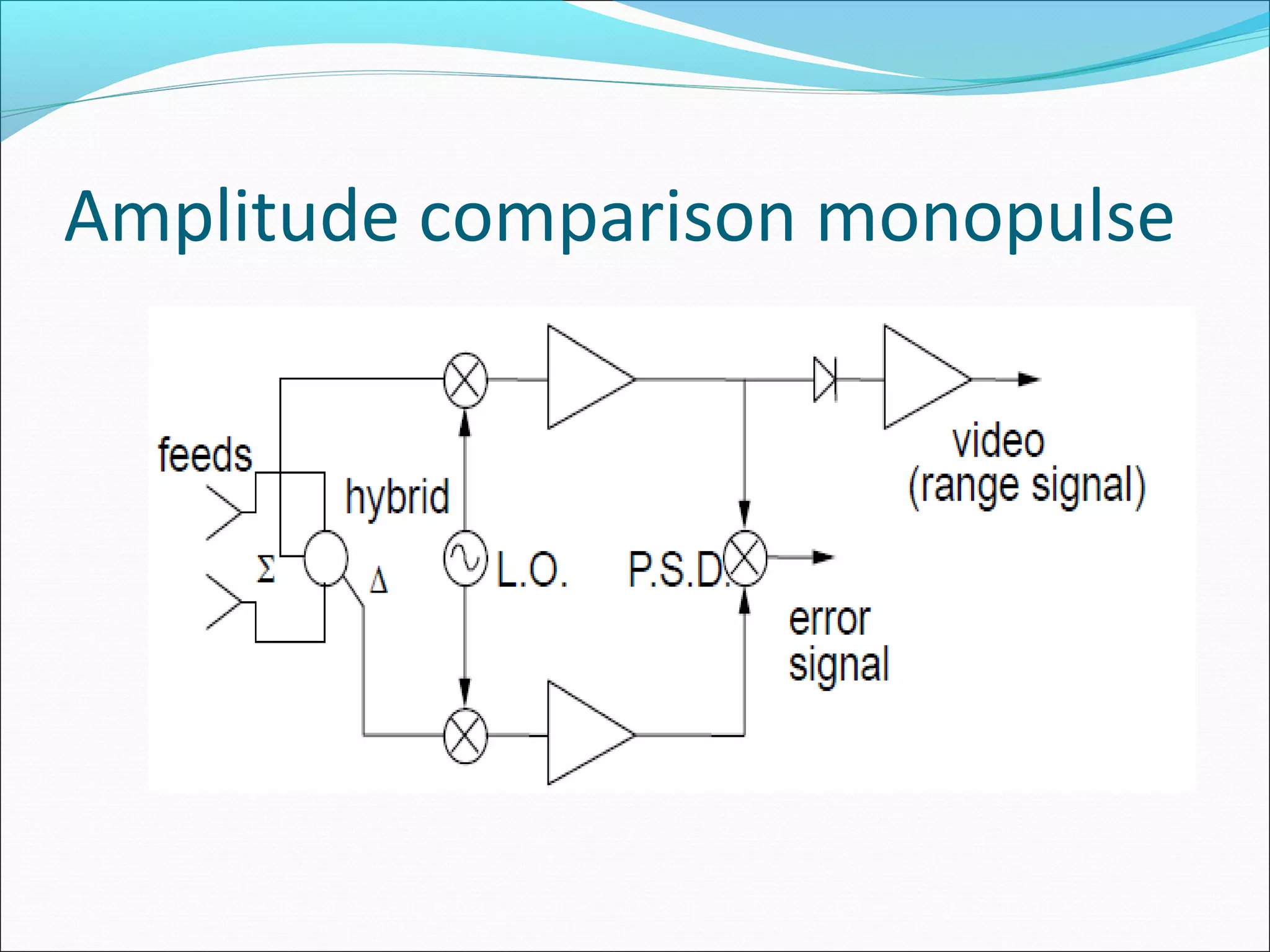
Amplitude comparison monopulse
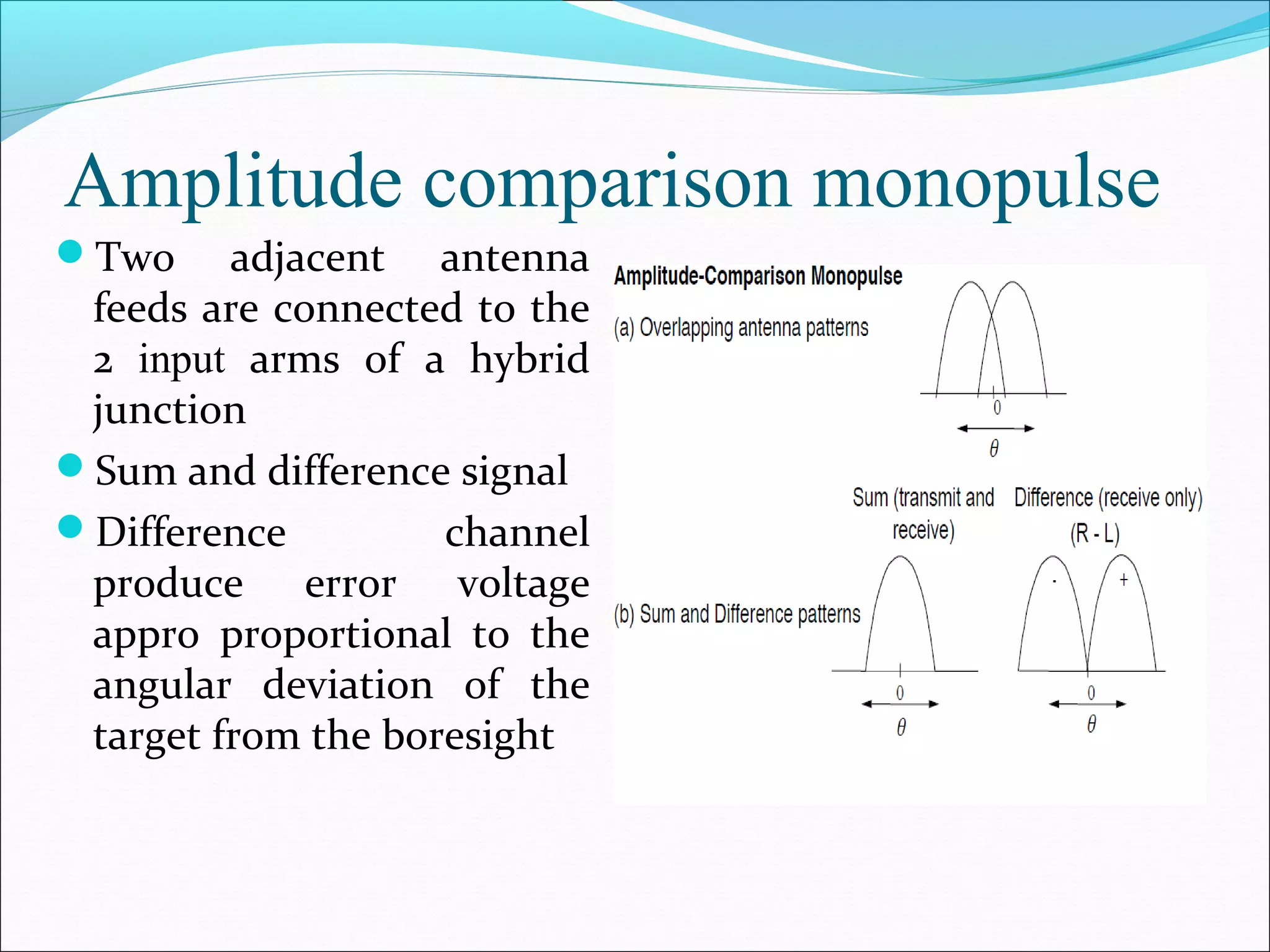
Two

adjacent antenna
feeds are connected to the
2 input arms of a hybrid
junction
Sum and difference signal
Difference
channel
produce error voltage
appro proportional to the
angular deviation of the
target from the boresight
Amplitude comparison monopulse
By comparing the phase of sum and difference signal

direction of angle error is found
Depending on these information's the servo meter will
drive the antenna back to the target
Phase sensitive detector is used to compare the phase
of two signals
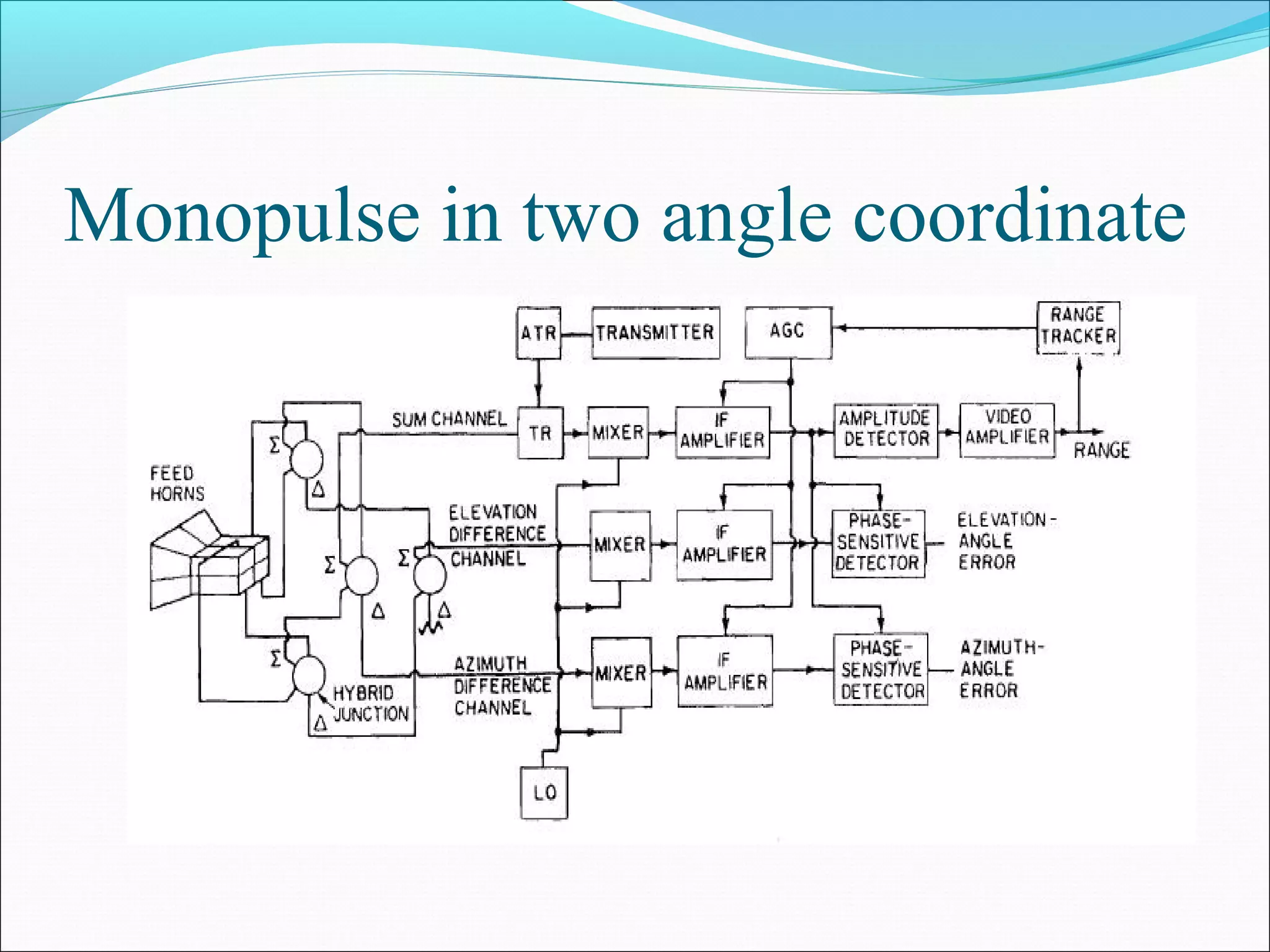
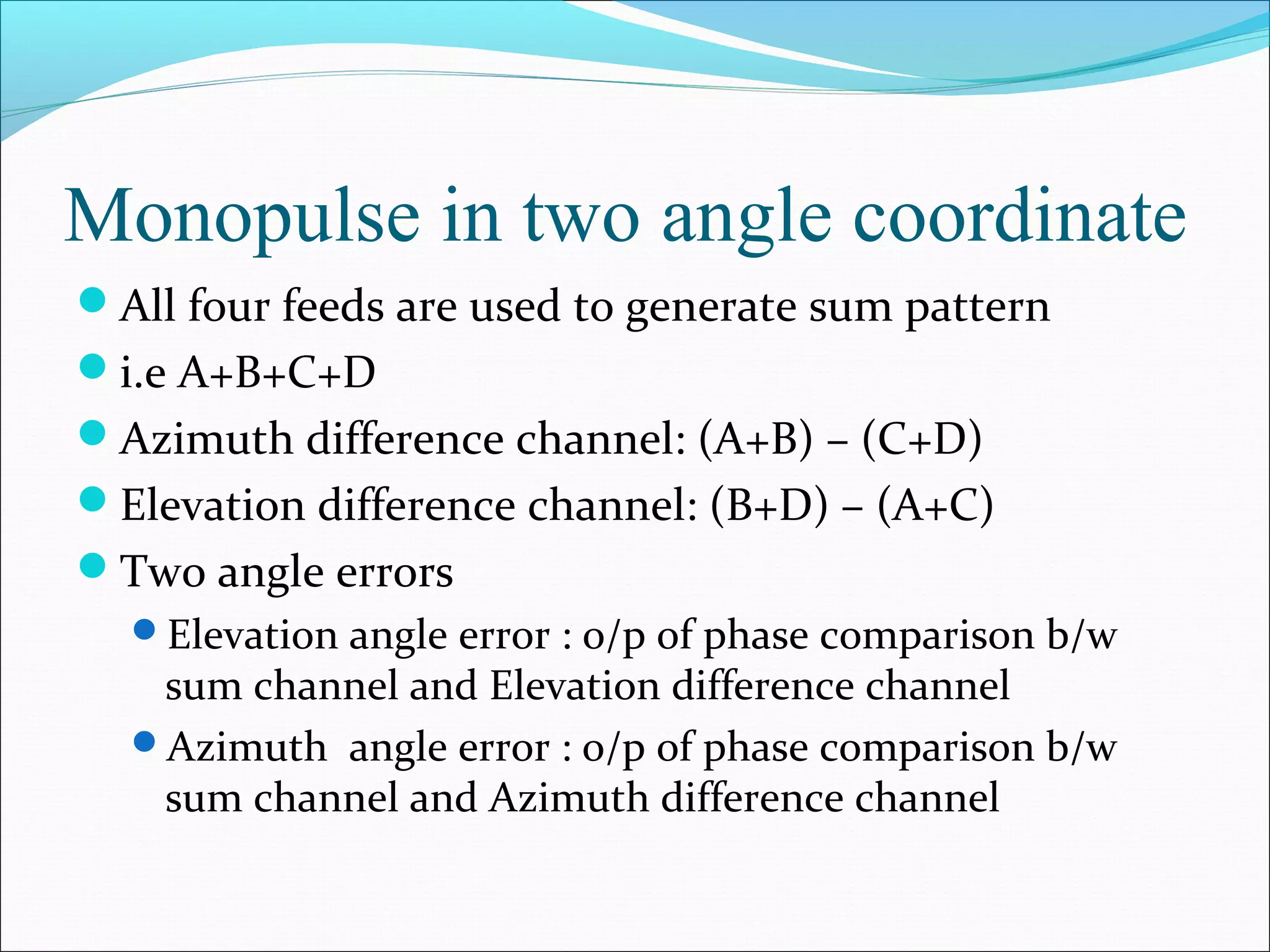
Monopulse in two angle coordinate
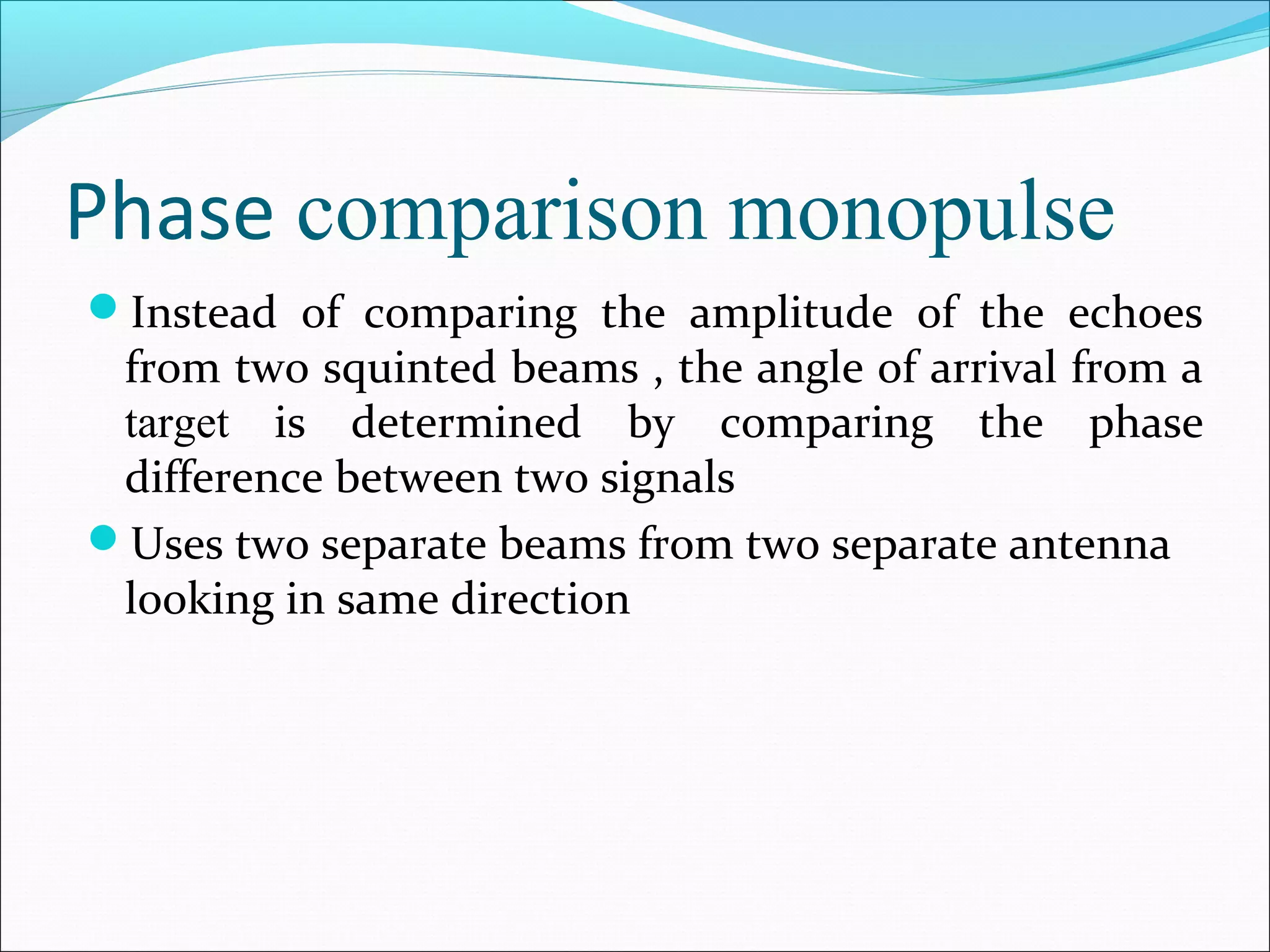
All four feeds are used to generate sum pattern
i.e A+B+C+D
Azimuth difference channel: (A+B) – (C+D)
Elevation difference channel: (B+D) – (A+C)
Two angle errors
Elevation angle error : o/p of phase comparison b/w

sum channel and Elevation difference channel
Azimuth angle error : o/p of phase comparison b/w
sum channel and Azimuth difference channel
Phase comparison monopulse
Instead of comparing the amplitude of the echoes

from two squinted beams , the angle of arrival from a
target is determined by comparing the phase
difference between two signals
Uses two separate beams from two separate antenna
looking in same direction
Phase comparison monopulse
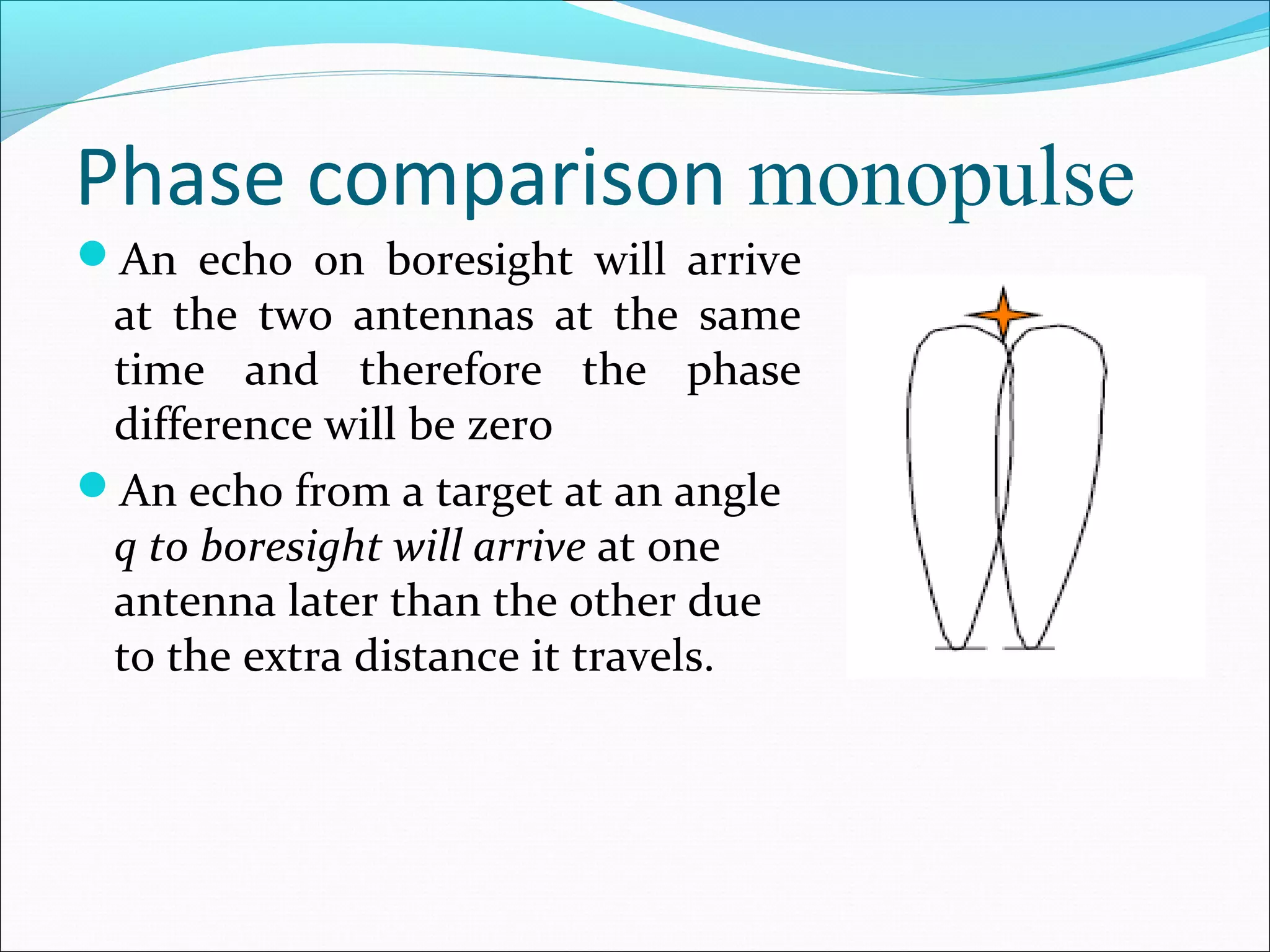
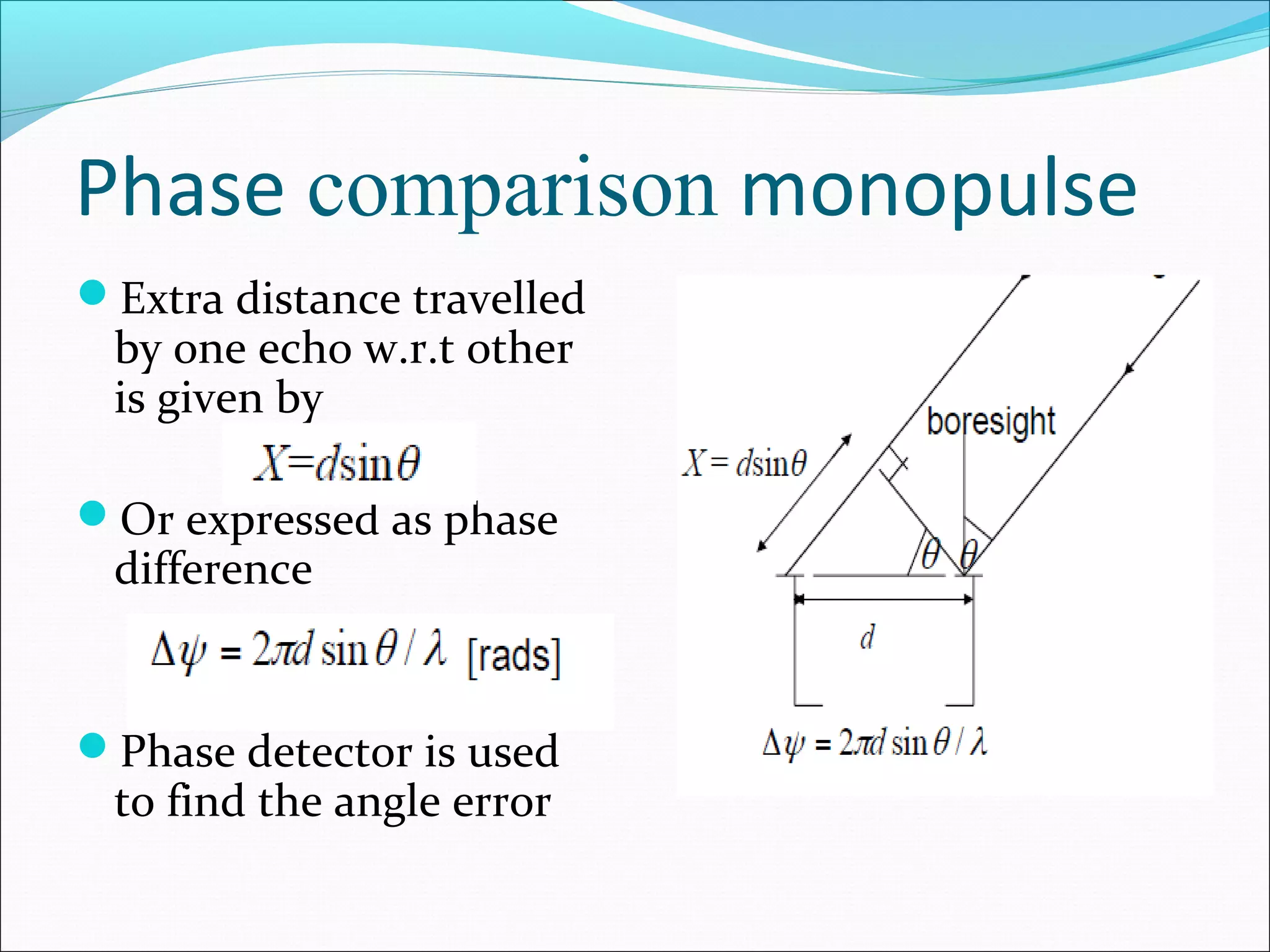
An echo on boresight will arrive

at the two antennas at the same
time and therefore the phase
difference will be zero
An echo from a target at an angle
q to boresight will arrive at one
antenna later than the other due
to the extra distance it travels.
Phase comparison monopulse
Extra distance travelled

by one echo w.r.t other
is given by

Or expressed as phase

difference

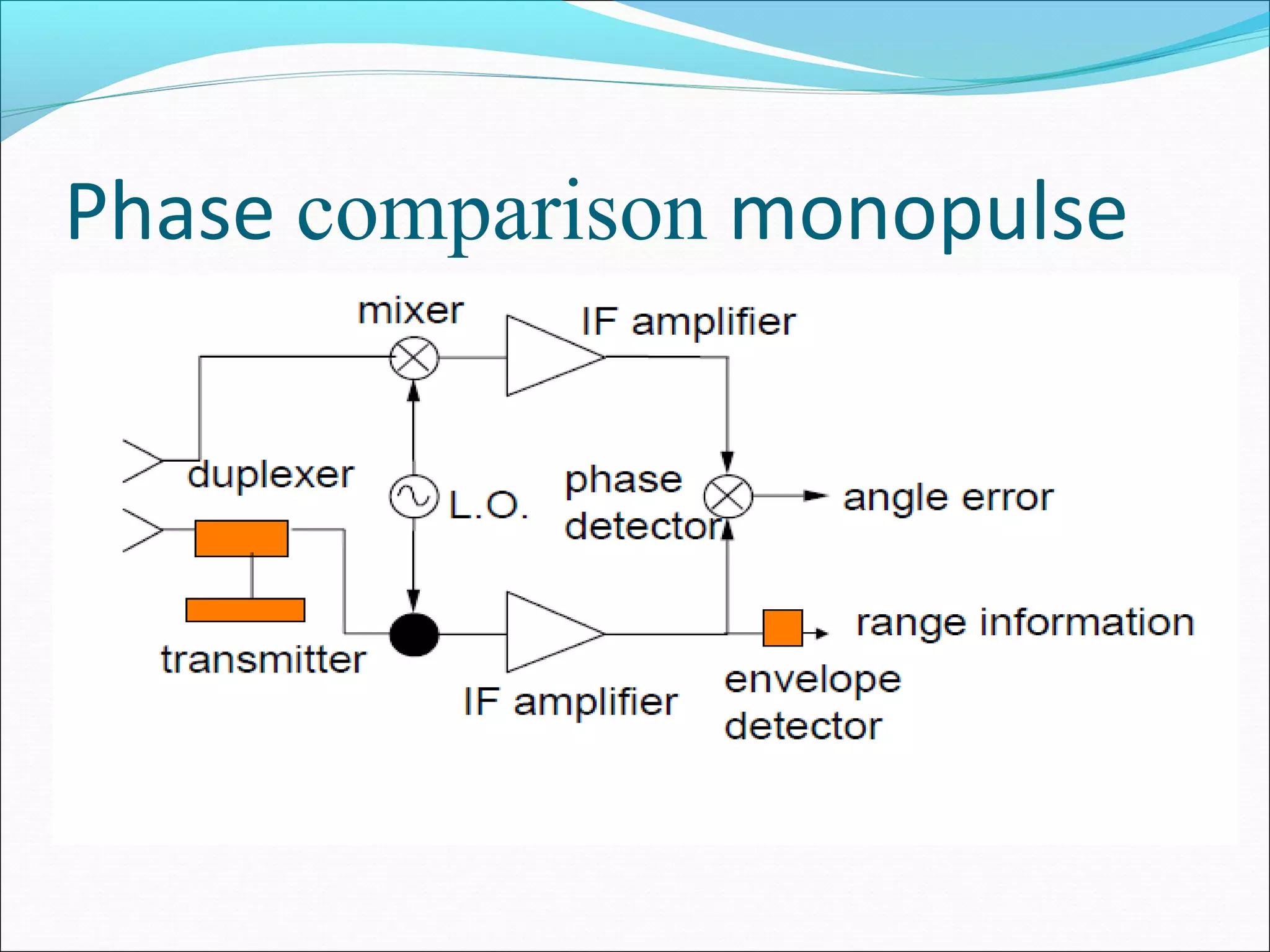
Phase detector is used

to find the angle error
Phase comparison monopulse
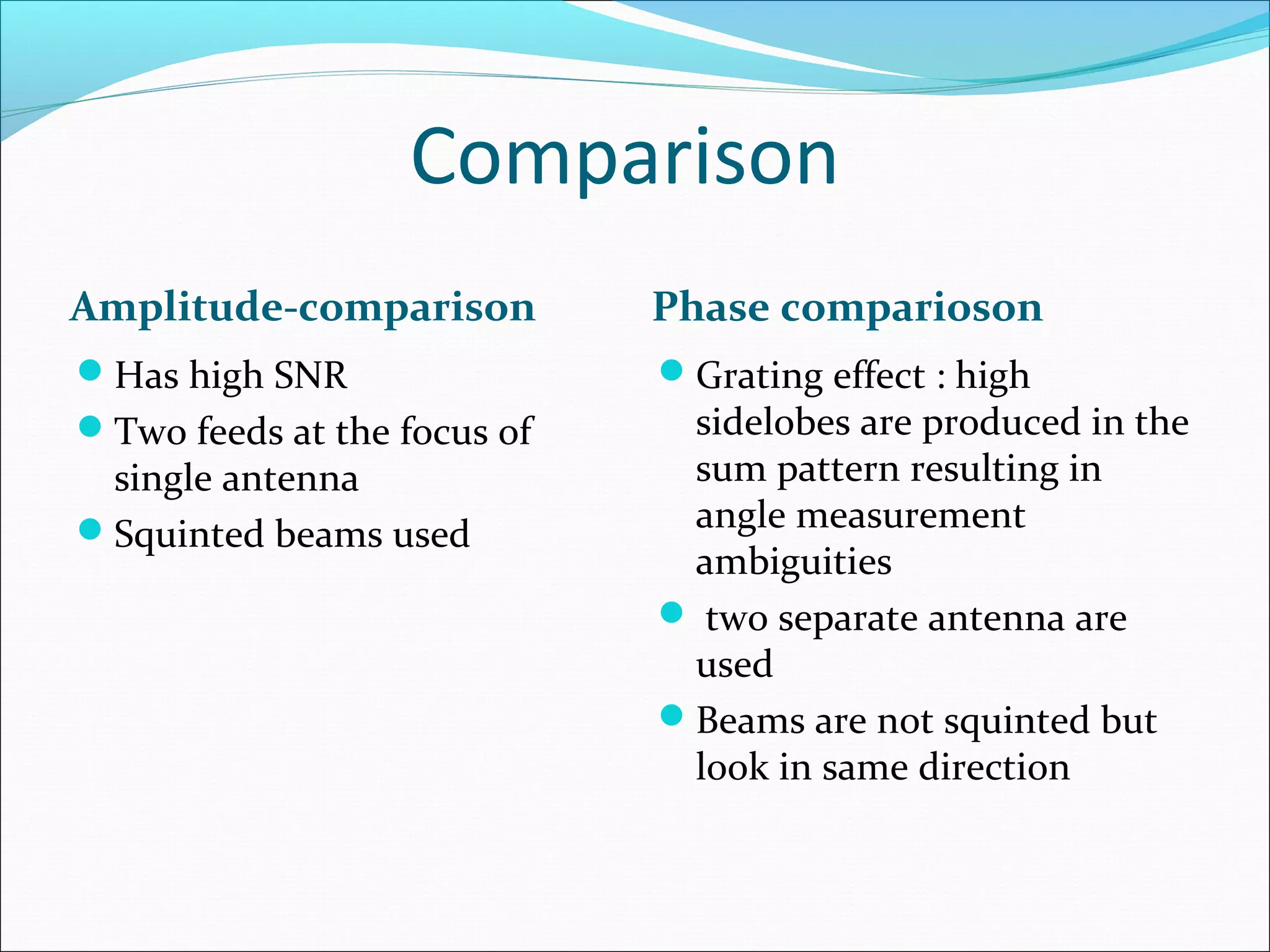
Comparison
Amplitude-comparison

Phase comparioson

Has high SNR

Grating effect : high

Two feeds at the focus of

single antenna
Squinted beams used

sidelobes are produced in the
sum pattern resulting in
angle measurement
ambiguities
 two separate antenna are
used
Beams are not squinted but
look in same direction
Monopulse tracking radar

Monopulse tracking radar

  • 2.
    Tracking Radar Measures thecoordinate of a target for determining the target path as well as to predict its future coordinates Based on the measured coordinated error signal will be generated Antenna should be moved based on error signal to maintain the target within the beam. Tracking of range, angle, Doppler frequency shift and radial velocity Uses pencil beam
  • 3.
    Angle tracking  Twobeams are squinted  Crossover of two beam: boresight  Boresight always maintained in the direction of the target  Relative amplitude of two beam determines how far the target is from boresight  Also direction in which beam needs to be repositioned  2 beams in both the coordinate
  • 4.
    Methods of generatingerror signal Conical scan or sequential lobing tracker Time shares a single beam Antenna beam is switched between two positions Simultaneous lobing or monopulse More than one simultaneous beam is used for tracking Usually 4 simultaneous beams to perform 2 dimensional tracking
  • 5.
    MonopulseTracking Radar Radar inwhich information concerning the angular location of the target is obtained by comparing the signal received in two or more simultaneous beams. Two offset antenna beams are combined to obtain both sum and difference signal This signals are multiplied in a phase sensitive detector to obtain both magnitude and direction
  • 6.
  • 7.
    Amplitude comparison monopulse Two adjacentantenna feeds are connected to the 2 input arms of a hybrid junction Sum and difference signal Difference channel produce error voltage appro proportional to the angular deviation of the target from the boresight
  • 8.
    Amplitude comparison monopulse Bycomparing the phase of sum and difference signal direction of angle error is found Depending on these information's the servo meter will drive the antenna back to the target Phase sensitive detector is used to compare the phase of two signals
  • 9.
    Monopulse in twoangle coordinate
  • 10.
    Monopulse in twoangle coordinate
  • 11.
    Monopulse in twoangle coordinate All four feeds are used to generate sum pattern i.e A+B+C+D Azimuth difference channel: (A+B) – (C+D) Elevation difference channel: (B+D) – (A+C) Two angle errors Elevation angle error : o/p of phase comparison b/w sum channel and Elevation difference channel Azimuth angle error : o/p of phase comparison b/w sum channel and Azimuth difference channel
  • 12.
    Phase comparison monopulse Insteadof comparing the amplitude of the echoes from two squinted beams , the angle of arrival from a target is determined by comparing the phase difference between two signals Uses two separate beams from two separate antenna looking in same direction
  • 13.
    Phase comparison monopulse Anecho on boresight will arrive at the two antennas at the same time and therefore the phase difference will be zero An echo from a target at an angle q to boresight will arrive at one antenna later than the other due to the extra distance it travels.
  • 14.
    Phase comparison monopulse Extradistance travelled by one echo w.r.t other is given by Or expressed as phase difference Phase detector is used to find the angle error
  • 15.
  • 16.
    Comparison Amplitude-comparison Phase comparioson Has highSNR Grating effect : high Two feeds at the focus of single antenna Squinted beams used sidelobes are produced in the sum pattern resulting in angle measurement ambiguities  two separate antenna are used Beams are not squinted but look in same direction