APA Madness: 
In-text Citations
In-text Citations: Basics 
In-text citations help readers locate the cited source 
in the References section of the paper. 
Whenever you use a source, provide in parenthesis: 
• the author’s name and the date of publication 
• for quotations and close paraphrases, provide 
the author’s name, date of publication, and a 
page number
In-text Citations: Formatting Quotations 
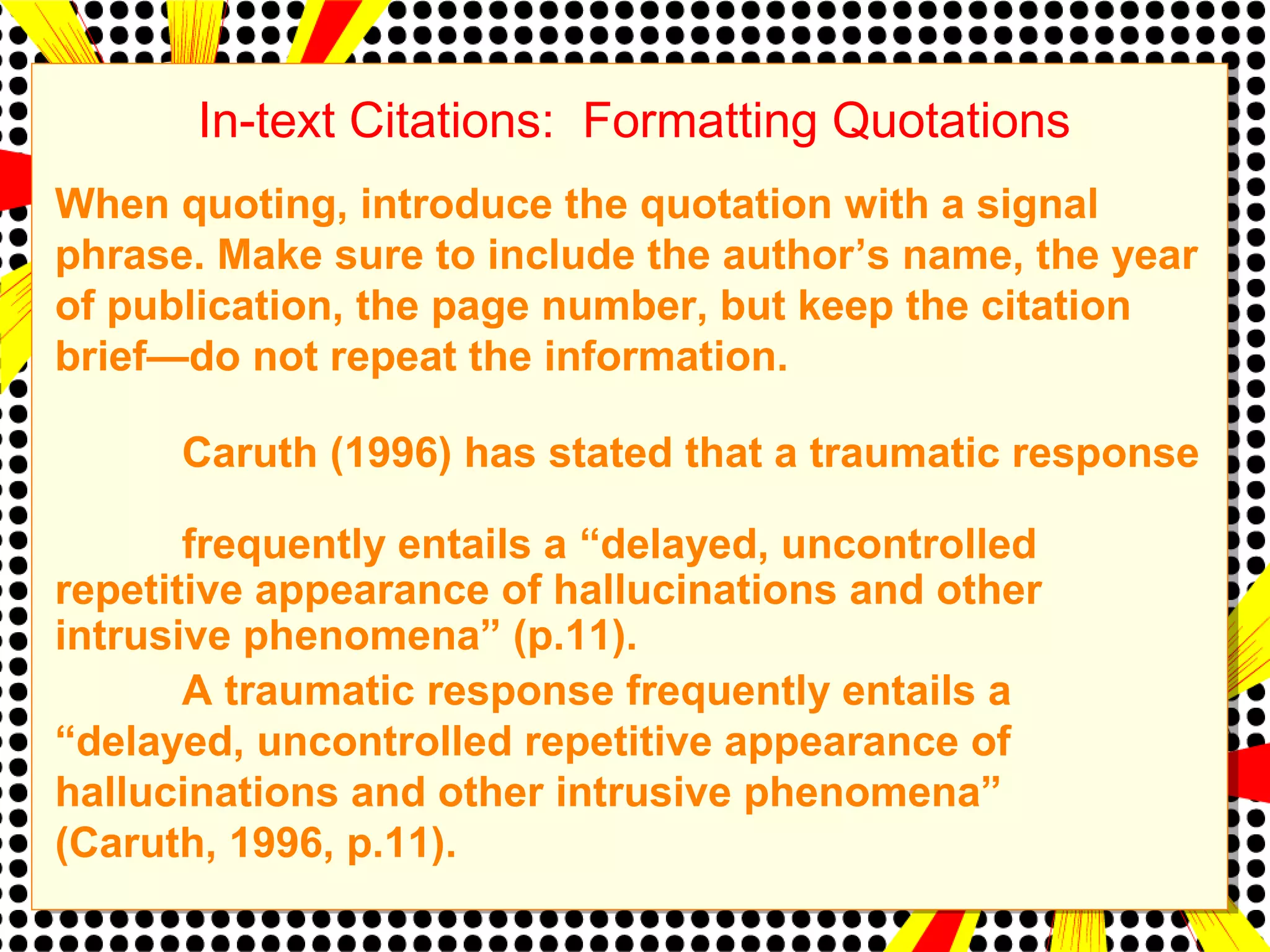
When quoting, introduce the quotation with a signal 
phrase. Make sure to include the author’s name, the year 
of publication, the page number, but keep the citation 
brief—do not repeat the information. 
Caruth (1996) has stated that a traumatic response 
frequently entails a “delayed, uncontrolled 
repetitive appearance of hallucinations and other 
intrusive phenomena” (p.11). 
A traumatic response frequently entails a 
“delayed, uncontrolled repetitive appearance of 
hallucinations and other intrusive phenomena” 
(Caruth, 1996, p.11).
In-text Citations: 
Formatting a Summary or Paraphrase 
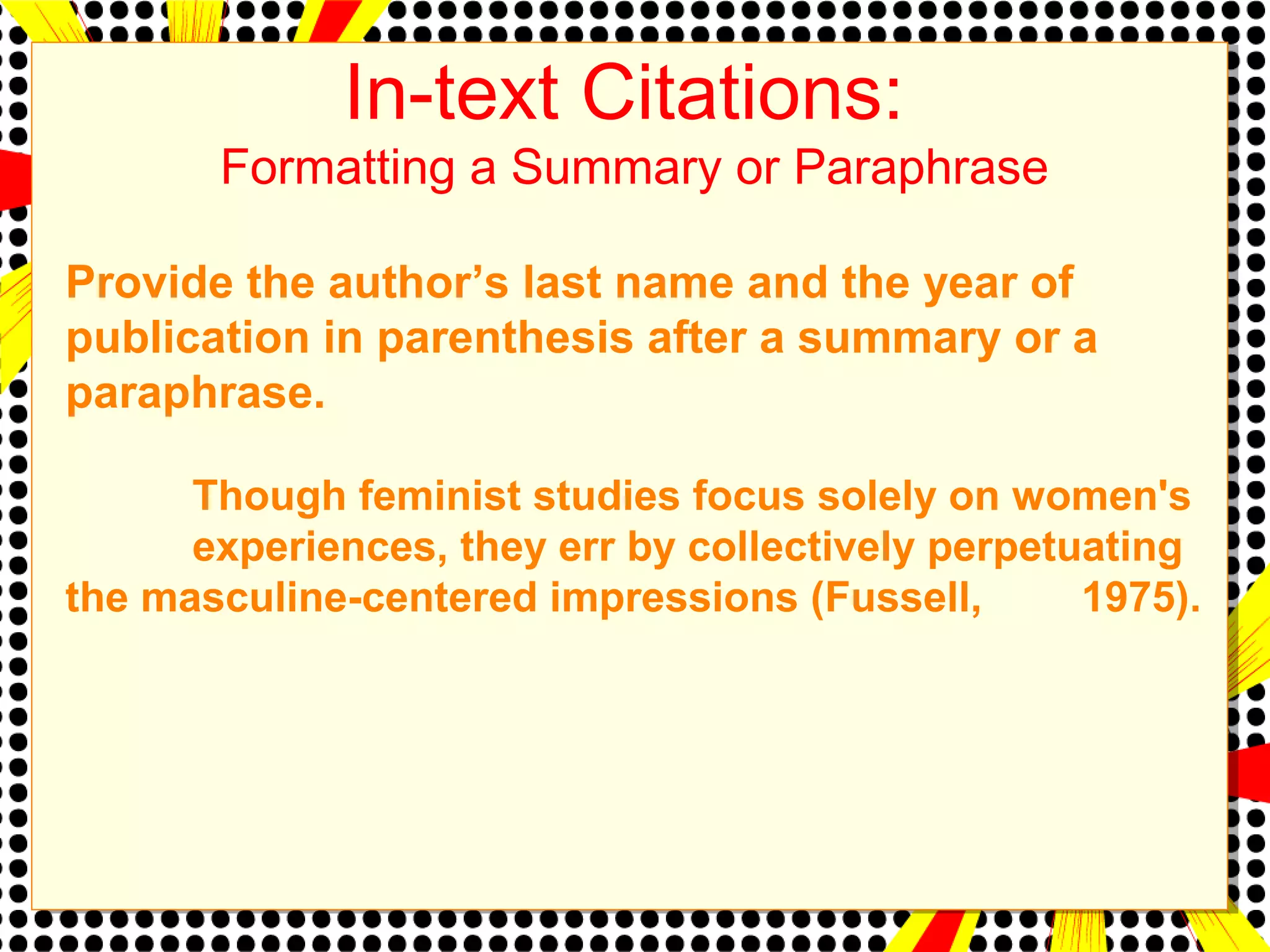
Provide the author’s last name and the year of 
publication in parenthesis after a summary or a 
paraphrase. 
Though feminist studies focus solely on women's 
experiences, they err by collectively perpetuating 
the masculine-centered impressions (Fussell, 1975).
In-text Citations: 
Formatting a Summary or Paraphrase 
Include the author’s name in a signal phrase followed 
by the year of publication in parenthesis. 
Recently, the history of warfare has been 
significantly revised by Higonnet et al. (1987), 
Marcus (1989), and Raitt and Tate (1997) to 
include women’s personal and cultural responses 
to battle and its resultant traumatic effects.
In-text Citations: 
Formatting a Summary or Paraphrase 
When including the quotation in a summary or 
paraphrase, also provide a page number in parenthesis 
after the quotation: 
According to feminist researchers Raitt and Tate 
(1997), “It is no longer true to claim that women's 
responses to the war have been ignored” (p. 2).
In-text Citations: Signal Words 
Introduce quotations with signal phrases, e.g. 
According to X. (2008), “….” (p. 3). 
X. (2008) argued that “……” (p. 3). 
Use such signal verbs as: 
acknowledged, contended, maintained, 
responded, reported, argued, concluded, 
etc. 
Use the past tense or the present perfect tense of 
verbs in signal phrases when they discuss past 
events.
In-text Citations: Two or More Works 
When the parenthetical citation includes two or 
more works, order them in the same way they 
appear in the reference list—the author’s name, 
the year of publication—separated by a 
semi-colon. 
(Kachru, 2005; Smith, 2008)
In-text Citations: A Work with Two Authors 
When citing a work with two authors, use “and” 
in between authors’ name in the signal phrase yet 
“&” between their names in parenthesis. 
According to feminist researchers Raitt and Tate 
(1997), “It is no longer true to claim that women's 
responses to the war have been ignored” (p. 2). 
Some feminists researchers question that “women's 
responses to the war have been ignored” (Raitt & 
Tate, 1997, p. 2).
In-text Citations: 
A Work with Three to Five authors 
When citing a work with three to five authors, identify all 
authors in the signal phrase or in parenthesis. 
(Harklau, Siegal, & Losey, 1999) 
In subsequent citations, only use the first author's last 
name followed by "et al." in the signal phrase or in 
parentheses. 
(Harklau et al., 1993)
In-text Citations: 
A Work with Six and More Authors 
When citing a work with six and more authors, identify 
the first author’s name followed by “et al.” 
Smith et al. (2006) maintained that…. 
(Smith et al., 2006)
In-text Citations: 
A Work of Unknown Author 
When citing a work of unknown author, use the source’s 
full title in the signal phrase and cite the first word of 
the title followed by the year of publication in 
parenthesis. Put titles of articles and chapters in 
quotation marks; italicize titles of books and reports. 
According to “Indiana Joins Federal 
Accountability System” (2008), … 
Or, 
(“Indiana,” 2008)
In-text Citations: Organization 
When citing an organization, mention the organization 
the first time when you cite the source in the signal 
phrase or the parenthetical citation. 
The data collected by the Food and Drug 
Administration (2008) confirmed that… 
If the organization has a well-known abbreviation, 
include the abbreviation in brackets the first time the 
source is cited and then use only the abbreviation in 
later citations. 
Food and Drug Administration (FDA) 
confirmed … FDA’s experts tested…
In-text Citations: 
The same last name/the same author 
When citing authors with the same last names, use first 
initials with the last names. 
(B. Kachru, 2005; Y. Kachru, 2008) 
When citing two or more works by the same author 
published in the same year, use lower-case letters (a, b, 
c) with the year of publication to order the references. 
Smith’s (1998a) study of adolescent immigrants…
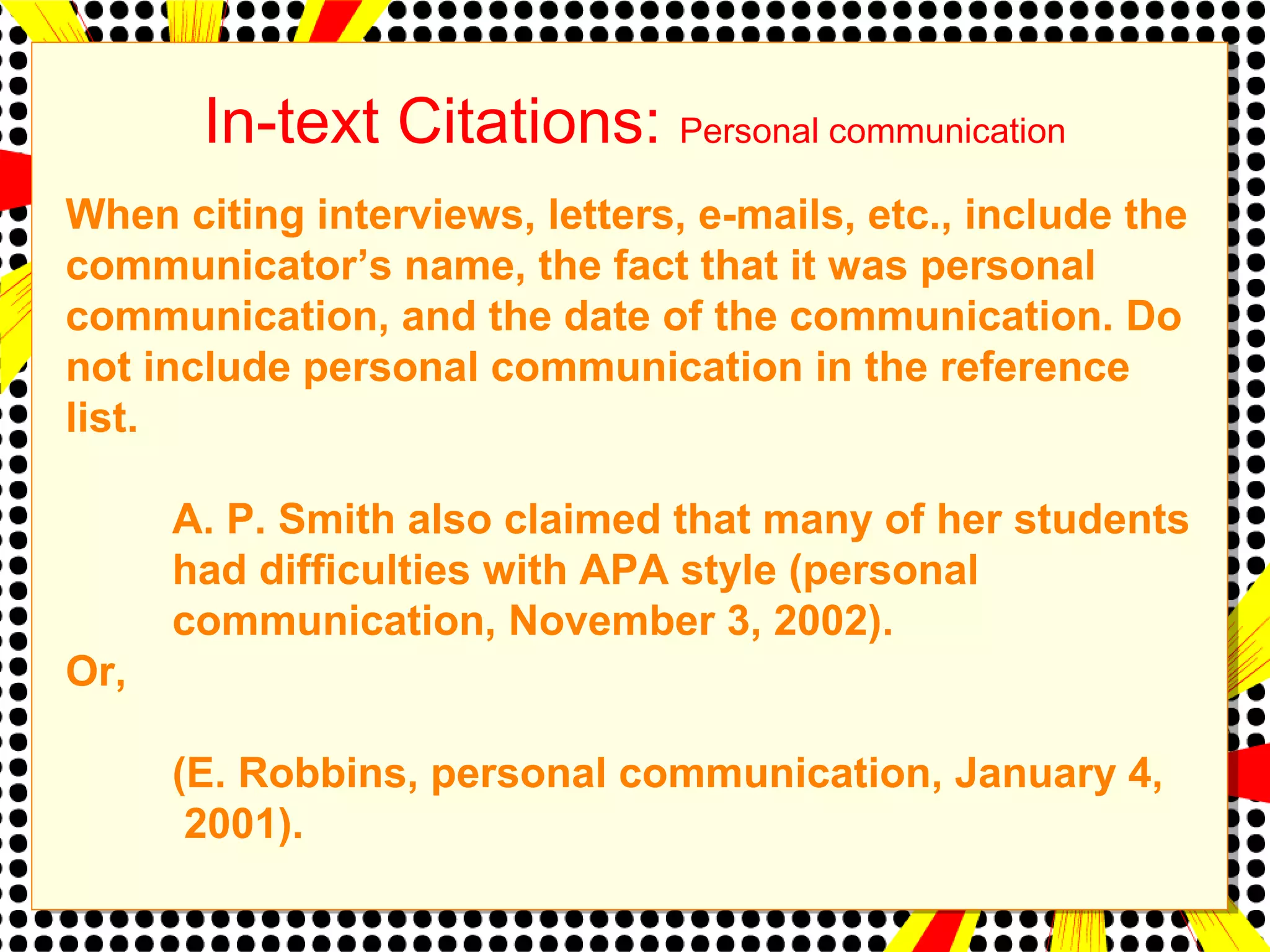
In-text Citations: Personal communication 
When citing interviews, letters, e-mails, etc., include the 
communicator’s name, the fact that it was personal 
communication, and the date of the communication. Do 
not include personal communication in the reference 
list. 
A. P. Smith also claimed that many of her students 
had difficulties with APA style (personal 
communication, November 3, 2002). 
Or, 
(E. Robbins, personal communication, January 4, 
2001).
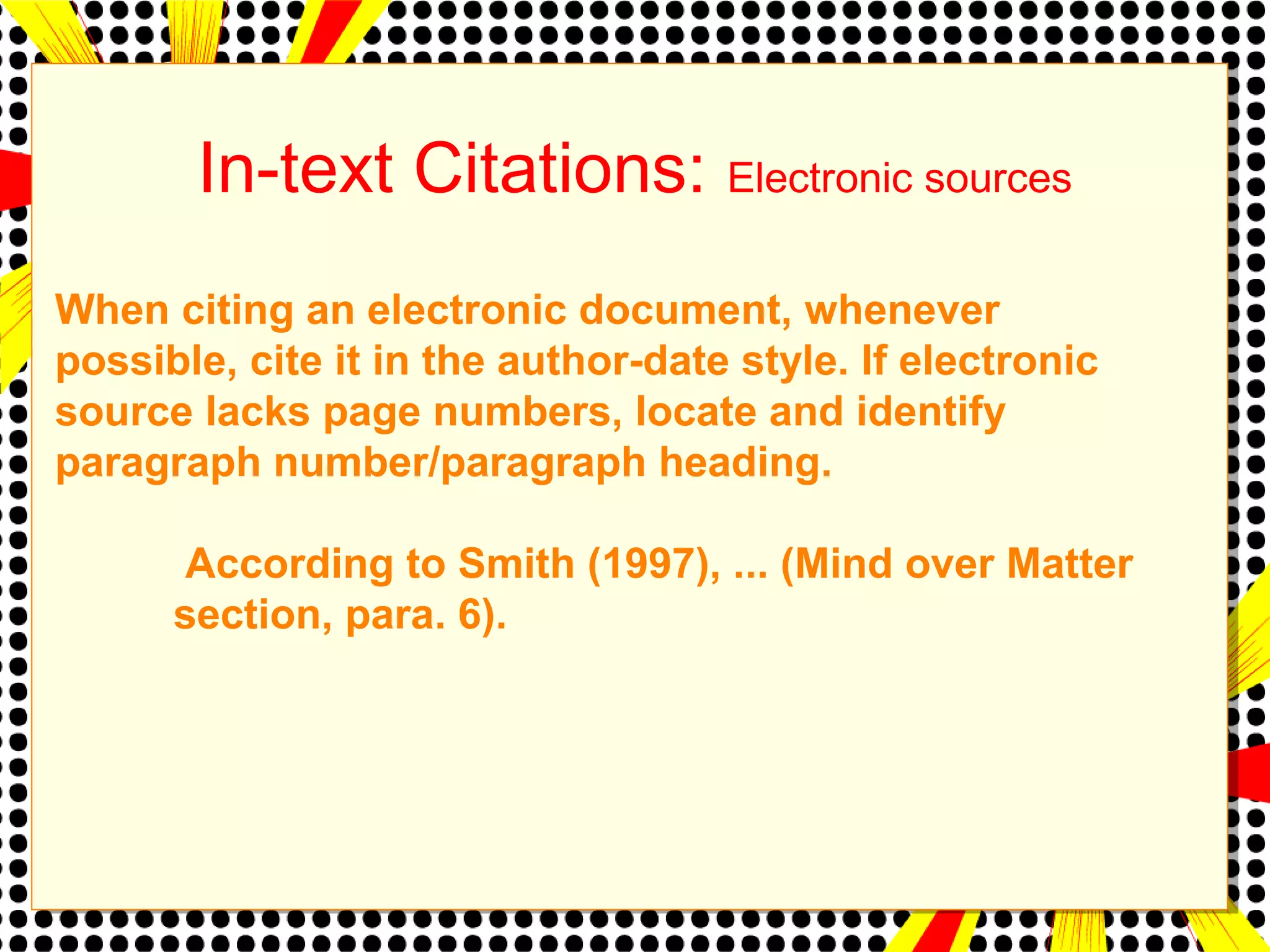
In-text Citations: Electronic sources 
When citing an electronic document, whenever 
possible, cite it in the author-date style. If electronic 
source lacks page numbers, locate and identify 
paragraph number/paragraph heading. 
According to Smith (1997), ... (Mind over Matter 
section, para. 6).
The End

In text citations

  • 1.
  • 2.
    In-text Citations: Basics In-text citations help readers locate the cited source in the References section of the paper. Whenever you use a source, provide in parenthesis: • the author’s name and the date of publication • for quotations and close paraphrases, provide the author’s name, date of publication, and a page number
  • 3.
    In-text Citations: FormattingQuotations When quoting, introduce the quotation with a signal phrase. Make sure to include the author’s name, the year of publication, the page number, but keep the citation brief—do not repeat the information. Caruth (1996) has stated that a traumatic response frequently entails a “delayed, uncontrolled repetitive appearance of hallucinations and other intrusive phenomena” (p.11). A traumatic response frequently entails a “delayed, uncontrolled repetitive appearance of hallucinations and other intrusive phenomena” (Caruth, 1996, p.11).
  • 4.
    In-text Citations: Formattinga Summary or Paraphrase Provide the author’s last name and the year of publication in parenthesis after a summary or a paraphrase. Though feminist studies focus solely on women's experiences, they err by collectively perpetuating the masculine-centered impressions (Fussell, 1975).
  • 5.
    In-text Citations: Formattinga Summary or Paraphrase Include the author’s name in a signal phrase followed by the year of publication in parenthesis. Recently, the history of warfare has been significantly revised by Higonnet et al. (1987), Marcus (1989), and Raitt and Tate (1997) to include women’s personal and cultural responses to battle and its resultant traumatic effects.
  • 6.
    In-text Citations: Formattinga Summary or Paraphrase When including the quotation in a summary or paraphrase, also provide a page number in parenthesis after the quotation: According to feminist researchers Raitt and Tate (1997), “It is no longer true to claim that women's responses to the war have been ignored” (p. 2).
  • 7.
    In-text Citations: SignalWords Introduce quotations with signal phrases, e.g. According to X. (2008), “….” (p. 3). X. (2008) argued that “……” (p. 3). Use such signal verbs as: acknowledged, contended, maintained, responded, reported, argued, concluded, etc. Use the past tense or the present perfect tense of verbs in signal phrases when they discuss past events.
  • 8.
    In-text Citations: Twoor More Works When the parenthetical citation includes two or more works, order them in the same way they appear in the reference list—the author’s name, the year of publication—separated by a semi-colon. (Kachru, 2005; Smith, 2008)
  • 9.
    In-text Citations: AWork with Two Authors When citing a work with two authors, use “and” in between authors’ name in the signal phrase yet “&” between their names in parenthesis. According to feminist researchers Raitt and Tate (1997), “It is no longer true to claim that women's responses to the war have been ignored” (p. 2). Some feminists researchers question that “women's responses to the war have been ignored” (Raitt & Tate, 1997, p. 2).
  • 10.
    In-text Citations: AWork with Three to Five authors When citing a work with three to five authors, identify all authors in the signal phrase or in parenthesis. (Harklau, Siegal, & Losey, 1999) In subsequent citations, only use the first author's last name followed by "et al." in the signal phrase or in parentheses. (Harklau et al., 1993)
  • 11.
    In-text Citations: AWork with Six and More Authors When citing a work with six and more authors, identify the first author’s name followed by “et al.” Smith et al. (2006) maintained that…. (Smith et al., 2006)
  • 12.
    In-text Citations: AWork of Unknown Author When citing a work of unknown author, use the source’s full title in the signal phrase and cite the first word of the title followed by the year of publication in parenthesis. Put titles of articles and chapters in quotation marks; italicize titles of books and reports. According to “Indiana Joins Federal Accountability System” (2008), … Or, (“Indiana,” 2008)
  • 13.
    In-text Citations: Organization When citing an organization, mention the organization the first time when you cite the source in the signal phrase or the parenthetical citation. The data collected by the Food and Drug Administration (2008) confirmed that… If the organization has a well-known abbreviation, include the abbreviation in brackets the first time the source is cited and then use only the abbreviation in later citations. Food and Drug Administration (FDA) confirmed … FDA’s experts tested…
  • 14.
    In-text Citations: Thesame last name/the same author When citing authors with the same last names, use first initials with the last names. (B. Kachru, 2005; Y. Kachru, 2008) When citing two or more works by the same author published in the same year, use lower-case letters (a, b, c) with the year of publication to order the references. Smith’s (1998a) study of adolescent immigrants…
  • 15.
    In-text Citations: Personalcommunication When citing interviews, letters, e-mails, etc., include the communicator’s name, the fact that it was personal communication, and the date of the communication. Do not include personal communication in the reference list. A. P. Smith also claimed that many of her students had difficulties with APA style (personal communication, November 3, 2002). Or, (E. Robbins, personal communication, January 4, 2001).
  • 16.
    In-text Citations: Electronicsources When citing an electronic document, whenever possible, cite it in the author-date style. If electronic source lacks page numbers, locate and identify paragraph number/paragraph heading. According to Smith (1997), ... (Mind over Matter section, para. 6).
  • 17.

Editor's Notes

  • #2 Welcome to “APA Formatting and Style Guide”. This Power Point Presentation is designed to introduce your students to the basics of APA Formatting and Style Guide. You might want to supplement the presentation with more detailed information posted on Purdue OWL http://owl.english.purdue.edu/owl/resource/560/01/
  • #3 This slide explains the basics of in-text citations. In-text citations help establish credibility of the writer, show respect to someone else’s intellectual property (and consequently, avoid plagiarism). More practically, in-text citations help readers locate the cited source in the references page. Thus, keep the in-text citation brief and make sure that the information provided in the body of the paper should be just enough so that a reader could easily cross-reference the citation with its matching entry on the reference page; i.e., the body of the paper and the in-text citation together contains the author’s name and the year of publication. To avoid plagiarism, also provide a page number (in p.3 / pp.3-5 format) for close paraphrases and quotations.
  • #4 This slide provides explanation and examples of in-text citations with quotations.
  • #5 The following three slides provide instructions and examples of in-text citations with summary/ paraphrase. The facilitator should emphasize the importance of developing the skills of critical reading (which enables finding main claims in the text), summarizing, and paraphrasing. When paraphrasing or summarizing, the major concern should be fair and accurate representation of the ideas in the source. This slide can be supplemented by the “Quoting, Paraphrasing, and Summarizing” section from OWL http://owl.english.purdue.edu/owl/resource/563/01/
  • #6 The following three slides provide instructions and examples of in-text citations with summary/ paraphrase. The facilitator should emphasize the importance of developing the skills of critical reading (which enables finding main claims in the text), summarizing, and paraphrasing. When paraphrasing or summarizing, the major concern should be fair and accurate representation of the ideas in the source. This slide can be supplemented by the “Quoting, Paraphrasing, and Summarizing” section from OWL http://owl.english.purdue.edu/owl/resource/563/01/ and sections on APA in-text citations: http://owl.english.purdue.edu/owl/resource/560/01/ http://owl.english.purdue.edu/owl/resource/560/02/
  • #7 This slide continues explaining formatting in-text citations with summary/ paraphrase.
  • #8 Acquiring a rich repertoire of signal words and phrases is the key to success in representing others’ ideas in academic writing. This slide provides a few examples of those and reminds that APA requires to use the past or present perfect tense of verbs in signal phrases. The facilitator might want to point to the chapter in the composition book that introduces and practices signal words.
  • #9 This slide explains and exemplifies the specific cases of in-text citations. It might be supplemented with “Author/Authors” section from OWL http://owl.english.purdue.edu/owl/resource/560/03/
  • #10 This slide explains and exemplifies the specific cases of in-text citations. It might be supplemented with “Author/Authors” section from OWL http://owl.english.purdue.edu/owl/resource/560/03/
  • #11 This slide explains and exemplifies the specific cases of in-text citations. It might be supplemented with “Author/Authors” section from OWL http://owl.english.purdue.edu/owl/resource/560/03/
  • #12 This slide explains and exemplifies the specific cases of in-text citations. It might be supplemented with “Author/Authors” section from OWL http://owl.english.purdue.edu/owl/resource/560/03/
  • #13 This slide explains and exemplifies the specific cases of in-text citations. It might be supplemented with “Author/Authors” section from OWL http://owl.english.purdue.edu/owl/resource/560/03/
  • #14 This slide explains and exemplifies the specific cases of in-text citations. It might be supplemented with “Author/Authors” section from OWL http://owl.english.purdue.edu/owl/resource/560/03/
  • #15 This slide explains and exemplifies the specific cases of in-text citations. It might be supplemented with “Author/Authors” section from OWL http://owl.english.purdue.edu/owl/resource/560/03/
  • #16 This slide explains and exemplifies the specific cases of in-text citations. It might be supplemented with “Author/Authors” section from OWL http://owl.english.purdue.edu/owl/resource/560/03/
  • #17 This slide explains and exemplifies the specific cases of in-text citations. It might be supplemented with “Author/Authors” section from OWL http://owl.english.purdue.edu/owl/resource/560/03/
  • #18 Writer and Designer: Jennifer Liethen Kunka Contributors: Muriel Harris, Karen Bishop, Bryan Kopp, Matthew Mooney, David Neyhart, and Andrew Kunka Revising Author: Elizabeth Angeli, 2011; Elena Lawrick, 2008 Developed with resources courtesy of the Purdue University Writing Lab Grant funding courtesy of the Multimedia Instructional Development Center at Purdue University © Copyright Purdue University, 2000, 2006, 2007, 2008