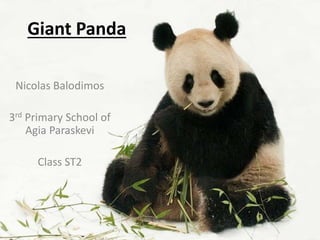
Giant Panda
Nicolas Balodimos
3rd Primary School of
Agia Paraskevi
Class ST2
Panda
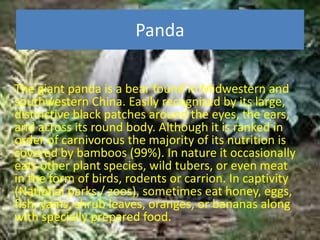
The giant panda is a bear found in Midwestern and
southwestern China. Easily recognized by its large,
distinctive black patches around the eyes, the ears,
and across its round body. Although it is ranked in
order of carnivorous the majority of its nutrition is
covered by bamboos (99%). In nature it occasionally
eats other plant species, wild tubers, or even meat
in the form of birds, rodents or carrion. In captivity
(National parks / zoos), sometimes eat honey, eggs,
fish, yams, shrub leaves, oranges, or bananas along
with specially prepared food.
Panda: symbol of China
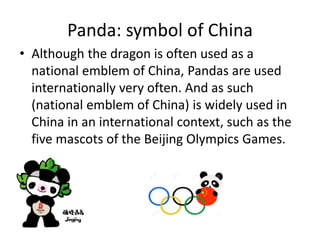
• Although the dragon is often used as a
national emblem of China, Pandas are used
internationally very often. And as such
(national emblem of China) is widely used in
China in an international context, such as the
five mascots of the Beijing Olympics Games.
Description
The giant panda has black fur.
Adults always have a length
ranging from 1.5 to 1.8 m,
including the tail (which is
approximately 13 cm) and a
height of 60-90 cm. Males can
weigh up to 160 kg. Females
(generally 10-20% smaller
than males) may weigh only
75 kg, but may also reach 125
kg. The average weight of an
adult is 100-115 kg.
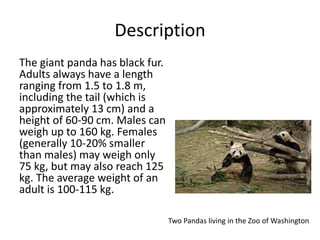
Two Pandas living in the Zoo of Washington
Population of Pandas
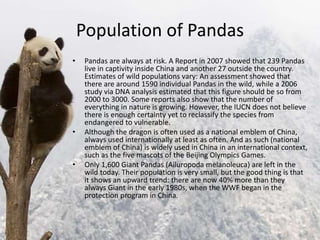
• Pandas are always at risk. A Report in 2007 showed that 239 Pandas
live in captivity inside China and another 27 outside the country.
Estimates of wild populations vary: An assessment showed that
there are around 1590 individual Pandas in the wild, while a 2006
study via DNA analysis estimated that this figure should be so from
2000 to 3000. Some reports also show that the number of
everything in nature is growing. However, the IUCN does not believe
there is enough certainty yet to reclassify the species from
endangered to vulnerable.
• Although the dragon is often used as a national emblem of China,
always used internationally at least as often. And as such (national
emblem of China) is widely used in China in an international context,
such as the five mascots of the Beijing Olympics Games.
• Only 1,600 Giant Pandas (Ailuropoda melanoleuca) are left in the
wild today. Their population is very small, but the good thing is that
it shows an upward trend: there are now 40% more than they
always Giant in the early 1980s, when the WWF began in the
protection program in China.
Habitat
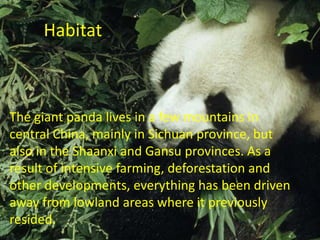
The giant panda lives in a few mountains in
central China, mainly in Sichuan province, but
also in the Shaanxi and Gansu provinces. As a
result of intensive farming, deforestation and
other developments, everything has been driven
away from lowland areas where it previously
resided.
Special
characteristics
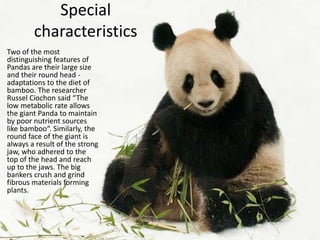
Two of the most
distinguishing features of
Pandas are their large size
and their round head -
adaptations to the diet of
bamboo. The researcher
Russel Ciochon said “The
low metabolic rate allows
the giant Panda to maintain
by poor nutrient sources
like bamboo“. Similarly, the
round face of the giant is
always a result of the strong
jaw, who adhered to the
top of the head and reach
up to the jaws. The big
bankers crush and grind
fibrous materials forming
plants.

Giant panda

  • 1.
    Giant Panda Nicolas Balodimos 3rdPrimary School of Agia Paraskevi Class ST2
  • 2.
    Panda The giant pandais a bear found in Midwestern and southwestern China. Easily recognized by its large, distinctive black patches around the eyes, the ears, and across its round body. Although it is ranked in order of carnivorous the majority of its nutrition is covered by bamboos (99%). In nature it occasionally eats other plant species, wild tubers, or even meat in the form of birds, rodents or carrion. In captivity (National parks / zoos), sometimes eat honey, eggs, fish, yams, shrub leaves, oranges, or bananas along with specially prepared food.
  • 3.
    Panda: symbol ofChina • Although the dragon is often used as a national emblem of China, Pandas are used internationally very often. And as such (national emblem of China) is widely used in China in an international context, such as the five mascots of the Beijing Olympics Games.
  • 4.
    Description The giant pandahas black fur. Adults always have a length ranging from 1.5 to 1.8 m, including the tail (which is approximately 13 cm) and a height of 60-90 cm. Males can weigh up to 160 kg. Females (generally 10-20% smaller than males) may weigh only 75 kg, but may also reach 125 kg. The average weight of an adult is 100-115 kg. Two Pandas living in the Zoo of Washington
  • 5.
    Population of Pandas •Pandas are always at risk. A Report in 2007 showed that 239 Pandas live in captivity inside China and another 27 outside the country. Estimates of wild populations vary: An assessment showed that there are around 1590 individual Pandas in the wild, while a 2006 study via DNA analysis estimated that this figure should be so from 2000 to 3000. Some reports also show that the number of everything in nature is growing. However, the IUCN does not believe there is enough certainty yet to reclassify the species from endangered to vulnerable. • Although the dragon is often used as a national emblem of China, always used internationally at least as often. And as such (national emblem of China) is widely used in China in an international context, such as the five mascots of the Beijing Olympics Games. • Only 1,600 Giant Pandas (Ailuropoda melanoleuca) are left in the wild today. Their population is very small, but the good thing is that it shows an upward trend: there are now 40% more than they always Giant in the early 1980s, when the WWF began in the protection program in China.
  • 6.
    Habitat The giant pandalives in a few mountains in central China, mainly in Sichuan province, but also in the Shaanxi and Gansu provinces. As a result of intensive farming, deforestation and other developments, everything has been driven away from lowland areas where it previously resided.
  • 7.
    Special characteristics Two of themost distinguishing features of Pandas are their large size and their round head - adaptations to the diet of bamboo. The researcher Russel Ciochon said “The low metabolic rate allows the giant Panda to maintain by poor nutrient sources like bamboo“. Similarly, the round face of the giant is always a result of the strong jaw, who adhered to the top of the head and reach up to the jaws. The big bankers crush and grind fibrous materials forming plants.