SITE ANALYSIS
ARE 202 Architectural Design-I
Site AnalysisSite Analysis
Introduction to Architectural DesignIntroduction to Architectural Design
By Sabeer HamidBy Sabeer Hamid
SITEANALYSIS
ARE202ArchitecturalDesign-I
Goal of site analysisGoal of site analysis
 To achieve a successful design, site analysis is aTo achieve a successful design, site analysis is a
must & should be done carefullymust & should be done carefully
 Site Analysis involves taking an inventory of siteSite Analysis involves taking an inventory of site
elements and analyzing these factors relative toelements and analyzing these factors relative to
the clients needs & aimsthe clients needs & aims
 Gather relevant information about the propertiesGather relevant information about the properties
of the site, from topography to climate to windof the site, from topography to climate to wind
pattern and vegetationpattern and vegetation
 Analyze these features and incorporate them intoAnalyze these features and incorporate them into
the designthe design
SITEANALYSIS
ARE202ArchitecturalDesign-I
Example Site Condition:Example Site Condition:
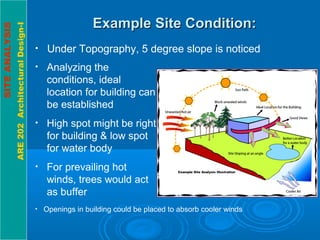
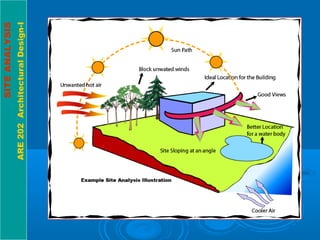
• Under Topography, 5 degree slope is noticed
• Analyzing the
conditions, ideal
location for building can
be established
• High spot might be right
for building & low spot
for water body
• For prevailing hot
winds, trees would act
as buffer
• Openings in building could be placed to absorb cooler winds
SITEANALYSIS
ARE202ArchitecturalDesign-I
SITEANALYSIS
ARE202ArchitecturalDesign-I
Site Analysis: Inventory ListSite Analysis: Inventory List
 Subsurface FeaturesSubsurface Features

Geology:Geology: Geological history of the area,Geological history of the area,
bedrock type & depth etc.bedrock type & depth etc.

Hydrology:Hydrology: Underground water table,Underground water table,
aquifers, springs etc.aquifers, springs etc.

Soil Genesis:Soil Genesis: erosion susceptibility,erosion susceptibility,
moisture (pF), reaction (pH) organic content,moisture (pF), reaction (pH) organic content,
bearing capacity etc.bearing capacity etc.
SITEANALYSIS
ARE202ArchitecturalDesign-I
Site Analysis: Inventory ListSite Analysis: Inventory List
 Natural Surface FeaturesNatural Surface Features

Vegetation:Vegetation: Type, size, location, shadeType, size, location, shade
pattern, aesthetics, ecology etc.pattern, aesthetics, ecology etc.

Slopes:Slopes: Gradient, landforms, elevations,Gradient, landforms, elevations,
drainage patternsdrainage patterns

Wild Life:Wild Life: ecology, species etc.ecology, species etc.

Climate:Climate: precipitation, annual rain/snow,precipitation, annual rain/snow,
humidity, wind direction, solar intensity &humidity, wind direction, solar intensity &
orientation, average/highest/lowestorientation, average/highest/lowest
temperaturetemperature
SITEANALYSIS
ARE202ArchitecturalDesign-I
Site Analysis: Inventory ListSite Analysis: Inventory List
 Cultural & Man-made FeaturesCultural & Man-made Features

Utilities:Utilities: sanitary, water supply, gas, electricalsanitary, water supply, gas, electrical
etc.etc.

Land use:Land use: Usage of site, adjacent use, zoningUsage of site, adjacent use, zoning
restrictions, easement etc.restrictions, easement etc.

Historic notes:Historic notes: archeological sites, landmarks,archeological sites, landmarks,
building type, size, conditionbuilding type, size, condition

Circulation:Circulation: linkages an transit roads, auto &linkages an transit roads, auto &
pedestrian access, mass transit routes etc.pedestrian access, mass transit routes etc.

Social Factors:Social Factors: population, intensity,population, intensity,
educational level, economic & political factors,educational level, economic & political factors,
ethnicity, cultural typology etc.ethnicity, cultural typology etc.
SITEANALYSIS
ARE202ArchitecturalDesign-I
Site Analysis: Inventory ListSite Analysis: Inventory List
 Aesthetic Factors:Aesthetic Factors:

Perceptual:Perceptual: from an auto, by pedestrian, byfrom an auto, by pedestrian, by
bike etc.bike etc.

Spatial Pattern:Spatial Pattern: views of the site, views fromviews of the site, views from
the site, spaces existing, potential for newthe site, spaces existing, potential for new
areas, sequential relationshipareas, sequential relationship

Natural Features:Natural Features: significant natural featuressignificant natural features
of the site, water elements, rock formations,of the site, water elements, rock formations,
plant materialsplant materials
SITEANALYSIS
ARE202ArchitecturalDesign-I
SITEANALYSIS
ARE202ArchitecturalDesign-I
SITEANALYSIS
ARE202ArchitecturalDesign-I
Thank youThank you

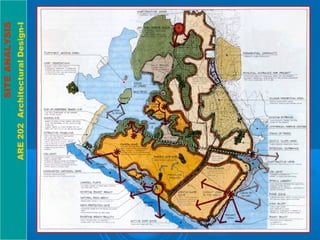
Site analysis-example

  • 1.
    SITE ANALYSIS ARE 202Architectural Design-I Site AnalysisSite Analysis Introduction to Architectural DesignIntroduction to Architectural Design By Sabeer HamidBy Sabeer Hamid
  • 2.
    SITEANALYSIS ARE202ArchitecturalDesign-I Goal of siteanalysisGoal of site analysis  To achieve a successful design, site analysis is aTo achieve a successful design, site analysis is a must & should be done carefullymust & should be done carefully  Site Analysis involves taking an inventory of siteSite Analysis involves taking an inventory of site elements and analyzing these factors relative toelements and analyzing these factors relative to the clients needs & aimsthe clients needs & aims  Gather relevant information about the propertiesGather relevant information about the properties of the site, from topography to climate to windof the site, from topography to climate to wind pattern and vegetationpattern and vegetation  Analyze these features and incorporate them intoAnalyze these features and incorporate them into the designthe design
  • 3.
    SITEANALYSIS ARE202ArchitecturalDesign-I Example Site Condition:ExampleSite Condition: • Under Topography, 5 degree slope is noticed • Analyzing the conditions, ideal location for building can be established • High spot might be right for building & low spot for water body • For prevailing hot winds, trees would act as buffer • Openings in building could be placed to absorb cooler winds
  • 4.
  • 5.
    SITEANALYSIS ARE202ArchitecturalDesign-I Site Analysis: InventoryListSite Analysis: Inventory List  Subsurface FeaturesSubsurface Features  Geology:Geology: Geological history of the area,Geological history of the area, bedrock type & depth etc.bedrock type & depth etc.  Hydrology:Hydrology: Underground water table,Underground water table, aquifers, springs etc.aquifers, springs etc.  Soil Genesis:Soil Genesis: erosion susceptibility,erosion susceptibility, moisture (pF), reaction (pH) organic content,moisture (pF), reaction (pH) organic content, bearing capacity etc.bearing capacity etc.
  • 6.
    SITEANALYSIS ARE202ArchitecturalDesign-I Site Analysis: InventoryListSite Analysis: Inventory List  Natural Surface FeaturesNatural Surface Features  Vegetation:Vegetation: Type, size, location, shadeType, size, location, shade pattern, aesthetics, ecology etc.pattern, aesthetics, ecology etc.  Slopes:Slopes: Gradient, landforms, elevations,Gradient, landforms, elevations, drainage patternsdrainage patterns  Wild Life:Wild Life: ecology, species etc.ecology, species etc.  Climate:Climate: precipitation, annual rain/snow,precipitation, annual rain/snow, humidity, wind direction, solar intensity &humidity, wind direction, solar intensity & orientation, average/highest/lowestorientation, average/highest/lowest temperaturetemperature
  • 7.
    SITEANALYSIS ARE202ArchitecturalDesign-I Site Analysis: InventoryListSite Analysis: Inventory List  Cultural & Man-made FeaturesCultural & Man-made Features  Utilities:Utilities: sanitary, water supply, gas, electricalsanitary, water supply, gas, electrical etc.etc.  Land use:Land use: Usage of site, adjacent use, zoningUsage of site, adjacent use, zoning restrictions, easement etc.restrictions, easement etc.  Historic notes:Historic notes: archeological sites, landmarks,archeological sites, landmarks, building type, size, conditionbuilding type, size, condition  Circulation:Circulation: linkages an transit roads, auto &linkages an transit roads, auto & pedestrian access, mass transit routes etc.pedestrian access, mass transit routes etc.  Social Factors:Social Factors: population, intensity,population, intensity, educational level, economic & political factors,educational level, economic & political factors, ethnicity, cultural typology etc.ethnicity, cultural typology etc.
  • 8.
    SITEANALYSIS ARE202ArchitecturalDesign-I Site Analysis: InventoryListSite Analysis: Inventory List  Aesthetic Factors:Aesthetic Factors:  Perceptual:Perceptual: from an auto, by pedestrian, byfrom an auto, by pedestrian, by bike etc.bike etc.  Spatial Pattern:Spatial Pattern: views of the site, views fromviews of the site, views from the site, spaces existing, potential for newthe site, spaces existing, potential for new areas, sequential relationshipareas, sequential relationship  Natural Features:Natural Features: significant natural featuressignificant natural features of the site, water elements, rock formations,of the site, water elements, rock formations, plant materialsplant materials
  • 9.
  • 10.
  • 11.