Advanced Invertebrates Circulation Support, Growth & Movement Nervous Systems (cont’d)
Circulation mollusks bivalves and gastropods – open w/ hemolymph & heart cephalopods – closed w/ heart annelids – closed w/ aortic arches arthropods crustaceans – open chelicerates – open uniramians – open w/ heart & aorta echinoderms – cellular diffusion
Support, Growth & Movement mollusks Gastropods have 1 shell exhibit torsion move w/ wavelike contractions of foot Bivalves have 2 shells move with “hatchet foot” extruded from body
Support, Growth & Movement mollusks Cephalopods jet propulsion stabilize with fins sometimes can crawl very  malleable  body
Support, Growth & Movement annelida longitudinal muscles  circular muscles parapodia – stumpy leg-like appendages setae – bristle like hairs
Support, Growth & Movement arthropods molt to grow larger – shed exoskeleton unprotected until new exoskeleton hardens many muscles jointed appendages allow full range of motion
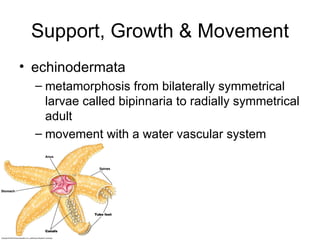
Support, Growth & Movement echinodermata metamorphosis from bilaterally symmetrical larvae called bipinnaria to radially symmetrical adult movement with a water vascular system
Neural Control & Sensory Organs annelids chain of ganglia ventral nerve cord connects ganglia in each segment setae
Neural Control & Sensory Organs arthropods crustaceans paired ganglia pair of branched antenna & pair of antennules, sensory hairs compound eyes on stalks  chelicerates brain simple eyes: usually three or more uniramians brain & ventral nerve cord paired ganglia in each segment antenna & sensory hairs simple & compound eyes tympanum: sound sensing
Neural Control & Sensory Organs echinodermata  nerve ring radial nerves

Advanced Invertebrates Csn

  • 1.
    Advanced Invertebrates CirculationSupport, Growth & Movement Nervous Systems (cont’d)
  • 2.
    Circulation mollusks bivalvesand gastropods – open w/ hemolymph & heart cephalopods – closed w/ heart annelids – closed w/ aortic arches arthropods crustaceans – open chelicerates – open uniramians – open w/ heart & aorta echinoderms – cellular diffusion
  • 3.
    Support, Growth &Movement mollusks Gastropods have 1 shell exhibit torsion move w/ wavelike contractions of foot Bivalves have 2 shells move with “hatchet foot” extruded from body
  • 4.
    Support, Growth &Movement mollusks Cephalopods jet propulsion stabilize with fins sometimes can crawl very malleable body
  • 5.
    Support, Growth &Movement annelida longitudinal muscles circular muscles parapodia – stumpy leg-like appendages setae – bristle like hairs
  • 6.
    Support, Growth &Movement arthropods molt to grow larger – shed exoskeleton unprotected until new exoskeleton hardens many muscles jointed appendages allow full range of motion
  • 7.
    Support, Growth &Movement echinodermata metamorphosis from bilaterally symmetrical larvae called bipinnaria to radially symmetrical adult movement with a water vascular system
  • 8.
    Neural Control &Sensory Organs annelids chain of ganglia ventral nerve cord connects ganglia in each segment setae
  • 9.
    Neural Control &Sensory Organs arthropods crustaceans paired ganglia pair of branched antenna & pair of antennules, sensory hairs compound eyes on stalks chelicerates brain simple eyes: usually three or more uniramians brain & ventral nerve cord paired ganglia in each segment antenna & sensory hairs simple & compound eyes tympanum: sound sensing
  • 10.
    Neural Control &Sensory Organs echinodermata nerve ring radial nerves