Little is known about the actual
origin of language as a system in
the human brain.
Researchers do not agree on how
to account for language acquisition.
The following questions about language still
remain unanswered:
Is language learnt or inborn?
Does it develop gradually or in distinct stages?
Is language competence universal or individual?
Is language a separate skill or is it an element of
cognitive development?
Is it a structure or a function that we acquire?
Therefore, there is a variety of approaches
accounting for the language acquisition.
1.Behavioural/Learning Approach
2.Nativist/Innatist/Mentalist/linguistic Approach
3.Cognitive Approach
4.Social Interactionist Approach
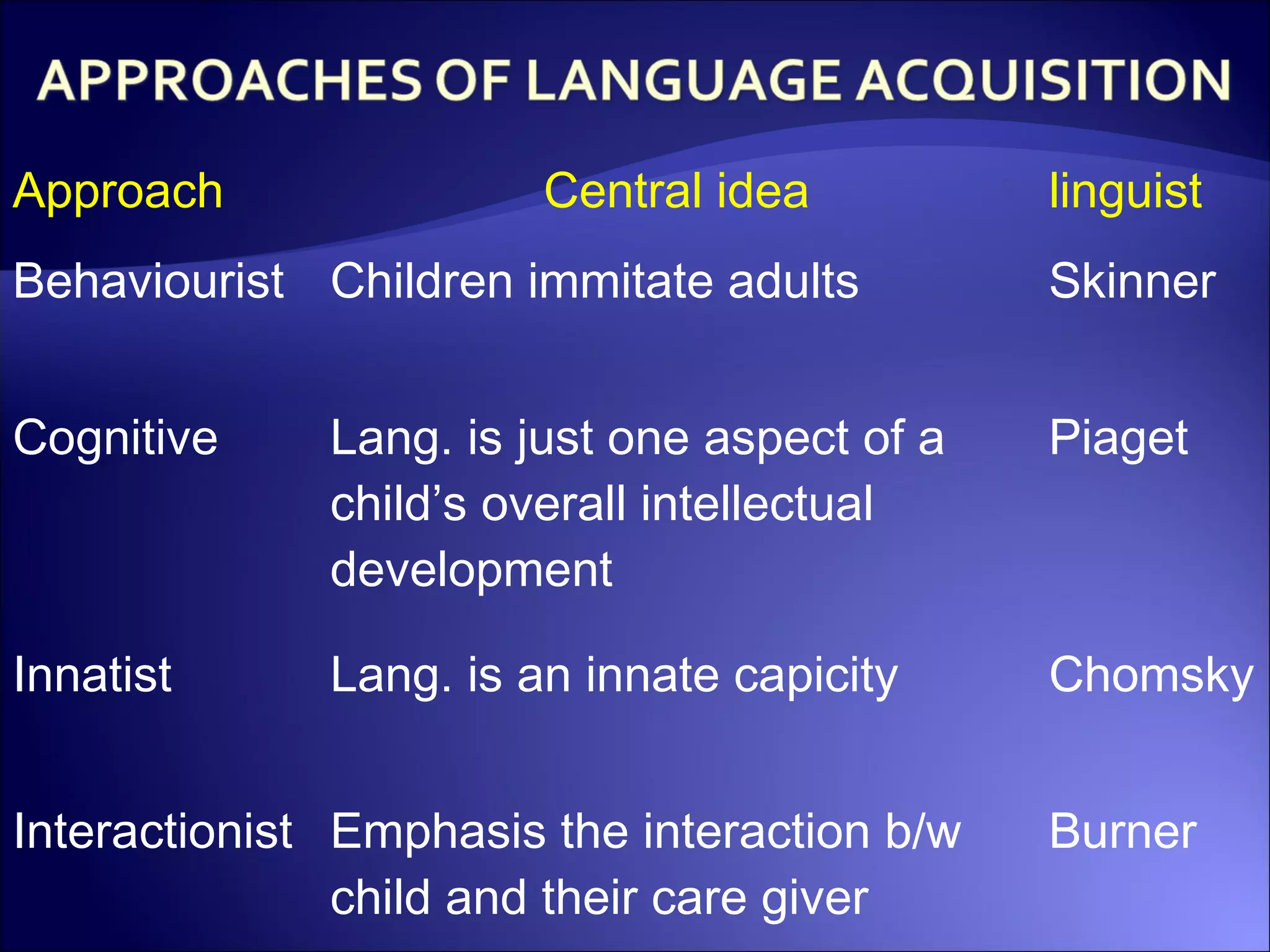
Approach Central idea linguist
Behaviourist Children immitate adults Skinner
Cognitive Lang. is just one aspect of a
child’s overall intellectual
development
Piaget
Innatist Lang. is an innate capicity Chomsky
Interactionist Emphasis the interaction b/w
child and their care giver
Burner
Social Interactionist Approach
Social interactionism ascribes the central role
in the process of language acquisition to the
environment. The focus of attention of social
interacionists is the way interaction leads to
the development of language competence.
Social Interaction takes place
Social interactionism ascribes the central role
in the process of language acquisition to the
environment. The focus of attention of social
interacionists is the way interaction leads to
the development of language competence.
Major Claim:
Language, according to social interactionists,
develops through interaction with other
human being, which leads to input
modification i.e. adjusting it to the capacity of
the learner.
Additionally, interactionists claim that no
‘critical period’ for language acquisition exists
as the process of interaction is not dependent
on biological or cognitive development.
Social interactionists do not deny the
existance of neuropsychological factors
affecting language acquisition; however, they
claim that biological factors are not sufficient.
They also do not accept placing language as
just one more element of cognitive
development.
Critical Period (Four stages of child language
acquisition by JEAN WILLIAM FRITZ PIAGET
Zone of proximal development (level of skill
of knowledge which is just beyond what the
learner currently copes with)
Mediation (the role played by ‘significant
people’, the people the learner admires, who
select and modify the learning material for the
learner helping him/her to move to the next
zone of proximal development)
Lev Vygotsky proposes the model of
language acquisition consisting of two major
concepts:
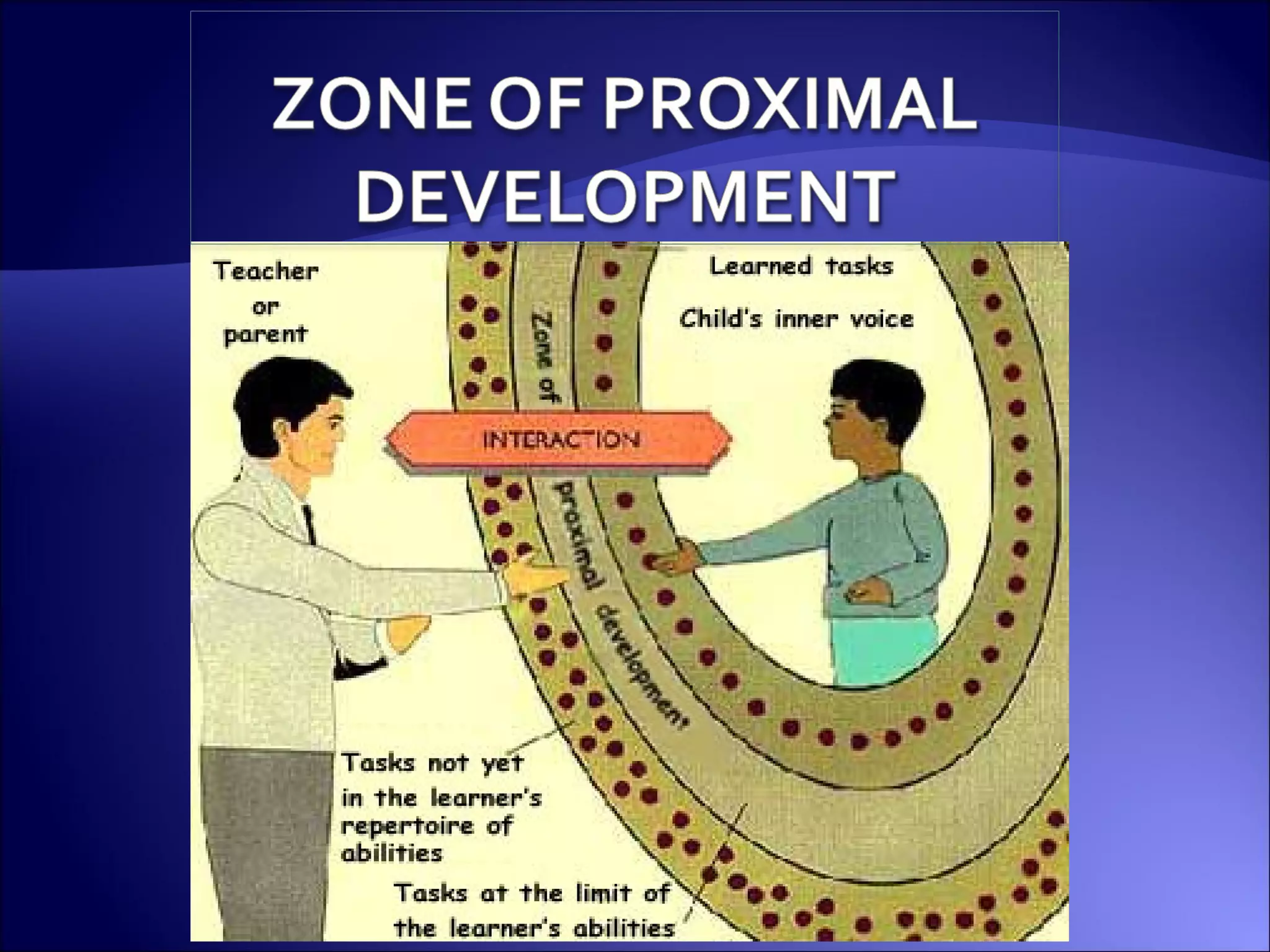
Zone of proximal development (level of skill
of knowledge which is just beyond what the
learner currently copes with)
Mediation (the role played by ‘significant
people’, the people the learner admires, who
select and modify the learning material for the
learner helping him/her to move to the next
zone of proximal development)
 Refers to the support or assistance that lets the child
accomplish a task he/she cannot accomplish
independently.
 It is not about doing the task for the child while
he/she watches.
 It is not about doing short cuts for the child.
 It should involve the judicious assistance given by
the adult or peer so that the child can move from the
zone of actual to the zone of proximal development.
Unzipping the lunch bag, opening the
food container and putting straw in
the child’s juice tetra pack for her /
him is NOT SCAFFOLDING.
 When the adult unzips the zipper an inch or two and
then holds the lunch bag still so that the child can
continue to unzip the lunch bag is SCAFFOLDING.
 Loosening the food container lid just a bit and letting
the child open the lid himself is SCAFFOLDING.
 Leading the straw to the hole and letting the child
put the straw through the tetra pack is
SCAFFOLDING.
The purpose of the support is to allow the
child to achieve higher levels of
development by:
1. simplifying the task or idea
2. motivating and encouraging the child
Highlighting important task elements or
errors
Giving models that can be imitated.
Conclusion
 Like Piaget, Bruner believed that children have
an innate capacity that helps them make
sense of the work and that cognitive abilities
develop through active interaction.
 “According to Burner “The child learns how
to use language within the social context of
language use in which the child interacts.
He grows up and needs to interact in the
social scenario of the caretaker (s) around
him and he gradually adopts their
movements & language.”
Question?

Social Interaction Approach

  • 3.
    Little is knownabout the actual origin of language as a system in the human brain. Researchers do not agree on how to account for language acquisition.
  • 4.
    The following questionsabout language still remain unanswered: Is language learnt or inborn? Does it develop gradually or in distinct stages? Is language competence universal or individual? Is language a separate skill or is it an element of cognitive development? Is it a structure or a function that we acquire?
  • 5.
    Therefore, there isa variety of approaches accounting for the language acquisition. 1.Behavioural/Learning Approach 2.Nativist/Innatist/Mentalist/linguistic Approach 3.Cognitive Approach 4.Social Interactionist Approach
  • 6.
    Approach Central idealinguist Behaviourist Children immitate adults Skinner Cognitive Lang. is just one aspect of a child’s overall intellectual development Piaget Innatist Lang. is an innate capicity Chomsky Interactionist Emphasis the interaction b/w child and their care giver Burner
  • 7.
    Social Interactionist Approach Socialinteractionism ascribes the central role in the process of language acquisition to the environment. The focus of attention of social interacionists is the way interaction leads to the development of language competence.
  • 8.
    Social Interaction takesplace Social interactionism ascribes the central role in the process of language acquisition to the environment. The focus of attention of social interacionists is the way interaction leads to the development of language competence.
  • 9.
    Major Claim: Language, accordingto social interactionists, develops through interaction with other human being, which leads to input modification i.e. adjusting it to the capacity of the learner.
  • 10.
    Additionally, interactionists claimthat no ‘critical period’ for language acquisition exists as the process of interaction is not dependent on biological or cognitive development. Social interactionists do not deny the existance of neuropsychological factors affecting language acquisition; however, they claim that biological factors are not sufficient. They also do not accept placing language as just one more element of cognitive development.
  • 11.
    Critical Period (Fourstages of child language acquisition by JEAN WILLIAM FRITZ PIAGET Zone of proximal development (level of skill of knowledge which is just beyond what the learner currently copes with) Mediation (the role played by ‘significant people’, the people the learner admires, who select and modify the learning material for the learner helping him/her to move to the next zone of proximal development)
  • 12.
    Lev Vygotsky proposesthe model of language acquisition consisting of two major concepts: Zone of proximal development (level of skill of knowledge which is just beyond what the learner currently copes with) Mediation (the role played by ‘significant people’, the people the learner admires, who select and modify the learning material for the learner helping him/her to move to the next zone of proximal development)
  • 14.
     Refers tothe support or assistance that lets the child accomplish a task he/she cannot accomplish independently.  It is not about doing the task for the child while he/she watches.  It is not about doing short cuts for the child.  It should involve the judicious assistance given by the adult or peer so that the child can move from the zone of actual to the zone of proximal development.
  • 15.
    Unzipping the lunchbag, opening the food container and putting straw in the child’s juice tetra pack for her / him is NOT SCAFFOLDING.
  • 16.
     When theadult unzips the zipper an inch or two and then holds the lunch bag still so that the child can continue to unzip the lunch bag is SCAFFOLDING.  Loosening the food container lid just a bit and letting the child open the lid himself is SCAFFOLDING.  Leading the straw to the hole and letting the child put the straw through the tetra pack is SCAFFOLDING.
  • 17.
    The purpose ofthe support is to allow the child to achieve higher levels of development by: 1. simplifying the task or idea 2. motivating and encouraging the child Highlighting important task elements or errors Giving models that can be imitated.
  • 18.
    Conclusion  Like Piaget,Bruner believed that children have an innate capacity that helps them make sense of the work and that cognitive abilities develop through active interaction.  “According to Burner “The child learns how to use language within the social context of language use in which the child interacts. He grows up and needs to interact in the social scenario of the caretaker (s) around him and he gradually adopts their movements & language.”
  • 19.

Editor's Notes

  • #2 During my education, I have learned a lot of theory, including, but not limited to management theory, personnel theory, theory of theory development, organizational theory, and others. The most applicable theory I have learned over the years has been the language learning theory that I will present to you. We will go over a few of the most important aspects AND how to adapt your lessons to this theory.
  • #3 During my education, I have learned a lot of theory, including, but not limited to management theory, personnel theory, theory of theory development, organizational theory, and others. The most applicable theory I have learned over the years has been the language learning theory that I will present to you. We will go over a few of the most important aspects AND how to adapt your lessons to this theory.
  • #4 Most of what we are going to discuss today comes from Stephen Krashen. And I have added a little that I have developed over the many years that I have taught ESOL. But let’s first look at how we learn a language. Has anyone in here ever been a baby? Great! Then you learned your first language naturally. And it is still the best way to learn any new language. We follow the exact same steps – we hear it, we say it, we read it, and we write it. If you have ever been around children under the age of 3, you hear them mimicking language. Sometimes they can make a few comprehensible words, but they are always trying to speak. If we didn’t speak to them, they wouldn’t try to speak to us. In elementary school, students FIRST learn how to read. They may learn the mechanics of writing at the same time they are reading – but reading comes first.
  • #5 Most of what we are going to discuss today comes from Stephen Krashen. And I have added a little that I have developed over the many years that I have taught ESOL. But let’s first look at how we learn a language. Has anyone in here ever been a baby? Great! Then you learned your first language naturally. And it is still the best way to learn any new language. We follow the exact same steps – we hear it, we say it, we read it, and we write it. If you have ever been around children under the age of 3, you hear them mimicking language. Sometimes they can make a few comprehensible words, but they are always trying to speak. If we didn’t speak to them, they wouldn’t try to speak to us. In elementary school, students FIRST learn how to read. They may learn the mechanics of writing at the same time they are reading – but reading comes first.
  • #6 Most of what we are going to discuss today comes from Stephen Krashen. And I have added a little that I have developed over the many years that I have taught ESOL. But let’s first look at how we learn a language. Has anyone in here ever been a baby? Great! Then you learned your first language naturally. And it is still the best way to learn any new language. We follow the exact same steps – we hear it, we say it, we read it, and we write it. If you have ever been around children under the age of 3, you hear them mimicking language. Sometimes they can make a few comprehensible words, but they are always trying to speak. If we didn’t speak to them, they wouldn’t try to speak to us. In elementary school, students FIRST learn how to read. They may learn the mechanics of writing at the same time they are reading – but reading comes first.
  • #7 Most of what we are going to discuss today comes from Stephen Krashen. And I have added a little that I have developed over the many years that I have taught ESOL. But let’s first look at how we learn a language. Has anyone in here ever been a baby? Great! Then you learned your first language naturally. And it is still the best way to learn any new language. We follow the exact same steps – we hear it, we say it, we read it, and we write it. If you have ever been around children under the age of 3, you hear them mimicking language. Sometimes they can make a few comprehensible words, but they are always trying to speak. If we didn’t speak to them, they wouldn’t try to speak to us. In elementary school, students FIRST learn how to read. They may learn the mechanics of writing at the same time they are reading – but reading comes first.
  • #8 Most of what we are going to discuss today comes from Stephen Krashen. And I have added a little that I have developed over the many years that I have taught ESOL. But let’s first look at how we learn a language. Has anyone in here ever been a baby? Great! Then you learned your first language naturally. And it is still the best way to learn any new language. We follow the exact same steps – we hear it, we say it, we read it, and we write it. If you have ever been around children under the age of 3, you hear them mimicking language. Sometimes they can make a few comprehensible words, but they are always trying to speak. If we didn’t speak to them, they wouldn’t try to speak to us. In elementary school, students FIRST learn how to read. They may learn the mechanics of writing at the same time they are reading – but reading comes first.
  • #9 Most of what we are going to discuss today comes from Stephen Krashen. And I have added a little that I have developed over the many years that I have taught ESOL. But let’s first look at how we learn a language. Has anyone in here ever been a baby? Great! Then you learned your first language naturally. And it is still the best way to learn any new language. We follow the exact same steps – we hear it, we say it, we read it, and we write it. If you have ever been around children under the age of 3, you hear them mimicking language. Sometimes they can make a few comprehensible words, but they are always trying to speak. If we didn’t speak to them, they wouldn’t try to speak to us. In elementary school, students FIRST learn how to read. They may learn the mechanics of writing at the same time they are reading – but reading comes first.
  • #10 Most of what we are going to discuss today comes from Stephen Krashen. And I have added a little that I have developed over the many years that I have taught ESOL. But let’s first look at how we learn a language. Has anyone in here ever been a baby? Great! Then you learned your first language naturally. And it is still the best way to learn any new language. We follow the exact same steps – we hear it, we say it, we read it, and we write it. If you have ever been around children under the age of 3, you hear them mimicking language. Sometimes they can make a few comprehensible words, but they are always trying to speak. If we didn’t speak to them, they wouldn’t try to speak to us. In elementary school, students FIRST learn how to read. They may learn the mechanics of writing at the same time they are reading – but reading comes first.
  • #11 Most of what we are going to discuss today comes from Stephen Krashen. And I have added a little that I have developed over the many years that I have taught ESOL. But let’s first look at how we learn a language. Has anyone in here ever been a baby? Great! Then you learned your first language naturally. And it is still the best way to learn any new language. We follow the exact same steps – we hear it, we say it, we read it, and we write it. If you have ever been around children under the age of 3, you hear them mimicking language. Sometimes they can make a few comprehensible words, but they are always trying to speak. If we didn’t speak to them, they wouldn’t try to speak to us. In elementary school, students FIRST learn how to read. They may learn the mechanics of writing at the same time they are reading – but reading comes first.
  • #12 Most of what we are going to discuss today comes from Stephen Krashen. And I have added a little that I have developed over the many years that I have taught ESOL. But let’s first look at how we learn a language. Has anyone in here ever been a baby? Great! Then you learned your first language naturally. And it is still the best way to learn any new language. We follow the exact same steps – we hear it, we say it, we read it, and we write it. If you have ever been around children under the age of 3, you hear them mimicking language. Sometimes they can make a few comprehensible words, but they are always trying to speak. If we didn’t speak to them, they wouldn’t try to speak to us. In elementary school, students FIRST learn how to read. They may learn the mechanics of writing at the same time they are reading – but reading comes first.
  • #13 Most of what we are going to discuss today comes from Stephen Krashen. And I have added a little that I have developed over the many years that I have taught ESOL. But let’s first look at how we learn a language. Has anyone in here ever been a baby? Great! Then you learned your first language naturally. And it is still the best way to learn any new language. We follow the exact same steps – we hear it, we say it, we read it, and we write it. If you have ever been around children under the age of 3, you hear them mimicking language. Sometimes they can make a few comprehensible words, but they are always trying to speak. If we didn’t speak to them, they wouldn’t try to speak to us. In elementary school, students FIRST learn how to read. They may learn the mechanics of writing at the same time they are reading – but reading comes first.
  • #19 Most of what we are going to discuss today comes from Stephen Krashen. And I have added a little that I have developed over the many years that I have taught ESOL. But let’s first look at how we learn a language. Has anyone in here ever been a baby? Great! Then you learned your first language naturally. And it is still the best way to learn any new language. We follow the exact same steps – we hear it, we say it, we read it, and we write it. If you have ever been around children under the age of 3, you hear them mimicking language. Sometimes they can make a few comprehensible words, but they are always trying to speak. If we didn’t speak to them, they wouldn’t try to speak to us. In elementary school, students FIRST learn how to read. They may learn the mechanics of writing at the same time they are reading – but reading comes first.
  • #20 Most of what we are going to discuss today comes from Stephen Krashen. And I have added a little that I have developed over the many years that I have taught ESOL. But let’s first look at how we learn a language. Has anyone in here ever been a baby? Great! Then you learned your first language naturally. And it is still the best way to learn any new language. We follow the exact same steps – we hear it, we say it, we read it, and we write it. If you have ever been around children under the age of 3, you hear them mimicking language. Sometimes they can make a few comprehensible words, but they are always trying to speak. If we didn’t speak to them, they wouldn’t try to speak to us. In elementary school, students FIRST learn how to read. They may learn the mechanics of writing at the same time they are reading – but reading comes first.