When ACLs Attack:
Cross-Platform File
Permissions

Andrew Leonard
ISB IT Exchange
July 13, 2012
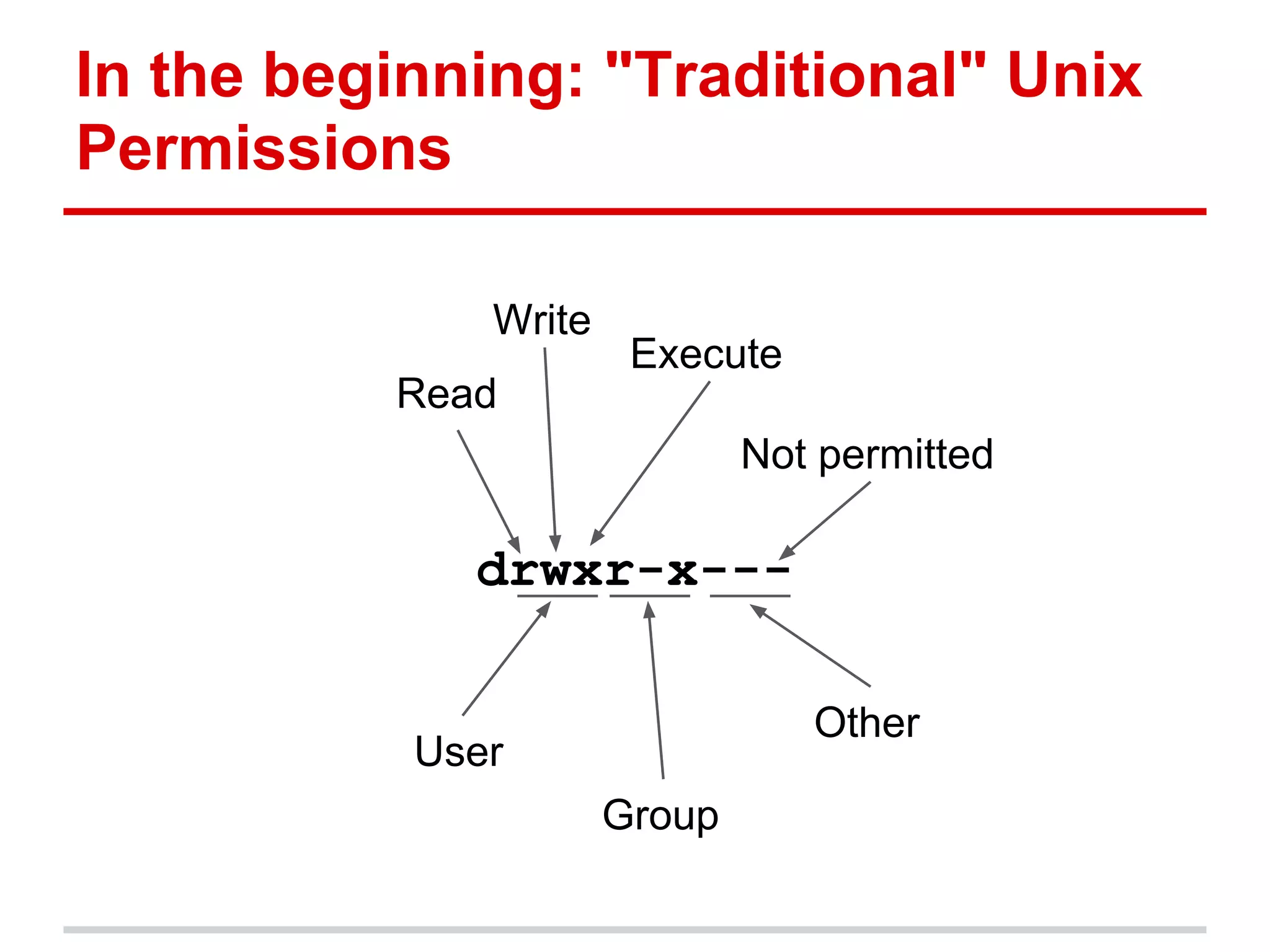
In the beginning: "Traditional" Unix
Permissions

              Write
                       Execute
          Read
                              Not permitted

             drwxr-x---

                                 Other
           User
                      Group
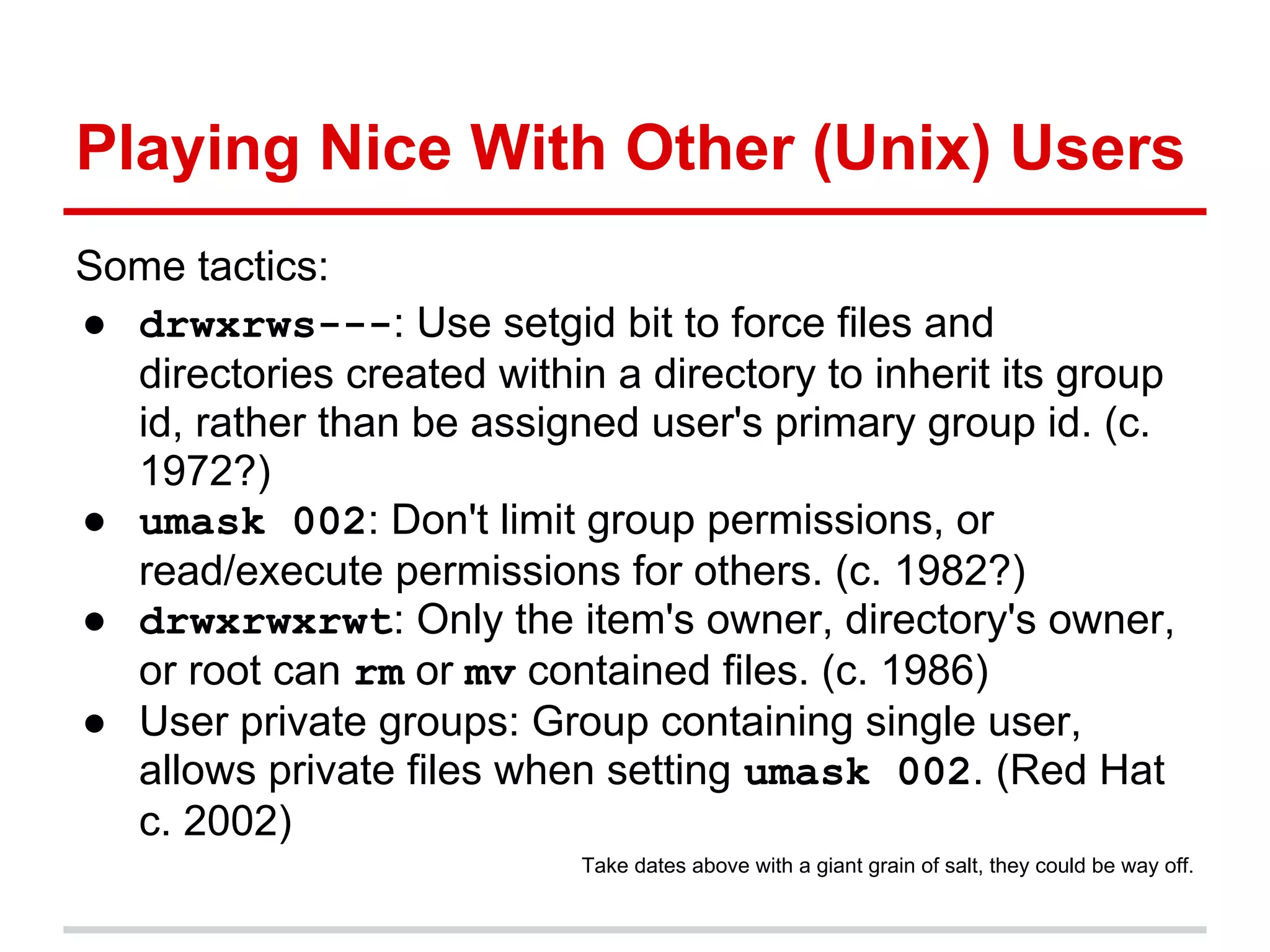
Playing Nice With Other (Unix) Users
Some tactics:
● drwxrws---: Use setgid bit to force files and
  directories created within a directory to inherit its group
  id, rather than be assigned user's primary group id. (c.
  1972?)
● umask 002: Don't limit group permissions, or
  read/execute permissions for others. (c. 1982?)
● drwxrwxrwt: Only the item's owner, directory's owner,
  or root can rm or mv contained files. (c. 1986)
● User private groups: Group containing single user,
  allows private files when setting umask 002. (Red Hat
  c. 2002)
                            Take dates above with a giant grain of salt, they could be way off.
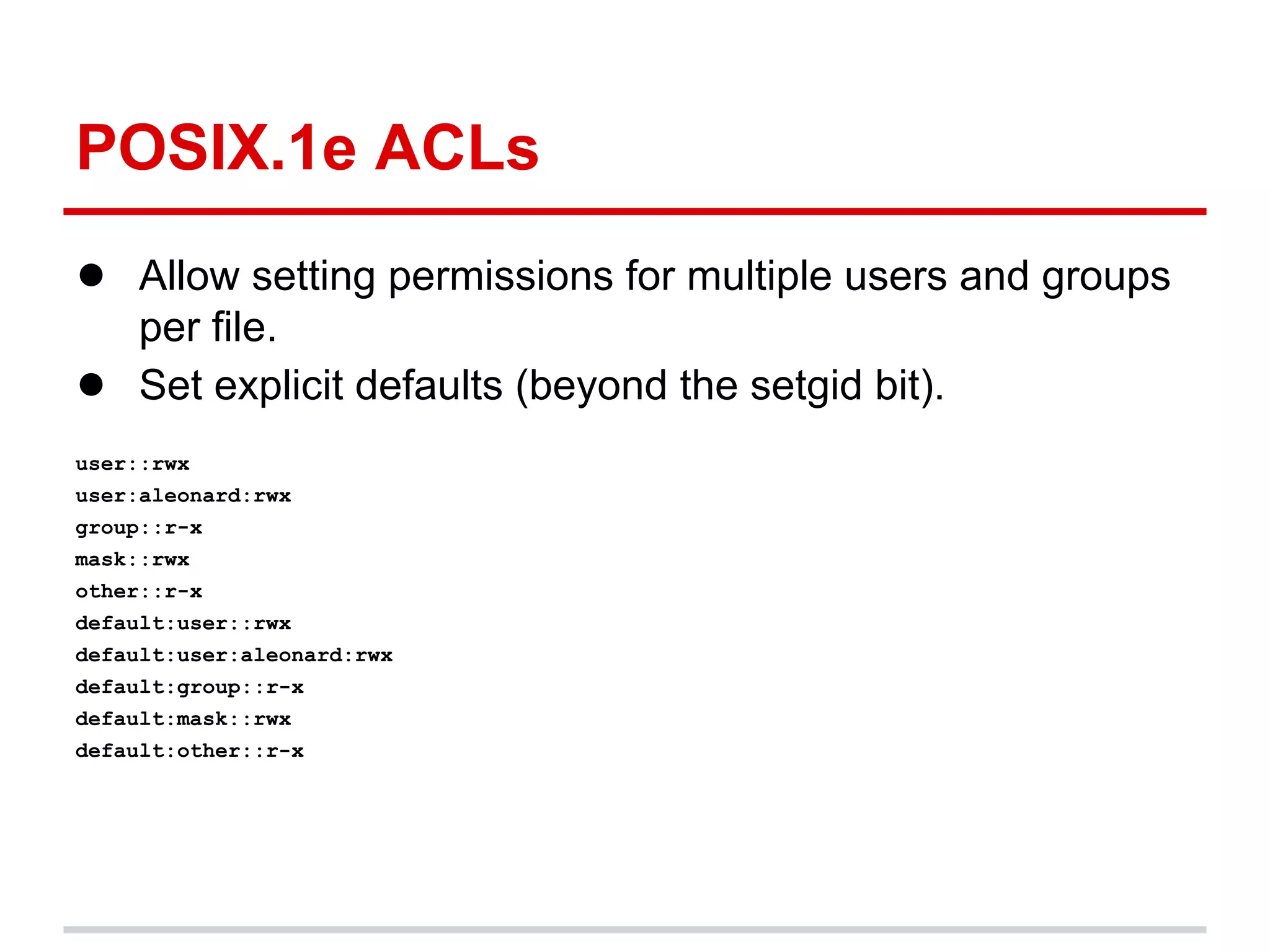
POSIX.1e ACLs
● Allow setting permissions for multiple users and groups
     per file.
●    Set explicit defaults (beyond the setgid bit).
user::rwx
user:aleonard:rwx
group::r-x
mask::rwx
other::r-x
default:user::rwx
default:user:aleonard:rwx
default:group::r-x
default:mask::rwx
default:other::r-x
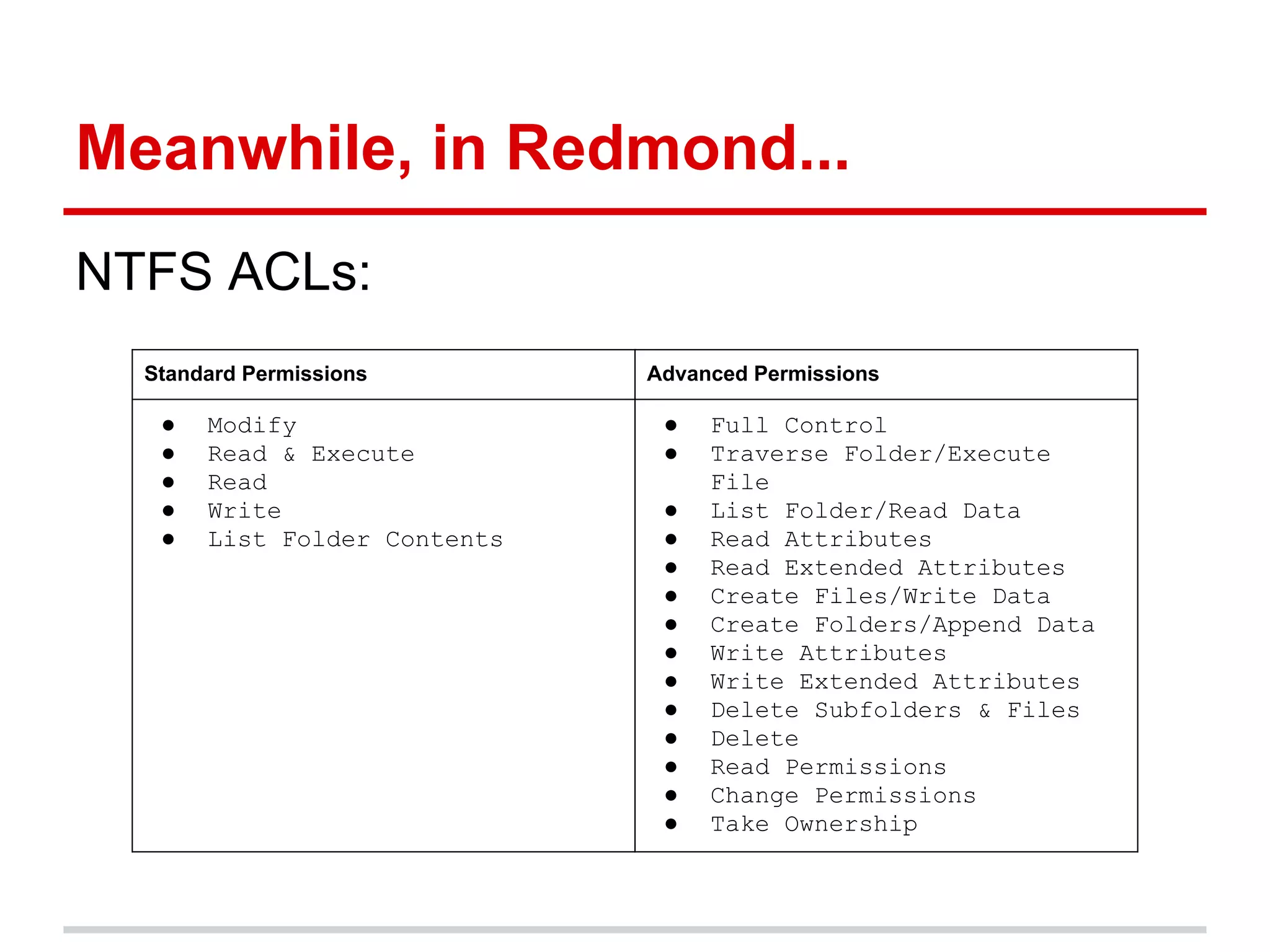
Meanwhile, in Redmond...
NTFS ACLs:
  Standard Permissions        Advanced Permissions

   ●   Modify                  ●   Full Control
   ●   Read & Execute          ●   Traverse Folder/Execute
   ●   Read                        File
   ●   Write                   ●   List Folder/Read Data
   ●   List Folder Contents    ●   Read Attributes
                               ●   Read Extended Attributes
                               ●   Create Files/Write Data
                               ●   Create Folders/Append Data
                               ●   Write Attributes
                               ●   Write Extended Attributes
                               ●   Delete Subfolders & Files
                               ●   Delete
                               ●   Read Permissions
                               ●   Change Permissions
                               ●   Take Ownership
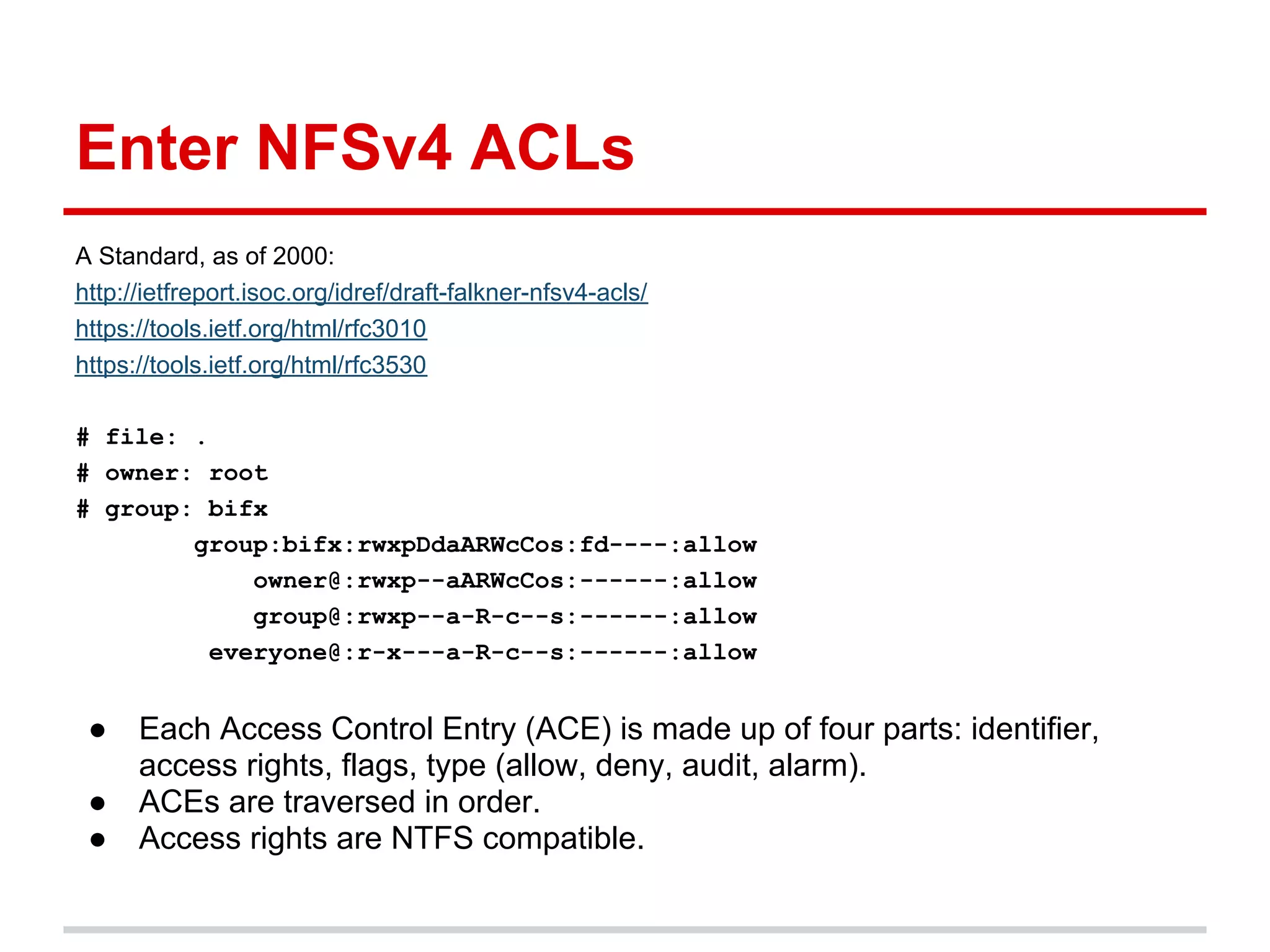
Enter NFSv4 ACLs
A Standard, as of 2000:
http://ietfreport.isoc.org/idref/draft-falkner-nfsv4-acls/
https://tools.ietf.org/html/rfc3010
https://tools.ietf.org/html/rfc3530

# file: .
# owner: root
# group: bifx
        group:bifx:rwxpDdaARWcCos:fd----:allow
             owner@:rwxp--aARWcCos:------:allow
             group@:rwxp--a-R-c--s:------:allow
          everyone@:r-x---a-R-c--s:------:allow


 ●    Each Access Control Entry (ACE) is made up of four parts: identifier,
      access rights, flags, type (allow, deny, audit, alarm).
 ●    ACEs are traversed in order.
 ●    Access rights are NTFS compatible.
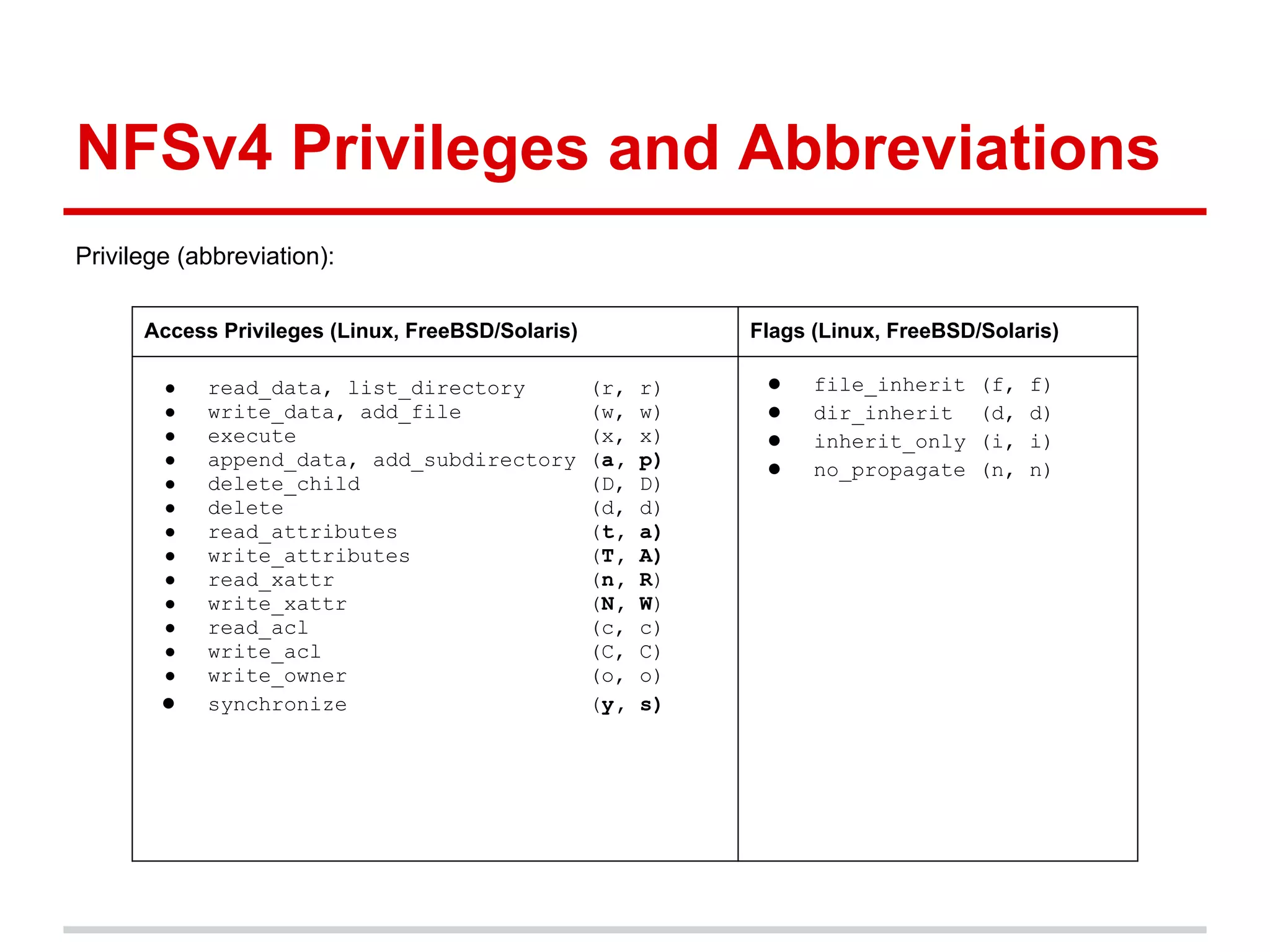
NFSv4 Privileges and Abbreviations
Privilege (abbreviation):

      Access Privileges (Linux, FreeBSD/Solaris)              Flags (Linux, FreeBSD/Solaris)

        ●   read_data, list_directory              (r,   r)    ●    file_inherit    (f,   f)
        ●   write_data, add_file                   (w,   w)    ●    dir_inherit     (d,   d)
        ●   execute                                (x,   x)    ●    inherit_only    (i,   i)
        ●   append_data, add_subdirectory          (a,   p)    ●    no_propagate    (n,   n)
        ●   delete_child                           (D,   D)
        ●   delete                                 (d,   d)
        ●   read_attributes                        (t,   a)
        ●   write_attributes                       (T,   A)
        ●   read_xattr                             (n,   R)
        ●   write_xattr                            (N,   W)
        ●   read_acl                               (c,   c)
        ●   write_acl                              (C,   C)
        ●   write_owner                            (o,   o)
        ●   synchronize                            (y,   s)
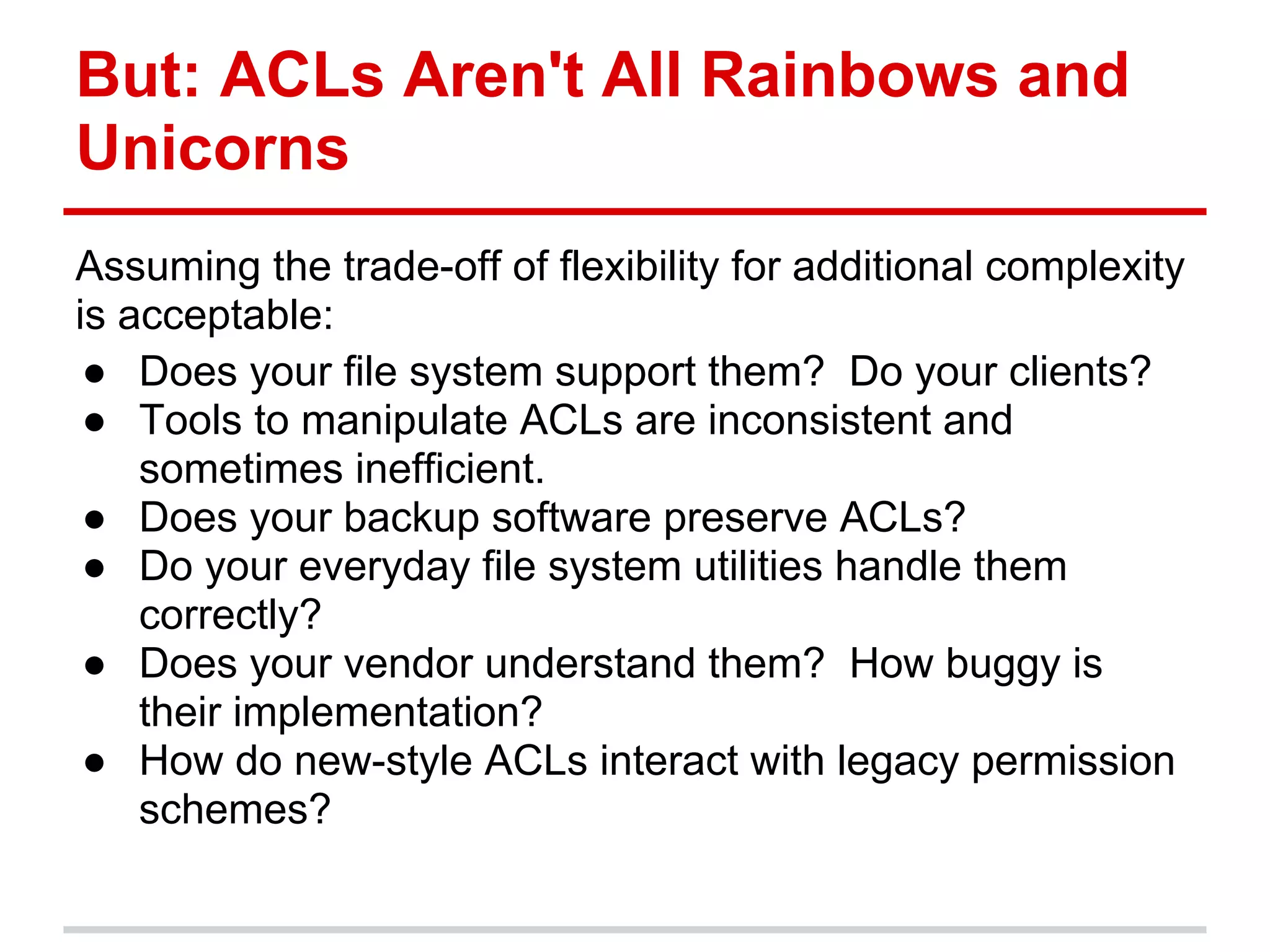
But: ACLs Aren't All Rainbows and
Unicorns
Assuming the trade-off of flexibility for additional complexity
is acceptable:
 ● Does your file system support them? Do your clients?
 ● Tools to manipulate ACLs are inconsistent and
    sometimes inefficient.
 ● Does your backup software preserve ACLs?
 ● Do your everyday file system utilities handle them
    correctly?
 ● Does your vendor understand them? How buggy is
    their implementation?
 ● How do new-style ACLs interact with legacy permission
    schemes?
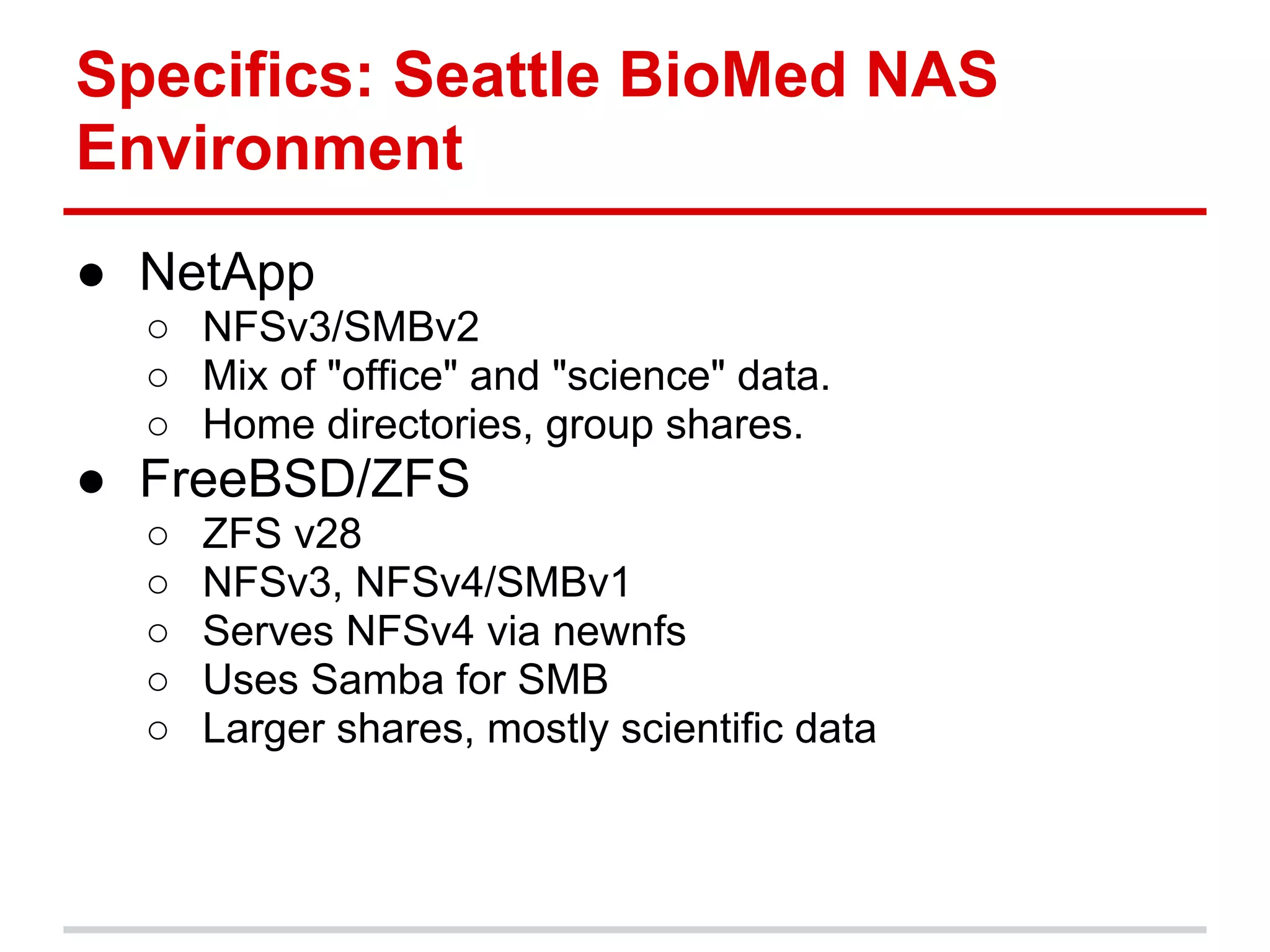
Specifics: Seattle BioMed NAS
Environment
● NetApp
  ○ NFSv3/SMBv2
  ○ Mix of "office" and "science" data.
  ○ Home directories, group shares.
● FreeBSD/ZFS
  ○   ZFS v28
  ○   NFSv3, NFSv4/SMBv1
  ○   Serves NFSv4 via newnfs
  ○   Uses Samba for SMB
  ○   Larger shares, mostly scientific data
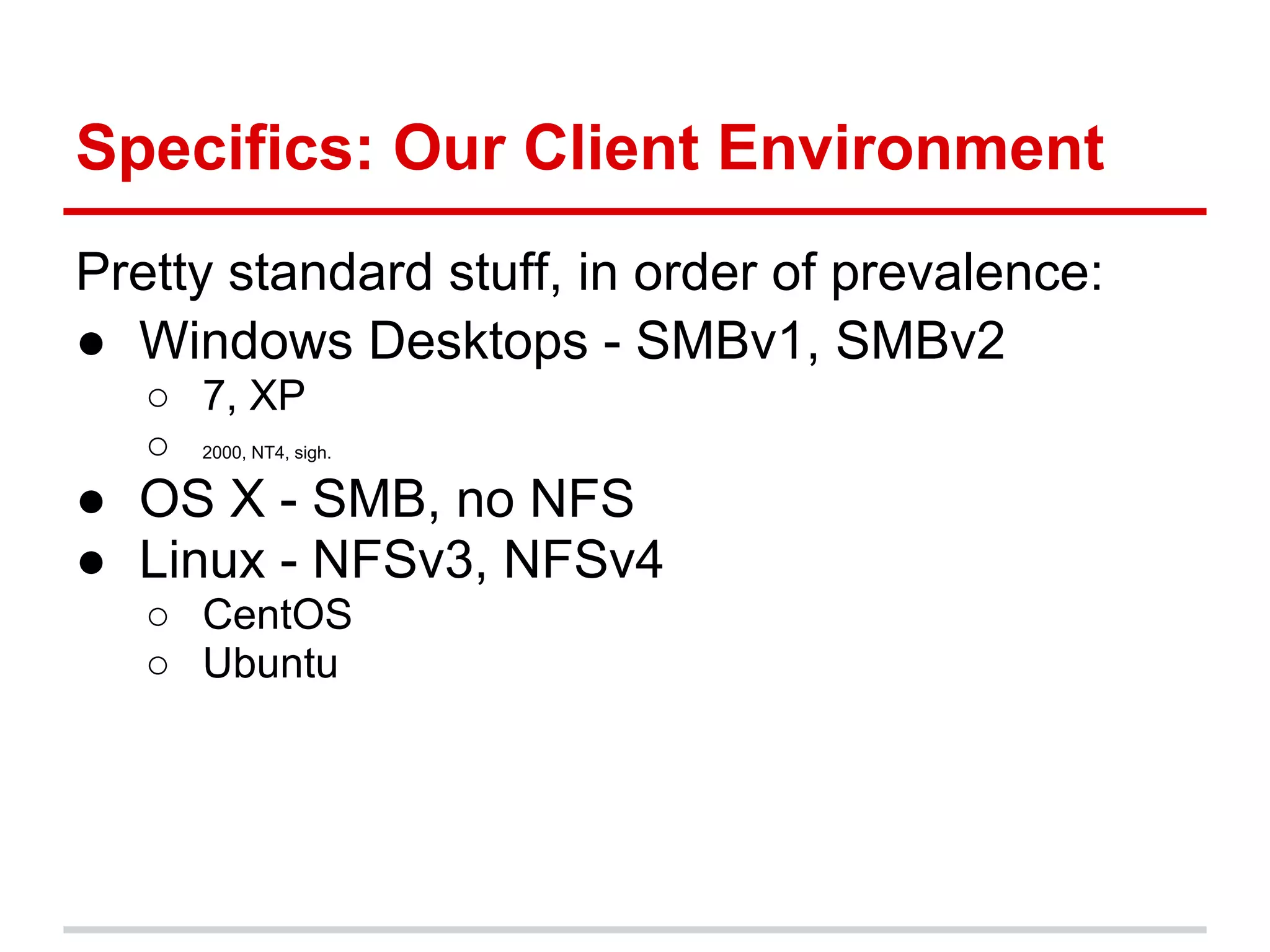
Specifics: Our Client Environment
Pretty standard stuff, in order of prevalence:
● Windows Desktops - SMBv1, SMBv2
   ○ 7, XP
   ○ 2000, NT4, sigh.
● OS X - SMB, no NFS
● Linux - NFSv3, NFSv4
   ○ CentOS
   ○ Ubuntu
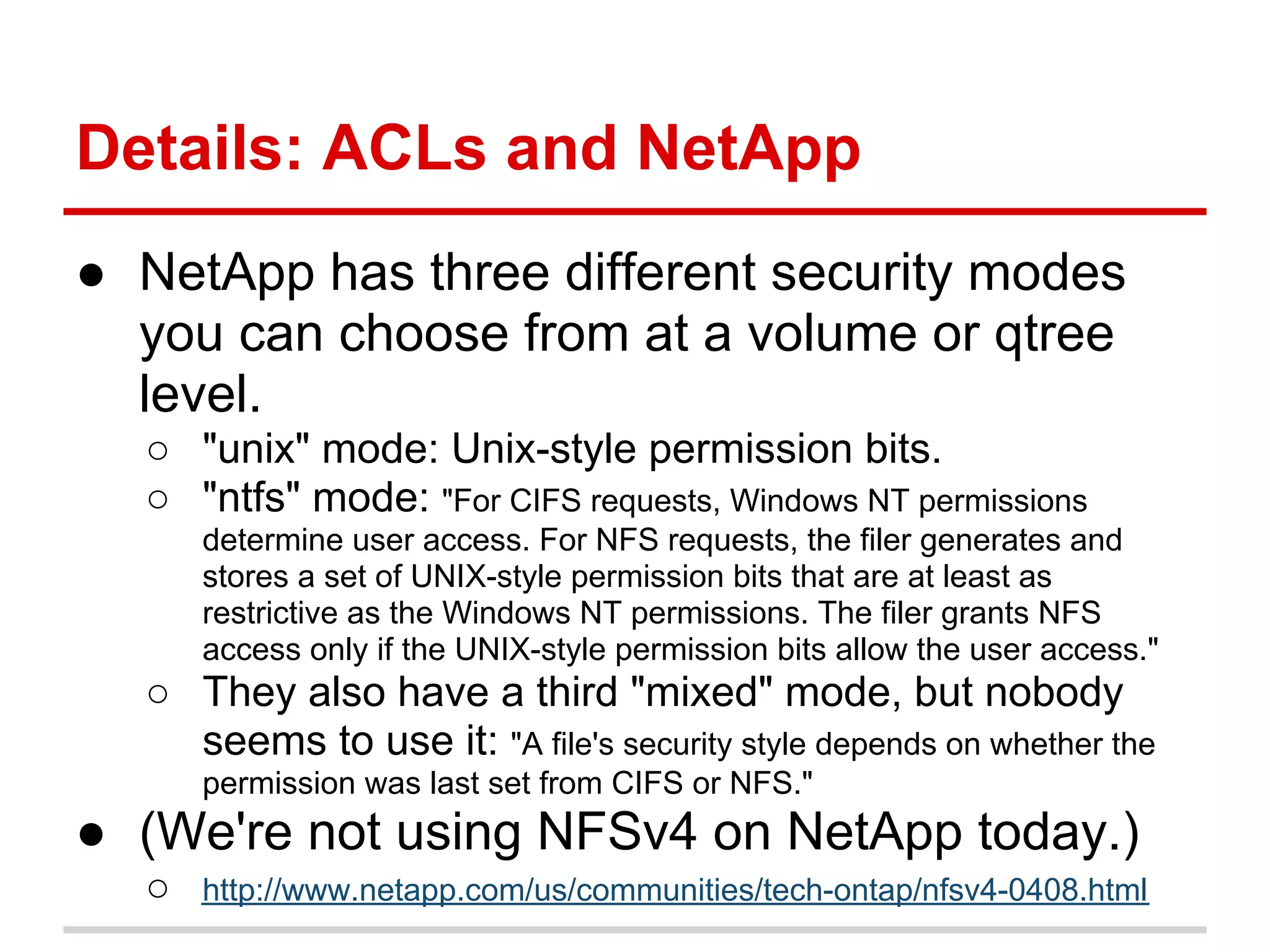
Details: ACLs and NetApp
● NetApp has three different security modes
  you can choose from at a volume or qtree
  level.
  ○ "unix" mode: Unix-style permission bits.
  ○ "ntfs" mode: "For CIFS requests, Windows NT permissions
      determine user access. For NFS requests, the filer generates and
      stores a set of UNIX-style permission bits that are at least as
      restrictive as the Windows NT permissions. The filer grants NFS
      access only if the UNIX-style permission bits allow the user access."
  ○ They also have a third "mixed" mode, but nobody
    seems to use it: "A file's security style depends on whether the
      permission was last set from CIFS or NFS."
● (We're not using NFSv4 on NetApp today.)
  ○   http://www.netapp.com/us/communities/tech-ontap/nfsv4-0408.html
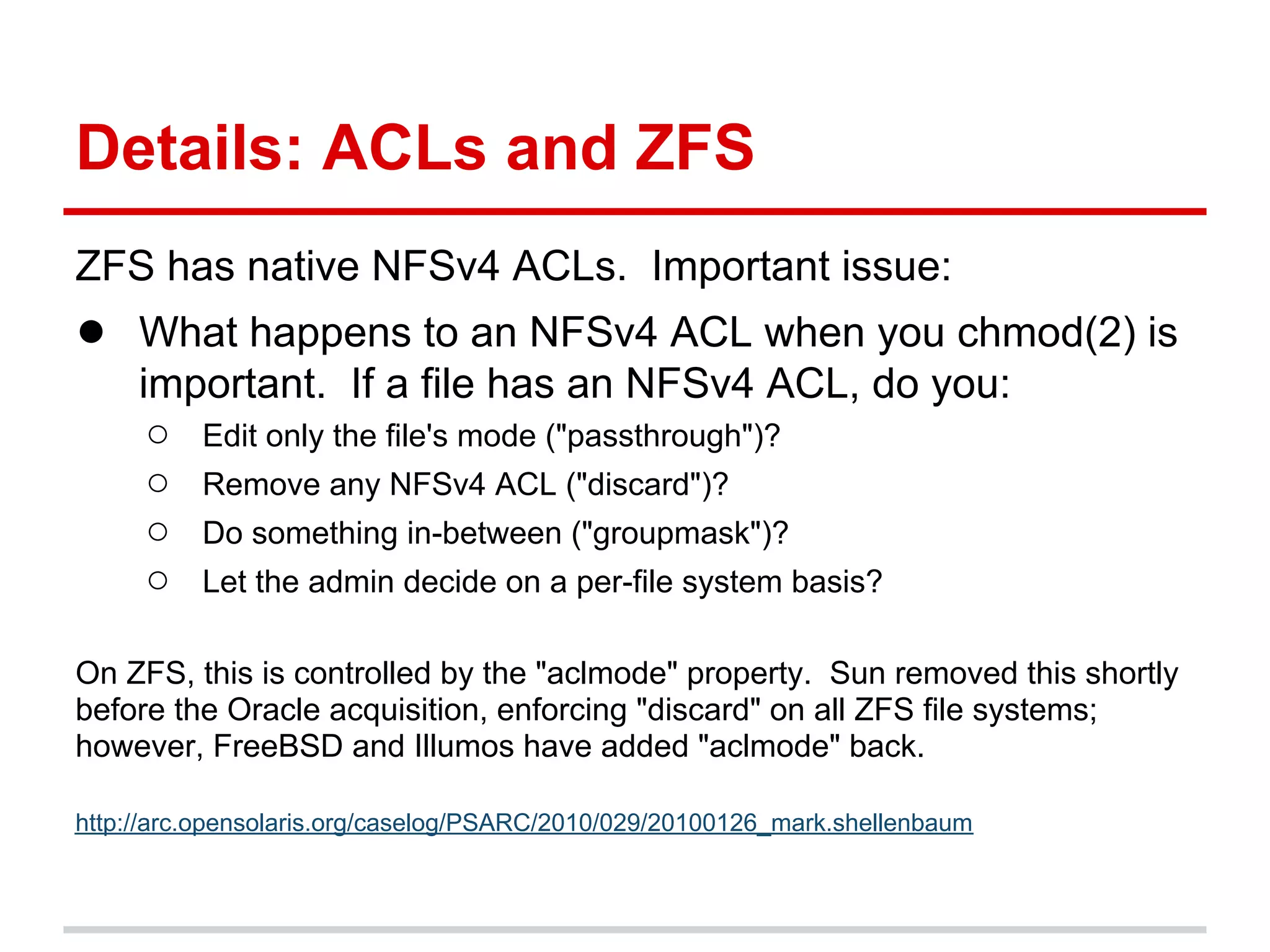
Details: ACLs and ZFS
ZFS has native NFSv4 ACLs. Important issue:
● What happens to an NFSv4 ACL when you chmod(2) is
     important. If a file has an NFSv4 ACL, do you:
      ○ Edit only the file's mode ("passthrough")?
      ○ Remove any NFSv4 ACL ("discard")?
      ○ Do something in-between ("groupmask")?
      ○ Let the admin decide on a per-file system basis?

On ZFS, this is controlled by the "aclmode" property. Sun removed this shortly
before the Oracle acquisition, enforcing "discard" on all ZFS file systems;
however, FreeBSD and Illumos have added "aclmode" back.

http://arc.opensolaris.org/caselog/PSARC/2010/029/20100126_mark.shellenbaum
Usage notes: User mapping matters
You can't share files across platforms if you
can't map identities across platforms.
We use Active Directory as our source of truth
for users and groups; NetApp and FreeBSD
systems access this information using LDAP.
Usage notes: General notes
● Simple permissions solve most of our use
  cases
  ○ User home directories are on NetApp, using unix-
    mode, 0700 permissions.
  ○ Ntfs-mode qtrees work well for most groups.
  ○ Many of our complex permission structures are
    SMB-only and therefore use ntfs-mode.
  ○ For those that need them, unix-mode qtrees are
    often enough.
● For everything else, there's NFSv4 ACLs on
  ZFS.
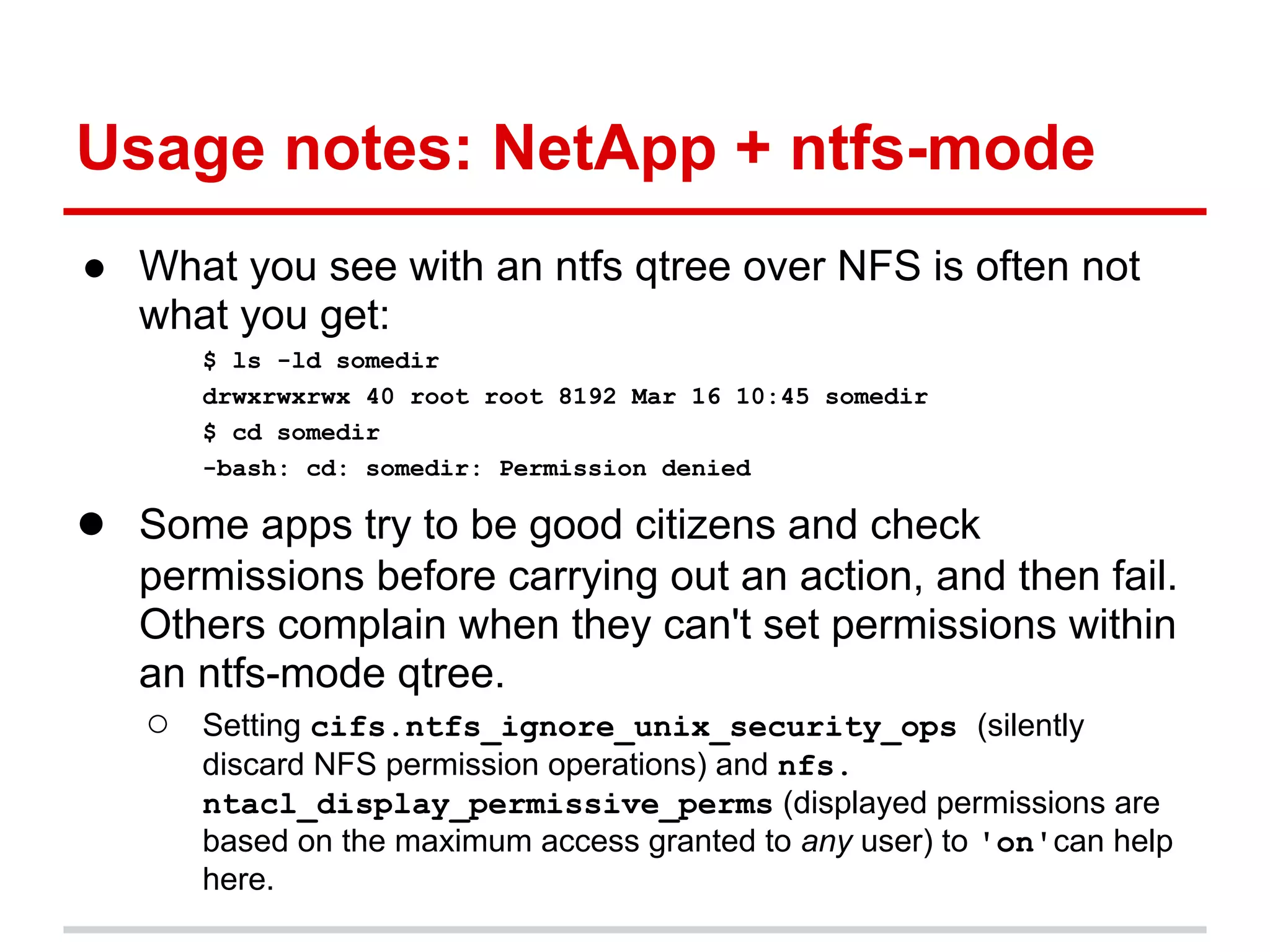
Usage notes: NetApp + ntfs-mode
● What you see with an ntfs qtree over NFS is often not
  what you get:
      $ ls -ld somedir
      drwxrwxrwx 40 root root 8192 Mar 16 10:45 somedir
      $ cd somedir
      -bash: cd: somedir: Permission denied

● Some apps try to be good citizens and check
   permissions before carrying out an action, and then fail.
   Others complain when they can't set permissions within
   an ntfs-mode qtree.
   ○ Setting cifs.ntfs_ignore_unix_security_ops (silently
      discard NFS permission operations) and nfs.
      ntacl_display_permissive_perms (displayed permissions are
      based on the maximum access granted to any user) to 'on'can help
      here.
Usage notes: NetApp + unix-mode
For simple configurations, these cifs shares
flags may get you what you need:

Make created files belong to a group:
-forcegroup <groupname>

Set initial permissions of newly created files and directories:
-umask <mask>
-dir_umask <mask>
-file_umask <mask>
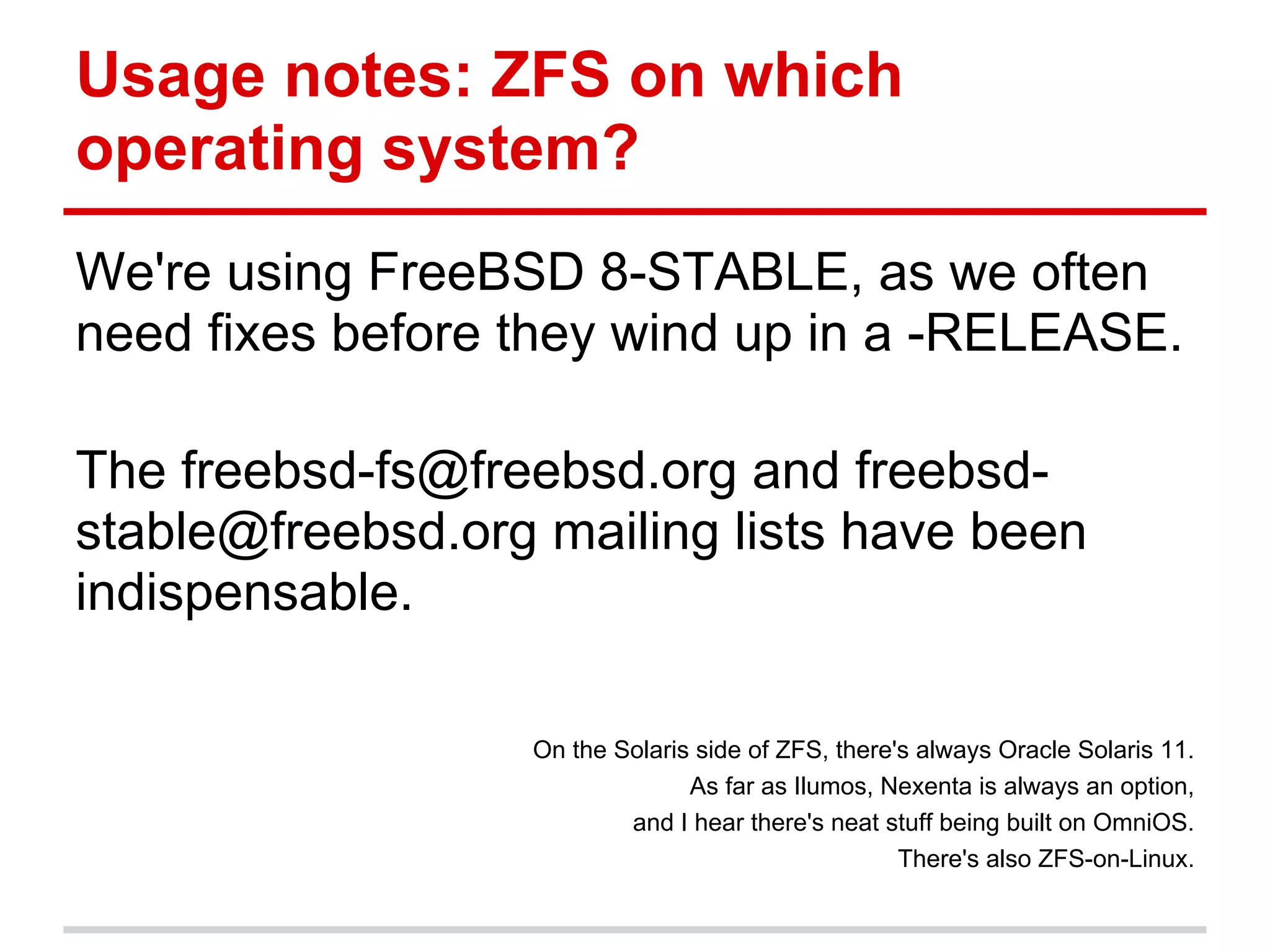
Usage notes: ZFS on which
operating system?
We're using FreeBSD 8-STABLE, as we often
need fixes before they wind up in a -RELEASE.

The freebsd-fs@freebsd.org and freebsd-
stable@freebsd.org mailing lists have been
indispensable.

                  On the Solaris side of ZFS, there's always Oracle Solaris 11.
                                As far as Ilumos, Nexenta is always an option,
                          and I hear there's neat stuff being built on OmniOS.
                                                    There's also ZFS-on-Linux.
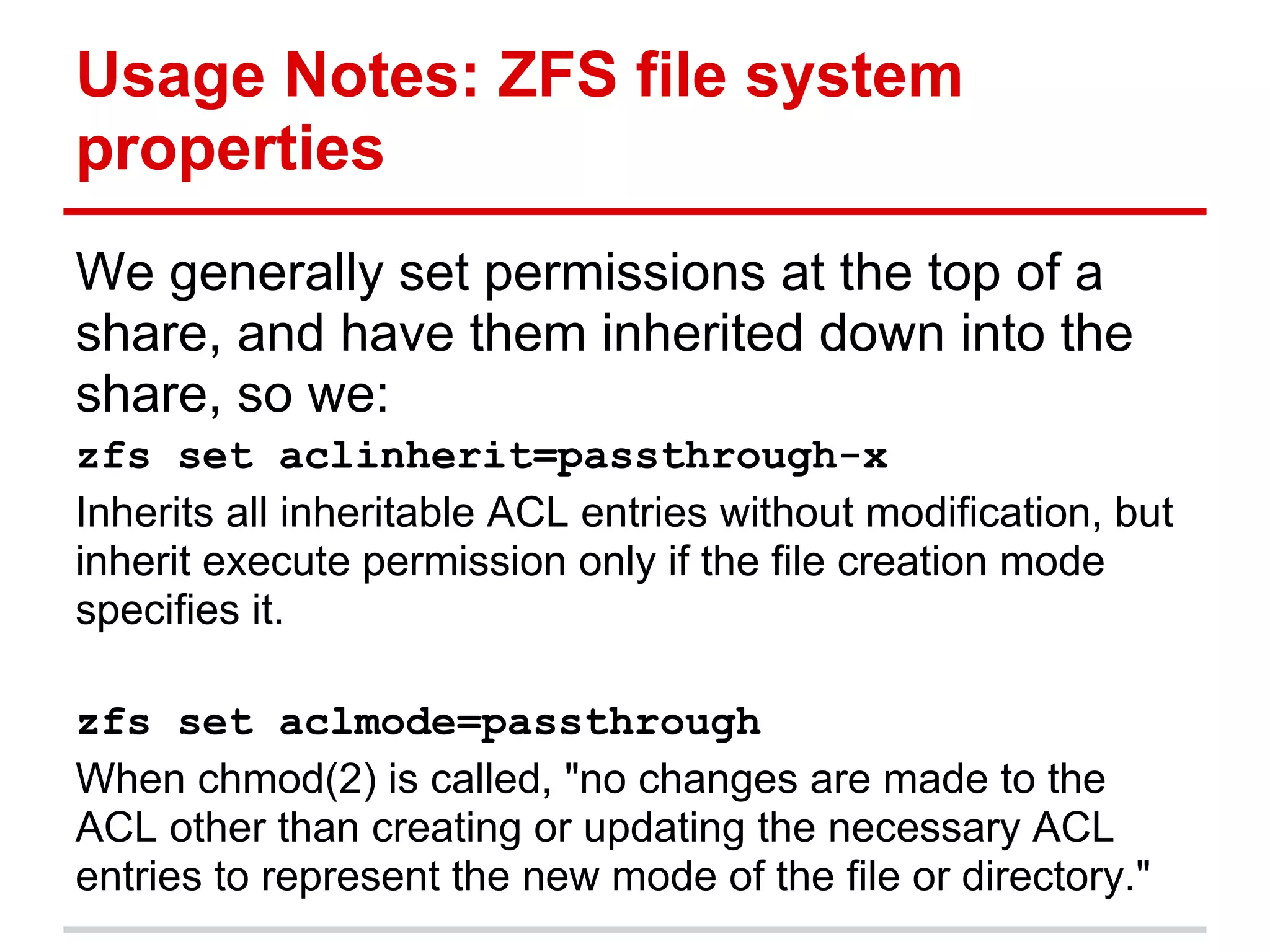
Usage Notes: ZFS file system
properties
We generally set permissions at the top of a
share, and have them inherited down into the
share, so we:
zfs set aclinherit=passthrough-x
Inherits all inheritable ACL entries without modification, but
inherit execute permission only if the file creation mode
specifies it.

zfs set aclmode=passthrough
When chmod(2) is called, "no changes are made to the
ACL other than creating or updating the necessary ACL
entries to represent the new mode of the file or directory."
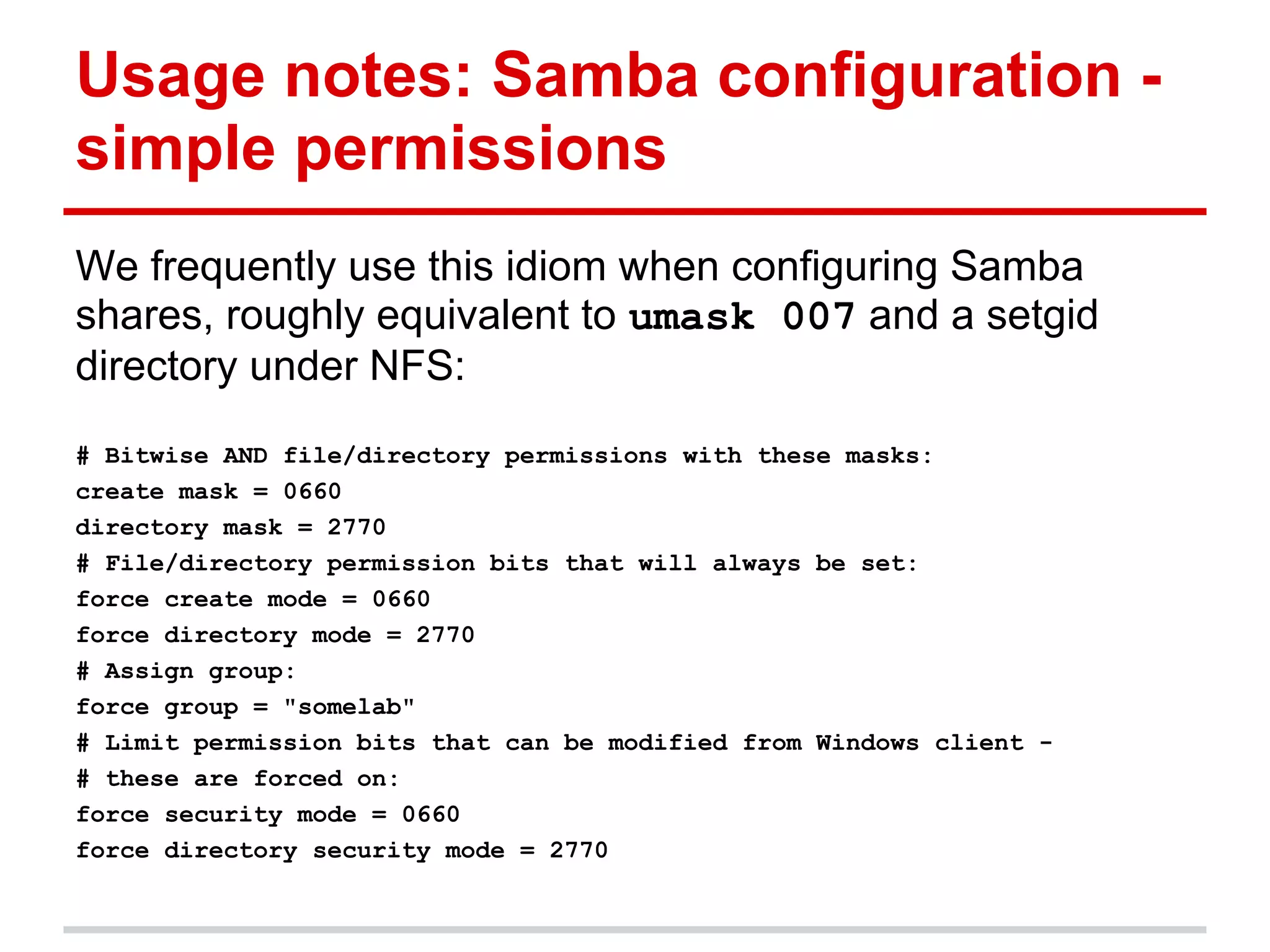
Usage notes: Samba configuration -
simple permissions
We frequently use this idiom when configuring Samba
shares, roughly equivalent to umask 007 and a setgid
directory under NFS:
# Bitwise AND file/directory permissions with these masks:
create mask = 0660
directory mask = 2770
# File/directory permission bits that will always be set:
force create mode = 0660
force directory mode = 2770
# Assign group:
force group = "somelab"
# Limit permission bits that can be modified from Windows client -
# these are forced on:
force security mode = 0660
force directory security mode = 2770
Usage notes: Samba configuration -
complex ACLs
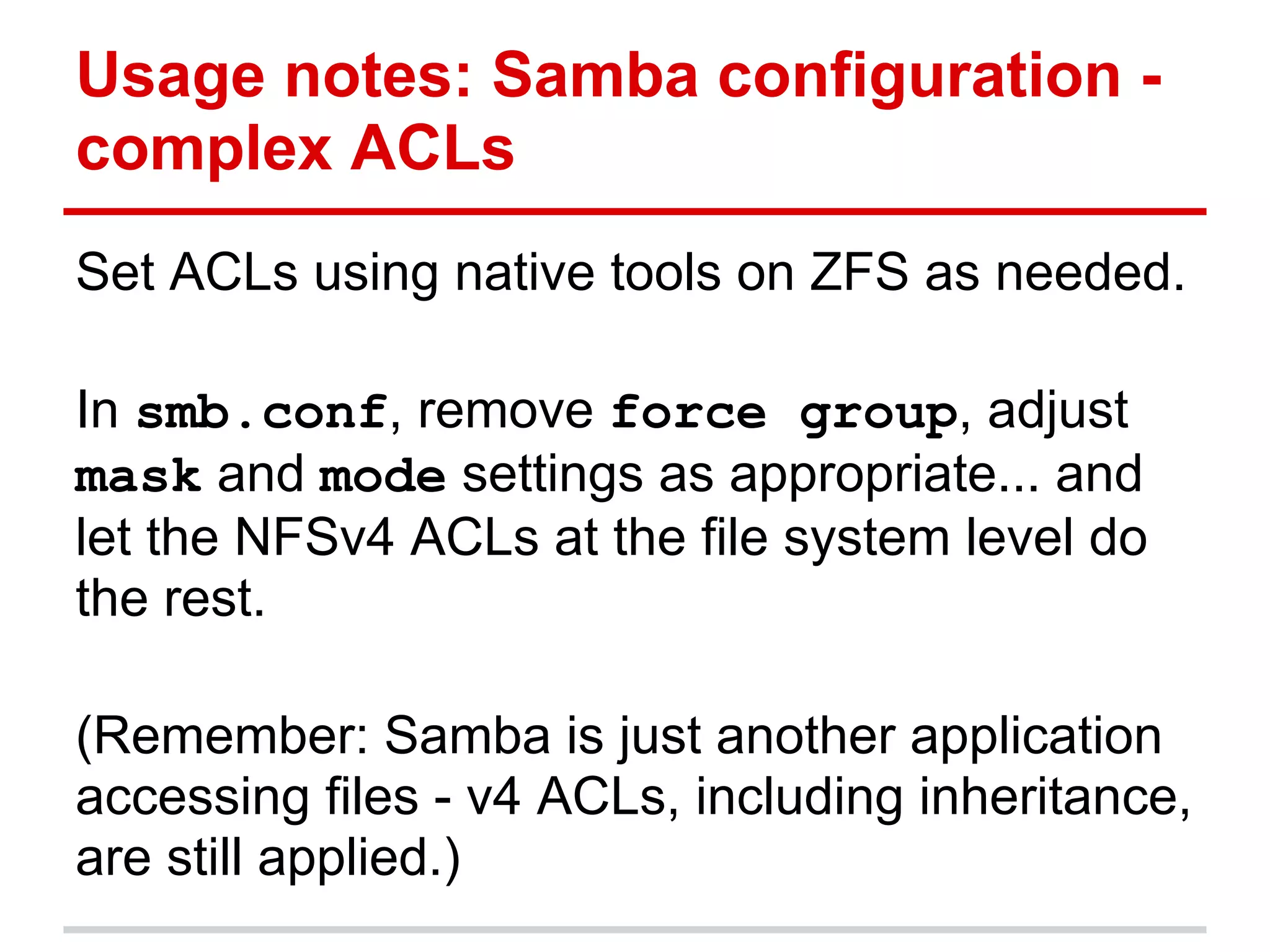
Set ACLs using native tools on ZFS as needed.

In smb.conf, remove force group, adjust
mask and mode settings as appropriate... and
let the NFSv4 ACLs at the file system level do
the rest.

(Remember: Samba is just another application
accessing files - v4 ACLs, including inheritance,
are still applied.)
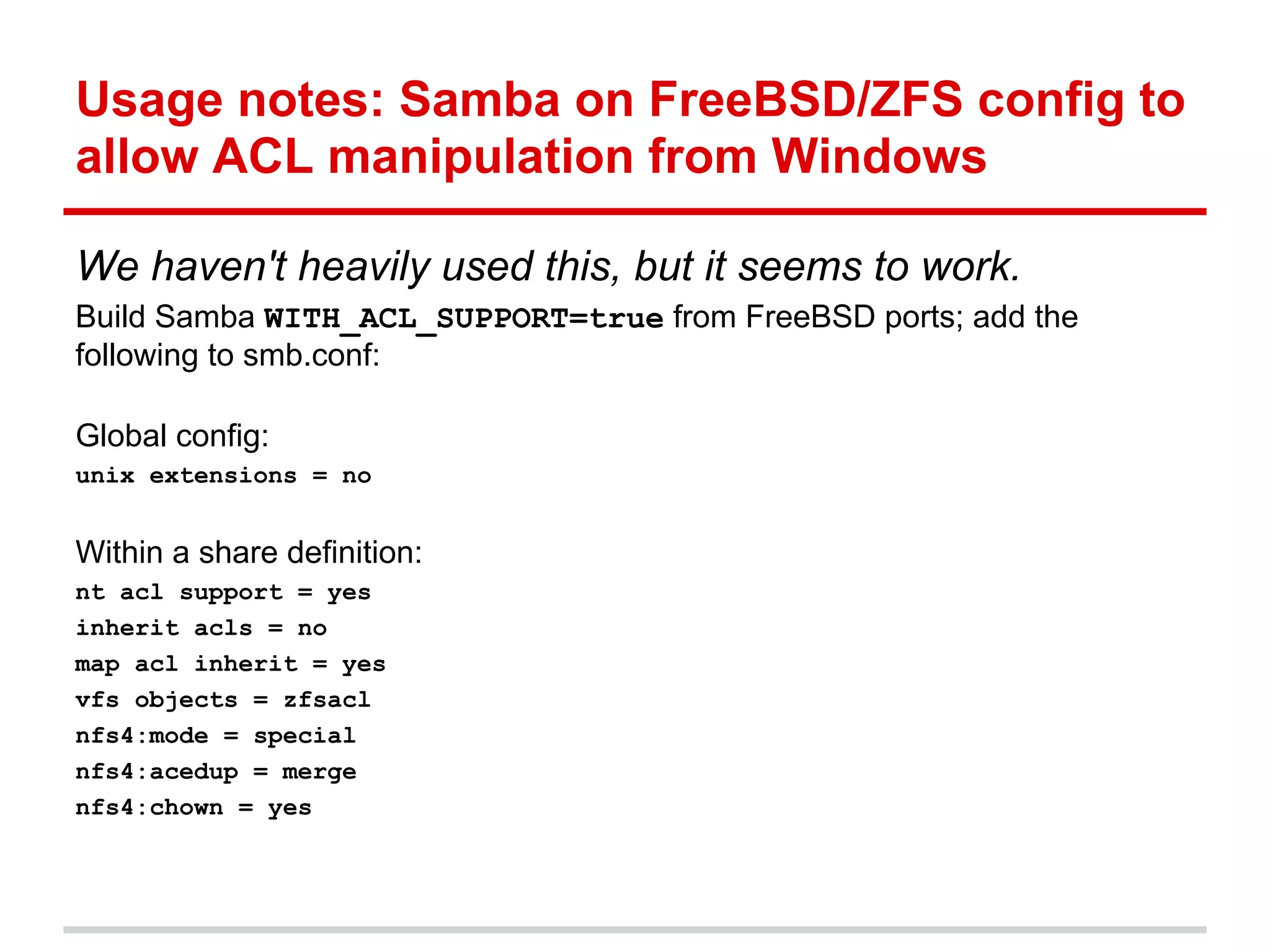
Usage notes: Samba on FreeBSD/ZFS config to
allow ACL manipulation from Windows

We haven't heavily used this, but it seems to work.
Build Samba WITH_ACL_SUPPORT=true from FreeBSD ports; add the
following to smb.conf:

Global config:
unix extensions = no


Within a share definition:
nt acl support = yes
inherit acls = no
map acl inherit = yes
vfs objects = zfsacl
nfs4:mode = special
nfs4:acedup = merge
nfs4:chown = yes
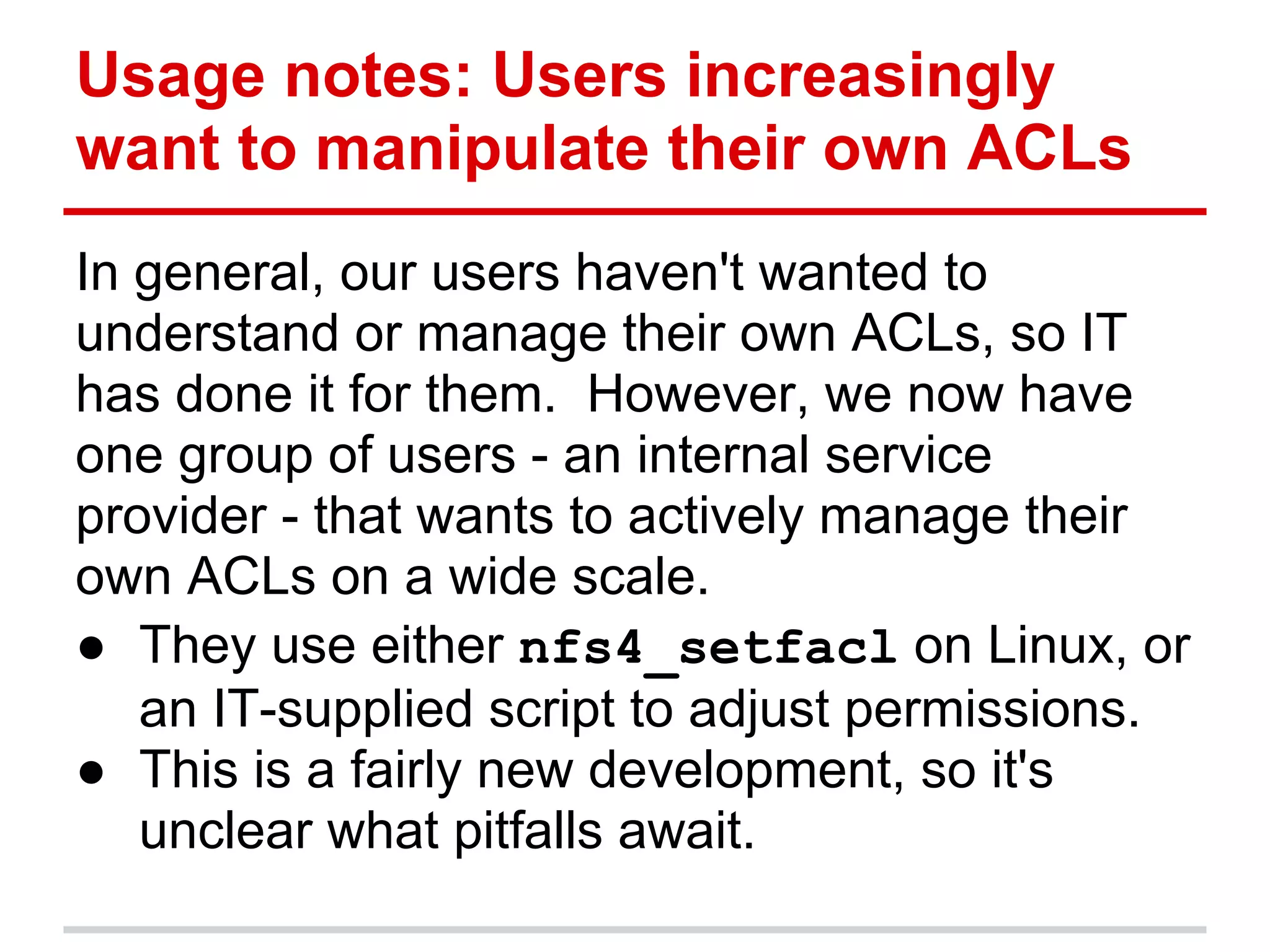
Usage notes: Users increasingly
want to manipulate their own ACLs
In general, our users haven't wanted to
understand or manage their own ACLs, so IT
has done it for them. However, we now have
one group of users - an internal service
provider - that wants to actively manage their
own ACLs on a wide scale.
● They use either nfs4_setfacl on Linux, or
   an IT-supplied script to adjust permissions.
● This is a fairly new development, so it's
   unclear what pitfalls await.
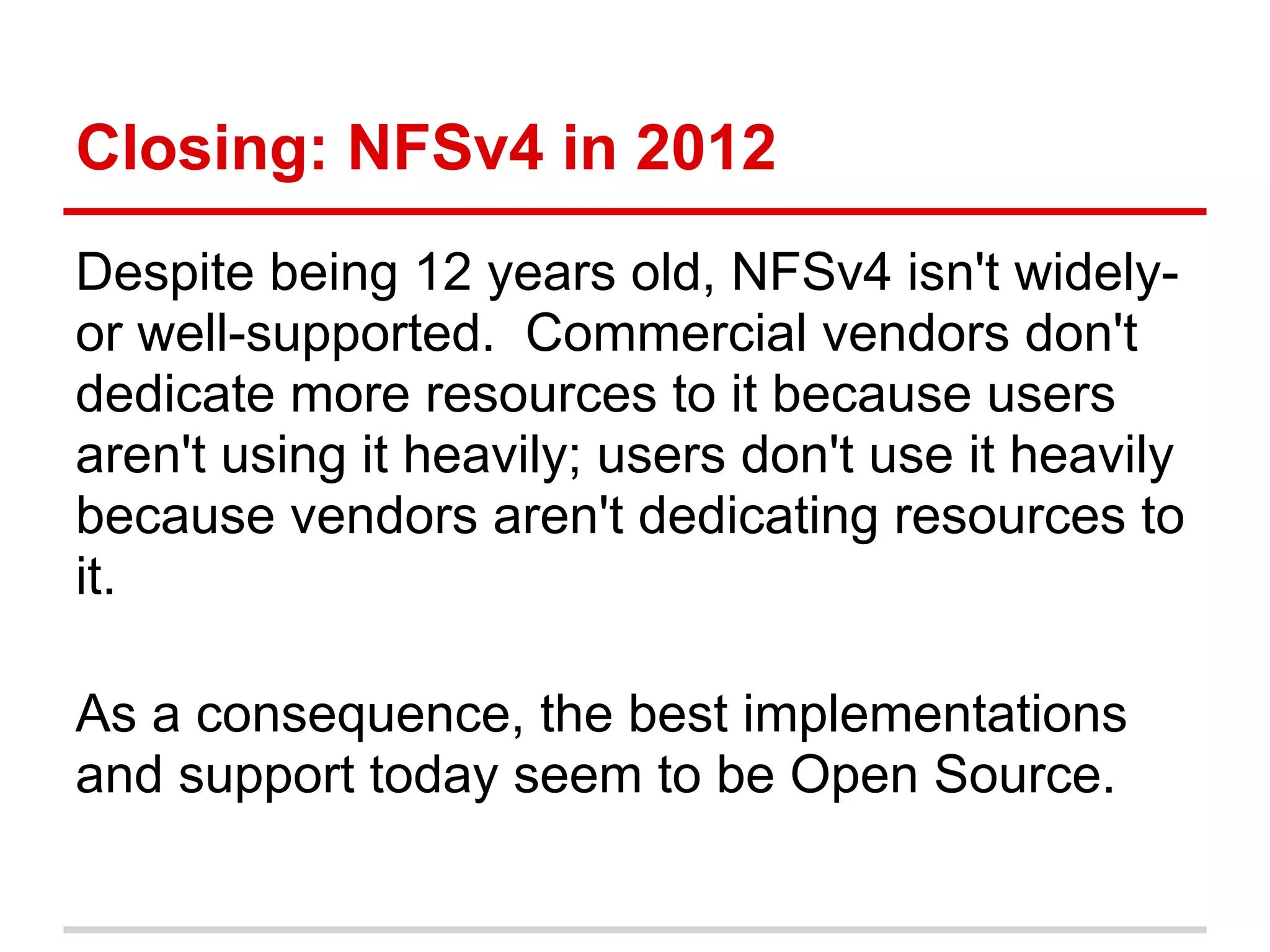
Closing: NFSv4 in 2012
Despite being 12 years old, NFSv4 isn't widely-
or well-supported. Commercial vendors don't
dedicate more resources to it because users
aren't using it heavily; users don't use it heavily
because vendors aren't dedicating resources to
it.

As a consequence, the best implementations
and support today seem to be Open Source.

When ACLs Attack

  • 1.
    When ACLs Attack: Cross-PlatformFile Permissions Andrew Leonard ISB IT Exchange July 13, 2012
  • 2.
    In the beginning:"Traditional" Unix Permissions Write Execute Read Not permitted drwxr-x--- Other User Group
  • 3.
    Playing Nice WithOther (Unix) Users Some tactics: ● drwxrws---: Use setgid bit to force files and directories created within a directory to inherit its group id, rather than be assigned user's primary group id. (c. 1972?) ● umask 002: Don't limit group permissions, or read/execute permissions for others. (c. 1982?) ● drwxrwxrwt: Only the item's owner, directory's owner, or root can rm or mv contained files. (c. 1986) ● User private groups: Group containing single user, allows private files when setting umask 002. (Red Hat c. 2002) Take dates above with a giant grain of salt, they could be way off.
  • 4.
    POSIX.1e ACLs ● Allowsetting permissions for multiple users and groups per file. ● Set explicit defaults (beyond the setgid bit). user::rwx user:aleonard:rwx group::r-x mask::rwx other::r-x default:user::rwx default:user:aleonard:rwx default:group::r-x default:mask::rwx default:other::r-x
  • 5.
    Meanwhile, in Redmond... NTFSACLs: Standard Permissions Advanced Permissions ● Modify ● Full Control ● Read & Execute ● Traverse Folder/Execute ● Read File ● Write ● List Folder/Read Data ● List Folder Contents ● Read Attributes ● Read Extended Attributes ● Create Files/Write Data ● Create Folders/Append Data ● Write Attributes ● Write Extended Attributes ● Delete Subfolders & Files ● Delete ● Read Permissions ● Change Permissions ● Take Ownership
  • 6.
    Enter NFSv4 ACLs AStandard, as of 2000: http://ietfreport.isoc.org/idref/draft-falkner-nfsv4-acls/ https://tools.ietf.org/html/rfc3010 https://tools.ietf.org/html/rfc3530 # file: . # owner: root # group: bifx group:bifx:rwxpDdaARWcCos:fd----:allow owner@:rwxp--aARWcCos:------:allow group@:rwxp--a-R-c--s:------:allow everyone@:r-x---a-R-c--s:------:allow ● Each Access Control Entry (ACE) is made up of four parts: identifier, access rights, flags, type (allow, deny, audit, alarm). ● ACEs are traversed in order. ● Access rights are NTFS compatible.
  • 7.
    NFSv4 Privileges andAbbreviations Privilege (abbreviation): Access Privileges (Linux, FreeBSD/Solaris) Flags (Linux, FreeBSD/Solaris) ● read_data, list_directory (r, r) ● file_inherit (f, f) ● write_data, add_file (w, w) ● dir_inherit (d, d) ● execute (x, x) ● inherit_only (i, i) ● append_data, add_subdirectory (a, p) ● no_propagate (n, n) ● delete_child (D, D) ● delete (d, d) ● read_attributes (t, a) ● write_attributes (T, A) ● read_xattr (n, R) ● write_xattr (N, W) ● read_acl (c, c) ● write_acl (C, C) ● write_owner (o, o) ● synchronize (y, s)
  • 8.
    But: ACLs Aren'tAll Rainbows and Unicorns Assuming the trade-off of flexibility for additional complexity is acceptable: ● Does your file system support them? Do your clients? ● Tools to manipulate ACLs are inconsistent and sometimes inefficient. ● Does your backup software preserve ACLs? ● Do your everyday file system utilities handle them correctly? ● Does your vendor understand them? How buggy is their implementation? ● How do new-style ACLs interact with legacy permission schemes?
  • 9.
    Specifics: Seattle BioMedNAS Environment ● NetApp ○ NFSv3/SMBv2 ○ Mix of "office" and "science" data. ○ Home directories, group shares. ● FreeBSD/ZFS ○ ZFS v28 ○ NFSv3, NFSv4/SMBv1 ○ Serves NFSv4 via newnfs ○ Uses Samba for SMB ○ Larger shares, mostly scientific data
  • 10.
    Specifics: Our ClientEnvironment Pretty standard stuff, in order of prevalence: ● Windows Desktops - SMBv1, SMBv2 ○ 7, XP ○ 2000, NT4, sigh. ● OS X - SMB, no NFS ● Linux - NFSv3, NFSv4 ○ CentOS ○ Ubuntu
  • 11.
    Details: ACLs andNetApp ● NetApp has three different security modes you can choose from at a volume or qtree level. ○ "unix" mode: Unix-style permission bits. ○ "ntfs" mode: "For CIFS requests, Windows NT permissions determine user access. For NFS requests, the filer generates and stores a set of UNIX-style permission bits that are at least as restrictive as the Windows NT permissions. The filer grants NFS access only if the UNIX-style permission bits allow the user access." ○ They also have a third "mixed" mode, but nobody seems to use it: "A file's security style depends on whether the permission was last set from CIFS or NFS." ● (We're not using NFSv4 on NetApp today.) ○ http://www.netapp.com/us/communities/tech-ontap/nfsv4-0408.html
  • 12.
    Details: ACLs andZFS ZFS has native NFSv4 ACLs. Important issue: ● What happens to an NFSv4 ACL when you chmod(2) is important. If a file has an NFSv4 ACL, do you: ○ Edit only the file's mode ("passthrough")? ○ Remove any NFSv4 ACL ("discard")? ○ Do something in-between ("groupmask")? ○ Let the admin decide on a per-file system basis? On ZFS, this is controlled by the "aclmode" property. Sun removed this shortly before the Oracle acquisition, enforcing "discard" on all ZFS file systems; however, FreeBSD and Illumos have added "aclmode" back. http://arc.opensolaris.org/caselog/PSARC/2010/029/20100126_mark.shellenbaum
  • 13.
    Usage notes: Usermapping matters You can't share files across platforms if you can't map identities across platforms. We use Active Directory as our source of truth for users and groups; NetApp and FreeBSD systems access this information using LDAP.
  • 14.
    Usage notes: Generalnotes ● Simple permissions solve most of our use cases ○ User home directories are on NetApp, using unix- mode, 0700 permissions. ○ Ntfs-mode qtrees work well for most groups. ○ Many of our complex permission structures are SMB-only and therefore use ntfs-mode. ○ For those that need them, unix-mode qtrees are often enough. ● For everything else, there's NFSv4 ACLs on ZFS.
  • 15.
    Usage notes: NetApp+ ntfs-mode ● What you see with an ntfs qtree over NFS is often not what you get: $ ls -ld somedir drwxrwxrwx 40 root root 8192 Mar 16 10:45 somedir $ cd somedir -bash: cd: somedir: Permission denied ● Some apps try to be good citizens and check permissions before carrying out an action, and then fail. Others complain when they can't set permissions within an ntfs-mode qtree. ○ Setting cifs.ntfs_ignore_unix_security_ops (silently discard NFS permission operations) and nfs. ntacl_display_permissive_perms (displayed permissions are based on the maximum access granted to any user) to 'on'can help here.
  • 16.
    Usage notes: NetApp+ unix-mode For simple configurations, these cifs shares flags may get you what you need: Make created files belong to a group: -forcegroup <groupname> Set initial permissions of newly created files and directories: -umask <mask> -dir_umask <mask> -file_umask <mask>
  • 17.
    Usage notes: ZFSon which operating system? We're using FreeBSD 8-STABLE, as we often need fixes before they wind up in a -RELEASE. The freebsd-fs@freebsd.org and freebsd- stable@freebsd.org mailing lists have been indispensable. On the Solaris side of ZFS, there's always Oracle Solaris 11. As far as Ilumos, Nexenta is always an option, and I hear there's neat stuff being built on OmniOS. There's also ZFS-on-Linux.
  • 18.
    Usage Notes: ZFSfile system properties We generally set permissions at the top of a share, and have them inherited down into the share, so we: zfs set aclinherit=passthrough-x Inherits all inheritable ACL entries without modification, but inherit execute permission only if the file creation mode specifies it. zfs set aclmode=passthrough When chmod(2) is called, "no changes are made to the ACL other than creating or updating the necessary ACL entries to represent the new mode of the file or directory."
  • 19.
    Usage notes: Sambaconfiguration - simple permissions We frequently use this idiom when configuring Samba shares, roughly equivalent to umask 007 and a setgid directory under NFS: # Bitwise AND file/directory permissions with these masks: create mask = 0660 directory mask = 2770 # File/directory permission bits that will always be set: force create mode = 0660 force directory mode = 2770 # Assign group: force group = "somelab" # Limit permission bits that can be modified from Windows client - # these are forced on: force security mode = 0660 force directory security mode = 2770
  • 20.
    Usage notes: Sambaconfiguration - complex ACLs Set ACLs using native tools on ZFS as needed. In smb.conf, remove force group, adjust mask and mode settings as appropriate... and let the NFSv4 ACLs at the file system level do the rest. (Remember: Samba is just another application accessing files - v4 ACLs, including inheritance, are still applied.)
  • 21.
    Usage notes: Sambaon FreeBSD/ZFS config to allow ACL manipulation from Windows We haven't heavily used this, but it seems to work. Build Samba WITH_ACL_SUPPORT=true from FreeBSD ports; add the following to smb.conf: Global config: unix extensions = no Within a share definition: nt acl support = yes inherit acls = no map acl inherit = yes vfs objects = zfsacl nfs4:mode = special nfs4:acedup = merge nfs4:chown = yes
  • 22.
    Usage notes: Usersincreasingly want to manipulate their own ACLs In general, our users haven't wanted to understand or manage their own ACLs, so IT has done it for them. However, we now have one group of users - an internal service provider - that wants to actively manage their own ACLs on a wide scale. ● They use either nfs4_setfacl on Linux, or an IT-supplied script to adjust permissions. ● This is a fairly new development, so it's unclear what pitfalls await.
  • 23.
    Closing: NFSv4 in2012 Despite being 12 years old, NFSv4 isn't widely- or well-supported. Commercial vendors don't dedicate more resources to it because users aren't using it heavily; users don't use it heavily because vendors aren't dedicating resources to it. As a consequence, the best implementations and support today seem to be Open Source.