Assessment :  Principles & Planning
What is the  Point  of Assessment?
 
 
Harrow School, London
Common complaints  about assessments?
Validity / Accuracy
Reliability /  Consistency
How do we ensure reliabilty? Set questions/paper in an  expected  form Be  consistent  for all classes Use  clear  language / stimulus Have  a  good  number  of test items Use  a  standard  marking scheme
How do we ensure validity? Require  subject mastery  by setters and vetters Examination / Coursework must accurately  represent syllabus Learning outcomes  must be tested Fair and correct level of  difficulty  must be applied
Which is more important? Accuracy or Consistency? (SHOW VIDEO)
“ In 21 st  century learning environments,  decontextualised  drop-in-from-the-sky assessments consisting of isolated tasks and performances will have zero validity as indices of educational attainment”  (Pellegrino, 1999)
Types of Assessments
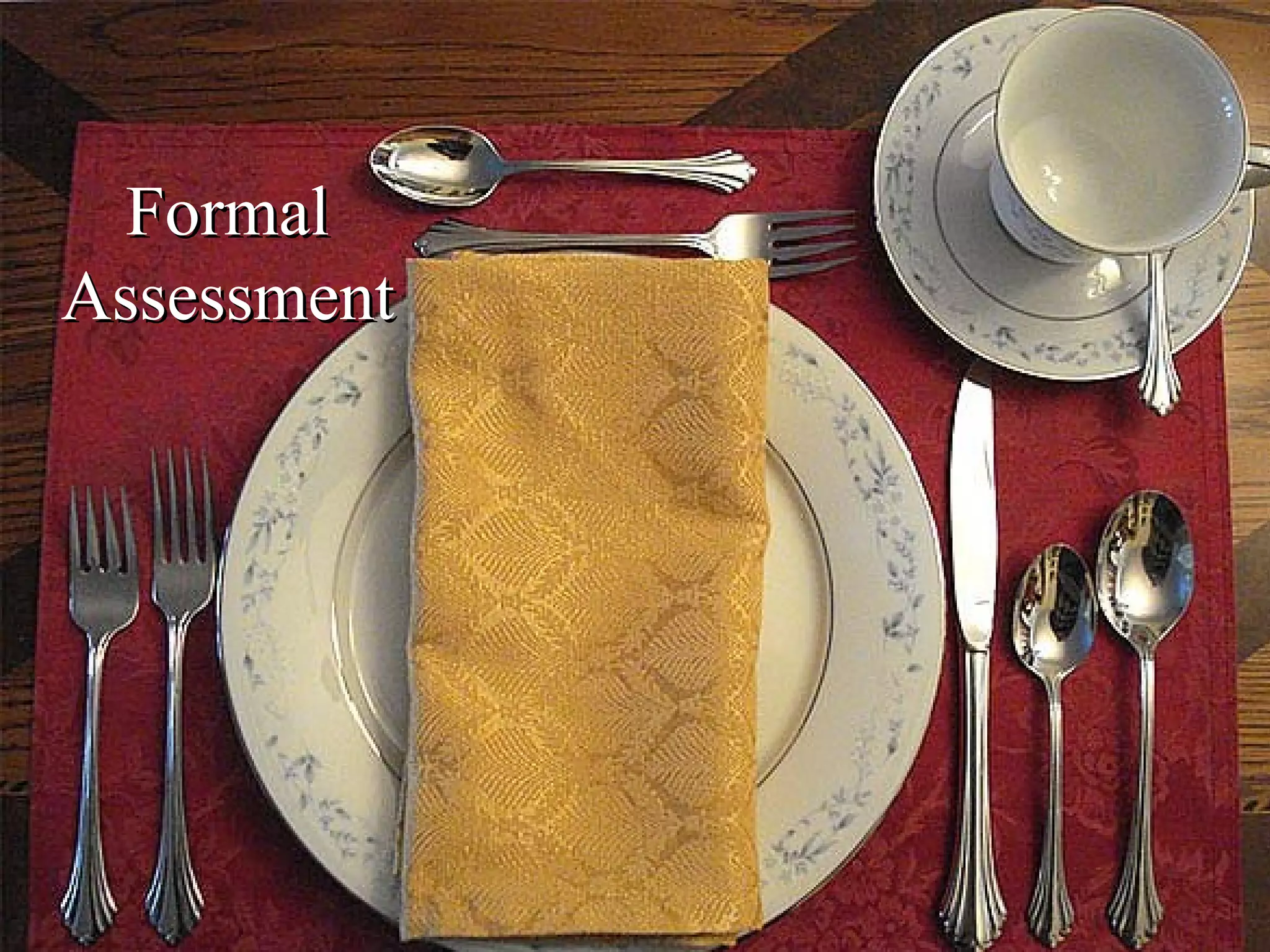
Formal Assessment
Informal Assessment
Quantitative Assessment
Qualitative Assessment
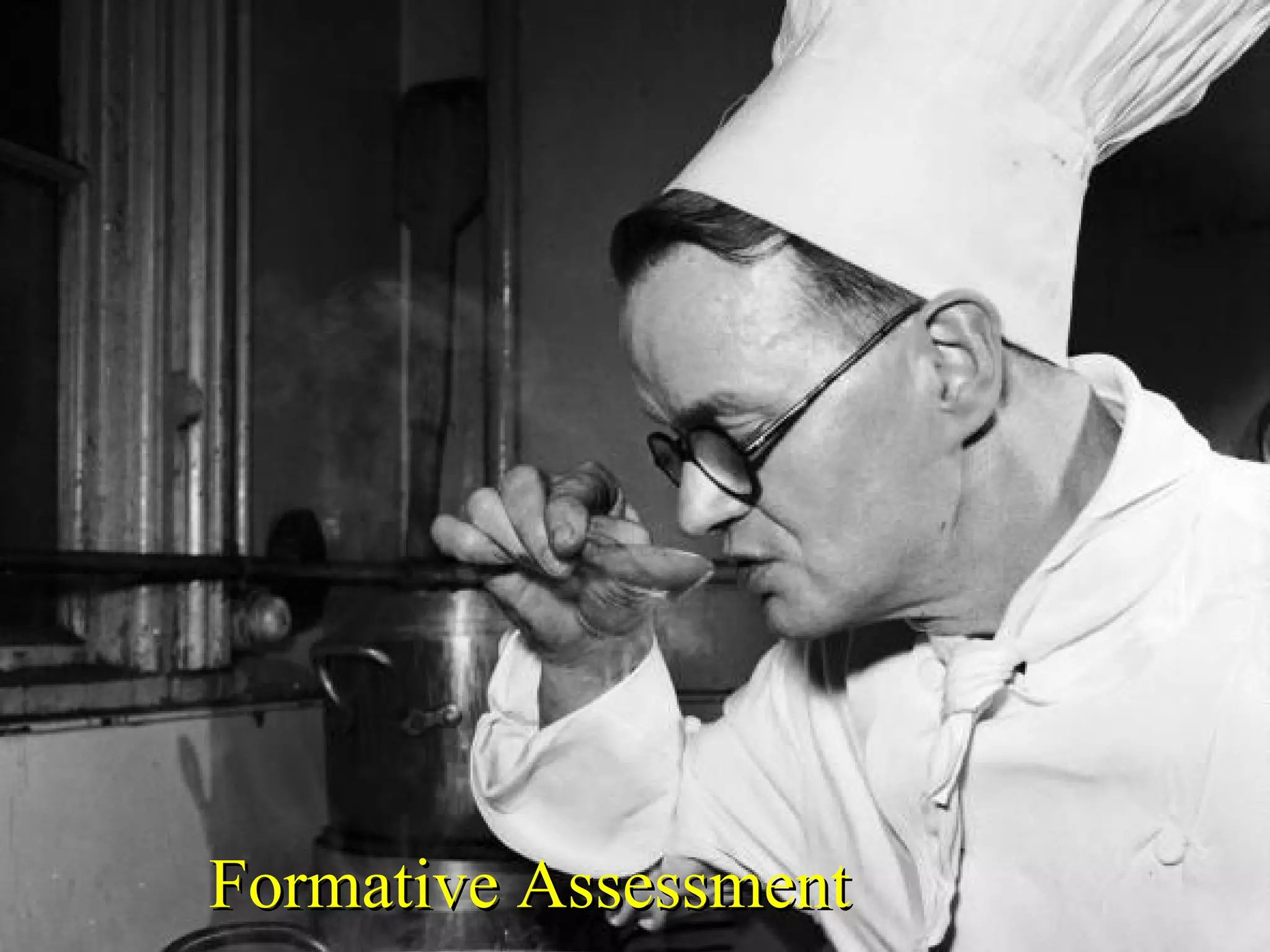
Formative Assessment
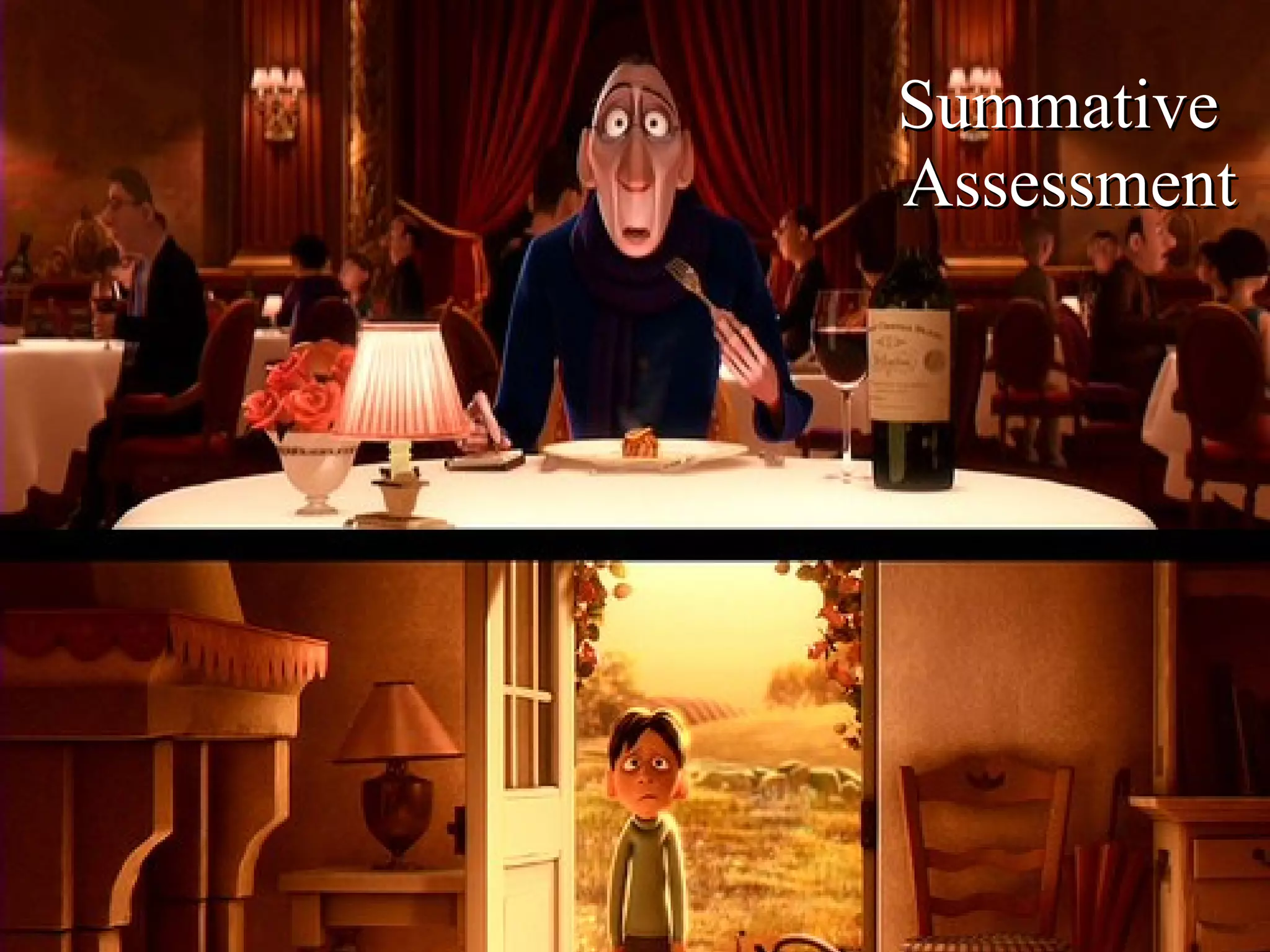
Summative  Assessment
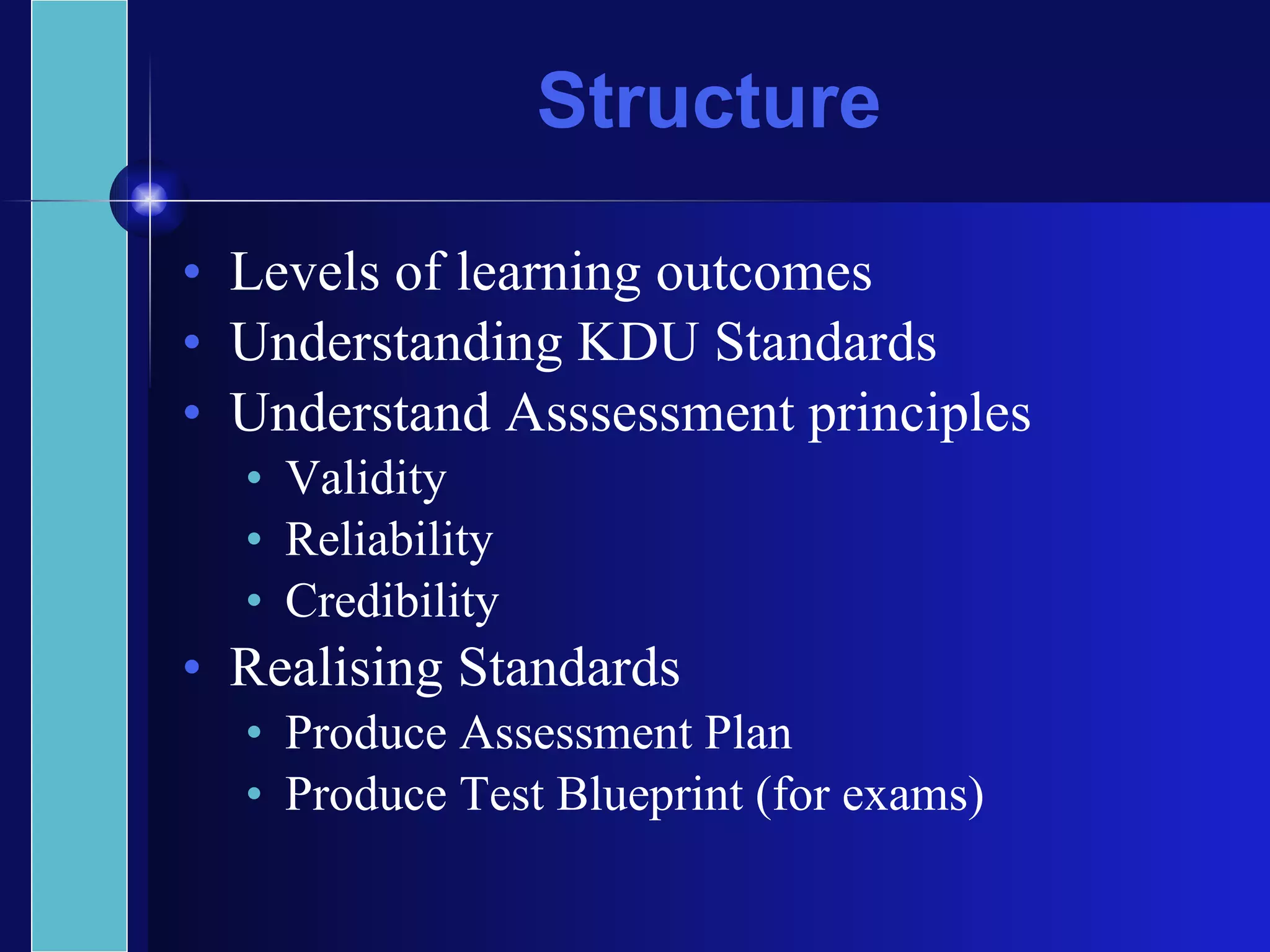
Structure Levels of learning outcomes Understanding KDU Standards Understand Asssessment principles Validity Reliability Credibility Realising Standards Produce Assessment Plan Produce Test Blueprint (for exams)
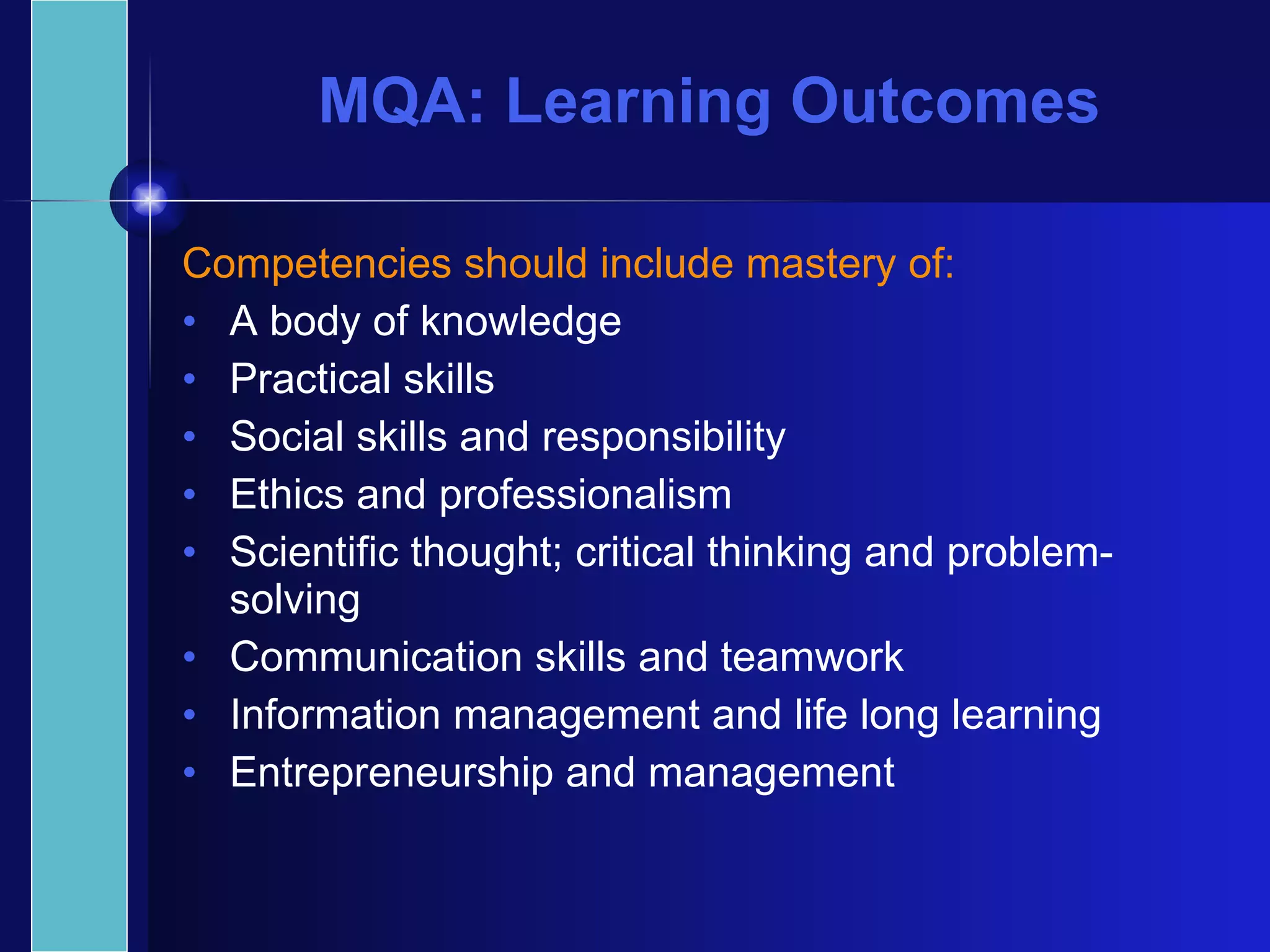
MQA: Learning Outcomes Competencies should include mastery of: A body of knowledge Practical skills Social skills and responsibility Ethics and professionalism Scientific thought; critical thinking and problem-solving Communication skills and teamwork Information management and life long learning Entrepreneurship and management
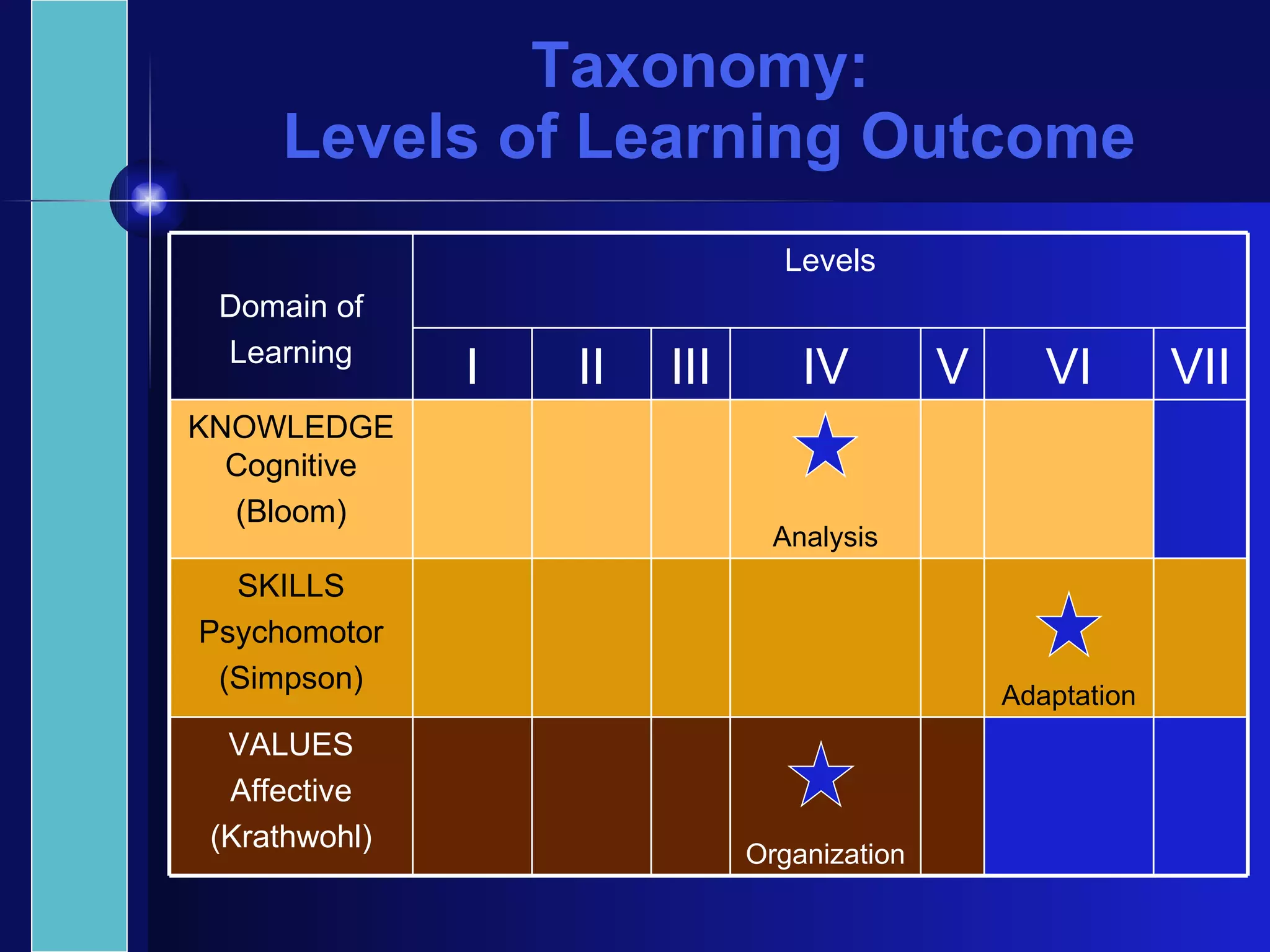
Taxonomy:  Levels of Learning Outcome VII VI V IV III II I Organization VALUES Affective (Krathwohl) Adaptation SKILLS Psychomotor (Simpson) Analysis KNOWLEDGE Cognitive (Bloom) Levels Domain of Learning
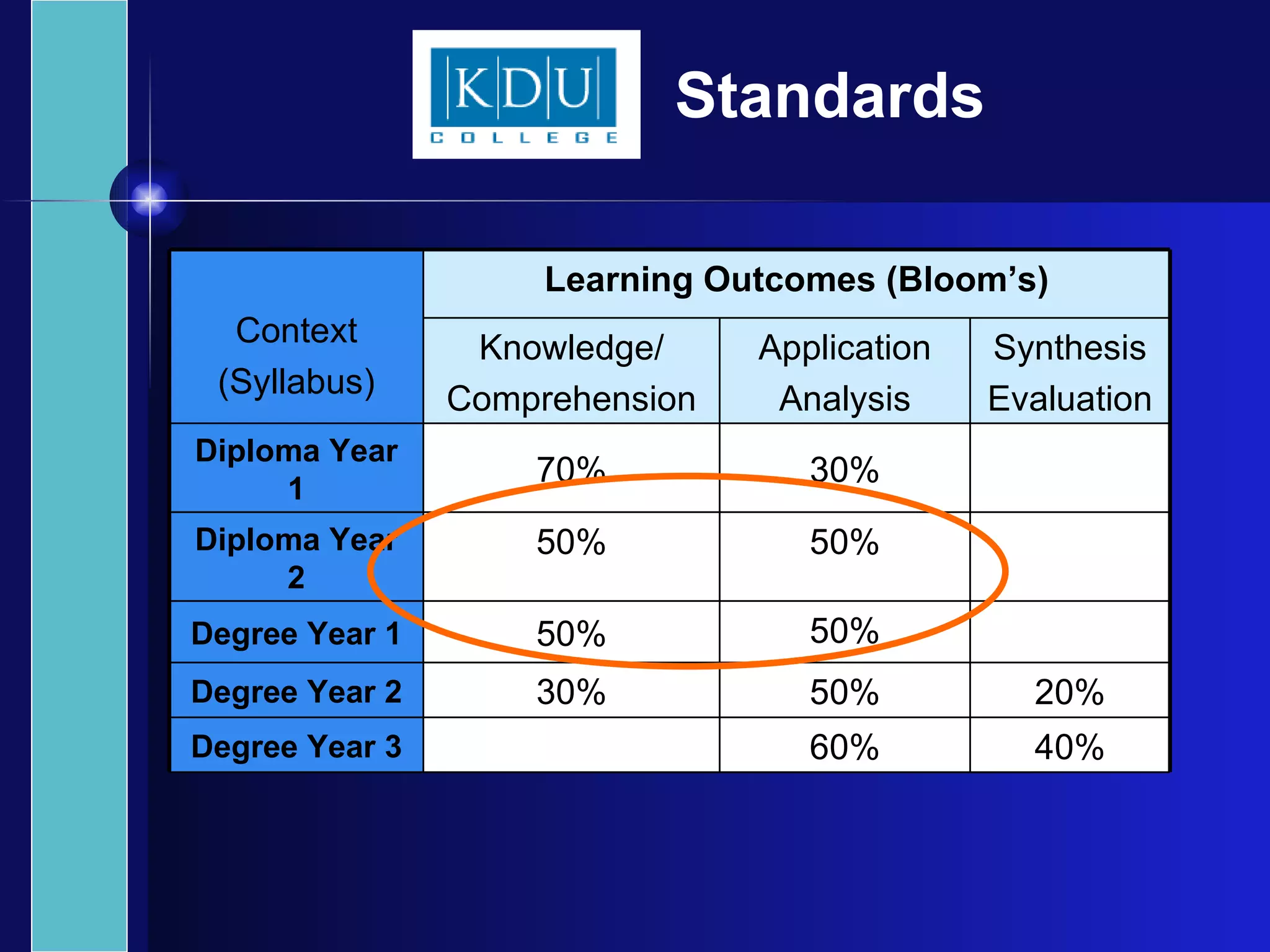
Standards 40% 60% Degree Year 3 20% 50% 30% Degree Year 2 Synthesis Evaluation Application Analysis Knowledge/ Comprehension 50% 50% Degree Year 1 50% 50% Diploma Year 2 30% 70% Diploma Year 1 Learning Outcomes (Bloom’s) Context (Syllabus)
How do we  realise  the standards?
Assessment Plan
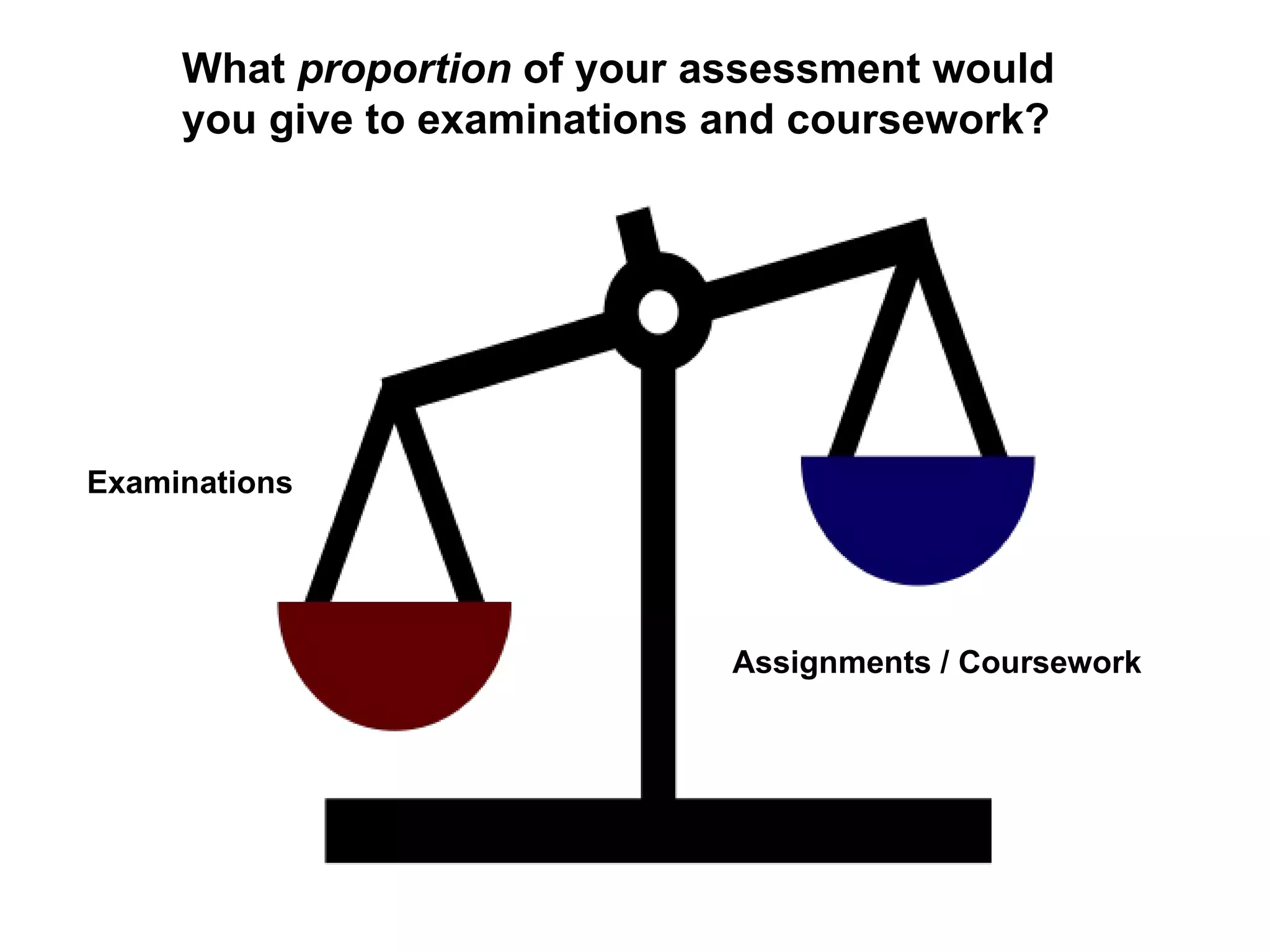
Assignments / Coursework Examinations What  proportion  of your assessment would you give to examinations and coursework?
Test Blueprint
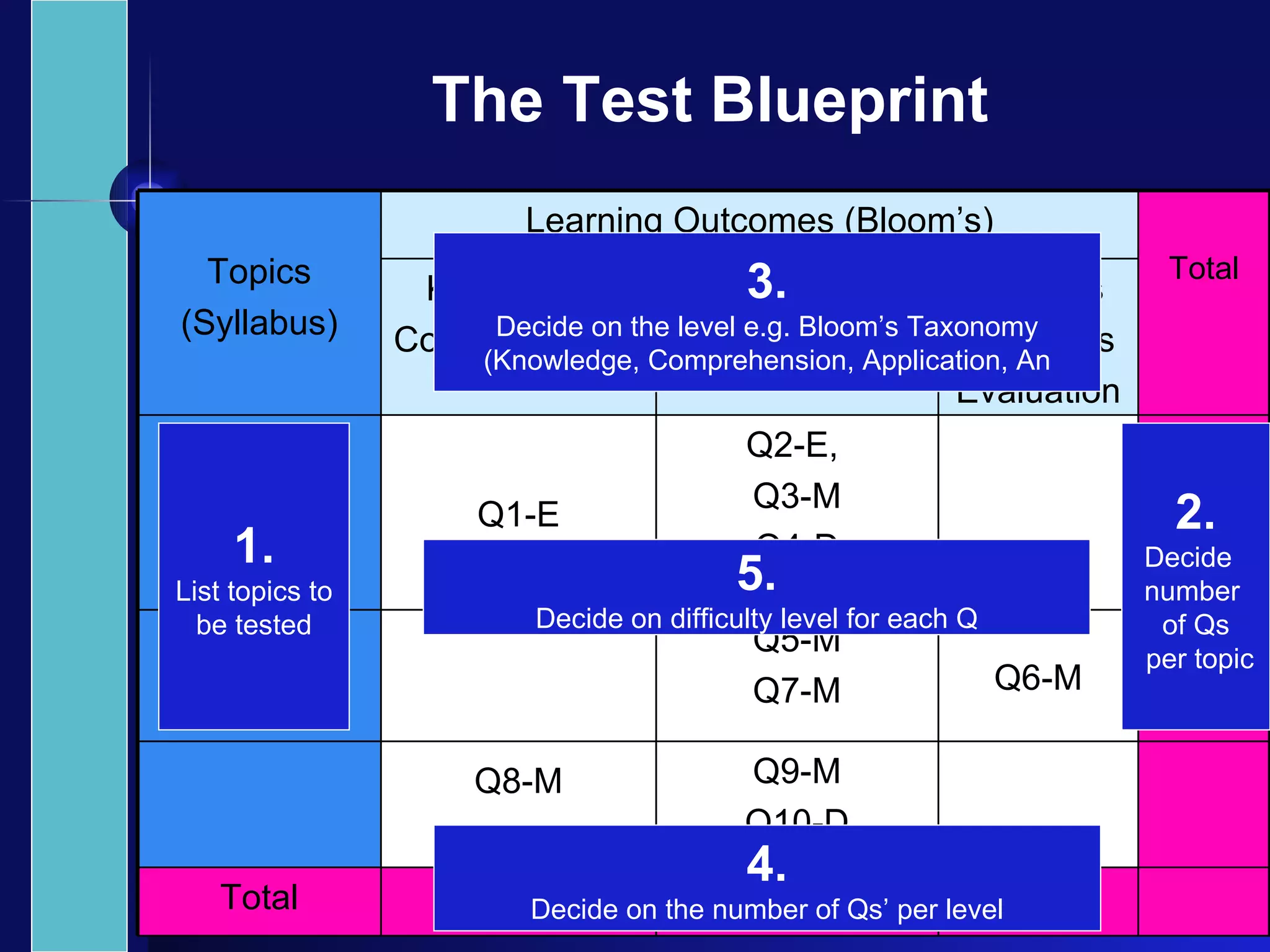
The Test Blueprint 1. List topics to be tested 2. Decide  number  of Qs per topic 3. Decide on the level e.g. Bloom’s Taxonomy (Knowledge, Comprehension, Application, An 4. Decide on the number of Qs’ per level 5. Decide on difficulty level for each Q Analysis Synthesis Evaluation Application Knowledge/ Comprehension 1 7 2 Total Q9-M Q10-D Q8-M Q6-M Q5-M Q7-M Q2-E,  Q3-M Q4-D Q1-E Total Learning Outcomes (Bloom’s) Topics (Syllabus)
The  questions  will change, not the blueprint!
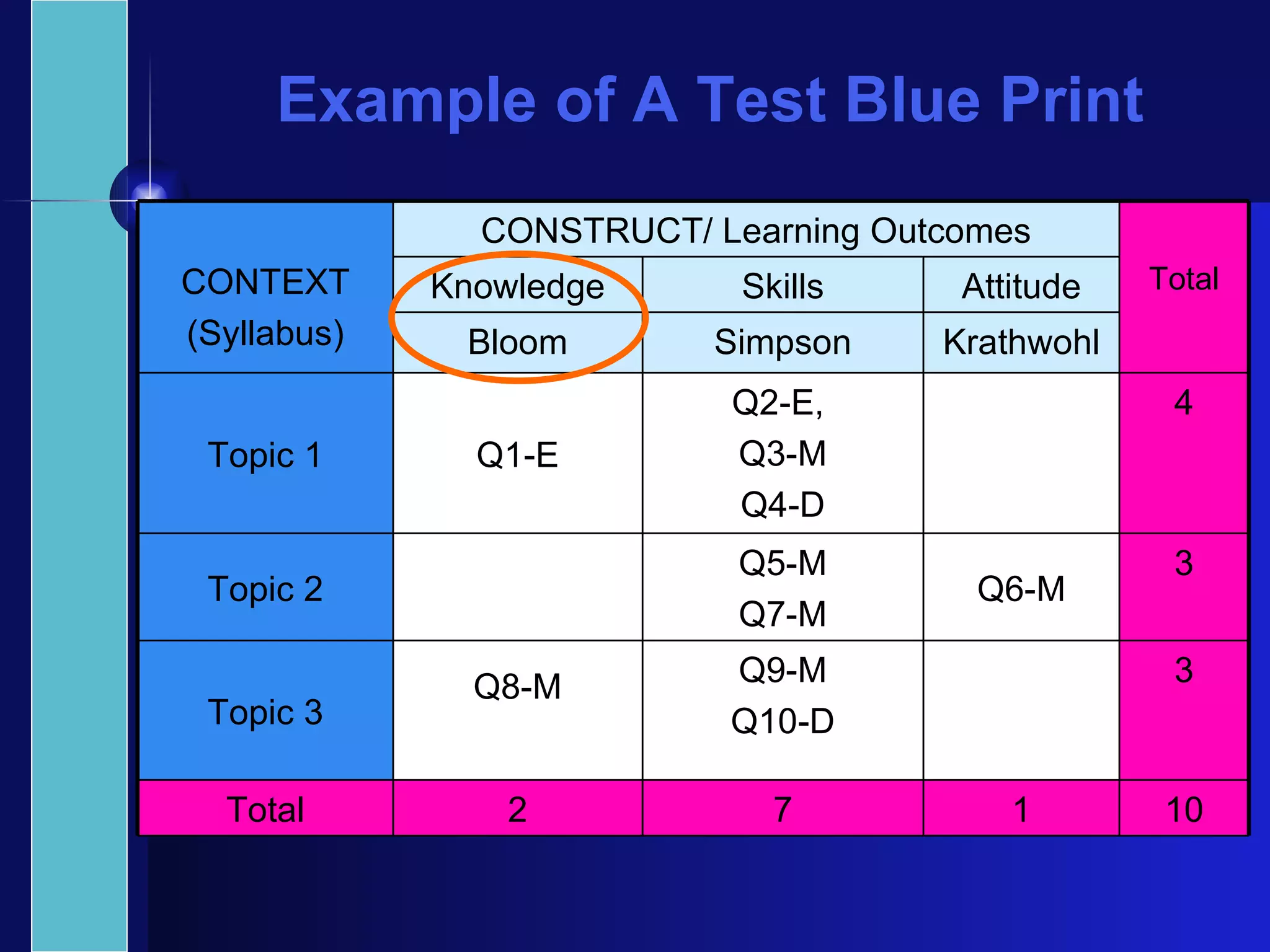
Example of A Test Blue Print Attitude Skills Knowledge 10 1 7 2 Total 3 Q9-M Q10-D Q8-M Topic 3 3 Q6-M Q5-M Q7-M Topic 2 4 Q2-E,  Q3-M Q4-D Q1-E Topic 1 Krathwohl Simpson Bloom Total CONSTRUCT/ Learning Outcomes CONTEXT (Syllabus)
“ Factual knowledge is valueless in a culture where Google and Wikipedia are a mouse-click away”  (Elliot, 2008)
A Blueprint ensures… Congruence with teaching & learning plan Content validity - test what has been taught Assist test setter especially the uninitiated  Maintain standard of test Comparable to other test(s)
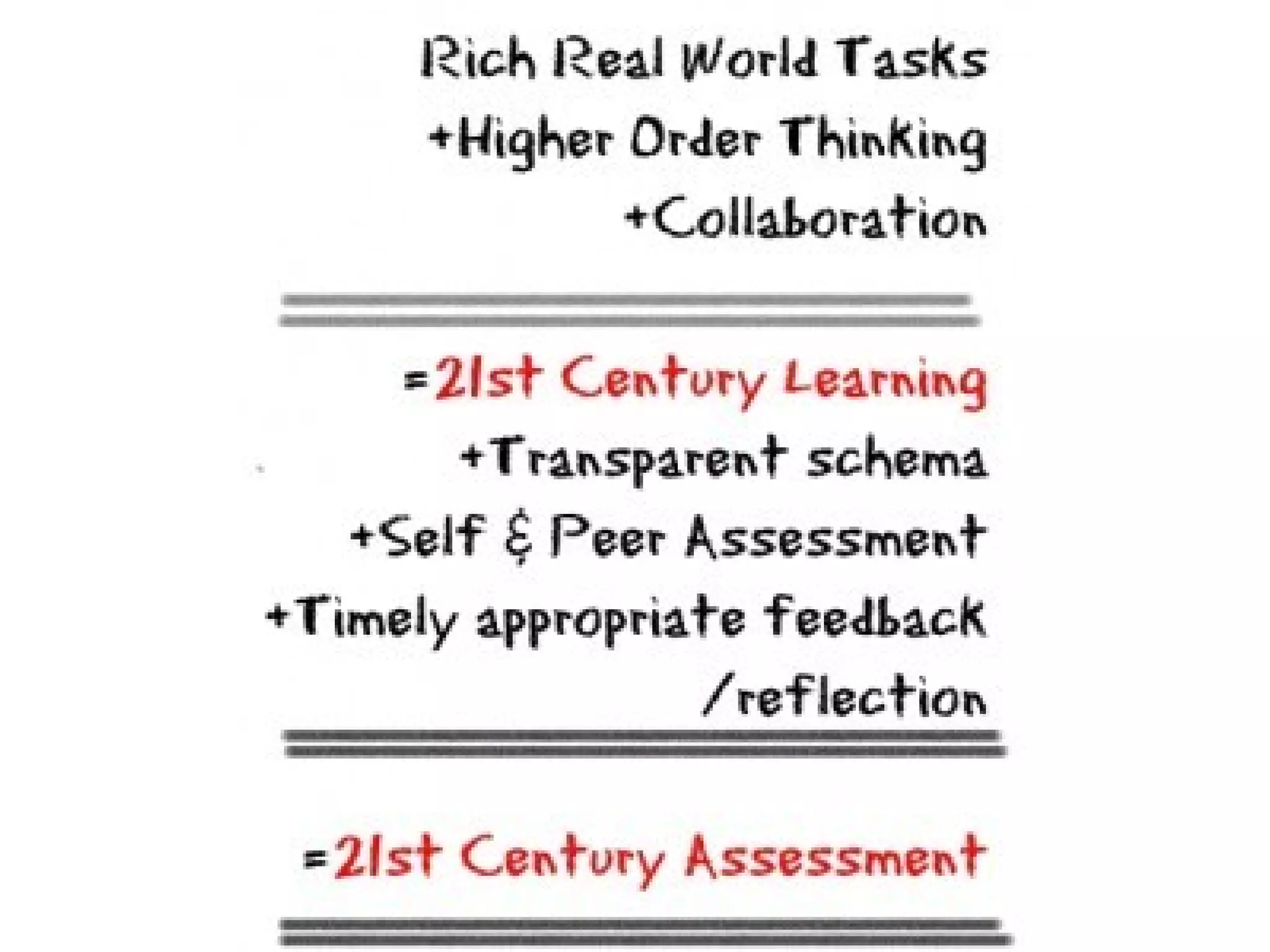
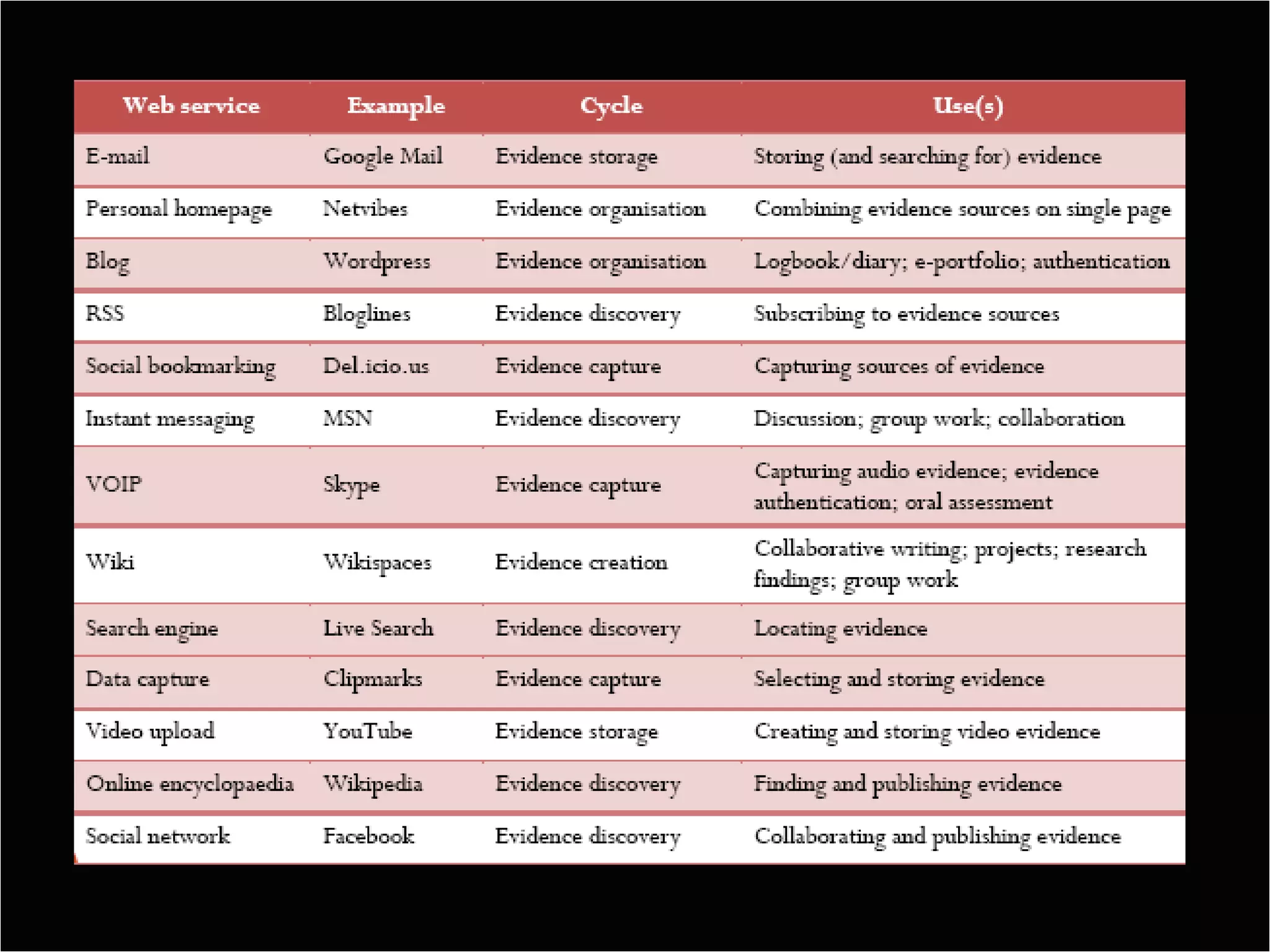
21 st  Century Assessment?
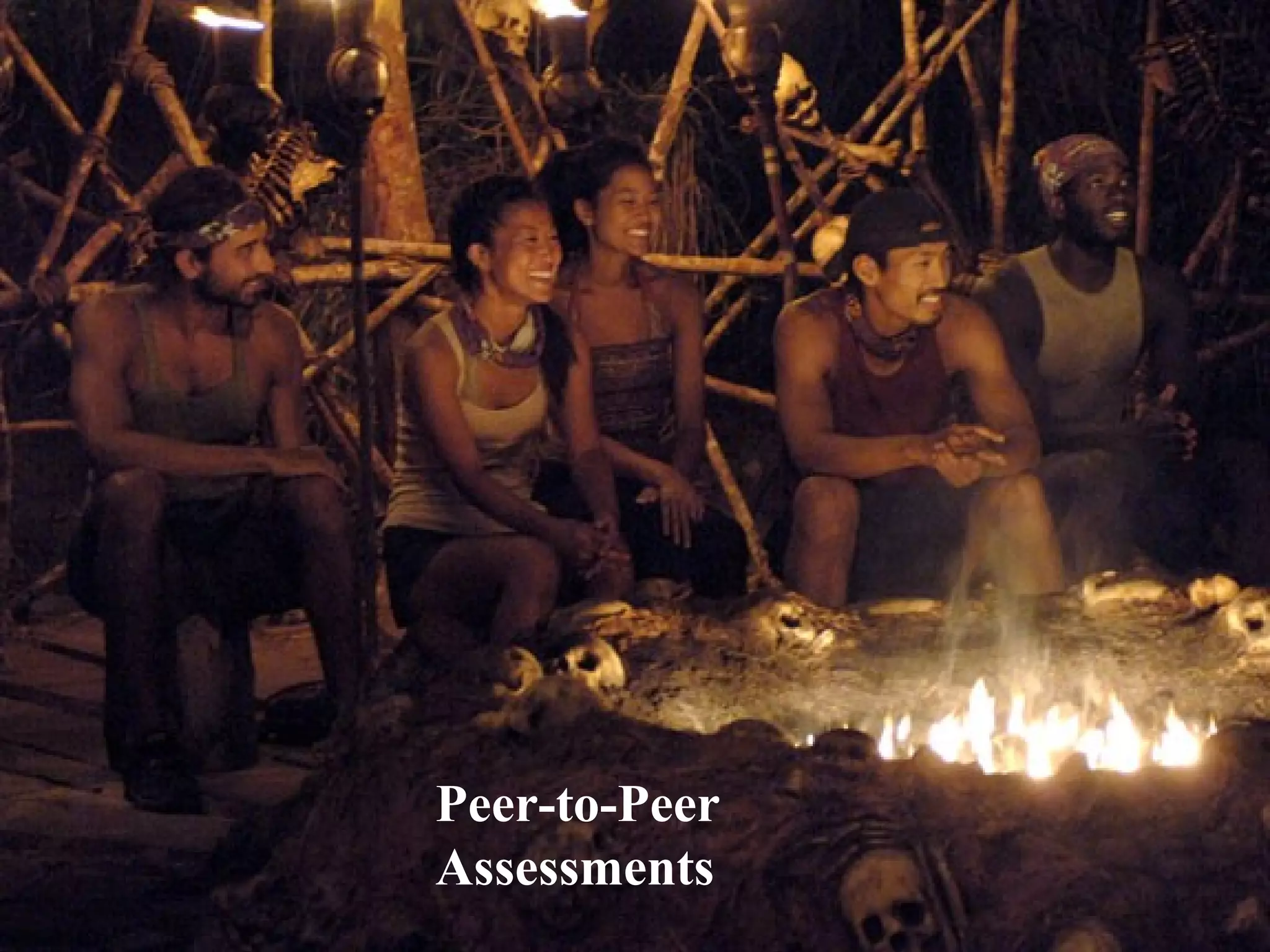
Peer-to-Peer Assessments
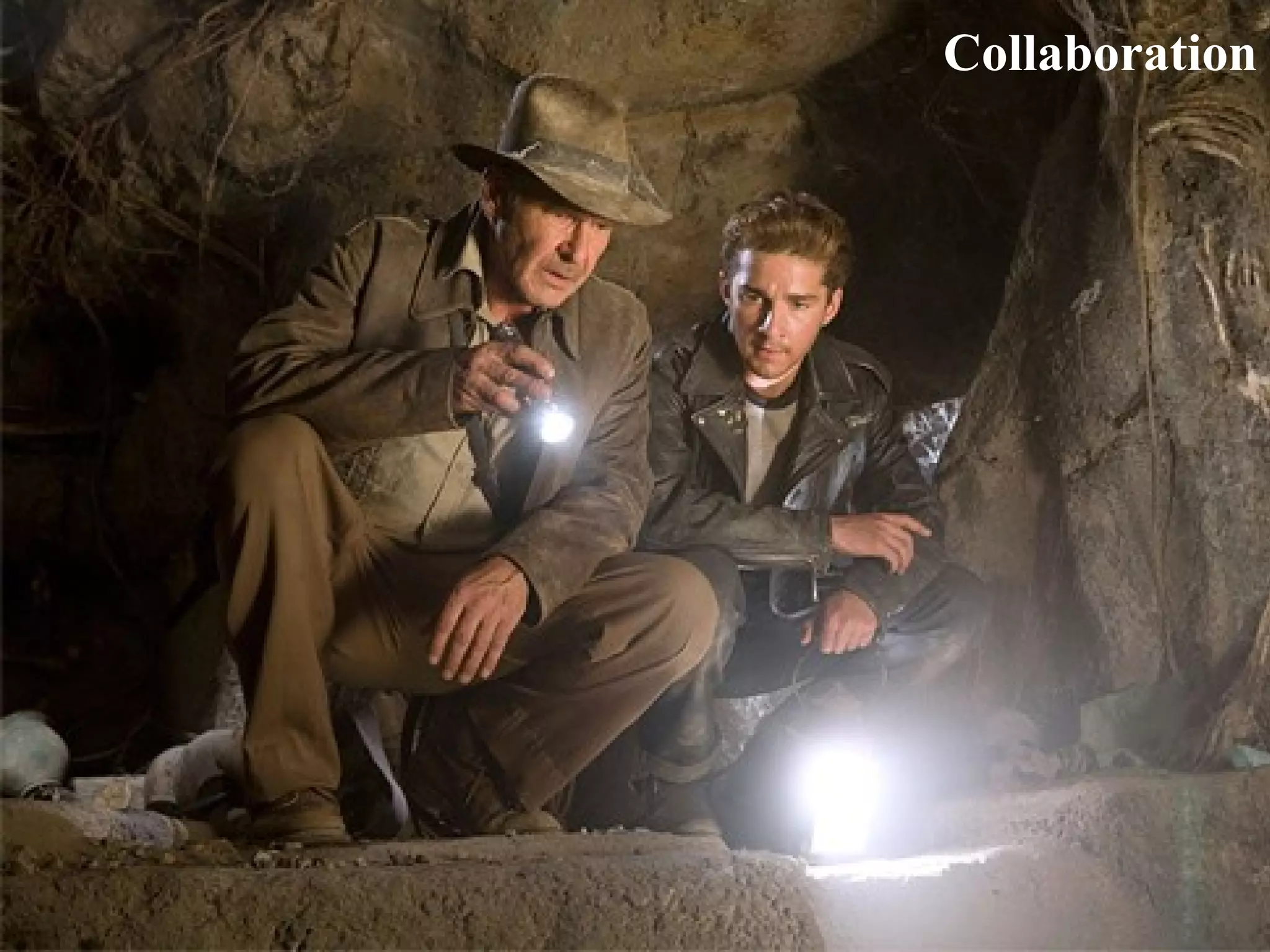
Collaboration
Multi-Media / Digital
Distributed
Real-world
 
 
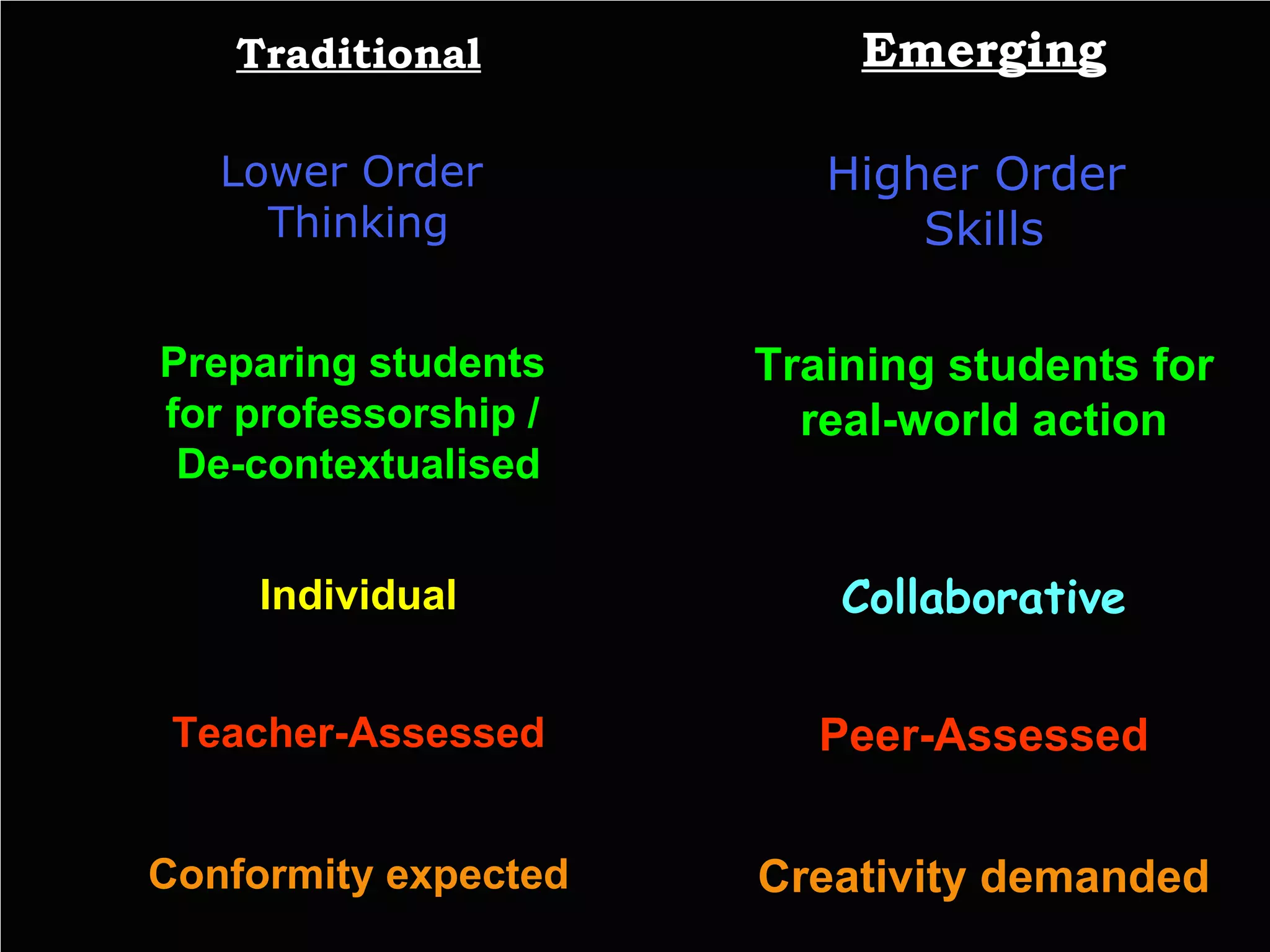
Traditional Emerging Preparing students  for professorship /  De-contextualised Training students for real-world action Lower Order  Thinking Higher Order  Skills Teacher-Assessed Peer-Assessed Individual Collaborative Conformity expected Creativity demanded

Assessment (Blueprint)

  • 1.
    Assessment : Principles & Planning
  • 2.
    What is the Point of Assessment?
  • 3.
  • 4.
  • 5.
  • 6.
    Common complaints about assessments?
  • 7.
  • 8.
    Reliability / Consistency
  • 9.
    How do weensure reliabilty? Set questions/paper in an expected form Be consistent for all classes Use clear language / stimulus Have a good number of test items Use a standard marking scheme
  • 10.
    How do weensure validity? Require subject mastery by setters and vetters Examination / Coursework must accurately represent syllabus Learning outcomes must be tested Fair and correct level of difficulty must be applied
  • 11.
    Which is moreimportant? Accuracy or Consistency? (SHOW VIDEO)
  • 12.
    “ In 21st century learning environments, decontextualised drop-in-from-the-sky assessments consisting of isolated tasks and performances will have zero validity as indices of educational attainment” (Pellegrino, 1999)
  • 13.
  • 14.
  • 15.
  • 16.
  • 17.
  • 18.
  • 19.
  • 20.
    Structure Levels oflearning outcomes Understanding KDU Standards Understand Asssessment principles Validity Reliability Credibility Realising Standards Produce Assessment Plan Produce Test Blueprint (for exams)
  • 21.
    MQA: Learning OutcomesCompetencies should include mastery of: A body of knowledge Practical skills Social skills and responsibility Ethics and professionalism Scientific thought; critical thinking and problem-solving Communication skills and teamwork Information management and life long learning Entrepreneurship and management
  • 22.
    Taxonomy: Levelsof Learning Outcome VII VI V IV III II I Organization VALUES Affective (Krathwohl) Adaptation SKILLS Psychomotor (Simpson) Analysis KNOWLEDGE Cognitive (Bloom) Levels Domain of Learning
  • 23.
    Standards 40% 60%Degree Year 3 20% 50% 30% Degree Year 2 Synthesis Evaluation Application Analysis Knowledge/ Comprehension 50% 50% Degree Year 1 50% 50% Diploma Year 2 30% 70% Diploma Year 1 Learning Outcomes (Bloom’s) Context (Syllabus)
  • 24.
    How do we realise the standards?
  • 25.
  • 26.
    Assignments / CourseworkExaminations What proportion of your assessment would you give to examinations and coursework?
  • 27.
  • 28.
    The Test Blueprint1. List topics to be tested 2. Decide number of Qs per topic 3. Decide on the level e.g. Bloom’s Taxonomy (Knowledge, Comprehension, Application, An 4. Decide on the number of Qs’ per level 5. Decide on difficulty level for each Q Analysis Synthesis Evaluation Application Knowledge/ Comprehension 1 7 2 Total Q9-M Q10-D Q8-M Q6-M Q5-M Q7-M Q2-E, Q3-M Q4-D Q1-E Total Learning Outcomes (Bloom’s) Topics (Syllabus)
  • 29.
    The questions will change, not the blueprint!
  • 30.
    Example of ATest Blue Print Attitude Skills Knowledge 10 1 7 2 Total 3 Q9-M Q10-D Q8-M Topic 3 3 Q6-M Q5-M Q7-M Topic 2 4 Q2-E, Q3-M Q4-D Q1-E Topic 1 Krathwohl Simpson Bloom Total CONSTRUCT/ Learning Outcomes CONTEXT (Syllabus)
  • 31.
    “ Factual knowledgeis valueless in a culture where Google and Wikipedia are a mouse-click away” (Elliot, 2008)
  • 32.
    A Blueprint ensures…Congruence with teaching & learning plan Content validity - test what has been taught Assist test setter especially the uninitiated Maintain standard of test Comparable to other test(s)
  • 33.
    21 st Century Assessment?
  • 34.
  • 35.
  • 36.
  • 37.
  • 38.
  • 39.
  • 40.
  • 41.
    Traditional Emerging Preparingstudents for professorship / De-contextualised Training students for real-world action Lower Order Thinking Higher Order Skills Teacher-Assessed Peer-Assessed Individual Collaborative Conformity expected Creativity demanded