Freight Logistics and Strategies:
Fundamentals of Freight Decisions
Alan Erera
Associate Professor, Industrial and Systems Engineering
Faculty Director, MS in Supply Chain Engineering Program
Planning for the Future of Freight Movement
Southeast Diesel Collaborative
September 16, 2013
Supply Chain Engineering at
Georgia Tech ISyE
• 25 faculty in logistics/manufacturing
• Graduate programs
– MS in Supply Chain Engineering
• 50 grads/yr
• Exec MS in International Logistics (EMIL)
– 20 grads/yr
• Ph.D. in IE: Supply Chain Engineering
– 5-10 grads/yr
My role
• MS in Supply Chain Engineering
– Faculty Director
• Research program
– Co-director, Center for Global
Transportation
– Optimizing design and control of logistics
systems
– Research program funded by
• NSF, DHS, USDOT
• Industry partners (trucking, freight railroads,
manufacturers)
What to remember
• Shippers focus on total logistics costs
when making freight transport
decisions
• Providers (carriers) configure freight
systems to deliver excellent customer
service at lowest possible cost
• Supply chains continuously evolve, but
fundamentals change little
Supply chain 101
• People demand products
– Food, clothing, staples (must have),
everything else (nice to have)
• Supply chain networks
– Procure/produce products
– Get them to people
• “Logistics” systems
– Connect suppliers to customers cost-
effectively, using freight transportation
networks and logistics facilities
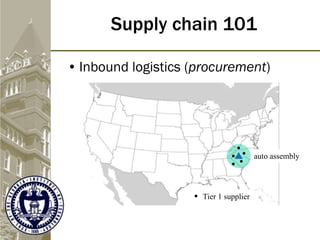
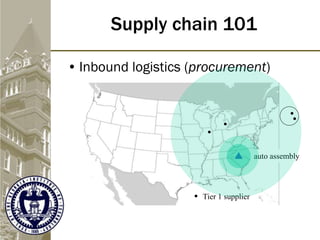
• Inbound logistics (procurement)
Supply chain 101
auto assembly
Tier 1 supplier
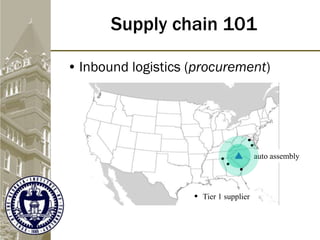
• Inbound logistics (procurement)
Supply chain 101
auto assembly
Tier 1 supplier
• Inbound logistics (procurement)
Supply chain 101
auto assembly
Tier 1 supplier
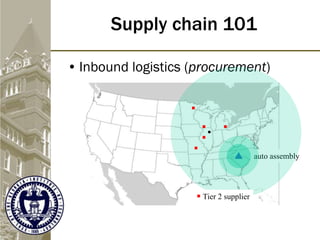
• Inbound logistics (procurement)
Supply chain 101
auto assembly
Tier 2 supplier
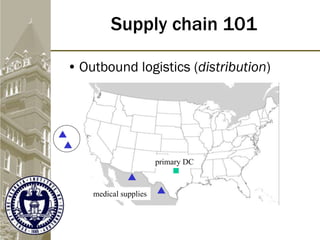
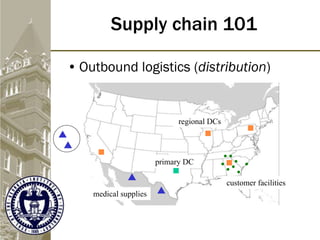
• Outbound logistics (distribution)
Supply chain 101
medical supplies
primary DC
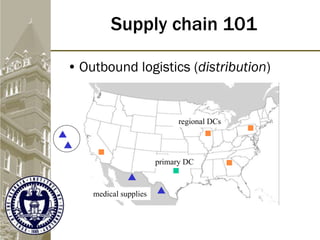
• Outbound logistics (distribution)
Supply chain 101
medical supplies
primary DC
regional DCs
• Outbound logistics (distribution)
Supply chain 101
medical supplies
primary DC
regional DCs
customer facilities
Fundamental 1: Transportation
Cost EOS and Batching
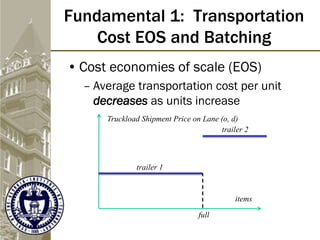
• Cost economies of scale (EOS)
– Average transportation cost per unit
decreases as units increase
items
Truckload Shipment Price on Lane (o, d)
full
trailer 1
trailer 2
Fundamental 1: Transportation
Cost EOS and Batching
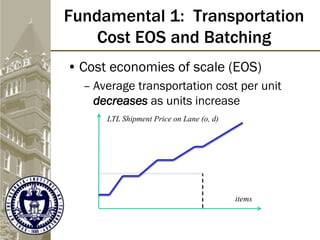
• Cost economies of scale (EOS)
– Average transportation cost per unit
decreases as units increase
items
LTL Shipment Price on Lane (o, d)
Fundamental 2: Balancing
Freight and Inventory Costs
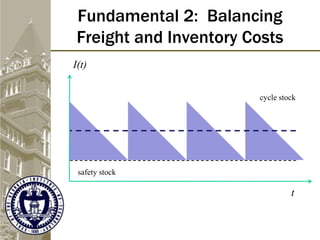
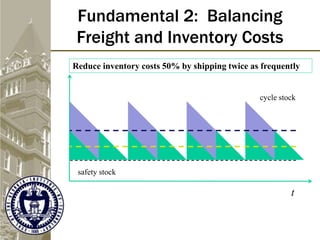
• Selecting shipment quantity
– Small shipments sent frequently lead to
high freight bill spending
– Larger batched shipments take advantage
of cost scale economies and reduce freight
spend, but
– Larger shipment quantities create
larger cycle inventories
• Working capital increase (cost)
• Storage capacity increase (cost)
• Other inventory carrying costs:
obsolescence/perishability, insurance, …
Fundamental 2: Balancing
Freight and Inventory Costs
t
I(t)
safety stock
cycle stock
Fundamental 2: Balancing
Freight and Inventory Costs
t
safety stock
Reduce inventory costs 50% by shipping twice as frequently
cycle stock
Fundamental 2: Balancing
Freight and Inventory Costs
• Another implication
– Although freight cost scale economies
often create incentives for sending full
trailer (container, …) shipments, cycle
inventory costs sometimes make it
worthwhile to send partially-loaded
equipment
Fundamental 3: Pipeline
Inventory and Mode Selection
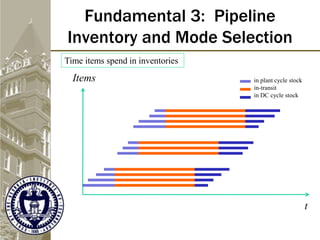
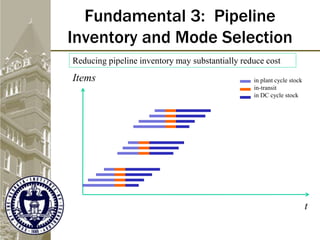
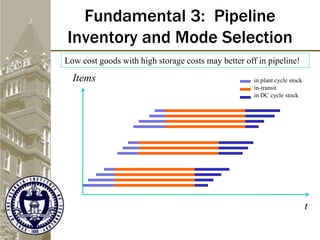
• Pipeline inventory
– Items on order, that have not yet
arrived, often in transit
– Although not stored in a facility, still
creates working capital and inventory
cost!!
• For shippers of very high value goods
or with high storage costs, inventory
costs dominate freight costs
– Hard to shift to slower modes
Fundamental 3: Pipeline
Inventory and Mode Selection
t
Time items spend in inventories
in plant cycle stock
in-transit
in DC cycle stock
Items
Fundamental 3: Pipeline
Inventory and Mode Selection
t
Items
Reducing pipeline inventory may substantially reduce cost
in plant cycle stock
in-transit
in DC cycle stock
Fundamental 3: Pipeline
Inventory and Mode Selection
t
in plant cycle stock
in-transit
in DC cycle stock
Items
Low cost goods with high storage costs may better off in pipeline!
Fundamental 4: Safety Stock
and Mode Selection
• Safety stock inventory
– Buffer inventory held in a supply chain
to hedge against uncertainty
•Customer demand uncertainty
•Procurement quality and reliability
uncertainty
•Freight transit time uncertainty
• Shippers with high costs of inventory
will strongly prefer freight modes with
little transit time variability
Fundamental 5: More Ton-Miles
is Often Cheaper
• Batching over geography (usually called
consolidation) can be as important as
batching over time
– for shippers
– and, for consolidation carriers like LTL,
package express, …
• Freight ton-miles may increase, but total
equipment miles and total costs may
decrease
– More time, and extra handling
Fundamental 5: More Ton-Miles
is Often Cheaper
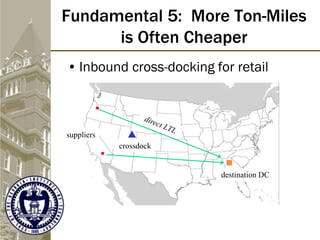
• Inbound cross-docking for retail
crossdock
suppliers
destination DC
Fundamental 5: More Ton-Miles
is Often Cheaper
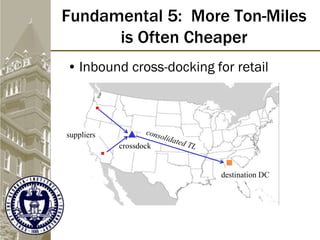
• Inbound cross-docking for retail
crossdock
suppliers
destination DC
Fundamental 5: More Ton-Miles
is Often Cheaper
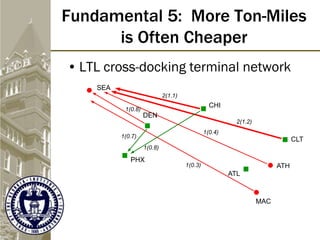
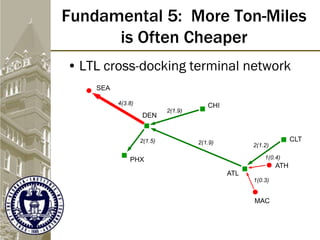
• LTL cross-docking terminal network
Fundamental 5: More Ton-Miles
is Often Cheaper
• LTL cross-docking terminal network
Fundamental 5: More Ton-Miles
is Often Cheaper
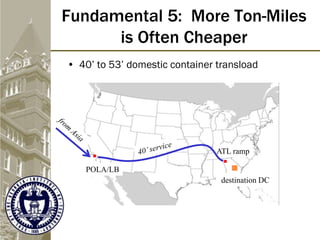
• 40’ to 53’ domestic container transload
destination DC
POLA/LB
ATL ramp
Fundamental 5: More Ton-Miles
is Often Cheaper
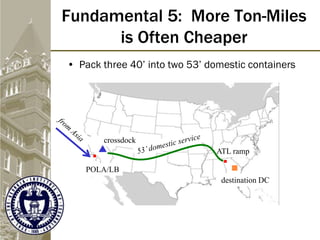
• Pack three 40’ into two 53’ domestic containers
crossdock
destination DC
POLA/LB
ATL ramp
Fundamental 5: More Ton-Miles
is Often Cheaper
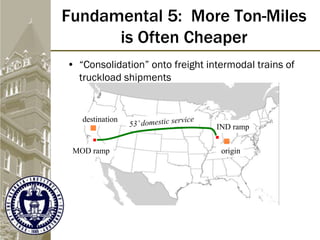
• “Consolidation” onto freight intermodal trains of
truckload shipments
originMOD ramp
IND ramp
destination
Fundamental 5: More Ton-Miles
is Often Cheaper
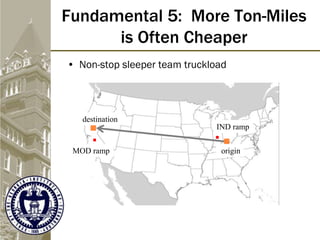
• Non-stop sleeper team truckload
originMOD ramp
IND ramp
destination
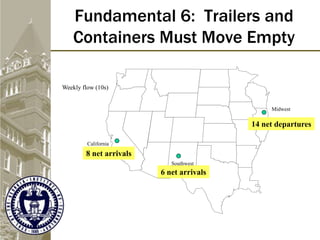
Fundamental 6: Trailers and
Containers Must Move Empty
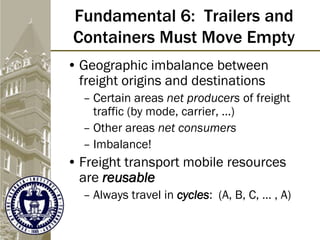
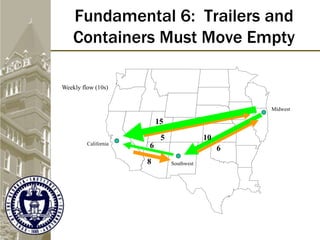
• Geographic imbalance between
freight origins and destinations
– Certain areas net producers of freight
traffic (by mode, carrier, …)
– Other areas net consumers
– Imbalance!
• Freight transport mobile resources
are reusable
– Always travel in cycles: (A, B, C, … , A)
California
Midwest
Southwest
15
10
6
Weekly flow (10s)
5
6
8
Fundamental 6: Trailers and
Containers Must Move Empty
California
Midwest
Southwest
Weekly flow (10s)
6 net arrivals
8 net arrivals
14 net departures
Fundamental 6: Trailers and
Containers Must Move Empty
Fundamental 6: Trailers and
Containers Must Move Empty
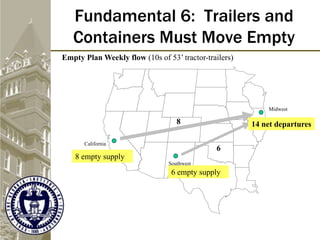
Empty Plan Weekly flow (10s of 53’ tractor-trailers)
California
Midwest
Southwest
6 empty supply
8 empty supply
8
6
14 net departures
Fundamental 7: Freight
Demand, Supply, and Pricing
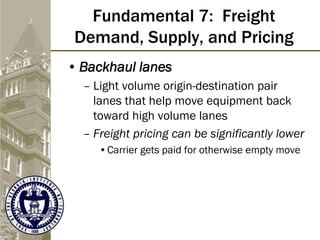
• Backhaul lanes
– Light volume origin-destination pair
lanes that help move equipment back
toward high volume lanes
– Freight pricing can be significantly lower
•Carrier gets paid for otherwise empty move
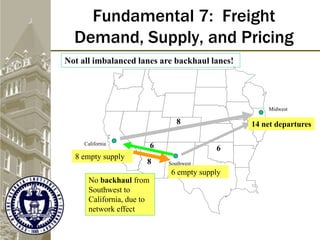
Fundamental 7: Freight
Demand, Supply, and Pricing
California
Midwest
Southwest
6 empty supply
8 empty supply
8
6
14 net departures
6
8
No backhaul from
Southwest to
California, due to
network effect
Not all imbalanced lanes are backhaul lanes!
Fundamental 8: Last-mile
Freight Efficiency is Hardest
• Last-mile
– Consolidation modes
– Pickup from shipper into first terminal
– Delivery to consignee from last terminal
• Examples
– Container drayage into seaport/IM terminal
– Package express pickup/delivery routes
– LTL pickup/delivery routes
– Distribution delivery routes into stores
Fundamental 8: Last-mile
Freight Efficiency is Hardest
• Challenges to efficiency
– Small shipment sizes
– Multiple stop vehicle tours
– Tour duration constraints, deadlines
– Customer delivery constraints, time
windows
– Urban logistics: congestion, parking,
regulation
Parting Thoughts: Trends for
Supply Chains
1. Global manufacturing here to stay
2. Consumers continue to demand
better cheaper products, faster
3. Retailing is more and more a supply
chain business
4. Ubiquitous sensors, connected
devices, data, automation will
continue to drive efficiency gains
5. Alternate fuel technologies will
expand steadily into fleets as total
costs to own/operate decrease
What to remember
• Shippers focus on total logistics costs
when making freight transport
decisions
• Providers (carriers) configure freight
systems to deliver excellent customer
service at lowest possible cost
• Supply chains continuously evolve, but
fundamentals change little

Freight Logistics Fundamentals

  • 1.
    Freight Logistics andStrategies: Fundamentals of Freight Decisions Alan Erera Associate Professor, Industrial and Systems Engineering Faculty Director, MS in Supply Chain Engineering Program Planning for the Future of Freight Movement Southeast Diesel Collaborative September 16, 2013
  • 2.
    Supply Chain Engineeringat Georgia Tech ISyE • 25 faculty in logistics/manufacturing • Graduate programs – MS in Supply Chain Engineering • 50 grads/yr • Exec MS in International Logistics (EMIL) – 20 grads/yr • Ph.D. in IE: Supply Chain Engineering – 5-10 grads/yr
  • 3.
    My role • MSin Supply Chain Engineering – Faculty Director • Research program – Co-director, Center for Global Transportation – Optimizing design and control of logistics systems – Research program funded by • NSF, DHS, USDOT • Industry partners (trucking, freight railroads, manufacturers)
  • 4.
    What to remember •Shippers focus on total logistics costs when making freight transport decisions • Providers (carriers) configure freight systems to deliver excellent customer service at lowest possible cost • Supply chains continuously evolve, but fundamentals change little
  • 5.
    Supply chain 101 •People demand products – Food, clothing, staples (must have), everything else (nice to have) • Supply chain networks – Procure/produce products – Get them to people • “Logistics” systems – Connect suppliers to customers cost- effectively, using freight transportation networks and logistics facilities
  • 6.
    • Inbound logistics(procurement) Supply chain 101 auto assembly Tier 1 supplier
  • 7.
    • Inbound logistics(procurement) Supply chain 101 auto assembly Tier 1 supplier
  • 8.
    • Inbound logistics(procurement) Supply chain 101 auto assembly Tier 1 supplier
  • 9.
    • Inbound logistics(procurement) Supply chain 101 auto assembly Tier 2 supplier
  • 10.
    • Outbound logistics(distribution) Supply chain 101 medical supplies primary DC
  • 11.
    • Outbound logistics(distribution) Supply chain 101 medical supplies primary DC regional DCs
  • 12.
    • Outbound logistics(distribution) Supply chain 101 medical supplies primary DC regional DCs customer facilities
  • 13.
    Fundamental 1: Transportation CostEOS and Batching • Cost economies of scale (EOS) – Average transportation cost per unit decreases as units increase items Truckload Shipment Price on Lane (o, d) full trailer 1 trailer 2
  • 14.
    Fundamental 1: Transportation CostEOS and Batching • Cost economies of scale (EOS) – Average transportation cost per unit decreases as units increase items LTL Shipment Price on Lane (o, d)
  • 15.
    Fundamental 2: Balancing Freightand Inventory Costs • Selecting shipment quantity – Small shipments sent frequently lead to high freight bill spending – Larger batched shipments take advantage of cost scale economies and reduce freight spend, but – Larger shipment quantities create larger cycle inventories • Working capital increase (cost) • Storage capacity increase (cost) • Other inventory carrying costs: obsolescence/perishability, insurance, …
  • 16.
    Fundamental 2: Balancing Freightand Inventory Costs t I(t) safety stock cycle stock
  • 17.
    Fundamental 2: Balancing Freightand Inventory Costs t safety stock Reduce inventory costs 50% by shipping twice as frequently cycle stock
  • 18.
    Fundamental 2: Balancing Freightand Inventory Costs • Another implication – Although freight cost scale economies often create incentives for sending full trailer (container, …) shipments, cycle inventory costs sometimes make it worthwhile to send partially-loaded equipment
  • 19.
    Fundamental 3: Pipeline Inventoryand Mode Selection • Pipeline inventory – Items on order, that have not yet arrived, often in transit – Although not stored in a facility, still creates working capital and inventory cost!! • For shippers of very high value goods or with high storage costs, inventory costs dominate freight costs – Hard to shift to slower modes
  • 20.
    Fundamental 3: Pipeline Inventoryand Mode Selection t Time items spend in inventories in plant cycle stock in-transit in DC cycle stock Items
  • 21.
    Fundamental 3: Pipeline Inventoryand Mode Selection t Items Reducing pipeline inventory may substantially reduce cost in plant cycle stock in-transit in DC cycle stock
  • 22.
    Fundamental 3: Pipeline Inventoryand Mode Selection t in plant cycle stock in-transit in DC cycle stock Items Low cost goods with high storage costs may better off in pipeline!
  • 23.
    Fundamental 4: SafetyStock and Mode Selection • Safety stock inventory – Buffer inventory held in a supply chain to hedge against uncertainty •Customer demand uncertainty •Procurement quality and reliability uncertainty •Freight transit time uncertainty • Shippers with high costs of inventory will strongly prefer freight modes with little transit time variability
  • 24.
    Fundamental 5: MoreTon-Miles is Often Cheaper • Batching over geography (usually called consolidation) can be as important as batching over time – for shippers – and, for consolidation carriers like LTL, package express, … • Freight ton-miles may increase, but total equipment miles and total costs may decrease – More time, and extra handling
  • 25.
    Fundamental 5: MoreTon-Miles is Often Cheaper • Inbound cross-docking for retail crossdock suppliers destination DC
  • 26.
    Fundamental 5: MoreTon-Miles is Often Cheaper • Inbound cross-docking for retail crossdock suppliers destination DC
  • 27.
    Fundamental 5: MoreTon-Miles is Often Cheaper • LTL cross-docking terminal network
  • 28.
    Fundamental 5: MoreTon-Miles is Often Cheaper • LTL cross-docking terminal network
  • 29.
    Fundamental 5: MoreTon-Miles is Often Cheaper • 40’ to 53’ domestic container transload destination DC POLA/LB ATL ramp
  • 30.
    Fundamental 5: MoreTon-Miles is Often Cheaper • Pack three 40’ into two 53’ domestic containers crossdock destination DC POLA/LB ATL ramp
  • 31.
    Fundamental 5: MoreTon-Miles is Often Cheaper • “Consolidation” onto freight intermodal trains of truckload shipments originMOD ramp IND ramp destination
  • 32.
    Fundamental 5: MoreTon-Miles is Often Cheaper • Non-stop sleeper team truckload originMOD ramp IND ramp destination
  • 33.
    Fundamental 6: Trailersand Containers Must Move Empty • Geographic imbalance between freight origins and destinations – Certain areas net producers of freight traffic (by mode, carrier, …) – Other areas net consumers – Imbalance! • Freight transport mobile resources are reusable – Always travel in cycles: (A, B, C, … , A)
  • 34.
  • 35.
    California Midwest Southwest Weekly flow (10s) 6net arrivals 8 net arrivals 14 net departures Fundamental 6: Trailers and Containers Must Move Empty
  • 36.
    Fundamental 6: Trailersand Containers Must Move Empty Empty Plan Weekly flow (10s of 53’ tractor-trailers) California Midwest Southwest 6 empty supply 8 empty supply 8 6 14 net departures
  • 37.
    Fundamental 7: Freight Demand,Supply, and Pricing • Backhaul lanes – Light volume origin-destination pair lanes that help move equipment back toward high volume lanes – Freight pricing can be significantly lower •Carrier gets paid for otherwise empty move
  • 38.
    Fundamental 7: Freight Demand,Supply, and Pricing California Midwest Southwest 6 empty supply 8 empty supply 8 6 14 net departures 6 8 No backhaul from Southwest to California, due to network effect Not all imbalanced lanes are backhaul lanes!
  • 39.
    Fundamental 8: Last-mile FreightEfficiency is Hardest • Last-mile – Consolidation modes – Pickup from shipper into first terminal – Delivery to consignee from last terminal • Examples – Container drayage into seaport/IM terminal – Package express pickup/delivery routes – LTL pickup/delivery routes – Distribution delivery routes into stores
  • 40.
    Fundamental 8: Last-mile FreightEfficiency is Hardest • Challenges to efficiency – Small shipment sizes – Multiple stop vehicle tours – Tour duration constraints, deadlines – Customer delivery constraints, time windows – Urban logistics: congestion, parking, regulation
  • 41.
    Parting Thoughts: Trendsfor Supply Chains 1. Global manufacturing here to stay 2. Consumers continue to demand better cheaper products, faster 3. Retailing is more and more a supply chain business 4. Ubiquitous sensors, connected devices, data, automation will continue to drive efficiency gains 5. Alternate fuel technologies will expand steadily into fleets as total costs to own/operate decrease
  • 42.
    What to remember •Shippers focus on total logistics costs when making freight transport decisions • Providers (carriers) configure freight systems to deliver excellent customer service at lowest possible cost • Supply chains continuously evolve, but fundamentals change little