www.inboundlogistics.com THE MAGAZINE FOR DEMAND-DRIVEN LOGISTICS • May 2015
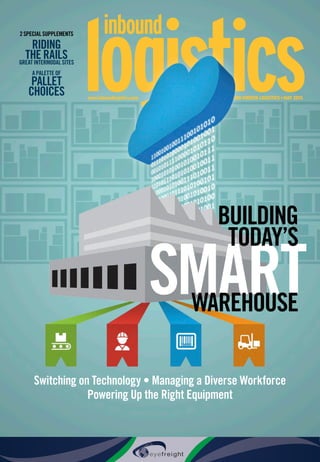
SMART
BUILDING
TODAY’S
WAREHOUSE
2 SPECIAL SUPPLEMENTS
RIDING
THE RAILSGREAT INTERMODAL SITES
A PALETTE OF
PALLET
CHOICES
Switching on Technology • Managing a Diverse Workforce
Powering Up the Right Equipment
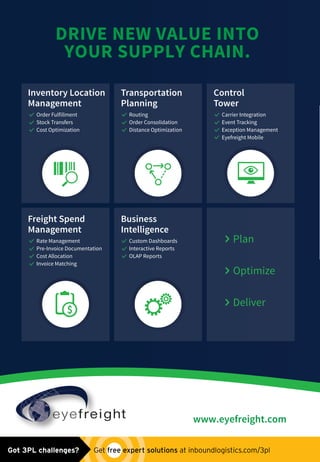
DRIVE NEW VALUE INTO
YOUR SUPPLY CHAIN.
Inventory Location
Management
Order Fulfillment
Stock Transfers
Cost Optimization
Transportation
Planning
Routing
Order Consolidation
Distance Optimization
Control
Tower
Plan
Optimize
Deliver
Carrier Integration
Event Tracking
Exception Management
Eyefreight Mobile
Freight Spend
Management
Rate Management
Pre-Invoice Documentation
Cost Allocation
Invoice Matching
Business
Intelligence
Custom Dashboards
Interactive Reports
OLAP Reports
www.eyefreight.com
Got 3PL challenges?  Get free expert solutions at inboundlogistics.com/3pl
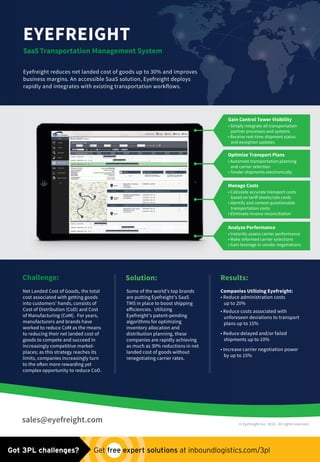
Gain Control Tower Visibility
• Simply integrate all transportation
partner processes and systems
• Receive real-time shipment status
and exception updates
Optimize Transport Plans
• Automate transportation planning
and carrier selection
• Tender shipments electronically
Manage Costs
• Calculate accurate transport costs
based on tariff sheets/rate cards
• Identify and contest questionable
transportation costs
• Eliminate invoice reconciliation
Analyze Performance
• Instantly assess carrier performance
• Make informed carrier selections
• Gain leverage in vendor negotiations
Solution: Results:Challenge:
Companies Utilizing Eyefreight:
• Reduce administration costs
up to 20%
• Reduce costs associated with
unforeseen deviations to transport
plans up to 15%
• Reduce delayed and/or failed
shipments up to 10%
• Increase carrier negotiation power
by up to 15%
Some of the world’s top brands
are putting Eyefreight’s SaaS
TMS in place to boost shipping
efficiencies. Utilizing
Eyefreight’s patent-pending
algorithms for optimizing
inventory allocation and
distribution planning, these
companies are rapidly achieving
as much as 30% reductions in net
landed cost of goods without
renegotiating carrier rates.
Net Landed Cost of Goods, the total
cost associated with getting goods
into customers’ hands, consists of
Cost of Distribution (CoD) and Cost
of Manufacturing (CoM). For years,
manufacturers and brands have
worked to reduce CoM as the means
to reducing their net landed cost of
goods to compete and succeed in
increasingly competitive market-
places; as this strategy reaches its
limits, companies increasingly turn
to the often more rewarding yet
complex opportunity to reduce CoD.
Eyefreight reduces net landed cost of goods up to 30% and improves
business margins. An accessible SaaS solution, Eyefreight deploys
rapidly and integrates with existing transportation workflows.
EYEFREIGHT
SaaSTransportation Management System
sales@eyefreight.com © Eyefreight Inc. 2015. All rights reserved.
Got 3PL challenges?  Get free expert solutions at inboundlogistics.com/3pl
There’s no such thing as a routine
call for the highly trained customer
service specialists at Saia. Every time
the phone rings, it’s personal. With
centralized access to the latest data
throughout our entire service network,
our experts can answer your questions,
address your needs, and resolve
potential challenges — and 97% of
requests are handled with a single
call. So whether we’re proactively
monitoring new accounts to ensure
problem-free shipping or fostering
long-term relationships with customers
around the country, it’s easy to see
Saia’s commitment to superior service.
1-800-765-7242 / www.saia.com
SAI_0831 Superhero Ad_CSR_InboundLog.indd 1 3/10/15 11:30 AMsaia_ad0515.indd 1 4/30/15 10:10 AMGot 3PL challenges?  Get free expert solutions at inboundlogistics.com/3pl
May 2015 • Inbound Logistics 1
May 2015 • Vol. 35 • No. 5
INDEPTH
	42	Building a Smarter Warehouse
Cloud computing, e-commerce, omnichannel
management, and last-mile logistics are reshaping
today’s warehouse. Make sure your facilities can
make the grade.
	48	The Changing Face of the
Warehouse Workforce
How does a warehouse manager transform a
group of people with different backgrounds,
outlooks, and abilities into a high-powered
workforce?
THE MAGAZINE FOR DEMAND-DRIVEN LOGISTICS
INPRACTICE
	12	READER PROFILE  Lori Harper: Running a Tight Ship
Lori Harper, vice president, supply chain management at Ingalls
Shipbuilding, is a natural leader who finds solutions to unexpected
challenges.
	89	IT TOOLKIT  Awake at the
Wheel: Delivering Customer
Satisfaction
When Sleepy’s customers got
tired of short notice and missed
deliveries, the specialty mattress
retailer brought in a technology
partner and dreamed up a solution
that put those problems to bed.
INSIGHT
	 6	 CHECKING IN
The walls come tumbling down.
	 8	 DIALOG
The ongoing conversation.
	 10	 10 TIPS
Improving shipper/carrier
relationships.
	 30	 TIGHT MARKET FOR
INDUSTRIAL REAL ESTATE
MARKET IMPACTS SUPPLY
CHAIN COSTS
KnowledgeBase sponsored by WSI.
	 32	 IMPROVING THE
WAREHOUSE STARTUP
PROCESS
Thought Leader sponsored by
Wagner Logistics.
	 34	 THE DRIVER SHORTAGE—
NOT JUST A CARRIER
ISSUE
Thought Leader sponsored by Saia.
	 36	 IT MATTERS
Finding an inventory solution that’s
just right for your small business.
	 38	 THE FINE PRINT
How Amtrak’s Supreme Court case
affects freight shippers.
	 40	 VIEWPOINT
Five ways to mitigate a truckload
capacity crunch.
	112	 LAST MILE:
THE CHOPPER DROPPER
THE CHANGING FACE
OF THE WAREHOUSE
WORKFORCE
page 48
May 2015 • Vol. 35 • No. 5
2  Inbound Logistics • May 2015
INDEPTH
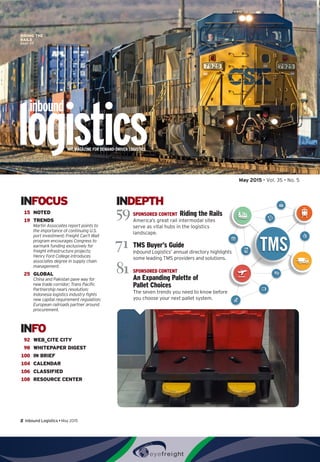
	59	SPONSORED CONTENT  Riding the Rails
America’s great rail intermodal sites
serve as vital hubs in the logistics
landscape.
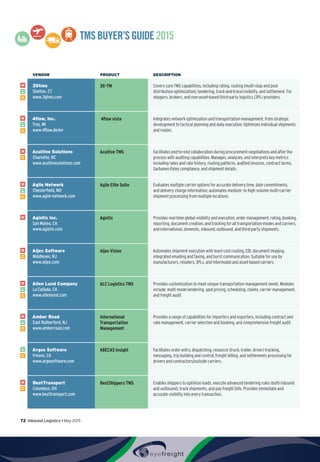
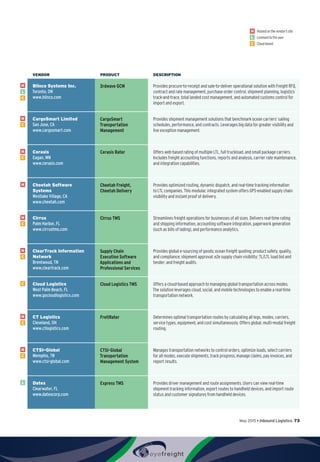
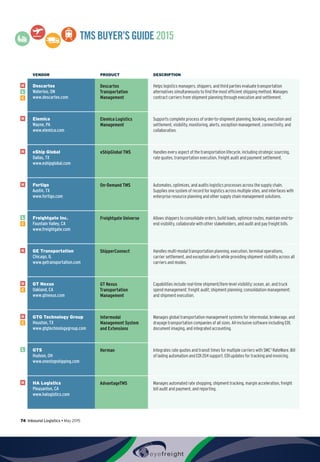
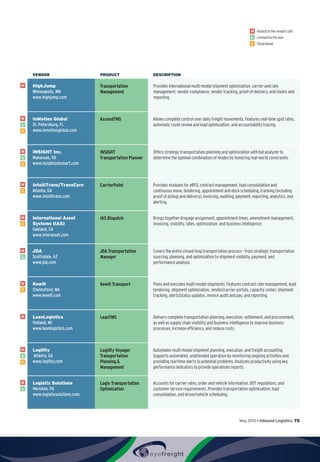
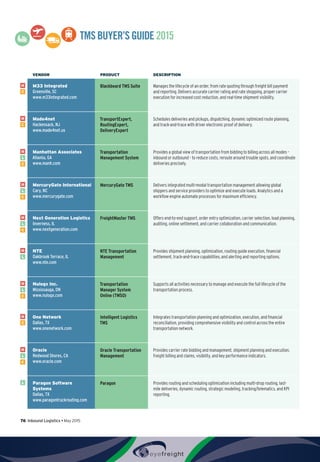
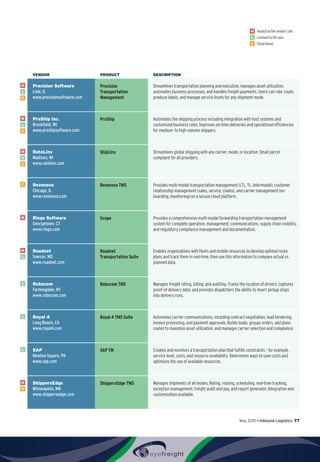
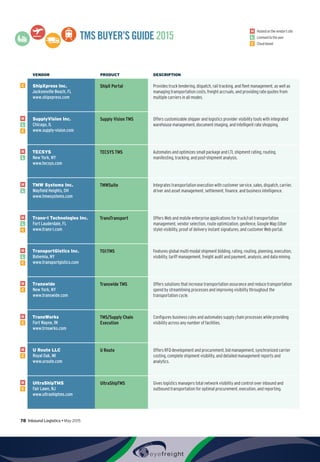
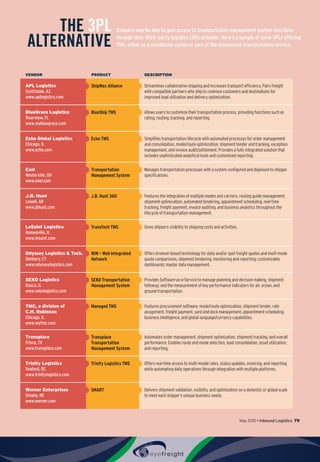
	71	TMS Buyer’s Guide
Inbound Logistics’ annual directory high­lights
some leading TMS providers and solutions.
	81	SPONSORED CONTENT  
An Expanding Palette of
Pallet Choices
The seven trends you need to know before
you choose your next pallet system.
THE MAGAZINE FOR DEMAND-DRIVEN LOGISTICS
INFOCUS
	 15 	NOTED
	 19	 TRENDS
Martin Associates report points to
the importance of continuing U.S.
port investment; Freight Can’t Wait
program encourages Congress to
earmark funding exclusively for
freight infrastructure projects;
Henry Ford College introduces
associates degree in supply chain
management.
	 25	 GLOBAL
China and Pakistan pave way for
new trade corridor; Trans Pacific
Partnership nears resolution;
Indonesia logistics industry fights
new capital requirement regulation;
European railroads partner around
procurement.
INFO
	 92	 WEB_CITE CITY
	 98 	WHITEPAPER DIGEST
	100 	IN BRIEF
	104	 CALENDAR
	106	 CLASSIFIED
	108	 RESOURCE CENTER
RIDING THE
RAILS
page 59
“Ashley takes care of us, and she is always quick to
respond to anything we send her—we know we
are in good hands when we send something to
her. She makes my job so much easier. Thanks to
Ashley, we are loyal C.H. Robinson customers.”
—C.H. Robinson chemical manufacturer customer
Ashley W.
Customer Account Manager
Bloomington, IL
REAL PEOPLE.
REAL IMPACT.
VOTE FOR C.H. ROBINSON AS YOUR #1 3PL
We strive to do more than simply get the job done.
We want to be an advantage to your company
by doing our best, so your supply chain can be
its best. Vote for C.H. Robinson in the Inbound
Logistics Top 10 3PL Excellence Awards to
support the real people making a real impact in
your company’s supply chain.
vote.chrobinson.com
© 2015 C.H. Robinson Worldwide, Inc. All Rights Reserved.
chrobinson_3pl_ad0515.indd 1 4/29/15 2:46 PMGot 3PL challenges?  Get free expert solutions at inboundlogistics.com/3pl
4  Inbound Logistics • May 2015
www.inboundlogistics.com
QUICKBYTES
2015 LOGISTICS PLANNER
Meet the leading logistics,
transportation, and supply chain
service providers; real estate
developers; port authorities;
materials handling equipment
companies; technology providers;
and more—all ready to help you
enhance your supply chain,
boost efficiency, cut costs, and
better serve your customers.
bit.ly/IL_2015Planner
LOGISTICS 
SUPPLY CHAIN NEWS
For up-to-the-minute information,
bookmark the IL news page.
Enjoy opinions, commentary, and
links to the latest news to help
you stay on top of your game.
bit.ly/IL-News
WEB_CITE CITY®
The most comprehensive and
clutter-free online directory of
supply chain websites — organized
by category, cross-referenced,
and fully searchable. You can
browse by category or search
for companies by name.
bit.ly/IL_WCC
ONLINE EXCLUSIVES
Communication is Key When Optimizing
Logistics Networks  bit.ly/1EUtwhQ
Jeff Vielhaber, Chief Operating Officer, TTS
The goal of optimization is to reduce costs while becoming more efficient.
But before you hire an analyst or invest in new technology to implement
your optimization plan, don’t forget about communication.
Improving Customer Satisfaction
With Consumer Engagement Apps bit.ly/1c1fSMM
Nate Henderson, Global Manager of BILT, SAP
Offering products with an accompanying app that provides interactive,
voice-guided assembly, repair, and installation instructions is a game
changer for manufacturers, and leaves retailers with satisfied customers. 
Manufacturing Skills Gap Calls for New
Approaches to Talent Development  bit.ly/1PeJZm2
Russ Rasmus, Managing Director, Operations/Manufacturing (pictured) and
David Smith, Senior Managing Director, Talent/Organization, Accenture Strategy
Manufacturers that invest in developing skills of new and incumbent
workers proactively position themselves to compete in today’s global
economy. Here’s a four-step process to stoke your pipeline with the talent
you need.
3PL RESOURCES
3PL Decision
Support Tool  bit.ly/IL3PLDST
Choose the services and capabilities you
need from a provider and the Decision
Support Tool will find matching companies.
You can even contact companies directly
through our linked RFP functionality.
3PL Request for
Proposal  bit.ly/IL3PLRFP
Describe your supply chain challenge, then
browse the list of top 3PLs. Select specific
companies to receive your RFP, and they’ll
provide free, no-obligation advice to meet
your logistics management needs.
Keep up to date with
the very latest:
  facebook.com/InboundLogistics
  @ILMagazine
 linkedin.com/company/
inbound-logistics
IMPROVING CUSTOMER
SATISFACTION WITH
CONSUMER ENGAGEMENT
APPS
bit.ly/1c1fSMM
Perform what-if analysis for
prepaid-to-collect conversion
on freight terms
Explore alternate methods
to maximize utilization of
private or contract fleets
Periodically realign static
routes to minimize travel,
accommodate variability
and improve service levels
Determine whether your
network could improve
service by altering facility
sourcing policies
TMS_Ad_PRINT_REV.indd 1 4/9/15 11:05 AM
Manhattan Associates Ad-PLACED 0415.indd 1 4/9/15 12:13 PMGot 3PL challenges?  Get free expert solutions at inboundlogistics.com/3pl
CHECKINGIN
by Felecia Stratton | Editor
Vol. 35, No. 5 May 2015
THE MAGAZINE FOR DEMAND-DRIVEN LOGISTICS
www.inboundlogistics.com
6  Inbound Logistics • May 2015
STAFF
PUBLISHER Keith G. Biondo
publisher@inboundlogistics.com
EDITOR Felecia J. Stratton
editor@inboundlogistics.com
MANAGING EDITOR Lauren Muskett
lmuskett@inboundlogistics.com
SENIOR WRITER Joseph O’Reilly
joseph@inboundlogistics.com
ASSOCIATE EDITOR Jason McDowell
jmcdowell@inboundlogistics.com
CONTRIBUTING EDITORS
Merrill Douglas • Lisa Terry
CREATIVE DIRECTOR Michael Murphy
mmurphy@thomaspublishing.com
ASSOC. ART DIRECTOR/
PRODUCTION MANAGER
Sean Doyle
sdoyle@inboundlogistics.com
DIGITAL DESIGN
MANAGER
Amy Palmisano
apalmisano@inboundlogistics.com
PUBLICATION MANAGER Sonia Casiano
sonia@inboundlogistics.com
CIRCULATION DIRECTOR Carolyn Smolin
SALES OFFICES
PUBLISHER: Keith Biondo
(212) 629-1560 • FAX: (212) 629-1565
publisher@inboundlogistics.com
WEST/MIDWEST/SOUTHWEST: Harold L. Leddy
(847) 446-8764 • FAX: (847) 305-5890
haroldleddy@inboundlogistics.com
Marshall Leddy
(612) 234-7436 • FAX: (847) 305-5890
marshall@inboundlogistics.com
SOUTHEAST: Gordon H. Harper
(404) 229-9691 • FAX: (404) 355-2036
south@inboundlogistics.com
MIDWEST/ECONOMIC DEVELOPMENT: Jim Armstrong
(314) 984-9007 • FAX: (314) 984-8878
jim@inboundlogistics.com
MOBILE, AL: Peter Muller
(251) 232-1920 • FAX: (251) 343-0541
petermuller@inboundlogistics.com
NORTHEAST: Rachael Sprinz
(212) 629-1560 • FAX: (212) 629-1565
rachael@inboundlogistics.com
FREE SUBSCRIPTIONS
www.inboundlogistics.com/free
Inbound Logistics supports sustainable best
practices. Our mission is rooted in helping companies
match demand to supply, eliminating waste from
the supply chain. This magazine is printed on paper
sourced from fast growth renewable timber.
Inbound Logistics welcomes comments and submissions. Contact us at
5 Penn Plaza, NY, NY 10001, (212) 629-1560, Fax (212) 629-1565, e-mail:
editorial@inboundlogistics.com.Foradvertising,reprint,orsubscription
information, call (212) 629-1560, or e-mail publisher@inboundlogistics.
com. Inbound Logistics is distributed without cost to those qualified
in North America. Interested readers must complete and return the
qualification card published in this issue, or may subscribe online at
www.inboundlogistics.com/free. Subscription price to others: in North
America: $95 per year. Foreign subscriptions: $229. Single copy price:
No. Amer. $10, foreign $19, back issues $15. Periodicals postage paid at
New York, NY, and additional mailing offices.
The Walls Come Tumbling Down
I
t might sound like two things I did this month—traveling to
Phoenix for ISM’s annual conference and working on this
Warehousing issue—have nothing in common. Ah, but they do.
What happens in the warehouse, the orchestration of products coming
in and going out to where they need to be, hinges on the convergence
of many functions—purchasing, finance, transportation, logistics, and
technology. And that convergence in the warehouse reflects what’s
happening in the larger sense in enterprises all over the world.
It’s also why the editor of a logistics/supply chain publication attended the
Institute for Supply Management’s (ISM) annual conference. There, I observed
purchasing, supply management, production, and inventory control professionals
embracing cross-functional cooperation. For example, I met with the 30 Under 30
Rising Supply Chain Stars winners, many of whom say that if their responsibilities
are broadened across the entire supply chain, they feel they have a better opportu-
nity to contribute, make a difference, and beneficially impact enterprise operations.
Driving this increase in cross-functional cooperation is a growing recognition
that linking supply functions with demand will benefit overall enterprise
performance. The industry organizations serving functions such as purchasing,
production, and supply, which traditionally had little direct involvement in
logistics operations, are recognizing this by starting to bring their members logistics
information, research, and, in some cases, certification.
At the conference, ISM CEO Tom Derry introduced the ISM Mastery Model,
which outlines new global standards of excellence for the supply management
profession. The free model outlines what it takes to be an exceptional supply
management professional. “This was not an ivory tower exercise within ISM,” Derry
says. “It was built on the knowledge provided by practitioners in the field.”
What it now takes to succeed in supply management is far different from what
it was decades ago. The Mastery Model’s new standards recognize that. But ISM
is not the only association bringing more logistics and supply chain information
to members. The recent merger between APICS and ASTL also illustrates how
hard and fast barriers between functions are coming down in recognition of today’s
global business realities. If industry associations support convergence by providing
the right kind of tools, such as the Mastery Model, they will create new value by
cross-pollinating each supply chain function.
Behind this convergence and cooperation is understanding that you have to
better match demand to supply to stay globally competitive. Industry associations
are encouraging it, and providing tools such as the Mastery Model to help supply
chain professionals excel in multi-disciplinary ways.  n
WHAT IF YOU COULD AVOID
COSTLY ________ AND
MAKE ________ MORE
ATTRACTIVE TO CARRIERS?
COSTLY ________ AND
ACCESSORIAL
MAKE ________ MORE
YOUR COMPANY NAME
Find out more at accelerateyouradvantage.com
800.323.7587 | solutions@chrobinson.com
ACCELERATE YOUR ADVANTAGE
®
© 2015 C.H. Robinson Worldwide, Inc. All Rights Reserved.
chrobinson_truck_ad0515.indd 1 4/29/15 2:44 PMGot 3PL challenges?  Get free expert solutions at inboundlogistics.com/3pl
DIALOGTHE ONGOING
CONVERSATION
Timothy LePage  @tplepage
13 APR 2015
Spotted a great @Staples program in
@ILMagazine’s “Trends” during some
light reading this weekend. bit.ly/1ciGslo
Inbound Logistics  @ILMagazine
15 APR 2015
Traditional Supply Chain Models Will
Be Extinct in 2025, Thanks to These 10
Disruptors – bit.ly/1yxmNRI
VChain Solutions  @VChain
Students looking to enter the field after
graduating, this is the future of the
supply chain. Will you be ready?
Inbound Logistics @ILMagazine
27 APR 2015
Offshore vs. Outsource for
Transportation  Logistics—
bit.ly/1Dsdvd3
Syed Qasim R Jafri @31Qasim
When offshore, it’s logical and cost
effective to outsource transport. Think
globally, but act locally.
Inbound Logistics 
27 APR 2015
Top 100 Logistics IT Providers  Market
Research Survey: bit.ly/1ciKCK0
GT Nexus
We are honored to be included on
your list!
Inbound Logistics
30 APR 2015
Time flies. Here’s a photo of our 2015
Top 100 Logistics IT Providers issue
(left), with its counterpart from 1999,
the first time we published a Top 100
Logistics IT Providers list. Believe it or
not, a handful of IT companies had the
staying power to be on both lists!
Hot Topics | IL articles getting the most impressions on LinkedIn: Six Secrets to
Controlling Supply Chain Costs Without Sacrificing Service: bit.ly/1uPBRi2 • Five Customs
Compliance Tips for Aerospace Companies: bit.ly/1ciKhqu • What is Globalization Doing to
the World of Logistics? bit.ly/1ACvSej • Top 100 Logistics IT Providers  Market Research
Survey: bit.ly/1ciKCK0 • Tracking Isn’t Just Tracking Anymore: bit.ly/1ciKEBs
Inbound Logistics  @ILMagazine
14 APR 2015
What do these dudes have to do
with logistics? Dematic scores ZZ
Top for its September conference!
www.mhlc.com
Know a Worthy
Supply Chain Student?
Pass this along. Inbound Logistics
and ASTL are now accepting
applications for their third-annual
Supply Chain Scholarship. As
part of the application process,
undergraduate students are
asked to submit a 2,000-
word essay on why they chose
logistics/supply chain as their
path of academic study, and how
they envision a career in the
industry impacting the company
they work for, as well as the U.S.
and global economy at large.
The winning student receives
a $2,500 scholarship. Inbound
Logistics will announce the
winner in our June 2015 issue.
For more information and an
application, email Laurie Denham
at ldenham@astl.org
Follow us:
  facebook.com/InboundLogistics
  twitter.com/ILMagazine
  linkedin.com/company/inbound-logistics
Drop us a line:
editor@inboundlogistics.com
or send snail mail to
Dialog, c/o Inbound Logistics
5 Penn Plaza, NY, NY 10001
8  Inbound Logistics • May 2015
© 2015 Prudential Financial, Inc. and its related entities. Prudential Real Estate Investors is a unit of Prudential Investment Management, Inc., a registered
investment adviser and a Prudential Financial company. Prudential, the Prudential logo, the Rock symbol, and PREI are registered service marks of Prudential
Financial, Inc. and its related entities, registered in many jurisdictions worldwide. KESW-9SAKGM
BRINGING A WORLD OF EXPERIENCE
TO INDUSTRIAL REAL ESTATE.
PRUDENTIAL REAL ESTATE INVESTORS
PREI has been investing in Latin America for more than a decade, and today we are one of the largest
international real estate investment managers in the region. Through Terrafina (BMV:TERRA13), a
Mexican real estate investment trust, we provide advisory services for 31 million square feet of
attractive, strategically located light manufacturing properties and other warehouses throughout the
Central, Bajio and Northern regions of Mexico. Managed by highly qualified industry specialists, and
supported by PREI’s global real estate platform, Terrafina aims to achieve successful performance of
its industrial real estate and land reserves.
PREI has invested in commercial real estate for more than 40 years. With investment and asset
management professionals based in 20 locations across the Americas, Europe and Asia Pacific, we
bring both global perspective and local market knowledge to real estate investment. For more
information, please contact Julien Higuero at Julien.Higuero@prudential.com or visit prei.com.
QUERETARO, MEXICO
Mexico Ad_V2.indd 1 1/8/2015 10:59:30 AMGot 3PL challenges?  Get free expert solutions at inboundlogistics.com/3pl
10TIPS
10  Inbound Logistics • May 2015
Improving Shipper/Carrier Relationships
F
rom shippers, receivers, and pur-
chasing agents to carriers and
third-party logistics companies,
everyone has an opinion on how to reduce
trucking costs. But they all agree that to
help save money, shippers should build
strong relationships with their less-than-
truckload (LTL) carriers. Mark Hamblin,
vice president of sales, west, for LTL car-
rier Saia, offers some advice on how to do
just that.
1
Work for a win-win. Work with your
carrier to determine which lanes and
freight work best. Carriers no longer
operate under the model of taking all the
freight offered to them. With the increase
of transportation management systems,
tighter driver availability, and growing
regulatory guidelines, it is essential to col-
laborate with carriers to ensure you are
adding profitable business to their network.
This will solidify a long-term relationship
that will save you from costly changeovers.
2
Follow through on commitments.
If you intend to hold your carriers to
their commitments, then you should
honor your commitments to them. Carriers
base their prices on the data you provide.
Supplying inaccurate data or not shipping
in the lanes and tonnages you commit to
could lead to renegotiation and changing
carriers sooner than you anticipated.
3
Provide data. Good data is impor-
tant to carriers during the bid process.
In addition to providing lane and ton-
nage data, you also need to provide freight
characteristic percentages and monthly
volumes. That information helps carriers
plan appropriately with regard to locations
and any specific freight characteristics, as
well as for seasonal changes in volume.
4
Share opportunities. When new
opportunities arise, bring them to your
partner carrier first. Everyone benefits
if you can come to an equitable agreement.
You benefit from a smooth transition and
save the time and expense of a formal RFP.
The carrier benefits by earning more of
your business.
5
Treat drivers well. Anything you
can do to make your facility more
driver-friendly helps your carriers
retain drivers, which reduces their operat-
ing costs to save money. A long-term driver
will know your business and your proce-
dures, and makes the pickup and delivery
process more efficient.
6
Mix it up. Talk to your carrier about
operational changes you can make
that won’t impact your operations. For
instance, if you already run a weekend shift,
why not offer weekend trailer swap options
to your carrier?
7
Plan. When you begin a new part-
nership, give the carrier time to get its
system ready and trained to take on the
new lanes and freight. Not doing so can get
the relationship off to a costly, rocky start.
8
Communicate. Shippers should hold
quarterly meetings with their carriers
to review performance metrics, and
new services and options, and to strengthen
the relationship. Business review meetings
should include discussions on high-cost
drivers, so strategies can be implemented
that reduce costs as opposed to raising rates.
Working together prior to renegotiation will
improve and solidify the partnership.
9
Use technology. Shippers expect
carriers to provide real-time data on
shipments, and carriers have gone
to great expense to do so. In return, ship-
pers should be willing to use programming
options that provide a smooth, accurate
transfer of data without requiring addi-
tional manual work on either side.
10
Monitor interactions. Ensure
you provide accurate information
and that customers are treated with
respect. A good relationship at all levels of
the organization is the best way to ensure
the shipper/carrier partnership is strong
and healthy, which reduces costs and
improves service. n
STEP-BY-STEP SOLUTIONS
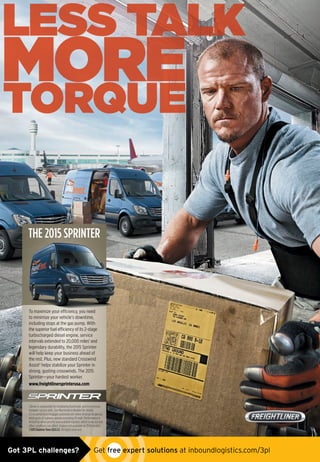
To maximize your efficiency, you need
to minimize your vehicle’s downtime,
including stops at the gas pump. With
the superior fuel efficiency of its 2-stage
turbocharged diesel engine, service
intervals extended to 20,000 miles1
and
legendary durability, the 2015 Sprinter
will help keep your business ahead of
the rest. Plus, new standard Crosswind
Assist2
helps stabilize your Sprinter in
strong, gusting crosswinds. The 2015
Sprinter—your hardest worker.
www.freightlinersprinterusa.com
THE 2015 SPRINTER
ToTTT mmmaxaxaximiiimizizee yoyourur eeffifficcieiencncy,y,y yyouou nnnneeeee ddd
THE 2015 SPRINTER
1 Driver is responsible for monitoring fluid levels and tire pressure
between service visits. See Maintenance Booklet for details.
2 Crosswind Assist engages automatically when sensing dangerous
wind gusts at highway speeds exceeding 50 mph. Performance is
limited by wind severity and available traction, which snow, ice and
other conditions can affect. Feature not available on 3500 models.
©2015 Daimler Vans USA LLC. All rights reserved.
FTL_1P_Inbound Logistics_FLEET_7.875x10.75in_2014.indd 1 1/29/15 3:17 PM
Got 3PL challenges?  Get free expert solutions at inboundlogistics.com/3pl
as told to Merrill Douglas
R E A D E R
PROFILE
12  Inbound Logistics • May 2015
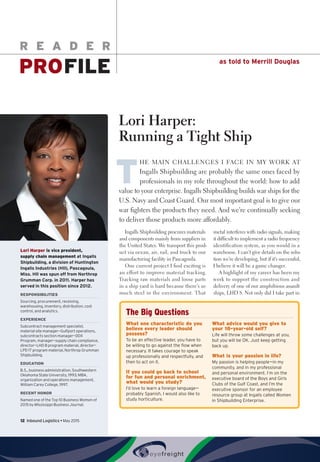
Lori Harper:
Running a Tight Ship
T
HE MAIN CHALLENGES I FACE IN MY WORK AT
Ingalls Shipbuilding are probably the same ones faced by
professionals in my role throughout the world: how to add
value to your enterprise. Ingalls Shipbuilding builds war ships for the
U.S. Navy and Coast Guard. Our most important goal is to give our
war fighters the products they need. And we’re continually seeking
to deliver those products more affordably.
Ingalls Shipbuilding procures materials
and components mainly from suppliers in
the United States. We transport this prod-
uct via ocean, air, rail, and truck to our
manufacturing facility in Pascagoula.
One current project I find exciting is
an effort to improve material tracking.
Tracking raw materials and loose parts
in a ship yard is hard because there’s so
much steel in the environment. That
metal interferes with radio signals, making
it difficult to implement a radio frequency
identification system, as you would in a
warehouse. I can’t give details on the solu-
tion we’re developing, but if it’s successful,
I believe it will be a game changer.
A highlight of my career has been my
work to support the construction and
delivery of one of our amphibious assault
ships, LHD 8. Not only did I take part in
Lori Harperis vice president,
supply chain managementat Ingalls
Shipbuilding, a division of Huntington
Ingalls Industries (HII), Pascagoula,
Miss. HII was spun off from Northrop
Grumman Corp. in 2011. Harper has
served in this position since 2012.
RESPONSIBILITIES
Sourcing, procurement, receiving,
warehousing, inventory, distribution, cost
control, and analytics.
EXPERIENCE
Subcontract management specialist,
material site manager—Gulfport operations,
subcontracts section manager—DDX
Program, manager—supply chain compliance,
director—LHD 8 program material, director—
LPD 17 program material, Northrop Grumman
Shipbuilding.
EDUCATION
B.S., business administration, Southwestern
Oklahoma State University, 1993; MBA,
organization and operations management,
William Carey College, 1997.
RECENT HONOR
Named one of the Top 10 Business Women of
2015 by Mississippi Business Journal.
The Big Questions
What one characteristic do you
believe every leader should
possess?
To be an effective leader, you have to
be willing to go against the flow when
necessary. It takes courage to speak
up professionally and respectfully, and
then to act on it.
If you could go back to school
for fun and personal enrichment,
what would you study?
I’d love to learn a foreign language—
probably Spanish. I would also like to
study horticulture.
What advice would you give to
your 18-year-old self?
Life will throw some challenges at you,
but you will be OK. Just keep getting
back up.
What is your passion in life?
My passion is helping people—in my
community, and in my professional
and personal environment. I’m on the
executive board of the Boys and Girls
Clubs of the Gulf Coast, and I’m the
executive sponsor for an employee
resource group at Ingalls called Women
in Shipbuilding Enterprise.
procuring materials, but I practically lived
on the ship for almost two years. I attended
daily meetings there, and went out on the
sea trials. We usually spent 16 or 17 hours
daily on board. It was incredibly rewarding.
Because this project was so important,
we implemented some unusual strategies.
For example, we stationed a supply chain
tiger team at the waterfront to provide
immediate support. Some of our suppliers
established operations on site. When you’re
testing a ship, inevitably some components
will not function exactly as needed. So it’s
critical to have suppliers there to help with
repairs and provide parts.
Throughout my career, I’ve had to
learn to adjust, think on my feet, and
figure out solutions to unexpected chal-
lenges. One early lesson in dealing with
the unexpected was when I served as the
Mississippi lead on the construction of a
petrochemical plant.
I was the only woman on site for several
months. In all the planning we did for that
greenfield project, no one thought about
providing a women’s restroom trailer. We
ended up ordering a single-person unit for
my use.
That’s just an example of the things you
have to consider as women start taking on
leadership roles where we haven’t in the
past. Being one of the first is a challenge,
but it’s also a phenomenal opportunity to
learn from others, and for the men I work
with to learn from me. I also enjoy being
able to open doors for other women. n
As your comprehensive cross-border
delivery partner, Holland has the
experience, network and equipment
to make supply chains – to and from
Canada – run smoothly. We provide:
• More next-day lanes
• Greater second-day reach
• Guaranteed service options
(to select destinations)
Holland also works with customs
brokers for pre-arrival clearance, so
goods are immediately accessible
for customer delivery.
Want to know more?
Call 866.465.5263 or go to
hollandregional.com for details!
hollandregional.com/social
866.465.5263
©2015 YRC Worldwide Inc.
COMPLETE
CANADA
SERVICEFrom customs to customers.
15HOl023_HollandCanadaAd_HP_InboundLogistics.indd 1 5/4/15 4:01 PM
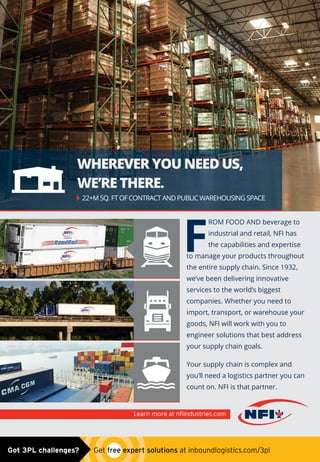
Learn more at nfiindustries.com
ROM FOOD AND beverage to
industrial and retail, NFI has
the capabilities and expertise
to manage your products throughout
the entire supply chain. Since 1932,
we’ve been delivering innovative
services to the world’s biggest
companies. Whether you need to
import, transport, or warehouse your
goods, NFI will work with you to
engineer solutions that best address
your supply chain goals.
Your supply chain is complex and
you’ll need a logistics partner you can
count on. NFI is that partner.
WHEREVER YOU NEED US,
WE’RE THERE.
F
22+M SQ. FT OF CONTRACT AND PUBLIC WAREHOUSING SPACE
Trim Edge Warning-NFI.indd 1 5/4/15 9:11 AMGot 3PL challenges?  Get free expert solutions at inboundlogistics.com/3pl
May 2015 • Inbound Logistics 15
NOTEDThe Supply Chain In Brief
INFOCUS
UP THE CHAIN
Craig Marton is joining
3PL Sunset Transportation
as president, and COO and
founder Jim Williams will
transition to chairman and
CEO. Marton leads day-to-day
business operations, strategic
planning, and implementation,
while Williams advises
on strategic decisions
and focuses on business
development and acquisitions.
GOOD WORKS
Crowley Maritime provided
shipping for a donated mobile
health clinic from the Blood
Alliance of Northeast Florida
to Haiti. The mobile health clinic
will serve more than three million
people.
Materials handling company The
Raymond Corporation donated
16 pallets of nonperishable
food and personal care items
to the Addison Community
Switchboard – an Addison, Ill.-
based non-profit organization that
provides emergency assistance to
residents.
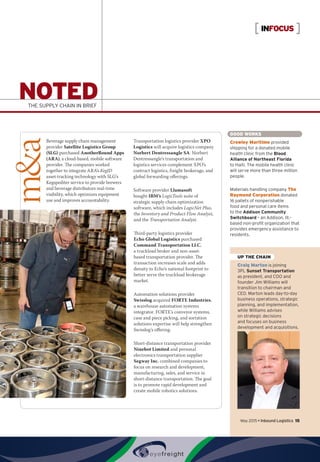
Beverage supply chain management
provider Satellite Logistics Group
(SLG) purchased AnotherRound Apps
(ARA), a cloud-based, mobile software
provider. The companies worked
together to integrate ARA’s KegID
asset-tracking technology with SLG’s
Kegspediter service to provide brewers
and beverage distributors real-time
visibility, which optimizes equipment
use and improves accountability.
Transportation logistics provider XPO
Logistics will acquire logistics company
Norbert Dentressangle SA. Norbert
Dentressangle’s transportation and
logistics services complement XPO’s
contract logistics, freight brokerage, and
global forwarding offerings.
Software provider Llamasoft
bought IBM’s LogicTools suite of
strategic supply chain optimization
software, which includes LogicNet Plus,
the Inventory and Product Flow Analyst,
and the Transportation Analyst.
Third-party logistics provider
Echo Global Logistics purchased
Command Transportation LLC,
a truckload broker and non-asset-
based transportation provider. The
transaction increases scale and adds
density to Echo’s national footprint to
better serve the truckload brokerage
market.
Automation solutions provider
Swisslog acquired FORTE Industries,
a warehouse automation systems
integrator. FORTE’s conveyor systems,
case and piece picking, and sortation
solutions expertise will help strengthen
Swisslog’s offering.
Short-distance transportation provider
Ninebot Limited and personal
electronics transportation supplier
Segway Inc. combined companies to
focus on research and development,
manufacturing, sales, and service in
short-distance transportation. The goal
is to promote rapid development and
create mobile robotics solutions.
recognition
Ocean carrier Evergreen
Shipping Agency (America)
Corporation named CN its
2014 Railroad Company of
the Year. CN was recognized
for its consistent high level
of performance and excellent
quality, service, and support.
Kristy Knichel, president
of Knichel Logistics, was
presented the inaugural
Distinguished Woman in
Logistics award. Established
by the Women in Trucking
Association, the award
promotes the achievements
of women in transportation.
APL Logistics VASCOR
Automotive, a specialist
provider of automotive
logistics services in India,
was presented with the Best
Emerging Player award
from the Indian Chamber
of Commerce. The award
recognizes APL for its multi-
modal logistics solutions for
the distribution of finished
vehicles across India.
Union Pacific Railroad
received 2014 Logistics
Excellence Awards in
customer service and
service performance from
Toyota Logistics Services.
The awards were based on
the railroad’s commitment
to service, ranging from
customized logistics to
reliable equipment.
16  Inbound Logistics • May 2015
INFOCUS NOTEDThe Supply Chain In Brief
GREEN SEEDS
The U.S. Environmental
Protection Agency honored
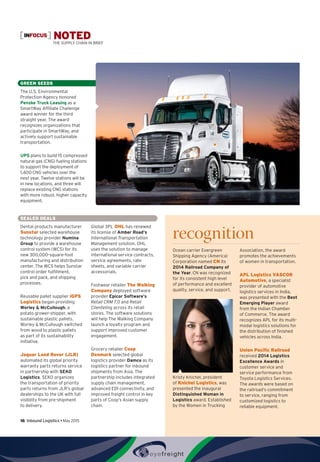
Penske Truck Leasing as a
SmartWay Affiliate Challenge
award winner for the third
straight year. The award
recognizes organizations that
participate in SmartWay, and
actively support sustainable
transportation.
UPS plans to build 15 compressed
natural gas (CNG) fueling stations
to support the deployment of
1,400 CNG vehicles over the
next year. Twelve stations will be
in new locations, and three will
replace existing CNG stations
with more robust, higher capacity
equipment.
SEALED DEALS
Dental products manufacturer
Sunstar selected warehouse
technology provider Numina
Group to provide a warehouse
control system (WCS) for its
new 300,000-square-foot
manufacturing and distribution
center. The WCS helps Sunstar
control order fulfillment,
pick and pack, and shipping
processes.
Reusable pallet supplier iGPS
Logistics began providing
Worley  McCullough, a
potato grower-shipper, with
sustainable plastic pallets.
Worley  McCullough switched
from wood to plastic pallets
as part of its sustainability
initiative.
Jaguar Land Rover (JLR)
automated its global priority
warranty parts returns service
in partnership with SEKO
Logistics. SEKO organizes
the transportation of priority
parts returns from JLR’s global
dealerships to the UK with full
visibility from pre-shipment
to delivery.
Global 3PL OHL has renewed
its license of Amber Road’s
International Transportation
Management solution. OHL
uses the solution to manage
international service contracts,
service agreements, rate
sheets, and variable carrier
accessorials.
Footwear retailer The Walking
Company deployed software
provider Epicor Software’s
Retail CRM 7.0 and Retail
Clienteling across its retail
stores. The software solutions
will help The Walking Company
launch a loyalty program and
support improved customer
engagement.
Grocery retailer Coop
Denmark selected global
logistics provider Damco as its
logistics partner for inbound
shipments from Asia. The
partnership includes integrated
supply chain management,
advanced EDI connectivity, and
improved freight control in key
parts of Coop’s Asian supply
chain.
DELAYS CAN COST YOU.
That’s why Penske has truck leasing and logistics solutions to help
put business problems behind you. So you can keep moving forward.
Visit gopenske.com or call 844-868-0816 to learn more.
© 2015 Penske. All Rights Reserved.
3721A0039_7.875x10.75_Flowers_Enterprise_1.indd
penske_flowers_ad0515.indd 1 4/30/15 10:40 AMGot 3PL challenges?  Get free expert solutions at inboundlogistics.com/3pl
WEB INTEGRATED NETWORK (WIN)
WIN IS NOT A TMS – IT’S BETTER!
 No upfront costs - No maintenance fees -
No transaction fees
 Easy-to-Use browser-based toolset
 Access your carrier network
plus WIN’s carrier network
plus Market-Leading Broker carrier networks
 Simple and quick ERP integration
through partnership
WHAT DOES WIN OFFER?
 Lower freight costs
 Single source for transportation
management
 Optimum rate selection
 Additional capacity
 In-Transit Track and Trace
 Rating and Tendering
 Network visibility
WIN is a product of Odyssey Logistics  Technology
Corporation. Gain capacity and access to the rates and
resources of Odyssey’s nearly two billion-dollar transportation
network of over 520,000 lanes and 2,700 carriers.
Visit us at www.gowithwin.com
or call 855-946-4739
Global Headquarters
39 Old Ridgebury Road
Danbury, CT 06810
Toll Free: 855.946.4739
info@gowithwin.com© 2015 Odyssey Logistics  Technology Corporation. All rights reserved.
through partnership
SCHEDULE A DEMO NOW!
Transportation Management Simplified
Odyssey_WIN_Inbound_Logistics_MAY.indd 1 4/23/15 2:35 PMOdyssey_win_ad0515.indd 1 5/4/15 9:36 AMGot 3PL challenges?  Get free expert solutions at inboundlogistics.com/3pl
TRENDSSHAPING THE FUTURE OF LOGISTICS
INFOCUS
May 2015 • Inbound Logistics 19
by Joseph O’Reilly
U.S. Ports Critical
To Sustained Economic Growth
Transportation budgeting at the state and federal levels has become a contentious battleground
as politicians and private sector lobbyists search for new funding mechanisms to execute much-
needed infrastructure upgrades. One point of consensus is that U.S. ports are key to sustained
economic growth—and therefore should be a priority on a very long legislative to-do list.
Martin Associates’ latest report, the 2014 National Economic Impact of the U.S. Coastal Port
System, documents the contributions of America’s seaports to the nation’s economy over the
past seven years.
From 2007 to 2014, the total economic value that U.S. coastal ports provided in terms of rev-
enue to businesses, personal income, and economic output rose 43 percent to $4.6 trillion. This
accounts for 26 percent of the nation’s $17.4-trillion economy in 2014, up from 20 percent of its
$16.1-trillion economy in 2007. Growth was robust in spite of the global recession, which damp-
ened cargo volumes between 2008 and 2012.
INFOCUS TRENDSSHAPING THE FUTURE OF LOGISTICS
Among other notable gains since 2007:
■■ Federal, state, and local tax revenues
generated by the port sector and importer/
exporter revenues rose 51 percent to
$321.1 billion.
■■ Jobs generated by port-related activity
jumped 74 percent to 23.1 million.
■■ Personal wages and local consump-
tion related to the port sector doubled to
$1.5 billion, with the average annual salary
of those directly employed by port-related
businesses equaling $53,723.
“The growth in jobs and economic
importance of America’s seaports reflects
the fact that the value of international
cargo handled at these ports increased by
$400 billion since 2007, reaching about
$1.8 trillion in 2014,” says John Martin,
president of the transportation consultancy.
“It’s important to emphasize that the key
growth in our international trade is in U.S.
exports, which saw a 60-percent increase
in value over the past seven years,” he adds.
Each dollar increase in the value of
export cargo supports significantly more
jobs in the United States than does a dol-
lar value of growth in imports.
“The growth in the contributions of our
ports to the nation’s economy underscores
the need to invest in infrastructure and
technology to support and foster good jobs,
national security, international trade, and
our standard of living,” adds Martin.
To that end, the American Association
of Port Authorities forecasts that ports need
to invest upwards of $30 billion by 2025
to maintain U.S. competiveness on today’s
global stage.
CAGT: Freight
Can’t Wait
The U.S. transportation and logistics
sector, and business interests in general,
have long been challenged by a public sec-
tor that continues to siphon transportation
revenues for other purposes. While some
states are cracking down on wandering
funds and specifically earmarking capital
for infrastructure projects, others remain
mired in pork barrel wheeling and dealing,
even as gas-tax revenues dry up.
To raise awareness of this problem, the
Washington, D.C.-based Coalition for
America’s Gateways  Trade Corridors
(CAGT) has introduced a “Freight Can’t
Wait” campaign to encourage Congress to
pass a surface transportation law that con-
tains a fully funded freight grant program.
“Freight infrastructure needs dedicated
funding. Establishing a competitive grant
program with broad, multimodal project
eligibility throughout the United States is a
priority for our coalition, and should be for
Henry Ford College Produces
Supply Chain Professionals
T
he past decade has seen a renaissance in supply chain and logistics
curriculum—a trend that continues today unabated. But as the
manufacturing and supply chain sectors encounter a growing labor
shortage, a widening gap is looming on the logistics frontline.
Increasingly, there is a move to bring supply chain education and career
development to high schools, vocational schools, and community colleges—
introducing a new generation of students and workers to an industry brimming
with job opportunities.
Henry Ford College, a public two-year college in Dearborn, Mich., is
seizing upon the legacy of its namesake to create an associate
degree program in supply chain management, as well as
a new SCM technician certificate through its business
and computer technology division. The new
curriculum will begin during the fall 2015
semester.
True to its mission, the college has
traditionally offered training and apprenticeship
programs for students involved in skilled trades. The
supply chain program will expand upon this foundation, as well as augment the
scope of its career development offerings.
“The purpose of this supply chain management program is to create job
opportunities for our students,” says Henry Ford College business instructor
Douglas Langs, a 22-year veteran of General Motors. “It prepares students to
obtain a job once they graduate with either their associate degree or certificate.”
Alternatively, it also provides a pathway for associate degree graduates to
continue their supply chain education elsewhere.
Case in point: Henry Ford College alumnus Ben Topping is currently studying
supply chain management at Wayne State University. Topping’s interest was
sparked by Langs’ capstone business course, which featured supply chain
management.
“During the first day of class, Professor Langs placed a small piece of chocolate
in front of each student, and we spent the entire 90-minute class discussing
where every ingredient of that chocolate—cacao, sugar, milk, aluminum for the
wrapper, paper for the tag—originated, as well as how it arrived in Hershey, Pa.,”
recalls Topping.
“Because I was already familiar with the basics of logistics, purchasing,
warehousing, and distribution, I was able to dive deeper into the field, enhancing
my learning,” he adds.
20  Inbound Logistics • May 2015
Untitled-2 1 5/12/15 10:53 AMkenco_proof_ad0515.indd 1 5/12/15 11:26 AMGot 3PL challenges?  Get free expert solutions at inboundlogistics.com/3pl
INFOCUS TRENDSSHAPING THE FUTURE OF LOGISTICS
our country also,” explains Leslie Blakey,
the coalition’s executive director.
The campaign features 36 gateway and
corridor projects of national significance
that would improve freight hubs, and sea
and land gateways, and augment roadway
capacity to ease freight chokepoints.
As part of this call to action, coalition
members are voicing their support for
the Economy in Motion: The National
Multimodal and Sustainable Freight
Infrastructure Act (H.R. 1308), a bill
introduced by U.S. Rep. Alan Lowenthal
(D-Calif.) that would dedicate $8 billion
per year to freight-related infrastruc-
ture projects.
The legislation prioritizes multimodal
projects, in addition to projects that help
relieve bottlenecks in the freight transpor-
tation system.
3D Printing
Moving Fast—in 1D
In the world of disruptive technology, 3D
printing might be the most unsettling
innovation to come down the pipe­line
since radio-frequency identification—​unset-
tling in the sense that industry is still
debating how much and to what degree
additive manufacturing will revolutionize
supply chains. Like RFID, 3D printing has
a lot of hype to live up to.
Manufacturers are privately toying and
tinkering with prototypes they believe will
eventually change the way they do busi-
ness. Many are keeping their progressions
close to the vest. Intellectual property
rights remain an unexplored minefield for
this nascent technology.
But as companies continue to proto-
type 3D printing technology, some are
discovering an unexpected and welcome
benefit. They are learning how to engineer
improved products, with different materials
and less waste.
For example, Fiat Chrysler Automobiles
(FCA) is using 3D printing to better under-
stand axle design and development. At
the Chrysler Technology Center (CTC)
in Auburn Hills, Mich., engineers are
using additive manufacturing to print see-
through plastic parts exclusively for test
purposes. When evaluating oil flow inside
axles, engineers traditionally had to cut
out two-dimensional windows in compo-
nents to visually inspect performance—but
this process often provided unsatisfac-
tory results.
The CTC is the auto industry’s only
headquarters where a vehicle design can
go from a napkin sketch to production pro-
totype to advertising campaign under one
roof, according to FCA officials.
“The Chrysler Technology Center is a
key competitive advantage for FCA US,”
says John Nigro, vice president, prod-
uct development. “We have more than
14,000 people under one roof, including
7,900 engineers. That speeds the collab-
orative process, which is the lifeblood of
our business.”
Chrysler’s example provides a good
idea of how 3D printing is likely to make
an initial step-change impact within the
manufacturing supply chain—helping
to hasten the process from design to the
assembly line.
McDonald’s Serves Up
New Sustainable Sourcing
Commitment
F
ood safety, quality, and accountability have long been
a challenge for restaurant chains—especially those that
prioritize economy. Increasing social media exposure,
and the threat of product recalls and brand integrity, are
shared risks. But some chains are addressing these issues
head on to appeal to consumer tastes for sustainability and
transparency.
McDonald’s has long touted sustainable sourcing as a
core principle within its supply chain. The Oak Brook, Ill.-
headquartered restaurant chain recently upped the ante with a pledge to lessen
its global impact on deforestation. The effort will cover all McDonald’s products
with a specific focus on beef, fiber-based packaging, coffee, palm oil, and poultry.
The company will continue working collaboratively with a broad range of
stakeholders, including suppliers, governments, and NGO partners, to develop
long-term solutions designed to combat deforestation around the world.
As part of this commitment, McDonald’s will apply several guiding principles
and practices across its supply chain:
■■ No deforestation of primary forests or areas of high conservation value.
■■ No development of high carbon stock forest areas.
■■ No development on peatlands, regardless of depth, and the utilization of best
management practices for existing commodity production on peatlands.
■■ Respect human rights.
■■ Respect the right of all affected communities to give or withhold their free,
prior, and informed consent for plantation developments on land they own
legally, communally, or by custom.
■■ Resolve land rights disputes through a balanced and transparent dispute
resolution process.
■■ Verify origin of raw material production.
■■ Support smallholders, farmers, plantation owners, and suppliers to comply
with this commitment.
22  Inbound Logistics • May 2015
U.S. Trucking Industry: Keep the Change
Change is accelerating within the U.S.
trucking industry, says a new study
from TMW Systems. The 2014 TMW
Transportation  Logistics Study cites
improved asset utilization and financial per-
formance among many carriers. Brokerage
and non-asset service providers also find
greater value leveraging developed carrier
networks to achieve stronger gross margins.
Among other insights:
Driver Retention. Survey responses
under­score the clear relationship
between driver wages and retention.
Length of haul and utilization are other
important factors in driver turnover.
Asset Utilization. Survey respondents
are successfully leveraging new technol-
ogy to achieve gains in utilization. As
one example, dedicated fleets that utilize
planning optimization experienced an
average year-over-year increase of 142 rev-
enue miles per seated truck per week.
Rates. Truckload carriers averaged
seven-percent net rate increases, a trend of
interest for brokerage and third-party logis-
tics providers, as well as shippers.
Fleet Maintenance. There is greater
difficulty gaining visibility into equipment
maintenance metrics than any other func-
tional area, and most respondents indicate
they do not adequately track maintenance
costs by equipment age group.
Operating Ratios. A majority of par-
ticipating asset-based businesses report
operating ratios of 96 percent or lower, a
healthy increase over 2013’s results.
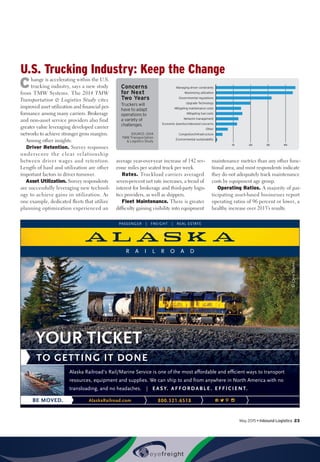
10 20 30 40
Managing driver constraints
Maximizing utilization
Governmental regulations
Upgrade Technology
Mitigating maintenance costs
Mitigating fuel costs
Network management
Economic downturn/demand concerns
Other
Congestion/infrastructure
Environmental sustainability
Concerns
for Next
Two Years
Truckers will
have to adapt
operations to
a variety of
challenges.
SOURCE: 2014
TMW Transportation
 Logistics Study
May 2015 • Inbound Logistics 23
©ChrisStarnesChrisStarnes
R A I L R O A D
PASSENGER | FREIGHT | REAL ESTATE
YOUR TICKET
TO GETTING IT DONE
800.321.6518AlaskaRailroad.comBE MOVED.
Alaska Railroad’s Rail/Marine Service is one of the most affordable and efficient ways to transport
resources, equipment and supplies. We can ship to and from anywhere in North America with no
transloading, and no headaches. | EASY. AFFORDABLE. EFFICIENT.
14-ARRC-1271 FREIGHT-INBOUND-OCT-spawn ideas-3A_AB.indd 1 9/18/14 9:41 AM
We’re Going Deeper. See how.
SCSPA.com
In two years, the Port of Charleston increased its rail volume 50%. Combining daily intermodal rail
service with a RapidRail dray system means a faster, more cost-competitive connection between ship
and rail hubs across the Southeast, Gulf and Midwest. Couple this with the region’s deepest channels,
and you now have the smartest and most efficient way to reach markets around Memphis, Atlanta,
Birmingham, Nashville, Charlotte, Louisville, Huntsville, the new Inland Port in Greer, SC, and beyond.
RAIL READY.
FULLY LOADED.
9818-01-PORT-Rail_Ready-FP-4C-Inbound_Logisitics-FINAL.indd 1 9/18/14 5:03 PM
south carolina ports_rail ready_ad0515.indd 1 5/4/15 10:55 AMGot 3PL challenges?  Get free expert solutions at inboundlogistics.com/3pl
GLOBALTHE WORLD AT A GLANCE by Joseph O’Reilly
China Picks Pakistan for Trade Corridor
China’s “global diplomacy” holds few
bounds. From Central and South America
to Africa, the country has been aggressively
asserting its influence and injecting capi-
tal into new infrastructure developments
that also pave the way for further commod-
ity sourcing.
But China’s impact in Asia is far greater,
especially as it relates to intra-regional
trade development. The country’s most
recent quarry is Pakistan, where Chinese
President Xi Jinping recently paid a visit.
Pakistan is seeking Chinese investment
(upwards of $46 billion) to help fund
needed infrastructure projects—notably
the Karakoram Highway connection to the
southern port of Gwadar and a cross-border
rail route between the two countries. Like
others before, Pakistan believes Chinese
money, clout, labor, and reputation for get-
ting things done quickly will help spur and
expedite development.
The outlay China is willing to invest in
Pakistan is more than twice the amount
of all foreign direct investment the coun-
try has received since 2008, according to
BBC reporting. Such an immediate infu-
sion of capital has Pakistan officials bullish
on making the partnership work.
Opening up a southwestern trade
corridor similarly benefits China. As man-
ufacturing moves westward, Pakistani
ports provide a more efficient and eco-
nomic means to move product. China is
also looking to forge a new Silk Road that
extends to the Middle East and Europe.
Pakistan is the world’s sixth-largest
country in terms of population. China
may similarly see Pakistan’s tenuous and
contentious relationship with India as
an opportunity to make new inroads as
competition between the two global jug-
gernauts stiffens. Pakistan, for its part, will
also benefit politically by having a closer
ally in China.
Still, the development plan is not with-
out considerable roadblocks. Provincial
politics in Pakistan, and the threat of sepa-
ratist insurgency, have cast shade on the
proposal. The Gwadar port is located in
Balochistan, which is Pakistan’s poorest
China is funding a construction
project to renovate a stretch
of the Karakoram Highway,
which is currently the only
overland connection between
China and Pakistan.
May 2015 • Inbound Logistics 25
INFOCUS
INFOCUS GLOBALTHE WORLD AT A GLANCE
and most volatile province. Government is
already steering corridor routing away from
the area, which has only fueled criticism
from Balochistan officials who argue the
more affluent Punjab Province will invari-
ably receive special privilege.
Indonesian
Logistics:
What’s It All
About, ALFI?
Transportation in Indonesia is a fore-
most challenge for shippers, given its
unique geography as an archipelago
comprising 18,000 islands. Keeping logis-
tics costs in check has been a recurring
problem that has beset Southeast Asia’s sec-
ond-largest economy. Poor infrastructure
and overreaching regulations have further
conflated costs of doing business.
While the country appeared to be mak-
ing progress under the leadership of new
President Joko Widodo—“A New Hope” as
branded by Time magazine—optimism is
beginning to wane. The commodity-driven
economy has taken a big hit because of
global oil price volatility.
To make matters worse, a new govern-
ment regulation has raised the minimum
capital for logistics companies to oper-
ate from US$15,000 to nearly $2 million,
much to the consternation of local logis-
tics service providers. Consequently, the
Indonesian Logistics and Forwarders
Association (ALFI) plans to file a lawsuit.
“We previously proposed to the transpor-
tation ministry an increase in minimum
total assets from $15,000 to approximately
$100,000,” says ALFI chairman Yukki
Nugrahawan Hanafi. “We don’t under-
stand the reason why the minister later
decided to increase the capital require-
ment to $2 million.”
Because of its transportation constraints,
and the costs therein, Indonesian eco-
nomic development is highly dependent
on the growth of its emerging logistics
industry. ALFI contends such regulation
would shut down many of the small and
mid-sized forwarders and service providers
that operate across the country, contribut-
ing to thousands of lost jobs. It estimates
that the transportation and logistics
industry in Indonesia employs about
534,000 people. Moreover, such a draco-
nian capital requirement would disrupt the
flow of cargo moving through the country,
while increasing costs.
The government is committed to
European railroads Bombardier Transportation, SNCF, and Deutsche Bahn are
among the founding members of the Railsponsible initiative.
European Railroads Partner
Around Procurement
European railroads have a one-track mind when it comes to growing
sustainable supply chain best practices. A group of six carriers—Alstom
Transport, Bombardier Transportation, Deutsche Bahn, Knorr-Bremse,
Nederlandse Spoorwegen and SNCF—recently partnered to promote
sustainable procurement in the railroad supply chain.
The initiative, titled “Railsponsible,” endeavors to create more ethical,
social, and environmental business practices among suppliers. The railroads
will encourage supplier participation in assessment campaigns, as well as hold
quarterly membership meetings to share best practices, analyze data, and
identify opportunities for supply chain improvement.
The group’s first priority is to promote supplier assessments, which will
be conducted by EcoVadis, a Paris, France-based supply chain sustainability
integrator. Partners will be required to submit one common questionnaire,
and will have full control over who can see their information and assessment
results. They can opt to share this information with any of the Railsponsible
members who are their customers.
26  Inbound Logistics • May 2015
Look at your world through fresh eyes. Think Young.
You’ll see not just logistics as usual,
but a flexible response to the unusual.
Not just getting it there, but making
sure nothing gets in the way. Not just
the routine black and white, but all
those gray areas in between.
This is the world according to DF Young.
Look to us for a century’s worth of
sophistication, experience and excellence
in international logistics. By sea, by
land and by air. Think Young.
Celebrating 100 years dfyoung.com
global reach solution oriented fortune 500 clients forward vision 360-degree flexibility technology driven worlds of experience
Got 3PL challenges?  Get free expert solutions at inboundlogistics.com/3pl
INFOCUS GLOBALTHE WORLD AT A GLANCE
moving forward with the new regulation—
a policy change that it believes will raise
the quality and reliability of the country’s
logistics sector. Companies will be given
three years to comply. The regulation is
currently with the Law and Human Rights
Ministry for further assessment.
Even with such a grace period for com-
pliance, ALFI argues that most companies
won’t be able to meet that requirement.
Instead it has suggested that the govern-
ment should classify logistics companies
by size rather than applying one set of reg-
ulations across the entire industry.
U.S.  Japan
Near TPPing
Point
The United States and Japan are still
at loggerheads over automobile and agri-
culture export terms, which is delaying
progress toward reaching a landmark Trans
Pacific Partnership (TPP). But both sides
indicate a deal is within reach, according
to a recent Associated Press report.
The talks between Japan and the United
States are part of negotiations among 12
nations participating in the U.S.-led Trans
Pacific Partnership. The goal of the part-
nership is to create a free trade zone in the
Asia-Pacific region.
A hangup over increased exports of
U.S. rice to Japan, and Japanese auto-
mobiles and auto parts to the United
States, appears to be nearing a resolution,
although negotiations continue.
In April 2015, U.S. lawmakers proposed
new legislation that would allow President
Barack Obama to negotiate trade accords
for overall congressional review. This is
helping to push forward negotiations, the
Associated Press reports.
Japan’s protectionist policies have long
favored agricultural products—nota-
bly rice. The country’s aging population
and changing tastes have contributed to
less rice consumption, which has created
a surplus. [ ]
Global Container Trade
Floats on Optimism
An uptick in ocean trade suggests that the global economy is showing
positive and sustainable signs of recovery. But an enduring capacity
imbalance still threatens steamship line profitability.
Demand for container shipping is expected to grow upwards of five percent
in 2015, even as freight rates continue to decline due to a surplus of capacity,
according to Lars Mikael Jensen, chief executive of Maersk Line’s Asia Pacific
region. As ships ordered several years ago are just now coming online, supply
growth is anticipated at five to seven percent.
The average revenue per TEU is dropping as rates vary in different trades,
which is attributed to supply-demand imbalance. This places additional
pressure on shipping lines to reduce costs on a per-box basis.
“We are working in a scenario where there won’t be a massive upward
return of the average revenue per box, so cost savings and efficiencies are
important,” says Jensen.
The recent financial results of most steamship lines suggest revenues and
profit margins are under pressure, he adds, especially those generated from
the east-west trades.
Maersk needs to invest in new ships to keep up with global growth, and to replace
older ships that are coming to the end of their efficient life span, notes Lars Mikael
Jensen, chief executive of Maersk Line’s Asia Pacific region.
28  Inbound Logistics • May 2015
Stockton_ad0515.indd 1 5/12/15 10:46 AMGot 3PL challenges?  Get free expert solutions at inboundlogistics.com/3pl
Rob Kriewaldt, Director of Client Solutions, WSI
920-831-3700 • InquiryIL@wsinc.com
knowledgebase©
L O G I S T I C S
TightMarketforIndustrialRealEstate
ImpactsSupplyChainCosts
T
he industrial real estate market is still recovering from
the effects of the Great Recession of 2008-2009.The
hangover from those years is now having a dramatic
effect on the cost and availability of warehousing
and distribution space in most key markets across the United
States. Additional factors, such as positive demographic trends,
expanding trade flows, inexpensive energy, and increased
manufacturing activity are also having a negative effect on
availability for industrial real estate.
The United States is one of the few industrialized countries
experiencing positive population growth. According to the United
Nations Department of Economics and Social Affairs, between
now and 2050, the U.S. population will increase from 320 million
to more than 400 million people. On the positive side, these
80 million new consumers will provide not only an expanded
market for goods and services, but at the same time require
additional supply chain infrastructure to serve their needs.
In addition to our population expansion, according to U.S.
Census Bureau data there is also a shift in the U.S. population
to concentrate in the south and east.This shift, coupled with
ever-increasing urbanization, is putting additional strain on
infrastructure in the affected markets.
U.S. ports continue to move more freight than ever. In spite of
the West Coast labor issues this past spring, overall port volumes
may end the year up by as much as six percent over 2014,
according to estimates from Piers.This increased freight volume
is a contributing factor for the L.A. industrial real estate market’s
current vacancy rate of less than two percent.
The United States has some of the least expensive energy
in the world. According to a Canadian government study, the
price of natural gas in North America is currently one-third of
the price in Europe, and one-quarter of the price in Japan.This
inexpensive energy has led to an unprecedented expansion of
the plastics industry inTexas and other energy-producing regions.
It is estimated that more than 100,000 new jobs were added in
Houston in 2014.
The effects of inexpensive energy, a relatively stable regulatory
environment, and skilled workforce has led many manufacturers
to expand production in the United States or to“re-shore”
production from other countries. For many goods, the total
landed cost of production is now lower in the United States than
China.Total landed cost takes into account not only the actual
cost to make the product, but also the logistics costs to get the
product to the end user. According to statistics published by
the U.S. Bureau of Labor Statistics and the Federal Reserve, U.S.
manufacturing output has increased by more than 50 percent the
past 25 years.
Finally, the post-recession period has seen a lack of new
construction. According to data published by CBRE Econometric
Advisors, new industrial real estate completions dropped from
more than 200 million square feet nationwide in 2008 to less
than 40 million square feet in 2010. CBRE is predicting that new
construction will not meet demand until at least 2017.
The foregoing factors have led to historic lows in industrial real
estate availability in the United States–together with significant
increases in rental rates. Overall vacancy rates nationwide are
currently less than six percent, with net absorption (additional
space being used) increasing to as much as 220 million square
feet in 2015 from a low of negative 126 million square feet
in 2009, according to estimates from Jones Lang LaSalle.This
reduction in availability has led to an estimated 18-percent
increase in leasing rates since 2012, with rates expected to
increase an additional 15 percent by 2018.
When setting future supply chain budgets, companies must
take into account not only the increased cost of industrial real
estate, but also longer lead times for new space in many markets.
WSI delivers tailored, integrated, end-to-end logistics and supply chain solutions designed to maximize operational efficiency, ensure reliable
performance, and minimize costs. For more information, go to www.wsinc.com.
30  Inbound Logistics • May 2015
Got 3PL challenges?  Get free expert solutions at inboundlogistics.com/3pl
©2015 Verizon. All Rights Reserved. AD-N118 - 2/19/15
Verizon Networkfleet’s patented telematics solution delivers the data you need
to improve your fleet’s performance. Route vehicles more efficiently. Control fuel
costs. Streamline vehicle maintenance. When your goals include lowering costs and
improving fleet performance, Verizon Networkfleet has the products and tools you
need to help you reach your goals – starting at $1 per day, per vehicle.
866.869.1353 | networkfleet.com/Ilgps
THE FUTURE OF FLEET IS HERE
Telematics-AD-N118.indd 1 2/19/15 11:55 AMGot 3PL challenges?  Get free expert solutions at inboundlogistics.com/3pl
Q
THOUGHT LEADERS
Q: What trends are you seeing with customers and
their warehousing needs?
A: We are seeing a larger number of existing and prospec-
tive customers looking for space in short time frames.
They might be looking to outsource their warehousing at
the end of an existing lease or they may have short-term
warehousing needs. Customers do not want to sacrifice
visibility, even for a short time frame, to their invento-
ries while transitioning to a new warehouse. They do not
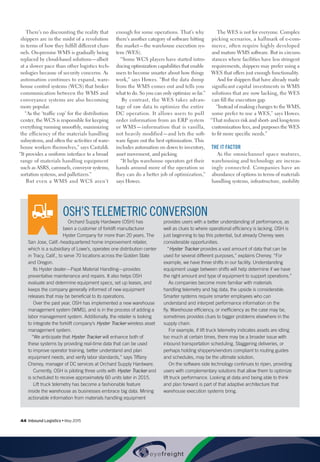
want to incur higher costs of labor to track the inventory
during the transition period or have a manual process
while their product is in a short-term warehouse space.
Q: What are the challenges, costs, and time
involved in traditional warehouse start-ups?
A: Warehouses can traditionally take anywhere from 30
days to 60 days to get started from a radio frequency
(RF) technology perspective. Challenges include: instal-
lation of wiring, access points, switches and dedicated
data lines. Dedicated data connectivity often takes the
longest period of time (minimum of 15-20 days) depend-
ing on the location and age of the warehouse even when
using expedited solutions. The cost of expediting can
vary greatly depending on the providers used and the
amount of effort needed to install the circuit; especially
with a new warehouse facility the provider has not pre-
viously serviced. Product often needs to be moved to the
new warehouse, prior to establishing all the technology
connections, leading to manual efforts by the warehouse
personnel to track the inbound and outbound inven-
tory. The cost can add up quickly for a customer with
the additional labor hours needed to track inventory
and expedited technology solutions. Additionally, there
tends to be a substantial sunken cost for the wiring that
is often left behind for a temporary warehouse solution.
Q: What alternatives are available to improve the
warehouse start-up process?
A: Recent improvements in wireless cellular technology
and mesh networks are being used in a variety of indus-
tries such as hospitals and remote construction facilities.
These improvements now provide us with solutions that
can be adapted for warehousing space. Wagner has
recently deployed an “IT-in-a-Box” solution in multi-
ple locations, which allows for a virtually wireless/mesh
solution that can have a warehouse fully up and run-
ning in 7-14 days. This solution provides customers with
immediate tracking of inbound and outbound inventory
using full RF technology and Warehouse Management
Systems. In addition to the rapid start-up, the entire solu-
tion can be quickly removed and reused for sites needing
the space for only short periods of time during peak sea-
sons. We typically see a savings of 20-30 percent based
on the decreased amount of labor needed at time of
start-up and the reduction in expediting costs.
Wagner Logistics | 800-817-1264
marketing@wagnerlogistics.com | www.wagnerlogistics.com
Improving the Warehouse Startup Process
32  Inbound Logistics • May 2015
JOE
JohnsonDirector of
Information Technology
Wagner Logistics 
Got 3PL challenges?  Get free expert solutions at inboundlogistics.com/3pl
Joe Johnson is Director of Information Technology, Wagner Logistics, 800-817-1264
reddawayregional.com/social
888.420.8960
©2015 YRC Worldwide Inc.
Reddaway, the next-day delivery leader with the largest regional
footprint in the West, ensures that your shipment will be delivered
before you know it. A 21-time recipient of the Quest for Quality Award,
we provide high on-time reliability and one of the lowest claim ratios in
the region – from Seattle to Boise, Fontana to Reno. Get to know Reddaway.
Call 888.420.8960 or visit reddawayregional.com/nextday today!
Quest for Quality Award winner
WE KNOW
WHAT IT TAKES
TO GET IT THERE
NEXT-DAY.
15RED015_ad.indd 1 4/28/15 3:07 PMreddaway_ad0515.indd 1 4/30/15 11:39 AMGot 3PL challenges?  Get free expert solutions at inboundlogistics.com/3pl
Q
THOUGHT LEADERS
The Driver Shortage—Not Just a Carrier Issue
Q: The transportation industry’s nationwide driver
shortage is getting worse. What is the cause?
A: Tougher regulations, a lack of interest by younger
workers, and the graying of today’s drivers are contrib-
uting to the driver shortage. The problem will continue
to grow over the next several years—especially as freight
volumes increase.
Despite the fact that carriers are implementing
dock-to-driver programs, increasing pay, and offering
hiring bonuses and better benefits to attract drivers, the
American Trucking Associations recently reported that
turnover at truckload carriers remained very high in the
fourth quarter of 2014—an overall industry indicator of
the driver shortage.
Q: What new solutions can carriers implement to
attract new drivers?
A: Aside from the programs and incentives carriers are
already implementing, another solution that is gaining
traction is for carriers to work with their customers to
make sure they are treating drivers like team members.
Not only do drivers deserve to be treated with respect
by their employers, they also want to be respected by
their customers.
Relationships matter more and more in today’s work
environment. And, while many shippers might think the
partnership with their carrier begins and ends with the
corporate office or their sales representative, it is impera-
tive they foster a relationship with their drivers.
Shippers can help by making their facilities more
driver-friendly, which, in turn, helps carriers retain
drivers. Not only does it make the pickup and deliv-
ery process more efficient for both parties, shippers can
benefit from having a long-term driver who knows their
business and procedures. It also reduces operating costs
for both carriers and shippers. Additionally, Hours-of-
Service regulations, along with electronic logging, make
it more important than ever for drivers to get in and out
of a facility quickly. Having a driver-friendly warehouse,
office, or dock helps make that possible.
Q: What else can shippers do to help ease the
driver shortage?
A: Another way shippers can help mitigate the driver
shortage is to expand their pickup and delivery windows.
Offering a delivery window that is convenient for their
operations, as well as the carrier’s, would go a long way
toward providing relief for trucking companies as they
schedule their drivers and routes each day.
Drivers are the backbone of the industry and its most
valuable resource. Operating a commercial vehicle now-
adays is more challenging and demanding than ever,
and overcoming the driver shortage will take a concerted
effort on the part of the transportation industry and ship-
pers who depend on it to haul their products, and deliver
them on-time and damage-free.
Shippers making simple, but meaningful, changes
can go a long way in helping carriers attract and retain
drivers—now and in the future.
Saia | 800-765-7242
customerservice@saia.com | www.saia.com
34  Inbound Logistics • May 2015
 
Marty
ReadyVice President of Human Resources
Saia
Got 3PL challenges?  Get free expert solutions at inboundlogistics.com/3pl
Marty Ready is Vice President of Human Resources, Saia, 800-765-7242
Tim Curry | Transportation  Logistics Group Head
tim.curry@regions.com
We created Regions Securities to provide small- to mid-cap companies with high-quality service and advice
from talented, relationship-oriented bankers. That means your business gets our dedicated “A Team” every
time. Our seasoned team of bankers understands your company’s desire for growth, and our capital markets
experience enables you to receive creative, customized solutions tailored to meet your company’s strategic
and financial objectives.
From capital raising in the debt and equity markets to mergers and acquisitions advice, our bankers can set things
in motion for your company.
WALL STREET CAPABILITIES. MAIN STREET SENSIBILITIES.
Corporate Banking | Capital Markets  Advisory Services | Dedicated Industry Experience
© 2015 Regions Securities LLC. Investment banking and business advisory services are offered through Regions Securities LLC, 1180 W. Peachtree St.
NW, Suite 1400, Atlanta, GA 30309. Member FINRA and SIPC. Regions Securities LLC is an affiliate of Regions Bank. | Regions and the Regions logo are
registered trademarks of Regions Bank. The LifeGreen color is a trademark of Regions Bank.
Investment and Insurance Products:
Are Not FDIC Insured | Are Not Bank Guaranteed | May Lose Value
Are Not Deposits | Are Not Insured by Any Federal Government Agency
Are Not a Condition of Any Banking Activity
Senior Secured Credit Facilities
Joint Lead Arranger and Joint Bookrunner
------------------------
$550,000,000
Senior Secured Credit Facilities
Joint Lead Arranger and Joint Bookrunner
------------------------
$43,600,000
------------------------
$53,500,000
Senior Secured Credit Facility
Joint Lead Arranger
Got 3PL challenges?  Get free expert solutions at inboundlogistics.com/3pl
BY Brian Sutter
Director of Marketing, Wasp Barcode Technologies
bsutter@waspbarcode.com | 866-547-9277
IT MATTERS
Finding an Inventory Solution That’s
Just Right for Your Small Business
I
nventory management, put simply, is ensuring you have the right
amount of product in the right place at the right time. It helps
you determine which items sell well, and which do not, giving
you the ability to adjust product levels accordingly.
As such a crucial step in the supply
chain, the importance of good inven-
tory management seems obvious, but
for small and medium-sized enterprises
(SMEs), choosing the best inventory
solution can seem daunting. How do
you ensure that you’re purchasing the
best inventory solution for your work-
flow? Which inventory solution features
are 100 percent required?
Know What to Look For
To help answer that question, find
an inventory solution that includes
these five important inventory-track-
ing functions:
1.	Automation. Using Excel spread-
sheets for inventory management is
outdated in today’s environment. Excel’s
limitations in tracking inventory can
cause your business to lose money and
waste time.
Avoid cumbersome manual pro-
cesses by looking for an automated
system. Employees who manually input
data into a spreadsheet—or worse, who
track using pen and paper—increase
the potential for errors. Automating as
much of your process as possible using
bar codes and scanners eliminates signif-
icant inventory mistakes. An automated
system also helps you find critical data
quickly and efficiently.
2.	Small business accessible. Big
businesses with big budgets have the
money to invest in an enterprise-level
solution, and the staff necessary to
implement such a large-scale inven-
tory system.
Solutions aren’t often one-size-fits-
all, so consider a software provider that
has experience assisting small businesses
with inventory needs. Resources such as
guides, a help desk, and classes, should
be readily available, as well as training
that covers the initial software setup, and
an overview of how employees need to
use it. Your business should be able to
quickly use the new solution to improve
profitability and purchasing efficiency.
3.	QuickBooks integration. Millions
of small businesses use QuickBooks
as their accounting software pack-
age. Because of that popularity, find
an option that allows customers to take
advantage of integrated financial solu-
tions, ensuring that data flows directly
into accounting records.
4.	Mobility. Being mobile lets you
accomplish more throughout the day.
Many wireless devices allow users to
create, edit, move, or remove inven-
tory items on the go, while updating
inventory control software accordingly.
Wireless communication enables real-
time inventory data updates from your
warehouse, stockroom, or supply closet,
so you always know exactly what is in
stock and where items are located.
5.	Security. Data breaches can
expose important organizational and
consumer information. Your solution
should help you maintain mission-crit-
ical data by providing feature-based
privileges that ensure data integrity.
Feature-based security gives the soft-
ware administrator the ability to create
group privileges and assign the appropri-
ate individuals to each group. Therefore,
users only access the functions they need.
In today’s fast-paced, omni-channel
world, companies have to know where
their products are at all times, and
that can be stressful. But if you find a
solution that covers these five areas,
inventory management might not seem
so intimidating. n
36  Inbound Logistics • May 2015
Efficiency, savings and
insights–delivered.
Today’s logistics do more than move items from Point A to Point B. They can provide
ways to help differentiate and define your business.
That’s why leading companies choose DLS Worldwide. Powered by RR Donnelley, our
solutions, network and global operational expertise help you streamline workflows for
cost efficiencies, provide greater transparency in your operations and simplify logistics
management and distribution.
Speed up your time-to-market, navigate complexity and increase your savings.
Learn more by calling 1.877.744.3818 or by visiting dls-ww.com today.
© 2015 R.R. Donnelley  Sons Company,
all rights reserved. RR Donnelley®
is a trademark
of R.R. Donnelley  Sons Company.
1000 Windham Parkway, Bolingbrook, IL 60490
877.744.3818, dlswintl@rrd.com, dls-ww.com
Licensed NVOCC IATA Certified
34366_RRD_Logistics_Pub_ad__nonbleed.indd 1 5/6/15 12:33 PM
Untitled-7 1 5/6/15 12:42 PMGot 3PL challenges?  Get free expert solutions at inboundlogistics.com/3pl
BY Kathryn C. Thomas
Partner, Litigation Practice Group  Transportation Team,
Freeborn  Peters LLP
kthomas@freeborn.com | 312-360-6520
FINE PRINT
THE
How Amtrak’s Supreme Court
Case Affects Freight Shippers
T
rack-sharing among railroads has long been a complicated
issue. The U.S. Supreme Court recently reviewed a case
determining whether Amtrak has the authority to regulate
privately owned freight railroads with which it shares rail.
The Rail Passenger Service Act of
1970 was supposed to reinvigorate a
national passenger rail system. The leg-
islation created Amtrak to “fully develop
the potential modern rail service in
meeting the nation’s intercity passen-
ger transportation requirements.” The
act also let railroad companies shed the
obligation of intercity passenger service
in exchange for allowing Amtrak to use
their tracks and facilities.
Today, freight railroads own nearly
97 percent of the track over which
Amtrak runs service. Because of track
coordination problems, Congress pre-
scribed that, absent an emergency,
Amtrak’s passenger rail takes preference
over freight transportation.
The Passenger Railroad Investment
and Improvement Act of 2008 (PRIIA)
addresses these coordination concerns.
Section 207 of PRIIA requires the
Federal Railroad Administration (FRA)
and Amtrak to jointly develop stan-
dards to evaluate the performance of
Amtrak trains. In light of this mandate,
the FRA and Amtrak issued on-time
performance (OTP) metrics and stan-
dards, the final version of which took
effect in May 2010.
Understanding the Lawsuit
In 2011, the Association of American
Railroads (AAR) filed suit on behalf of its
Class I freight railroad members against
the Department of Transportation and
others, challenging the constitutionality
of Section 207 of PRIIA and requesting
that the court vacate the OTP metrics
and standards. The AAR asserted that
Section 207:
■■ Unconstitutionally delegates
authority to Amtrak to regulate other
private entities.
■■ Amtrak’s regulation of its competi-
tors violates the Fifth Amendment’s Due
Process clause.
The District Court ruled in favor of
the Department of Transportation, but
the U.S. Court of Appeals reversed the
District Court’s decision, finding that
Amtrak was a private entity and thus, its
regulatory authority was unconstitutional.
The Department of Transportation
appealed the decision and the U.S.
Supreme Court granted certiorari.
Where Are We Now?
The Supreme Court, in a March 2015
decision, ultimately upheld Amtrak’s sta-
tus as a governmental entity, overturning
the Court of Appeals decision. The case
was remanded to the Court of Appeals to
decide three constitutional issues:
1.	Whether appointing Amtrak’s pres-
ident violates the law requiring election
of governmental officials.
2.	Whether PRIIA violates the Due
Process clause by granting Amtrak power
to control freight trains.
3.	Whether the current arbitrator
selection procedures for settling disputes
over use of railroad facilities violate the
constitutional rule that Congress cannot
delegate its own legislative powers.
Rail shippers should pay close atten-
tion to these pending determinations.
The outcome of DOT v. AAR will sig-
nificantly impact the rights and power
of Amtrak and/or the freight railroads
going forward, and potentially impact
the cargo those freight railroads carry.n
Kathryn C. Thomas co-authors The Freeborn
Dispatch Blog and has extensive business
litigation experience in matters involving
intellectual property, products liability, and
general commercial litigation.
38  Inbound Logistics • May 2015
DISTRIBUTION
• Public Warehousing
• Inventory Management
• Food Grade DC’s
• Alcohol Permitted (ABC)
• FDA  ASI regulated
• Separate Hazardous
Material and Chemicals
DC (NACD Members)
• Extensive Retail/Import,
Apparel  Electronics
experience
TRANSPORTATION
• In-house Drayage
• Freight Consolidation
• Direct Store Delivery
(DSD)
ON-SITE FULFILLMENT
• Co-pack  Packaging
• UCC Labeling
• Custom wrapping
• Carton Packaging
• Floor displays
TECHNOLOGY BENEFITS
• Client Specific Solutions
• EDI Services
• RF Inventory Systems
• Web Based Reporting
• E-Commerce
• WMS
You need Pacific Coast Warehouse Company.
When safety, security, and compliance
matter most, you need a reliable partner
with a proven track record.
www.pcwc.com | 909.545.8100 x237 | cma@pcwc.com
TAILORED SERVICES
DEDICATED CUSTOMER SERVICE
FORTUNE 500 MANAGEMENT
Pacific Coast Warehouse Company
Moving Product to Market Better Since 1927
PCW provides chemical manufacturers with
safe, secure, and compliant storage and
transportation of products within the western U.S.
As NACD members, PCW utilizes Responsible
Distribution Processes (RDP) and industry best
practices to warehouse, store and deliver a
full range of chemicals, flammables, oxidizers,
corrosives, gases, and non-regulated materials.
PCWC Ad 0614-V4.indd 1 6/12/14 2:41 PMGot 3PL challenges?  Get free expert solutions at inboundlogistics.com/3pl
BY Kevin Zweier
Vice President of Transportation, Chainalytics
kzweier@chainalytics.com | 770-450-6581
Five Ways to Mitigate
A Truckload Capacity Crunch
M
any factors have led to increased costs for truckload
services, and created challenges to the freight pricing
status quo for shippers. In the wake of the disruptions
caused by the current capacity crunch, many are asking: “Am I
overpaying? And if I am, what can I do about it?”
To avoid paying too much for truck-
load services during periods of tight
capacity, consider the following tactics
to help you maintain your firm’s long-
term equilibrium:
1.	Know if you are overpaying
and where opportunities exist in
your network. Some shippers pay above
market for truckload capacity; others pay
below. Those who lack visibility into
actual truckload market rates become
likely targets for carrier overcharges, and
often don’t recognize carriers that pro-
vide great value at a great price.
Industry benchmarks and services
are available to help you understand
the nuances on each of your lanes, and
model market rates based on actual
carrier rate data from hundreds of the
world’s most active shippers. Developing
a competency in the transportation mar-
ket allows shippers to develop successful
procurement strategies that can outlast a
capacity crunch.
2.	Conduct regular truckload capac-
ity procurement events. Shippers often
end up overpaying for truckload capac-
ity simply by accepting annual rate
increases from incumbent carriers over
a number of years. Both shipper and car-
rier networks change from year to year.
Holding a well-timed procurement event
each year should be part of a shipper’s
transportation spend strategy.
3.	Make your freight attractive
to truckload carriers. When capac-
ity tightens, truckload carriers become
more selective about the shippers they
choose. Become a carrier-friendly ship-
per by driving efficiency and helping the
carrier keep its trucks and drivers mov-
ing and making money. Carriers need
to turn freight quickly, so shippers with
drop-and-hook programs gain preference
over those using live unload freight. In
addition, carriers view shippers who pro-
vide driver perks that improve carrier
productivity in a favorable light.
4.	Institute reasonable truckload
carrier payment terms. Many shippers
push payments to carriers far beyond
the typical 30-day payment term policy.
But the primary costs carriers incur are
driver salaries and fuel charges—costs
that can’t wait 60 or 90 days to be paid.
As a result, carriers often find themselves
strapped for liquid cash. Reducing pay-
ment times goes a long way toward
fostering goodwill, and shippers who pay
their bills the fastest often receive pref-
erential treatment from carriers when
capacity tightens.
5.	Expand your truckload carrier
base or reconsider your modal options.
There are more than 100,000 North
American truckload carriers. Modern
transportation management systems are
designed to help manage a large pool of
carriers, so most shippers are equipped
to effectively deal with a diverse base.
Shippers who have not secured required
truckload capacity from their incumbent
carriers should waste no time in expand-
ing their carrier pool.
For shippers with enough freight vol-
ume on competitive lanes, a private
fleet can also be a viable alternative.
Reconsidering your modal mix may also
prove beneficial. Intermodal transporta-
tion has become an appealing force on
many lanes, and is worth exploring.
In the end, passivity is a shipper’s
worst enemy. A proactive transportation
strategy pays dividends in all markets,
but especially when capacity is tight. n
40  Inbound Logistics • May 2015
Discover GOLD in
Freight Payment  Audit
Transform traditional FPA into a modern gold mine.
Only RateLinx advanced software standardizes carrier invoice data in
real-time. With this comprehensive look inside your transportation supply
chain, you will discover the freight savings you’ve been looking for.
(262) 565-6150
ratelinx.com/gold
© RateLinx. All rights reserved.
RateLinx_gold_ad0515.indd 1 5/12/15 10:42 AMGot 3PL challenges?  Get free expert solutions at inboundlogistics.com/3pl
42  Inbound Logistics • May 2015
SMARTER
BUILDING A
W
arehouse perceptions have changed
considerably over the past two
decades. It wasn’t long ago that users
perceived the four walls as just that—
a fixed, immovable force that served as the nexus for
any distribution network.
Today, such representations are increasingly
obsolete largely because of forces beyond the four
walls. Cloud computing, e-commerce, omnichan-
nel management, big data, and last-mile logistics
are reshaping today’s distribution facility.
The warehouse is still core. But its role in the
supply chain is much more fluid. The modern
DC is molded by countless external pressures that
are eroding convention and shaping invention.
Technology and materials handling innovation
have become important catalysts in the evolution
of smarter warehouses.
SMART BY DESIGN
The intelligent warehouse features three crit-
ical traits—visibility, mobility, and flexibility.
Technology, ultimately, is the means to those ends.
“Warehousing is no longer an unsophisticated
business. Operators need to embrace technology
and understand it,” says John Watkins, CEO of
Manhattan Beach, Calif.-based cloud WMS solu-
tions provider 3PL Central.
“Two things come to mind when we talk about
smart warehouses,” says Mike Howes, vice presi-
dent, software engineering and services at Forte
Industries, a Mason, Ohio-based materials handling
May 2015 • Inbound Logistics 43
engineering and systems integrator. “The
first consideration is visibility into the
operation. This includes the ability for
users to get to information they need in an
approachable and intuitive way.
“Secondly, it’s not just about data,” he
says. “The cornerstone of an intelligent
warehouse is real-time actionable infor-
mation. Traditional systems typically bring
good data to the screen. But you have to
use the secret decoder ring to figure out
what it’s trying to tell you.”
Real-time visibility is contingent on
accessibility, which raises the importance
of mobile solutions. There’s no shortage of
rugged RF devices, smartphones, tablets,
and wearable technology, as well as the req-
uisite software and applications to support
a more dynamic workflow and workforce.
Gathering and vetting information is
one thing. Users also need to be empow-
ered to act on real-time data. The tactical
pressures omnichannel places on a ware-
house, whether a shipper facility or 3PL,
cannot be minimized.
“We’re not necessarily seeing a reliance
on big data, but rather on systems talking
to one another. This doesn’t naturally hap-
pen,” says Steve Katz, vice president of
sales and marketing at 3PL Central.
That’s why the growth of e-commerce
and the emergence of omnichannel
management frame the importance of
intuitive DCs. Change is the operative
word in any B2C supply chain. Consumer
proclivities are a moving needle. Inventory
ebbs and flows. Managing exceptions is
an expectation. All the while, SKU diver-
sity and availability, customer service, and
economy demands endure.
“Omnichannel is the new normal,”
says Chris Castaldi, director of business
development at WH Systems, a mate-
rials handling systems integrator based in
Carlstadt, N.J. “There is a presumption
that a retailer will always be in stock on
the items the consumer wants to buy, and
that product can be delivered quickly.
“In the omnichannel world, retailers
have a holistic view into inventory, allow-
ing them to fulfill orders from any location
or ship inventory to other locations where
inventory is needed or sells better,” he adds.
“The goal of omnichannel is to give retail-
ers a 360-degree view of customers, orders,
and inventory.”
Whether consumers opt for same-day
delivery, click and collect/return at store,
shop and “showroom,” or even pick up
e-commerce shipments at specified locations,
order and inventory systems need to iden-
tify demand variances and react. Warehouse
optimization becomes paramount.
While DC infrastructure is evolving,
the level of functionality is consistent.
“Conveyors are conveyors,” says Howes,
who contends warehouses are looking
more at technology, and less at equipment.
“Users want adaptive architecture—a
way to layer information technology over
materials handling systems and automa-
tion that allows them to optimize what they
have now and moving forward,” he adds.
GET OUT THE CRYSTAL BALL
The rapidity of change is a challenge
for businesses as they try and adapt exist-
ing infrastructure and technology systems.
Whether it’s identifying automation needs
or picking the right warehouse manage-
ment system (WMS), operators have to
account for the future.
Over the past few years, this has proven
to be a real concern. Many businesses
made educated warehouse technology buys
to enhance their e-commerce operations
only to see the omnichannel trend catch
fire and change requirements. Inventory
traditionally resides in the warehouse. But
now companies are pulling and positioning
product from countless different touch-
points in the supply chain, whether it’s in
a brick-and-mortar backroom, directly from
the manufacturer, or from other DCs and
depots. So technology and systems in the
DC have to adapt.
Cloud computing, omnichannel management, and big data
are the questions. Can your warehouse supply the answers?
WAREHOUSEBY JOSEPH O’REILLY
44  Inbound Logistics • May 2015
There’s no discounting the reality that
shippers are in the midst of a revolution
in terms of how they fulfill different chan-
nels. On-premise WMS is gradually being
replaced by cloud-based solutions—albeit
at a slower pace than other logistics tech-
nologies because of security concerns. As
automation continues to expand, ware-
house control systems (WCS) that broker
communication between the WMS and
conveyance systems are also becoming
more popular.
“As the ‘traffic cop’ for the distribution
center, the WCS is responsible for keeping
everything running smoothly, maximizing
the efficiency of the materials handling
subsystems, and often the activities of ware-
house workers themselves,” says Castaldi.
“It provides a uniform interface to a broad
range of materials handling equipment
such as ASRS, carousels, conveyor systems,
sortation systems, and palletizers.”
But even a WMS and WCS aren’t
enough for some operations. That’s why
there’s another category of software hitting
the market—the warehouse execution sys-
tem (WES).
“Some WCS players have started intro-
ducing optimization capabilities that enable
users to become smarter about how things
work,” says Howes. “But the data dump
from the WMS comes out and tells you
what to do. So you can only optimize so far.”
By contrast, the WES takes advan-
tage of raw data to optimize the entire
DC operation. It allows users to pull
order information from an ERP system
or WMS—information that is vanilla,
not heavily modified—and lets the soft-
ware figure out the best optimization. This
includes automation on down to inventory,
asset movement, and picking.
“It helps warehouse operators get their
hands around more of the operation so
they can do a better job of optimization,”
says Howes.
The WES is not for everyone. Complex
picking scenarios, a hallmark of e-com-
merce, often require highly developed
and mature WMS software. But in circum-
stances where facilities have less stringent
requirements, shippers may prefer using a
WES that offers just enough functionality.
And for shippers that have already made
significant capital investments in WMS
solutions that are now lacking, the WES
can fill the execution gap.
“Instead of making changes to the WMS,
some prefer to use a WES,” says Howes.
“That reduces risk and short- and long-term
customization fees, and purposes the WES
to fit more specific needs.”
THE IT FACTOR
As the omnichannel space matures,
warehousing and technology are increas-
ingly connected. Companies have an
abundance of options in terms of materials
handling systems, infrastructure, mobility
OSH’S TELEMETRIC CONVERSION
Orchard Supply Hardware (OSH) has
been a customer of forklift manufacturer
Hyster Company for more than 20 years. The
San Jose, Calif.-headquartered home improvement retailer,
which is a subsidiary of Lowe’s, operates one distribution center
in Tracy, Calif., to serve 70 locations across the Golden State
and Oregon.
Its Hyster dealer—Papé Material Handling—provides
preventative maintenance and repairs. It also helps OSH
evaluate and determine equipment specs, set up leases, and
keeps the company generally informed of new equipment
releases that may be beneficial to its operations.
Over the past year, OSH has implemented a new warehouse
management system (WMS), and is in the process of adding a
labor management system. Additionally, the retailer is looking
to integrate the forklift company’s Hyster Tracker wireless asset
management system.
“We anticipate that Hyster Tracker will enhance both of
these systems by providing real-time data that can be used
to improve operator training, better understand and plan
equipment needs, and verify labor standards,” says Tiffany
Cheney, manager of DC services at Orchard Supply Hardware.
Currently, OSH is piloting three units with Hyster Tracker and
is scheduled to receive approximately 60 units later in 2015.
Lift truck telemetry has become a fashionable feature
inside the warehouse as businesses embrace big data. Mining
actionable information from materials handling equipment
provides users with a better understanding of performance, as
well as clues to where operational efficiency is lacking. OSH is
just beginning to tap this potential, but already Cheney sees
considerable opportunities.
“Hyster Tracker provides a vast amount of data that can be
used for several different purposes,” explains Cheney. “For
example, we have three shifts in our facility. Understanding
equipment usage between shifts will help determine if we have
the right amount and type of equipment to support operations.”
As companies become more familiar with materials
handling telemetry and big data, the upside is considerable.
Smarter systems require smarter employees who can
understand and interpret performance information on the
fly. Warehouse efficiency, or inefficiency as the case may be,
sometimes provides clues to bigger problems elsewhere in the
supply chain.
For example, if lift truck telemetry indicates assets are idling
too much at certain times, there may be a broader issue with
inbound transportation scheduling. Staggering deliveries, or
perhaps holding shippers/vendors compliant to routing guides
and schedules, may be the ultimate solution.
On the software side technology continues to ripen, providing
users with complementary solutions that allow them to optimize
lift truck performance. Looking at data and being able to think
and plan forward is part of that adaptive architecture that
warehouse execution systems bring.
sclogistics.com/fulfillment | 888-878-1177
Your business never stops—growing, changing,
adapting. You need fulfillment operations that
can flex to meet your needs. With automated
solutions, sophisticated systems and facilities
nationwide, we’re ready to tackle your toughest
challenges. Customized, efficient, cost effective.
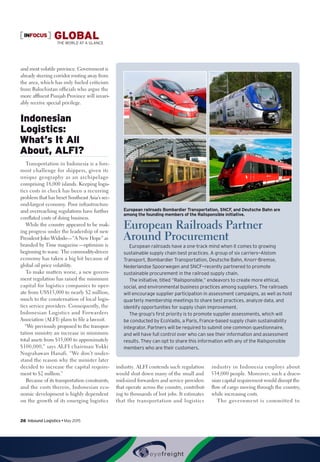
We make it easy to get ahead.
Fulfillment for businesses on the move.
SCL-IL_fulfillment_May2015.indd 1 5/1/15 9:27 AM
SCL_fulfillment_ad0515.indd 1 5/4/15 9:44 AMGot 3PL challenges?  Get free expert solutions at inboundlogistics.com/3pl
46  Inbound Logistics • May 2015
hardware, and software to plug and play dif-
ferent functionalities.
The DC has truly become a “data ware-
house” and operators need to mine this
information to make more proactive deci-
sions about where to position inventory to
fulfill traditional brick-and-mortar chan-
nels, as well as e-commerce.
“It’s not just about looking at real-time
data,” says Howes. “Companies can also
capture information and play it against
simulated scenarios—looking for oppor-
tunities to optimize or avert downstream
problems before they arise.” This level of
visibility empowers more supply chain-type
decision-making.
WMS, WCS, and WES implementa-
tions help shippers and third-party logistics
providers optimize on the fly, which is a
competitive differentiator as omnichannel
flux breeds uncertainty.
Future innovation will likely replace
many mundane tasks that still exist on the
warehouse floor. Facilities will become
smarter. As the Internet of Things phenom-
enon takes hold, systems will intuitively
communicate with one another, creating
even more synergies.
“In the supply chain, nothing happens in
isolation. Like a house of cards, each link
is influenced by everything that comes
before and after,” says Castaldi. “With
the right warehouse software and systems,
businesses are no longer forced to play the
hand they’re dealt.” n
INSIDE THE OMNICHANNEL DC
The explosion of e-commerce has forced warehouse operators
to rethink how they equip facilities and fulfill different channels.
Managing multiple channels within one facility requires significant
capital investment in systems and technology, such as:
■■ Inventory management system that spans the entire supply chain for
achieving real-time visibility.
■■ Distributed order management system to decide cost-effectively whether to
drop orders into a DC, e-commerce fulfillment center, combination DC, or
store to meet customer service levels.
■■ Warehouse Management System.
■■ Warehouse Control System to direct the flow of materials within the
warehouse and communicate with all the materials handling equipment.
■■ Conveyors for moving products to appropriate locations.
■■ Sortation units that deliver items to shipping locations.
■■ Picking/packing systems for directing workers what to pick, how
many, and where to pick or pack. Some DCs are starting to use robotic
picking technology.
■■ Automatic Storage and Retrieval Systems (AS/RS).
WE KNOW
WHAT IT TAKES
TO GET IT THERE
NEXT-DAY.
Holland, the next-day delivery leader, is committed to knowing your business inside
and out. Annual winner of the Quest for Quality Award since its inception, we deliver the
most next-day service lanes in our area – from Chicago to Cincinnati, St. Paul to St. Louis –
and annually record one of the lowest claim ratios in the industry. Want to know more?
Call 866.465.5263 or go to hollandregional.com/nextday today for details!
hollandregional.com/social
866.465.5263©2015 YRC Worldwide Inc.
15HOL025_HollandBrand_HP_InboundLogistics.indd 1 4/30/15 4:39 PM
Pharr_International_ad0515.indd 1 5/4/15 3:14 PMGot 3PL challenges?  Get free expert solutions at inboundlogistics.com/3pl
48  Inbound Logistics • May 2015
How does a warehouse manager
transform a group of people with
different backgrounds, outlooks, and
abilities into a high-powered workforce?
BY MERRILL DOUGLAS
A
bout 10 years ago, consultant Curt Sardeson helped a cli-
ent implement a warehouse management system (WMS),
which triggered an unexpected labor management issue.
“Within six months, the company replaced every lift driver because
of language differences,” says Sardeson, president of Open Sky
Group, Fuquay-Varina, N.C. Because the original drivers didn’t
read English, they couldn’t follow the directions the new WMS
displayed on their screens.
Language diversity is one of many challenges warehouse man-
agers face in their efforts to turn a collection of individuals into a
May 2015 • Inbound Logistics 49
highly productive workforce. Differences in literacy levels, cultural
backgrounds, gender, and age can also complicate the job of train-
ing, integrating, and managing a diverse workforce. So can heavy
employee turnover, or the need to use temporary labor for peak
workloads or special projects.
From translation to technology to the buddy system, warehouse
managers call on a varied range of strategies to get diverse work-
forces pulling together as one.
As a nation of immigrants, the United States has dealt with lan-
guage diversity in the labor force since its earliest days. In many
American warehouses today, a large contingent of workers who
speak English as a second language (ESL)—if they speak English
at all—is not the exception, but the rule.
Take food service distributor Ben E. Keith Foods, which oper-
ates eight distribution centers (DCs) in Texas, New Mexico,
Oklahoma, and Arkansas. “Most of our warehouses have ethnic
diversities,” says Roy Markham, the company’s vice president of
operations and transportation. Ben E. Keith’s workforce includes
many Spanish speakers, as well as a group of Vietnamese immi-
grants at one of its locations.
THE CHANGING
FACE  OF THE
WAREHOUSE
WORKFORCE
50  Inbound Logistics • May 2015
Spanish speakers also figure prominently
in the facilities that third-party logistics
(3PL) company Norbert Dentressangle
(acquisition by XPO Logistics pending)
operates in central Pennsylvania. But other
language groups play a role as well.
“We have a significant Bosnian and
Croatian culture in our region,” says Dave
Bumbarger, vice president, operations,
contract logistics services with Norbert
Dentressangle. “And we’re starting to see
more people from the Middle East make
their way into the workforce.”
GETTING A READ ON WORKERS
Among the 13 warehouses that Wagner
Logistics operates, those in urban areas
attract many Spanish-speaking workers
who struggle with English, says Justin Eck,
director of operations at the 3PL, based in
North Kansas City, Mo. Facilities in rural
regions tend to see a different challenge—
associates who speak English fluently but
can’t read.
“At one operation Wagner ran in
Arkansas for a number of years, we tested
our employees and found that more
than 50 percent were illiterate,” says Joe
Johnson, the company’s director of infor-
mation technology.
When not everyone in a warehouse
speaks and understands the same language,
one obvious solution is to hire bilingual
supervisors and team leaders. Those indi-
viduals can communicate directly with
non-English-speaking associates, and serve
as translators when needed.
“Because the workforce is diverse, I
expect my management team will be
diverse as well,” says Bumbarger. Norbert
Dentressangle looks for front-line supervi-
sors who speak both English and Spanish.
The company is also seeking people who
can communicate in other languages.
As part of that search, the company
might promote ESL speakers from the
rank and file who show leadership poten-
tial. “If they need to learn more English
than they have today, we’ll support that,”
Bumbarger says.
To help him teach new processes to
associates who lack strong English skills,
training supervisor James Orosco, at the
U.S. Foods DC in Fife, Wash., has tapped
bilingual associates as translators. But
that’s just an initial tactic, he says: a lit-
tle time and patience erases the need for
a go-between.
“At first, the associates are afraid they
can’t communicate with me,” says Orosco.
But as they get to know him, workers often
find they can speak their minds even with
limited English. “They don’t have to feel
that they’re not properly communicating
what they need,” he adds.
LIKE A ROSETTA STONE
Besides recruiting bilingual employees,
a company might help English-speaking
supervisors pick up new language skills.
“We’re looking into whether we should
acquire a resource such as Rosetta Stone
Intelligrated’s voice-directed picking solution speaks to workers in their native language, boosting productivity in warehouses with non-
English-speaking permanent and temporary workforces.
Preoccupied
withyourshipments?
That’swhereATTcanhelp.Oursupplychain
solutions are designed to work together
acrossourhighlysecure,globalnetwork— for
enhanced asset monitoring, security and
visibilityvirtuallyanywhere.Leavingyoufree
to focus on what matters most.
ATT BusinessSolutions
att.com/assetmanagement
©2015 ATT Intellectual Property. All rights reserved. All other marks used herein are the property of their respective owners.
ATT_ad0515.indd 1 5/11/15 10:35 AMGot 3PL challenges?  Get free expert solutions at inboundlogistics.com/3pl
52  Inbound Logistics • May 2015
[the technology-based language learning
program], so we can train some of our
good leaders and supervisors in Spanish,”
Johnson says.
An English-speaking supervisor doesn’t
need to fully master a second language
to improve communications. Eck recalls
his early days as a warehouse manager,
when his staff included 20 to 30 Spanish-
speaking associates. “I learned how to ask
them if they needed more water, if they
needed to use the restroom, if they were
doing okay—just so I could walk around
and let them know I was concerned for
their well being,” he says. When the time
came to hold a more complex conversation,
he tapped a bilingual worker to translate.
Of course, in a polyglot warehouse—
a place where, say, Spanish, Russian, and
two Chinese dialects fill the air—commu-
nications grow even more complicated.
One of Sardeson’s clients met that chal-
lenge by putting all the associates who
spoke the same language on the same
team. “It created an environment where,
with one supervisor leading a team of 12,
they weren’t embarrassed to ask questions,”
Sardeson says. Everyone could take care of
business in his or her native tongue.
Does that strategy promote segregation
or discrimination? Not at all, Sardeson
says. “They’re putting people in a situation
where they can win,” he notes. “I thought
it was bold of them to break them up that
way, and it was much more effective.”
A different set of solutions applies to
the literacy challenge. From instructional
materials, to signage in the building, to
read-outs on handheld scanners, ware-
house managers look for ways to convey
important information to workers who
don’t read English well, or can’t read at all.
When not everyone reads the same lan-
guage, a WMS that issues picking and
putaway instructions on a printed list, or
through a readout on a handheld radio
frequency (RF) scanner, presents a tough
challenge. “It becomes cost prohibitive to
maintain several languages for paper and
RF processes,” says Bruce Stubbs, industry
marketing director at Honeywell Scanning
and Mobility.
THE LANGUAGE OF LOGISTICS
The challenge is even tougher when
managing associates who lack reading skills
in any language.
Some warehouses level the playing field
for workers by implementing voice-directed
picking and putaway solutions. Instead of
requiring a worker to read from a screen or
printout, these systems speak directions in
English or another language. The associ-
ate also can confirm completed activities
by speaking into the system.
“The user simply trains the voice data-
base in the language they feel comfortable
using,” says Stubbs, whose company’s
products include the Vocollect family of
voice-based warehouse solutions. “Voice is
smart enough to also allow for dialect dif-
ferences, and the different ways that people
speaking the same language pronounce
certain words.”
Vocollect supports more than 35 lan-
guages, says Jay Blinderman, director
of product marketing for Honeywell’s
Vocollect Solutions, headquartered in
Pittsburgh. It’s even possible to mix and
match languages to some extent. “For
example, if workers understand English
but are more comfortable speaking in
Spanish, the system might direct them to
pick three units, and the workers may con-
firm by saying ‘tres,’” Blinderman says.
Intelligrated, a vendor of materials han-
dling solutions based in Mason, Ohio,
offers a voice-directed picking solution
that operates in approximately 65 lan-
guages and requires no training. “Users put
Technology such as voice-directed picking or putaway systems facilitate communication
with warehouse workers who lack reading skills or may not speak English.
HOW’S
MY
DRIVING?
Real-time data monitoring
Automated vehicle access
and control
Impact monitoring
Electronic daily operator
checklist completion to
meet OSHA compliance
Metrics to help you achieve
timely productivity gains
iWAREHOUSE
®
KNOWS
iWAREHOUSE Essential is an integrated suite of fleet
management solutions that can be used with any
industrial vehicle to collect and transmit information
about lift truck and operator performance.
To find out more, visit www.iwarehouseknows.com/driving
RAYMOND IS A PROUD
SUPPORTER OF
Essential™
Untitled-1 1 5/18/15 9:14 AMGot 3PL challenges?  Get free expert solutions at inboundlogistics.com/3pl
54  Inbound Logistics • May 2015
on a headset and it speaks to them in their
native language,” says Jason Franklin, the
company’s director of labor management
and business intelligence software.
If the warehouse team includes people
from several different language groups, the
company will provide the appropriate lan-
guage pack for each worker.
Logistics consultancy F. Curtis Barry, in
Richmond, Va., has helped some of its cli-
ents build voice-enabled applications based
on smartphones or tablets. “They apply it
through all aspects of the distribution pro-
cess: receiving, cycle counting, returns
processing—not just picking anymore,”
says Curt Barry, the company’s presi-
dent and founder. “It’s cheaper because it
requires far less client-server architecture.”
And the mobile devices cost less than the
typical scanning gun, he adds.
Another solution that takes reading out
of the picture is the pick- and put-to-light
system, which uses visual cues to show a
worker where to go and how many units
to retrieve or put away. “It lights up the
cubbies that workers need to grab items
from, and then it shows how many to grab,”
says Franklin.
KEEPING IT SYMBOL
Although voice- and light-based systems
eliminate the need to read, ESL-speakers
and non-readers may do fine with paper- or
screen-based systems if the instructions are
simple enough—for example, if they use
numbers and symbols rather than words.
Markham tells a story to illustrate that
point. Some years back, when he was man-
aging Ben E. Keith’s Dallas-Fort Worth DC,
Markham learned that one of his associates
had picked 170,000 cases without making a
single error. He sought out the young man
to congratulate and thank him face to face.
The associate just stood there, smiling. “He
didn’t understand a word I said,” Markham
laughs. “But he was extremely accurate.
He couldn’t write or speak English, but he
understood our system.”
To help new associates who can’t read,
Wagner Logistics has been simplifying its
training materials. The idea is to rely less
on text and more on pictures. “The mate-
rials show pallets being moved off a truck,
for example, so workers can see the process
they’re doing,” says Johnson. The company
is also replacing text-based instructions on
scanner screens with numerical codes. For
example, when the screen displays Option
2, that’s the signal to perform a specific task.
After a trainer demonstrates a process,
it’s important to monitor performance
to confirm that workers understand the
instructions. “Sometimes people are
embarrassed about not being bilingual, or
being illiterate,” says Eck. “They’d rather
do something wrong than let you realize
they don’t understand what you told them.”
By keeping an eye on performance metrics,
managers can zero in on employees who
need extra help, and find further opportu-
nities to simplify their instructions.
A company that uses a labor manage-
ment system (LMS) to track performance
can easily identify workers who aren’t hit-
ting productivity targets. “That may shine
a light on the fact that English might be
a second language and they’re having
trouble understanding the process,” says
Franklin. As the LMS automates perfor-
mance monitoring, supervisors gain more
time to coach employees who need extra
help, he says.
If a reading knowledge of English is cru-
cial to a job, it’s a good idea to make sure
the human resources (HR) department
accounts for that need when screening
job applicants. After Sardeson’s client
found it had to replace lift drivers who
didn’t read English, the logistics team and
HR took a fresh look at the hiring process.
One problem rose to their attention: all
the employment forms were available in
Spanish as well as English.
“It was possible for an employee to come
into a position that required some func-
tional English reading capabilities but
never touch an English document in the
hiring process,” says Sardeson. The com-
pany started giving language tests to people
who applied for jobs that required them to
interact with a computer system in English.
TEMPS AND TURNOVER
Even when everyone speaks and reads
the same language, warehouse managers
face integration challenges when they hire
temporary workers for their peak seasons or
to handle special projects. Those employ-
ees need to get up to speed quickly.
If a warehouse sees heavy turnover in its
labor force, a similar issue arises: managers
are continuously training new employees,
GOLD
STRIKEIF
YOU
Once they’ve created a cohesive
workforce, warehouse managers naturally
want to keep that great operation
humming along. Two ways to keep the
team strong are to hang on to the best
workers, and tap their connections to find
others who are just as good.
Many companies that use seasonal
temps rehire the same people year after
year. They rely on their human resources
departments to develop lists of good
temps and keep those lists updated.
“Some of our clients who do this are very
intentional, making sure they stay in
touch with people throughout the year to
keep up the relationship,” says Curt Barry,
president and founder of consulting firm
F. Curtis Barry, Richmond, Va.
A company might also ask star
employees to help recruit others who they
know will do a terrific job. At food service
distributor Ben E. Keith Foods, in Fort
Worth, Texas, that strategy has worked
especially well with associates from
immigrant communities.
“If you hit a vein of gold in a family
or network of friends within a niche
ethnic group, it can expand to create
an excellent workforce,” says Roy
Markham, Ben E. Keith’s vice president
of operations and transportation. “If they
have a proven work ethic, we’ll mine that
vein pretty deep.”
www.lynden.com 1-888-596-3361
At Lynden, we understand that plans change but deadlines don’t. That’s why we
proudly offer our exclusive Dynamic Routing system. Designed to work around
your unique requirements, Dynamic Routing allows you to choose the mode of
transportation — air, sea or land — to control the speed of your deliveries so they
arrive just as they are needed. With Lynden you only pay for the speed you need!
Only pay for the speed you need...
Dynamic Routing!
SM
The new Lynden phone app is now available to download!
05-15-LyndenAd-IL+App.indd 1 5/1/15 2:40 PMUntitled-1 1 5/4/15 9:25 AMGot 3PL challenges?  Get free expert solutions at inboundlogistics.com/3pl
56  Inbound Logistics • May 2015
trying to make them as productive as pos-
sible as fast as possible.
In some ways, managing temporary
workers is a lot like managing employees
who can’t read. “You need to have a sim-
ple-to-train process,” notes Sardeson.
When a company hires temps to han-
dle peak season volumes, that’s the time
to break jobs down into easier sub-tasks,
says Barry. “During average or low-volume
weeks, when you have core employees
doing the work, they might be able to do
a task that involves multiple steps,” he
says. But temps who try to do the same job
quickly might fall down on speed, or accu-
racy, or both. To gain better performance,
a company could, for example, spread a
three-step task across two or three tempo-
rary workers.
When a warehouse works with tempo-
rary staffing agencies, analytic software can
help ensure only the most productive indi-
viduals show up for work. Intelligrated’s
LMS not only monitors the performance
of individual temps, but also tracks which
agencies provide which workers. “I can
start to gather information about the qual-
ity of the workforce the agencies provide,”
says Franklin.
For example, say the temps sent by
Agency A perform at 50 percent of expecta-
tion on average, while temps from Agency
B perform at 75 percent. “I can tell Agency
A, ‘You’re going to have to vet people bet-
ter or charge me less money, or I’ll push
all my resources to the other agency,’”
Franklin notes.
MIXING IT UP
At Norbert Dentressangle, Bumbarger
often pairs temps with seasoned employ-
ees, or mixes core employees and temps
in work groups. “For instance, we might
have a fulfillment opportunity that involves
putting together kits,” he says. “I can work
people in cells of 10 to 15, with two or
three full-time associates assisting the
temps to get to the levels we need.”
Along with hiring temps as required,
Norbert Dentressangle’s operation in cen-
tral Pennsylvania often flexes its workforce
by shifting workers among different facil-
ities. A cross-training policy ensures that
workers remain productive as they move
from place to place.
One complicating factor is that not
all the buildings currently use the same
WMS. “We have a core group of ‘super-
users’ who know how to use each one of
them,” Bumbarger says. “They can go to
any building, jump on an RF system, and
use it.”
In warehouses that see a lot of turnover,
perhaps the best strategy for boosting pro-
ductivity is to shut down that revolving
door. Employees who understand the jobs
they’re taking on, and learn to do them
well, are more likely to stay.
“It’s interesting how many times new
employees get hired and then I hear, after
they’ve worked three days, ‘I didn’t know
what this job was,” or ‘I don’t like this job,’”
says Barry. “When you’re interviewing peo-
ple, you need to determine whether they
understand the work. Have they done that
kind of work before, and do they have the
skills to make sure they’re going to do a
good job?”
Just because people have warehouse
experience doesn’t mean they can walk
in and start producing. “They may know
how to use a pallet jack, but know noth-
ing about your system and your processes,”
says Orosco.
When Orosco brings a new group on
board, he gives everyone basic training
in procedures and safety, and then sends
each new employee to the floor with an
experienced worker. At that point, he starts
separating novices from workers who were
top performers in previous jobs. “If they
can show me they know everything that’s
going on, I’ll let them go to work,” he says.
Less-experienced recruits get a full day of
additional training.
When the newbies finally hit the floor,
Orosco tries to pair them with experienced
“buddies.” He also makes sure new hires
feel welcome and supported. “Everyone
introduces themselves,” he says. “I wel-
come them as a new part of the family and
tell my workers to treat them as such and
get them up to speed.” Workers are surpris-
ingly generous about stopping to correct or
help new colleagues, he adds.
CHANGING CULTURE
As women have moved into warehouse
positions held mainly by men in the past,
that change also has spurred some integra-
tion challenges. At Wagner Logistics, for

example, the cultural norms that prevail
among some immigrant groups may cause
friction when men find themselves report-
ing to a female team leader. The solution is
to make sure all employees understand that
the women receive their authority directly
from Wagner’s management.
“We tell them we award positions
based on the quality of the employee and
what they are capable of, not on gender,”
says Eck. “That generally seems to ease
any tension.”
Age disparities may also spur resistance,
especially when a young supervisor tries
telling long-tenured employees to change
a work process. “Many of them automati-
cally assume they know the best way to do
it, because they’ve been doing it that way
forever,”says Eck.
The supervisor needs to work side by
side with the employees, first gaining their
trust, and then gradually suggesting small
tweaks. “When they see some improve-
ments, you get their buy-in and you see
the hard shell soften,” says Eck. “Then
you have a team that can work together
and improve.”
In the end, that’s the goal for every ware-
house manager—getting a facility full of
diverse individuals to pull together as a
team, and achieve amazing results.  n
In warehouses that see a lot of turnover,
perhaps the best strategy for boosting
productivity is to shut down that revolving
door. Employees who understand the jobs
they’re taking on, and learn to do them
well, are more likely to stay.
Untitled-7 1 1/16/15 12:54 PMGot 3PL challenges?  Get free expert solutions at inboundlogistics.com/3pl
2015_077_ad_inbound_logistics_outlines_03_30.indd 1 3/30/15 9:09 AMCN_map_ad0515.indd 1 5/12/15 11:11 AMGot 3PL challenges?  Get free expert solutions at inboundlogistics.com/3pl
May 2015 • Inbound Logistics 59
T
he romance of the railroad is deeply embedded in
American culture. The image of a train chugging
through the landscape has inspired countless songs and
stories that capture the character of the country.
But for logistics professionals, the lore and the lure
of rail goes far beyond charming words and pictures. In
today’s high-speed supply chain networks, rail represents a key com-
ponent of the intermodal framework. Linked with ship, air, and truck
transportation, the mighty freight train cuts through the landscape
with the products that drive the world economy.
In the United States, several states and regions stand out as lead-
ing rail intermodal sites – places where geographic, economic, and
logistics resources blend into an ideal crossroads for moving prod-
ucts from Point A to Point B.
RIDING
RAILS
THE
America’s great rail
intermodal sites serve
as vital hubs in the
logistics landscape.
SPONSORED CONTENT
60  Inbound Logistics • May 2015
RIDING
RAILSTHE
KENTUCKY: A LOGISTICAL PARADISE
The lyrics to the American folk song
“I’ve Been Working on the Railroad” have
a special ring in Kentucky, where rail has
long established its role in the logistics
infrastructure. An enterprising adventurer
named Richard J. Corman helped make
it so.
Corman, founder and owner of R.J.
Corman Railroad Group, worked on the
railroad from his teens until his death in
2013. Right after graduating from high
school in 1973, the Nicholasville, Ky.,
native started his career in railroad con-
struction. He turned a railroad crossing
reconstruction operation with a single
backhoe into one of the leading diversified
railroad services companies in the nation.
With more than 60 operating loca-
tions in 24 states as far west as Arizona
and Montana, the R.J. Corman family
of companies now has more than 1,600
employees. The company also has had a
particularly strong impact on its Kentucky
home. One example is its rail service for
Logan Aluminum in Russellville, Ky.
“We take 15,000 trucks off the road
each year by moving aluminum ingots
from Berea, Ky., to the Logan plant,” says
Bob Helton, economic development
manager for the R.J. Corman Railroad
Group. “We also provide freight rail ser-
vices for grain moving from farms in south
central Kentucky, for peanuts moving to
the Jiff peanut butter plant in Lexington,
and for river sand being transported from
Louisville to Lexington.”
R.J. Corman’s freight rail operations are
emblematic of Kentucky’s prominent place
on the list of great rail intermodal sites.
“Kentucky is a logistical paradise,” says
Mandy Lambert, commissioner of business
development for the Kentucky Cabinet
for Economic Development, the primary
state agency responsible for encouraging
job creation and retention, as well as new
investment in the state.
Impressive numbers support her conten-
tion. “The state is located within one day’s
drive of two-thirds of the American popu-
lation, and is in the middle of a 34-state
distribution area,” Lambert says. “Our two
international airports are home to two of
the world’s top air cargo hubs, UPS and
DHL. They helped Kentucky rank third in
total air cargo shipments last year.
“Kentucky also features 1,000 miles of
navigable rivers, seven public riverports, 19
interstate highways and controlled-access
parkways, and nearly 3,000 miles of rail
throughout the state,” she adds. “No matter
where or how you need to move a product,
Kentucky has the ability, access, and infra-
structure to make it happen.”
In addition to its ideal location for mov-
ing products, Kentucky is a great place
to do business. “We consistently have
some of the lowest overall business costs
in the eastern United States, the lowest
electricity costs east of the Mississippi,
and the nation’s lowest cost of living,”
Lambert notes.
The Commonwealth also has built a
strong reputation for meeting and exceed-
ing industry needs, providing companies
with a skilled and available workforce to
meet the demands of a global economy.
“Our Kentucky Skills Network trains
Contributing to Kentucky’s rail offerings is R.J. Corman, headquartered in Nicholasville.
The company owns shortline rail lines in seven states, and offers other railroad,
warehousing, and aviation services throughout the United States.
Headquartered in Lexington, Ky., Gray Construction is building logistics excellence in the
state. It specializes in providing engineering, architecture, and construction services to
both domestic and international companies.
Untitled-7 1 4/30/15 9:35 AMGot 3PL challenges?  Get free expert solutions at inboundlogistics.com/3pl
62  Inbound Logistics • May 2015
RIDING
RAILSTHE
workers in industry-specific skill sets, and
our ability to provide the flexibility and
customization that companies require sets
us apart,” Lambert says. “Additionally, the
friendly, hard-working people of Kentucky
possess an unbridled spirit that can boost
any company’s bottom line.”
Moreover, the Cabinet of Economic
Development stands ready to help compa-
nies make the best of the state’s economic
and logistical assets. The Cabinet admin-
isters programs that support and promote
economic development, primarily by
attracting new industries to the state, assist-
ing in the expansion of existing industries,
leading a statewide network of support
for entrepreneurs, small-business owners,
and knowledge-based startup entities, and
assisting communities in preparing for eco-
nomic development opportunities.
It all adds up to the three Rs of logistics:
right people, right place, right time.
“Kentucky is open for business and wants
to be a strategic partner with both new and
existing companies to create opportunities
for all,” Lambert says. “Whether a com-
pany is looking for a competitive tax
climate, progressive incentive programs, an
ideal location, or an unsurpassed quality of
life, Kentucky offers the can-do workforce
and business climate companies need
to succeed.”
FLORIDA: SUNNY SKIES AHEAD
In Florida, prospects are bright and
sunny for an ever-improving rail intermo-
dal future. A noteworthy case in point is
Florida East Coast Railway (FECR), which
operates 351 miles of mainline track along
the east coast of Florida, with direct rail
access to South Florida’s ports.
FECR also serves five intermodal termi-
nals and provides full-service drayage. The
railway moves intermodal loads and car-
load commodities from pulp and paper to
aggregate and automobiles.
“We convert over-the-road (OTR) truck
service to intermodal by providing what
we call ‘time-definite services,’” says Jim
Hertwig, FECR’s president and CEO. “We
have six trains moving south and six trains
moving north every day. If a shipper misses
the cutoff, there’s another train in five or
six hours.
“The key to competing with other modes
is the frequency of the FECR train sched-
ule,” he adds.
The density of Florida’s population –
the state has now surpassed New York as
the third most dense population in the
United States – makes the rail alterna-
tive especially important. The Case for
Intermodal in South Florida, a study con-
ducted by Logistics Capital  Strategy for
FECR, underscores that point.
“Trucking companies have increasingly
turned to intermodal as a reliable and
cost-effective option for managing freight
flows in South Florida,” the study says.
“Intermodal offers carriers a ‘truck-like’ ser-
vice into South Florida without the hassle
of congestion or retrieving backhaul loads.
“Furthermore,” the study continues,
“intermodal accommodates the transporta-
tion of consumer goods (food, household
36’ CLEAR
ON DEMAND EXPANSION SPACE
Meeting retail demands means expanding and adapting. Watson’s 36’
clear facilities with built-in expansion space let you rapidly grow your
operations and inventory without adding to your
leasing costs.
LEARN HOW TO EXPAND UP AND SAVE!
www.36ftclear.com
watsonlandcompany_ad0515.indd 1 4/30/15 9:46 AMGot 3PL challenges?  Get free expert solutions at inboundlogistics.com/3pl
64  Inbound Logistics • May 2015
RIDING
RAILSTHE
supplies, electronics, building supplies,
office products) normally carried via truck.”
Without rail, “all the car-truck traffic
had to go through congested downtown
Miami,” Hertwig points out.
TUNNELING THROUGH TRAFFIC
In addition to the benefits of intermodal,
the South Florida ports have made signifi-
cant investments to increase capacity and
relieve traffic bottlenecks. For example, in
August 2014, PortMiami opened a tun-
nel to alleviate traffic congestion around
downtown Miami. This tunnel allows truck
cargo leaving the port to directly enter onto
the interstate highway system, avoiding
downtown Miami completely when deliv-
ering to and from PortMiami.
Prospects for the region are brighter still,
given the Panama Canal expansion slated
for 2016. Hertwig points to a South Florida
port strategy at both PortMiami and Port
Everglades. “We believe we will capture
market share on those big vessels,” he says.
A new facility at Port Everglades was fin-
ished in July 2014, complete with separate
gates for domestic and international ship-
pers. “Both ports are efficient. The use of
state-of-the art technology helps truckers
get in and out in record time,” Hertwig says.
“With our service, both ports will grow.”
Hertwig is proud that FECR has a
mainline that rivals Class 1 railroads.
“Our mainline has all concrete rail ties,”
he notes, “and 77 percent of our units
are intermodal.”
Also contributing to the railway’s assets
is its recent purchase of 24 Tier 3 GE loco-
motives. At the end of 2014, these Tier 3
locomotives were the most current to meet
emission standards. With 55 locomotives
already in operation, FECR returned
11 leased locomotives and took an addi-
tional 13 out of service by leasing them to
a Class 1 railroad. “We have now modeled
out our system through 2018,” Hertwig
says. “It was a major investment, but it was
the right buy for us.”
The new locomotives can be converted
to LNG from diesel, and the railway will
begin to test LNG later in 2015, following
Federal Railroad Administration standards.
“As fuel prices increase, I-95 con-
gestion yields volatility in transit times,
and imbalanced freight flows generate
unpredictable backhauls, carriers will
increasingly benefit from reliable and
cost-effective intermodal service in South
Florida,” the Logistics Capital  Strategy
study concludes.
With connections to CSX and Norfolk
Southern in Jacksonville, Florida East
Coast Railway is right on track to be a
prominent player in that growth.
SOUTHERN CALIFORNIA: COASTAL SUCCESS
When logistics professionals identify
the best points of entry for products manu-
factured offshore, they apply a lesson first
expressed by Benjamin Franklin: “Time is
money.” It is little wonder, then, that the
West Coast is prominent among the coun-
try’s great rail intermodal sites. The West
Coast represents the shortest all-water route
into the United States.
In particular, southern California stands
out as a leading intermodal site. The twin
ports of Los Angeles and Long Beach serve
as the Pacific gateway for products coming
into the United States from Asia.
But it is not enough just to get products
into the country. The key is how efficiently
they are handled after they arrive. Playing
a major role in that part of the equation
is Watson Land Company, a developer,
owner, and manager of industrial proper-
ties throughout southern California.
“Our master-planned centers are
developed within locations that provide
immediate access to major freeways, ports,
airports, and intermodal rail,” says Lance
Ryan, the company’s vice president of
marketing and leasing. “This provides com-
panies speed and flexibility whether they
are transloading imports, exporting raw
materials, or distributing their own manu-
factured products.”
Watson Land Company, based in
Carson, Calif., has developed millions
of square feet of master-planned cen-
ters within four miles of the Los Angeles
and Long Beach ports. This results in
a much lower drayage cost and a signifi-
cant increase in truck turns. The company
also maintains facilities in Carson/Rancho
Dominguez, Chino, Apple Valley, Fontana,
and Redlands, Calif.
Watson Land Company has a Foreign
Trade Zone (FTZ) designation on more
than eight million square feet of its distri-
bution buildings. The FTZ designation
allows companies to significantly reduce
operating costs through methods such as
single weekly entry of containers (thus
reducing merchandise processing fees) and
duty deferral.
As the growth of intermodal trans-
portation has accelerated, Watson Land
Company has moved aggressively to keep
pace. The company continually makes
investments to support intermodal’s impor-
tant place in the logistics infrastructure.
Watson Land Company’s rich history
extends back more than 200 years to the
Rancho San Pedro, the first piece of land
granted to a private citizen in southern
Florida East Coast Railway’s on-dock intermodal rail facility at PortMiami handles cargo
efficiently to better meet the needs of its customers.
Inbound Logistics July 2014.indd 1 7/11/14 2:59 PMGot 3PL challenges?  Get free expert solutions at inboundlogistics.com/3pl
66  Inbound Logistics • May 2015
RIDING
RAILSTHE
California. In 1784, King Carlos III of
Spain granted the 75,000-acre tract of land
to Spanish soldier Juan Jose Dominguez.
When the soldier’s great grandniece,
Maria Dolores Dominguez, married law-
yer James Alexander Watson in 1855,
the merger of the two families eventu-
ally led to the creation of Watson Estate
Company – later renamed Watson Land
Company – in 1912.
The land owned by the company was
used for agriculture and oil produc-
tion until 1963. In response to southern
California’s rapidly changing business envi-
ronment, the company shifted its focus to
real estate development with the initial
goal of enhancing the value of its holdings
through the creation of master-planned
centers for industrial buildings.
In the 1960s, the master-planned
Watson Industrial Center in Carson
paved the way for the firm’s evolution
into one of the region’s most influential
real estate companies, serving a broad
range of regional, national, and interna-
tional companies.
Today, Watson Land Company is one
of the largest industrial developers in the
nation. The company has earned a reputa-
tion for delivering functional, high-quality
buildings within master-planned centers.
Watson was the first industrial devel-
oper in southern California to design and
construct speculative industrial build-
ings in accordance with the U.S. Green
Building Council’s Leadership in Energy 
Environmental Design (LEED) guidelines.
Because Watson’s assets and operations
are backed by one of the most conserva-
tively managed balance sheets in the real
estate industry, the company is able to fund
ambitious projects regardless of external
market forces. For example, a few miles
from the port, some five million square
feet of buildings are in a designated over-
weight corridor to provide companies a
place where they can split overweight loads
into smaller shipments.
The logistics advantages of the region
Watson Land Company serves are further
enhanced by the sheer size of southern
California’s population. With some 22 mil-
lion residents, southern California offers an
ample and willing workforce. Moreover,
several logistics-focused trade schools
are located in the region, and California
State University, Long Beach, offers a well-
respected global logistics program.
NEBRASKA: CENTER OF ATTENTION
When considering America’s great
rail intermodal sites, certainly the heart-
land cannot be overlooked. Right in the
middle of everywhere is Nebraska, home
to many leading transportation compa-
nies. Prominent among them is Werner
Enterprises, a premier transportation and
logistics company and one of the five larg-
est truckload carriers in the country.
With global headquarters in Omaha,
Werner maintains offices in the United
States, Canada, Mexico, China, and
Australia. The company’s diversified port-
folio of value-added transportation services
includes intermodal, freight management,
and truck brokerage. International services
are provided through Werner’s domestic
and subsidiary companies, and include
freight forwarding, customs brokerage, and
ocean, air, and ground transportation.
Derek Leathers, Werner’s president and
COO, believes that prospects for volume
increases in intermodal traffic will keep
improving as the economy continues to
gain its footing.
“With regulatory, driver, and equipment
cost headwinds, freight will continue to
gravitate toward intermodal where these
constraints are less impactful,” Leathers
says, adding that key variables will affect
the pace of growth. “The magnitude of
share shift to intermodal will be contin-
gent upon many factors, including energy
prices, rail operational efficiencies, and
the employment alternatives available for
today’s driver force,” he says.
But, he says, all indications are that inter-
modal traffic will accelerate. “Regardless of
how these variables take shape, we expect a
continued shift toward intermodal for the
foreseeable future,” Leathers says.
With the inherent blessings of its geog-
raphy, Nebraska stands to be a primary
beneficiary of the growth. Nebraska repre-
sents a centralized point of distribution for
imported products, and its location assets
are enhanced by road and rail systems that
facilitate both inland delivery and export
shipments to the east, west, and gulf ports.
Werner takes full advantage of all these
assets while also offering services designed
to set it apart from its competitors, not only
in Nebraska but worldwide.
“Our intermodal advantages can be
described with one word – flexibility,”
Leathers says. “Werner’s service offering
consists of multiple rail partners, various
types of equipment, a diversity of services,
and a balanced portfolio of our own dray-
age fleets and qualified partners.”
By adapting to shipper priorities, the
company has become recognized as a
global logistics partner providing custom-
ized supply chain solutions that manage
cost, improve visibility, and pursue con-
tinuous improvement throughout its
customers’ network.
INDIANA  ILLINOIS:
POWERED FOR PROGRESS
An essential piece of the rail intermodal
success equation is the availability of low-
cost, efficient energy. For much of Indiana
and Illinois, the source of that power is
Hoosier Energy.
Hoosier Energy is a generation and
transmission cooperative providing whole-
sale electric power and services to 18
member distribution cooperatives in
central and southern Indiana and south-
eastern Illinois. Based in Bloomington,
Ind., Hoosier Energy operates coal, natu-
ral gas, and renewable energy power plants,
and delivers power through a nearly 1,800-
mile transmission network.
The generation and transmission coop-
erative and its members serve nearly
800,000 residents, businesses, industries,
and farms. The company is part of the
Touchstone Energy Cooperative, a nation-
wide alliance of electric co-ops.
Hoosier Energy provides electricity to
developed sites and industrial parks along
the I-70, I-65, I-64, I-69, and I-74 corridors.
Both rail and Ohio River ports are available
and used for transshipping as well. Hoosier
Energy’s workforce is located in adjacent
metropolitan areas such as Indianapolis,
Louisville, Cincinnati, and Evansville.
Sites served by Hoosier Energy stretch
over a wide region. The eastern boundary
of its service region offers one-day delivery
812-876-0294
OnceyouhearallthebenefitsofmovingorexpandingyourfoodbusinessintoHoosier
Energy territory, you’ll think to yourself, “Why didn’t I do this sooner?” And there are
miles and miles of options. It all starts with our 59 counties in central and southern
Indiana and southeastern Illinois offering a pro-business environment. Together they
provide access to about 70% of the U.S. population in only a day’s drive. Toss in an
experienced workforce, fertile soil and excellent climate conditions and the business
recipe starts looking pretty appetizing. That all means once you’ve seen our shovel-
readysitesorexistingfacilitiesyou’llcomeupwithyourownreasonstolocatehere.
HOOSIERSITES.COM
HOOSIER placed ad_1214.indd 1 11/19/14 11:20 AMGot 3PL challenges?  Get free expert solutions at inboundlogistics.com/3pl
68  Inbound Logistics • May 2015
RIDING
RAILSTHE
to most of the East Coast, while the west-
ern boundary is a short drive away from St.
Louis. Many parts of the region have easy
access to southeastern and south central
markets such as Nashville and Memphis.
The logistics advantages of the region
keep improving, according to Harold
Gutzwiller, Hoosier Energy’s manager of
key accounts and economic development.
“Indiana finished construction of
Interstate 69, section 3, in 2012,” Gutzwiller
says. “The next portion, section 4, will be
completed in December 2015. Section 5
will be finished by December 2016.”
For shippers and site selectors, the
impact of the highway expansion is dra-
matic. “This major infrastructure project
has opened up several completely new
interstate interchanges between Evansville
and Indianapolis, and improves shipping
access to the Indianapolis and Evansville
airports, as well as the State of Indiana port
on the Ohio River,” Gutzwiller explains.
As highways pave the way for shippers,
Hoosier Energy is positioned to power
the new businesses that follow the path
to the company’s service region. “Hoosier
Energy can offer a new five-year Economic
Development Rider (EDR) for existing
plant expansion or new plant construc-
tion,” Gutzwiller says. “The EDR gives a
discount on both energy and demand com-
ponents of the industrial power bill, and is
a competitive incentive.”
The EDR is the newest among a range
of services Hoosier Energy offers to man-
ufacturers, shippers, and other businesses
in the region. In 2014, the company
launched a full redesign and overhaul of
its economic development website to fur-
ther support growth throughout central and
southern Indiana and southeastern Illinois.
The update to hoosiersites.com provides
enhanced access to economic develop-
ment tools and calculators. Integration of
a sites and building database called LOIS
brings new demographic research tools to
the site search process. The company has
also made updates to the tax abatement
and workers compensation estimators.
“The website redesign is an improve-
ment to an already powerful tool that
allows us to help local economic devel-
opment organizations achieve their goals,”
says Jeff Quyle, Hoosier Energy’s economic
development coordinator. “It gives them
the competitive edge they need to bring
economic success to communities through-
out Indiana and Illinois.”
JOPLIN, MISSOURI: GROWTH CURVE
Another midwest standout is Missouri,
where the logistical assets of the Joplin
region are growing faster than, well, a
speeding train. In Newton County, one
of the areas served by the Joplin Regional
Partnership, officials are talking about
a proposed rail-to-truck hub that will
enhance the area’s already considerable
offerings to shippers. Neosho, Mo., lies on
the western edge of the Ozarks.
Neosho is “at the center” of the Joplin
Region, says Mike Franks, chief executive
officer for the Neosho Area Business and
Industrial Foundation. He is excited about
the proposed rail-to-truck hub because
“you have an inland port, the Kansas City
Southern Railway, and two interstate high-
ways all converging in this area,” he says,
making it an ideal location for the pro-
posed hub.
In addition, plans for a FTZ are quickly
coming to fruition. “The FTZ has received
preliminary approval,” Franks says, “and
it is now in front of the Department of
Commerce.” He hopes to soon have more
word about the 300-acre FTZ.
“We’re very excited about all of this,” says
Rob O’Brian, president of the Joplin Area
Chamber of Commerce, part of the Joplin
Regional Partnership.
The Joplin Region is comprised of 10
communities and five counties in south-
west Missouri and southeast Kansas. The
Joplin Regional Partnership coordinates
economic development efforts through-
out the region, providing site selection
assistance, incentive and business tax infor-
mation, key contacts in business and local
government, demographic and economic
data, and other services.
O’Brian is upbeat about the prospects
for continued growth in the region’s
logistics sphere. “We’re seeing increased
demand for different transportation loca-
tions,” he says.
He points to the region’s easy access to
prime locations across the country. “There
is great transportation from a highway
standpoint,” he says. “Interstate 44 con-
nects the Midwest to the Southwest. It’s
one of the few angled interstates in the
United States. Meanwhile, Interstate 49
connects Kansas City with Fort Smith, Ark.,
and resumes again in Louisiana. That’s
great connectivity.”
Rail access likewise puts the region out
front. “Kansas City Southern goes north
and south and into Mexico,” O’Brian says.
Kansas City Southern is a Class I railroad
serving both ports in Mexico. In addition,
two shortlines service the region.
“Joplin is the heartland of the country,”
O’Brian says. “And we have companies that
import heavily too, principally from Asia.”
The completion of the Panama Canal
presents additional opportunities for the gulf
ports. “It will change the landscape,” he says.
But regardless of how the American
logistics landscape changes in the future,
one thing is certain: The country’s great
rail intermodal sites will have giant stars
on the map. n
The historic opening of the I-69 corridor in
southwestern Indiana is expected to create
opportunities for growth in areas served by
Hoosier Energy members.
Facebook.com/ThinkKentucky
Twitter.com/ThinkKentucky
Cabinet for Economic Development
ROGER, KENTUCKY LOBSTER, YOU ARE
CLEARED FOR TAKEOFF.
If you dined on fresh lobster last night, chances are, it originated in Kentucky.
That’s because Clearwater Fine Foods chose to locate its seafood distribution center
just a few miles down the road from the UPS world air hub at Louisville International
Airport. Lots of businesses locate near UPS in Louisville and near the DHL global hub
at the Cincinnati/Northern Kentucky International Airport. So claw your way to greater
competitiveness. Let Kentucky add speed to your supply chain.
For more information visit ThinkKentucky.com or call 800-626-2930.
CED_Inbound_Logistics_Lobster_7p875x10p75_v4.indd 1 11/7/2014 3:19:41 PMKentucky Cabinet placed_ad1114.indd 1 11/7/14 4:02 PMGot 3PL challenges?  Get free expert solutions at inboundlogistics.com/3pl
1-855-313-4473
solutions@jbhunt.com
www.jbhunt.com/360
Get back to with J.B. Hunt 360
TM
1-855-313-4473
CAST YOUR VOTE
FOR TOP LOGISTICS PROVIDER
jbhunt.com/vote
CLICKHERE
VIDER
Get back to withfamily
business
vacation
success
life
360 INBOUND AD 2015 V3.indd 1 5/1/15 9:45 AMGot 3PL challenges?  Get free expert solutions at inboundlogistics.com/3pl
May 2015 • Inbound Logistics 71
BUYER’S
GUIDE
2015
Transportation management systems (TMS) can
help improve your transport network by optimizing
strategic and operational planning, network design,
execution and monitoring, invoicing, billing, settle-
ment, and more. But with so many TMS solutions
on the market today, it can be a challenge to find
the one that aligns with your needs.
To help you get started, Inbound Logistics’ TMS
Buyer’s Guide highlights some leading providers
and solutions. One of them just might be right
for you.
72  Inbound Logistics • May 2015
TMSBUYER’SGUIDE2015
VENDOR PRODUCT DESCRIPTION
H
L
C
3Gtms
Shelton, CT
www.3gtms.com
3G-TM Covers core TMS capabilities, including rating, routing (multi-stop and pool
distribution optimization), tendering, track-and-trace/visibility, and settlement. For
shippers, brokers, and non-asset-based third-party logistics (3PL) providers.
H
L
C
4flow, Inc.
Troy, MI
www.4flow.de/en
4flow vista Integrates network optimization and transportation management, from strategic
development to tactical planning and daily execution. Optimizes individual shipments
and routes.
H
C
Acuitive Solutions
Charlotte, NC
www.acuitivesolutions.com
Acuitive TMS Facilitates end-to-end collaboration during procurement negotiations and after the
process with auditing capabilities. Manages, analyzes, and interprets key metrics
including rates and rate history, routing patterns, audited invoices, contract terms,
Sarbanes-Oxley compliance, and shipment details.
H
L
C
Agile Network
Chesterfield, MO
www.agile-network.com
Agile Elite Suite Evaluates multiple carrier options for accurate delivery time, date commitments,
and delivery charge information; automates medium- to high-volume multi-carrier
shipment processing from multiple locations.
H Agistix Inc.
San Mateo, CA
www.agistix.com
Agistix Provides real-time global visibility and execution, order management, rating, booking,
reporting, document creation, and tracking for all transportation modes and carriers,
and international, domestic, inbound, outbound, and third-party shipments.
H
C
Aljex Software
Middlesex, NJ
www.aljex.com
Aljex Vision Automates shipment execution with least-cost routing, EDI, document imaging,
integrated emailing and faxing, and burst communication. Suitable for use by
manufacturers, retailers, 3PLs, and intermodal and asset-based carriers.
H
L
C
Allen Lund Company
La Cañada, CA
www.allenlund.com
ALC Logistics TMS Provides customization to meet unique transportation management needs. Modules
include: multi-mode tendering, spot pricing, scheduling, claims, carrier management,
and freight audit.
H
L
C
Amber Road
East Rutherford, NJ
www.amberroad.com
International
Transportation
Management
Provides a range of capabilities for importers and exporters, including contract and
rate management, carrier selection and booking, and comprehensive freight audit.
L
C
Argos Software
Fresno, CA
www.argosoftware.com
ABECAS Insight Facilitates order entry, dispatching, resource (truck, trailer, driver) tracking,
messaging, trip building and control, freight billing, and settlements processing for
drivers and contractors/outside carriers.
H
C
BestTransport
Columbus, OH
www.besttransport.com
BestShippers TMS Enables shippers to optimize loads, execute advanced tendering rules (both inbound
and outbound), track shipments, and pay freight bills. Provides immediate and
accurate visibility into every transaction.
May 2015 • Inbound Logistics 73
H
L
C
Hostedonthevendor’ssite
Licensedtotheuser
Cloudbased
VENDOR PRODUCT DESCRIPTION
H
L
C
Blinco Systems Inc.
Toronto, ON
www.blinco.com
3rdwave GCM Provides procure-to-receipt and sale-to-deliver operational solution with Freight RFQ,
contract and rate management, purchase order control, shipment planning, logistics
track-and-trace, total landed cost management, and automated customs control for
import and export.
H
C
CargoSmart Limited
San Jose, CA
www.cargosmart.com
CargoSmart
Transportation
Management
Provides shipment management solutions that benchmark ocean carriers’ sailing
schedules, performance, and contracts. Leverages big data for greater visibility and
live exception management.
H
C
Cerasis
Eagan, MN
www.cerasis.com
Cerasis Rater Offers web-based rating of multiple LTL, full truckload, and small package carriers.
Includes freight accounting functions, reports and analysis, carrier rate maintenance,
and integration capabilities.
H Cheetah Software
Systems
Westlake Village, CA
www.cheetah.com
Cheetah Freight,
Cheetah Delivery
Provides optimized routing, dynamic dispatch, and real-time tracking information
to LTL companies. This modular, integrated system offers GPS-enabled supply chain
visibility and instant proof of delivery.
H
C
Cirrus
Palm Harbor, FL
www.cirrustms.com
Cirrus TMS Streamlines freight operations for businesses of all sizes. Delivers real-time rating
and shipping information, accounting software integration, paperwork generation
(such as bills of lading), and performance analytics.
H
C
ClearTrack Information
Network
Brentwood, TN
www.cleartrack.com
Supply Chain
Execution Software
Applications and
Professional Services
Provides global e-sourcing of goods; ocean freight quoting; product safety, quality,
and compliance; shipment approval; e2e supply chain visibility; TL/LTL load bid and
tender; and freight audits.
C Cloud Logistics
West Palm Beach, FL
www.gocloudlogistics.com
Cloud Logistics TMS Offers a cloud-based approach to managing global transportation across modes.
The solution leverages cloud, social, and mobile technologies to enable a real-time
transportation network.
H
C
CT Logistics
Cleveland, OH
www.ctlogistics.com
FreitRater Determines optimal transportation routes by calculating all legs, modes, carriers,
service types, equipment, and cost simultaneously. Offers global, multi-modal freight
routing.
H
C
CTSI-Global
Memphis, TN
www.ctsi-global.com
CTSI-Global
Transportation
Management System
Manages transportation networks to control orders, optimize loads, select carriers
for all modes, execute shipments, track progress, manage claims, pay invoices, and
report results.
L Datex
Clearwater, FL
www.datexcorp.com
Express TMS Provides driver management and route assignments. Users can view real-time
shipment tracking information, export routes to handheld devices, and import route
status and customer signatures from handheld devices.
74  Inbound Logistics • May 2015
TMSBUYER’SGUIDE2015
VENDOR PRODUCT DESCRIPTION
H
L
C
Descartes
Waterloo, ON
www.descartes.com
Descartes
Transportation
Management
Helps logistics managers, shippers, and third parties evaluate transportation
alternatives simultaneously to find the most efficient shipping method. Manages
contract carriers from shipment planning through execution and settlement.
H Elemica
Wayne, PA
www.elemica.com
Elemica Logistics
Management
Supports complete process of order-to-shipment planning, booking, execution and
settlement, visibility, monitoring, alerts, exception management, connectivity, and
collaboration.
H eShip Global
Dallas, TX
www.eshipglobal.com
eShipGlobal TMS Handles every aspect of the transportation lifecycle, including strategic sourcing,
rate quotes, transportation execution, freight audit and payment settlement.
H Fortigo
Austin, TX
www.fortigo.com
On-Demand TMS Automates, optimizes, and audits logistics processes across the supply chain.
Supplies one system of record for logistics across multiple sites, and interfaces with
enterprise resource planning and other supply chain management solutions.
L
C
Freightgate Inc.
Fountain Valley, CA
www.freightgate.com
Freightgate Universe Allows shippers to consolidate orders, build loads, optimize routes, maintain end-to-
end visibility, collaborate with other stakeholders, and audit and pay freight bills.
H GE Transportation
Chicago, IL
www.getransportation.com
ShipperConnect Handles multi-modal transportation planning, execution, terminal operations,
carrier settlement, and exception alerts while providing shipment visibility across all
carriers and modes.
H
C
GT Nexus
Oakland, CA
www.gtnexus.com
GT Nexus
Transportation
Management
Capabilities include real-time shipment/item-level visibility; ocean, air, and truck
spend management; freight audit; shipment planning; consolidation management;
and shipment execution.
H
C
GTG Technology Group
Houston, TX
www.gtgtechnologygroup.com
Intermodal
Management System
and Extensions
Manages global transportation management systems for intermodal, brokerage, and
drayage transportation companies of all sizes. All-inclusive software including EDI,
document imaging, and integrated accounting.
L GTS
Hudson, OH
www.onestopshipping.com
Herman Integrates rate quotes and transit times for multiple carriers with SMC3
RateWare. Bill
of lading automation and EDI 204 support. EDI updates for tracking and invoicing.
H HA Logistics
Pleasanton, CA
www.halogistics.com
AdvantageTMS Manages automated rate shopping, shipment tracking, margin acceleration, freight
bill audit and payment, and reporting.
May 2015 • Inbound Logistics 75
H
L
C
Hostedonthevendor’ssite
Licensedtotheuser
Cloudbased
VENDOR PRODUCT DESCRIPTION
H HighJump
Minneapolis, MN
www.highjump.com
Transportation
Management
Provides international multi-modal shipment optimization, carrier and rate
management, vendor compliance, vendor tracking, proof-of-delivery, and claims and
reporting.
H
L
C
InMotion Global
St. Petersburg, FL
www.inmotionglobal.com
AscendTMS Allows complete control over daily freight movements. Features real-time spot rates,
automatic route review and load optimization, and accountability tracing.
H
L
C
INSIGHT Inc.
Manassas, VA
www.insightoutsmart.com
INSIGHT
Transportation Planner
Offers strategic transportation planning and optimization with bid analyzer to
determine the optimal combination of modes by honoring real-world constraints.
H
C
IntelliTrans/TransCore
Atlanta, GA
www.intellitrans.com
CarrierPoint Provides modules for eRFQ, contract management, load consolidation and
continuous move, tendering, appointment and dock scheduling, tracking (including
proof of pickup and delivery), invoicing, auditing, payment, reporting, analytics, and
alerting.
H
C
International Asset
Systems (IAS)
Oakland, CA
www.interasset.com
IAS Dispatch Brings together drayage assignment, appointment times, amendment management,
invoicing, visibility, rates, optimization, and business intelligence.
H
L
JDA
Scottsdale, AZ
www.jda.com
JDA Transportation
Manager
Covers the entire closed loop transportation process — from strategic transportation
sourcing, planning, and optimization to shipment visibility, payment, and
performance analysis.
H
C
Kewill
Chelmsford, MA
www.kewill.com
Kewill Transport Plans and executes multi-modal shipments. Features contract rate management, load
tendering, shipment optimization, vendor/carrier portals, capacity center, shipment
tracking, alerts/status updates, invoice audit and pay, and reporting.
H LeanLogistics
Holland, MI
www.leanlogistics.com
LeanTMS Delivers complete transportation planning, execution, settlement, and procurement,
as well as supply chain visibility and business intelligence to improve business
processes, increase efficiency, and reduce costs.
H
L
C
Logility
 Atlanta, GA
www.logility.com
Logility Voyager
Transportation
Planning 
Management
Automates multi-modal shipment planning, execution, and freight accounting.
Supports automated, unattended operation by monitoring ongoing activities and
providing real-time alerts to potential problems. Analyzes productivity using key
performance indicators to provide operations reports.
H
L
Logistix Solutions
Herndon, VA
www.logistixsolutions.com
Logix Transportation
Optimization
Accounts for carrier rates, order and vehicle information, DOT regulations, and
customer service requirements. Provides transportation optimization, load
consolidation, and driver/vehicle scheduling.
76  Inbound Logistics • May 2015
TMSBUYER’SGUIDE2015
VENDOR PRODUCT DESCRIPTION
H
C
M33 Integrated
Greenville, SC
www.m33integrated.com
Blackbeard TMS Suite Manages the lifecycle of an order, from rate quoting through freight bill payment
and reporting. Delivers accurate carrier rating and rate shopping, proper carrier
execution for increased cost reduction, and real-time shipment visibility.
H
C
Made4net
Hackensack, NJ
www.made4net.us
TransportExpert,
RoutingExpert,
DeliveryExpert
Schedules deliveries and pickups, dispatching, dynamic optimized route planning,
and track-and-trace with driver electronic proof of delivery.
H
L
C
Manhattan Associates
Atlanta, GA
www.manh.com
Transportation
Management System
Provides a global view of transportation from bidding to billing across all modes –
inbound or outbound – to reduce costs, reroute around trouble spots, and coordinate
deliveries precisely.
H
L
C
MercuryGate International
Cary, NC
www.mercurygate.com
MercuryGate TMS Delivers integrated multi-modal transportation management allowing global
shippers and service providers to optimize and execute loads. Analytics and a
workflow engine automate processes for maximum efficiency.
H
L
C
Next Generation Logistics
Inverness, IL
www.nextgeneration.com
FreightMaster TMS Offers end-to-end support, order entry optimization, carrier selection, load planning,
auditing, online settlement, and carrier collaboration and communication.
H
L
NTE
Oakbrook Terrace, IL
www.nte.com
NTE Transportation
Management
Provides shipment planning, optimization, routing guide execution, financial
settlement, track-and-trace capabilities, and alerting and reporting options.
H
L
C
Nulogx Inc. 
Mississauga, ON
www.nulogx.com
Transportation
Manager System
Online (TMSO)
Supports all activities necessary to manage and execute the full lifecycle of the
transportation process.
H
C
One Network
Dallas, TX
www.onenetwork.com
Intelligent Logistics
TMS
Integrates transportation planning and optimization, execution, and financial
reconciliation, providing comprehensive visibility and control across the entire
transportation network.
H
L
C
Oracle
Redwood Shores, CA
www.oracle.com
Oracle Transportation
Management
Provides carrier rate bidding and management, shipment planning and execution,
freight billing and claims, visibility, and key performance indicators.
L Paragon Software
Systems
Dallas, TX
www.paragontruckrouting.com
Paragon Provides routing and scheduling optimization including multi-drop routing, last-
mile deliveries, dynamic routing, strategic modeling, tracking/telematics, and KPI
reporting.
May 2015 • Inbound Logistics 77
H
L
C
Hostedonthevendor’ssite
Licensedtotheuser
Cloudbased
VENDOR PRODUCT DESCRIPTION
H
L
C
Precision Software
Lisle, IL
www.precisionsoftware.com
Precision
Transportation
Management
Streamlines transportation planning and execution, manages asset utilization,
automates business processes, and handles freight payments. Users can rate, route,
produce labels, and manage service levels for any shipment mode.
H
L
C
ProShip Inc.
Brookfield, WI
www.proshipsoftware.com
ProShip Automates the shipping process including integration with host systems and
customized business rules. Improves on-time deliveries and operational efficiencies
for medium- to high-volume shippers.
H
L
C
RateLinx
Madison, WI
www.ratelinx.com
ShipLinx Streamlines global shipping with any carrier, mode, or location. Small parcel
compliant for all providers.
C Revenova
Chicago, IL
www.revenova.com
Revenova TMS Provides multi-modal transportation management (LTL, TL, intermodal), customer
relationship management (sales, service, claims), and carrier management (on-
boarding, monitoring) on a secure cloud platform.
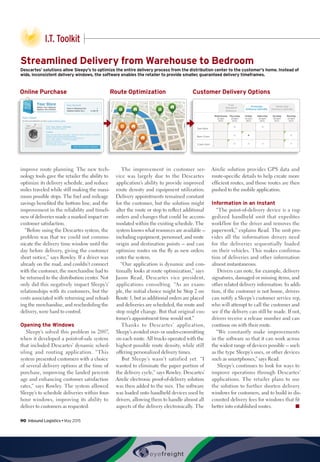
H Riege Software
Georgetown, CT
www.riege.com
Scope Provides a comprehensive multi-modal forwarding transportation management
system for complete operation, management, communications, supply chain visibility,
and regulatory compliance management and documentation.
H
L
Roadnet
Towson, MD
www.roadnet.com
Roadnet
Transportation Suite
Enables organizations with fleets and mobile resources to develop optimal route
plans and track them in real-time, then use this information to compare actual vs.
planned data.
L Robocom
Farmingdale, NY
www.robocom.com
Robocom TMS Manages freight rating, billing, and auditing. Tracks the location of drivers, captures
proof-of-delivery data, and provides dispatchers the ability to insert pickup stops
into delivery runs.
L Royal 4
Long Beach, CA
www.royal4.com
Royal 4 TMS Suite Automates carrier communications, including contract negotiation, load tendering,
invoice processing, and payment approvals. Builds loads, groups orders, and plans
routes to maximize asset utilization, and manages carrier selection and compliance.
L SAP
Newton Square, PA
www.sap.com
SAP TM Creates and monitors a transportation plan that fulfills constraints – for example,
service level, costs, and resource availability. Determines ways to save costs and
optimizes the use of available resources.
H
C
ShippersEdge 
Minneapolis, MN
www.shippersedge.com
ShippersEdge TMS Manages shipments of all modes. Rating, routing, scheduling, real-time tracking,
exception management, freight audit and pay, and report generator. Integration and
customization available.
78  Inbound Logistics • May 2015
TMSBUYER’SGUIDE2015
VENDOR PRODUCT DESCRIPTION
C ShipXpress Inc.
Jacksonville Beach, FL
www.shipxpress.com
ShipX Portal Provides truck tendering, dispatch, rail tracking, and fleet management, as well as
managing transportation costs, freight accruals, and providing rate quotes from
multiple carriers in all modes.
H
L
C
SupplyVision Inc.
Chicago, IL
www.supply-vision.com
Supply Vision TMS Offers customizable shipper and logistics provider visibility tools with integrated
warehouse management, document imaging, and intelligent rate shopping.
H
L
TECSYS
New York, NY
www.tecsys.com
TECSYS TMS Automates and optimizes small package and LTL shipment rating, routing,
manifesting, tracking, and post-shipment analysis.
H
L
TMW Systems Inc.
Mayfield Heights, OH
www.tmwsystems.com
TMWSuite Integrates transportation execution with customer service, sales, dispatch, carrier,
driver and asset management, settlement, finance, and business intelligence.
H
L
C
Trans-i Technologies Inc.
Fort Lauderdale, FL
www.trans-i.com
TransTransport  Offers Web and mobile enterprise applications for truck/rail transportation
management, vendor selection, route optimization, geofence, Google Map (Uber
style) visibility, proof of delivery instant signatures, and customer Web portal.
H
L
C
TransportGistics Inc.
Bohemia, NY
www.transportgistics.com
TGI:TMS Features global multi-modal shipment bidding, rating, routing, planning, execution,
visibility, tariff management, freight audit and payment, analysis, and data mining.
H
C
Transwide
New York, NY
www.transwide.com
Transwide TMS Offers solutions that increase transportation assurance and reduce transportation
spend by streamlining processes and improving visibility throughout the
transportation cycle.
H
C
TransWorks
Fort Wayne, IN
www.trnswrks.com
TMS/Supply Chain
Execution
Configures business rules and automates supply chain processes while providing
visibility across any number of facilities.
H
C
U Route LLC
Royal Oak, MI
www.uroute.com
U Route Offers RFQ development and procurement, bid management, synchronized carrier
costing, complete shipment visibility, and detailed management reports and
analytics.
H
C
UltraShipTMS
Fair Lawn, NJ
www.ultrashiptms.com
UltraShipTMS Gives logistics managers total network visibility and control over inbound and
outbound transportation for optimal procurement, execution, and reporting.
H
L
C
Hostedonthevendor’ssite
Licensedtotheuser
Cloudbased
May 2015 • Inbound Logistics 79
VENDOR PRODUCT DESCRIPTION
APL Logistics
Scottsdale, AZ
www.apllogistics.com
ShipMax Alliance Streamlines collaborative shipping and increases transport efficiency. Pairs freight
with compatible partners who ship to common customers and destinations for
improved load utilization and delivery optimization.
BlueGrace Logistics
Riverview, FL
www.mybluegrace.com
BlueShip TMS Allows users to customize their transportation process, providing functions such as
rating, routing, tracking, and reporting.
Echo Global Logistics
Chicago, IL
www.echo.com
Echo TMS Simplifies transportation lifecycle with automated processes for order management
and consolidation, mode/route optimization, shipment tender and tracking, exception
management, and invoice audit/settlement. Provides a fully integrated solution that
includes sophisticated analytical tools and customized reporting.
Exel
Westerville, OH
www.exel.com
Transportation
Management System
Manages transportation processes with a system configured and deployed to shipper
specifications.
J.B. Hunt
Lowell, AR
www.jbhunt.com
J.B. Hunt 360 Features the integration of multiple modes and carriers, routing guide management,
shipment optimization, automated tendering, appointment scheduling, real-time
tracking, freight payment, invoice auditing, and business analytics throughout the
lifecycle of transportation management.
LeSaint Logistics
Romeoville, IL
www.lesaint.com
TransTech TMS Gives shippers visibility to shipping costs and activities.
Odyssey Logistics  Tech.
Danbury, CT
www.odysseylogistics.com
WIN – Web Integrated
Network
Offers browser-based technology for daily and/or spot freight quotes and multi-mode
quote comparisons, shipment tendering, monitoring and reporting; customizable
dashboards; master data management.
SEKO Logistics
Itasca, IL
www.sekologistics.com
SEKO Transportation
Management System
Provides Software-as-a-Service to manage planning and decision making, shipment
followup, and the measurement of key performance indicators for air, ocean, and
ground transportation.
TMC, a division of
C.H. Robinson
Chicago, IL
www.mytmc.com
Managed TMS Features procurement software, mode/route optimization, shipment tender, rate
assignment, freight payment, yard and dock management, appointment scheduling,
business intelligence, and global language/currency capabilities.
Transplace
Frisco, TX
www.transplace.com
Transplace
Transportation
Management System
Automates order management, shipment optimization, shipment tracking, and overall
performance. Enables route and mode selection, load consolidation, asset utilization,
and reporting.
Trinity Logistics
Seaford, DE
www.trinitylogistics.com
Trinity Logistics TMS Offers real-time access to multi-modal rates, status updates, invoicing, and reporting
while automating daily operations through integration with multiple platforms.
Werner Enterprises
Omaha, NE
www.werner.com
SMART Delivers shipment validation, visibility, and optimization on a domestic or global scale
to meet each shipper’s unique business needs.
THE 3PL
ALTERNATIVE
Shippers may be able to gain access to transportation management system functions
through their third-party logistics (3PL) provider. Here’s a sample of some 3PLs offering
TMS, either as a standalone option or part of the outsourced transportation service.
Fortigo offers value-add technology logistics services to streamline the supply
chain, reduce operating costs, improve productivity and facilitate collaboration
with carriers and vendors.
Fortigo On-Demand TMS delivers best-in-class, carrier neutral
domestic and international shipping automation, visibility, event
management and freight audit.
866.376.8884 tel | www.fortigo.com
On-Demand TMS
Freight Audit
Mobility
Services
C O L L A B O R A T I V E L O G I S T I C S
CUSTOMERCARRIERVENDOR SHIPPER
Reduce Cost | Improve Efficiency | Elevate Customer Service | Eliminate Paperwork | Optimize Logistics | Accelerate Receivables
Fortigo_logistics_PortraitAd.indd 1 4/11/13 4:30 PM
Untitled-4 1 4/12/13 10:55 AMGot 3PL challenges?  Get free expert solutions at inboundlogistics.com/3pl
May 2015 • Inbound Logistics 81
SPONSORED CONTENT
AnExpanding
Paletteof
PalletChoices
S
mart shippers know pallets are the key to unlocking all
kinds of benefits, from process efficiency to better den-
sity to the improved safety of cargo and the people who
handle it. Some 80 percent of all U.S. commerce is carried on
pallets, making them an indispensable part of nearly every supply
chain. That’s why it’s so important to gain a full understanding of
current trends when shopping for a pallet system that will help
optimize your supply chain operations.
Despite initial appearances, the two billion or so pallets circu-
lating in the United States alone are far from identical; they vary
in size, design, materials, reusability, sustainability, compliance
with various industry standards, and more. Shippers must con-
sider not only the physical properties of the pallets they choose,
but also how they fit into the systems in which they will be used:
The seven trends you need
to know before you choose
your next pallet system.
82  Inbound Logistics • May 2015
The material handling equipment, warehouse racks, trailers, and
containers they will encounter in their own facilities, as well as
those of their trading partners. They must also think about their
lifecycles: How will they ensure the right pallets are in the right
places in the right quantities at the right times? Who will be the
right partner to deliver on those needs?
Keeping up on the latest trends in pallet systems helps shippers
ensure they are reaping the best value from their pallets and pallet
partners. Here are seven key developments to know about:
1
Pallet demand is rising.
The pallet market is tied closely to
the economy and factors such as pop-
ulation growth and the rise in disposable
income, according to TechNavio’s report,
Pallet Market in the U.S. 2014-2018. While
the economic downturn slowed growth
between 2007 and 2012, TechNavio
expects increases as the economy improves.
2
Size choices are wide,
and expanding.
Geography and industry largely
dictate pallet size. The International
Organization for Standardization (ISO)
maintains six standards for pallet dimen-
sions to account for sizes commonly used
in various countries.
In the United States, the 40-inch
by 48-inch standard adopted by the Grocery Manufacturers
Association is the most common size, but other industries have dif-
ferent needs. Chemicals, for instance, favor 48 x 42 inches, while
paint moves on 42 x 42s.
Retail sometimes uses 48 x 20 or other streamlined sizes to make
it more efficient to move goods directly from truck to store floor as
store sizes shrink. To meet retailers’ new demands, PECO Pallet,
an Irvington, N.Y.-based North American pallet rental services pro-
vider, recently introduced a half-size (48-inches x 20-inches ) block
pallet, ideal for in-store merchandise displays and end-cap promo-
tions, which can be used for shipments in Canada.
ORBIS Corporation, a subsidiary of Oconomowoc, Wis.-based
Menasha Corporation, also reports seeing a trend for small format
pallets for retail shipments. Nearly 60 percent of stores opened
in the next five years will be small format, and with this growth,
companies are looking for ways to reduce unloading time and
speed up merchandising time in these smaller stores that typi-
cally have narrow doors and no receiving dock. To answer that
need, ORBIS recently launched a 42-inch x 30-inch Small Format
Distribution Pallet, which minimizes touches, allowing drivers
and store employees to optimize the delivery and merchandising
process. This also means employees can spend more time assist-
ing customers.
ORBIS also sees trends related to cleanability to support food
safety initiatives. ORBIS offers several highly hygienic pallets that
are easy to clean and interface well with automation.
Another new option in pallet choices is fabric dunnage, a
combination of ergonomically friendly dunnage materials
designed to be a uniquely flexible and customizable solution for
challenging packaging requirements. This follows the recent re-
branding of the company’s entire line of protective dunnage as
ORBIShield™.
Assembly manufacturers are increasingly turning to fabric as a
dunnage choice due to its ability to protect parts of various sizes,
complex geometry, and Class-A surfaces. Fabric provides a favor-
able alternative for companies that need to ship a large, and often
changing, variety of components. In certain applications, fabric
dunnage is the best option for custom protective interior dunnage.
ORBIS is addressing this move by manufacturing a full line of fab-
ric dunnage.
3
Preferences are shifting to block
designs over stringers.
The pallet industry is seeing a shift in preference from
stringer to block styles. Large retailers, most notably Costco
and Walmart, are helping to drive this shift through block pallet
requirements, according to TechNavio, which also predicts block
pallets will account for a large proportion of the market by 2018.
One pallet maker using the block design is PECO, which offers
its distinctive red 48-inch x 40-inch wood block pallets with four-
way entry for ease of use as they move through the supply chains
of major grocery and consumer goods manufacturers throughout
North America. “True four-way block pallets can be stacked and
transported more efficiently, which reduces emissions and fuel
consumption,” says Adrian Potgieter, senior vice president, sales
for PECO.
4
Wood dominates, but plastic is growing fast.
Pallets can be made of metal, paper, recycled materials,
or even niche materials such as presswood and corrugated.
But for many shippers, the pallet decision comes down to plastic
vs. wood. Wood pallets are more widely used, accounting for as
much as 46 percent of total U.S. hardwood lumber production,
ORBIS Corporation’s Small-Format HP Pallet is designed to optimize the supply
chain of small footprint retailers by eliminating product touches during the order
replenishment process – from distribution center to store to floor.
Peco_diamond_ad0515.indd 1 5/12/15 11:05 AMGot 3PL challenges?  Get free expert solutions at inboundlogistics.com/3pl
84  Inbound Logistics • May 2015
but plastic pallet use is growing more quickly.
Orlando-based pallet pooling and rental service pro-
vider Intelligent Global Pooling Systems (iGPS) uses plastic pallets
measuring 48-inches x 40-inches that meet or exceed Grocery
Manufacturers of America and National Institute of Occupational
Safety standards. The company says its plastic pal-
lets weigh less than 50 pounds, are about 30 percent
lighter than wood alternatives, and don’t shed debris,
such as broken pieces of wood or loose nails.
In addition, iGPS pallets don’t absorb liquids,
are impervious to infestation, and are 100-percent
recyclable. iGPS plastic pallets flow through palletizers and
stretch-wrap machines easily, the company says, with few break-
downs and back-ups. Pallets are cleaned as they pass through the
depot network, which works well for product sensitive manufac-
turing areas.
“There are validated cost efficiencies available that can only
come from using plastic pallets that are approximately 20 pounds
lighter, have no missing leading edges, and allow for more weight
to be shipped with better stability due to a more reliable pallet
perimeter and our cruciform bottom board design,” says Jeffrey
Liebesman, CEO of iGPS Logistics.
Despite the benefits of plastic, wood pallets remain popular for
the benefits they offer. PECO’s wood pallets, for example, are rated
at 2,800-pound capacity and edge-rackable.
“Our pallets are carefully inspected, cleaned, and maintained
every time they cycle through a depot, so we ship full truckloads
of pallets that are ready to use and don’t require extra sorting time,”
says Potgieter. Higher quality wood pallets also work smoothly in
automated processing lines, he adds.
“Recent volatility in lumber pricing, however, is affecting the
entire wood pallet industry and is generating a greater interest in
alternative pallet materials,” says Potgieter. Because of this, PECO
has developed prototypes of both all-plastic and wood/plastic
hybrid models that are currently in field testing.
ORBIS offers standard pallets in polyethylene and polypropyl-
ene plastic, in three major styles: nestable, stackable, and rackable
in footprints from 24-inches x 24-inches to 48-inches x 72-inches.
The company also offers metal and X-ray detectable, fire retar-
dant, or FDA-approved materials. “While many standard plastic
pallets are available, plastic pallets also have the ability to be
custom designed for nearly any application, if the return on invest-
ment is evident,” notes Curt Most, senior marketing manager for
ORBIS Corporation.
5
As sustainability importance rises, environmental
considerations are coming into play.
As with most products, determining what pallet material
fits best with sustainability goals, in addition to fulfilling supply
chain requirements, is a complex exercise. Each material delivers
both benefits and trade-offs, and pallet system operators can offer
detailed data to use in this calculation.
Lighter pallets mean less fuel consumption, reduced carbon
footprint, and sometimes more product transported per truckload,
according to iGPS. Other factors to consider, says Liebesman, are
the impact of lower customer product costs when shipped on an
iGPS pallet, in addition to reduced pallet damage, resulting in less
iGPS offers all-plastic pallets
with embedded radio frequency
identification tags.
Piling on the Benefits
By optimizing their pallet selection, shippers can reap
multiple benefits, according to Curt Most, senior marketing
manager for ORBIS Corporation. Among them:
■■ Reduced cost per trip.
■■ Repeatable performance. As today’s distribution centers
become more automated, plastic pallets reduce system
downtime that can happen with inconsistently sized platforms.
Because plastic pallets are molded, they retain consistent
sizing throughout the life of the pallet.
■■ Hygiene and cleanliness are top priorities for today’s
distribution centers. Plastic pallets are a hygienic solution for
food applications, as well as beverage and pharmaceutical
applications, because they are produced from virgin material
and are easy to clean, with features such as flow-through decks
and drain holes.
■■ Reusable plastic pallets can be a highly sustainable
solution. They can last many trips when compared to
alternative pallets, and are fully recyclable at the end of their
service life, resulting in no solid waste in landfills.
■■ Reusable plastic pallets provide economic value. With
a long service life, their return on investment can take just a
few months, and then the user has an asset in its system that
continues to provide value for years to come. Long life and
reusability equal rapid and positive return on investment.
■■ Safety and ergonomics with contoured surfaces
and design.
It is important to treat pallets as assets that have significant
value over their service life, and to understand the cost-per-trip
over the life of the pallet, Most suggests. He also recommends
looking at the softer benefits such as worker handling,
improved warehouse space utilization, and automation
integration. Through re-use, pallets can bring economic benefit,
as well as a variety of other important business benefits.
To see more green for your company call
1(800) 884-0225, or visit:
www.ipgs.net
Great news for your bottom line.
There are more than 40 areas of
savings when businesses switch
from wood pallets to iGPS plastic
platforms. This includes lower
transport costs, less product damage
and reduced equipment downtime.
The new and stronger iGPS has
reemerged as a driving market force
with its unique Plastic Pallet Pooling
System, that provides cutting edge,
global supply chain solutions for
some of the leading companies and
manufacturers in the world.
Lower Costs
Go green
igps_ad0515.indd 1 4/29/15 3:51 PMGot 3PL challenges?  Get free expert solutions at inboundlogistics.com/3pl
86  Inbound Logistics • May 2015
natural resources needed for repairs, transportation, and handling.
PECO’s high-quality #2 grade douglas fir and southern yellow
pine wood is responsibly harvested in North America. “Switching
from single-use white wood pallets to reusable block pallets is an
excellent way for companies to improve their environmental sus-
tainability,” says Potgieter. “PECO’s sturdy wood block pallets are
designed for continued reuse, and our strict maintenance stan-
dards extend pallet life over 10 years. And all PECO pallets are
fully recycled once they have reached the end of their useful life
into mulch or livestock bedding, and even the nails are removed
with magnets and recycled. Nothing goes to the landfill.”
ORBIS uses its proprietary Environmental Analysis Tool, which
calculates the environmental impacts of different pallet scenarios.
The company works with customers to compare their current pack-
aging to future plastic packaging so they can identify the impacts
on solid waste, energy usage, and greenhouse gas emissions.
6
Pallet pools are growing.
Pallet pools can be an excellent way to serve the needs
of an entire supply chain with a pallet tailor-made for the
properties of its products. Ironically, pallets both facilitate logistics
and require logistics: pallet systems must be carefully managed
to not only ensure the right pallets are in the right places at the
right times, but that they are properly cleaned and kept in good
repair. Some companies that ship only locally form their own pal-
let pools, but more commonly, companies turn to third-party pallet
pool operators, which saw a boost in business when Costco and
Walmart mandated block style pallets.
It’s important to understand how third-party pallet pool opera-
tors manage their fleets so that their services and business processes
match customer needs.
Understanding the entire supply chain is critical to a success-
ful pallet pool, as is working with all supply chain partners on the
program, says Most.
“It’s extremely important to consider how pooled pallets are
maintained,” concurs Potgieter, who calls PECO’s quality stan-
dards the strictest in the industry. “We are the only pooled pallet
provider that inspects, cleans, and repairs pallets every time they
Making the
Right Choice
Choosing the right reusable pallet depends on
the pallet program’s application, specific needs, and
objectives. To help guide shippers toward the best choice
for their operations, ORBIS Corporation asks prospective
customers the following types of questions:
■■ What type of product are you shipping/storing
(food, cartons, frozen)?
■■ To determine load capacity, how much does
it weigh?
■■ What is the load distribution?
■■ What are the cleanliness requirements?
■■ Who are your supply chain partners for inbound
and outbound shipments?
■■ What are the products’ unique environmental
factors (freezer, refrigerated, indoor/
outdoor storage)?
■■ How will it interface with automation?
■■ How will it be used? As work in process, storage,
racking, or distribution?
■■ How many trips do you make in a week/month/
year?
■■ What is the trip distance?
■■ How will the pallet be returned to point of origin?
■■ What footprint is required?
PECO’s high-quality
block pallets help reduce
product damage and
streamline operations.
May 2015 • Inbound Logistics 87
cycle through our depots,” he notes. “Our customers get consis-
tent, high-quality pallets in every load.”
Liebesman confirms iGPS’s strong commitment to ensuring
that pallet quality is maintained to the highest standard, which
is reinforced by a pattern of continued investment, and research
and development at the leading edge of design and technology. A
customer-centric culture focused on creating strong supply chain
relationships is critical, he adds.
“Building an efficient and effectively optimized national, and
ultimately global, pooling network requires working continuously
with the marketplace to maximize pallet turns and asset utiliza-
tion, and developing world-class asset management and recovery
systems, processes, and controls to reduce losses and improve turns
and utilization,” Liebesman says.
7
Pallets are going high-tech.
RFID chips embedded in some pallets, such as those from
iGPS, enable the pallet’s unique serial number or Global
Returnable Asset Identifier (GRAI) to be read by RFID readers,
which don’t require a line of sight to the tag. They also encode
that information into the pallet’s bar code.
Pallet management also takes advantage of advances in technol-
ogy. PECO RedLink™, the company’s proprietary online pallet
management tool, enables users to log in 24 hours a day to place
orders, check delivery dates, view invoices, or generate useful at-
a-glance reports. Easy access to the same information the vendor
uses enables provider and customer to collaborate to manage pallet
flows, identify problem areas, and find new ways to reduce costs.
iGPS offers customers the opportunity to manage their pallet
reporting process using RFID tracking capability, as well as via
batch tracking pallet management processes.
“Adding batch tracking was a direct response to listening to cus-
tomers and recognizing that it’s a far more common practice in
today’s supply chain,” says Liebesman. “We work hard to foster a
shared respect for two-way reporting disciplines to ensure that our
customers’ pallet balances are kept accurate, and that we deal with
any exceptions within an agreed upon, but short, time. We cap-
ture and measure all of these metrics as part of a KPI process, and
report monthly to our customers.”
Choosing Wisely Pays Dividends
Shippers need pallets that are clean and in good repair, work
well for the products they will carry and the equipment and facil-
ities they will encounter, and are present in the right places at
the right times to meet demand. ORBIS works to minimize risk
by working with all stakeholders prior to pallet selection. “We
work together to find the best pallet for the application, then do a
small pilot program and train the users,” says Most. “We encour-
age companies to treat pallets as assets, so we help with training
and handling.”
No matter what kind of pallet or vendor you choose, select-
ing carefully can positively impact productivity, safety, efficiency,
waste, and cost, and enhance sustainability goals while keeping
goods intact and moving. n
When you can fill your trailers higher,
which way do you think your profits will go?
ORBIS Small-Format pallets carry the same size load as a standard
pallet, while occupying a smaller footprint in your trailers. The 42”x 30”
footprint increases order stack height, offering a more economical
delivery solution for reduced case orders. With pallets packed-out
higher, instead of wider, your trailer density will increase and so will
your profit margins. Contact us to learn more.
a shift in thinking | orbiscorporation.com/smallformat
ORBIS_InboundLog_HalfPageHorizontal_051115.indd 1 5/11/2015 2:24:02 PM
smc3_ad0515.indd 1 4/30/15 10:32 AMGot 3PL challenges?  Get free expert solutions at inboundlogistics.com/3pl
INPRACTICE
When Sleepy’s customers
got tired of short notice
and missed deliveries, the
specialty mattress retailer
brought in a technology
partner and dreamed up
a solution that put those
problems to bed.
I.T. Toolkit | by Wally Weart
Awake at the Wheel: Delivering
Customer Satisfaction
D
elivering thousands of mattresses nationwide every day might make
you ready for a nap. But not Sleepy’s. When the specialty mattress
retailer needed to figure out how to sync up its distribution centers
and independent delivery contractors with the needs of its customers, it was
time to wake up and bring in a technology expert.
Founded in 1957, Sleepy’s has become
one of the largest privately owned spe-
ciality retailers in the country, supplying
mattresses, box springs, pillows, bedding,
and furniture to countless bedrooms.
The company has grown to more than
1,000 retail locations in 17 states, and
operates seven distribution centers that
make about 3,000 daily deliveries.
“Sleepy’s lives by a code to offer custom-
ers the best price, most convenient delivery,
and most reliable service so that 100 per-
cent of customers are satisfied 100 percent
of the time,” says Donald Rowley, chief
information officer for Sleepy’s.
With this mission as the cornerstone
of operations, Sleepy’s doesn’t take cus-
tomer delivery lightly. “We not only
deliver the new mattress or other items,
we also provide setup services and haul
away the old mattress,” Rowley explains.
“Landed percentage, which measures
how many deliveries are made in accor-
dance with customer requirements, is a
key metric for us.” Improving this num-
ber enhances service and reduces cost.
Scheduling deliveries has always been
important to the sales cycle – both for cus-
tomer satisfaction and delivery fleet cost
control. Before implementing a software
solution, scheduling delivery appoint-
ments was difficult and time-consuming.
Sleepy’s began working with The
Descartes Systems Group, a technol-
ogy solutions provider based in Ontario,
Canada, nearly one decade ago to help
May 2015 • Inbound Logistics 89
I.T. Toolkit 
improve route planning. The new tech-
nology tools gave the retailer the ability to
optimize its delivery schedule, and reduce
miles traveled while still making the maxi-
mum possible stops. The fuel and mileage
savings benefited the bottom line, and the
improvement in the reliability and timeli-
ness of deliveries made a marked impact on
customer satisfaction.
“Before using the Descartes system, the
problem was that we could not commu-
nicate the delivery time window until the
day before delivery, giving the customer
short notice,” says Rowley. If a driver was
already on the road, and couldn’t connect
with the customer, the merchandise had to
be returned to the distribution center. Not
only did this negatively impact Sleepy’s’
relationships with its customers, but the
costs associated with returning and reload-
ing the merchandise, and rescheduling the
delivery, were hard to control.
Opening the Windows
Sleepy’s solved this problem in 2007,
when it developed a point-of-sale system
that included Descartes’ dynamic sched-
uling and routing application. “This
system presented customers with a choice
of several delivery options at the time of
purchase, improving the landed percent-
age and enhancing customer satisfaction
rates,” says Rowley. The system allowed
Sleepy’s to schedule deliveries within four-
hour windows, improving its ability to
deliver to customers as requested.
The improvement in customer ser-
vice was largely due to the Descartes
application’s ability to provide improved
route density and equipment utilization.
Delivery appointments remained constant
for the customer, but the solution might
alter the route or stop to reflect additional
orders and changes that could be accom-
modated within the existing schedule. The
system knows what resources are available –
including equipment, personnel, and route
origin and destination points – and can
optimize routes on the fly as new orders
enter the system.
“Our application is dynamic and con-
tinually looks at route optimization,” says
Jason Read, Descartes vice president,
applications consulting. “As an exam-
ple, the initial choice might be Stop 2 on
Route 1, but as additional orders are placed
and deliveries are scheduled, the route and
stop might change. But that original cus-
tomer’s appointment time would not.”
Thanks to Descartes’ application,
Sleepy’s avoided over- or under-committing
on each route. All trucks operated with the
highest possible route density, while still
offering personalized delivery times.
But Sleepy’s wasn’t satisfied yet. “I
wanted to eliminate the paper portion of
the delivery cycle,” says Rowley. Descartes’
Airclic electronic proof-of-delivery solution
was then added to the mix. The software
was loaded onto handheld devices used by
drivers, allowing them to handle almost all
aspects of the delivery electronically. The
Airclic solution provides GPS data and
route-specific details to help create more
efficient routes, and those routes are then
pushed to the mobile application.
Information in an Instant
“The point-of-delivery device is a rug-
gedized handheld unit that expedites
workflow for the driver and removes the
paperwork,” explains Read. The unit pro-
vides all the information drivers need
for the deliveries sequentially loaded
on their vehicles. This makes confirma-
tion of deliveries and other information
almost instantaneous.
Drivers can note, for example, delivery
signatures, damaged or missing items, and
other related delivery information. In addi-
tion, if the customer is not home, drivers
can notify a Sleepy’s customer service rep,
who will attempt to call the customer and
see if the delivery can still be made. If not,
drivers receive a release number and can
continue on with their route.
“We constantly make improvements
in the software so that it can work across
the widest range of devices possible – such
as the type Sleepy’s uses, or other devices
such as smartphones,” says Read.
Sleepy’s continues to look for ways to
improve operations through Descartes’
applications. The retailer plans to use
the solution to further shorten delivery
windows for customers, and to build in dis-
counted delivery fees for windows that fit
better into established routes. n
Streamlined Delivery from Warehouse to Bedroom
Descartes’ solutions allow Sleepy’s to optimize the entire delivery process from the distribution center to the customer’s home. Instead of
wide, inconsistent delivery windows, the software enables the retailer to provide smaller, guaranteed delivery timeframes.
Customer Delivery OptionsOnline Purchase Route Optimization
90  Inbound Logistics • May 2015
At ThomasNet.com, you’ll find 700,000+ industrial and commercial suppliers.
In-depth, content-rich profiles to vet prospective partners. Powerful tools to
qualify, compare, and contact the ones that are right for you. And it’s all FREE.
Tap into ThomasNet.com today. And discover how it’s simply the shortest
distance to your ideal supplier shortlist.
Simplify the
logistics
of supplier
discovery.
Untitled-13 1 4/30/15 10:55 AMGot 3PL challenges?  Get free expert solutions at inboundlogistics.com/3pl
IN THIS SECTION:
3PL – Pallets
Mallory Alexander International Logistics • www.mallorygroup.com
Mallory Alexander International Logistics is a leading third-party
logistics (3PL) provider. As a specialist in global logistics and supply
chain services, Mallory Alexander acts as a single source for all logistics
and supply chain needs. Specifically, Mallory Alexander provides public
and contract warehousing, freight forwarding (international, domestic,
air, and ocean), customs brokerage, import/export services, intermodal
trucking and transportation, logistics services, and consulting.
The Raymond Corporation • www.raymondcorp.com
The Raymond Corporation® is a global provider of end-to-end warehouse
and material handling solutions, expertise and support. Designed with
ecological and economic benefits, Raymond lift trucks are engineered to
achieve higher performance and increase efficiency. Raymond offers a
full line of manual and electric lift trucks and the iWarehouse® Fleet and
Warehouse Optimization System. Raymond further enhances warehouse
and material handling practices through flexible automation solutions,
customized financing options, and industry-leading consultation.
iGPS Logistics • www.igps.net
iGPS Logistics is North America’s only pooler of 48x40 plastic pallets.
iGPS pallets generate measurable savings in transport, reduced product
damage, and other operational efficiencies. The world’s only multi-use
pallet to receive NSF Food Equipment Certification, iGPS’ platform is a
major advance in supply chain hygiene—a platform that can easily be
cleaned. Contact us at 1-800-884-0225 or visit www.igps.net.
ORBIS • www.orbiscorporation.com
As leading companies continue to drive sustainability in their business, they
scrutinize every point of their supply chain, including the packaging used
to move their product. ORBIS provides reusable plastic containers, pallets,
dunnage, and bulk systems that improve the flow of product all along the
supply chain to reduce costs, enhance profitability, and add sustainability.
3PL
FORKLIFTS
PALLETS
92  Inbound Logistics • May 2015
IN THIS SECTION:
Pallets – TMS
PECO Pallet • www.pecopallet.com
PECO Pallet is the North American leader in pallet rental services with an
outstanding reputation for quality, service, and sustainability. Leading
consumer goods manufacturers utilize PECO’s sturdy red wood block
pallets to ship to grocery and warehouse retailers in the United States,
Canada, and Mexico. For more information, visit www.pecopallet.com.
Canadian National (CN) • www.cn.ca
CN’s network of logistics parks are strategically located at the heart of North
America to connect your business to world markets. Located in, or adjacent
to, its intermodal rail yards, CN provides you with seamless and efficient
transportation and easy access to major highways. CN provides access to all key
logistics services—rail, intermodal, warehousing, distribution, CargoFlo liquid
and dry bulk transload, and Autoport distribution facilities—in one location. As
your supply chain partner, CN can help you find your new distribution home.
Hoosier Energy • www.hepn.com
Hoosier Energy is a generation and transmission cooperative providing electric power
to 17 member electric distribution cooperatives in central and southern Indiana and one
member cooperative in Illinois. Based in Bloomington, Ind., Hoosier Energy operates coal,
natural gas, and renewable energy power plants and delivers power through a 1,450-mile
transmission network. Hoosier Energy is a Touchstone Energy Cooperative, one member
of a nationwide alliance of electric co-ops providing high standards of service according
to four core values: integrity, accountability, innovation, and commitment to community.
C.H. Robinson • www.chrobinson.com
In today’s global business environment, scalable global technology is becoming
a necessity. That is why one of our top priorities is providing you with flexible,
efficient, and integrated technology solutions that bring all aspects of your supply
chain together. Whether you need clear visibility to your operations, optimization
of your business processes, better technical connectivity to your customers
and service providers, or strategic data and reporting to help drive decisions,
the tools you need are right at your fingertips via Navisphere® online access.
RAIL
SITE SELECTION
TMS
May 2015 • Inbound Logistics 93
IN THIS SECTION:
TMS
CT Logistics • www.ctlogistics.com
CT Logistics can help you save money, no matter your company’s size.
For small and medium-sized shippers, CT Logistics offers its TranSaver
shipper cooperative buying program. Larger shippers can simplify their
freight spending with CT Logistics’ exclusive FreitRater freight bill rating
and processing system. And businesses of all sizes can benefit from
AuditPay freight payment services. Add to these offerings a wealth of online
collaboration and reporting tools, and it’s easy to see why shippers have trusted
CT Logistics with their freight payment needs for more than 86 years.
Fortigo • www.fortigo.com
Fortigo’s team of experts specializes in logistics optimization and enterprise
Web-based software. For companies seeking to reduce costs, improve
customer satisfaction, and increase profitability, Fortigo automates,
optimizes, and audits logistics decisions. Fortigo plugs into established
supply chain applications and provides rapid return on investment by
optimizing and deploying closed-loop logistics processes, minimizing ship-
to-order times and streamlining collaboration with logistics providers.
J.B. Hunt Transport • www.jbhunt.com
J.B. Hunt Transport focuses on providing safe and reliable transportation
services to a diverse group of customers throughout the continental United
States, Canada and Mexico. Utilizing an integrated, multimodal approach, the
company provides capacity-oriented solutions centered on delivering customer
value and industry-leading service. J.B. Hunt Transport Services, Inc. stock
trades on NASDAQ under the ticker symbol JBHT, and is a component of
the Dow Jones Transportation Average. J.B. Hunt Transport, Inc. is a wholly
owned subsidiary of JBHT. For more information, visit www.jbhunt.com.
Magaya Logistics Software Solutions • www.magaya.com
Magaya’s logistics software is designed specifically for freight forwarders,
NVOCCs, logistics providers, warehousing and distribution centers,
importers, exporters, and others in the logistics industry. Our software is a
complete package that integrates logistics, communication, and accounting
features built on the award-winning Magaya Network. Companies can
exchange documents for shipping, and more, with their customers and
agents worldwide via the Network and give them real-time tracking.
94  Inbound Logistics • May 2015
IN THIS SECTION:
TMS – Transportation Mgmt/Freight Mgmt
Manhattan Associates • www.manh.com
For 23 years, Manhattan Associates has provided global supply chain
excellence to organizations that consider supply chain software, processes,
and technology strategic to market leadership. The company’s platform-based
supply chain software portfolios — Manhattan SCOPE®, Manhattan SCALE™
and Manhattan Carrier™ — are designed to deliver both business agility and
total cost of ownership advantages and are used by 1,200 companies globally.
MercuryGate International, Inc. • www.mercurygate.com
MercuryGate delivers a multi-modal TMS solution that allows shippers, freight
brokers, and third-party logistics providers to plan, execute, track, and settle
freight movements. Customers use a single SaaS or self-hosted application to
realize savings through consolidated loads, optimized carrier selection, and
process improvements. For more information, visit www.mercurygate.com.
WIN (Web Integrated Network) • www.gowithwin.com
WIN (Web Integrated Network) is not a Transportation Management System,
it’s better. WIN is the no-fee Web-based tool that enables you to manage your
shipping from one place. It helps optimize freight movements; simplifying
your daily transportation management activities while providing immediate
savings. WIN is your route to transportation control and freight savings, and
always leaves you in control of your transportation management role.
Echo Global Logistics • www.echo.com
Echo Global Logistics, Inc. (Nasdaq: ECHO) is a provider of technology-
enabled transportation and supply chain management services. Echo
maintains a proprietary, Web-based technology platform that compiles
and analyzes data from its network of more than 30,000 transportation
providers to serve its clients’ needs. Offering freight brokerage and
managed transportation services across all major modes, Echo works to
simplify the critical tasks involved in transportation management.
TRANSPORTATION MGMT/FREIGHT MGMT
May 2015 • Inbound Logistics 95
IN THIS SECTION:
Transportation Mgmt/Freight Mgmt – Warehousing
Precision Software • www.precisionsoftware.com
Precision Software, a division of QAD Inc., is a provider of industry-
leading transportation and global trade management software
solutions. Precision’s unique single platform product suite is designed
with open architecture and integrates with leading enterprise
resource planning (ERP), warehouse management systems (WMS),
transportation management systems (TMS) and legacy applications.
DF Young • www.dfyoung.com
DF Young has more than 100 years of experience providing international
businesses with the full range of transportation and logistics solutions.
DF Young’s customized, person-to-person services are proven to meet
today’s challenging logistics requirements. DF Young paves the way for
international shipments clear across continents, using the most sophisticated
air, sea, and land transportation services available. Each move is backed by
state-of-the-art technology and Internet access that spans the globe.
Lynden • www.lynden.com
Over land, on the water, in the air—or in any combination—Lynden has
been helping customers solve transportation problems for almost
a century. Operating in such challenging areas as Alaska, Western
Canada and Russia, as well as other areas around the globe, Lynden
has built a reputation of superior service to diverse industries.
NFI • www.nfiindustries.com
NFI is a supply chain management provider offering dedicated fleets, logistics,
distribution, warehousing, intermodal, global, commercial and industrial real
estate, consulting, transportation brokerage, and solar services across the U.S.
and Canada. NFI owns facilities nationwide and globally, more than 2,000 tractors,
and more than 7,000 trailers. Privately held by one family since its inception in
1932, NFI operates 20+ million square feet of warehouse and distribution space,
and generates more than $1 billion in revenue annually. NFI is an EPA Smartway
Transport and WasteWise Partner and is dedicated to increasing energy efficiency
and reducing the impact of the freight industry upon the environment.
WAREHOUSING
96  Inbound Logistics • May 2015
IN THIS SECTION:
Warehousing
Pacific Coast Warehouse Company • www.pcwc.com
Pacific Coast Warehouse Company (PCWC) is a third-party logistics provider
based in California, with more than 70,000 food grade rack and bulk pallet storage
positions in the southern and northern California markets. PCWC offers a complete
line of warehousing and value-added services, as well as all levels of transportation
service, including drayage, intermodal, full truckload, flatbed, and LTL. For
more information about Pacific Coast Warehouse Co., visit www.pcwc.com.
Penske Logistics • www.penske.com
Penske Logistics is an award-winning logistics services provider with operations
in North America, South America, Europe and Asia. Our innovative solutions,
engineering, and advanced technology help leading companies drive down supply
chain and logistics costs, and boost operational efficiency. Penske Logistics offers
dedicated contract carriage, distribution center management, transportation
management, lead logistics, supply chain consulting, freight brokerage, and fully
customizable solutions. Call Penske Logistics at 1-800-529-6531 to learn more.
Saddle Creek Logistics Services • www.sclogistics.com
Saddle Creek Logistics Services is a third-party logistics company. We leverage
our broad array of capabilities—including warehousing, transportation,
packaging and fulfillment—to provide integrated solutions that support our
customers’ business objectives. For more information, visit sclogistics.com.
WSI (Warehouse Specialists, Inc.) • www.wsinc.com
Reliability is everything. At WSI, that has been our approach to integrated logistics
and supply chain solutions for more than 40 years. Our promise of Condition,
Count  Time ensures accurate, timely, and sound performance—every time.
Recognized as one of the top 3PL companies in North America, WSI delivers
custom solutions for warehousing/distribution, fulfillment, transportation,
import/export, information technology, and customer support services. Depend
on WSI for increased efficiency, reduced costs, and absolute reliability.
May 2015 • Inbound Logistics 97
Industry experts amass supply chain
management best practices and skill sets,
and invest in new research and evaluation
tools. Now you can benefit. Inbound
Logistics has selected this collection of
whitepapers that will give you a jump on
important supply chain issues. For more
information on any of these whitepapers,
visit the Web sites listed below.
WhitePaperDigest
98  Inbound Logistics • May 2015
Unyson
	 TITLE:	 Failure of Traditional LTL
	DOWNLOAD:	 bit.ly/1Ac3eAk
	 SUMMARY:	 This whitepaper covers the development of a unique consolidation
system powered by Unyson technology to provide cost impact relief,
tracking visibility, and service improvements.
ThomasNet
	 TITLE:	 Industry Market Barometer
	DOWNLOAD:	 bit.ly/1uPtEKO
	 SUMMARY:	 The news for the general economy may be mixed, but for manufacturers
it’s all systems growth. ThomasNet’s annual Industry Market Barometer
survey shows an upward trajectory for manufacturers as they continue
to lead the economy forward. Manufacturers are getting more business
from existing markets, increasing production capacity, optimizing
operations, and hiring and retraining staff. ThomasNet’s latest research
helps you stay one step ahead.
C3 Solutions
	 TITLE:	 Dock Scheduling and the Retail Industry
	DOWNLOAD:	 bit.ly/1Ac3orj
	 SUMMARY:	 Are you still making dock appointments with emails, paper calendars,
and spreadsheets? Then check out this free eBook, which explains the
benefits of using a dock scheduling system to cut the time spent on
scheduling, obtain better visibility via KPIs, and access reports to make
operations more efficient.
Got 3PL challenges?  Get free expert solutions at inboundlogistics.com/3pl
May 2015 • Inbound Logistics 99
Share your whitepaper with IL readers!
WhitePaper Digest is designed to bring readers up-to-date information on
all aspects of supply chain management. We’re building a database of SCM
whitepapers, and you can help. E-mail us with whitepaper recommendations:
editorial@inboundlogistics.com
Exel
	 TITLE:	 Lean and Agile: The Resilient Tech Sector Supply Chain
	DOWNLOAD:	 bit.ly/1zYlzXe
	 SUMMARY:	 Exel, in conjunction with sister company DHL Supply Chain, offers
a new whitepaper that reveals technology companies must take an
innovative approach to their product development, and apply it to their
supply chain management, to help prevent loss of market share. The
research makes clear that tomorrow’s tech supply chains must be lean,
responsive, and resilient. Tech companies must develop highly adaptive
supply chains that can quickly align across global markets. This agility
revolves around staying asset-light, but being able to access fully
qualified capacity when needed, typically through partnerships with
lead logistics providers.
Cerasis
	 TITLE:	 The Complete Guide to Freight  Transportation Accounting
	DOWNLOAD:	 bit.ly/1zYlCSK
	 SUMMARY:	 If you are looking to better understand how transportation costs fit into
your business, and make better informed decisions to wrangle ever-
increasing transportation costs, this whitepaper is for you. You will
learn the benefits of freight audit; the difference between a freight bill
and a bill of lading; ways to make your invoices work for you, not against
you; and how implementing a consolidated freight invoices program
will make you the finance department’s hero. Get started today by
downloading this free resource.
BestTransport
	 TITLE:	 Crossing Over: TMS Delivering Big Value for Small Shippers
	DOWNLOAD:	 bit.ly/1F5foiQ
	 SUMMARY:	 No matter the size of your shipping operation, the logistics are
complicated. Optimizing loads, reducing dock dwell, load tendering,
meeting deadlines, and many other issues combine to challenge your
business every day. Transportation Management Systems (TMS) have
long been a mainstay in large shipping departments, while smaller
shippers have been left using manual systems such as spreadsheets,
or worse. Not anymore. A SaaS cloud-based TMS will show you the
money – with little to no investment up front, and big value to your
bottom line. Find out more by downloading this free whitepaper.
Got 3PL challenges?  Get free expert solutions at inboundlogistics.com/3pl
INBRIEF NEW SERVICES  SOLUTIONS
// Technology //
Supply chain management software
provider TECSYS released a new
management toolbox, Visual Metrics
Performance Measurement Suite. Using
dashboards, best practice metrics, and
analytics, the software exposes the
supply chain to help users understand
cause-and-effect relationships across
the spectrum. 

Technology solutions provider Epicor
Software launched version 9.0 of
Epicor Eclipse. Users can now access
a volume rebate tracking system for
vendor purchases, an improved central
purchasing process, faster material
returns, and integration to Avalara for
tax calculation and filing services.
Manufacturing enterprise resource
planning (ERP) software provider IQMS
teamed up with medical manufacturer
Tessy Plastics and supply chain solution
consultant Blue Horseshoe to release
Advanced WMS. The partnership allows
users to integrate into an ERP solution
for traceability, accountability, and
efficiency.
Materials handling solutions provider
Toyota Industrial Equipment launched
T-Matics, a forklift vehicle management
system that includes dashboard-style,
Web-based reporting to help increase
efficiency and uptime by tracking
current usage and long-term operating
trends.
Intermodal cold chain tracking provider
WAM Technologies partnered with
reefer monitoring and protective
services provider Mark-it Services to
release The ReeferWatch Global Cargo
Monitoring Service. Users can constantly
monitor reefer equipment and
perishable cargo status, and are alerted
to temperature changes, equipment
failure, or an unplugged reefer container.
Taiwan-based China Airlines relocated its
regional base to Al Maktoum International
at Dubai World Central. The carrier operates
flights from Taipei to Dubai and onwards
to Amsterdam, Luxembourg, and Frankfurt
using its fleet of Boeing 747s.
100  Inbound Logistics • May 2015
Supply chain management software
provider HighJump released HighJump
Pulse, a supply chain intelligence
solution to increase the availability
and visibility of a company's key
performance indicators. The solution
integrates data from across an
enterprise to provide self-service
reporting and analysis.
Supply chain consulting and IT services
firm enVista released a new version
of its Model DC distribution center
optimization tool. The latest version
features 75 different charts and graphs
that can be used in the modeling
process.
Software provider McLeod Software
released version 15.1 of its LoadMaster,
PowerBroker, and LoadMaster LTL core
transportation solution. The new release
includes intermodal management
updates and real-time metrics.
// Transportation //
Freight consolidator Famous Pacific
Shipping began operating weekly less-
than-containerload (LCL) service from
Rotterdam, the Netherlands, to St.
Petersburg, Russia. The service provides
a direct alternative to traditional routing,
reducing transit time from 15 to four days.
CaroTrans, an ocean freight consolidator,
launched a LCL route from Shanghai
to Atlanta, via the Port of Savannah.
Transit time is 32 days, and expedited
distribution services are available to
Alabama, Georgia, North and South
Carolina, Florida, and Tennessee.
Container shipping company CMA
CGM Group launched a weekly service
linking the Mediterranean to the U.S.
Gulf and Caribbean (Dominican Republic
and Jamaica). The new route improves
transit time between Mexico and
Houston to Spain and Italy, and offers a
direct rotation from Houston to Tangiers.
The Kansas City Southern Railway
Company (KCSR) invested $19 million in
2015 on construction and improvement
projects on KCSR’s Beaumont
Subdivision line, which runs from
Beaumont, Texas, to DeQuincy, La.
These projects include the replacement
of 20 miles of rail and 40,000 cross
ties, as well as improvements to 10 road
crossings. The improvements will help
grow capacity and enhance safety.
To expand its service on the India-Gulf
trade, Evergreen Line partnered with
Simatech, a feeder operator based
in Dubai, to launch a joint Chennai-
Colombo-Gulf service. The weekly
service links the major ports of southern
India and Sri Lanka with the gulf, and
connects to Evergreen's global service
network in Colombo.
Brass Knuckle CR4300 (BKCR4300) work gloves from Safety Today offer ANSI
cut level 4 protection, and a latex coating on the full finger and palm. The gloves
are made of a high-density polyethylene — a low-lint, continuous filament yarn that
is stronger than steel on an equal-weight basis.
May 2015 • Inbound Logistics 101
INBRIEF
Non-vessel-operating common
carrier CaroTrans launched a
weekly LCL service from New York
to Helsinki, Finland, a key hub for
consolidations into northwestern Russia.
The direct service option eliminates
transshipment costs and delays.
Less-than-truckload provider Dayton
Freight Lines introduced DFXpedited
Service (DFX), which operates 24/7 for
urgent, on-demand shipments in North
America. DFX provides same-day and
next-day shipping for freight of any
weight and dimension.
Online freight forwarder iContainers
started door-to-door ocean freight
services for imports, exports, and
overseas moves. The service provides
door-to-port services, including FCL and
LCL shipping, from the United States
and Spain to anywhere in the world.
// Products //
The Jungheinrich ETR 230-235
series of pantograph reach trucks
from Mitsubishi Caterpillar
Forklift America Inc. combines
on-board electric controllers, AC
electrical motor technology, and a
servicing software system to minimize
energy consumption. The 36-volt
pantograph reach trucks can run up to
two shifts on a single battery charge in
most applications.
Storage solutions manufacturer Akro-
Mils’ Super-Size AkroBins securely stack
on top of each other, and sit on shelving,
carts, or dollies. Bins can stack with
casters attached, and are available in 12
sizes and five colors.
Hyster Company’s H1050-1150HD-CH
series container handler comes with an
integral mounted spreader capable of
handling both 20-foot and 40-foot ISO
and domestic containers. The series
features a Tier 4 Final Cummins engine
that lowers fuel consumption by up to
20 percent, but delivers hoist speeds of
59 feet per minute, and lowering speeds
of 98 feet per minute.
The Stärke Material Handling Group’s
three-wheel Mini Forklift helps move
product in factories and warehouses
with narrow aisles, and can deliver
materials directly to most workstations
and production lines with no width or
height restrictions.
Big Joe Forklift’s J2 model electric
forklift can handle a wide variety of
pallets, half pallets, and skids. The lift’s
compact size and flexible operation
allows users to perform case, batch, and
cluster picking with one machine.
ClearSpan Fabric Structures added
a Giant Doors feature to its fabric and
metal building solutions. The bi-fold
Giant Doors are fully customizable,
and provide an entryway that is
large enough for any type of vehicle,
machinery, or equipment.
Packaging equipment provider Combi Packaging
Systems and robotics automation company Motion
Controls Robotics introduced the RCE Robotic Random
Case Erector. The robot helps reduce ergonomic injuries
to employees from repetitive motion, and can construct
up to eight different box sizes at a rate of 10 per minute.
102  Inbound Logistics • May 2015
NEW SERVICES  SOLUTIONS
// Books //
Lehigh University professor Paul
Myerson released Supply Chain and
Logistics Management Made Easy,
which introduces the modern field of
supply chain and logistics management,
explains why it has become so important,
shows how its pieces all fit together, and
presents best practices.
// Services //
Third-party logistics (3PL) provider
Hanover Logistics purchased a
warehouse in Hanover, Pa. The
425,000-square-foot location provides
a central distribution point for shippers
to reach their East Coast customers.
3PL M33 Integrated expanded in
downtown Greensboro, S.C., with a
new 16,000-square-foot location. The
expansion brings M33’s total presence
to approximately 24,000 square feet
within downtown Greensboro.
Express delivery company TNT opened
a new hub in Sydney, Australia, to handle
domestic and international shipments.
The facility implemented new parcel
sortation technology to streamline
operations and reduce processing times.
Logistics company On Time Logistics
(OTL) doubled its warehousing space
and docks with a move to a new
Springdale, Ark., location. The added
capacity helps OTL grow its fulfillment in
the Northwest.
Temperature-controlled warehouse
operator Preferred Freezer Services
is constructing a 331,568-square-foot
warehouse in Lynden, Wash., to expand
its Pacific Northwest presence. The
facility will open in September 2015,
and will serve the local agricultural and
seafood industries.
May 2015 • Inbound Logistics 103
Shippers know you’re a shipping company,
so why do your ads show them ships
instead of solutions?
VOOSS HANEMANN
A S S O C I A T E S
Think out loud.
For more than 25 years, we’ve helped transportation companies cut through
clutter, get noticed, and give potential customers a reason to come aboard.
Stop wasting your marketing budget on “me too” messages, and start putting
your advertising dollars to work. We create the things you put your name on —
advertising, sales material, online content, corporate communications, media
relations, and more — and care for your needs with a level of understanding
and professionalism that will help you stand out from the competition.
(212) 877-9900 info@voosshanemann.comwww.voosshanemann.com
Call Mike Vooss at (212)877-9900 or send him a note at mike@voosshanemann.com. He’ll
help find solutions to enhance your advertising’s impact. Mention this ad and he’ll also send
you our free booklet,“10 steps toward effective advertising for your transportation business.”
©2015, Vooss Hanemann Associates, Inc.
Vooss ad half page 1 for IL - FINAL.indd 1 5/12/15 11:27 AM
vooss_placed(halfbleed)_0515.indd 1 5/15/15 2:56 PM
104  Inbound Logistics • May 2015
CALENDAR YOUR LOGISTICS
DATEBOOK
CONFERENCES
JULY 13-14, 2015  Lake Geneva, Wis.
Midwest Association of Rail Shippers
MARS Summer Meeting
www.mwrailshippers.com
AUDIENCE: Supply chain and
transportation managers, rail shippers
FOCUS: Resolving transportation and
railcar supply problems, railroad
operating practices, innovations in
transportation, new rail legislation
AUG 23-25, 2015  San Diego, Calif.
Quartz Events
SCOPE Fall 2015
www.scopefall.com
AUDIENCE: Logistics, materials handling,
operations, procurement, supply chain,
and transportation professionals
FOCUS: Applying supply chain strategy to
drive value, the evolution of distribution
and logistics partnerships, making
sustainability a competitive advantage,
merging retail supply chains, automating
export compliance
SEPT 27-30, 2015  San Diego, Calif.
Council of Supply Chain
Management Professionals
CSCMP’s 2015 Annual
Conference
www.cscmp.org
AUDIENCE: Supply chain, logistics, and
transportation professionals
FOCUS: Supply chain innovations,
cultivating an environment that fosters
leadership, manufacturing performance
from a supply chain perspective, supply
chain best practices, supply chain
infrastructure
SEPT 28-30, 2015  Princeton, N.J.
Worldwide Business Research
LogiPharma 2015
www.logipharma.com
AUDIENCE: Pharmaceutical supply chain
stakeholders
FOCUS: Supply chain integrity, visibility,
and risk management; customer-
driven supply chains; supply chain
segmentation; emerging markets;
working capital management and
optimizing inventory; supply chain
planning and forecasting
OCT 5-7, 2015  Las Vegas, Nev.
American Production and
Inventory Control Society
APICS 2015
www.apics.org
AUDIENCE: Supply chain and logistics
professionals
FOCUS: Best practices in sustainable
supply chains, solutions exhibition, the
future of supply chain and operations
management
OCT 18-21, 2015  Chicago, Ill.
Customized Logistics and
Delivery Association
PARCEL Forum ’15
www.parcelforum.com
AUDIENCE: Distribution, logistics, supply
chain, and warehouse managers; small-
package supply chain stakeholders
FOCUS: Parcel industry educational
tracks and case studies; dimensional
weight pricing; home delivery strategies;
distribution center tours; regional carrier,
warehousing, and materials handling
exhibition
NOV 2-4, 2015  Miami, Fla.
American Association of Port Authorities
AAPA 2015
www.aapaportmiami.com
AUDIENCE: Port officials, marine
transportation industry stakeholders
FOCUS: Intermodal logistics, managing risk,
optimizing global supply chain networks
SEMINARS  WORKSHOPS
JUNE 12  19, 2015  Bethlehem, Pa.
Lehigh University Center for
Supply Chain Research
APICS Certified Supply Chain
Professional Certification
bit.ly/1H2DzjG
AUDIENCE: Logistics and supply chain
professionals
FOCUS: Supply chain management best
practices, concepts, metrics, techniques,
and methodologies; impact of sales and
operations planning on the supply chain;
implementing change management
JUNE 15-17, 2015  Evanston, Ill.
Northwestern University
Transportation Center
NUTC Executive Education
Series: Freight Transportation
and Logistics
www.transportation.northwestern.edu
AUDIENCE: Logistics, supply chain, and
transportation managers
FOCUS: International and domestic
logistics trends, parcel shipping, freight
brokerage, global sourcing, multimodal
and intermodal transportation, data and
analytics, third-party logistics
FEB 17-18, 2016  Savannah, Ga.
Georgia Tech Supply Chain
 Logistics Institute
Lean Inbound Logistics
bit.ly/GATechLeanInbound
AUDIENCE: Logistics, procurement, and
supply chain professionals
FOCUS: Lean strategy development,
strategic supplier management, mapping
an inbound logistics network, calculating
logistics costs, improving balances and
costs of material flow
SEPT
20
Intermodal Association of North America
Intermodal EXPOwww.intermodal.org  |  Ft. Lauderdale, Fla.  |  SEPT 20-22
AUDIENCE: Supply chain and transportation
professionals, intermodal shippers and stakeholders
FOCUS: The future of intermodal in 2015 and beyond,
effects of maritime labor uncertainties, chassis
provisioning, intermodal conversion, managing
drayage relationships, intermodal legislative update,
intermodal solutions exhibition
Create a database of prospective partners…prepare your
Request for Proposal list…build your knowledge base…
with Inbound Logistics’ FREE online RFP service.
The 3PL RFP is your opportunity to have third-party logistics experts look at your
specific outsourcing challenges and needs, and give you free, no-obligation advice,
solutions, and information specific to your request.
Whether you need to outsource your entire logistics operation, or just one segment
of it, choosing the right third-party logistics partner can be a complex challenge. In
response to reader requests, Inbound Logistics offers an online 3PL RFP tool to help
simplify your selection process.
Get started now at inboundlogistics.com/rfp
Choosing a
3PL Partner
Just Got Easier.Just Got Easier.
Got 3PL challenges?  Get free expert solutions at inboundlogistics.com/3pl
106  Inbound Logistics • May 2015
INBOUNDCLASSIFIED
Global Warehouse Solutions specializes in finding solutions
to your company’s storage, transportation, inspection, pick/pack,
rework, and assembly challenges. Think of us as an extension of your
company, freeing you from having to micromanage every detail.
Our revolutionary new computerized system allows us to
accurately track and manage your inventory, allowing for greater
speed and efficiency.
Global Warehouse Solutions provides warehousing
and distribution options as a strategic complement to our
transportation and delivery services. Unlike public warehouses, our
secure facilities provide the flexibility, responsiveness, reliability,
and personal touch needed to optimize product flow and improve
storage and inventory requirements.
With our asset-based facilities, plus access to 300,000 square feet of
warehouse space, we can provide the short- or long-term solutions to
meet your warehousing and distribution challenges. Contact us today.
GLOBAL WAREHOUSE SOLUTIONS
20600 NW 47 Ave., Miami Gardens, FL 33055
305-624-6623
www.global-warehousesolutions.com
WAREHOUSING • LOGISTICS • DISTRIBUTION
Supply Chain Solutions
with Organization.
Precision. Honesty.
globalwhse_class_half_ad0115.indd 1 1/30/15 9:55 AM
● Continuous Move Planning
● Backhaul Matching
● Fleet Deployment
● Network Design
● Routing and Scheduling
● Fleet Sizing
● Supply Demand Matching
● Paratransit Routing
Logistics Planning Software
1.855.472.7236
sales@paradoxsci.com
www.paradoxsci.com
Paradox Classified Quarter-page Classified 0515.indd 1 5/19/15 12:40 PM
• CEO’s, COO’s, CFO’s, CIO’s,
CMO’s, CLO’s
• Vice Presidents / Directors
• Sales Managers
• Directors Of Business Development
• Solutions Engineers
• TMS/WMS/LMS Systems
Implementation Managers
• Carrier Sourcing Managers
• Freight Brokerage / Branch Managers
• Facility Managers
• Pricing Managers
• IT Managers
• Trade Compliance Managers
“Building world class supply chain organizations
one individual at a time.”
All fees company paid.
3PL Staffing Firm
847-382-3877
Fax: 847-382-3878
www.srimatch.com
Specializing in direct and contract hiring including:
Search Resources AD_0115.indd 1 1/20/15 11:07 AM
Mine claim data to identify problem
carriers or products
Lower administrative costs by reducing
filing time to just 15 minutes per claim
Avoid costly missed deadlines with
automated system alerts
Cloud-based software as a Service (SaaS)
TranSolutions
If it’s more than 10, MyEZClaim Freight Claim
Software can reduce your filing costs:
Visit www.TranSolutionsInc.com, call 480.473.2453
or email sales@myezclaim.com to learn more.
HOW MANY freight claims do you file per month?
TranSolutions_TradeJournals_PrintAds.indd 1 10/6/14 5:08 PM
for your business.
IntermodaltothepowerofEXPO.
Sept.20–22, Ft.Lauderdale,FL | IntermodalEXPO.com
Untitled-4 1 4/10/15 3:24 PMGot 3PL challenges?  Get free expert solutions at inboundlogistics.com/3pl
108  Inbound Logistics • May 2015
For a specific
response, contact
these advertisers
directly. Please tell
them you saw their ad in
Inbound Logistics.
For faster service,
go online:
inboundlogistics.com/rfp
05.15RESOURCE
CENTERINBOUND LOGISTICS WORKS FOR YOU!
3PLs
C.H. Robinson pg. 3, 7
www.accelerateyouradvantage.com 800-323-7587
CT Logistics pg. 57
www.ctlogistics.com 216-267-2000 x2190
DF Young pg. 27
www.dfyoung.com 610-570-2620
J.B. Hunt Transport Services pg. 70
www.jbhunt.com/360 855-313-4473
Kenco pg. 21
www.kencogroup.com 855-877-5910
Lynden pg. 55
www.lynden.com 888-596-3361
NFI  pg. 14
www.nfiindustries.com 877-634-3777
Pacific Coast Warehouse pg. 39
www.pcwc.com 909-545-8100
RR Donnelley  pg. 37
www.dls-ww.com 877-744-3818
Saddle Creek Logistics Services pg. 45
www.sclogistics.com 888-878-1177
Wagner Logistics pg. 32
www.wagnerlogistics.com 800-817-1264
Werner Enterprises pg. 65
www.werner.com 800-228-2240
WSI (Warehouse Specialists, Inc.)  pg. 30
www.wsinc.com 920-831-3700
Events
CSCMP Annual Conference pg. 111
www.cscmpconference.org 630-574-0985
IANA Intermodal Expo 2015  pg. 107
www.intermodalexpo.com 301-982-3400 x332
SMC3
Connections 2015 pg. 88
www.smc3connections.com 800-845-8090 x5802
Financial Services
Regions Bank pg. 35
www.regions.com/transportation 404-888-5111
Logistics IT
ATT pg. 51
www.att.com/assetmanagement 800-225-5288
Fortigo pg. 80
www.fortigo.com 866-376-8884
iWAREHOUSE (Raymond)  pg. 53
www.iwarehouseknows.com/driving 800-235-7200
Magaya Logistics
Software Solutions Cover 4
www.magaya.com 786-845-9150
Manhattan Associates  pg. 5
www.manh.com 877-596-9208
May 2015 • Inbound Logistics 109
For a specific
response, contact
these advertisers
directly. Please tell
them you saw their ad in
Inbound Logistics.
For faster service,
go online:
inboundlogistics.com/rfp
Use our Resource Center and let the information you need find you.
MercuryGate Cover 3
www.mercurygate.com 919-469-8057
Networkfleet  pg. 31
www.networkfleet.com/Ilgps 866-869-1353
RateLinx pg. 41
www.ratelinx.com/gold 262-565-6150
WIN (Odyssey)  pg. 18
www.gowithwin.com 855-946-4739
Pallets
iGPS pg. 85
www.igps.net 800-884-0225
ORBIS pg. 87
www.orbiscorporation.com 800-890-7292
Peco Pallet  pg. 83
www.pecopallet.com 877-227-7326
Ports
Port of Stockton pg. 29
www.portofstockton.com 209-946-0246
South Carolina Ports pg. 24
www.scspa.com 843-723-8651
Purchasing Guide
ThomasNet  pg. 91
www.thomasnet.com 866-585-1191
Rail
Alaska Railroad pg. 23
www.alaskarailroad.com 800-321-6518
Canadian National (CN)  pg. 58
www.cn.ca 888-668-4626
Florida East Coast Railway pg. 61
www.fecrwy.com 904-538-6100
Real Estate Logistics/Site Selection
Hoosier Energy pg. 67
www.hoosiersites.com 812-876-0294
Joplin Regional Partnership pg. 62
www.joplincc.com 417-624-4150
Kentucky Cabinet for
Economic Development pg. 69
www.thinkkentucky.com 800-626-2930
Pharr International Bridge pg. 47
www.pharrbridge.com 956-402-4660
Prudential Real Estate Investors pg. 9
www.prei.com 52-55-5093-2770
Watson Land Company pg. 63
www.36ftclear.com 310-952-6401
Trucking
Holland pg. 13, 46
www.hollandregional.com 866-465-5263
Penske Truck Leasing pg. 17
www.gopenske.com 844-868-0816
110  Inbound Logistics • May 2015
For a specific
response, contact
these advertisers
directly. Please tell
them you saw their ad in
Inbound Logistics.
For faster service,
go online:
inboundlogistics.com/rfp
05.15RESOURCE
CENTERINBOUND LOGISTICS WORKS FOR YOU!
Reddaway pg. 33
www.reddawayregional.com 888-420-8960
Saia Cover 2, 34
www.saia.com 800-765-7242
Trucks
Freightliner pg. 11
www.freightlinersprinterusa.com 877-762-8267
Inbound Logistics (ISSN 0888-8493, USPS 703990) is mailed monthly to approximately 60,000 business professionals who buy, specify, or recommend logistics technology,
transportation, and related services, by Thomas Publishing Company LLC, 5 Penn Plaza, NY, NY 10001. José E. Andrade, chairman; Carl T. Holst-Knudsen, president. Periodicals
postage paid at New York, NY, and additional mailing offices. All rights reserved. The publisher accepts no responsibility for the validity of claims of any products or services
described. No part of this publication may be reproduced or transmitted in any form or by any electronic means, or stored in any information retrieval system, without permis-
sion from the publisher.
POSTMASTER SEND ADDRESS CHANGES TO: Inbound Logistics, 5 Penn Plaza, New York, NY 10001
ADVERTISER PAGE ADVERTISER PAGE
INDEX
Alaska Railroad 23
ATT 51
C.H. Robinson 3, 7
Canadian National (CN)  58
CSCMP Annual Conference 111
CT Logistics 57
DF Young 27
Florida East Coast Railway 61
Fortigo 80
Freightliner 11
Holland 13, 46
Hoosier Energy 67
IANA Intermodal Expo 2015  107
iGPS 85
iWAREHOUSE (Raymond)  53
J.B. Hunt Transport Services 70
Joplin Regional Partnership 62
Kenco 21
Kentucky Cabinet for Economic Development 69
Lynden 55
Magaya Logistics Software Solutions Cover 4
Manhattan Associates  5
MercuryGate Cover 3
Networkfleet  31
NFI  14
ORBIS 87
Pacific Coast Warehouse 39
Peco Pallet  83
Penske Truck Leasing 17
Pharr International Bridge 47
Port of Stockton 29
Prudential Real Estate Investors 9
RateLinx 41
Reddaway 33
Regions Bank 35
RR Donnelley  37
Saddle Creek Logistics Services 45
Saia Cover 2, 34
SMC3
Connections 2015 88
South Carolina Ports 24
ThomasNet  91
Wagner Logistics 32
Watson Land Company 63
Werner Enterprises 65
WIN (Odyssey)  18
WSI (Warehouse Specialists, Inc.)  30
cscmpconference.org September 27-30, 2015
San Diego, California, USA
San Diego Convention Center
If you’re not connected to the global community of successful supply chain businesses,
thought leaders, and innovators, your company and your career can never reach their
full potential. CSCMP’s 2015 Annual Conference is an event like none other, presenting
you with unlimited opportunities to learn from industry experts, hear dynamic speakers
you won’t hear anywhere else, and network with the most influential supply chain leaders
in the world. You’ll also connect to the latest supply chain management knowledge, research,
and industry developments. Join your colleagues from around the world in San Diego at supply
chain’s premier event™
and make the connections that will accelerate your success.
Learn from Two of the World’s Most Influential Leaders in Supply Chain Today
For more information, or to register, visit cscmpconference.org.
*Expires June 30, 2015. Excludes Young Professional, Student, and Educator member types.
EDUCATING AND CONNECTING THE WORLD’S SUPPLY CHAIN PROFESSIONALS.™
The Council of Supply Chain Management Professionals (CSCMP) is the leading
worldwide professional association dedicated to education, research, and the
advancement of the supply chain management profession.
Monday Speaker
Howard Schultz
chairman, president, and
chief executive officer
Starbucks
Tuesday Speaker
Dave Clark
senior vice president of
worldwide operations
and customer service
Amazon
WHERE
GREAT SUPPLY CHAIN
MINDSMEET
TEXT “CONFERENCE” TO 42828
for monthly conference e-promotions
$200 OFF REGISTRATION RATES
Enter coupon code 15AC-INBL upon checkout.*
Untitled-1 1 5/14/15 10:52 AMGot 3PL challenges?  Get free expert solutions at inboundlogistics.com/3pl
CHICAGO
MÜNCHEN
The Chopper
Dropper...Right to
Your Trunk
DHL is all about trying new methods to deliver packages
faster. Within the past year, DHL Express launched
helicopter service deliveries to avoid traffic bottlenecks in
London, Chicago, and Los Angeles. The company has been
using helicopters in New York for years.
And when couriers meet those helicopters to take your
package for final-mile delivery, they might soon deliver it
right to the trunk of your car. A new Germany-wide pilot
between DHL Parcel, Amazon, and Audi is testing the
feasibility of using parked automobiles as drop-off boxes to
make deliveries.
Using a smartphone app, DHL receives the exact
location of the car and access to the vehicle’s trunk. After
DHL makes the delivery, it locks the car automatically and
informs the car owner of the successful delivery via email.
For commuters and other people who are consistently on
the go, DHL wants to make missing package deliveries at
home a problem of the past.
THE LAST MILE
LOGISTICS OUTSIDE THE BOX
112  Inbound Logistics • May 2015
MercuryGate_ad0515.indd 1 5/13/15 4:01 PMGot 3PL challenges?  Get free expert solutions at inboundlogistics.com/3pl
See your inventory clearly
786.845.9150 www.magaya.com info@magaya.com
Warehouse Management System
Magaya_boxes_ad0515.indd 1 5/12/15 11:16 AMGot 3PL challenges?  Get free expert solutions at inboundlogistics.com/3pl

Logistics and supply chain May 2015

  • 1.
    www.inboundlogistics.com THE MAGAZINEFOR DEMAND-DRIVEN LOGISTICS • May 2015 SMART BUILDING TODAY’S WAREHOUSE 2 SPECIAL SUPPLEMENTS RIDING THE RAILSGREAT INTERMODAL SITES A PALETTE OF PALLET CHOICES Switching on Technology • Managing a Diverse Workforce Powering Up the Right Equipment
  • 2.
    DRIVE NEW VALUEINTO YOUR SUPPLY CHAIN. Inventory Location Management Order Fulfillment Stock Transfers Cost Optimization Transportation Planning Routing Order Consolidation Distance Optimization Control Tower Plan Optimize Deliver Carrier Integration Event Tracking Exception Management Eyefreight Mobile Freight Spend Management Rate Management Pre-Invoice Documentation Cost Allocation Invoice Matching Business Intelligence Custom Dashboards Interactive Reports OLAP Reports www.eyefreight.com Got 3PL challenges?  Get free expert solutions at inboundlogistics.com/3pl
  • 3.
    Gain Control TowerVisibility • Simply integrate all transportation partner processes and systems • Receive real-time shipment status and exception updates Optimize Transport Plans • Automate transportation planning and carrier selection • Tender shipments electronically Manage Costs • Calculate accurate transport costs based on tariff sheets/rate cards • Identify and contest questionable transportation costs • Eliminate invoice reconciliation Analyze Performance • Instantly assess carrier performance • Make informed carrier selections • Gain leverage in vendor negotiations Solution: Results:Challenge: Companies Utilizing Eyefreight: • Reduce administration costs up to 20% • Reduce costs associated with unforeseen deviations to transport plans up to 15% • Reduce delayed and/or failed shipments up to 10% • Increase carrier negotiation power by up to 15% Some of the world’s top brands are putting Eyefreight’s SaaS TMS in place to boost shipping efficiencies. Utilizing Eyefreight’s patent-pending algorithms for optimizing inventory allocation and distribution planning, these companies are rapidly achieving as much as 30% reductions in net landed cost of goods without renegotiating carrier rates. Net Landed Cost of Goods, the total cost associated with getting goods into customers’ hands, consists of Cost of Distribution (CoD) and Cost of Manufacturing (CoM). For years, manufacturers and brands have worked to reduce CoM as the means to reducing their net landed cost of goods to compete and succeed in increasingly competitive market- places; as this strategy reaches its limits, companies increasingly turn to the often more rewarding yet complex opportunity to reduce CoD. Eyefreight reduces net landed cost of goods up to 30% and improves business margins. An accessible SaaS solution, Eyefreight deploys rapidly and integrates with existing transportation workflows. EYEFREIGHT SaaSTransportation Management System sales@eyefreight.com © Eyefreight Inc. 2015. All rights reserved. Got 3PL challenges?  Get free expert solutions at inboundlogistics.com/3pl
  • 4.
    There’s no suchthing as a routine call for the highly trained customer service specialists at Saia. Every time the phone rings, it’s personal. With centralized access to the latest data throughout our entire service network, our experts can answer your questions, address your needs, and resolve potential challenges — and 97% of requests are handled with a single call. So whether we’re proactively monitoring new accounts to ensure problem-free shipping or fostering long-term relationships with customers around the country, it’s easy to see Saia’s commitment to superior service. 1-800-765-7242 / www.saia.com SAI_0831 Superhero Ad_CSR_InboundLog.indd 1 3/10/15 11:30 AMsaia_ad0515.indd 1 4/30/15 10:10 AMGot 3PL challenges?  Get free expert solutions at inboundlogistics.com/3pl
  • 5.
    May 2015 •Inbound Logistics 1 May 2015 • Vol. 35 • No. 5 INDEPTH 42 Building a Smarter Warehouse Cloud computing, e-commerce, omnichannel management, and last-mile logistics are reshaping today’s warehouse. Make sure your facilities can make the grade. 48 The Changing Face of the Warehouse Workforce How does a warehouse manager transform a group of people with different backgrounds, outlooks, and abilities into a high-powered workforce? THE MAGAZINE FOR DEMAND-DRIVEN LOGISTICS INPRACTICE 12 READER PROFILE  Lori Harper: Running a Tight Ship Lori Harper, vice president, supply chain management at Ingalls Shipbuilding, is a natural leader who finds solutions to unexpected challenges. 89 IT TOOLKIT  Awake at the Wheel: Delivering Customer Satisfaction When Sleepy’s customers got tired of short notice and missed deliveries, the specialty mattress retailer brought in a technology partner and dreamed up a solution that put those problems to bed. INSIGHT 6 CHECKING IN The walls come tumbling down. 8 DIALOG The ongoing conversation. 10 10 TIPS Improving shipper/carrier relationships. 30 TIGHT MARKET FOR INDUSTRIAL REAL ESTATE MARKET IMPACTS SUPPLY CHAIN COSTS KnowledgeBase sponsored by WSI. 32 IMPROVING THE WAREHOUSE STARTUP PROCESS Thought Leader sponsored by Wagner Logistics. 34 THE DRIVER SHORTAGE— NOT JUST A CARRIER ISSUE Thought Leader sponsored by Saia. 36 IT MATTERS Finding an inventory solution that’s just right for your small business. 38 THE FINE PRINT How Amtrak’s Supreme Court case affects freight shippers. 40 VIEWPOINT Five ways to mitigate a truckload capacity crunch. 112 LAST MILE: THE CHOPPER DROPPER THE CHANGING FACE OF THE WAREHOUSE WORKFORCE page 48
  • 6.
    May 2015 •Vol. 35 • No. 5 2  Inbound Logistics • May 2015 INDEPTH 59 SPONSORED CONTENT  Riding the Rails America’s great rail intermodal sites serve as vital hubs in the logistics landscape. 71 TMS Buyer’s Guide Inbound Logistics’ annual directory high­lights some leading TMS providers and solutions. 81 SPONSORED CONTENT  An Expanding Palette of Pallet Choices The seven trends you need to know before you choose your next pallet system. THE MAGAZINE FOR DEMAND-DRIVEN LOGISTICS INFOCUS 15 NOTED 19 TRENDS Martin Associates report points to the importance of continuing U.S. port investment; Freight Can’t Wait program encourages Congress to earmark funding exclusively for freight infrastructure projects; Henry Ford College introduces associates degree in supply chain management. 25 GLOBAL China and Pakistan pave way for new trade corridor; Trans Pacific Partnership nears resolution; Indonesia logistics industry fights new capital requirement regulation; European railroads partner around procurement. INFO 92 WEB_CITE CITY 98 WHITEPAPER DIGEST 100 IN BRIEF 104 CALENDAR 106 CLASSIFIED 108 RESOURCE CENTER RIDING THE RAILS page 59
  • 7.
    “Ashley takes careof us, and she is always quick to respond to anything we send her—we know we are in good hands when we send something to her. She makes my job so much easier. Thanks to Ashley, we are loyal C.H. Robinson customers.” —C.H. Robinson chemical manufacturer customer Ashley W. Customer Account Manager Bloomington, IL REAL PEOPLE. REAL IMPACT. VOTE FOR C.H. ROBINSON AS YOUR #1 3PL We strive to do more than simply get the job done. We want to be an advantage to your company by doing our best, so your supply chain can be its best. Vote for C.H. Robinson in the Inbound Logistics Top 10 3PL Excellence Awards to support the real people making a real impact in your company’s supply chain. vote.chrobinson.com © 2015 C.H. Robinson Worldwide, Inc. All Rights Reserved. chrobinson_3pl_ad0515.indd 1 4/29/15 2:46 PMGot 3PL challenges?  Get free expert solutions at inboundlogistics.com/3pl
  • 8.
    4  Inbound Logistics• May 2015 www.inboundlogistics.com QUICKBYTES 2015 LOGISTICS PLANNER Meet the leading logistics, transportation, and supply chain service providers; real estate developers; port authorities; materials handling equipment companies; technology providers; and more—all ready to help you enhance your supply chain, boost efficiency, cut costs, and better serve your customers. bit.ly/IL_2015Planner LOGISTICS SUPPLY CHAIN NEWS For up-to-the-minute information, bookmark the IL news page. Enjoy opinions, commentary, and links to the latest news to help you stay on top of your game. bit.ly/IL-News WEB_CITE CITY® The most comprehensive and clutter-free online directory of supply chain websites — organized by category, cross-referenced, and fully searchable. You can browse by category or search for companies by name. bit.ly/IL_WCC ONLINE EXCLUSIVES Communication is Key When Optimizing Logistics Networks  bit.ly/1EUtwhQ Jeff Vielhaber, Chief Operating Officer, TTS The goal of optimization is to reduce costs while becoming more efficient. But before you hire an analyst or invest in new technology to implement your optimization plan, don’t forget about communication. Improving Customer Satisfaction With Consumer Engagement Apps bit.ly/1c1fSMM Nate Henderson, Global Manager of BILT, SAP Offering products with an accompanying app that provides interactive, voice-guided assembly, repair, and installation instructions is a game changer for manufacturers, and leaves retailers with satisfied customers.  Manufacturing Skills Gap Calls for New Approaches to Talent Development  bit.ly/1PeJZm2 Russ Rasmus, Managing Director, Operations/Manufacturing (pictured) and David Smith, Senior Managing Director, Talent/Organization, Accenture Strategy Manufacturers that invest in developing skills of new and incumbent workers proactively position themselves to compete in today’s global economy. Here’s a four-step process to stoke your pipeline with the talent you need. 3PL RESOURCES 3PL Decision Support Tool  bit.ly/IL3PLDST Choose the services and capabilities you need from a provider and the Decision Support Tool will find matching companies. You can even contact companies directly through our linked RFP functionality. 3PL Request for Proposal  bit.ly/IL3PLRFP Describe your supply chain challenge, then browse the list of top 3PLs. Select specific companies to receive your RFP, and they’ll provide free, no-obligation advice to meet your logistics management needs. Keep up to date with the very latest:   facebook.com/InboundLogistics   @ILMagazine  linkedin.com/company/ inbound-logistics IMPROVING CUSTOMER SATISFACTION WITH CONSUMER ENGAGEMENT APPS bit.ly/1c1fSMM
  • 9.
    Perform what-if analysisfor prepaid-to-collect conversion on freight terms Explore alternate methods to maximize utilization of private or contract fleets Periodically realign static routes to minimize travel, accommodate variability and improve service levels Determine whether your network could improve service by altering facility sourcing policies TMS_Ad_PRINT_REV.indd 1 4/9/15 11:05 AM Manhattan Associates Ad-PLACED 0415.indd 1 4/9/15 12:13 PMGot 3PL challenges?  Get free expert solutions at inboundlogistics.com/3pl
  • 10.
    CHECKINGIN by Felecia Stratton| Editor Vol. 35, No. 5 May 2015 THE MAGAZINE FOR DEMAND-DRIVEN LOGISTICS www.inboundlogistics.com 6  Inbound Logistics • May 2015 STAFF PUBLISHER Keith G. Biondo publisher@inboundlogistics.com EDITOR Felecia J. Stratton editor@inboundlogistics.com MANAGING EDITOR Lauren Muskett lmuskett@inboundlogistics.com SENIOR WRITER Joseph O’Reilly joseph@inboundlogistics.com ASSOCIATE EDITOR Jason McDowell jmcdowell@inboundlogistics.com CONTRIBUTING EDITORS Merrill Douglas • Lisa Terry CREATIVE DIRECTOR Michael Murphy mmurphy@thomaspublishing.com ASSOC. ART DIRECTOR/ PRODUCTION MANAGER Sean Doyle sdoyle@inboundlogistics.com DIGITAL DESIGN MANAGER Amy Palmisano apalmisano@inboundlogistics.com PUBLICATION MANAGER Sonia Casiano sonia@inboundlogistics.com CIRCULATION DIRECTOR Carolyn Smolin SALES OFFICES PUBLISHER: Keith Biondo (212) 629-1560 • FAX: (212) 629-1565 publisher@inboundlogistics.com WEST/MIDWEST/SOUTHWEST: Harold L. Leddy (847) 446-8764 • FAX: (847) 305-5890 haroldleddy@inboundlogistics.com Marshall Leddy (612) 234-7436 • FAX: (847) 305-5890 marshall@inboundlogistics.com SOUTHEAST: Gordon H. Harper (404) 229-9691 • FAX: (404) 355-2036 south@inboundlogistics.com MIDWEST/ECONOMIC DEVELOPMENT: Jim Armstrong (314) 984-9007 • FAX: (314) 984-8878 jim@inboundlogistics.com MOBILE, AL: Peter Muller (251) 232-1920 • FAX: (251) 343-0541 petermuller@inboundlogistics.com NORTHEAST: Rachael Sprinz (212) 629-1560 • FAX: (212) 629-1565 rachael@inboundlogistics.com FREE SUBSCRIPTIONS www.inboundlogistics.com/free Inbound Logistics supports sustainable best practices. Our mission is rooted in helping companies match demand to supply, eliminating waste from the supply chain. This magazine is printed on paper sourced from fast growth renewable timber. Inbound Logistics welcomes comments and submissions. Contact us at 5 Penn Plaza, NY, NY 10001, (212) 629-1560, Fax (212) 629-1565, e-mail: editorial@inboundlogistics.com.Foradvertising,reprint,orsubscription information, call (212) 629-1560, or e-mail publisher@inboundlogistics. com. Inbound Logistics is distributed without cost to those qualified in North America. Interested readers must complete and return the qualification card published in this issue, or may subscribe online at www.inboundlogistics.com/free. Subscription price to others: in North America: $95 per year. Foreign subscriptions: $229. Single copy price: No. Amer. $10, foreign $19, back issues $15. Periodicals postage paid at New York, NY, and additional mailing offices. The Walls Come Tumbling Down I t might sound like two things I did this month—traveling to Phoenix for ISM’s annual conference and working on this Warehousing issue—have nothing in common. Ah, but they do. What happens in the warehouse, the orchestration of products coming in and going out to where they need to be, hinges on the convergence of many functions—purchasing, finance, transportation, logistics, and technology. And that convergence in the warehouse reflects what’s happening in the larger sense in enterprises all over the world. It’s also why the editor of a logistics/supply chain publication attended the Institute for Supply Management’s (ISM) annual conference. There, I observed purchasing, supply management, production, and inventory control professionals embracing cross-functional cooperation. For example, I met with the 30 Under 30 Rising Supply Chain Stars winners, many of whom say that if their responsibilities are broadened across the entire supply chain, they feel they have a better opportu- nity to contribute, make a difference, and beneficially impact enterprise operations. Driving this increase in cross-functional cooperation is a growing recognition that linking supply functions with demand will benefit overall enterprise performance. The industry organizations serving functions such as purchasing, production, and supply, which traditionally had little direct involvement in logistics operations, are recognizing this by starting to bring their members logistics information, research, and, in some cases, certification. At the conference, ISM CEO Tom Derry introduced the ISM Mastery Model, which outlines new global standards of excellence for the supply management profession. The free model outlines what it takes to be an exceptional supply management professional. “This was not an ivory tower exercise within ISM,” Derry says. “It was built on the knowledge provided by practitioners in the field.” What it now takes to succeed in supply management is far different from what it was decades ago. The Mastery Model’s new standards recognize that. But ISM is not the only association bringing more logistics and supply chain information to members. The recent merger between APICS and ASTL also illustrates how hard and fast barriers between functions are coming down in recognition of today’s global business realities. If industry associations support convergence by providing the right kind of tools, such as the Mastery Model, they will create new value by cross-pollinating each supply chain function. Behind this convergence and cooperation is understanding that you have to better match demand to supply to stay globally competitive. Industry associations are encouraging it, and providing tools such as the Mastery Model to help supply chain professionals excel in multi-disciplinary ways.  n
  • 11.
    WHAT IF YOUCOULD AVOID COSTLY ________ AND MAKE ________ MORE ATTRACTIVE TO CARRIERS? COSTLY ________ AND ACCESSORIAL MAKE ________ MORE YOUR COMPANY NAME Find out more at accelerateyouradvantage.com 800.323.7587 | solutions@chrobinson.com ACCELERATE YOUR ADVANTAGE ® © 2015 C.H. Robinson Worldwide, Inc. All Rights Reserved. chrobinson_truck_ad0515.indd 1 4/29/15 2:44 PMGot 3PL challenges?  Get free expert solutions at inboundlogistics.com/3pl
  • 12.
    DIALOGTHE ONGOING CONVERSATION Timothy LePage @tplepage 13 APR 2015 Spotted a great @Staples program in @ILMagazine’s “Trends” during some light reading this weekend. bit.ly/1ciGslo Inbound Logistics  @ILMagazine 15 APR 2015 Traditional Supply Chain Models Will Be Extinct in 2025, Thanks to These 10 Disruptors – bit.ly/1yxmNRI VChain Solutions  @VChain Students looking to enter the field after graduating, this is the future of the supply chain. Will you be ready? Inbound Logistics @ILMagazine 27 APR 2015 Offshore vs. Outsource for Transportation Logistics— bit.ly/1Dsdvd3 Syed Qasim R Jafri @31Qasim When offshore, it’s logical and cost effective to outsource transport. Think globally, but act locally. Inbound Logistics  27 APR 2015 Top 100 Logistics IT Providers Market Research Survey: bit.ly/1ciKCK0 GT Nexus We are honored to be included on your list! Inbound Logistics 30 APR 2015 Time flies. Here’s a photo of our 2015 Top 100 Logistics IT Providers issue (left), with its counterpart from 1999, the first time we published a Top 100 Logistics IT Providers list. Believe it or not, a handful of IT companies had the staying power to be on both lists! Hot Topics | IL articles getting the most impressions on LinkedIn: Six Secrets to Controlling Supply Chain Costs Without Sacrificing Service: bit.ly/1uPBRi2 • Five Customs Compliance Tips for Aerospace Companies: bit.ly/1ciKhqu • What is Globalization Doing to the World of Logistics? bit.ly/1ACvSej • Top 100 Logistics IT Providers Market Research Survey: bit.ly/1ciKCK0 • Tracking Isn’t Just Tracking Anymore: bit.ly/1ciKEBs Inbound Logistics  @ILMagazine 14 APR 2015 What do these dudes have to do with logistics? Dematic scores ZZ Top for its September conference! www.mhlc.com Know a Worthy Supply Chain Student? Pass this along. Inbound Logistics and ASTL are now accepting applications for their third-annual Supply Chain Scholarship. As part of the application process, undergraduate students are asked to submit a 2,000- word essay on why they chose logistics/supply chain as their path of academic study, and how they envision a career in the industry impacting the company they work for, as well as the U.S. and global economy at large. The winning student receives a $2,500 scholarship. Inbound Logistics will announce the winner in our June 2015 issue. For more information and an application, email Laurie Denham at ldenham@astl.org Follow us:   facebook.com/InboundLogistics   twitter.com/ILMagazine   linkedin.com/company/inbound-logistics Drop us a line: editor@inboundlogistics.com or send snail mail to Dialog, c/o Inbound Logistics 5 Penn Plaza, NY, NY 10001 8  Inbound Logistics • May 2015
  • 13.
    © 2015 PrudentialFinancial, Inc. and its related entities. Prudential Real Estate Investors is a unit of Prudential Investment Management, Inc., a registered investment adviser and a Prudential Financial company. Prudential, the Prudential logo, the Rock symbol, and PREI are registered service marks of Prudential Financial, Inc. and its related entities, registered in many jurisdictions worldwide. KESW-9SAKGM BRINGING A WORLD OF EXPERIENCE TO INDUSTRIAL REAL ESTATE. PRUDENTIAL REAL ESTATE INVESTORS PREI has been investing in Latin America for more than a decade, and today we are one of the largest international real estate investment managers in the region. Through Terrafina (BMV:TERRA13), a Mexican real estate investment trust, we provide advisory services for 31 million square feet of attractive, strategically located light manufacturing properties and other warehouses throughout the Central, Bajio and Northern regions of Mexico. Managed by highly qualified industry specialists, and supported by PREI’s global real estate platform, Terrafina aims to achieve successful performance of its industrial real estate and land reserves. PREI has invested in commercial real estate for more than 40 years. With investment and asset management professionals based in 20 locations across the Americas, Europe and Asia Pacific, we bring both global perspective and local market knowledge to real estate investment. For more information, please contact Julien Higuero at Julien.Higuero@prudential.com or visit prei.com. QUERETARO, MEXICO Mexico Ad_V2.indd 1 1/8/2015 10:59:30 AMGot 3PL challenges?  Get free expert solutions at inboundlogistics.com/3pl
  • 14.
    10TIPS 10  Inbound Logistics• May 2015 Improving Shipper/Carrier Relationships F rom shippers, receivers, and pur- chasing agents to carriers and third-party logistics companies, everyone has an opinion on how to reduce trucking costs. But they all agree that to help save money, shippers should build strong relationships with their less-than- truckload (LTL) carriers. Mark Hamblin, vice president of sales, west, for LTL car- rier Saia, offers some advice on how to do just that. 1 Work for a win-win. Work with your carrier to determine which lanes and freight work best. Carriers no longer operate under the model of taking all the freight offered to them. With the increase of transportation management systems, tighter driver availability, and growing regulatory guidelines, it is essential to col- laborate with carriers to ensure you are adding profitable business to their network. This will solidify a long-term relationship that will save you from costly changeovers. 2 Follow through on commitments. If you intend to hold your carriers to their commitments, then you should honor your commitments to them. Carriers base their prices on the data you provide. Supplying inaccurate data or not shipping in the lanes and tonnages you commit to could lead to renegotiation and changing carriers sooner than you anticipated. 3 Provide data. Good data is impor- tant to carriers during the bid process. In addition to providing lane and ton- nage data, you also need to provide freight characteristic percentages and monthly volumes. That information helps carriers plan appropriately with regard to locations and any specific freight characteristics, as well as for seasonal changes in volume. 4 Share opportunities. When new opportunities arise, bring them to your partner carrier first. Everyone benefits if you can come to an equitable agreement. You benefit from a smooth transition and save the time and expense of a formal RFP. The carrier benefits by earning more of your business. 5 Treat drivers well. Anything you can do to make your facility more driver-friendly helps your carriers retain drivers, which reduces their operat- ing costs to save money. A long-term driver will know your business and your proce- dures, and makes the pickup and delivery process more efficient. 6 Mix it up. Talk to your carrier about operational changes you can make that won’t impact your operations. For instance, if you already run a weekend shift, why not offer weekend trailer swap options to your carrier? 7 Plan. When you begin a new part- nership, give the carrier time to get its system ready and trained to take on the new lanes and freight. Not doing so can get the relationship off to a costly, rocky start. 8 Communicate. Shippers should hold quarterly meetings with their carriers to review performance metrics, and new services and options, and to strengthen the relationship. Business review meetings should include discussions on high-cost drivers, so strategies can be implemented that reduce costs as opposed to raising rates. Working together prior to renegotiation will improve and solidify the partnership. 9 Use technology. Shippers expect carriers to provide real-time data on shipments, and carriers have gone to great expense to do so. In return, ship- pers should be willing to use programming options that provide a smooth, accurate transfer of data without requiring addi- tional manual work on either side. 10 Monitor interactions. Ensure you provide accurate information and that customers are treated with respect. A good relationship at all levels of the organization is the best way to ensure the shipper/carrier partnership is strong and healthy, which reduces costs and improves service. n STEP-BY-STEP SOLUTIONS
  • 15.
    To maximize yourefficiency, you need to minimize your vehicle’s downtime, including stops at the gas pump. With the superior fuel efficiency of its 2-stage turbocharged diesel engine, service intervals extended to 20,000 miles1 and legendary durability, the 2015 Sprinter will help keep your business ahead of the rest. Plus, new standard Crosswind Assist2 helps stabilize your Sprinter in strong, gusting crosswinds. The 2015 Sprinter—your hardest worker. www.freightlinersprinterusa.com THE 2015 SPRINTER ToTTT mmmaxaxaximiiimizizee yoyourur eeffifficcieiencncy,y,y yyouou nnnneeeee ddd THE 2015 SPRINTER 1 Driver is responsible for monitoring fluid levels and tire pressure between service visits. See Maintenance Booklet for details. 2 Crosswind Assist engages automatically when sensing dangerous wind gusts at highway speeds exceeding 50 mph. Performance is limited by wind severity and available traction, which snow, ice and other conditions can affect. Feature not available on 3500 models. ©2015 Daimler Vans USA LLC. All rights reserved. FTL_1P_Inbound Logistics_FLEET_7.875x10.75in_2014.indd 1 1/29/15 3:17 PM Got 3PL challenges?  Get free expert solutions at inboundlogistics.com/3pl
  • 16.
    as told toMerrill Douglas R E A D E R PROFILE 12  Inbound Logistics • May 2015 Lori Harper: Running a Tight Ship T HE MAIN CHALLENGES I FACE IN MY WORK AT Ingalls Shipbuilding are probably the same ones faced by professionals in my role throughout the world: how to add value to your enterprise. Ingalls Shipbuilding builds war ships for the U.S. Navy and Coast Guard. Our most important goal is to give our war fighters the products they need. And we’re continually seeking to deliver those products more affordably. Ingalls Shipbuilding procures materials and components mainly from suppliers in the United States. We transport this prod- uct via ocean, air, rail, and truck to our manufacturing facility in Pascagoula. One current project I find exciting is an effort to improve material tracking. Tracking raw materials and loose parts in a ship yard is hard because there’s so much steel in the environment. That metal interferes with radio signals, making it difficult to implement a radio frequency identification system, as you would in a warehouse. I can’t give details on the solu- tion we’re developing, but if it’s successful, I believe it will be a game changer. A highlight of my career has been my work to support the construction and delivery of one of our amphibious assault ships, LHD 8. Not only did I take part in Lori Harperis vice president, supply chain managementat Ingalls Shipbuilding, a division of Huntington Ingalls Industries (HII), Pascagoula, Miss. HII was spun off from Northrop Grumman Corp. in 2011. Harper has served in this position since 2012. RESPONSIBILITIES Sourcing, procurement, receiving, warehousing, inventory, distribution, cost control, and analytics. EXPERIENCE Subcontract management specialist, material site manager—Gulfport operations, subcontracts section manager—DDX Program, manager—supply chain compliance, director—LHD 8 program material, director— LPD 17 program material, Northrop Grumman Shipbuilding. EDUCATION B.S., business administration, Southwestern Oklahoma State University, 1993; MBA, organization and operations management, William Carey College, 1997. RECENT HONOR Named one of the Top 10 Business Women of 2015 by Mississippi Business Journal. The Big Questions What one characteristic do you believe every leader should possess? To be an effective leader, you have to be willing to go against the flow when necessary. It takes courage to speak up professionally and respectfully, and then to act on it. If you could go back to school for fun and personal enrichment, what would you study? I’d love to learn a foreign language— probably Spanish. I would also like to study horticulture. What advice would you give to your 18-year-old self? Life will throw some challenges at you, but you will be OK. Just keep getting back up. What is your passion in life? My passion is helping people—in my community, and in my professional and personal environment. I’m on the executive board of the Boys and Girls Clubs of the Gulf Coast, and I’m the executive sponsor for an employee resource group at Ingalls called Women in Shipbuilding Enterprise.
  • 17.
    procuring materials, butI practically lived on the ship for almost two years. I attended daily meetings there, and went out on the sea trials. We usually spent 16 or 17 hours daily on board. It was incredibly rewarding. Because this project was so important, we implemented some unusual strategies. For example, we stationed a supply chain tiger team at the waterfront to provide immediate support. Some of our suppliers established operations on site. When you’re testing a ship, inevitably some components will not function exactly as needed. So it’s critical to have suppliers there to help with repairs and provide parts. Throughout my career, I’ve had to learn to adjust, think on my feet, and figure out solutions to unexpected chal- lenges. One early lesson in dealing with the unexpected was when I served as the Mississippi lead on the construction of a petrochemical plant. I was the only woman on site for several months. In all the planning we did for that greenfield project, no one thought about providing a women’s restroom trailer. We ended up ordering a single-person unit for my use. That’s just an example of the things you have to consider as women start taking on leadership roles where we haven’t in the past. Being one of the first is a challenge, but it’s also a phenomenal opportunity to learn from others, and for the men I work with to learn from me. I also enjoy being able to open doors for other women. n As your comprehensive cross-border delivery partner, Holland has the experience, network and equipment to make supply chains – to and from Canada – run smoothly. We provide: • More next-day lanes • Greater second-day reach • Guaranteed service options (to select destinations) Holland also works with customs brokers for pre-arrival clearance, so goods are immediately accessible for customer delivery. Want to know more? Call 866.465.5263 or go to hollandregional.com for details! hollandregional.com/social 866.465.5263 ©2015 YRC Worldwide Inc. COMPLETE CANADA SERVICEFrom customs to customers. 15HOl023_HollandCanadaAd_HP_InboundLogistics.indd 1 5/4/15 4:01 PM
  • 18.
    Learn more atnfiindustries.com ROM FOOD AND beverage to industrial and retail, NFI has the capabilities and expertise to manage your products throughout the entire supply chain. Since 1932, we’ve been delivering innovative services to the world’s biggest companies. Whether you need to import, transport, or warehouse your goods, NFI will work with you to engineer solutions that best address your supply chain goals. Your supply chain is complex and you’ll need a logistics partner you can count on. NFI is that partner. WHEREVER YOU NEED US, WE’RE THERE. F 22+M SQ. FT OF CONTRACT AND PUBLIC WAREHOUSING SPACE Trim Edge Warning-NFI.indd 1 5/4/15 9:11 AMGot 3PL challenges?  Get free expert solutions at inboundlogistics.com/3pl
  • 19.
    May 2015 •Inbound Logistics 15 NOTEDThe Supply Chain In Brief INFOCUS UP THE CHAIN Craig Marton is joining 3PL Sunset Transportation as president, and COO and founder Jim Williams will transition to chairman and CEO. Marton leads day-to-day business operations, strategic planning, and implementation, while Williams advises on strategic decisions and focuses on business development and acquisitions. GOOD WORKS Crowley Maritime provided shipping for a donated mobile health clinic from the Blood Alliance of Northeast Florida to Haiti. The mobile health clinic will serve more than three million people. Materials handling company The Raymond Corporation donated 16 pallets of nonperishable food and personal care items to the Addison Community Switchboard – an Addison, Ill.- based non-profit organization that provides emergency assistance to residents. Beverage supply chain management provider Satellite Logistics Group (SLG) purchased AnotherRound Apps (ARA), a cloud-based, mobile software provider. The companies worked together to integrate ARA’s KegID asset-tracking technology with SLG’s Kegspediter service to provide brewers and beverage distributors real-time visibility, which optimizes equipment use and improves accountability. Transportation logistics provider XPO Logistics will acquire logistics company Norbert Dentressangle SA. Norbert Dentressangle’s transportation and logistics services complement XPO’s contract logistics, freight brokerage, and global forwarding offerings. Software provider Llamasoft bought IBM’s LogicTools suite of strategic supply chain optimization software, which includes LogicNet Plus, the Inventory and Product Flow Analyst, and the Transportation Analyst. Third-party logistics provider Echo Global Logistics purchased Command Transportation LLC, a truckload broker and non-asset- based transportation provider. The transaction increases scale and adds density to Echo’s national footprint to better serve the truckload brokerage market. Automation solutions provider Swisslog acquired FORTE Industries, a warehouse automation systems integrator. FORTE’s conveyor systems, case and piece picking, and sortation solutions expertise will help strengthen Swisslog’s offering. Short-distance transportation provider Ninebot Limited and personal electronics transportation supplier Segway Inc. combined companies to focus on research and development, manufacturing, sales, and service in short-distance transportation. The goal is to promote rapid development and create mobile robotics solutions.
  • 20.
    recognition Ocean carrier Evergreen ShippingAgency (America) Corporation named CN its 2014 Railroad Company of the Year. CN was recognized for its consistent high level of performance and excellent quality, service, and support. Kristy Knichel, president of Knichel Logistics, was presented the inaugural Distinguished Woman in Logistics award. Established by the Women in Trucking Association, the award promotes the achievements of women in transportation. APL Logistics VASCOR Automotive, a specialist provider of automotive logistics services in India, was presented with the Best Emerging Player award from the Indian Chamber of Commerce. The award recognizes APL for its multi- modal logistics solutions for the distribution of finished vehicles across India. Union Pacific Railroad received 2014 Logistics Excellence Awards in customer service and service performance from Toyota Logistics Services. The awards were based on the railroad’s commitment to service, ranging from customized logistics to reliable equipment. 16  Inbound Logistics • May 2015 INFOCUS NOTEDThe Supply Chain In Brief GREEN SEEDS The U.S. Environmental Protection Agency honored Penske Truck Leasing as a SmartWay Affiliate Challenge award winner for the third straight year. The award recognizes organizations that participate in SmartWay, and actively support sustainable transportation. UPS plans to build 15 compressed natural gas (CNG) fueling stations to support the deployment of 1,400 CNG vehicles over the next year. Twelve stations will be in new locations, and three will replace existing CNG stations with more robust, higher capacity equipment. SEALED DEALS Dental products manufacturer Sunstar selected warehouse technology provider Numina Group to provide a warehouse control system (WCS) for its new 300,000-square-foot manufacturing and distribution center. The WCS helps Sunstar control order fulfillment, pick and pack, and shipping processes. Reusable pallet supplier iGPS Logistics began providing Worley McCullough, a potato grower-shipper, with sustainable plastic pallets. Worley McCullough switched from wood to plastic pallets as part of its sustainability initiative. Jaguar Land Rover (JLR) automated its global priority warranty parts returns service in partnership with SEKO Logistics. SEKO organizes the transportation of priority parts returns from JLR’s global dealerships to the UK with full visibility from pre-shipment to delivery. Global 3PL OHL has renewed its license of Amber Road’s International Transportation Management solution. OHL uses the solution to manage international service contracts, service agreements, rate sheets, and variable carrier accessorials. Footwear retailer The Walking Company deployed software provider Epicor Software’s Retail CRM 7.0 and Retail Clienteling across its retail stores. The software solutions will help The Walking Company launch a loyalty program and support improved customer engagement. Grocery retailer Coop Denmark selected global logistics provider Damco as its logistics partner for inbound shipments from Asia. The partnership includes integrated supply chain management, advanced EDI connectivity, and improved freight control in key parts of Coop’s Asian supply chain.
  • 21.
    DELAYS CAN COSTYOU. That’s why Penske has truck leasing and logistics solutions to help put business problems behind you. So you can keep moving forward. Visit gopenske.com or call 844-868-0816 to learn more. © 2015 Penske. All Rights Reserved. 3721A0039_7.875x10.75_Flowers_Enterprise_1.indd penske_flowers_ad0515.indd 1 4/30/15 10:40 AMGot 3PL challenges?  Get free expert solutions at inboundlogistics.com/3pl
  • 22.
    WEB INTEGRATED NETWORK(WIN) WIN IS NOT A TMS – IT’S BETTER! No upfront costs - No maintenance fees - No transaction fees Easy-to-Use browser-based toolset Access your carrier network plus WIN’s carrier network plus Market-Leading Broker carrier networks Simple and quick ERP integration through partnership WHAT DOES WIN OFFER? Lower freight costs Single source for transportation management Optimum rate selection Additional capacity In-Transit Track and Trace Rating and Tendering Network visibility WIN is a product of Odyssey Logistics Technology Corporation. Gain capacity and access to the rates and resources of Odyssey’s nearly two billion-dollar transportation network of over 520,000 lanes and 2,700 carriers. Visit us at www.gowithwin.com or call 855-946-4739 Global Headquarters 39 Old Ridgebury Road Danbury, CT 06810 Toll Free: 855.946.4739 info@gowithwin.com© 2015 Odyssey Logistics Technology Corporation. All rights reserved. through partnership SCHEDULE A DEMO NOW! Transportation Management Simplified Odyssey_WIN_Inbound_Logistics_MAY.indd 1 4/23/15 2:35 PMOdyssey_win_ad0515.indd 1 5/4/15 9:36 AMGot 3PL challenges?  Get free expert solutions at inboundlogistics.com/3pl
  • 23.
    TRENDSSHAPING THE FUTUREOF LOGISTICS INFOCUS May 2015 • Inbound Logistics 19 by Joseph O’Reilly U.S. Ports Critical To Sustained Economic Growth Transportation budgeting at the state and federal levels has become a contentious battleground as politicians and private sector lobbyists search for new funding mechanisms to execute much- needed infrastructure upgrades. One point of consensus is that U.S. ports are key to sustained economic growth—and therefore should be a priority on a very long legislative to-do list. Martin Associates’ latest report, the 2014 National Economic Impact of the U.S. Coastal Port System, documents the contributions of America’s seaports to the nation’s economy over the past seven years. From 2007 to 2014, the total economic value that U.S. coastal ports provided in terms of rev- enue to businesses, personal income, and economic output rose 43 percent to $4.6 trillion. This accounts for 26 percent of the nation’s $17.4-trillion economy in 2014, up from 20 percent of its $16.1-trillion economy in 2007. Growth was robust in spite of the global recession, which damp- ened cargo volumes between 2008 and 2012.
  • 24.
    INFOCUS TRENDSSHAPING THEFUTURE OF LOGISTICS Among other notable gains since 2007: ■■ Federal, state, and local tax revenues generated by the port sector and importer/ exporter revenues rose 51 percent to $321.1 billion. ■■ Jobs generated by port-related activity jumped 74 percent to 23.1 million. ■■ Personal wages and local consump- tion related to the port sector doubled to $1.5 billion, with the average annual salary of those directly employed by port-related businesses equaling $53,723. “The growth in jobs and economic importance of America’s seaports reflects the fact that the value of international cargo handled at these ports increased by $400 billion since 2007, reaching about $1.8 trillion in 2014,” says John Martin, president of the transportation consultancy. “It’s important to emphasize that the key growth in our international trade is in U.S. exports, which saw a 60-percent increase in value over the past seven years,” he adds. Each dollar increase in the value of export cargo supports significantly more jobs in the United States than does a dol- lar value of growth in imports. “The growth in the contributions of our ports to the nation’s economy underscores the need to invest in infrastructure and technology to support and foster good jobs, national security, international trade, and our standard of living,” adds Martin. To that end, the American Association of Port Authorities forecasts that ports need to invest upwards of $30 billion by 2025 to maintain U.S. competiveness on today’s global stage. CAGT: Freight Can’t Wait The U.S. transportation and logistics sector, and business interests in general, have long been challenged by a public sec- tor that continues to siphon transportation revenues for other purposes. While some states are cracking down on wandering funds and specifically earmarking capital for infrastructure projects, others remain mired in pork barrel wheeling and dealing, even as gas-tax revenues dry up. To raise awareness of this problem, the Washington, D.C.-based Coalition for America’s Gateways Trade Corridors (CAGT) has introduced a “Freight Can’t Wait” campaign to encourage Congress to pass a surface transportation law that con- tains a fully funded freight grant program. “Freight infrastructure needs dedicated funding. Establishing a competitive grant program with broad, multimodal project eligibility throughout the United States is a priority for our coalition, and should be for Henry Ford College Produces Supply Chain Professionals T he past decade has seen a renaissance in supply chain and logistics curriculum—a trend that continues today unabated. But as the manufacturing and supply chain sectors encounter a growing labor shortage, a widening gap is looming on the logistics frontline. Increasingly, there is a move to bring supply chain education and career development to high schools, vocational schools, and community colleges— introducing a new generation of students and workers to an industry brimming with job opportunities. Henry Ford College, a public two-year college in Dearborn, Mich., is seizing upon the legacy of its namesake to create an associate degree program in supply chain management, as well as a new SCM technician certificate through its business and computer technology division. The new curriculum will begin during the fall 2015 semester. True to its mission, the college has traditionally offered training and apprenticeship programs for students involved in skilled trades. The supply chain program will expand upon this foundation, as well as augment the scope of its career development offerings. “The purpose of this supply chain management program is to create job opportunities for our students,” says Henry Ford College business instructor Douglas Langs, a 22-year veteran of General Motors. “It prepares students to obtain a job once they graduate with either their associate degree or certificate.” Alternatively, it also provides a pathway for associate degree graduates to continue their supply chain education elsewhere. Case in point: Henry Ford College alumnus Ben Topping is currently studying supply chain management at Wayne State University. Topping’s interest was sparked by Langs’ capstone business course, which featured supply chain management. “During the first day of class, Professor Langs placed a small piece of chocolate in front of each student, and we spent the entire 90-minute class discussing where every ingredient of that chocolate—cacao, sugar, milk, aluminum for the wrapper, paper for the tag—originated, as well as how it arrived in Hershey, Pa.,” recalls Topping. “Because I was already familiar with the basics of logistics, purchasing, warehousing, and distribution, I was able to dive deeper into the field, enhancing my learning,” he adds. 20  Inbound Logistics • May 2015
  • 25.
    Untitled-2 1 5/12/1510:53 AMkenco_proof_ad0515.indd 1 5/12/15 11:26 AMGot 3PL challenges?  Get free expert solutions at inboundlogistics.com/3pl
  • 26.
    INFOCUS TRENDSSHAPING THEFUTURE OF LOGISTICS our country also,” explains Leslie Blakey, the coalition’s executive director. The campaign features 36 gateway and corridor projects of national significance that would improve freight hubs, and sea and land gateways, and augment roadway capacity to ease freight chokepoints. As part of this call to action, coalition members are voicing their support for the Economy in Motion: The National Multimodal and Sustainable Freight Infrastructure Act (H.R. 1308), a bill introduced by U.S. Rep. Alan Lowenthal (D-Calif.) that would dedicate $8 billion per year to freight-related infrastruc- ture projects. The legislation prioritizes multimodal projects, in addition to projects that help relieve bottlenecks in the freight transpor- tation system. 3D Printing Moving Fast—in 1D In the world of disruptive technology, 3D printing might be the most unsettling innovation to come down the pipe­line since radio-frequency identification—​unset- tling in the sense that industry is still debating how much and to what degree additive manufacturing will revolutionize supply chains. Like RFID, 3D printing has a lot of hype to live up to. Manufacturers are privately toying and tinkering with prototypes they believe will eventually change the way they do busi- ness. Many are keeping their progressions close to the vest. Intellectual property rights remain an unexplored minefield for this nascent technology. But as companies continue to proto- type 3D printing technology, some are discovering an unexpected and welcome benefit. They are learning how to engineer improved products, with different materials and less waste. For example, Fiat Chrysler Automobiles (FCA) is using 3D printing to better under- stand axle design and development. At the Chrysler Technology Center (CTC) in Auburn Hills, Mich., engineers are using additive manufacturing to print see- through plastic parts exclusively for test purposes. When evaluating oil flow inside axles, engineers traditionally had to cut out two-dimensional windows in compo- nents to visually inspect performance—but this process often provided unsatisfac- tory results. The CTC is the auto industry’s only headquarters where a vehicle design can go from a napkin sketch to production pro- totype to advertising campaign under one roof, according to FCA officials. “The Chrysler Technology Center is a key competitive advantage for FCA US,” says John Nigro, vice president, prod- uct development. “We have more than 14,000 people under one roof, including 7,900 engineers. That speeds the collab- orative process, which is the lifeblood of our business.” Chrysler’s example provides a good idea of how 3D printing is likely to make an initial step-change impact within the manufacturing supply chain—helping to hasten the process from design to the assembly line. McDonald’s Serves Up New Sustainable Sourcing Commitment F ood safety, quality, and accountability have long been a challenge for restaurant chains—especially those that prioritize economy. Increasing social media exposure, and the threat of product recalls and brand integrity, are shared risks. But some chains are addressing these issues head on to appeal to consumer tastes for sustainability and transparency. McDonald’s has long touted sustainable sourcing as a core principle within its supply chain. The Oak Brook, Ill.- headquartered restaurant chain recently upped the ante with a pledge to lessen its global impact on deforestation. The effort will cover all McDonald’s products with a specific focus on beef, fiber-based packaging, coffee, palm oil, and poultry. The company will continue working collaboratively with a broad range of stakeholders, including suppliers, governments, and NGO partners, to develop long-term solutions designed to combat deforestation around the world. As part of this commitment, McDonald’s will apply several guiding principles and practices across its supply chain: ■■ No deforestation of primary forests or areas of high conservation value. ■■ No development of high carbon stock forest areas. ■■ No development on peatlands, regardless of depth, and the utilization of best management practices for existing commodity production on peatlands. ■■ Respect human rights. ■■ Respect the right of all affected communities to give or withhold their free, prior, and informed consent for plantation developments on land they own legally, communally, or by custom. ■■ Resolve land rights disputes through a balanced and transparent dispute resolution process. ■■ Verify origin of raw material production. ■■ Support smallholders, farmers, plantation owners, and suppliers to comply with this commitment. 22  Inbound Logistics • May 2015
  • 27.
    U.S. Trucking Industry:Keep the Change Change is accelerating within the U.S. trucking industry, says a new study from TMW Systems. The 2014 TMW Transportation Logistics Study cites improved asset utilization and financial per- formance among many carriers. Brokerage and non-asset service providers also find greater value leveraging developed carrier networks to achieve stronger gross margins. Among other insights: Driver Retention. Survey responses under­score the clear relationship between driver wages and retention. Length of haul and utilization are other important factors in driver turnover. Asset Utilization. Survey respondents are successfully leveraging new technol- ogy to achieve gains in utilization. As one example, dedicated fleets that utilize planning optimization experienced an average year-over-year increase of 142 rev- enue miles per seated truck per week. Rates. Truckload carriers averaged seven-percent net rate increases, a trend of interest for brokerage and third-party logis- tics providers, as well as shippers. Fleet Maintenance. There is greater difficulty gaining visibility into equipment maintenance metrics than any other func- tional area, and most respondents indicate they do not adequately track maintenance costs by equipment age group. Operating Ratios. A majority of par- ticipating asset-based businesses report operating ratios of 96 percent or lower, a healthy increase over 2013’s results. 10 20 30 40 Managing driver constraints Maximizing utilization Governmental regulations Upgrade Technology Mitigating maintenance costs Mitigating fuel costs Network management Economic downturn/demand concerns Other Congestion/infrastructure Environmental sustainability Concerns for Next Two Years Truckers will have to adapt operations to a variety of challenges. SOURCE: 2014 TMW Transportation Logistics Study May 2015 • Inbound Logistics 23 ©ChrisStarnesChrisStarnes R A I L R O A D PASSENGER | FREIGHT | REAL ESTATE YOUR TICKET TO GETTING IT DONE 800.321.6518AlaskaRailroad.comBE MOVED. Alaska Railroad’s Rail/Marine Service is one of the most affordable and efficient ways to transport resources, equipment and supplies. We can ship to and from anywhere in North America with no transloading, and no headaches. | EASY. AFFORDABLE. EFFICIENT. 14-ARRC-1271 FREIGHT-INBOUND-OCT-spawn ideas-3A_AB.indd 1 9/18/14 9:41 AM
  • 28.
    We’re Going Deeper.See how. SCSPA.com In two years, the Port of Charleston increased its rail volume 50%. Combining daily intermodal rail service with a RapidRail dray system means a faster, more cost-competitive connection between ship and rail hubs across the Southeast, Gulf and Midwest. Couple this with the region’s deepest channels, and you now have the smartest and most efficient way to reach markets around Memphis, Atlanta, Birmingham, Nashville, Charlotte, Louisville, Huntsville, the new Inland Port in Greer, SC, and beyond. RAIL READY. FULLY LOADED. 9818-01-PORT-Rail_Ready-FP-4C-Inbound_Logisitics-FINAL.indd 1 9/18/14 5:03 PM south carolina ports_rail ready_ad0515.indd 1 5/4/15 10:55 AMGot 3PL challenges?  Get free expert solutions at inboundlogistics.com/3pl
  • 29.
    GLOBALTHE WORLD ATA GLANCE by Joseph O’Reilly China Picks Pakistan for Trade Corridor China’s “global diplomacy” holds few bounds. From Central and South America to Africa, the country has been aggressively asserting its influence and injecting capi- tal into new infrastructure developments that also pave the way for further commod- ity sourcing. But China’s impact in Asia is far greater, especially as it relates to intra-regional trade development. The country’s most recent quarry is Pakistan, where Chinese President Xi Jinping recently paid a visit. Pakistan is seeking Chinese investment (upwards of $46 billion) to help fund needed infrastructure projects—notably the Karakoram Highway connection to the southern port of Gwadar and a cross-border rail route between the two countries. Like others before, Pakistan believes Chinese money, clout, labor, and reputation for get- ting things done quickly will help spur and expedite development. The outlay China is willing to invest in Pakistan is more than twice the amount of all foreign direct investment the coun- try has received since 2008, according to BBC reporting. Such an immediate infu- sion of capital has Pakistan officials bullish on making the partnership work. Opening up a southwestern trade corridor similarly benefits China. As man- ufacturing moves westward, Pakistani ports provide a more efficient and eco- nomic means to move product. China is also looking to forge a new Silk Road that extends to the Middle East and Europe. Pakistan is the world’s sixth-largest country in terms of population. China may similarly see Pakistan’s tenuous and contentious relationship with India as an opportunity to make new inroads as competition between the two global jug- gernauts stiffens. Pakistan, for its part, will also benefit politically by having a closer ally in China. Still, the development plan is not with- out considerable roadblocks. Provincial politics in Pakistan, and the threat of sepa- ratist insurgency, have cast shade on the proposal. The Gwadar port is located in Balochistan, which is Pakistan’s poorest China is funding a construction project to renovate a stretch of the Karakoram Highway, which is currently the only overland connection between China and Pakistan. May 2015 • Inbound Logistics 25 INFOCUS
  • 30.
    INFOCUS GLOBALTHE WORLDAT A GLANCE and most volatile province. Government is already steering corridor routing away from the area, which has only fueled criticism from Balochistan officials who argue the more affluent Punjab Province will invari- ably receive special privilege. Indonesian Logistics: What’s It All About, ALFI? Transportation in Indonesia is a fore- most challenge for shippers, given its unique geography as an archipelago comprising 18,000 islands. Keeping logis- tics costs in check has been a recurring problem that has beset Southeast Asia’s sec- ond-largest economy. Poor infrastructure and overreaching regulations have further conflated costs of doing business. While the country appeared to be mak- ing progress under the leadership of new President Joko Widodo—“A New Hope” as branded by Time magazine—optimism is beginning to wane. The commodity-driven economy has taken a big hit because of global oil price volatility. To make matters worse, a new govern- ment regulation has raised the minimum capital for logistics companies to oper- ate from US$15,000 to nearly $2 million, much to the consternation of local logis- tics service providers. Consequently, the Indonesian Logistics and Forwarders Association (ALFI) plans to file a lawsuit. “We previously proposed to the transpor- tation ministry an increase in minimum total assets from $15,000 to approximately $100,000,” says ALFI chairman Yukki Nugrahawan Hanafi. “We don’t under- stand the reason why the minister later decided to increase the capital require- ment to $2 million.” Because of its transportation constraints, and the costs therein, Indonesian eco- nomic development is highly dependent on the growth of its emerging logistics industry. ALFI contends such regulation would shut down many of the small and mid-sized forwarders and service providers that operate across the country, contribut- ing to thousands of lost jobs. It estimates that the transportation and logistics industry in Indonesia employs about 534,000 people. Moreover, such a draco- nian capital requirement would disrupt the flow of cargo moving through the country, while increasing costs. The government is committed to European railroads Bombardier Transportation, SNCF, and Deutsche Bahn are among the founding members of the Railsponsible initiative. European Railroads Partner Around Procurement European railroads have a one-track mind when it comes to growing sustainable supply chain best practices. A group of six carriers—Alstom Transport, Bombardier Transportation, Deutsche Bahn, Knorr-Bremse, Nederlandse Spoorwegen and SNCF—recently partnered to promote sustainable procurement in the railroad supply chain. The initiative, titled “Railsponsible,” endeavors to create more ethical, social, and environmental business practices among suppliers. The railroads will encourage supplier participation in assessment campaigns, as well as hold quarterly membership meetings to share best practices, analyze data, and identify opportunities for supply chain improvement. The group’s first priority is to promote supplier assessments, which will be conducted by EcoVadis, a Paris, France-based supply chain sustainability integrator. Partners will be required to submit one common questionnaire, and will have full control over who can see their information and assessment results. They can opt to share this information with any of the Railsponsible members who are their customers. 26  Inbound Logistics • May 2015
  • 31.
    Look at yourworld through fresh eyes. Think Young. You’ll see not just logistics as usual, but a flexible response to the unusual. Not just getting it there, but making sure nothing gets in the way. Not just the routine black and white, but all those gray areas in between. This is the world according to DF Young. Look to us for a century’s worth of sophistication, experience and excellence in international logistics. By sea, by land and by air. Think Young. Celebrating 100 years dfyoung.com global reach solution oriented fortune 500 clients forward vision 360-degree flexibility technology driven worlds of experience Got 3PL challenges?  Get free expert solutions at inboundlogistics.com/3pl
  • 32.
    INFOCUS GLOBALTHE WORLDAT A GLANCE moving forward with the new regulation— a policy change that it believes will raise the quality and reliability of the country’s logistics sector. Companies will be given three years to comply. The regulation is currently with the Law and Human Rights Ministry for further assessment. Even with such a grace period for com- pliance, ALFI argues that most companies won’t be able to meet that requirement. Instead it has suggested that the govern- ment should classify logistics companies by size rather than applying one set of reg- ulations across the entire industry. U.S. Japan Near TPPing Point The United States and Japan are still at loggerheads over automobile and agri- culture export terms, which is delaying progress toward reaching a landmark Trans Pacific Partnership (TPP). But both sides indicate a deal is within reach, according to a recent Associated Press report. The talks between Japan and the United States are part of negotiations among 12 nations participating in the U.S.-led Trans Pacific Partnership. The goal of the part- nership is to create a free trade zone in the Asia-Pacific region. A hangup over increased exports of U.S. rice to Japan, and Japanese auto- mobiles and auto parts to the United States, appears to be nearing a resolution, although negotiations continue. In April 2015, U.S. lawmakers proposed new legislation that would allow President Barack Obama to negotiate trade accords for overall congressional review. This is helping to push forward negotiations, the Associated Press reports. Japan’s protectionist policies have long favored agricultural products—nota- bly rice. The country’s aging population and changing tastes have contributed to less rice consumption, which has created a surplus. [ ] Global Container Trade Floats on Optimism An uptick in ocean trade suggests that the global economy is showing positive and sustainable signs of recovery. But an enduring capacity imbalance still threatens steamship line profitability. Demand for container shipping is expected to grow upwards of five percent in 2015, even as freight rates continue to decline due to a surplus of capacity, according to Lars Mikael Jensen, chief executive of Maersk Line’s Asia Pacific region. As ships ordered several years ago are just now coming online, supply growth is anticipated at five to seven percent. The average revenue per TEU is dropping as rates vary in different trades, which is attributed to supply-demand imbalance. This places additional pressure on shipping lines to reduce costs on a per-box basis. “We are working in a scenario where there won’t be a massive upward return of the average revenue per box, so cost savings and efficiencies are important,” says Jensen. The recent financial results of most steamship lines suggest revenues and profit margins are under pressure, he adds, especially those generated from the east-west trades. Maersk needs to invest in new ships to keep up with global growth, and to replace older ships that are coming to the end of their efficient life span, notes Lars Mikael Jensen, chief executive of Maersk Line’s Asia Pacific region. 28  Inbound Logistics • May 2015
  • 33.
    Stockton_ad0515.indd 1 5/12/1510:46 AMGot 3PL challenges?  Get free expert solutions at inboundlogistics.com/3pl
  • 34.
    Rob Kriewaldt, Directorof Client Solutions, WSI 920-831-3700 • InquiryIL@wsinc.com knowledgebase© L O G I S T I C S TightMarketforIndustrialRealEstate ImpactsSupplyChainCosts T he industrial real estate market is still recovering from the effects of the Great Recession of 2008-2009.The hangover from those years is now having a dramatic effect on the cost and availability of warehousing and distribution space in most key markets across the United States. Additional factors, such as positive demographic trends, expanding trade flows, inexpensive energy, and increased manufacturing activity are also having a negative effect on availability for industrial real estate. The United States is one of the few industrialized countries experiencing positive population growth. According to the United Nations Department of Economics and Social Affairs, between now and 2050, the U.S. population will increase from 320 million to more than 400 million people. On the positive side, these 80 million new consumers will provide not only an expanded market for goods and services, but at the same time require additional supply chain infrastructure to serve their needs. In addition to our population expansion, according to U.S. Census Bureau data there is also a shift in the U.S. population to concentrate in the south and east.This shift, coupled with ever-increasing urbanization, is putting additional strain on infrastructure in the affected markets. U.S. ports continue to move more freight than ever. In spite of the West Coast labor issues this past spring, overall port volumes may end the year up by as much as six percent over 2014, according to estimates from Piers.This increased freight volume is a contributing factor for the L.A. industrial real estate market’s current vacancy rate of less than two percent. The United States has some of the least expensive energy in the world. According to a Canadian government study, the price of natural gas in North America is currently one-third of the price in Europe, and one-quarter of the price in Japan.This inexpensive energy has led to an unprecedented expansion of the plastics industry inTexas and other energy-producing regions. It is estimated that more than 100,000 new jobs were added in Houston in 2014. The effects of inexpensive energy, a relatively stable regulatory environment, and skilled workforce has led many manufacturers to expand production in the United States or to“re-shore” production from other countries. For many goods, the total landed cost of production is now lower in the United States than China.Total landed cost takes into account not only the actual cost to make the product, but also the logistics costs to get the product to the end user. According to statistics published by the U.S. Bureau of Labor Statistics and the Federal Reserve, U.S. manufacturing output has increased by more than 50 percent the past 25 years. Finally, the post-recession period has seen a lack of new construction. According to data published by CBRE Econometric Advisors, new industrial real estate completions dropped from more than 200 million square feet nationwide in 2008 to less than 40 million square feet in 2010. CBRE is predicting that new construction will not meet demand until at least 2017. The foregoing factors have led to historic lows in industrial real estate availability in the United States–together with significant increases in rental rates. Overall vacancy rates nationwide are currently less than six percent, with net absorption (additional space being used) increasing to as much as 220 million square feet in 2015 from a low of negative 126 million square feet in 2009, according to estimates from Jones Lang LaSalle.This reduction in availability has led to an estimated 18-percent increase in leasing rates since 2012, with rates expected to increase an additional 15 percent by 2018. When setting future supply chain budgets, companies must take into account not only the increased cost of industrial real estate, but also longer lead times for new space in many markets. WSI delivers tailored, integrated, end-to-end logistics and supply chain solutions designed to maximize operational efficiency, ensure reliable performance, and minimize costs. For more information, go to www.wsinc.com. 30  Inbound Logistics • May 2015 Got 3PL challenges?  Get free expert solutions at inboundlogistics.com/3pl
  • 35.
    ©2015 Verizon. AllRights Reserved. AD-N118 - 2/19/15 Verizon Networkfleet’s patented telematics solution delivers the data you need to improve your fleet’s performance. Route vehicles more efficiently. Control fuel costs. Streamline vehicle maintenance. When your goals include lowering costs and improving fleet performance, Verizon Networkfleet has the products and tools you need to help you reach your goals – starting at $1 per day, per vehicle. 866.869.1353 | networkfleet.com/Ilgps THE FUTURE OF FLEET IS HERE Telematics-AD-N118.indd 1 2/19/15 11:55 AMGot 3PL challenges?  Get free expert solutions at inboundlogistics.com/3pl
  • 36.
    Q THOUGHT LEADERS Q: Whattrends are you seeing with customers and their warehousing needs? A: We are seeing a larger number of existing and prospec- tive customers looking for space in short time frames. They might be looking to outsource their warehousing at the end of an existing lease or they may have short-term warehousing needs. Customers do not want to sacrifice visibility, even for a short time frame, to their invento- ries while transitioning to a new warehouse. They do not want to incur higher costs of labor to track the inventory during the transition period or have a manual process while their product is in a short-term warehouse space. Q: What are the challenges, costs, and time involved in traditional warehouse start-ups? A: Warehouses can traditionally take anywhere from 30 days to 60 days to get started from a radio frequency (RF) technology perspective. Challenges include: instal- lation of wiring, access points, switches and dedicated data lines. Dedicated data connectivity often takes the longest period of time (minimum of 15-20 days) depend- ing on the location and age of the warehouse even when using expedited solutions. The cost of expediting can vary greatly depending on the providers used and the amount of effort needed to install the circuit; especially with a new warehouse facility the provider has not pre- viously serviced. Product often needs to be moved to the new warehouse, prior to establishing all the technology connections, leading to manual efforts by the warehouse personnel to track the inbound and outbound inven- tory. The cost can add up quickly for a customer with the additional labor hours needed to track inventory and expedited technology solutions. Additionally, there tends to be a substantial sunken cost for the wiring that is often left behind for a temporary warehouse solution. Q: What alternatives are available to improve the warehouse start-up process? A: Recent improvements in wireless cellular technology and mesh networks are being used in a variety of indus- tries such as hospitals and remote construction facilities. These improvements now provide us with solutions that can be adapted for warehousing space. Wagner has recently deployed an “IT-in-a-Box” solution in multi- ple locations, which allows for a virtually wireless/mesh solution that can have a warehouse fully up and run- ning in 7-14 days. This solution provides customers with immediate tracking of inbound and outbound inventory using full RF technology and Warehouse Management Systems. In addition to the rapid start-up, the entire solu- tion can be quickly removed and reused for sites needing the space for only short periods of time during peak sea- sons. We typically see a savings of 20-30 percent based on the decreased amount of labor needed at time of start-up and the reduction in expediting costs. Wagner Logistics | 800-817-1264 marketing@wagnerlogistics.com | www.wagnerlogistics.com Improving the Warehouse Startup Process 32  Inbound Logistics • May 2015 JOE JohnsonDirector of Information Technology Wagner Logistics  Got 3PL challenges?  Get free expert solutions at inboundlogistics.com/3pl
  • 37.
    Joe Johnson isDirector of Information Technology, Wagner Logistics, 800-817-1264 reddawayregional.com/social 888.420.8960 ©2015 YRC Worldwide Inc. Reddaway, the next-day delivery leader with the largest regional footprint in the West, ensures that your shipment will be delivered before you know it. A 21-time recipient of the Quest for Quality Award, we provide high on-time reliability and one of the lowest claim ratios in the region – from Seattle to Boise, Fontana to Reno. Get to know Reddaway. Call 888.420.8960 or visit reddawayregional.com/nextday today! Quest for Quality Award winner WE KNOW WHAT IT TAKES TO GET IT THERE NEXT-DAY. 15RED015_ad.indd 1 4/28/15 3:07 PMreddaway_ad0515.indd 1 4/30/15 11:39 AMGot 3PL challenges?  Get free expert solutions at inboundlogistics.com/3pl
  • 38.
    Q THOUGHT LEADERS The DriverShortage—Not Just a Carrier Issue Q: The transportation industry’s nationwide driver shortage is getting worse. What is the cause? A: Tougher regulations, a lack of interest by younger workers, and the graying of today’s drivers are contrib- uting to the driver shortage. The problem will continue to grow over the next several years—especially as freight volumes increase. Despite the fact that carriers are implementing dock-to-driver programs, increasing pay, and offering hiring bonuses and better benefits to attract drivers, the American Trucking Associations recently reported that turnover at truckload carriers remained very high in the fourth quarter of 2014—an overall industry indicator of the driver shortage. Q: What new solutions can carriers implement to attract new drivers? A: Aside from the programs and incentives carriers are already implementing, another solution that is gaining traction is for carriers to work with their customers to make sure they are treating drivers like team members. Not only do drivers deserve to be treated with respect by their employers, they also want to be respected by their customers. Relationships matter more and more in today’s work environment. And, while many shippers might think the partnership with their carrier begins and ends with the corporate office or their sales representative, it is impera- tive they foster a relationship with their drivers. Shippers can help by making their facilities more driver-friendly, which, in turn, helps carriers retain drivers. Not only does it make the pickup and deliv- ery process more efficient for both parties, shippers can benefit from having a long-term driver who knows their business and procedures. It also reduces operating costs for both carriers and shippers. Additionally, Hours-of- Service regulations, along with electronic logging, make it more important than ever for drivers to get in and out of a facility quickly. Having a driver-friendly warehouse, office, or dock helps make that possible. Q: What else can shippers do to help ease the driver shortage? A: Another way shippers can help mitigate the driver shortage is to expand their pickup and delivery windows. Offering a delivery window that is convenient for their operations, as well as the carrier’s, would go a long way toward providing relief for trucking companies as they schedule their drivers and routes each day. Drivers are the backbone of the industry and its most valuable resource. Operating a commercial vehicle now- adays is more challenging and demanding than ever, and overcoming the driver shortage will take a concerted effort on the part of the transportation industry and ship- pers who depend on it to haul their products, and deliver them on-time and damage-free. Shippers making simple, but meaningful, changes can go a long way in helping carriers attract and retain drivers—now and in the future. Saia | 800-765-7242 customerservice@saia.com | www.saia.com 34  Inbound Logistics • May 2015   Marty ReadyVice President of Human Resources Saia Got 3PL challenges?  Get free expert solutions at inboundlogistics.com/3pl
  • 39.
    Marty Ready isVice President of Human Resources, Saia, 800-765-7242 Tim Curry | Transportation Logistics Group Head tim.curry@regions.com We created Regions Securities to provide small- to mid-cap companies with high-quality service and advice from talented, relationship-oriented bankers. That means your business gets our dedicated “A Team” every time. Our seasoned team of bankers understands your company’s desire for growth, and our capital markets experience enables you to receive creative, customized solutions tailored to meet your company’s strategic and financial objectives. From capital raising in the debt and equity markets to mergers and acquisitions advice, our bankers can set things in motion for your company. WALL STREET CAPABILITIES. MAIN STREET SENSIBILITIES. Corporate Banking | Capital Markets Advisory Services | Dedicated Industry Experience © 2015 Regions Securities LLC. Investment banking and business advisory services are offered through Regions Securities LLC, 1180 W. Peachtree St. NW, Suite 1400, Atlanta, GA 30309. Member FINRA and SIPC. Regions Securities LLC is an affiliate of Regions Bank. | Regions and the Regions logo are registered trademarks of Regions Bank. The LifeGreen color is a trademark of Regions Bank. Investment and Insurance Products: Are Not FDIC Insured | Are Not Bank Guaranteed | May Lose Value Are Not Deposits | Are Not Insured by Any Federal Government Agency Are Not a Condition of Any Banking Activity Senior Secured Credit Facilities Joint Lead Arranger and Joint Bookrunner ------------------------ $550,000,000 Senior Secured Credit Facilities Joint Lead Arranger and Joint Bookrunner ------------------------ $43,600,000 ------------------------ $53,500,000 Senior Secured Credit Facility Joint Lead Arranger Got 3PL challenges?  Get free expert solutions at inboundlogistics.com/3pl
  • 40.
    BY Brian Sutter Directorof Marketing, Wasp Barcode Technologies bsutter@waspbarcode.com | 866-547-9277 IT MATTERS Finding an Inventory Solution That’s Just Right for Your Small Business I nventory management, put simply, is ensuring you have the right amount of product in the right place at the right time. It helps you determine which items sell well, and which do not, giving you the ability to adjust product levels accordingly. As such a crucial step in the supply chain, the importance of good inven- tory management seems obvious, but for small and medium-sized enterprises (SMEs), choosing the best inventory solution can seem daunting. How do you ensure that you’re purchasing the best inventory solution for your work- flow? Which inventory solution features are 100 percent required? Know What to Look For To help answer that question, find an inventory solution that includes these five important inventory-track- ing functions: 1. Automation. Using Excel spread- sheets for inventory management is outdated in today’s environment. Excel’s limitations in tracking inventory can cause your business to lose money and waste time. Avoid cumbersome manual pro- cesses by looking for an automated system. Employees who manually input data into a spreadsheet—or worse, who track using pen and paper—increase the potential for errors. Automating as much of your process as possible using bar codes and scanners eliminates signif- icant inventory mistakes. An automated system also helps you find critical data quickly and efficiently. 2. Small business accessible. Big businesses with big budgets have the money to invest in an enterprise-level solution, and the staff necessary to implement such a large-scale inven- tory system. Solutions aren’t often one-size-fits- all, so consider a software provider that has experience assisting small businesses with inventory needs. Resources such as guides, a help desk, and classes, should be readily available, as well as training that covers the initial software setup, and an overview of how employees need to use it. Your business should be able to quickly use the new solution to improve profitability and purchasing efficiency. 3. QuickBooks integration. Millions of small businesses use QuickBooks as their accounting software pack- age. Because of that popularity, find an option that allows customers to take advantage of integrated financial solu- tions, ensuring that data flows directly into accounting records. 4. Mobility. Being mobile lets you accomplish more throughout the day. Many wireless devices allow users to create, edit, move, or remove inven- tory items on the go, while updating inventory control software accordingly. Wireless communication enables real- time inventory data updates from your warehouse, stockroom, or supply closet, so you always know exactly what is in stock and where items are located. 5. Security. Data breaches can expose important organizational and consumer information. Your solution should help you maintain mission-crit- ical data by providing feature-based privileges that ensure data integrity. Feature-based security gives the soft- ware administrator the ability to create group privileges and assign the appropri- ate individuals to each group. Therefore, users only access the functions they need. In today’s fast-paced, omni-channel world, companies have to know where their products are at all times, and that can be stressful. But if you find a solution that covers these five areas, inventory management might not seem so intimidating. n 36  Inbound Logistics • May 2015
  • 41.
    Efficiency, savings and insights–delivered. Today’slogistics do more than move items from Point A to Point B. They can provide ways to help differentiate and define your business. That’s why leading companies choose DLS Worldwide. Powered by RR Donnelley, our solutions, network and global operational expertise help you streamline workflows for cost efficiencies, provide greater transparency in your operations and simplify logistics management and distribution. Speed up your time-to-market, navigate complexity and increase your savings. Learn more by calling 1.877.744.3818 or by visiting dls-ww.com today. © 2015 R.R. Donnelley Sons Company, all rights reserved. RR Donnelley® is a trademark of R.R. Donnelley Sons Company. 1000 Windham Parkway, Bolingbrook, IL 60490 877.744.3818, dlswintl@rrd.com, dls-ww.com Licensed NVOCC IATA Certified 34366_RRD_Logistics_Pub_ad__nonbleed.indd 1 5/6/15 12:33 PM Untitled-7 1 5/6/15 12:42 PMGot 3PL challenges?  Get free expert solutions at inboundlogistics.com/3pl
  • 42.
    BY Kathryn C.Thomas Partner, Litigation Practice Group Transportation Team, Freeborn Peters LLP kthomas@freeborn.com | 312-360-6520 FINE PRINT THE How Amtrak’s Supreme Court Case Affects Freight Shippers T rack-sharing among railroads has long been a complicated issue. The U.S. Supreme Court recently reviewed a case determining whether Amtrak has the authority to regulate privately owned freight railroads with which it shares rail. The Rail Passenger Service Act of 1970 was supposed to reinvigorate a national passenger rail system. The leg- islation created Amtrak to “fully develop the potential modern rail service in meeting the nation’s intercity passen- ger transportation requirements.” The act also let railroad companies shed the obligation of intercity passenger service in exchange for allowing Amtrak to use their tracks and facilities. Today, freight railroads own nearly 97 percent of the track over which Amtrak runs service. Because of track coordination problems, Congress pre- scribed that, absent an emergency, Amtrak’s passenger rail takes preference over freight transportation. The Passenger Railroad Investment and Improvement Act of 2008 (PRIIA) addresses these coordination concerns. Section 207 of PRIIA requires the Federal Railroad Administration (FRA) and Amtrak to jointly develop stan- dards to evaluate the performance of Amtrak trains. In light of this mandate, the FRA and Amtrak issued on-time performance (OTP) metrics and stan- dards, the final version of which took effect in May 2010. Understanding the Lawsuit In 2011, the Association of American Railroads (AAR) filed suit on behalf of its Class I freight railroad members against the Department of Transportation and others, challenging the constitutionality of Section 207 of PRIIA and requesting that the court vacate the OTP metrics and standards. The AAR asserted that Section 207: ■■ Unconstitutionally delegates authority to Amtrak to regulate other private entities. ■■ Amtrak’s regulation of its competi- tors violates the Fifth Amendment’s Due Process clause. The District Court ruled in favor of the Department of Transportation, but the U.S. Court of Appeals reversed the District Court’s decision, finding that Amtrak was a private entity and thus, its regulatory authority was unconstitutional. The Department of Transportation appealed the decision and the U.S. Supreme Court granted certiorari. Where Are We Now? The Supreme Court, in a March 2015 decision, ultimately upheld Amtrak’s sta- tus as a governmental entity, overturning the Court of Appeals decision. The case was remanded to the Court of Appeals to decide three constitutional issues: 1. Whether appointing Amtrak’s pres- ident violates the law requiring election of governmental officials. 2. Whether PRIIA violates the Due Process clause by granting Amtrak power to control freight trains. 3. Whether the current arbitrator selection procedures for settling disputes over use of railroad facilities violate the constitutional rule that Congress cannot delegate its own legislative powers. Rail shippers should pay close atten- tion to these pending determinations. The outcome of DOT v. AAR will sig- nificantly impact the rights and power of Amtrak and/or the freight railroads going forward, and potentially impact the cargo those freight railroads carry.n Kathryn C. Thomas co-authors The Freeborn Dispatch Blog and has extensive business litigation experience in matters involving intellectual property, products liability, and general commercial litigation. 38  Inbound Logistics • May 2015
  • 43.
    DISTRIBUTION • Public Warehousing •Inventory Management • Food Grade DC’s • Alcohol Permitted (ABC) • FDA ASI regulated • Separate Hazardous Material and Chemicals DC (NACD Members) • Extensive Retail/Import, Apparel Electronics experience TRANSPORTATION • In-house Drayage • Freight Consolidation • Direct Store Delivery (DSD) ON-SITE FULFILLMENT • Co-pack Packaging • UCC Labeling • Custom wrapping • Carton Packaging • Floor displays TECHNOLOGY BENEFITS • Client Specific Solutions • EDI Services • RF Inventory Systems • Web Based Reporting • E-Commerce • WMS You need Pacific Coast Warehouse Company. When safety, security, and compliance matter most, you need a reliable partner with a proven track record. www.pcwc.com | 909.545.8100 x237 | cma@pcwc.com TAILORED SERVICES DEDICATED CUSTOMER SERVICE FORTUNE 500 MANAGEMENT Pacific Coast Warehouse Company Moving Product to Market Better Since 1927 PCW provides chemical manufacturers with safe, secure, and compliant storage and transportation of products within the western U.S. As NACD members, PCW utilizes Responsible Distribution Processes (RDP) and industry best practices to warehouse, store and deliver a full range of chemicals, flammables, oxidizers, corrosives, gases, and non-regulated materials. PCWC Ad 0614-V4.indd 1 6/12/14 2:41 PMGot 3PL challenges?  Get free expert solutions at inboundlogistics.com/3pl
  • 44.
    BY Kevin Zweier VicePresident of Transportation, Chainalytics kzweier@chainalytics.com | 770-450-6581 Five Ways to Mitigate A Truckload Capacity Crunch M any factors have led to increased costs for truckload services, and created challenges to the freight pricing status quo for shippers. In the wake of the disruptions caused by the current capacity crunch, many are asking: “Am I overpaying? And if I am, what can I do about it?” To avoid paying too much for truck- load services during periods of tight capacity, consider the following tactics to help you maintain your firm’s long- term equilibrium: 1. Know if you are overpaying and where opportunities exist in your network. Some shippers pay above market for truckload capacity; others pay below. Those who lack visibility into actual truckload market rates become likely targets for carrier overcharges, and often don’t recognize carriers that pro- vide great value at a great price. Industry benchmarks and services are available to help you understand the nuances on each of your lanes, and model market rates based on actual carrier rate data from hundreds of the world’s most active shippers. Developing a competency in the transportation mar- ket allows shippers to develop successful procurement strategies that can outlast a capacity crunch. 2. Conduct regular truckload capac- ity procurement events. Shippers often end up overpaying for truckload capac- ity simply by accepting annual rate increases from incumbent carriers over a number of years. Both shipper and car- rier networks change from year to year. Holding a well-timed procurement event each year should be part of a shipper’s transportation spend strategy. 3. Make your freight attractive to truckload carriers. When capac- ity tightens, truckload carriers become more selective about the shippers they choose. Become a carrier-friendly ship- per by driving efficiency and helping the carrier keep its trucks and drivers mov- ing and making money. Carriers need to turn freight quickly, so shippers with drop-and-hook programs gain preference over those using live unload freight. In addition, carriers view shippers who pro- vide driver perks that improve carrier productivity in a favorable light. 4. Institute reasonable truckload carrier payment terms. Many shippers push payments to carriers far beyond the typical 30-day payment term policy. But the primary costs carriers incur are driver salaries and fuel charges—costs that can’t wait 60 or 90 days to be paid. As a result, carriers often find themselves strapped for liquid cash. Reducing pay- ment times goes a long way toward fostering goodwill, and shippers who pay their bills the fastest often receive pref- erential treatment from carriers when capacity tightens. 5. Expand your truckload carrier base or reconsider your modal options. There are more than 100,000 North American truckload carriers. Modern transportation management systems are designed to help manage a large pool of carriers, so most shippers are equipped to effectively deal with a diverse base. Shippers who have not secured required truckload capacity from their incumbent carriers should waste no time in expand- ing their carrier pool. For shippers with enough freight vol- ume on competitive lanes, a private fleet can also be a viable alternative. Reconsidering your modal mix may also prove beneficial. Intermodal transporta- tion has become an appealing force on many lanes, and is worth exploring. In the end, passivity is a shipper’s worst enemy. A proactive transportation strategy pays dividends in all markets, but especially when capacity is tight. n 40  Inbound Logistics • May 2015
  • 45.
    Discover GOLD in FreightPayment Audit Transform traditional FPA into a modern gold mine. Only RateLinx advanced software standardizes carrier invoice data in real-time. With this comprehensive look inside your transportation supply chain, you will discover the freight savings you’ve been looking for. (262) 565-6150 ratelinx.com/gold © RateLinx. All rights reserved. RateLinx_gold_ad0515.indd 1 5/12/15 10:42 AMGot 3PL challenges?  Get free expert solutions at inboundlogistics.com/3pl
  • 46.
    42  Inbound Logistics• May 2015 SMARTER BUILDING A W arehouse perceptions have changed considerably over the past two decades. It wasn’t long ago that users perceived the four walls as just that— a fixed, immovable force that served as the nexus for any distribution network. Today, such representations are increasingly obsolete largely because of forces beyond the four walls. Cloud computing, e-commerce, omnichan- nel management, big data, and last-mile logistics are reshaping today’s distribution facility. The warehouse is still core. But its role in the supply chain is much more fluid. The modern DC is molded by countless external pressures that are eroding convention and shaping invention. Technology and materials handling innovation have become important catalysts in the evolution of smarter warehouses. SMART BY DESIGN The intelligent warehouse features three crit- ical traits—visibility, mobility, and flexibility. Technology, ultimately, is the means to those ends. “Warehousing is no longer an unsophisticated business. Operators need to embrace technology and understand it,” says John Watkins, CEO of Manhattan Beach, Calif.-based cloud WMS solu- tions provider 3PL Central. “Two things come to mind when we talk about smart warehouses,” says Mike Howes, vice presi- dent, software engineering and services at Forte Industries, a Mason, Ohio-based materials handling
  • 47.
    May 2015 •Inbound Logistics 43 engineering and systems integrator. “The first consideration is visibility into the operation. This includes the ability for users to get to information they need in an approachable and intuitive way. “Secondly, it’s not just about data,” he says. “The cornerstone of an intelligent warehouse is real-time actionable infor- mation. Traditional systems typically bring good data to the screen. But you have to use the secret decoder ring to figure out what it’s trying to tell you.” Real-time visibility is contingent on accessibility, which raises the importance of mobile solutions. There’s no shortage of rugged RF devices, smartphones, tablets, and wearable technology, as well as the req- uisite software and applications to support a more dynamic workflow and workforce. Gathering and vetting information is one thing. Users also need to be empow- ered to act on real-time data. The tactical pressures omnichannel places on a ware- house, whether a shipper facility or 3PL, cannot be minimized. “We’re not necessarily seeing a reliance on big data, but rather on systems talking to one another. This doesn’t naturally hap- pen,” says Steve Katz, vice president of sales and marketing at 3PL Central. That’s why the growth of e-commerce and the emergence of omnichannel management frame the importance of intuitive DCs. Change is the operative word in any B2C supply chain. Consumer proclivities are a moving needle. Inventory ebbs and flows. Managing exceptions is an expectation. All the while, SKU diver- sity and availability, customer service, and economy demands endure. “Omnichannel is the new normal,” says Chris Castaldi, director of business development at WH Systems, a mate- rials handling systems integrator based in Carlstadt, N.J. “There is a presumption that a retailer will always be in stock on the items the consumer wants to buy, and that product can be delivered quickly. “In the omnichannel world, retailers have a holistic view into inventory, allow- ing them to fulfill orders from any location or ship inventory to other locations where inventory is needed or sells better,” he adds. “The goal of omnichannel is to give retail- ers a 360-degree view of customers, orders, and inventory.” Whether consumers opt for same-day delivery, click and collect/return at store, shop and “showroom,” or even pick up e-commerce shipments at specified locations, order and inventory systems need to iden- tify demand variances and react. Warehouse optimization becomes paramount. While DC infrastructure is evolving, the level of functionality is consistent. “Conveyors are conveyors,” says Howes, who contends warehouses are looking more at technology, and less at equipment. “Users want adaptive architecture—a way to layer information technology over materials handling systems and automa- tion that allows them to optimize what they have now and moving forward,” he adds. GET OUT THE CRYSTAL BALL The rapidity of change is a challenge for businesses as they try and adapt exist- ing infrastructure and technology systems. Whether it’s identifying automation needs or picking the right warehouse manage- ment system (WMS), operators have to account for the future. Over the past few years, this has proven to be a real concern. Many businesses made educated warehouse technology buys to enhance their e-commerce operations only to see the omnichannel trend catch fire and change requirements. Inventory traditionally resides in the warehouse. But now companies are pulling and positioning product from countless different touch- points in the supply chain, whether it’s in a brick-and-mortar backroom, directly from the manufacturer, or from other DCs and depots. So technology and systems in the DC have to adapt. Cloud computing, omnichannel management, and big data are the questions. Can your warehouse supply the answers? WAREHOUSEBY JOSEPH O’REILLY
  • 48.
    44  Inbound Logistics• May 2015 There’s no discounting the reality that shippers are in the midst of a revolution in terms of how they fulfill different chan- nels. On-premise WMS is gradually being replaced by cloud-based solutions—albeit at a slower pace than other logistics tech- nologies because of security concerns. As automation continues to expand, ware- house control systems (WCS) that broker communication between the WMS and conveyance systems are also becoming more popular. “As the ‘traffic cop’ for the distribution center, the WCS is responsible for keeping everything running smoothly, maximizing the efficiency of the materials handling subsystems, and often the activities of ware- house workers themselves,” says Castaldi. “It provides a uniform interface to a broad range of materials handling equipment such as ASRS, carousels, conveyor systems, sortation systems, and palletizers.” But even a WMS and WCS aren’t enough for some operations. That’s why there’s another category of software hitting the market—the warehouse execution sys- tem (WES). “Some WCS players have started intro- ducing optimization capabilities that enable users to become smarter about how things work,” says Howes. “But the data dump from the WMS comes out and tells you what to do. So you can only optimize so far.” By contrast, the WES takes advan- tage of raw data to optimize the entire DC operation. It allows users to pull order information from an ERP system or WMS—information that is vanilla, not heavily modified—and lets the soft- ware figure out the best optimization. This includes automation on down to inventory, asset movement, and picking. “It helps warehouse operators get their hands around more of the operation so they can do a better job of optimization,” says Howes. The WES is not for everyone. Complex picking scenarios, a hallmark of e-com- merce, often require highly developed and mature WMS software. But in circum- stances where facilities have less stringent requirements, shippers may prefer using a WES that offers just enough functionality. And for shippers that have already made significant capital investments in WMS solutions that are now lacking, the WES can fill the execution gap. “Instead of making changes to the WMS, some prefer to use a WES,” says Howes. “That reduces risk and short- and long-term customization fees, and purposes the WES to fit more specific needs.” THE IT FACTOR As the omnichannel space matures, warehousing and technology are increas- ingly connected. Companies have an abundance of options in terms of materials handling systems, infrastructure, mobility OSH’S TELEMETRIC CONVERSION Orchard Supply Hardware (OSH) has been a customer of forklift manufacturer Hyster Company for more than 20 years. The San Jose, Calif.-headquartered home improvement retailer, which is a subsidiary of Lowe’s, operates one distribution center in Tracy, Calif., to serve 70 locations across the Golden State and Oregon. Its Hyster dealer—Papé Material Handling—provides preventative maintenance and repairs. It also helps OSH evaluate and determine equipment specs, set up leases, and keeps the company generally informed of new equipment releases that may be beneficial to its operations. Over the past year, OSH has implemented a new warehouse management system (WMS), and is in the process of adding a labor management system. Additionally, the retailer is looking to integrate the forklift company’s Hyster Tracker wireless asset management system. “We anticipate that Hyster Tracker will enhance both of these systems by providing real-time data that can be used to improve operator training, better understand and plan equipment needs, and verify labor standards,” says Tiffany Cheney, manager of DC services at Orchard Supply Hardware. Currently, OSH is piloting three units with Hyster Tracker and is scheduled to receive approximately 60 units later in 2015. Lift truck telemetry has become a fashionable feature inside the warehouse as businesses embrace big data. Mining actionable information from materials handling equipment provides users with a better understanding of performance, as well as clues to where operational efficiency is lacking. OSH is just beginning to tap this potential, but already Cheney sees considerable opportunities. “Hyster Tracker provides a vast amount of data that can be used for several different purposes,” explains Cheney. “For example, we have three shifts in our facility. Understanding equipment usage between shifts will help determine if we have the right amount and type of equipment to support operations.” As companies become more familiar with materials handling telemetry and big data, the upside is considerable. Smarter systems require smarter employees who can understand and interpret performance information on the fly. Warehouse efficiency, or inefficiency as the case may be, sometimes provides clues to bigger problems elsewhere in the supply chain. For example, if lift truck telemetry indicates assets are idling too much at certain times, there may be a broader issue with inbound transportation scheduling. Staggering deliveries, or perhaps holding shippers/vendors compliant to routing guides and schedules, may be the ultimate solution. On the software side technology continues to ripen, providing users with complementary solutions that allow them to optimize lift truck performance. Looking at data and being able to think and plan forward is part of that adaptive architecture that warehouse execution systems bring.
  • 49.
    sclogistics.com/fulfillment | 888-878-1177 Yourbusiness never stops—growing, changing, adapting. You need fulfillment operations that can flex to meet your needs. With automated solutions, sophisticated systems and facilities nationwide, we’re ready to tackle your toughest challenges. Customized, efficient, cost effective. We make it easy to get ahead. Fulfillment for businesses on the move. SCL-IL_fulfillment_May2015.indd 1 5/1/15 9:27 AM SCL_fulfillment_ad0515.indd 1 5/4/15 9:44 AMGot 3PL challenges?  Get free expert solutions at inboundlogistics.com/3pl
  • 50.
    46  Inbound Logistics• May 2015 hardware, and software to plug and play dif- ferent functionalities. The DC has truly become a “data ware- house” and operators need to mine this information to make more proactive deci- sions about where to position inventory to fulfill traditional brick-and-mortar chan- nels, as well as e-commerce. “It’s not just about looking at real-time data,” says Howes. “Companies can also capture information and play it against simulated scenarios—looking for oppor- tunities to optimize or avert downstream problems before they arise.” This level of visibility empowers more supply chain-type decision-making. WMS, WCS, and WES implementa- tions help shippers and third-party logistics providers optimize on the fly, which is a competitive differentiator as omnichannel flux breeds uncertainty. Future innovation will likely replace many mundane tasks that still exist on the warehouse floor. Facilities will become smarter. As the Internet of Things phenom- enon takes hold, systems will intuitively communicate with one another, creating even more synergies. “In the supply chain, nothing happens in isolation. Like a house of cards, each link is influenced by everything that comes before and after,” says Castaldi. “With the right warehouse software and systems, businesses are no longer forced to play the hand they’re dealt.” n INSIDE THE OMNICHANNEL DC The explosion of e-commerce has forced warehouse operators to rethink how they equip facilities and fulfill different channels. Managing multiple channels within one facility requires significant capital investment in systems and technology, such as: ■■ Inventory management system that spans the entire supply chain for achieving real-time visibility. ■■ Distributed order management system to decide cost-effectively whether to drop orders into a DC, e-commerce fulfillment center, combination DC, or store to meet customer service levels. ■■ Warehouse Management System. ■■ Warehouse Control System to direct the flow of materials within the warehouse and communicate with all the materials handling equipment. ■■ Conveyors for moving products to appropriate locations. ■■ Sortation units that deliver items to shipping locations. ■■ Picking/packing systems for directing workers what to pick, how many, and where to pick or pack. Some DCs are starting to use robotic picking technology. ■■ Automatic Storage and Retrieval Systems (AS/RS). WE KNOW WHAT IT TAKES TO GET IT THERE NEXT-DAY. Holland, the next-day delivery leader, is committed to knowing your business inside and out. Annual winner of the Quest for Quality Award since its inception, we deliver the most next-day service lanes in our area – from Chicago to Cincinnati, St. Paul to St. Louis – and annually record one of the lowest claim ratios in the industry. Want to know more? Call 866.465.5263 or go to hollandregional.com/nextday today for details! hollandregional.com/social 866.465.5263©2015 YRC Worldwide Inc. 15HOL025_HollandBrand_HP_InboundLogistics.indd 1 4/30/15 4:39 PM
  • 51.
    Pharr_International_ad0515.indd 1 5/4/153:14 PMGot 3PL challenges?  Get free expert solutions at inboundlogistics.com/3pl
  • 52.
    48  Inbound Logistics• May 2015 How does a warehouse manager transform a group of people with different backgrounds, outlooks, and abilities into a high-powered workforce? BY MERRILL DOUGLAS A bout 10 years ago, consultant Curt Sardeson helped a cli- ent implement a warehouse management system (WMS), which triggered an unexpected labor management issue. “Within six months, the company replaced every lift driver because of language differences,” says Sardeson, president of Open Sky Group, Fuquay-Varina, N.C. Because the original drivers didn’t read English, they couldn’t follow the directions the new WMS displayed on their screens. Language diversity is one of many challenges warehouse man- agers face in their efforts to turn a collection of individuals into a
  • 53.
    May 2015 •Inbound Logistics 49 highly productive workforce. Differences in literacy levels, cultural backgrounds, gender, and age can also complicate the job of train- ing, integrating, and managing a diverse workforce. So can heavy employee turnover, or the need to use temporary labor for peak workloads or special projects. From translation to technology to the buddy system, warehouse managers call on a varied range of strategies to get diverse work- forces pulling together as one. As a nation of immigrants, the United States has dealt with lan- guage diversity in the labor force since its earliest days. In many American warehouses today, a large contingent of workers who speak English as a second language (ESL)—if they speak English at all—is not the exception, but the rule. Take food service distributor Ben E. Keith Foods, which oper- ates eight distribution centers (DCs) in Texas, New Mexico, Oklahoma, and Arkansas. “Most of our warehouses have ethnic diversities,” says Roy Markham, the company’s vice president of operations and transportation. Ben E. Keith’s workforce includes many Spanish speakers, as well as a group of Vietnamese immi- grants at one of its locations. THE CHANGING FACE  OF THE WAREHOUSE WORKFORCE
  • 54.
    50  Inbound Logistics• May 2015 Spanish speakers also figure prominently in the facilities that third-party logistics (3PL) company Norbert Dentressangle (acquisition by XPO Logistics pending) operates in central Pennsylvania. But other language groups play a role as well. “We have a significant Bosnian and Croatian culture in our region,” says Dave Bumbarger, vice president, operations, contract logistics services with Norbert Dentressangle. “And we’re starting to see more people from the Middle East make their way into the workforce.” GETTING A READ ON WORKERS Among the 13 warehouses that Wagner Logistics operates, those in urban areas attract many Spanish-speaking workers who struggle with English, says Justin Eck, director of operations at the 3PL, based in North Kansas City, Mo. Facilities in rural regions tend to see a different challenge— associates who speak English fluently but can’t read. “At one operation Wagner ran in Arkansas for a number of years, we tested our employees and found that more than 50 percent were illiterate,” says Joe Johnson, the company’s director of infor- mation technology. When not everyone in a warehouse speaks and understands the same language, one obvious solution is to hire bilingual supervisors and team leaders. Those indi- viduals can communicate directly with non-English-speaking associates, and serve as translators when needed. “Because the workforce is diverse, I expect my management team will be diverse as well,” says Bumbarger. Norbert Dentressangle looks for front-line supervi- sors who speak both English and Spanish. The company is also seeking people who can communicate in other languages. As part of that search, the company might promote ESL speakers from the rank and file who show leadership poten- tial. “If they need to learn more English than they have today, we’ll support that,” Bumbarger says. To help him teach new processes to associates who lack strong English skills, training supervisor James Orosco, at the U.S. Foods DC in Fife, Wash., has tapped bilingual associates as translators. But that’s just an initial tactic, he says: a lit- tle time and patience erases the need for a go-between. “At first, the associates are afraid they can’t communicate with me,” says Orosco. But as they get to know him, workers often find they can speak their minds even with limited English. “They don’t have to feel that they’re not properly communicating what they need,” he adds. LIKE A ROSETTA STONE Besides recruiting bilingual employees, a company might help English-speaking supervisors pick up new language skills. “We’re looking into whether we should acquire a resource such as Rosetta Stone Intelligrated’s voice-directed picking solution speaks to workers in their native language, boosting productivity in warehouses with non- English-speaking permanent and temporary workforces.
  • 55.
    Preoccupied withyourshipments? That’swhereATTcanhelp.Oursupplychain solutions are designedto work together acrossourhighlysecure,globalnetwork— for enhanced asset monitoring, security and visibilityvirtuallyanywhere.Leavingyoufree to focus on what matters most. ATT BusinessSolutions att.com/assetmanagement ©2015 ATT Intellectual Property. All rights reserved. All other marks used herein are the property of their respective owners. ATT_ad0515.indd 1 5/11/15 10:35 AMGot 3PL challenges?  Get free expert solutions at inboundlogistics.com/3pl
  • 56.
    52  Inbound Logistics• May 2015 [the technology-based language learning program], so we can train some of our good leaders and supervisors in Spanish,” Johnson says. An English-speaking supervisor doesn’t need to fully master a second language to improve communications. Eck recalls his early days as a warehouse manager, when his staff included 20 to 30 Spanish- speaking associates. “I learned how to ask them if they needed more water, if they needed to use the restroom, if they were doing okay—just so I could walk around and let them know I was concerned for their well being,” he says. When the time came to hold a more complex conversation, he tapped a bilingual worker to translate. Of course, in a polyglot warehouse— a place where, say, Spanish, Russian, and two Chinese dialects fill the air—commu- nications grow even more complicated. One of Sardeson’s clients met that chal- lenge by putting all the associates who spoke the same language on the same team. “It created an environment where, with one supervisor leading a team of 12, they weren’t embarrassed to ask questions,” Sardeson says. Everyone could take care of business in his or her native tongue. Does that strategy promote segregation or discrimination? Not at all, Sardeson says. “They’re putting people in a situation where they can win,” he notes. “I thought it was bold of them to break them up that way, and it was much more effective.” A different set of solutions applies to the literacy challenge. From instructional materials, to signage in the building, to read-outs on handheld scanners, ware- house managers look for ways to convey important information to workers who don’t read English well, or can’t read at all. When not everyone reads the same lan- guage, a WMS that issues picking and putaway instructions on a printed list, or through a readout on a handheld radio frequency (RF) scanner, presents a tough challenge. “It becomes cost prohibitive to maintain several languages for paper and RF processes,” says Bruce Stubbs, industry marketing director at Honeywell Scanning and Mobility. THE LANGUAGE OF LOGISTICS The challenge is even tougher when managing associates who lack reading skills in any language. Some warehouses level the playing field for workers by implementing voice-directed picking and putaway solutions. Instead of requiring a worker to read from a screen or printout, these systems speak directions in English or another language. The associ- ate also can confirm completed activities by speaking into the system. “The user simply trains the voice data- base in the language they feel comfortable using,” says Stubbs, whose company’s products include the Vocollect family of voice-based warehouse solutions. “Voice is smart enough to also allow for dialect dif- ferences, and the different ways that people speaking the same language pronounce certain words.” Vocollect supports more than 35 lan- guages, says Jay Blinderman, director of product marketing for Honeywell’s Vocollect Solutions, headquartered in Pittsburgh. It’s even possible to mix and match languages to some extent. “For example, if workers understand English but are more comfortable speaking in Spanish, the system might direct them to pick three units, and the workers may con- firm by saying ‘tres,’” Blinderman says. Intelligrated, a vendor of materials han- dling solutions based in Mason, Ohio, offers a voice-directed picking solution that operates in approximately 65 lan- guages and requires no training. “Users put Technology such as voice-directed picking or putaway systems facilitate communication with warehouse workers who lack reading skills or may not speak English.
  • 57.
    HOW’S MY DRIVING? Real-time data monitoring Automatedvehicle access and control Impact monitoring Electronic daily operator checklist completion to meet OSHA compliance Metrics to help you achieve timely productivity gains iWAREHOUSE ® KNOWS iWAREHOUSE Essential is an integrated suite of fleet management solutions that can be used with any industrial vehicle to collect and transmit information about lift truck and operator performance. To find out more, visit www.iwarehouseknows.com/driving RAYMOND IS A PROUD SUPPORTER OF Essential™ Untitled-1 1 5/18/15 9:14 AMGot 3PL challenges?  Get free expert solutions at inboundlogistics.com/3pl
  • 58.
    54  Inbound Logistics• May 2015 on a headset and it speaks to them in their native language,” says Jason Franklin, the company’s director of labor management and business intelligence software. If the warehouse team includes people from several different language groups, the company will provide the appropriate lan- guage pack for each worker. Logistics consultancy F. Curtis Barry, in Richmond, Va., has helped some of its cli- ents build voice-enabled applications based on smartphones or tablets. “They apply it through all aspects of the distribution pro- cess: receiving, cycle counting, returns processing—not just picking anymore,” says Curt Barry, the company’s presi- dent and founder. “It’s cheaper because it requires far less client-server architecture.” And the mobile devices cost less than the typical scanning gun, he adds. Another solution that takes reading out of the picture is the pick- and put-to-light system, which uses visual cues to show a worker where to go and how many units to retrieve or put away. “It lights up the cubbies that workers need to grab items from, and then it shows how many to grab,” says Franklin. KEEPING IT SYMBOL Although voice- and light-based systems eliminate the need to read, ESL-speakers and non-readers may do fine with paper- or screen-based systems if the instructions are simple enough—for example, if they use numbers and symbols rather than words. Markham tells a story to illustrate that point. Some years back, when he was man- aging Ben E. Keith’s Dallas-Fort Worth DC, Markham learned that one of his associates had picked 170,000 cases without making a single error. He sought out the young man to congratulate and thank him face to face. The associate just stood there, smiling. “He didn’t understand a word I said,” Markham laughs. “But he was extremely accurate. He couldn’t write or speak English, but he understood our system.” To help new associates who can’t read, Wagner Logistics has been simplifying its training materials. The idea is to rely less on text and more on pictures. “The mate- rials show pallets being moved off a truck, for example, so workers can see the process they’re doing,” says Johnson. The company is also replacing text-based instructions on scanner screens with numerical codes. For example, when the screen displays Option 2, that’s the signal to perform a specific task. After a trainer demonstrates a process, it’s important to monitor performance to confirm that workers understand the instructions. “Sometimes people are embarrassed about not being bilingual, or being illiterate,” says Eck. “They’d rather do something wrong than let you realize they don’t understand what you told them.” By keeping an eye on performance metrics, managers can zero in on employees who need extra help, and find further opportu- nities to simplify their instructions. A company that uses a labor manage- ment system (LMS) to track performance can easily identify workers who aren’t hit- ting productivity targets. “That may shine a light on the fact that English might be a second language and they’re having trouble understanding the process,” says Franklin. As the LMS automates perfor- mance monitoring, supervisors gain more time to coach employees who need extra help, he says. If a reading knowledge of English is cru- cial to a job, it’s a good idea to make sure the human resources (HR) department accounts for that need when screening job applicants. After Sardeson’s client found it had to replace lift drivers who didn’t read English, the logistics team and HR took a fresh look at the hiring process. One problem rose to their attention: all the employment forms were available in Spanish as well as English. “It was possible for an employee to come into a position that required some func- tional English reading capabilities but never touch an English document in the hiring process,” says Sardeson. The com- pany started giving language tests to people who applied for jobs that required them to interact with a computer system in English. TEMPS AND TURNOVER Even when everyone speaks and reads the same language, warehouse managers face integration challenges when they hire temporary workers for their peak seasons or to handle special projects. Those employ- ees need to get up to speed quickly. If a warehouse sees heavy turnover in its labor force, a similar issue arises: managers are continuously training new employees, GOLD STRIKEIF YOU Once they’ve created a cohesive workforce, warehouse managers naturally want to keep that great operation humming along. Two ways to keep the team strong are to hang on to the best workers, and tap their connections to find others who are just as good. Many companies that use seasonal temps rehire the same people year after year. They rely on their human resources departments to develop lists of good temps and keep those lists updated. “Some of our clients who do this are very intentional, making sure they stay in touch with people throughout the year to keep up the relationship,” says Curt Barry, president and founder of consulting firm F. Curtis Barry, Richmond, Va. A company might also ask star employees to help recruit others who they know will do a terrific job. At food service distributor Ben E. Keith Foods, in Fort Worth, Texas, that strategy has worked especially well with associates from immigrant communities. “If you hit a vein of gold in a family or network of friends within a niche ethnic group, it can expand to create an excellent workforce,” says Roy Markham, Ben E. Keith’s vice president of operations and transportation. “If they have a proven work ethic, we’ll mine that vein pretty deep.”
  • 59.
    www.lynden.com 1-888-596-3361 At Lynden,we understand that plans change but deadlines don’t. That’s why we proudly offer our exclusive Dynamic Routing system. Designed to work around your unique requirements, Dynamic Routing allows you to choose the mode of transportation — air, sea or land — to control the speed of your deliveries so they arrive just as they are needed. With Lynden you only pay for the speed you need! Only pay for the speed you need... Dynamic Routing! SM The new Lynden phone app is now available to download! 05-15-LyndenAd-IL+App.indd 1 5/1/15 2:40 PMUntitled-1 1 5/4/15 9:25 AMGot 3PL challenges?  Get free expert solutions at inboundlogistics.com/3pl
  • 60.
    56  Inbound Logistics• May 2015 trying to make them as productive as pos- sible as fast as possible. In some ways, managing temporary workers is a lot like managing employees who can’t read. “You need to have a sim- ple-to-train process,” notes Sardeson. When a company hires temps to han- dle peak season volumes, that’s the time to break jobs down into easier sub-tasks, says Barry. “During average or low-volume weeks, when you have core employees doing the work, they might be able to do a task that involves multiple steps,” he says. But temps who try to do the same job quickly might fall down on speed, or accu- racy, or both. To gain better performance, a company could, for example, spread a three-step task across two or three tempo- rary workers. When a warehouse works with tempo- rary staffing agencies, analytic software can help ensure only the most productive indi- viduals show up for work. Intelligrated’s LMS not only monitors the performance of individual temps, but also tracks which agencies provide which workers. “I can start to gather information about the qual- ity of the workforce the agencies provide,” says Franklin. For example, say the temps sent by Agency A perform at 50 percent of expecta- tion on average, while temps from Agency B perform at 75 percent. “I can tell Agency A, ‘You’re going to have to vet people bet- ter or charge me less money, or I’ll push all my resources to the other agency,’” Franklin notes. MIXING IT UP At Norbert Dentressangle, Bumbarger often pairs temps with seasoned employ- ees, or mixes core employees and temps in work groups. “For instance, we might have a fulfillment opportunity that involves putting together kits,” he says. “I can work people in cells of 10 to 15, with two or three full-time associates assisting the temps to get to the levels we need.” Along with hiring temps as required, Norbert Dentressangle’s operation in cen- tral Pennsylvania often flexes its workforce by shifting workers among different facil- ities. A cross-training policy ensures that workers remain productive as they move from place to place. One complicating factor is that not all the buildings currently use the same WMS. “We have a core group of ‘super- users’ who know how to use each one of them,” Bumbarger says. “They can go to any building, jump on an RF system, and use it.” In warehouses that see a lot of turnover, perhaps the best strategy for boosting pro- ductivity is to shut down that revolving door. Employees who understand the jobs they’re taking on, and learn to do them well, are more likely to stay. “It’s interesting how many times new employees get hired and then I hear, after they’ve worked three days, ‘I didn’t know what this job was,” or ‘I don’t like this job,’” says Barry. “When you’re interviewing peo- ple, you need to determine whether they understand the work. Have they done that kind of work before, and do they have the skills to make sure they’re going to do a good job?” Just because people have warehouse experience doesn’t mean they can walk in and start producing. “They may know how to use a pallet jack, but know noth- ing about your system and your processes,” says Orosco. When Orosco brings a new group on board, he gives everyone basic training in procedures and safety, and then sends each new employee to the floor with an experienced worker. At that point, he starts separating novices from workers who were top performers in previous jobs. “If they can show me they know everything that’s going on, I’ll let them go to work,” he says. Less-experienced recruits get a full day of additional training. When the newbies finally hit the floor, Orosco tries to pair them with experienced “buddies.” He also makes sure new hires feel welcome and supported. “Everyone introduces themselves,” he says. “I wel- come them as a new part of the family and tell my workers to treat them as such and get them up to speed.” Workers are surpris- ingly generous about stopping to correct or help new colleagues, he adds. CHANGING CULTURE As women have moved into warehouse positions held mainly by men in the past, that change also has spurred some integra- tion challenges. At Wagner Logistics, for example, the cultural norms that prevail among some immigrant groups may cause friction when men find themselves report- ing to a female team leader. The solution is to make sure all employees understand that the women receive their authority directly from Wagner’s management. “We tell them we award positions based on the quality of the employee and what they are capable of, not on gender,” says Eck. “That generally seems to ease any tension.” Age disparities may also spur resistance, especially when a young supervisor tries telling long-tenured employees to change a work process. “Many of them automati- cally assume they know the best way to do it, because they’ve been doing it that way forever,”says Eck. The supervisor needs to work side by side with the employees, first gaining their trust, and then gradually suggesting small tweaks. “When they see some improve- ments, you get their buy-in and you see the hard shell soften,” says Eck. “Then you have a team that can work together and improve.” In the end, that’s the goal for every ware- house manager—getting a facility full of diverse individuals to pull together as a team, and achieve amazing results. n In warehouses that see a lot of turnover, perhaps the best strategy for boosting productivity is to shut down that revolving door. Employees who understand the jobs they’re taking on, and learn to do them well, are more likely to stay.
  • 61.
    Untitled-7 1 1/16/1512:54 PMGot 3PL challenges?  Get free expert solutions at inboundlogistics.com/3pl
  • 62.
    2015_077_ad_inbound_logistics_outlines_03_30.indd 1 3/30/159:09 AMCN_map_ad0515.indd 1 5/12/15 11:11 AMGot 3PL challenges?  Get free expert solutions at inboundlogistics.com/3pl
  • 63.
    May 2015 •Inbound Logistics 59 T he romance of the railroad is deeply embedded in American culture. The image of a train chugging through the landscape has inspired countless songs and stories that capture the character of the country. But for logistics professionals, the lore and the lure of rail goes far beyond charming words and pictures. In today’s high-speed supply chain networks, rail represents a key com- ponent of the intermodal framework. Linked with ship, air, and truck transportation, the mighty freight train cuts through the landscape with the products that drive the world economy. In the United States, several states and regions stand out as lead- ing rail intermodal sites – places where geographic, economic, and logistics resources blend into an ideal crossroads for moving prod- ucts from Point A to Point B. RIDING RAILS THE America’s great rail intermodal sites serve as vital hubs in the logistics landscape. SPONSORED CONTENT
  • 64.
    60  Inbound Logistics• May 2015 RIDING RAILSTHE KENTUCKY: A LOGISTICAL PARADISE The lyrics to the American folk song “I’ve Been Working on the Railroad” have a special ring in Kentucky, where rail has long established its role in the logistics infrastructure. An enterprising adventurer named Richard J. Corman helped make it so. Corman, founder and owner of R.J. Corman Railroad Group, worked on the railroad from his teens until his death in 2013. Right after graduating from high school in 1973, the Nicholasville, Ky., native started his career in railroad con- struction. He turned a railroad crossing reconstruction operation with a single backhoe into one of the leading diversified railroad services companies in the nation. With more than 60 operating loca- tions in 24 states as far west as Arizona and Montana, the R.J. Corman family of companies now has more than 1,600 employees. The company also has had a particularly strong impact on its Kentucky home. One example is its rail service for Logan Aluminum in Russellville, Ky. “We take 15,000 trucks off the road each year by moving aluminum ingots from Berea, Ky., to the Logan plant,” says Bob Helton, economic development manager for the R.J. Corman Railroad Group. “We also provide freight rail ser- vices for grain moving from farms in south central Kentucky, for peanuts moving to the Jiff peanut butter plant in Lexington, and for river sand being transported from Louisville to Lexington.” R.J. Corman’s freight rail operations are emblematic of Kentucky’s prominent place on the list of great rail intermodal sites. “Kentucky is a logistical paradise,” says Mandy Lambert, commissioner of business development for the Kentucky Cabinet for Economic Development, the primary state agency responsible for encouraging job creation and retention, as well as new investment in the state. Impressive numbers support her conten- tion. “The state is located within one day’s drive of two-thirds of the American popu- lation, and is in the middle of a 34-state distribution area,” Lambert says. “Our two international airports are home to two of the world’s top air cargo hubs, UPS and DHL. They helped Kentucky rank third in total air cargo shipments last year. “Kentucky also features 1,000 miles of navigable rivers, seven public riverports, 19 interstate highways and controlled-access parkways, and nearly 3,000 miles of rail throughout the state,” she adds. “No matter where or how you need to move a product, Kentucky has the ability, access, and infra- structure to make it happen.” In addition to its ideal location for mov- ing products, Kentucky is a great place to do business. “We consistently have some of the lowest overall business costs in the eastern United States, the lowest electricity costs east of the Mississippi, and the nation’s lowest cost of living,” Lambert notes. The Commonwealth also has built a strong reputation for meeting and exceed- ing industry needs, providing companies with a skilled and available workforce to meet the demands of a global economy. “Our Kentucky Skills Network trains Contributing to Kentucky’s rail offerings is R.J. Corman, headquartered in Nicholasville. The company owns shortline rail lines in seven states, and offers other railroad, warehousing, and aviation services throughout the United States. Headquartered in Lexington, Ky., Gray Construction is building logistics excellence in the state. It specializes in providing engineering, architecture, and construction services to both domestic and international companies.
  • 65.
    Untitled-7 1 4/30/159:35 AMGot 3PL challenges?  Get free expert solutions at inboundlogistics.com/3pl
  • 66.
    62  Inbound Logistics• May 2015 RIDING RAILSTHE workers in industry-specific skill sets, and our ability to provide the flexibility and customization that companies require sets us apart,” Lambert says. “Additionally, the friendly, hard-working people of Kentucky possess an unbridled spirit that can boost any company’s bottom line.” Moreover, the Cabinet of Economic Development stands ready to help compa- nies make the best of the state’s economic and logistical assets. The Cabinet admin- isters programs that support and promote economic development, primarily by attracting new industries to the state, assist- ing in the expansion of existing industries, leading a statewide network of support for entrepreneurs, small-business owners, and knowledge-based startup entities, and assisting communities in preparing for eco- nomic development opportunities. It all adds up to the three Rs of logistics: right people, right place, right time. “Kentucky is open for business and wants to be a strategic partner with both new and existing companies to create opportunities for all,” Lambert says. “Whether a com- pany is looking for a competitive tax climate, progressive incentive programs, an ideal location, or an unsurpassed quality of life, Kentucky offers the can-do workforce and business climate companies need to succeed.” FLORIDA: SUNNY SKIES AHEAD In Florida, prospects are bright and sunny for an ever-improving rail intermo- dal future. A noteworthy case in point is Florida East Coast Railway (FECR), which operates 351 miles of mainline track along the east coast of Florida, with direct rail access to South Florida’s ports. FECR also serves five intermodal termi- nals and provides full-service drayage. The railway moves intermodal loads and car- load commodities from pulp and paper to aggregate and automobiles. “We convert over-the-road (OTR) truck service to intermodal by providing what we call ‘time-definite services,’” says Jim Hertwig, FECR’s president and CEO. “We have six trains moving south and six trains moving north every day. If a shipper misses the cutoff, there’s another train in five or six hours. “The key to competing with other modes is the frequency of the FECR train sched- ule,” he adds. The density of Florida’s population – the state has now surpassed New York as the third most dense population in the United States – makes the rail alterna- tive especially important. The Case for Intermodal in South Florida, a study con- ducted by Logistics Capital Strategy for FECR, underscores that point. “Trucking companies have increasingly turned to intermodal as a reliable and cost-effective option for managing freight flows in South Florida,” the study says. “Intermodal offers carriers a ‘truck-like’ ser- vice into South Florida without the hassle of congestion or retrieving backhaul loads. “Furthermore,” the study continues, “intermodal accommodates the transporta- tion of consumer goods (food, household
  • 67.
    36’ CLEAR ON DEMANDEXPANSION SPACE Meeting retail demands means expanding and adapting. Watson’s 36’ clear facilities with built-in expansion space let you rapidly grow your operations and inventory without adding to your leasing costs. LEARN HOW TO EXPAND UP AND SAVE! www.36ftclear.com watsonlandcompany_ad0515.indd 1 4/30/15 9:46 AMGot 3PL challenges?  Get free expert solutions at inboundlogistics.com/3pl
  • 68.
    64  Inbound Logistics• May 2015 RIDING RAILSTHE supplies, electronics, building supplies, office products) normally carried via truck.” Without rail, “all the car-truck traffic had to go through congested downtown Miami,” Hertwig points out. TUNNELING THROUGH TRAFFIC In addition to the benefits of intermodal, the South Florida ports have made signifi- cant investments to increase capacity and relieve traffic bottlenecks. For example, in August 2014, PortMiami opened a tun- nel to alleviate traffic congestion around downtown Miami. This tunnel allows truck cargo leaving the port to directly enter onto the interstate highway system, avoiding downtown Miami completely when deliv- ering to and from PortMiami. Prospects for the region are brighter still, given the Panama Canal expansion slated for 2016. Hertwig points to a South Florida port strategy at both PortMiami and Port Everglades. “We believe we will capture market share on those big vessels,” he says. A new facility at Port Everglades was fin- ished in July 2014, complete with separate gates for domestic and international ship- pers. “Both ports are efficient. The use of state-of-the art technology helps truckers get in and out in record time,” Hertwig says. “With our service, both ports will grow.” Hertwig is proud that FECR has a mainline that rivals Class 1 railroads. “Our mainline has all concrete rail ties,” he notes, “and 77 percent of our units are intermodal.” Also contributing to the railway’s assets is its recent purchase of 24 Tier 3 GE loco- motives. At the end of 2014, these Tier 3 locomotives were the most current to meet emission standards. With 55 locomotives already in operation, FECR returned 11 leased locomotives and took an addi- tional 13 out of service by leasing them to a Class 1 railroad. “We have now modeled out our system through 2018,” Hertwig says. “It was a major investment, but it was the right buy for us.” The new locomotives can be converted to LNG from diesel, and the railway will begin to test LNG later in 2015, following Federal Railroad Administration standards. “As fuel prices increase, I-95 con- gestion yields volatility in transit times, and imbalanced freight flows generate unpredictable backhauls, carriers will increasingly benefit from reliable and cost-effective intermodal service in South Florida,” the Logistics Capital Strategy study concludes. With connections to CSX and Norfolk Southern in Jacksonville, Florida East Coast Railway is right on track to be a prominent player in that growth. SOUTHERN CALIFORNIA: COASTAL SUCCESS When logistics professionals identify the best points of entry for products manu- factured offshore, they apply a lesson first expressed by Benjamin Franklin: “Time is money.” It is little wonder, then, that the West Coast is prominent among the coun- try’s great rail intermodal sites. The West Coast represents the shortest all-water route into the United States. In particular, southern California stands out as a leading intermodal site. The twin ports of Los Angeles and Long Beach serve as the Pacific gateway for products coming into the United States from Asia. But it is not enough just to get products into the country. The key is how efficiently they are handled after they arrive. Playing a major role in that part of the equation is Watson Land Company, a developer, owner, and manager of industrial proper- ties throughout southern California. “Our master-planned centers are developed within locations that provide immediate access to major freeways, ports, airports, and intermodal rail,” says Lance Ryan, the company’s vice president of marketing and leasing. “This provides com- panies speed and flexibility whether they are transloading imports, exporting raw materials, or distributing their own manu- factured products.” Watson Land Company, based in Carson, Calif., has developed millions of square feet of master-planned cen- ters within four miles of the Los Angeles and Long Beach ports. This results in a much lower drayage cost and a signifi- cant increase in truck turns. The company also maintains facilities in Carson/Rancho Dominguez, Chino, Apple Valley, Fontana, and Redlands, Calif. Watson Land Company has a Foreign Trade Zone (FTZ) designation on more than eight million square feet of its distri- bution buildings. The FTZ designation allows companies to significantly reduce operating costs through methods such as single weekly entry of containers (thus reducing merchandise processing fees) and duty deferral. As the growth of intermodal trans- portation has accelerated, Watson Land Company has moved aggressively to keep pace. The company continually makes investments to support intermodal’s impor- tant place in the logistics infrastructure. Watson Land Company’s rich history extends back more than 200 years to the Rancho San Pedro, the first piece of land granted to a private citizen in southern Florida East Coast Railway’s on-dock intermodal rail facility at PortMiami handles cargo efficiently to better meet the needs of its customers.
  • 69.
    Inbound Logistics July2014.indd 1 7/11/14 2:59 PMGot 3PL challenges?  Get free expert solutions at inboundlogistics.com/3pl
  • 70.
    66  Inbound Logistics• May 2015 RIDING RAILSTHE California. In 1784, King Carlos III of Spain granted the 75,000-acre tract of land to Spanish soldier Juan Jose Dominguez. When the soldier’s great grandniece, Maria Dolores Dominguez, married law- yer James Alexander Watson in 1855, the merger of the two families eventu- ally led to the creation of Watson Estate Company – later renamed Watson Land Company – in 1912. The land owned by the company was used for agriculture and oil produc- tion until 1963. In response to southern California’s rapidly changing business envi- ronment, the company shifted its focus to real estate development with the initial goal of enhancing the value of its holdings through the creation of master-planned centers for industrial buildings. In the 1960s, the master-planned Watson Industrial Center in Carson paved the way for the firm’s evolution into one of the region’s most influential real estate companies, serving a broad range of regional, national, and interna- tional companies. Today, Watson Land Company is one of the largest industrial developers in the nation. The company has earned a reputa- tion for delivering functional, high-quality buildings within master-planned centers. Watson was the first industrial devel- oper in southern California to design and construct speculative industrial build- ings in accordance with the U.S. Green Building Council’s Leadership in Energy Environmental Design (LEED) guidelines. Because Watson’s assets and operations are backed by one of the most conserva- tively managed balance sheets in the real estate industry, the company is able to fund ambitious projects regardless of external market forces. For example, a few miles from the port, some five million square feet of buildings are in a designated over- weight corridor to provide companies a place where they can split overweight loads into smaller shipments. The logistics advantages of the region Watson Land Company serves are further enhanced by the sheer size of southern California’s population. With some 22 mil- lion residents, southern California offers an ample and willing workforce. Moreover, several logistics-focused trade schools are located in the region, and California State University, Long Beach, offers a well- respected global logistics program. NEBRASKA: CENTER OF ATTENTION When considering America’s great rail intermodal sites, certainly the heart- land cannot be overlooked. Right in the middle of everywhere is Nebraska, home to many leading transportation compa- nies. Prominent among them is Werner Enterprises, a premier transportation and logistics company and one of the five larg- est truckload carriers in the country. With global headquarters in Omaha, Werner maintains offices in the United States, Canada, Mexico, China, and Australia. The company’s diversified port- folio of value-added transportation services includes intermodal, freight management, and truck brokerage. International services are provided through Werner’s domestic and subsidiary companies, and include freight forwarding, customs brokerage, and ocean, air, and ground transportation. Derek Leathers, Werner’s president and COO, believes that prospects for volume increases in intermodal traffic will keep improving as the economy continues to gain its footing. “With regulatory, driver, and equipment cost headwinds, freight will continue to gravitate toward intermodal where these constraints are less impactful,” Leathers says, adding that key variables will affect the pace of growth. “The magnitude of share shift to intermodal will be contin- gent upon many factors, including energy prices, rail operational efficiencies, and the employment alternatives available for today’s driver force,” he says. But, he says, all indications are that inter- modal traffic will accelerate. “Regardless of how these variables take shape, we expect a continued shift toward intermodal for the foreseeable future,” Leathers says. With the inherent blessings of its geog- raphy, Nebraska stands to be a primary beneficiary of the growth. Nebraska repre- sents a centralized point of distribution for imported products, and its location assets are enhanced by road and rail systems that facilitate both inland delivery and export shipments to the east, west, and gulf ports. Werner takes full advantage of all these assets while also offering services designed to set it apart from its competitors, not only in Nebraska but worldwide. “Our intermodal advantages can be described with one word – flexibility,” Leathers says. “Werner’s service offering consists of multiple rail partners, various types of equipment, a diversity of services, and a balanced portfolio of our own dray- age fleets and qualified partners.” By adapting to shipper priorities, the company has become recognized as a global logistics partner providing custom- ized supply chain solutions that manage cost, improve visibility, and pursue con- tinuous improvement throughout its customers’ network. INDIANA ILLINOIS: POWERED FOR PROGRESS An essential piece of the rail intermodal success equation is the availability of low- cost, efficient energy. For much of Indiana and Illinois, the source of that power is Hoosier Energy. Hoosier Energy is a generation and transmission cooperative providing whole- sale electric power and services to 18 member distribution cooperatives in central and southern Indiana and south- eastern Illinois. Based in Bloomington, Ind., Hoosier Energy operates coal, natu- ral gas, and renewable energy power plants, and delivers power through a nearly 1,800- mile transmission network. The generation and transmission coop- erative and its members serve nearly 800,000 residents, businesses, industries, and farms. The company is part of the Touchstone Energy Cooperative, a nation- wide alliance of electric co-ops. Hoosier Energy provides electricity to developed sites and industrial parks along the I-70, I-65, I-64, I-69, and I-74 corridors. Both rail and Ohio River ports are available and used for transshipping as well. Hoosier Energy’s workforce is located in adjacent metropolitan areas such as Indianapolis, Louisville, Cincinnati, and Evansville. Sites served by Hoosier Energy stretch over a wide region. The eastern boundary of its service region offers one-day delivery
  • 71.
    812-876-0294 OnceyouhearallthebenefitsofmovingorexpandingyourfoodbusinessintoHoosier Energy territory, you’llthink to yourself, “Why didn’t I do this sooner?” And there are miles and miles of options. It all starts with our 59 counties in central and southern Indiana and southeastern Illinois offering a pro-business environment. Together they provide access to about 70% of the U.S. population in only a day’s drive. Toss in an experienced workforce, fertile soil and excellent climate conditions and the business recipe starts looking pretty appetizing. That all means once you’ve seen our shovel- readysitesorexistingfacilitiesyou’llcomeupwithyourownreasonstolocatehere. HOOSIERSITES.COM HOOSIER placed ad_1214.indd 1 11/19/14 11:20 AMGot 3PL challenges?  Get free expert solutions at inboundlogistics.com/3pl
  • 72.
    68  Inbound Logistics• May 2015 RIDING RAILSTHE to most of the East Coast, while the west- ern boundary is a short drive away from St. Louis. Many parts of the region have easy access to southeastern and south central markets such as Nashville and Memphis. The logistics advantages of the region keep improving, according to Harold Gutzwiller, Hoosier Energy’s manager of key accounts and economic development. “Indiana finished construction of Interstate 69, section 3, in 2012,” Gutzwiller says. “The next portion, section 4, will be completed in December 2015. Section 5 will be finished by December 2016.” For shippers and site selectors, the impact of the highway expansion is dra- matic. “This major infrastructure project has opened up several completely new interstate interchanges between Evansville and Indianapolis, and improves shipping access to the Indianapolis and Evansville airports, as well as the State of Indiana port on the Ohio River,” Gutzwiller explains. As highways pave the way for shippers, Hoosier Energy is positioned to power the new businesses that follow the path to the company’s service region. “Hoosier Energy can offer a new five-year Economic Development Rider (EDR) for existing plant expansion or new plant construc- tion,” Gutzwiller says. “The EDR gives a discount on both energy and demand com- ponents of the industrial power bill, and is a competitive incentive.” The EDR is the newest among a range of services Hoosier Energy offers to man- ufacturers, shippers, and other businesses in the region. In 2014, the company launched a full redesign and overhaul of its economic development website to fur- ther support growth throughout central and southern Indiana and southeastern Illinois. The update to hoosiersites.com provides enhanced access to economic develop- ment tools and calculators. Integration of a sites and building database called LOIS brings new demographic research tools to the site search process. The company has also made updates to the tax abatement and workers compensation estimators. “The website redesign is an improve- ment to an already powerful tool that allows us to help local economic devel- opment organizations achieve their goals,” says Jeff Quyle, Hoosier Energy’s economic development coordinator. “It gives them the competitive edge they need to bring economic success to communities through- out Indiana and Illinois.” JOPLIN, MISSOURI: GROWTH CURVE Another midwest standout is Missouri, where the logistical assets of the Joplin region are growing faster than, well, a speeding train. In Newton County, one of the areas served by the Joplin Regional Partnership, officials are talking about a proposed rail-to-truck hub that will enhance the area’s already considerable offerings to shippers. Neosho, Mo., lies on the western edge of the Ozarks. Neosho is “at the center” of the Joplin Region, says Mike Franks, chief executive officer for the Neosho Area Business and Industrial Foundation. He is excited about the proposed rail-to-truck hub because “you have an inland port, the Kansas City Southern Railway, and two interstate high- ways all converging in this area,” he says, making it an ideal location for the pro- posed hub. In addition, plans for a FTZ are quickly coming to fruition. “The FTZ has received preliminary approval,” Franks says, “and it is now in front of the Department of Commerce.” He hopes to soon have more word about the 300-acre FTZ. “We’re very excited about all of this,” says Rob O’Brian, president of the Joplin Area Chamber of Commerce, part of the Joplin Regional Partnership. The Joplin Region is comprised of 10 communities and five counties in south- west Missouri and southeast Kansas. The Joplin Regional Partnership coordinates economic development efforts through- out the region, providing site selection assistance, incentive and business tax infor- mation, key contacts in business and local government, demographic and economic data, and other services. O’Brian is upbeat about the prospects for continued growth in the region’s logistics sphere. “We’re seeing increased demand for different transportation loca- tions,” he says. He points to the region’s easy access to prime locations across the country. “There is great transportation from a highway standpoint,” he says. “Interstate 44 con- nects the Midwest to the Southwest. It’s one of the few angled interstates in the United States. Meanwhile, Interstate 49 connects Kansas City with Fort Smith, Ark., and resumes again in Louisiana. That’s great connectivity.” Rail access likewise puts the region out front. “Kansas City Southern goes north and south and into Mexico,” O’Brian says. Kansas City Southern is a Class I railroad serving both ports in Mexico. In addition, two shortlines service the region. “Joplin is the heartland of the country,” O’Brian says. “And we have companies that import heavily too, principally from Asia.” The completion of the Panama Canal presents additional opportunities for the gulf ports. “It will change the landscape,” he says. But regardless of how the American logistics landscape changes in the future, one thing is certain: The country’s great rail intermodal sites will have giant stars on the map. n The historic opening of the I-69 corridor in southwestern Indiana is expected to create opportunities for growth in areas served by Hoosier Energy members.
  • 73.
    Facebook.com/ThinkKentucky Twitter.com/ThinkKentucky Cabinet for EconomicDevelopment ROGER, KENTUCKY LOBSTER, YOU ARE CLEARED FOR TAKEOFF. If you dined on fresh lobster last night, chances are, it originated in Kentucky. That’s because Clearwater Fine Foods chose to locate its seafood distribution center just a few miles down the road from the UPS world air hub at Louisville International Airport. Lots of businesses locate near UPS in Louisville and near the DHL global hub at the Cincinnati/Northern Kentucky International Airport. So claw your way to greater competitiveness. Let Kentucky add speed to your supply chain. For more information visit ThinkKentucky.com or call 800-626-2930. CED_Inbound_Logistics_Lobster_7p875x10p75_v4.indd 1 11/7/2014 3:19:41 PMKentucky Cabinet placed_ad1114.indd 1 11/7/14 4:02 PMGot 3PL challenges?  Get free expert solutions at inboundlogistics.com/3pl
  • 74.
    1-855-313-4473 solutions@jbhunt.com www.jbhunt.com/360 Get back towith J.B. Hunt 360 TM 1-855-313-4473 CAST YOUR VOTE FOR TOP LOGISTICS PROVIDER jbhunt.com/vote CLICKHERE VIDER Get back to withfamily business vacation success life 360 INBOUND AD 2015 V3.indd 1 5/1/15 9:45 AMGot 3PL challenges?  Get free expert solutions at inboundlogistics.com/3pl
  • 75.
    May 2015 •Inbound Logistics 71 BUYER’S GUIDE 2015 Transportation management systems (TMS) can help improve your transport network by optimizing strategic and operational planning, network design, execution and monitoring, invoicing, billing, settle- ment, and more. But with so many TMS solutions on the market today, it can be a challenge to find the one that aligns with your needs. To help you get started, Inbound Logistics’ TMS Buyer’s Guide highlights some leading providers and solutions. One of them just might be right for you.
  • 76.
    72  Inbound Logistics• May 2015 TMSBUYER’SGUIDE2015 VENDOR PRODUCT DESCRIPTION H L C 3Gtms Shelton, CT www.3gtms.com 3G-TM Covers core TMS capabilities, including rating, routing (multi-stop and pool distribution optimization), tendering, track-and-trace/visibility, and settlement. For shippers, brokers, and non-asset-based third-party logistics (3PL) providers. H L C 4flow, Inc. Troy, MI www.4flow.de/en 4flow vista Integrates network optimization and transportation management, from strategic development to tactical planning and daily execution. Optimizes individual shipments and routes. H C Acuitive Solutions Charlotte, NC www.acuitivesolutions.com Acuitive TMS Facilitates end-to-end collaboration during procurement negotiations and after the process with auditing capabilities. Manages, analyzes, and interprets key metrics including rates and rate history, routing patterns, audited invoices, contract terms, Sarbanes-Oxley compliance, and shipment details. H L C Agile Network Chesterfield, MO www.agile-network.com Agile Elite Suite Evaluates multiple carrier options for accurate delivery time, date commitments, and delivery charge information; automates medium- to high-volume multi-carrier shipment processing from multiple locations. H Agistix Inc. San Mateo, CA www.agistix.com Agistix Provides real-time global visibility and execution, order management, rating, booking, reporting, document creation, and tracking for all transportation modes and carriers, and international, domestic, inbound, outbound, and third-party shipments. H C Aljex Software Middlesex, NJ www.aljex.com Aljex Vision Automates shipment execution with least-cost routing, EDI, document imaging, integrated emailing and faxing, and burst communication. Suitable for use by manufacturers, retailers, 3PLs, and intermodal and asset-based carriers. H L C Allen Lund Company La Cañada, CA www.allenlund.com ALC Logistics TMS Provides customization to meet unique transportation management needs. Modules include: multi-mode tendering, spot pricing, scheduling, claims, carrier management, and freight audit. H L C Amber Road East Rutherford, NJ www.amberroad.com International Transportation Management Provides a range of capabilities for importers and exporters, including contract and rate management, carrier selection and booking, and comprehensive freight audit. L C Argos Software Fresno, CA www.argosoftware.com ABECAS Insight Facilitates order entry, dispatching, resource (truck, trailer, driver) tracking, messaging, trip building and control, freight billing, and settlements processing for drivers and contractors/outside carriers. H C BestTransport Columbus, OH www.besttransport.com BestShippers TMS Enables shippers to optimize loads, execute advanced tendering rules (both inbound and outbound), track shipments, and pay freight bills. Provides immediate and accurate visibility into every transaction.
  • 77.
    May 2015 •Inbound Logistics 73 H L C Hostedonthevendor’ssite Licensedtotheuser Cloudbased VENDOR PRODUCT DESCRIPTION H L C Blinco Systems Inc. Toronto, ON www.blinco.com 3rdwave GCM Provides procure-to-receipt and sale-to-deliver operational solution with Freight RFQ, contract and rate management, purchase order control, shipment planning, logistics track-and-trace, total landed cost management, and automated customs control for import and export. H C CargoSmart Limited San Jose, CA www.cargosmart.com CargoSmart Transportation Management Provides shipment management solutions that benchmark ocean carriers’ sailing schedules, performance, and contracts. Leverages big data for greater visibility and live exception management. H C Cerasis Eagan, MN www.cerasis.com Cerasis Rater Offers web-based rating of multiple LTL, full truckload, and small package carriers. Includes freight accounting functions, reports and analysis, carrier rate maintenance, and integration capabilities. H Cheetah Software Systems Westlake Village, CA www.cheetah.com Cheetah Freight, Cheetah Delivery Provides optimized routing, dynamic dispatch, and real-time tracking information to LTL companies. This modular, integrated system offers GPS-enabled supply chain visibility and instant proof of delivery. H C Cirrus Palm Harbor, FL www.cirrustms.com Cirrus TMS Streamlines freight operations for businesses of all sizes. Delivers real-time rating and shipping information, accounting software integration, paperwork generation (such as bills of lading), and performance analytics. H C ClearTrack Information Network Brentwood, TN www.cleartrack.com Supply Chain Execution Software Applications and Professional Services Provides global e-sourcing of goods; ocean freight quoting; product safety, quality, and compliance; shipment approval; e2e supply chain visibility; TL/LTL load bid and tender; and freight audits. C Cloud Logistics West Palm Beach, FL www.gocloudlogistics.com Cloud Logistics TMS Offers a cloud-based approach to managing global transportation across modes. The solution leverages cloud, social, and mobile technologies to enable a real-time transportation network. H C CT Logistics Cleveland, OH www.ctlogistics.com FreitRater Determines optimal transportation routes by calculating all legs, modes, carriers, service types, equipment, and cost simultaneously. Offers global, multi-modal freight routing. H C CTSI-Global Memphis, TN www.ctsi-global.com CTSI-Global Transportation Management System Manages transportation networks to control orders, optimize loads, select carriers for all modes, execute shipments, track progress, manage claims, pay invoices, and report results. L Datex Clearwater, FL www.datexcorp.com Express TMS Provides driver management and route assignments. Users can view real-time shipment tracking information, export routes to handheld devices, and import route status and customer signatures from handheld devices.
  • 78.
    74  Inbound Logistics• May 2015 TMSBUYER’SGUIDE2015 VENDOR PRODUCT DESCRIPTION H L C Descartes Waterloo, ON www.descartes.com Descartes Transportation Management Helps logistics managers, shippers, and third parties evaluate transportation alternatives simultaneously to find the most efficient shipping method. Manages contract carriers from shipment planning through execution and settlement. H Elemica Wayne, PA www.elemica.com Elemica Logistics Management Supports complete process of order-to-shipment planning, booking, execution and settlement, visibility, monitoring, alerts, exception management, connectivity, and collaboration. H eShip Global Dallas, TX www.eshipglobal.com eShipGlobal TMS Handles every aspect of the transportation lifecycle, including strategic sourcing, rate quotes, transportation execution, freight audit and payment settlement. H Fortigo Austin, TX www.fortigo.com On-Demand TMS Automates, optimizes, and audits logistics processes across the supply chain. Supplies one system of record for logistics across multiple sites, and interfaces with enterprise resource planning and other supply chain management solutions. L C Freightgate Inc. Fountain Valley, CA www.freightgate.com Freightgate Universe Allows shippers to consolidate orders, build loads, optimize routes, maintain end-to- end visibility, collaborate with other stakeholders, and audit and pay freight bills. H GE Transportation Chicago, IL www.getransportation.com ShipperConnect Handles multi-modal transportation planning, execution, terminal operations, carrier settlement, and exception alerts while providing shipment visibility across all carriers and modes. H C GT Nexus Oakland, CA www.gtnexus.com GT Nexus Transportation Management Capabilities include real-time shipment/item-level visibility; ocean, air, and truck spend management; freight audit; shipment planning; consolidation management; and shipment execution. H C GTG Technology Group Houston, TX www.gtgtechnologygroup.com Intermodal Management System and Extensions Manages global transportation management systems for intermodal, brokerage, and drayage transportation companies of all sizes. All-inclusive software including EDI, document imaging, and integrated accounting. L GTS Hudson, OH www.onestopshipping.com Herman Integrates rate quotes and transit times for multiple carriers with SMC3 RateWare. Bill of lading automation and EDI 204 support. EDI updates for tracking and invoicing. H HA Logistics Pleasanton, CA www.halogistics.com AdvantageTMS Manages automated rate shopping, shipment tracking, margin acceleration, freight bill audit and payment, and reporting.
  • 79.
    May 2015 •Inbound Logistics 75 H L C Hostedonthevendor’ssite Licensedtotheuser Cloudbased VENDOR PRODUCT DESCRIPTION H HighJump Minneapolis, MN www.highjump.com Transportation Management Provides international multi-modal shipment optimization, carrier and rate management, vendor compliance, vendor tracking, proof-of-delivery, and claims and reporting. H L C InMotion Global St. Petersburg, FL www.inmotionglobal.com AscendTMS Allows complete control over daily freight movements. Features real-time spot rates, automatic route review and load optimization, and accountability tracing. H L C INSIGHT Inc. Manassas, VA www.insightoutsmart.com INSIGHT Transportation Planner Offers strategic transportation planning and optimization with bid analyzer to determine the optimal combination of modes by honoring real-world constraints. H C IntelliTrans/TransCore Atlanta, GA www.intellitrans.com CarrierPoint Provides modules for eRFQ, contract management, load consolidation and continuous move, tendering, appointment and dock scheduling, tracking (including proof of pickup and delivery), invoicing, auditing, payment, reporting, analytics, and alerting. H C International Asset Systems (IAS) Oakland, CA www.interasset.com IAS Dispatch Brings together drayage assignment, appointment times, amendment management, invoicing, visibility, rates, optimization, and business intelligence. H L JDA Scottsdale, AZ www.jda.com JDA Transportation Manager Covers the entire closed loop transportation process — from strategic transportation sourcing, planning, and optimization to shipment visibility, payment, and performance analysis. H C Kewill Chelmsford, MA www.kewill.com Kewill Transport Plans and executes multi-modal shipments. Features contract rate management, load tendering, shipment optimization, vendor/carrier portals, capacity center, shipment tracking, alerts/status updates, invoice audit and pay, and reporting. H LeanLogistics Holland, MI www.leanlogistics.com LeanTMS Delivers complete transportation planning, execution, settlement, and procurement, as well as supply chain visibility and business intelligence to improve business processes, increase efficiency, and reduce costs. H L C Logility  Atlanta, GA www.logility.com Logility Voyager Transportation Planning Management Automates multi-modal shipment planning, execution, and freight accounting. Supports automated, unattended operation by monitoring ongoing activities and providing real-time alerts to potential problems. Analyzes productivity using key performance indicators to provide operations reports. H L Logistix Solutions Herndon, VA www.logistixsolutions.com Logix Transportation Optimization Accounts for carrier rates, order and vehicle information, DOT regulations, and customer service requirements. Provides transportation optimization, load consolidation, and driver/vehicle scheduling.
  • 80.
    76  Inbound Logistics• May 2015 TMSBUYER’SGUIDE2015 VENDOR PRODUCT DESCRIPTION H C M33 Integrated Greenville, SC www.m33integrated.com Blackbeard TMS Suite Manages the lifecycle of an order, from rate quoting through freight bill payment and reporting. Delivers accurate carrier rating and rate shopping, proper carrier execution for increased cost reduction, and real-time shipment visibility. H C Made4net Hackensack, NJ www.made4net.us TransportExpert, RoutingExpert, DeliveryExpert Schedules deliveries and pickups, dispatching, dynamic optimized route planning, and track-and-trace with driver electronic proof of delivery. H L C Manhattan Associates Atlanta, GA www.manh.com Transportation Management System Provides a global view of transportation from bidding to billing across all modes – inbound or outbound – to reduce costs, reroute around trouble spots, and coordinate deliveries precisely. H L C MercuryGate International Cary, NC www.mercurygate.com MercuryGate TMS Delivers integrated multi-modal transportation management allowing global shippers and service providers to optimize and execute loads. Analytics and a workflow engine automate processes for maximum efficiency. H L C Next Generation Logistics Inverness, IL www.nextgeneration.com FreightMaster TMS Offers end-to-end support, order entry optimization, carrier selection, load planning, auditing, online settlement, and carrier collaboration and communication. H L NTE Oakbrook Terrace, IL www.nte.com NTE Transportation Management Provides shipment planning, optimization, routing guide execution, financial settlement, track-and-trace capabilities, and alerting and reporting options. H L C Nulogx Inc.  Mississauga, ON www.nulogx.com Transportation Manager System Online (TMSO) Supports all activities necessary to manage and execute the full lifecycle of the transportation process. H C One Network Dallas, TX www.onenetwork.com Intelligent Logistics TMS Integrates transportation planning and optimization, execution, and financial reconciliation, providing comprehensive visibility and control across the entire transportation network. H L C Oracle Redwood Shores, CA www.oracle.com Oracle Transportation Management Provides carrier rate bidding and management, shipment planning and execution, freight billing and claims, visibility, and key performance indicators. L Paragon Software Systems Dallas, TX www.paragontruckrouting.com Paragon Provides routing and scheduling optimization including multi-drop routing, last- mile deliveries, dynamic routing, strategic modeling, tracking/telematics, and KPI reporting.
  • 81.
    May 2015 •Inbound Logistics 77 H L C Hostedonthevendor’ssite Licensedtotheuser Cloudbased VENDOR PRODUCT DESCRIPTION H L C Precision Software Lisle, IL www.precisionsoftware.com Precision Transportation Management Streamlines transportation planning and execution, manages asset utilization, automates business processes, and handles freight payments. Users can rate, route, produce labels, and manage service levels for any shipment mode. H L C ProShip Inc. Brookfield, WI www.proshipsoftware.com ProShip Automates the shipping process including integration with host systems and customized business rules. Improves on-time deliveries and operational efficiencies for medium- to high-volume shippers. H L C RateLinx Madison, WI www.ratelinx.com ShipLinx Streamlines global shipping with any carrier, mode, or location. Small parcel compliant for all providers. C Revenova Chicago, IL www.revenova.com Revenova TMS Provides multi-modal transportation management (LTL, TL, intermodal), customer relationship management (sales, service, claims), and carrier management (on- boarding, monitoring) on a secure cloud platform. H Riege Software Georgetown, CT www.riege.com Scope Provides a comprehensive multi-modal forwarding transportation management system for complete operation, management, communications, supply chain visibility, and regulatory compliance management and documentation. H L Roadnet Towson, MD www.roadnet.com Roadnet Transportation Suite Enables organizations with fleets and mobile resources to develop optimal route plans and track them in real-time, then use this information to compare actual vs. planned data. L Robocom Farmingdale, NY www.robocom.com Robocom TMS Manages freight rating, billing, and auditing. Tracks the location of drivers, captures proof-of-delivery data, and provides dispatchers the ability to insert pickup stops into delivery runs. L Royal 4 Long Beach, CA www.royal4.com Royal 4 TMS Suite Automates carrier communications, including contract negotiation, load tendering, invoice processing, and payment approvals. Builds loads, groups orders, and plans routes to maximize asset utilization, and manages carrier selection and compliance. L SAP Newton Square, PA www.sap.com SAP TM Creates and monitors a transportation plan that fulfills constraints – for example, service level, costs, and resource availability. Determines ways to save costs and optimizes the use of available resources. H C ShippersEdge  Minneapolis, MN www.shippersedge.com ShippersEdge TMS Manages shipments of all modes. Rating, routing, scheduling, real-time tracking, exception management, freight audit and pay, and report generator. Integration and customization available.
  • 82.
    78  Inbound Logistics• May 2015 TMSBUYER’SGUIDE2015 VENDOR PRODUCT DESCRIPTION C ShipXpress Inc. Jacksonville Beach, FL www.shipxpress.com ShipX Portal Provides truck tendering, dispatch, rail tracking, and fleet management, as well as managing transportation costs, freight accruals, and providing rate quotes from multiple carriers in all modes. H L C SupplyVision Inc. Chicago, IL www.supply-vision.com Supply Vision TMS Offers customizable shipper and logistics provider visibility tools with integrated warehouse management, document imaging, and intelligent rate shopping. H L TECSYS New York, NY www.tecsys.com TECSYS TMS Automates and optimizes small package and LTL shipment rating, routing, manifesting, tracking, and post-shipment analysis. H L TMW Systems Inc. Mayfield Heights, OH www.tmwsystems.com TMWSuite Integrates transportation execution with customer service, sales, dispatch, carrier, driver and asset management, settlement, finance, and business intelligence. H L C Trans-i Technologies Inc. Fort Lauderdale, FL www.trans-i.com TransTransport  Offers Web and mobile enterprise applications for truck/rail transportation management, vendor selection, route optimization, geofence, Google Map (Uber style) visibility, proof of delivery instant signatures, and customer Web portal. H L C TransportGistics Inc. Bohemia, NY www.transportgistics.com TGI:TMS Features global multi-modal shipment bidding, rating, routing, planning, execution, visibility, tariff management, freight audit and payment, analysis, and data mining. H C Transwide New York, NY www.transwide.com Transwide TMS Offers solutions that increase transportation assurance and reduce transportation spend by streamlining processes and improving visibility throughout the transportation cycle. H C TransWorks Fort Wayne, IN www.trnswrks.com TMS/Supply Chain Execution Configures business rules and automates supply chain processes while providing visibility across any number of facilities. H C U Route LLC Royal Oak, MI www.uroute.com U Route Offers RFQ development and procurement, bid management, synchronized carrier costing, complete shipment visibility, and detailed management reports and analytics. H C UltraShipTMS Fair Lawn, NJ www.ultrashiptms.com UltraShipTMS Gives logistics managers total network visibility and control over inbound and outbound transportation for optimal procurement, execution, and reporting. H L C Hostedonthevendor’ssite Licensedtotheuser Cloudbased
  • 83.
    May 2015 •Inbound Logistics 79 VENDOR PRODUCT DESCRIPTION APL Logistics Scottsdale, AZ www.apllogistics.com ShipMax Alliance Streamlines collaborative shipping and increases transport efficiency. Pairs freight with compatible partners who ship to common customers and destinations for improved load utilization and delivery optimization. BlueGrace Logistics Riverview, FL www.mybluegrace.com BlueShip TMS Allows users to customize their transportation process, providing functions such as rating, routing, tracking, and reporting. Echo Global Logistics Chicago, IL www.echo.com Echo TMS Simplifies transportation lifecycle with automated processes for order management and consolidation, mode/route optimization, shipment tender and tracking, exception management, and invoice audit/settlement. Provides a fully integrated solution that includes sophisticated analytical tools and customized reporting. Exel Westerville, OH www.exel.com Transportation Management System Manages transportation processes with a system configured and deployed to shipper specifications. J.B. Hunt Lowell, AR www.jbhunt.com J.B. Hunt 360 Features the integration of multiple modes and carriers, routing guide management, shipment optimization, automated tendering, appointment scheduling, real-time tracking, freight payment, invoice auditing, and business analytics throughout the lifecycle of transportation management. LeSaint Logistics Romeoville, IL www.lesaint.com TransTech TMS Gives shippers visibility to shipping costs and activities. Odyssey Logistics Tech. Danbury, CT www.odysseylogistics.com WIN – Web Integrated Network Offers browser-based technology for daily and/or spot freight quotes and multi-mode quote comparisons, shipment tendering, monitoring and reporting; customizable dashboards; master data management. SEKO Logistics Itasca, IL www.sekologistics.com SEKO Transportation Management System Provides Software-as-a-Service to manage planning and decision making, shipment followup, and the measurement of key performance indicators for air, ocean, and ground transportation. TMC, a division of C.H. Robinson Chicago, IL www.mytmc.com Managed TMS Features procurement software, mode/route optimization, shipment tender, rate assignment, freight payment, yard and dock management, appointment scheduling, business intelligence, and global language/currency capabilities. Transplace Frisco, TX www.transplace.com Transplace Transportation Management System Automates order management, shipment optimization, shipment tracking, and overall performance. Enables route and mode selection, load consolidation, asset utilization, and reporting. Trinity Logistics Seaford, DE www.trinitylogistics.com Trinity Logistics TMS Offers real-time access to multi-modal rates, status updates, invoicing, and reporting while automating daily operations through integration with multiple platforms. Werner Enterprises Omaha, NE www.werner.com SMART Delivers shipment validation, visibility, and optimization on a domestic or global scale to meet each shipper’s unique business needs. THE 3PL ALTERNATIVE Shippers may be able to gain access to transportation management system functions through their third-party logistics (3PL) provider. Here’s a sample of some 3PLs offering TMS, either as a standalone option or part of the outsourced transportation service.
  • 84.
    Fortigo offers value-addtechnology logistics services to streamline the supply chain, reduce operating costs, improve productivity and facilitate collaboration with carriers and vendors. Fortigo On-Demand TMS delivers best-in-class, carrier neutral domestic and international shipping automation, visibility, event management and freight audit. 866.376.8884 tel | www.fortigo.com On-Demand TMS Freight Audit Mobility Services C O L L A B O R A T I V E L O G I S T I C S CUSTOMERCARRIERVENDOR SHIPPER Reduce Cost | Improve Efficiency | Elevate Customer Service | Eliminate Paperwork | Optimize Logistics | Accelerate Receivables Fortigo_logistics_PortraitAd.indd 1 4/11/13 4:30 PM Untitled-4 1 4/12/13 10:55 AMGot 3PL challenges?  Get free expert solutions at inboundlogistics.com/3pl
  • 85.
    May 2015 •Inbound Logistics 81 SPONSORED CONTENT AnExpanding Paletteof PalletChoices S mart shippers know pallets are the key to unlocking all kinds of benefits, from process efficiency to better den- sity to the improved safety of cargo and the people who handle it. Some 80 percent of all U.S. commerce is carried on pallets, making them an indispensable part of nearly every supply chain. That’s why it’s so important to gain a full understanding of current trends when shopping for a pallet system that will help optimize your supply chain operations. Despite initial appearances, the two billion or so pallets circu- lating in the United States alone are far from identical; they vary in size, design, materials, reusability, sustainability, compliance with various industry standards, and more. Shippers must con- sider not only the physical properties of the pallets they choose, but also how they fit into the systems in which they will be used: The seven trends you need to know before you choose your next pallet system.
  • 86.
    82  Inbound Logistics• May 2015 The material handling equipment, warehouse racks, trailers, and containers they will encounter in their own facilities, as well as those of their trading partners. They must also think about their lifecycles: How will they ensure the right pallets are in the right places in the right quantities at the right times? Who will be the right partner to deliver on those needs? Keeping up on the latest trends in pallet systems helps shippers ensure they are reaping the best value from their pallets and pallet partners. Here are seven key developments to know about: 1 Pallet demand is rising. The pallet market is tied closely to the economy and factors such as pop- ulation growth and the rise in disposable income, according to TechNavio’s report, Pallet Market in the U.S. 2014-2018. While the economic downturn slowed growth between 2007 and 2012, TechNavio expects increases as the economy improves. 2 Size choices are wide, and expanding. Geography and industry largely dictate pallet size. The International Organization for Standardization (ISO) maintains six standards for pallet dimen- sions to account for sizes commonly used in various countries. In the United States, the 40-inch by 48-inch standard adopted by the Grocery Manufacturers Association is the most common size, but other industries have dif- ferent needs. Chemicals, for instance, favor 48 x 42 inches, while paint moves on 42 x 42s. Retail sometimes uses 48 x 20 or other streamlined sizes to make it more efficient to move goods directly from truck to store floor as store sizes shrink. To meet retailers’ new demands, PECO Pallet, an Irvington, N.Y.-based North American pallet rental services pro- vider, recently introduced a half-size (48-inches x 20-inches ) block pallet, ideal for in-store merchandise displays and end-cap promo- tions, which can be used for shipments in Canada. ORBIS Corporation, a subsidiary of Oconomowoc, Wis.-based Menasha Corporation, also reports seeing a trend for small format pallets for retail shipments. Nearly 60 percent of stores opened in the next five years will be small format, and with this growth, companies are looking for ways to reduce unloading time and speed up merchandising time in these smaller stores that typi- cally have narrow doors and no receiving dock. To answer that need, ORBIS recently launched a 42-inch x 30-inch Small Format Distribution Pallet, which minimizes touches, allowing drivers and store employees to optimize the delivery and merchandising process. This also means employees can spend more time assist- ing customers. ORBIS also sees trends related to cleanability to support food safety initiatives. ORBIS offers several highly hygienic pallets that are easy to clean and interface well with automation. Another new option in pallet choices is fabric dunnage, a combination of ergonomically friendly dunnage materials designed to be a uniquely flexible and customizable solution for challenging packaging requirements. This follows the recent re- branding of the company’s entire line of protective dunnage as ORBIShield™. Assembly manufacturers are increasingly turning to fabric as a dunnage choice due to its ability to protect parts of various sizes, complex geometry, and Class-A surfaces. Fabric provides a favor- able alternative for companies that need to ship a large, and often changing, variety of components. In certain applications, fabric dunnage is the best option for custom protective interior dunnage. ORBIS is addressing this move by manufacturing a full line of fab- ric dunnage. 3 Preferences are shifting to block designs over stringers. The pallet industry is seeing a shift in preference from stringer to block styles. Large retailers, most notably Costco and Walmart, are helping to drive this shift through block pallet requirements, according to TechNavio, which also predicts block pallets will account for a large proportion of the market by 2018. One pallet maker using the block design is PECO, which offers its distinctive red 48-inch x 40-inch wood block pallets with four- way entry for ease of use as they move through the supply chains of major grocery and consumer goods manufacturers throughout North America. “True four-way block pallets can be stacked and transported more efficiently, which reduces emissions and fuel consumption,” says Adrian Potgieter, senior vice president, sales for PECO. 4 Wood dominates, but plastic is growing fast. Pallets can be made of metal, paper, recycled materials, or even niche materials such as presswood and corrugated. But for many shippers, the pallet decision comes down to plastic vs. wood. Wood pallets are more widely used, accounting for as much as 46 percent of total U.S. hardwood lumber production, ORBIS Corporation’s Small-Format HP Pallet is designed to optimize the supply chain of small footprint retailers by eliminating product touches during the order replenishment process – from distribution center to store to floor.
  • 87.
    Peco_diamond_ad0515.indd 1 5/12/1511:05 AMGot 3PL challenges?  Get free expert solutions at inboundlogistics.com/3pl
  • 88.
    84  Inbound Logistics• May 2015 but plastic pallet use is growing more quickly. Orlando-based pallet pooling and rental service pro- vider Intelligent Global Pooling Systems (iGPS) uses plastic pallets measuring 48-inches x 40-inches that meet or exceed Grocery Manufacturers of America and National Institute of Occupational Safety standards. The company says its plastic pal- lets weigh less than 50 pounds, are about 30 percent lighter than wood alternatives, and don’t shed debris, such as broken pieces of wood or loose nails. In addition, iGPS pallets don’t absorb liquids, are impervious to infestation, and are 100-percent recyclable. iGPS plastic pallets flow through palletizers and stretch-wrap machines easily, the company says, with few break- downs and back-ups. Pallets are cleaned as they pass through the depot network, which works well for product sensitive manufac- turing areas. “There are validated cost efficiencies available that can only come from using plastic pallets that are approximately 20 pounds lighter, have no missing leading edges, and allow for more weight to be shipped with better stability due to a more reliable pallet perimeter and our cruciform bottom board design,” says Jeffrey Liebesman, CEO of iGPS Logistics. Despite the benefits of plastic, wood pallets remain popular for the benefits they offer. PECO’s wood pallets, for example, are rated at 2,800-pound capacity and edge-rackable. “Our pallets are carefully inspected, cleaned, and maintained every time they cycle through a depot, so we ship full truckloads of pallets that are ready to use and don’t require extra sorting time,” says Potgieter. Higher quality wood pallets also work smoothly in automated processing lines, he adds. “Recent volatility in lumber pricing, however, is affecting the entire wood pallet industry and is generating a greater interest in alternative pallet materials,” says Potgieter. Because of this, PECO has developed prototypes of both all-plastic and wood/plastic hybrid models that are currently in field testing. ORBIS offers standard pallets in polyethylene and polypropyl- ene plastic, in three major styles: nestable, stackable, and rackable in footprints from 24-inches x 24-inches to 48-inches x 72-inches. The company also offers metal and X-ray detectable, fire retar- dant, or FDA-approved materials. “While many standard plastic pallets are available, plastic pallets also have the ability to be custom designed for nearly any application, if the return on invest- ment is evident,” notes Curt Most, senior marketing manager for ORBIS Corporation. 5 As sustainability importance rises, environmental considerations are coming into play. As with most products, determining what pallet material fits best with sustainability goals, in addition to fulfilling supply chain requirements, is a complex exercise. Each material delivers both benefits and trade-offs, and pallet system operators can offer detailed data to use in this calculation. Lighter pallets mean less fuel consumption, reduced carbon footprint, and sometimes more product transported per truckload, according to iGPS. Other factors to consider, says Liebesman, are the impact of lower customer product costs when shipped on an iGPS pallet, in addition to reduced pallet damage, resulting in less iGPS offers all-plastic pallets with embedded radio frequency identification tags. Piling on the Benefits By optimizing their pallet selection, shippers can reap multiple benefits, according to Curt Most, senior marketing manager for ORBIS Corporation. Among them: ■■ Reduced cost per trip. ■■ Repeatable performance. As today’s distribution centers become more automated, plastic pallets reduce system downtime that can happen with inconsistently sized platforms. Because plastic pallets are molded, they retain consistent sizing throughout the life of the pallet. ■■ Hygiene and cleanliness are top priorities for today’s distribution centers. Plastic pallets are a hygienic solution for food applications, as well as beverage and pharmaceutical applications, because they are produced from virgin material and are easy to clean, with features such as flow-through decks and drain holes. ■■ Reusable plastic pallets can be a highly sustainable solution. They can last many trips when compared to alternative pallets, and are fully recyclable at the end of their service life, resulting in no solid waste in landfills. ■■ Reusable plastic pallets provide economic value. With a long service life, their return on investment can take just a few months, and then the user has an asset in its system that continues to provide value for years to come. Long life and reusability equal rapid and positive return on investment. ■■ Safety and ergonomics with contoured surfaces and design. It is important to treat pallets as assets that have significant value over their service life, and to understand the cost-per-trip over the life of the pallet, Most suggests. He also recommends looking at the softer benefits such as worker handling, improved warehouse space utilization, and automation integration. Through re-use, pallets can bring economic benefit, as well as a variety of other important business benefits.
  • 89.
    To see moregreen for your company call 1(800) 884-0225, or visit: www.ipgs.net Great news for your bottom line. There are more than 40 areas of savings when businesses switch from wood pallets to iGPS plastic platforms. This includes lower transport costs, less product damage and reduced equipment downtime. The new and stronger iGPS has reemerged as a driving market force with its unique Plastic Pallet Pooling System, that provides cutting edge, global supply chain solutions for some of the leading companies and manufacturers in the world. Lower Costs Go green igps_ad0515.indd 1 4/29/15 3:51 PMGot 3PL challenges?  Get free expert solutions at inboundlogistics.com/3pl
  • 90.
    86  Inbound Logistics• May 2015 natural resources needed for repairs, transportation, and handling. PECO’s high-quality #2 grade douglas fir and southern yellow pine wood is responsibly harvested in North America. “Switching from single-use white wood pallets to reusable block pallets is an excellent way for companies to improve their environmental sus- tainability,” says Potgieter. “PECO’s sturdy wood block pallets are designed for continued reuse, and our strict maintenance stan- dards extend pallet life over 10 years. And all PECO pallets are fully recycled once they have reached the end of their useful life into mulch or livestock bedding, and even the nails are removed with magnets and recycled. Nothing goes to the landfill.” ORBIS uses its proprietary Environmental Analysis Tool, which calculates the environmental impacts of different pallet scenarios. The company works with customers to compare their current pack- aging to future plastic packaging so they can identify the impacts on solid waste, energy usage, and greenhouse gas emissions. 6 Pallet pools are growing. Pallet pools can be an excellent way to serve the needs of an entire supply chain with a pallet tailor-made for the properties of its products. Ironically, pallets both facilitate logistics and require logistics: pallet systems must be carefully managed to not only ensure the right pallets are in the right places at the right times, but that they are properly cleaned and kept in good repair. Some companies that ship only locally form their own pal- let pools, but more commonly, companies turn to third-party pallet pool operators, which saw a boost in business when Costco and Walmart mandated block style pallets. It’s important to understand how third-party pallet pool opera- tors manage their fleets so that their services and business processes match customer needs. Understanding the entire supply chain is critical to a success- ful pallet pool, as is working with all supply chain partners on the program, says Most. “It’s extremely important to consider how pooled pallets are maintained,” concurs Potgieter, who calls PECO’s quality stan- dards the strictest in the industry. “We are the only pooled pallet provider that inspects, cleans, and repairs pallets every time they Making the Right Choice Choosing the right reusable pallet depends on the pallet program’s application, specific needs, and objectives. To help guide shippers toward the best choice for their operations, ORBIS Corporation asks prospective customers the following types of questions: ■■ What type of product are you shipping/storing (food, cartons, frozen)? ■■ To determine load capacity, how much does it weigh? ■■ What is the load distribution? ■■ What are the cleanliness requirements? ■■ Who are your supply chain partners for inbound and outbound shipments? ■■ What are the products’ unique environmental factors (freezer, refrigerated, indoor/ outdoor storage)? ■■ How will it interface with automation? ■■ How will it be used? As work in process, storage, racking, or distribution? ■■ How many trips do you make in a week/month/ year? ■■ What is the trip distance? ■■ How will the pallet be returned to point of origin? ■■ What footprint is required? PECO’s high-quality block pallets help reduce product damage and streamline operations.
  • 91.
    May 2015 •Inbound Logistics 87 cycle through our depots,” he notes. “Our customers get consis- tent, high-quality pallets in every load.” Liebesman confirms iGPS’s strong commitment to ensuring that pallet quality is maintained to the highest standard, which is reinforced by a pattern of continued investment, and research and development at the leading edge of design and technology. A customer-centric culture focused on creating strong supply chain relationships is critical, he adds. “Building an efficient and effectively optimized national, and ultimately global, pooling network requires working continuously with the marketplace to maximize pallet turns and asset utiliza- tion, and developing world-class asset management and recovery systems, processes, and controls to reduce losses and improve turns and utilization,” Liebesman says. 7 Pallets are going high-tech. RFID chips embedded in some pallets, such as those from iGPS, enable the pallet’s unique serial number or Global Returnable Asset Identifier (GRAI) to be read by RFID readers, which don’t require a line of sight to the tag. They also encode that information into the pallet’s bar code. Pallet management also takes advantage of advances in technol- ogy. PECO RedLink™, the company’s proprietary online pallet management tool, enables users to log in 24 hours a day to place orders, check delivery dates, view invoices, or generate useful at- a-glance reports. Easy access to the same information the vendor uses enables provider and customer to collaborate to manage pallet flows, identify problem areas, and find new ways to reduce costs. iGPS offers customers the opportunity to manage their pallet reporting process using RFID tracking capability, as well as via batch tracking pallet management processes. “Adding batch tracking was a direct response to listening to cus- tomers and recognizing that it’s a far more common practice in today’s supply chain,” says Liebesman. “We work hard to foster a shared respect for two-way reporting disciplines to ensure that our customers’ pallet balances are kept accurate, and that we deal with any exceptions within an agreed upon, but short, time. We cap- ture and measure all of these metrics as part of a KPI process, and report monthly to our customers.” Choosing Wisely Pays Dividends Shippers need pallets that are clean and in good repair, work well for the products they will carry and the equipment and facil- ities they will encounter, and are present in the right places at the right times to meet demand. ORBIS works to minimize risk by working with all stakeholders prior to pallet selection. “We work together to find the best pallet for the application, then do a small pilot program and train the users,” says Most. “We encour- age companies to treat pallets as assets, so we help with training and handling.” No matter what kind of pallet or vendor you choose, select- ing carefully can positively impact productivity, safety, efficiency, waste, and cost, and enhance sustainability goals while keeping goods intact and moving. n When you can fill your trailers higher, which way do you think your profits will go? ORBIS Small-Format pallets carry the same size load as a standard pallet, while occupying a smaller footprint in your trailers. The 42”x 30” footprint increases order stack height, offering a more economical delivery solution for reduced case orders. With pallets packed-out higher, instead of wider, your trailer density will increase and so will your profit margins. Contact us to learn more. a shift in thinking | orbiscorporation.com/smallformat ORBIS_InboundLog_HalfPageHorizontal_051115.indd 1 5/11/2015 2:24:02 PM
  • 92.
    smc3_ad0515.indd 1 4/30/1510:32 AMGot 3PL challenges?  Get free expert solutions at inboundlogistics.com/3pl
  • 93.
    INPRACTICE When Sleepy’s customers gottired of short notice and missed deliveries, the specialty mattress retailer brought in a technology partner and dreamed up a solution that put those problems to bed. I.T. Toolkit | by Wally Weart Awake at the Wheel: Delivering Customer Satisfaction D elivering thousands of mattresses nationwide every day might make you ready for a nap. But not Sleepy’s. When the specialty mattress retailer needed to figure out how to sync up its distribution centers and independent delivery contractors with the needs of its customers, it was time to wake up and bring in a technology expert. Founded in 1957, Sleepy’s has become one of the largest privately owned spe- ciality retailers in the country, supplying mattresses, box springs, pillows, bedding, and furniture to countless bedrooms. The company has grown to more than 1,000 retail locations in 17 states, and operates seven distribution centers that make about 3,000 daily deliveries. “Sleepy’s lives by a code to offer custom- ers the best price, most convenient delivery, and most reliable service so that 100 per- cent of customers are satisfied 100 percent of the time,” says Donald Rowley, chief information officer for Sleepy’s. With this mission as the cornerstone of operations, Sleepy’s doesn’t take cus- tomer delivery lightly. “We not only deliver the new mattress or other items, we also provide setup services and haul away the old mattress,” Rowley explains. “Landed percentage, which measures how many deliveries are made in accor- dance with customer requirements, is a key metric for us.” Improving this num- ber enhances service and reduces cost. Scheduling deliveries has always been important to the sales cycle – both for cus- tomer satisfaction and delivery fleet cost control. Before implementing a software solution, scheduling delivery appoint- ments was difficult and time-consuming. Sleepy’s began working with The Descartes Systems Group, a technol- ogy solutions provider based in Ontario, Canada, nearly one decade ago to help May 2015 • Inbound Logistics 89
  • 94.
    I.T. Toolkit  improve routeplanning. The new tech- nology tools gave the retailer the ability to optimize its delivery schedule, and reduce miles traveled while still making the maxi- mum possible stops. The fuel and mileage savings benefited the bottom line, and the improvement in the reliability and timeli- ness of deliveries made a marked impact on customer satisfaction. “Before using the Descartes system, the problem was that we could not commu- nicate the delivery time window until the day before delivery, giving the customer short notice,” says Rowley. If a driver was already on the road, and couldn’t connect with the customer, the merchandise had to be returned to the distribution center. Not only did this negatively impact Sleepy’s’ relationships with its customers, but the costs associated with returning and reload- ing the merchandise, and rescheduling the delivery, were hard to control. Opening the Windows Sleepy’s solved this problem in 2007, when it developed a point-of-sale system that included Descartes’ dynamic sched- uling and routing application. “This system presented customers with a choice of several delivery options at the time of purchase, improving the landed percent- age and enhancing customer satisfaction rates,” says Rowley. The system allowed Sleepy’s to schedule deliveries within four- hour windows, improving its ability to deliver to customers as requested. The improvement in customer ser- vice was largely due to the Descartes application’s ability to provide improved route density and equipment utilization. Delivery appointments remained constant for the customer, but the solution might alter the route or stop to reflect additional orders and changes that could be accom- modated within the existing schedule. The system knows what resources are available – including equipment, personnel, and route origin and destination points – and can optimize routes on the fly as new orders enter the system. “Our application is dynamic and con- tinually looks at route optimization,” says Jason Read, Descartes vice president, applications consulting. “As an exam- ple, the initial choice might be Stop 2 on Route 1, but as additional orders are placed and deliveries are scheduled, the route and stop might change. But that original cus- tomer’s appointment time would not.” Thanks to Descartes’ application, Sleepy’s avoided over- or under-committing on each route. All trucks operated with the highest possible route density, while still offering personalized delivery times. But Sleepy’s wasn’t satisfied yet. “I wanted to eliminate the paper portion of the delivery cycle,” says Rowley. Descartes’ Airclic electronic proof-of-delivery solution was then added to the mix. The software was loaded onto handheld devices used by drivers, allowing them to handle almost all aspects of the delivery electronically. The Airclic solution provides GPS data and route-specific details to help create more efficient routes, and those routes are then pushed to the mobile application. Information in an Instant “The point-of-delivery device is a rug- gedized handheld unit that expedites workflow for the driver and removes the paperwork,” explains Read. The unit pro- vides all the information drivers need for the deliveries sequentially loaded on their vehicles. This makes confirma- tion of deliveries and other information almost instantaneous. Drivers can note, for example, delivery signatures, damaged or missing items, and other related delivery information. In addi- tion, if the customer is not home, drivers can notify a Sleepy’s customer service rep, who will attempt to call the customer and see if the delivery can still be made. If not, drivers receive a release number and can continue on with their route. “We constantly make improvements in the software so that it can work across the widest range of devices possible – such as the type Sleepy’s uses, or other devices such as smartphones,” says Read. Sleepy’s continues to look for ways to improve operations through Descartes’ applications. The retailer plans to use the solution to further shorten delivery windows for customers, and to build in dis- counted delivery fees for windows that fit better into established routes. n Streamlined Delivery from Warehouse to Bedroom Descartes’ solutions allow Sleepy’s to optimize the entire delivery process from the distribution center to the customer’s home. Instead of wide, inconsistent delivery windows, the software enables the retailer to provide smaller, guaranteed delivery timeframes. Customer Delivery OptionsOnline Purchase Route Optimization 90  Inbound Logistics • May 2015
  • 95.
    At ThomasNet.com, you’llfind 700,000+ industrial and commercial suppliers. In-depth, content-rich profiles to vet prospective partners. Powerful tools to qualify, compare, and contact the ones that are right for you. And it’s all FREE. Tap into ThomasNet.com today. And discover how it’s simply the shortest distance to your ideal supplier shortlist. Simplify the logistics of supplier discovery. Untitled-13 1 4/30/15 10:55 AMGot 3PL challenges?  Get free expert solutions at inboundlogistics.com/3pl
  • 96.
    IN THIS SECTION: 3PL – Pallets MalloryAlexander International Logistics • www.mallorygroup.com Mallory Alexander International Logistics is a leading third-party logistics (3PL) provider. As a specialist in global logistics and supply chain services, Mallory Alexander acts as a single source for all logistics and supply chain needs. Specifically, Mallory Alexander provides public and contract warehousing, freight forwarding (international, domestic, air, and ocean), customs brokerage, import/export services, intermodal trucking and transportation, logistics services, and consulting. The Raymond Corporation • www.raymondcorp.com The Raymond Corporation® is a global provider of end-to-end warehouse and material handling solutions, expertise and support. Designed with ecological and economic benefits, Raymond lift trucks are engineered to achieve higher performance and increase efficiency. Raymond offers a full line of manual and electric lift trucks and the iWarehouse® Fleet and Warehouse Optimization System. Raymond further enhances warehouse and material handling practices through flexible automation solutions, customized financing options, and industry-leading consultation. iGPS Logistics • www.igps.net iGPS Logistics is North America’s only pooler of 48x40 plastic pallets. iGPS pallets generate measurable savings in transport, reduced product damage, and other operational efficiencies. The world’s only multi-use pallet to receive NSF Food Equipment Certification, iGPS’ platform is a major advance in supply chain hygiene—a platform that can easily be cleaned. Contact us at 1-800-884-0225 or visit www.igps.net. ORBIS • www.orbiscorporation.com As leading companies continue to drive sustainability in their business, they scrutinize every point of their supply chain, including the packaging used to move their product. ORBIS provides reusable plastic containers, pallets, dunnage, and bulk systems that improve the flow of product all along the supply chain to reduce costs, enhance profitability, and add sustainability. 3PL FORKLIFTS PALLETS 92  Inbound Logistics • May 2015
  • 97.
    IN THIS SECTION: Pallets– TMS PECO Pallet • www.pecopallet.com PECO Pallet is the North American leader in pallet rental services with an outstanding reputation for quality, service, and sustainability. Leading consumer goods manufacturers utilize PECO’s sturdy red wood block pallets to ship to grocery and warehouse retailers in the United States, Canada, and Mexico. For more information, visit www.pecopallet.com. Canadian National (CN) • www.cn.ca CN’s network of logistics parks are strategically located at the heart of North America to connect your business to world markets. Located in, or adjacent to, its intermodal rail yards, CN provides you with seamless and efficient transportation and easy access to major highways. CN provides access to all key logistics services—rail, intermodal, warehousing, distribution, CargoFlo liquid and dry bulk transload, and Autoport distribution facilities—in one location. As your supply chain partner, CN can help you find your new distribution home. Hoosier Energy • www.hepn.com Hoosier Energy is a generation and transmission cooperative providing electric power to 17 member electric distribution cooperatives in central and southern Indiana and one member cooperative in Illinois. Based in Bloomington, Ind., Hoosier Energy operates coal, natural gas, and renewable energy power plants and delivers power through a 1,450-mile transmission network. Hoosier Energy is a Touchstone Energy Cooperative, one member of a nationwide alliance of electric co-ops providing high standards of service according to four core values: integrity, accountability, innovation, and commitment to community. C.H. Robinson • www.chrobinson.com In today’s global business environment, scalable global technology is becoming a necessity. That is why one of our top priorities is providing you with flexible, efficient, and integrated technology solutions that bring all aspects of your supply chain together. Whether you need clear visibility to your operations, optimization of your business processes, better technical connectivity to your customers and service providers, or strategic data and reporting to help drive decisions, the tools you need are right at your fingertips via Navisphere® online access. RAIL SITE SELECTION TMS May 2015 • Inbound Logistics 93
  • 98.
    IN THIS SECTION: TMS CTLogistics • www.ctlogistics.com CT Logistics can help you save money, no matter your company’s size. For small and medium-sized shippers, CT Logistics offers its TranSaver shipper cooperative buying program. Larger shippers can simplify their freight spending with CT Logistics’ exclusive FreitRater freight bill rating and processing system. And businesses of all sizes can benefit from AuditPay freight payment services. Add to these offerings a wealth of online collaboration and reporting tools, and it’s easy to see why shippers have trusted CT Logistics with their freight payment needs for more than 86 years. Fortigo • www.fortigo.com Fortigo’s team of experts specializes in logistics optimization and enterprise Web-based software. For companies seeking to reduce costs, improve customer satisfaction, and increase profitability, Fortigo automates, optimizes, and audits logistics decisions. Fortigo plugs into established supply chain applications and provides rapid return on investment by optimizing and deploying closed-loop logistics processes, minimizing ship- to-order times and streamlining collaboration with logistics providers. J.B. Hunt Transport • www.jbhunt.com J.B. Hunt Transport focuses on providing safe and reliable transportation services to a diverse group of customers throughout the continental United States, Canada and Mexico. Utilizing an integrated, multimodal approach, the company provides capacity-oriented solutions centered on delivering customer value and industry-leading service. J.B. Hunt Transport Services, Inc. stock trades on NASDAQ under the ticker symbol JBHT, and is a component of the Dow Jones Transportation Average. J.B. Hunt Transport, Inc. is a wholly owned subsidiary of JBHT. For more information, visit www.jbhunt.com. Magaya Logistics Software Solutions • www.magaya.com Magaya’s logistics software is designed specifically for freight forwarders, NVOCCs, logistics providers, warehousing and distribution centers, importers, exporters, and others in the logistics industry. Our software is a complete package that integrates logistics, communication, and accounting features built on the award-winning Magaya Network. Companies can exchange documents for shipping, and more, with their customers and agents worldwide via the Network and give them real-time tracking. 94  Inbound Logistics • May 2015
  • 99.
    IN THIS SECTION: TMS– Transportation Mgmt/Freight Mgmt Manhattan Associates • www.manh.com For 23 years, Manhattan Associates has provided global supply chain excellence to organizations that consider supply chain software, processes, and technology strategic to market leadership. The company’s platform-based supply chain software portfolios — Manhattan SCOPE®, Manhattan SCALE™ and Manhattan Carrier™ — are designed to deliver both business agility and total cost of ownership advantages and are used by 1,200 companies globally. MercuryGate International, Inc. • www.mercurygate.com MercuryGate delivers a multi-modal TMS solution that allows shippers, freight brokers, and third-party logistics providers to plan, execute, track, and settle freight movements. Customers use a single SaaS or self-hosted application to realize savings through consolidated loads, optimized carrier selection, and process improvements. For more information, visit www.mercurygate.com. WIN (Web Integrated Network) • www.gowithwin.com WIN (Web Integrated Network) is not a Transportation Management System, it’s better. WIN is the no-fee Web-based tool that enables you to manage your shipping from one place. It helps optimize freight movements; simplifying your daily transportation management activities while providing immediate savings. WIN is your route to transportation control and freight savings, and always leaves you in control of your transportation management role. Echo Global Logistics • www.echo.com Echo Global Logistics, Inc. (Nasdaq: ECHO) is a provider of technology- enabled transportation and supply chain management services. Echo maintains a proprietary, Web-based technology platform that compiles and analyzes data from its network of more than 30,000 transportation providers to serve its clients’ needs. Offering freight brokerage and managed transportation services across all major modes, Echo works to simplify the critical tasks involved in transportation management. TRANSPORTATION MGMT/FREIGHT MGMT May 2015 • Inbound Logistics 95
  • 100.
    IN THIS SECTION: TransportationMgmt/Freight Mgmt – Warehousing Precision Software • www.precisionsoftware.com Precision Software, a division of QAD Inc., is a provider of industry- leading transportation and global trade management software solutions. Precision’s unique single platform product suite is designed with open architecture and integrates with leading enterprise resource planning (ERP), warehouse management systems (WMS), transportation management systems (TMS) and legacy applications. DF Young • www.dfyoung.com DF Young has more than 100 years of experience providing international businesses with the full range of transportation and logistics solutions. DF Young’s customized, person-to-person services are proven to meet today’s challenging logistics requirements. DF Young paves the way for international shipments clear across continents, using the most sophisticated air, sea, and land transportation services available. Each move is backed by state-of-the-art technology and Internet access that spans the globe. Lynden • www.lynden.com Over land, on the water, in the air—or in any combination—Lynden has been helping customers solve transportation problems for almost a century. Operating in such challenging areas as Alaska, Western Canada and Russia, as well as other areas around the globe, Lynden has built a reputation of superior service to diverse industries. NFI • www.nfiindustries.com NFI is a supply chain management provider offering dedicated fleets, logistics, distribution, warehousing, intermodal, global, commercial and industrial real estate, consulting, transportation brokerage, and solar services across the U.S. and Canada. NFI owns facilities nationwide and globally, more than 2,000 tractors, and more than 7,000 trailers. Privately held by one family since its inception in 1932, NFI operates 20+ million square feet of warehouse and distribution space, and generates more than $1 billion in revenue annually. NFI is an EPA Smartway Transport and WasteWise Partner and is dedicated to increasing energy efficiency and reducing the impact of the freight industry upon the environment. WAREHOUSING 96  Inbound Logistics • May 2015
  • 101.
    IN THIS SECTION: Warehousing PacificCoast Warehouse Company • www.pcwc.com Pacific Coast Warehouse Company (PCWC) is a third-party logistics provider based in California, with more than 70,000 food grade rack and bulk pallet storage positions in the southern and northern California markets. PCWC offers a complete line of warehousing and value-added services, as well as all levels of transportation service, including drayage, intermodal, full truckload, flatbed, and LTL. For more information about Pacific Coast Warehouse Co., visit www.pcwc.com. Penske Logistics • www.penske.com Penske Logistics is an award-winning logistics services provider with operations in North America, South America, Europe and Asia. Our innovative solutions, engineering, and advanced technology help leading companies drive down supply chain and logistics costs, and boost operational efficiency. Penske Logistics offers dedicated contract carriage, distribution center management, transportation management, lead logistics, supply chain consulting, freight brokerage, and fully customizable solutions. Call Penske Logistics at 1-800-529-6531 to learn more. Saddle Creek Logistics Services • www.sclogistics.com Saddle Creek Logistics Services is a third-party logistics company. We leverage our broad array of capabilities—including warehousing, transportation, packaging and fulfillment—to provide integrated solutions that support our customers’ business objectives. For more information, visit sclogistics.com. WSI (Warehouse Specialists, Inc.) • www.wsinc.com Reliability is everything. At WSI, that has been our approach to integrated logistics and supply chain solutions for more than 40 years. Our promise of Condition, Count Time ensures accurate, timely, and sound performance—every time. Recognized as one of the top 3PL companies in North America, WSI delivers custom solutions for warehousing/distribution, fulfillment, transportation, import/export, information technology, and customer support services. Depend on WSI for increased efficiency, reduced costs, and absolute reliability. May 2015 • Inbound Logistics 97
  • 102.
    Industry experts amasssupply chain management best practices and skill sets, and invest in new research and evaluation tools. Now you can benefit. Inbound Logistics has selected this collection of whitepapers that will give you a jump on important supply chain issues. For more information on any of these whitepapers, visit the Web sites listed below. WhitePaperDigest 98  Inbound Logistics • May 2015 Unyson TITLE: Failure of Traditional LTL DOWNLOAD: bit.ly/1Ac3eAk SUMMARY: This whitepaper covers the development of a unique consolidation system powered by Unyson technology to provide cost impact relief, tracking visibility, and service improvements. ThomasNet TITLE: Industry Market Barometer DOWNLOAD: bit.ly/1uPtEKO SUMMARY: The news for the general economy may be mixed, but for manufacturers it’s all systems growth. ThomasNet’s annual Industry Market Barometer survey shows an upward trajectory for manufacturers as they continue to lead the economy forward. Manufacturers are getting more business from existing markets, increasing production capacity, optimizing operations, and hiring and retraining staff. ThomasNet’s latest research helps you stay one step ahead. C3 Solutions TITLE: Dock Scheduling and the Retail Industry DOWNLOAD: bit.ly/1Ac3orj SUMMARY: Are you still making dock appointments with emails, paper calendars, and spreadsheets? Then check out this free eBook, which explains the benefits of using a dock scheduling system to cut the time spent on scheduling, obtain better visibility via KPIs, and access reports to make operations more efficient. Got 3PL challenges?  Get free expert solutions at inboundlogistics.com/3pl
  • 103.
    May 2015 •Inbound Logistics 99 Share your whitepaper with IL readers! WhitePaper Digest is designed to bring readers up-to-date information on all aspects of supply chain management. We’re building a database of SCM whitepapers, and you can help. E-mail us with whitepaper recommendations: editorial@inboundlogistics.com Exel TITLE: Lean and Agile: The Resilient Tech Sector Supply Chain DOWNLOAD: bit.ly/1zYlzXe SUMMARY: Exel, in conjunction with sister company DHL Supply Chain, offers a new whitepaper that reveals technology companies must take an innovative approach to their product development, and apply it to their supply chain management, to help prevent loss of market share. The research makes clear that tomorrow’s tech supply chains must be lean, responsive, and resilient. Tech companies must develop highly adaptive supply chains that can quickly align across global markets. This agility revolves around staying asset-light, but being able to access fully qualified capacity when needed, typically through partnerships with lead logistics providers. Cerasis TITLE: The Complete Guide to Freight Transportation Accounting DOWNLOAD: bit.ly/1zYlCSK SUMMARY: If you are looking to better understand how transportation costs fit into your business, and make better informed decisions to wrangle ever- increasing transportation costs, this whitepaper is for you. You will learn the benefits of freight audit; the difference between a freight bill and a bill of lading; ways to make your invoices work for you, not against you; and how implementing a consolidated freight invoices program will make you the finance department’s hero. Get started today by downloading this free resource. BestTransport TITLE: Crossing Over: TMS Delivering Big Value for Small Shippers DOWNLOAD: bit.ly/1F5foiQ SUMMARY: No matter the size of your shipping operation, the logistics are complicated. Optimizing loads, reducing dock dwell, load tendering, meeting deadlines, and many other issues combine to challenge your business every day. Transportation Management Systems (TMS) have long been a mainstay in large shipping departments, while smaller shippers have been left using manual systems such as spreadsheets, or worse. Not anymore. A SaaS cloud-based TMS will show you the money – with little to no investment up front, and big value to your bottom line. Find out more by downloading this free whitepaper. Got 3PL challenges?  Get free expert solutions at inboundlogistics.com/3pl
  • 104.
    INBRIEF NEW SERVICES SOLUTIONS // Technology // Supply chain management software provider TECSYS released a new management toolbox, Visual Metrics Performance Measurement Suite. Using dashboards, best practice metrics, and analytics, the software exposes the supply chain to help users understand cause-and-effect relationships across the spectrum. 
 Technology solutions provider Epicor Software launched version 9.0 of Epicor Eclipse. Users can now access a volume rebate tracking system for vendor purchases, an improved central purchasing process, faster material returns, and integration to Avalara for tax calculation and filing services. Manufacturing enterprise resource planning (ERP) software provider IQMS teamed up with medical manufacturer Tessy Plastics and supply chain solution consultant Blue Horseshoe to release Advanced WMS. The partnership allows users to integrate into an ERP solution for traceability, accountability, and efficiency. Materials handling solutions provider Toyota Industrial Equipment launched T-Matics, a forklift vehicle management system that includes dashboard-style, Web-based reporting to help increase efficiency and uptime by tracking current usage and long-term operating trends. Intermodal cold chain tracking provider WAM Technologies partnered with reefer monitoring and protective services provider Mark-it Services to release The ReeferWatch Global Cargo Monitoring Service. Users can constantly monitor reefer equipment and perishable cargo status, and are alerted to temperature changes, equipment failure, or an unplugged reefer container. Taiwan-based China Airlines relocated its regional base to Al Maktoum International at Dubai World Central. The carrier operates flights from Taipei to Dubai and onwards to Amsterdam, Luxembourg, and Frankfurt using its fleet of Boeing 747s. 100  Inbound Logistics • May 2015
  • 105.
    Supply chain managementsoftware provider HighJump released HighJump Pulse, a supply chain intelligence solution to increase the availability and visibility of a company's key performance indicators. The solution integrates data from across an enterprise to provide self-service reporting and analysis. Supply chain consulting and IT services firm enVista released a new version of its Model DC distribution center optimization tool. The latest version features 75 different charts and graphs that can be used in the modeling process. Software provider McLeod Software released version 15.1 of its LoadMaster, PowerBroker, and LoadMaster LTL core transportation solution. The new release includes intermodal management updates and real-time metrics. // Transportation // Freight consolidator Famous Pacific Shipping began operating weekly less- than-containerload (LCL) service from Rotterdam, the Netherlands, to St. Petersburg, Russia. The service provides a direct alternative to traditional routing, reducing transit time from 15 to four days. CaroTrans, an ocean freight consolidator, launched a LCL route from Shanghai to Atlanta, via the Port of Savannah. Transit time is 32 days, and expedited distribution services are available to Alabama, Georgia, North and South Carolina, Florida, and Tennessee. Container shipping company CMA CGM Group launched a weekly service linking the Mediterranean to the U.S. Gulf and Caribbean (Dominican Republic and Jamaica). The new route improves transit time between Mexico and Houston to Spain and Italy, and offers a direct rotation from Houston to Tangiers. The Kansas City Southern Railway Company (KCSR) invested $19 million in 2015 on construction and improvement projects on KCSR’s Beaumont Subdivision line, which runs from Beaumont, Texas, to DeQuincy, La. These projects include the replacement of 20 miles of rail and 40,000 cross ties, as well as improvements to 10 road crossings. The improvements will help grow capacity and enhance safety. To expand its service on the India-Gulf trade, Evergreen Line partnered with Simatech, a feeder operator based in Dubai, to launch a joint Chennai- Colombo-Gulf service. The weekly service links the major ports of southern India and Sri Lanka with the gulf, and connects to Evergreen's global service network in Colombo. Brass Knuckle CR4300 (BKCR4300) work gloves from Safety Today offer ANSI cut level 4 protection, and a latex coating on the full finger and palm. The gloves are made of a high-density polyethylene — a low-lint, continuous filament yarn that is stronger than steel on an equal-weight basis. May 2015 • Inbound Logistics 101
  • 106.
    INBRIEF Non-vessel-operating common carrier CaroTranslaunched a weekly LCL service from New York to Helsinki, Finland, a key hub for consolidations into northwestern Russia. The direct service option eliminates transshipment costs and delays. Less-than-truckload provider Dayton Freight Lines introduced DFXpedited Service (DFX), which operates 24/7 for urgent, on-demand shipments in North America. DFX provides same-day and next-day shipping for freight of any weight and dimension. Online freight forwarder iContainers started door-to-door ocean freight services for imports, exports, and overseas moves. The service provides door-to-port services, including FCL and LCL shipping, from the United States and Spain to anywhere in the world. // Products // The Jungheinrich ETR 230-235 series of pantograph reach trucks from Mitsubishi Caterpillar Forklift America Inc. combines on-board electric controllers, AC electrical motor technology, and a servicing software system to minimize energy consumption. The 36-volt pantograph reach trucks can run up to two shifts on a single battery charge in most applications. Storage solutions manufacturer Akro- Mils’ Super-Size AkroBins securely stack on top of each other, and sit on shelving, carts, or dollies. Bins can stack with casters attached, and are available in 12 sizes and five colors. Hyster Company’s H1050-1150HD-CH series container handler comes with an integral mounted spreader capable of handling both 20-foot and 40-foot ISO and domestic containers. The series features a Tier 4 Final Cummins engine that lowers fuel consumption by up to 20 percent, but delivers hoist speeds of 59 feet per minute, and lowering speeds of 98 feet per minute. The Stärke Material Handling Group’s three-wheel Mini Forklift helps move product in factories and warehouses with narrow aisles, and can deliver materials directly to most workstations and production lines with no width or height restrictions. Big Joe Forklift’s J2 model electric forklift can handle a wide variety of pallets, half pallets, and skids. The lift’s compact size and flexible operation allows users to perform case, batch, and cluster picking with one machine. ClearSpan Fabric Structures added a Giant Doors feature to its fabric and metal building solutions. The bi-fold Giant Doors are fully customizable, and provide an entryway that is large enough for any type of vehicle, machinery, or equipment. Packaging equipment provider Combi Packaging Systems and robotics automation company Motion Controls Robotics introduced the RCE Robotic Random Case Erector. The robot helps reduce ergonomic injuries to employees from repetitive motion, and can construct up to eight different box sizes at a rate of 10 per minute. 102  Inbound Logistics • May 2015
  • 107.
    NEW SERVICES SOLUTIONS // Books // Lehigh University professor Paul Myerson released Supply Chain and Logistics Management Made Easy, which introduces the modern field of supply chain and logistics management, explains why it has become so important, shows how its pieces all fit together, and presents best practices. // Services // Third-party logistics (3PL) provider Hanover Logistics purchased a warehouse in Hanover, Pa. The 425,000-square-foot location provides a central distribution point for shippers to reach their East Coast customers. 3PL M33 Integrated expanded in downtown Greensboro, S.C., with a new 16,000-square-foot location. The expansion brings M33’s total presence to approximately 24,000 square feet within downtown Greensboro. Express delivery company TNT opened a new hub in Sydney, Australia, to handle domestic and international shipments. The facility implemented new parcel sortation technology to streamline operations and reduce processing times. Logistics company On Time Logistics (OTL) doubled its warehousing space and docks with a move to a new Springdale, Ark., location. The added capacity helps OTL grow its fulfillment in the Northwest. Temperature-controlled warehouse operator Preferred Freezer Services is constructing a 331,568-square-foot warehouse in Lynden, Wash., to expand its Pacific Northwest presence. The facility will open in September 2015, and will serve the local agricultural and seafood industries. May 2015 • Inbound Logistics 103 Shippers know you’re a shipping company, so why do your ads show them ships instead of solutions? VOOSS HANEMANN A S S O C I A T E S Think out loud. For more than 25 years, we’ve helped transportation companies cut through clutter, get noticed, and give potential customers a reason to come aboard. Stop wasting your marketing budget on “me too” messages, and start putting your advertising dollars to work. We create the things you put your name on — advertising, sales material, online content, corporate communications, media relations, and more — and care for your needs with a level of understanding and professionalism that will help you stand out from the competition. (212) 877-9900 info@voosshanemann.comwww.voosshanemann.com Call Mike Vooss at (212)877-9900 or send him a note at mike@voosshanemann.com. He’ll help find solutions to enhance your advertising’s impact. Mention this ad and he’ll also send you our free booklet,“10 steps toward effective advertising for your transportation business.” ©2015, Vooss Hanemann Associates, Inc. Vooss ad half page 1 for IL - FINAL.indd 1 5/12/15 11:27 AM vooss_placed(halfbleed)_0515.indd 1 5/15/15 2:56 PM
  • 108.
    104  Inbound Logistics• May 2015 CALENDAR YOUR LOGISTICS DATEBOOK CONFERENCES JULY 13-14, 2015  Lake Geneva, Wis. Midwest Association of Rail Shippers MARS Summer Meeting www.mwrailshippers.com AUDIENCE: Supply chain and transportation managers, rail shippers FOCUS: Resolving transportation and railcar supply problems, railroad operating practices, innovations in transportation, new rail legislation AUG 23-25, 2015  San Diego, Calif. Quartz Events SCOPE Fall 2015 www.scopefall.com AUDIENCE: Logistics, materials handling, operations, procurement, supply chain, and transportation professionals FOCUS: Applying supply chain strategy to drive value, the evolution of distribution and logistics partnerships, making sustainability a competitive advantage, merging retail supply chains, automating export compliance SEPT 27-30, 2015  San Diego, Calif. Council of Supply Chain Management Professionals CSCMP’s 2015 Annual Conference www.cscmp.org AUDIENCE: Supply chain, logistics, and transportation professionals FOCUS: Supply chain innovations, cultivating an environment that fosters leadership, manufacturing performance from a supply chain perspective, supply chain best practices, supply chain infrastructure SEPT 28-30, 2015  Princeton, N.J. Worldwide Business Research LogiPharma 2015 www.logipharma.com AUDIENCE: Pharmaceutical supply chain stakeholders FOCUS: Supply chain integrity, visibility, and risk management; customer- driven supply chains; supply chain segmentation; emerging markets; working capital management and optimizing inventory; supply chain planning and forecasting OCT 5-7, 2015  Las Vegas, Nev. American Production and Inventory Control Society APICS 2015 www.apics.org AUDIENCE: Supply chain and logistics professionals FOCUS: Best practices in sustainable supply chains, solutions exhibition, the future of supply chain and operations management OCT 18-21, 2015  Chicago, Ill. Customized Logistics and Delivery Association PARCEL Forum ’15 www.parcelforum.com AUDIENCE: Distribution, logistics, supply chain, and warehouse managers; small- package supply chain stakeholders FOCUS: Parcel industry educational tracks and case studies; dimensional weight pricing; home delivery strategies; distribution center tours; regional carrier, warehousing, and materials handling exhibition NOV 2-4, 2015  Miami, Fla. American Association of Port Authorities AAPA 2015 www.aapaportmiami.com AUDIENCE: Port officials, marine transportation industry stakeholders FOCUS: Intermodal logistics, managing risk, optimizing global supply chain networks SEMINARS WORKSHOPS JUNE 12 19, 2015  Bethlehem, Pa. Lehigh University Center for Supply Chain Research APICS Certified Supply Chain Professional Certification bit.ly/1H2DzjG AUDIENCE: Logistics and supply chain professionals FOCUS: Supply chain management best practices, concepts, metrics, techniques, and methodologies; impact of sales and operations planning on the supply chain; implementing change management JUNE 15-17, 2015  Evanston, Ill. Northwestern University Transportation Center NUTC Executive Education Series: Freight Transportation and Logistics www.transportation.northwestern.edu AUDIENCE: Logistics, supply chain, and transportation managers FOCUS: International and domestic logistics trends, parcel shipping, freight brokerage, global sourcing, multimodal and intermodal transportation, data and analytics, third-party logistics FEB 17-18, 2016  Savannah, Ga. Georgia Tech Supply Chain Logistics Institute Lean Inbound Logistics bit.ly/GATechLeanInbound AUDIENCE: Logistics, procurement, and supply chain professionals FOCUS: Lean strategy development, strategic supplier management, mapping an inbound logistics network, calculating logistics costs, improving balances and costs of material flow SEPT 20 Intermodal Association of North America Intermodal EXPOwww.intermodal.org  |  Ft. Lauderdale, Fla.  |  SEPT 20-22 AUDIENCE: Supply chain and transportation professionals, intermodal shippers and stakeholders FOCUS: The future of intermodal in 2015 and beyond, effects of maritime labor uncertainties, chassis provisioning, intermodal conversion, managing drayage relationships, intermodal legislative update, intermodal solutions exhibition
  • 109.
    Create a databaseof prospective partners…prepare your Request for Proposal list…build your knowledge base… with Inbound Logistics’ FREE online RFP service. The 3PL RFP is your opportunity to have third-party logistics experts look at your specific outsourcing challenges and needs, and give you free, no-obligation advice, solutions, and information specific to your request. Whether you need to outsource your entire logistics operation, or just one segment of it, choosing the right third-party logistics partner can be a complex challenge. In response to reader requests, Inbound Logistics offers an online 3PL RFP tool to help simplify your selection process. Get started now at inboundlogistics.com/rfp Choosing a 3PL Partner Just Got Easier.Just Got Easier. Got 3PL challenges?  Get free expert solutions at inboundlogistics.com/3pl
  • 110.
    106  Inbound Logistics• May 2015 INBOUNDCLASSIFIED Global Warehouse Solutions specializes in finding solutions to your company’s storage, transportation, inspection, pick/pack, rework, and assembly challenges. Think of us as an extension of your company, freeing you from having to micromanage every detail. Our revolutionary new computerized system allows us to accurately track and manage your inventory, allowing for greater speed and efficiency. Global Warehouse Solutions provides warehousing and distribution options as a strategic complement to our transportation and delivery services. Unlike public warehouses, our secure facilities provide the flexibility, responsiveness, reliability, and personal touch needed to optimize product flow and improve storage and inventory requirements. With our asset-based facilities, plus access to 300,000 square feet of warehouse space, we can provide the short- or long-term solutions to meet your warehousing and distribution challenges. Contact us today. GLOBAL WAREHOUSE SOLUTIONS 20600 NW 47 Ave., Miami Gardens, FL 33055 305-624-6623 www.global-warehousesolutions.com WAREHOUSING • LOGISTICS • DISTRIBUTION Supply Chain Solutions with Organization. Precision. Honesty. globalwhse_class_half_ad0115.indd 1 1/30/15 9:55 AM ● Continuous Move Planning ● Backhaul Matching ● Fleet Deployment ● Network Design ● Routing and Scheduling ● Fleet Sizing ● Supply Demand Matching ● Paratransit Routing Logistics Planning Software 1.855.472.7236 sales@paradoxsci.com www.paradoxsci.com Paradox Classified Quarter-page Classified 0515.indd 1 5/19/15 12:40 PM • CEO’s, COO’s, CFO’s, CIO’s, CMO’s, CLO’s • Vice Presidents / Directors • Sales Managers • Directors Of Business Development • Solutions Engineers • TMS/WMS/LMS Systems Implementation Managers • Carrier Sourcing Managers • Freight Brokerage / Branch Managers • Facility Managers • Pricing Managers • IT Managers • Trade Compliance Managers “Building world class supply chain organizations one individual at a time.” All fees company paid. 3PL Staffing Firm 847-382-3877 Fax: 847-382-3878 www.srimatch.com Specializing in direct and contract hiring including: Search Resources AD_0115.indd 1 1/20/15 11:07 AM Mine claim data to identify problem carriers or products Lower administrative costs by reducing filing time to just 15 minutes per claim Avoid costly missed deadlines with automated system alerts Cloud-based software as a Service (SaaS) TranSolutions If it’s more than 10, MyEZClaim Freight Claim Software can reduce your filing costs: Visit www.TranSolutionsInc.com, call 480.473.2453 or email sales@myezclaim.com to learn more. HOW MANY freight claims do you file per month? TranSolutions_TradeJournals_PrintAds.indd 1 10/6/14 5:08 PM
  • 111.
    for your business. IntermodaltothepowerofEXPO. Sept.20–22,Ft.Lauderdale,FL | IntermodalEXPO.com Untitled-4 1 4/10/15 3:24 PMGot 3PL challenges?  Get free expert solutions at inboundlogistics.com/3pl
  • 112.
    108  Inbound Logistics• May 2015 For a specific response, contact these advertisers directly. Please tell them you saw their ad in Inbound Logistics. For faster service, go online: inboundlogistics.com/rfp 05.15RESOURCE CENTERINBOUND LOGISTICS WORKS FOR YOU! 3PLs C.H. Robinson pg. 3, 7 www.accelerateyouradvantage.com 800-323-7587 CT Logistics pg. 57 www.ctlogistics.com 216-267-2000 x2190 DF Young pg. 27 www.dfyoung.com 610-570-2620 J.B. Hunt Transport Services pg. 70 www.jbhunt.com/360 855-313-4473 Kenco pg. 21 www.kencogroup.com 855-877-5910 Lynden pg. 55 www.lynden.com 888-596-3361 NFI pg. 14 www.nfiindustries.com 877-634-3777 Pacific Coast Warehouse pg. 39 www.pcwc.com 909-545-8100 RR Donnelley pg. 37 www.dls-ww.com 877-744-3818 Saddle Creek Logistics Services pg. 45 www.sclogistics.com 888-878-1177 Wagner Logistics pg. 32 www.wagnerlogistics.com 800-817-1264 Werner Enterprises pg. 65 www.werner.com 800-228-2240 WSI (Warehouse Specialists, Inc.) pg. 30 www.wsinc.com 920-831-3700 Events CSCMP Annual Conference pg. 111 www.cscmpconference.org 630-574-0985 IANA Intermodal Expo 2015 pg. 107 www.intermodalexpo.com 301-982-3400 x332 SMC3 Connections 2015 pg. 88 www.smc3connections.com 800-845-8090 x5802 Financial Services Regions Bank pg. 35 www.regions.com/transportation 404-888-5111 Logistics IT ATT pg. 51 www.att.com/assetmanagement 800-225-5288 Fortigo pg. 80 www.fortigo.com 866-376-8884 iWAREHOUSE (Raymond) pg. 53 www.iwarehouseknows.com/driving 800-235-7200 Magaya Logistics Software Solutions Cover 4 www.magaya.com 786-845-9150 Manhattan Associates pg. 5 www.manh.com 877-596-9208
  • 113.
    May 2015 •Inbound Logistics 109 For a specific response, contact these advertisers directly. Please tell them you saw their ad in Inbound Logistics. For faster service, go online: inboundlogistics.com/rfp Use our Resource Center and let the information you need find you. MercuryGate Cover 3 www.mercurygate.com 919-469-8057 Networkfleet pg. 31 www.networkfleet.com/Ilgps 866-869-1353 RateLinx pg. 41 www.ratelinx.com/gold 262-565-6150 WIN (Odyssey) pg. 18 www.gowithwin.com 855-946-4739 Pallets iGPS pg. 85 www.igps.net 800-884-0225 ORBIS pg. 87 www.orbiscorporation.com 800-890-7292 Peco Pallet pg. 83 www.pecopallet.com 877-227-7326 Ports Port of Stockton pg. 29 www.portofstockton.com 209-946-0246 South Carolina Ports pg. 24 www.scspa.com 843-723-8651 Purchasing Guide ThomasNet pg. 91 www.thomasnet.com 866-585-1191 Rail Alaska Railroad pg. 23 www.alaskarailroad.com 800-321-6518 Canadian National (CN) pg. 58 www.cn.ca 888-668-4626 Florida East Coast Railway pg. 61 www.fecrwy.com 904-538-6100 Real Estate Logistics/Site Selection Hoosier Energy pg. 67 www.hoosiersites.com 812-876-0294 Joplin Regional Partnership pg. 62 www.joplincc.com 417-624-4150 Kentucky Cabinet for Economic Development pg. 69 www.thinkkentucky.com 800-626-2930 Pharr International Bridge pg. 47 www.pharrbridge.com 956-402-4660 Prudential Real Estate Investors pg. 9 www.prei.com 52-55-5093-2770 Watson Land Company pg. 63 www.36ftclear.com 310-952-6401 Trucking Holland pg. 13, 46 www.hollandregional.com 866-465-5263 Penske Truck Leasing pg. 17 www.gopenske.com 844-868-0816
  • 114.
    110  Inbound Logistics• May 2015 For a specific response, contact these advertisers directly. Please tell them you saw their ad in Inbound Logistics. For faster service, go online: inboundlogistics.com/rfp 05.15RESOURCE CENTERINBOUND LOGISTICS WORKS FOR YOU! Reddaway pg. 33 www.reddawayregional.com 888-420-8960 Saia Cover 2, 34 www.saia.com 800-765-7242 Trucks Freightliner pg. 11 www.freightlinersprinterusa.com 877-762-8267 Inbound Logistics (ISSN 0888-8493, USPS 703990) is mailed monthly to approximately 60,000 business professionals who buy, specify, or recommend logistics technology, transportation, and related services, by Thomas Publishing Company LLC, 5 Penn Plaza, NY, NY 10001. José E. Andrade, chairman; Carl T. Holst-Knudsen, president. Periodicals postage paid at New York, NY, and additional mailing offices. All rights reserved. The publisher accepts no responsibility for the validity of claims of any products or services described. No part of this publication may be reproduced or transmitted in any form or by any electronic means, or stored in any information retrieval system, without permis- sion from the publisher. POSTMASTER SEND ADDRESS CHANGES TO: Inbound Logistics, 5 Penn Plaza, New York, NY 10001 ADVERTISER PAGE ADVERTISER PAGE INDEX Alaska Railroad 23 ATT 51 C.H. Robinson 3, 7 Canadian National (CN) 58 CSCMP Annual Conference 111 CT Logistics 57 DF Young 27 Florida East Coast Railway 61 Fortigo 80 Freightliner 11 Holland 13, 46 Hoosier Energy 67 IANA Intermodal Expo 2015 107 iGPS 85 iWAREHOUSE (Raymond) 53 J.B. Hunt Transport Services 70 Joplin Regional Partnership 62 Kenco 21 Kentucky Cabinet for Economic Development 69 Lynden 55 Magaya Logistics Software Solutions Cover 4 Manhattan Associates 5 MercuryGate Cover 3 Networkfleet 31 NFI 14 ORBIS 87 Pacific Coast Warehouse 39 Peco Pallet 83 Penske Truck Leasing 17 Pharr International Bridge 47 Port of Stockton 29 Prudential Real Estate Investors 9 RateLinx 41 Reddaway 33 Regions Bank 35 RR Donnelley 37 Saddle Creek Logistics Services 45 Saia Cover 2, 34 SMC3 Connections 2015 88 South Carolina Ports 24 ThomasNet 91 Wagner Logistics 32 Watson Land Company 63 Werner Enterprises 65 WIN (Odyssey) 18 WSI (Warehouse Specialists, Inc.) 30
  • 115.
    cscmpconference.org September 27-30,2015 San Diego, California, USA San Diego Convention Center If you’re not connected to the global community of successful supply chain businesses, thought leaders, and innovators, your company and your career can never reach their full potential. CSCMP’s 2015 Annual Conference is an event like none other, presenting you with unlimited opportunities to learn from industry experts, hear dynamic speakers you won’t hear anywhere else, and network with the most influential supply chain leaders in the world. You’ll also connect to the latest supply chain management knowledge, research, and industry developments. Join your colleagues from around the world in San Diego at supply chain’s premier event™ and make the connections that will accelerate your success. Learn from Two of the World’s Most Influential Leaders in Supply Chain Today For more information, or to register, visit cscmpconference.org. *Expires June 30, 2015. Excludes Young Professional, Student, and Educator member types. EDUCATING AND CONNECTING THE WORLD’S SUPPLY CHAIN PROFESSIONALS.™ The Council of Supply Chain Management Professionals (CSCMP) is the leading worldwide professional association dedicated to education, research, and the advancement of the supply chain management profession. Monday Speaker Howard Schultz chairman, president, and chief executive officer Starbucks Tuesday Speaker Dave Clark senior vice president of worldwide operations and customer service Amazon WHERE GREAT SUPPLY CHAIN MINDSMEET TEXT “CONFERENCE” TO 42828 for monthly conference e-promotions $200 OFF REGISTRATION RATES Enter coupon code 15AC-INBL upon checkout.* Untitled-1 1 5/14/15 10:52 AMGot 3PL challenges?  Get free expert solutions at inboundlogistics.com/3pl
  • 116.
    CHICAGO MÜNCHEN The Chopper Dropper...Right to YourTrunk DHL is all about trying new methods to deliver packages faster. Within the past year, DHL Express launched helicopter service deliveries to avoid traffic bottlenecks in London, Chicago, and Los Angeles. The company has been using helicopters in New York for years. And when couriers meet those helicopters to take your package for final-mile delivery, they might soon deliver it right to the trunk of your car. A new Germany-wide pilot between DHL Parcel, Amazon, and Audi is testing the feasibility of using parked automobiles as drop-off boxes to make deliveries. Using a smartphone app, DHL receives the exact location of the car and access to the vehicle’s trunk. After DHL makes the delivery, it locks the car automatically and informs the car owner of the successful delivery via email. For commuters and other people who are consistently on the go, DHL wants to make missing package deliveries at home a problem of the past. THE LAST MILE LOGISTICS OUTSIDE THE BOX 112  Inbound Logistics • May 2015
  • 117.
    MercuryGate_ad0515.indd 1 5/13/154:01 PMGot 3PL challenges?  Get free expert solutions at inboundlogistics.com/3pl
  • 118.
    See your inventoryclearly 786.845.9150 www.magaya.com info@magaya.com Warehouse Management System Magaya_boxes_ad0515.indd 1 5/12/15 11:16 AMGot 3PL challenges?  Get free expert solutions at inboundlogistics.com/3pl