Supply Chain Metrics That Matter:
Third Party Logistics Providers
Using Financial Data from Corporate Annual Reports to
Better Understand Third Party Logistics Providers
12/10/2013

By Abby Mayer
Research Associate
Supply Chain Insights LLC
Contents
Research ................................................................................................................................... 2
Disclosure .................................................................................................................................. 2
Research Methodology .............................................................................................................. 2
Executive Overview ................................................................................................................... 4
History of the Third Party Logistics Industry ............................................................................... 6
Growth: Slowing With Age .......................................................................................................... 6
Profitability: Tight Margins .......................................................................................................... 7
Cycle: Cash Flow Management ................................................................................................. 7
Complexity: Adding Strategy to the Equation ............................................................................. 8
Recommendations ..................................................................................................................... 9
Conclusion ................................................................................................................................10
Company Profiles......................................................................................................................10
Other Reports in This Series: .................................................................................................... 11
About Supply Chain Insights LLC ..............................................................................................12
About Abby Mayer .....................................................................................................................12

Copyright ยฉ 2013

Supply Chain Insights LLC

Page 1
Research
Supply Chain Metrics That Matter is a series of reports published throughout the year by Supply
Chain Insights LLC. They are a deep focus on a specific industry.
These reports are based on data collected from financial balance sheets and income
statements over the period of 2000-2012. In these reports, we analyze how companies made
trade-offs over the course of the last decade in balancing growth, profitability, cycles and
complexity.
Within the world of Supply Chain Management (SCM), each industry is unique. We believe that
it is dangerous to list all industries in a spreadsheet and declare a supply chain leader. Instead,
we believe that we have to evaluate change over time by peer group. In this series of reports,
we analyze the potential of each supply chain peer group, share insights from industry leaders
from each industry, and give recommendations based on general market trends.

Disclosure
Your trust is important to us. As such, we are open and transparent about our financial
relationships and our research process. This independent research is 100% funded by Supply
Chain Insights.
These reports are intended for you to read, share and use to improve your supply chain
decisions. Please share this data freely within your company and across your industry. All we
ask for in return is attribution when you use the materials in this report. We publish under the
Creative Commons License Attribution-Noncommercial-Share Alike 3.0 United States and you
will find our citation policy here.

Research Methodology
The basis of this report is publicly available information from corporate annual reports from the
period of 2000-2012 for publicly-owned companies involved in the third party logistics (3PL)
industry.
In picking companies for the Supply Chain Metrics That Matter report, we traditionally rely on
companies recently listed in the Fortune Global 500. For the 3PL industry, we identified three
pure play 3PL companies using both the Fortune Global 500 and the Morningstar Integrated
Shipping & Logistics peer group to inform our decision.
The financial ratios used enable supply chain leaders to better understand where the industry is
on the Supply Chain Effective Frontier. In this report, we share a framework for supply chain
Copyright ยฉ 2013

Supply Chain Insights LLC

Page 2
excellence that balances growth, profitability, cycles and complexity metrics. In each Supply
Chain Metrics That Matter report, we share insights from each of these metrics categories. Due
to the fact that the supply chain is a complex system that must be managed holistically, we
share the trends on each of these dimensions over the course of the last decade.
We use the financial data to help readers learn from past trends, to better understand current
operating environments, and we provide recommendations for the future. We augment the
financial data analysis with information from our quantitative and qualitative research studies as
well as our work with clients operating within the industry.

Copyright ยฉ 2013

Supply Chain Insights LLC

Page 3
Executive Overview
Third party logistics (3PL) providers fill a critical role in todayโ€™s global supply chains. With the
rise in e-commerce, the growth of global markets, and the reshaping of the retail market,
dependency on 3PLs is rising. It is an industry with fierce competition. Despite the promises of
technology-driven differentiation, as of yet, no 3PL has successfully been able to differentiate
and create significant brand loyalty. This is the market opportunity moving forward.
Today, companies on average send 30% of goods through third party logistics (3PL) providers.
The 3PL market is now $148 billion in size with single-digit annual growth. 1 Hit hard by the
Great Recession, the industry is still in recovery. The 3PL industry has matured over the last 50
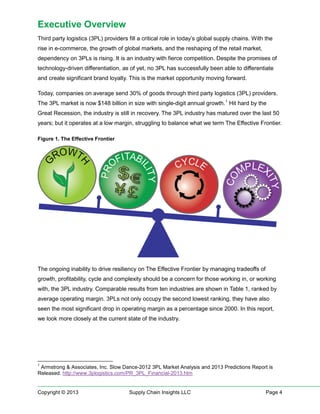
years; but it operates at a low margin, struggling to balance what we term The Effective Frontier.
Figure 1. The Effective Frontier

The ongoing inability to drive resiliency on The Effective Frontier by managing tradeoffs of
growth, profitability, cycle and complexity should be a concern for those working in, or working
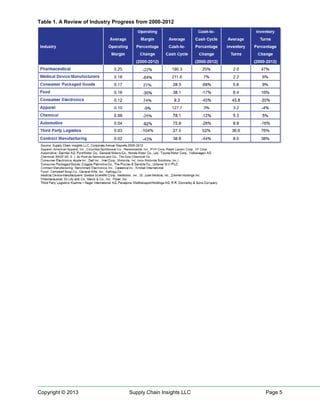
with, the 3PL industry. Comparable results from ten industries are shown in Table 1, ranked by
average operating margin. 3PLs not only occupy the second lowest ranking, they have also
seen the most significant drop in operating margin as a percentage since 2000. In this report,
we look more closely at the current state of the industry.

1

Armstrong & Associates, Inc. Slow Dance-2012 3PL Market Analysis and 2013 Predictions Report is
Released. http://www.3plogistics.com/PR_3PL_Financial-2013.htm

Copyright ยฉ 2013

Supply Chain Insights LLC

Page 4
Table 1. A Review of Industry Progress from 2000-2012

Copyright ยฉ 2013

Supply Chain Insights LLC

Page 5
History of the Third Party Logistics Industry
The third party logistics industry is evolving and is very different by geography. Although some
companies date back hundreds of years with their involvement in international trade, the
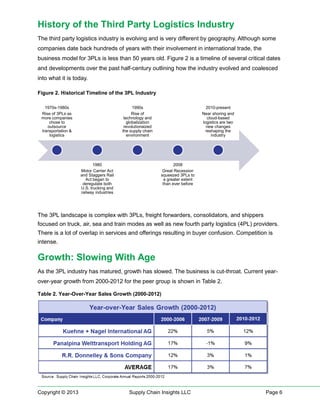
business model for 3PLs is less than 50 years old. Figure 2 is a timeline of several critical dates
and developments over the past half-century outlining how the industry evolved and coalesced
into what it is today.
Figure 2. Historical Timeline of the 3PL Industry
1970s-1980s
Rise of 3PLs as
more companies
chose to
outsource
transportation &
logistics

1990s
Rise of
technology and
globalization
revolutionaized
the supply chain
environment

1980
Motor Carrier Act
and Staggers Rail
Act began to
deregulate both
U.S. trucking and
railway industries

2010-present
Near shoring and
cloud-based
logistics are two
new changes
reshaping the
industry

2008
Great Recession
squeezed 3PLs to
a greater extent
than ever before

The 3PL landscape is complex with 3PLs, freight forwarders, consolidators, and shippers
focused on truck, air, sea and train modes as well as new fourth party logistics (4PL) providers.
There is a lot of overlap in services and offerings resulting in buyer confusion. Competition is
intense.

Growth: Slowing With Age
As the 3PL industry has matured, growth has slowed. The business is cut-throat. Current yearover-year growth from 2000-2012 for the peer group is shown in Table 2.
Table 2. Year-Over-Year Sales Growth (2000-2012)

Copyright ยฉ 2013

Supply Chain Insights LLC

Page 6
Profitability: Tight Margins
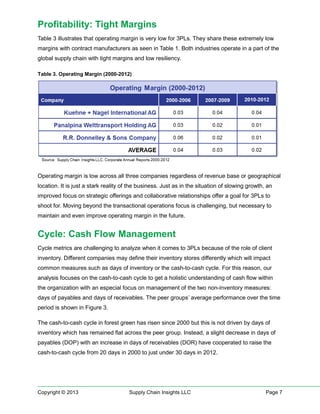
Table 3 illustrates that operating margin is very low for 3PLs. They share these extremely low
margins with contract manufacturers as seen in Table 1. Both industries operate in a part of the
global supply chain with tight margins and low resiliency.
Table 3. Operating Margin (2000-2012)

Operating margin is low across all three companies regardless of revenue base or geographical
location. It is just a stark reality of the business. Just as in the situation of slowing growth, an
improved focus on strategic offerings and collaborative relationships offer a goal for 3PLs to
shoot for. Moving beyond the transactional operations focus is challenging, but necessary to
maintain and even improve operating margin in the future.

Cycle: Cash Flow Management
Cycle metrics are challenging to analyze when it comes to 3PLs because of the role of client
inventory. Different companies may define their inventory stores differently which will impact
common measures such as days of inventory or the cash-to-cash cycle. For this reason, our
analysis focuses on the cash-to-cash cycle to get a holistic understanding of cash flow within
the organization with an especial focus on management of the two non-inventory measures:
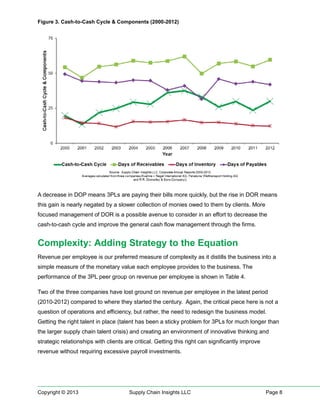
days of payables and days of receivables. The peer groupsโ€™ average performance over the time
period is shown in Figure 3.
The cash-to-cash cycle in forest green has risen since 2000 but this is not driven by days of
inventory which has remained flat across the peer group. Instead, a slight decrease in days of
payables (DOP) with an increase in days of receivables (DOR) have cooperated to raise the
cash-to-cash cycle from 20 days in 2000 to just under 30 days in 2012.

Copyright ยฉ 2013

Supply Chain Insights LLC

Page 7
Figure 3. Cash-to-Cash Cycle & Components (2000-2012)

A decrease in DOP means 3PLs are paying their bills more quickly, but the rise in DOR means
this gain is nearly negated by a slower collection of monies owed to them by clients. More
focused management of DOR is a possible avenue to consider in an effort to decrease the
cash-to-cash cycle and improve the general cash flow management through the firms.

Complexity: Adding Strategy to the Equation
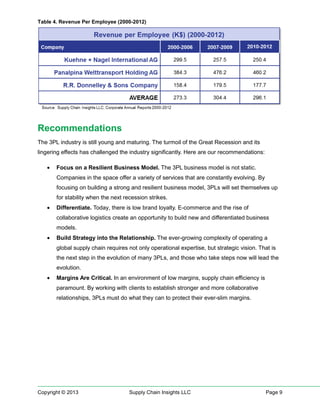
Revenue per employee is our preferred measure of complexity as it distills the business into a
simple measure of the monetary value each employee provides to the business. The
performance of the 3PL peer group on revenue per employee is shown in Table 4.
Two of the three companies have lost ground on revenue per employee in the latest period
(2010-2012) compared to where they started the century. Again, the critical piece here is not a
question of operations and efficiency, but rather, the need to redesign the business model.
Getting the right talent in place (talent has been a sticky problem for 3PLs for much longer than
the larger supply chain talent crisis) and creating an environment of innovative thinking and
strategic relationships with clients are critical. Getting this right can significantly improve
revenue without requiring excessive payroll investments.

Copyright ยฉ 2013

Supply Chain Insights LLC

Page 8
Table 4. Revenue Per Employee (2000-2012)

Recommendations
The 3PL industry is still young and maturing. The turmoil of the Great Recession and its
lingering effects has challenged the industry significantly. Here are our recommendations:
โ€ข

Focus on a Resilient Business Model. The 3PL business model is not static.
Companies in the space offer a variety of services that are constantly evolving. By
focusing on building a strong and resilient business model, 3PLs will set themselves up
for stability when the next recession strikes.

โ€ข

Differentiate. Today, there is low brand loyalty. E-commerce and the rise of
collaborative logistics create an opportunity to build new and differentiated business
models.

โ€ข

Build Strategy into the Relationship. The ever-growing complexity of operating a
global supply chain requires not only operational expertise, but strategic vision. That is
the next step in the evolution of many 3PLs, and those who take steps now will lead the
evolution.

โ€ข

Margins Are Critical. In an environment of low margins, supply chain efficiency is
paramount. By working with clients to establish stronger and more collaborative
relationships, 3PLs must do what they can to protect their ever-slim margins.

Copyright ยฉ 2013

Supply Chain Insights LLC

Page 9
Conclusion
Is the 3PL model viable? We believe we do not yet have the answer. Today, third party logistics
providers play a key role in the global supply chain. Their role is especially critical for small
shippers and companies expanding into new, untested geographies. It is a relatively young
business model with a variety of companies offering comparable, but not identical, solutions to
clients. By focusing on strategy and differentiated service offerings, 3PLs can strengthen their
own financial health while also providing a more resilient partner for their clients. Until this
happens, shippers should be cautious. The 3PL industry needs to improve resiliency to evolve
into the valuable partner it wishes to be.

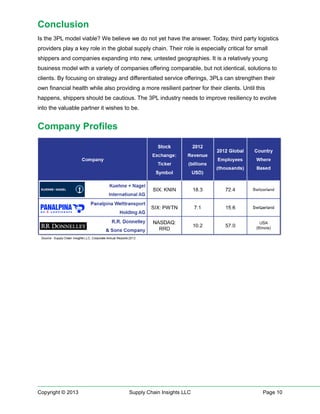
Company Profiles

Copyright ยฉ 2013

Supply Chain Insights LLC

Page 10
Other Reports in This Series:
Supply Chain Metrics That Matter: A Focus on Retail
Published by Supply Chain Insights in August 2012.
Supply Chain Metrics That Matter: A Focus on Consumer Products
Published by Supply Chain Insights in September 2012.
Supply Chain Metrics That Matter: A Focus on the Chemical Industry
Published by Supply Chain Insights in November 2012.
Supply Chain Metrics That Matter: The Cash-to-Cash Cycle
Published by Supply Chain Insights in November 2012.
Supply Chain Metrics That Matter: A Focus on the Pharmaceutical Industry
Published by Supply Chain Insights in December 2012.
Supply Chain Metrics That Matter: Driving Reliability in Margins
Published by Supply Chain Insights in January 2013.
Supply Chain Metrics That Matter: A Focus on Hospitals
Published by Supply Chain Insights in January 2013.
Supply Chain Metrics That Matter: A Focus on Brick & Mortar Retail
Published by Supply Chain Insights in February 2013.
Supply Chain Metrics That Matter: A Focus on Medical Device Manufacturers
Published by Supply Chain Insights in February 2013.
Supply Chain Metrics That Matter: A Focus on Consumer Electronics
Published by Supply Chain Insights in April 2013.
Supply Chain Metrics That Matter: A Focus on Apparel
Published by Supply Chain Insights in May 2013
Supply Chain Metrics That Matter: A Focus on Contract Manufacturing
Published by Supply Chain Insights in August 2013
Supply Chain Metrics That Matter: A Focus on the Automotive Industry
Published by Supply Chain Insights in October 2013
Supply Chain Metrics That Matter: A Closer Look at the Cash-To-Cash Cycle (2000-2012)
Published by Supply Chain Insights in November 2013

Copyright ยฉ 2013

Supply Chain Insights LLC

Page 11
About Supply Chain Insights LLC
Founded in February, 2012 by Lora Cecere, Supply Chain Insights LLC is focused on delivering
independent, actionable and objective advice for supply chain leaders. If you need to know
which practices and technologies make the biggest difference to corporate performance, turn to
us. We are a company dedicated to this research. We help you understand supply chain trends,
evolving technologies and which metrics matter.

About Abby Mayer
Abby Mayer (twitter ID @indexgirl), Research Associate, is one of the
original members of the Supply Chain Insights LLC team. She is also the
author of the newly-founded blog, Supply Chain Index. Her supply chain
interests include connecting financial performance and supply chain
excellence, as well as talent management issues and emerging markets.
Abby has a B.A. in International Politics and Economics from Middlebury
College and a M.S. in International Supply Chain Management from
Plymouth University in the United Kingdom. She has also completed a
thru-hike of Vermontโ€™s 280 mile Long Trail, the oldest long distance hiking trail in the United
States. As part of the planning and food prep process, she became interested in supply chain
management when she was asked to predict hunger pangs for the entire three-week trip before
departure. If that isnโ€™t advanced demand planning, what is?!?!

Copyright ยฉ 2013

Supply Chain Insights LLC

Page 12

Supply Chain Metrics That Matter: Third Party Logistics Providers-10 DEC 2013

  • 1.
    Supply Chain MetricsThat Matter: Third Party Logistics Providers Using Financial Data from Corporate Annual Reports to Better Understand Third Party Logistics Providers 12/10/2013 By Abby Mayer Research Associate Supply Chain Insights LLC
  • 2.
    Contents Research ................................................................................................................................... 2 Disclosure.................................................................................................................................. 2 Research Methodology .............................................................................................................. 2 Executive Overview ................................................................................................................... 4 History of the Third Party Logistics Industry ............................................................................... 6 Growth: Slowing With Age .......................................................................................................... 6 Profitability: Tight Margins .......................................................................................................... 7 Cycle: Cash Flow Management ................................................................................................. 7 Complexity: Adding Strategy to the Equation ............................................................................. 8 Recommendations ..................................................................................................................... 9 Conclusion ................................................................................................................................10 Company Profiles......................................................................................................................10 Other Reports in This Series: .................................................................................................... 11 About Supply Chain Insights LLC ..............................................................................................12 About Abby Mayer .....................................................................................................................12 Copyright ยฉ 2013 Supply Chain Insights LLC Page 1
  • 3.
    Research Supply Chain MetricsThat Matter is a series of reports published throughout the year by Supply Chain Insights LLC. They are a deep focus on a specific industry. These reports are based on data collected from financial balance sheets and income statements over the period of 2000-2012. In these reports, we analyze how companies made trade-offs over the course of the last decade in balancing growth, profitability, cycles and complexity. Within the world of Supply Chain Management (SCM), each industry is unique. We believe that it is dangerous to list all industries in a spreadsheet and declare a supply chain leader. Instead, we believe that we have to evaluate change over time by peer group. In this series of reports, we analyze the potential of each supply chain peer group, share insights from industry leaders from each industry, and give recommendations based on general market trends. Disclosure Your trust is important to us. As such, we are open and transparent about our financial relationships and our research process. This independent research is 100% funded by Supply Chain Insights. These reports are intended for you to read, share and use to improve your supply chain decisions. Please share this data freely within your company and across your industry. All we ask for in return is attribution when you use the materials in this report. We publish under the Creative Commons License Attribution-Noncommercial-Share Alike 3.0 United States and you will find our citation policy here. Research Methodology The basis of this report is publicly available information from corporate annual reports from the period of 2000-2012 for publicly-owned companies involved in the third party logistics (3PL) industry. In picking companies for the Supply Chain Metrics That Matter report, we traditionally rely on companies recently listed in the Fortune Global 500. For the 3PL industry, we identified three pure play 3PL companies using both the Fortune Global 500 and the Morningstar Integrated Shipping & Logistics peer group to inform our decision. The financial ratios used enable supply chain leaders to better understand where the industry is on the Supply Chain Effective Frontier. In this report, we share a framework for supply chain Copyright ยฉ 2013 Supply Chain Insights LLC Page 2
  • 4.
    excellence that balancesgrowth, profitability, cycles and complexity metrics. In each Supply Chain Metrics That Matter report, we share insights from each of these metrics categories. Due to the fact that the supply chain is a complex system that must be managed holistically, we share the trends on each of these dimensions over the course of the last decade. We use the financial data to help readers learn from past trends, to better understand current operating environments, and we provide recommendations for the future. We augment the financial data analysis with information from our quantitative and qualitative research studies as well as our work with clients operating within the industry. Copyright ยฉ 2013 Supply Chain Insights LLC Page 3
  • 5.
    Executive Overview Third partylogistics (3PL) providers fill a critical role in todayโ€™s global supply chains. With the rise in e-commerce, the growth of global markets, and the reshaping of the retail market, dependency on 3PLs is rising. It is an industry with fierce competition. Despite the promises of technology-driven differentiation, as of yet, no 3PL has successfully been able to differentiate and create significant brand loyalty. This is the market opportunity moving forward. Today, companies on average send 30% of goods through third party logistics (3PL) providers. The 3PL market is now $148 billion in size with single-digit annual growth. 1 Hit hard by the Great Recession, the industry is still in recovery. The 3PL industry has matured over the last 50 years; but it operates at a low margin, struggling to balance what we term The Effective Frontier. Figure 1. The Effective Frontier The ongoing inability to drive resiliency on The Effective Frontier by managing tradeoffs of growth, profitability, cycle and complexity should be a concern for those working in, or working with, the 3PL industry. Comparable results from ten industries are shown in Table 1, ranked by average operating margin. 3PLs not only occupy the second lowest ranking, they have also seen the most significant drop in operating margin as a percentage since 2000. In this report, we look more closely at the current state of the industry. 1 Armstrong & Associates, Inc. Slow Dance-2012 3PL Market Analysis and 2013 Predictions Report is Released. http://www.3plogistics.com/PR_3PL_Financial-2013.htm Copyright ยฉ 2013 Supply Chain Insights LLC Page 4
  • 6.
    Table 1. AReview of Industry Progress from 2000-2012 Copyright ยฉ 2013 Supply Chain Insights LLC Page 5
  • 7.
    History of theThird Party Logistics Industry The third party logistics industry is evolving and is very different by geography. Although some companies date back hundreds of years with their involvement in international trade, the business model for 3PLs is less than 50 years old. Figure 2 is a timeline of several critical dates and developments over the past half-century outlining how the industry evolved and coalesced into what it is today. Figure 2. Historical Timeline of the 3PL Industry 1970s-1980s Rise of 3PLs as more companies chose to outsource transportation & logistics 1990s Rise of technology and globalization revolutionaized the supply chain environment 1980 Motor Carrier Act and Staggers Rail Act began to deregulate both U.S. trucking and railway industries 2010-present Near shoring and cloud-based logistics are two new changes reshaping the industry 2008 Great Recession squeezed 3PLs to a greater extent than ever before The 3PL landscape is complex with 3PLs, freight forwarders, consolidators, and shippers focused on truck, air, sea and train modes as well as new fourth party logistics (4PL) providers. There is a lot of overlap in services and offerings resulting in buyer confusion. Competition is intense. Growth: Slowing With Age As the 3PL industry has matured, growth has slowed. The business is cut-throat. Current yearover-year growth from 2000-2012 for the peer group is shown in Table 2. Table 2. Year-Over-Year Sales Growth (2000-2012) Copyright ยฉ 2013 Supply Chain Insights LLC Page 6
  • 8.
    Profitability: Tight Margins Table3 illustrates that operating margin is very low for 3PLs. They share these extremely low margins with contract manufacturers as seen in Table 1. Both industries operate in a part of the global supply chain with tight margins and low resiliency. Table 3. Operating Margin (2000-2012) Operating margin is low across all three companies regardless of revenue base or geographical location. It is just a stark reality of the business. Just as in the situation of slowing growth, an improved focus on strategic offerings and collaborative relationships offer a goal for 3PLs to shoot for. Moving beyond the transactional operations focus is challenging, but necessary to maintain and even improve operating margin in the future. Cycle: Cash Flow Management Cycle metrics are challenging to analyze when it comes to 3PLs because of the role of client inventory. Different companies may define their inventory stores differently which will impact common measures such as days of inventory or the cash-to-cash cycle. For this reason, our analysis focuses on the cash-to-cash cycle to get a holistic understanding of cash flow within the organization with an especial focus on management of the two non-inventory measures: days of payables and days of receivables. The peer groupsโ€™ average performance over the time period is shown in Figure 3. The cash-to-cash cycle in forest green has risen since 2000 but this is not driven by days of inventory which has remained flat across the peer group. Instead, a slight decrease in days of payables (DOP) with an increase in days of receivables (DOR) have cooperated to raise the cash-to-cash cycle from 20 days in 2000 to just under 30 days in 2012. Copyright ยฉ 2013 Supply Chain Insights LLC Page 7
  • 9.
    Figure 3. Cash-to-CashCycle & Components (2000-2012) A decrease in DOP means 3PLs are paying their bills more quickly, but the rise in DOR means this gain is nearly negated by a slower collection of monies owed to them by clients. More focused management of DOR is a possible avenue to consider in an effort to decrease the cash-to-cash cycle and improve the general cash flow management through the firms. Complexity: Adding Strategy to the Equation Revenue per employee is our preferred measure of complexity as it distills the business into a simple measure of the monetary value each employee provides to the business. The performance of the 3PL peer group on revenue per employee is shown in Table 4. Two of the three companies have lost ground on revenue per employee in the latest period (2010-2012) compared to where they started the century. Again, the critical piece here is not a question of operations and efficiency, but rather, the need to redesign the business model. Getting the right talent in place (talent has been a sticky problem for 3PLs for much longer than the larger supply chain talent crisis) and creating an environment of innovative thinking and strategic relationships with clients are critical. Getting this right can significantly improve revenue without requiring excessive payroll investments. Copyright ยฉ 2013 Supply Chain Insights LLC Page 8
  • 10.
    Table 4. RevenuePer Employee (2000-2012) Recommendations The 3PL industry is still young and maturing. The turmoil of the Great Recession and its lingering effects has challenged the industry significantly. Here are our recommendations: โ€ข Focus on a Resilient Business Model. The 3PL business model is not static. Companies in the space offer a variety of services that are constantly evolving. By focusing on building a strong and resilient business model, 3PLs will set themselves up for stability when the next recession strikes. โ€ข Differentiate. Today, there is low brand loyalty. E-commerce and the rise of collaborative logistics create an opportunity to build new and differentiated business models. โ€ข Build Strategy into the Relationship. The ever-growing complexity of operating a global supply chain requires not only operational expertise, but strategic vision. That is the next step in the evolution of many 3PLs, and those who take steps now will lead the evolution. โ€ข Margins Are Critical. In an environment of low margins, supply chain efficiency is paramount. By working with clients to establish stronger and more collaborative relationships, 3PLs must do what they can to protect their ever-slim margins. Copyright ยฉ 2013 Supply Chain Insights LLC Page 9
  • 11.
    Conclusion Is the 3PLmodel viable? We believe we do not yet have the answer. Today, third party logistics providers play a key role in the global supply chain. Their role is especially critical for small shippers and companies expanding into new, untested geographies. It is a relatively young business model with a variety of companies offering comparable, but not identical, solutions to clients. By focusing on strategy and differentiated service offerings, 3PLs can strengthen their own financial health while also providing a more resilient partner for their clients. Until this happens, shippers should be cautious. The 3PL industry needs to improve resiliency to evolve into the valuable partner it wishes to be. Company Profiles Copyright ยฉ 2013 Supply Chain Insights LLC Page 10
  • 12.
    Other Reports inThis Series: Supply Chain Metrics That Matter: A Focus on Retail Published by Supply Chain Insights in August 2012. Supply Chain Metrics That Matter: A Focus on Consumer Products Published by Supply Chain Insights in September 2012. Supply Chain Metrics That Matter: A Focus on the Chemical Industry Published by Supply Chain Insights in November 2012. Supply Chain Metrics That Matter: The Cash-to-Cash Cycle Published by Supply Chain Insights in November 2012. Supply Chain Metrics That Matter: A Focus on the Pharmaceutical Industry Published by Supply Chain Insights in December 2012. Supply Chain Metrics That Matter: Driving Reliability in Margins Published by Supply Chain Insights in January 2013. Supply Chain Metrics That Matter: A Focus on Hospitals Published by Supply Chain Insights in January 2013. Supply Chain Metrics That Matter: A Focus on Brick & Mortar Retail Published by Supply Chain Insights in February 2013. Supply Chain Metrics That Matter: A Focus on Medical Device Manufacturers Published by Supply Chain Insights in February 2013. Supply Chain Metrics That Matter: A Focus on Consumer Electronics Published by Supply Chain Insights in April 2013. Supply Chain Metrics That Matter: A Focus on Apparel Published by Supply Chain Insights in May 2013 Supply Chain Metrics That Matter: A Focus on Contract Manufacturing Published by Supply Chain Insights in August 2013 Supply Chain Metrics That Matter: A Focus on the Automotive Industry Published by Supply Chain Insights in October 2013 Supply Chain Metrics That Matter: A Closer Look at the Cash-To-Cash Cycle (2000-2012) Published by Supply Chain Insights in November 2013 Copyright ยฉ 2013 Supply Chain Insights LLC Page 11
  • 13.
    About Supply ChainInsights LLC Founded in February, 2012 by Lora Cecere, Supply Chain Insights LLC is focused on delivering independent, actionable and objective advice for supply chain leaders. If you need to know which practices and technologies make the biggest difference to corporate performance, turn to us. We are a company dedicated to this research. We help you understand supply chain trends, evolving technologies and which metrics matter. About Abby Mayer Abby Mayer (twitter ID @indexgirl), Research Associate, is one of the original members of the Supply Chain Insights LLC team. She is also the author of the newly-founded blog, Supply Chain Index. Her supply chain interests include connecting financial performance and supply chain excellence, as well as talent management issues and emerging markets. Abby has a B.A. in International Politics and Economics from Middlebury College and a M.S. in International Supply Chain Management from Plymouth University in the United Kingdom. She has also completed a thru-hike of Vermontโ€™s 280 mile Long Trail, the oldest long distance hiking trail in the United States. As part of the planning and food prep process, she became interested in supply chain management when she was asked to predict hunger pangs for the entire three-week trip before departure. If that isnโ€™t advanced demand planning, what is?!?! Copyright ยฉ 2013 Supply Chain Insights LLC Page 12