Intelligent well completion
Made by- Akshaya kumar mishra
Roll no.- 14MPE12
OUTLINE
• Introduction
• What are well completions?
• What is intelligent well completion?
• Reasons for Intelligent well completion
• Components
• Applications
• Well control during IWC installation
• Case study
• Advantages/Disadvantages of Intelligent well
completion over conventional completions
• Conclusion
• References
Introduction
• Through the years different types of processes have
been used to complete and produce oil from
reservoirs after drilling.
• Demand for processes which maximize the
recoverable reserves while reducing costs due to
intervention has been on the increase which has
brought about the latest well completion technique
which is INTELLIGENT WELL COMPLETION
(IWC).
• This presentation therefore is to help acquaint us
with this process.
What is well completion?
• This is a process of making a well ready for
production or(injection), this principally
involves preparing the bottom of the hole to the
required specifications, running in the
production tubing and its associated downhole
tools, as well as perforating and stimulating as
required.
• Sometimes the process of running in and
cementing the casing is also included.
What is intelligent well completion?
• An intelligent well is a permanent system capable of
collecting, transmitting, and analyzing wellbore
production and reservoir and completion integrity data,
and enabling remote action to better control reservoir,
well, and production processes.
• IWC can be explained as the type of completion that is
based on the strategy of using REAL TIME well
monitoring and closed loop capability to maximize the
final recovery of reserves.
• This is achieved by running gauges downhole to study
REAL TIME data per zone in order to make pro
active(preventive) rather than reactive(corrective)
decisions.
Reasons for intelligent well completion
The instances in which IWC’s are suitable for are thus-
COMMINGLED PRODUCTION
• Some fields have two or more reservoirs that could be produced at
the same time (usually at different depths) but these reservoirs
could have different petro physical properties, fluid characteristics
and/or different pressures.
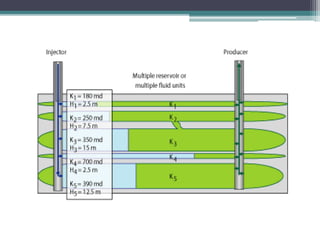
INJECTION PROFILE ISSUES
• Due to the subdivision by some Fluid units inside the same reservoir
with different petro physical properties, differential depletion occurs
(some flow units deplete faster than others) during the production
process or differential replacement occurs (some fluids units build
up their pressure faster than others), when injecting fluids for
pressure support.
DUMP FLOOD STRATEGIES
• Enhanced Oil Recovery (EOR) strategies are among the most
complex , successful but expensive methods for maximizing final
recovery of reserves. Reducing costs in these projects is highly
desirable.
Components
Applications
1. WATER AND GAS SHUT OFF
2. OPTIMAL SEQUENTIAL PRODUCTION
3. COMMINGLED PRODUCTION
4. INTELLIGENT WATER FLOODING
5. INTELLIGENT GAS LIFT
6. MONITORING
7. DOWNHOLE PRODUCTION TEST
8. SAND CONTROL
9. CHEMICAL INJECTION SYSTEM
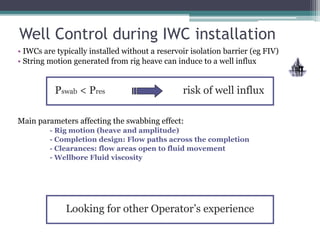
Well Control during IWC installation
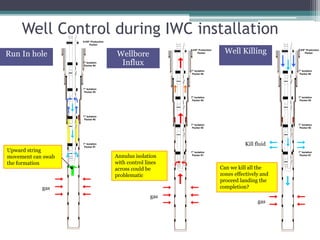
• IWCs are typically installed without a reservoir isolation barrier (eg FIV)
• String motion generated from rig heave can induce to a well influx
Main parameters affecting the swabbing effect:
- Rig motion (heave and amplitude)
- Completion design: Flow paths across the completion
- Clearances: flow areas open to fluid movement
- Wellbore Fluid viscosity
Pswab < Pres risk of well influx
Looking for other Operator’s experience
Well Control during IWC installation
Run In hole
9-5/8" Production
Packer
7" Isolation
Packer #4
7" Isolation
Packer #3
7" Isolation
Packer #2
7" Isolation
Packer #1
Upward string
movement can swab
the formation
gas
Wellbore
Influx
9-5/8" Production
Packer
7" Isolation
Packer #4
7" Isolation
Packer #3
7" Isolation
Packer #2
7" Isolation
Packer #1
Annulus isolation
with control lines
across could be
problematic
gas
Well Killing 9-5/8" Production
Packer
7" Isolation
Packer #4
7" Isolation
Packer #3
7" Isolation
Packer #2
7" Isolation
Packer #1
Can we kill all the
zones effectively and
proceed landing the
completion?
gas
Kill fluid
Well Control during IWC installation
95 psi
150 psi
4 Zone SMART in Viscous polymer
95 psi
150 psi
4 Zone SMART in Viscous polymer
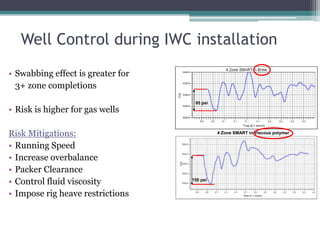
• Swabbing effect is greater for
3+ zone completions
• Risk is higher for gas wells
Risk Mitigations:
• Running Speed
• Increase overbalance
• Packer Clearance
• Control fluid viscosity
• Impose rig heave restrictions
Marine Riser
Seabed
Sea Level
Rig Floor
BOP
D
ME
LE
UE
Marine Riser
Tensioners
SFT
Surface
Flow Tree
THRT
Tubing
Hanger
Smart
completion
Surface Downhole
Potential for
swabbing the
formation
Reservoir
communication
during completion
installation
Well Control during IWC installation
Case study
• Flexibility of eRED® valve aids success of acid
stimulation operation
• Asia: Swellpacker System and Gravel Pack Enable
Zonal Isolation in OH SmartWell Completion
• Kuwait’s first multilateral intelligent completion
results in a cost effective field management solution
• Successful Auto Gas-Lift Using Intelligent
Completion Boosted Oil Production
• Intelligent Completion Technology Enables
Selective Injection and Production in Mature Field
Offshore China
Intellizone Compact Modular System
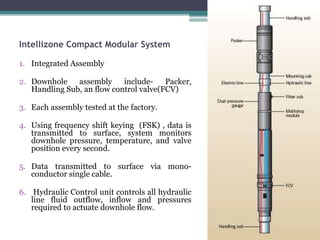
1. Integrated Assembly
2. Downhole assembly include- Packer,
Handling Sub, an flow control valve(FCV)
3. Each assembly tested at the factory.
4. Using frequency shift keying (FSK) , data is
transmitted to surface, system monitors
downhole pressure, temperature, and valve
position every second.
5. Data transmitted to surface via mono-
conductor single cable.
6. Hydraulic Control unit controls all hydraulic
line fluid outflow, inflow and pressures
required to actuate downhole flow.
Case 2
savings in india
• India’s offshore operator decide to complete three zone well within
economic restraints of a marginal field. They sought to reduce CAPEX by
using already purchased equipment and optimum return on their
investment through control of each zone independently.
• Completion choices- Sliding sleeves and Surface Controlled downhole flow
control system.
• Problem-
1. Sliding sleeve requires interventions to shift them and to bring these wells
online they would have to perform coiled tubing-conveyed acid treatments
across each zone individually.
2. Treating all zones at once would have result in most of acid entering in one
permeable zone and leaving the other two untreated.
3. Its not possible to isolate each zone using SCSFS because three have
required more hydraulic lines than existing penetrations in company own
wellhead.
ADVANTAGES/DISADVANTAGES OF IWC’S(CHOKING
CAPABILITY)
ADVANTAGES;
• Total control of production or injection profiles.
• No cross flow between different zones.
• Real-time monitoring of different zones.
• Control valves can be activated remotely.
• Well test can be performed without intervention.
• Operations associated with production or injection optimization
can be performed online (closed loop).
• Does not require maintenance.
DISADVANTAGE;
• Completion cost is higher than mechanical systems.
Conclusion
• It is obvious that IWC offers flexibility and reliability, but
the most important aspect of this technology is its ability
to adapt to changing well conditions, whether these
changes are part of a planned reservoir exploitation
strategy or an unplanned event.
• It is important to note that an IWC is the key component
of an exploitation strategy to maximize final recovery of
reserves through maximum control, real time
monitoring and closed loop capability.
• Finally, IWC can help operators make the right decision
at the right time by reducing uncertainty levels.
Refrences
• Halliburton WellDynamics Catalogue
• Kevin Beveridge et al: ‘Intelligent completions at the ready’, Oilfield
Review autumn 2011, pp.18-27
• Mike Robinson, Energy Development Partners Ltd. ‘Chapter 3 –
Intelligent Well Completions’, Vol. IV Emerging and Peripheral
Technologies, 2007,SPE
• Saeed Mubarak et.al : ‘Lessons Learned from 100 Intelligent Wells
Equipped with Multiple Downhole Valves’, ’The Journal of Saudi
Aramco Technology’, Fall 2009, pp.2-7
• http://www.halliburton.com/en-US/ps/well-dynamics/well-
completions/intelligent-completions/default.page?node-
id=hfqel9vs&nav=en-US_completions_public, accessed at
18/09/2013 at 12.05 am

Intelligent well completion

  • 1.
    Intelligent well completion Madeby- Akshaya kumar mishra Roll no.- 14MPE12
  • 2.
    OUTLINE • Introduction • Whatare well completions? • What is intelligent well completion? • Reasons for Intelligent well completion • Components • Applications • Well control during IWC installation • Case study • Advantages/Disadvantages of Intelligent well completion over conventional completions • Conclusion • References
  • 3.
    Introduction • Through theyears different types of processes have been used to complete and produce oil from reservoirs after drilling. • Demand for processes which maximize the recoverable reserves while reducing costs due to intervention has been on the increase which has brought about the latest well completion technique which is INTELLIGENT WELL COMPLETION (IWC). • This presentation therefore is to help acquaint us with this process.
  • 4.
    What is wellcompletion? • This is a process of making a well ready for production or(injection), this principally involves preparing the bottom of the hole to the required specifications, running in the production tubing and its associated downhole tools, as well as perforating and stimulating as required. • Sometimes the process of running in and cementing the casing is also included.
  • 5.
    What is intelligentwell completion? • An intelligent well is a permanent system capable of collecting, transmitting, and analyzing wellbore production and reservoir and completion integrity data, and enabling remote action to better control reservoir, well, and production processes. • IWC can be explained as the type of completion that is based on the strategy of using REAL TIME well monitoring and closed loop capability to maximize the final recovery of reserves. • This is achieved by running gauges downhole to study REAL TIME data per zone in order to make pro active(preventive) rather than reactive(corrective) decisions.
  • 6.
    Reasons for intelligentwell completion The instances in which IWC’s are suitable for are thus- COMMINGLED PRODUCTION • Some fields have two or more reservoirs that could be produced at the same time (usually at different depths) but these reservoirs could have different petro physical properties, fluid characteristics and/or different pressures. INJECTION PROFILE ISSUES • Due to the subdivision by some Fluid units inside the same reservoir with different petro physical properties, differential depletion occurs (some flow units deplete faster than others) during the production process or differential replacement occurs (some fluids units build up their pressure faster than others), when injecting fluids for pressure support. DUMP FLOOD STRATEGIES • Enhanced Oil Recovery (EOR) strategies are among the most complex , successful but expensive methods for maximizing final recovery of reserves. Reducing costs in these projects is highly desirable.
  • 8.
  • 9.
    Applications 1. WATER ANDGAS SHUT OFF 2. OPTIMAL SEQUENTIAL PRODUCTION 3. COMMINGLED PRODUCTION 4. INTELLIGENT WATER FLOODING 5. INTELLIGENT GAS LIFT 6. MONITORING 7. DOWNHOLE PRODUCTION TEST 8. SAND CONTROL 9. CHEMICAL INJECTION SYSTEM
  • 10.
    Well Control duringIWC installation • IWCs are typically installed without a reservoir isolation barrier (eg FIV) • String motion generated from rig heave can induce to a well influx Main parameters affecting the swabbing effect: - Rig motion (heave and amplitude) - Completion design: Flow paths across the completion - Clearances: flow areas open to fluid movement - Wellbore Fluid viscosity Pswab < Pres risk of well influx Looking for other Operator’s experience
  • 11.
    Well Control duringIWC installation Run In hole 9-5/8" Production Packer 7" Isolation Packer #4 7" Isolation Packer #3 7" Isolation Packer #2 7" Isolation Packer #1 Upward string movement can swab the formation gas Wellbore Influx 9-5/8" Production Packer 7" Isolation Packer #4 7" Isolation Packer #3 7" Isolation Packer #2 7" Isolation Packer #1 Annulus isolation with control lines across could be problematic gas Well Killing 9-5/8" Production Packer 7" Isolation Packer #4 7" Isolation Packer #3 7" Isolation Packer #2 7" Isolation Packer #1 Can we kill all the zones effectively and proceed landing the completion? gas Kill fluid
  • 12.
    Well Control duringIWC installation 95 psi 150 psi 4 Zone SMART in Viscous polymer 95 psi 150 psi 4 Zone SMART in Viscous polymer • Swabbing effect is greater for 3+ zone completions • Risk is higher for gas wells Risk Mitigations: • Running Speed • Increase overbalance • Packer Clearance • Control fluid viscosity • Impose rig heave restrictions
  • 13.
    Marine Riser Seabed Sea Level RigFloor BOP D ME LE UE Marine Riser Tensioners SFT Surface Flow Tree THRT Tubing Hanger Smart completion Surface Downhole Potential for swabbing the formation Reservoir communication during completion installation Well Control during IWC installation
  • 14.
    Case study • Flexibilityof eRED® valve aids success of acid stimulation operation • Asia: Swellpacker System and Gravel Pack Enable Zonal Isolation in OH SmartWell Completion • Kuwait’s first multilateral intelligent completion results in a cost effective field management solution • Successful Auto Gas-Lift Using Intelligent Completion Boosted Oil Production • Intelligent Completion Technology Enables Selective Injection and Production in Mature Field Offshore China
  • 15.
    Intellizone Compact ModularSystem 1. Integrated Assembly 2. Downhole assembly include- Packer, Handling Sub, an flow control valve(FCV) 3. Each assembly tested at the factory. 4. Using frequency shift keying (FSK) , data is transmitted to surface, system monitors downhole pressure, temperature, and valve position every second. 5. Data transmitted to surface via mono- conductor single cable. 6. Hydraulic Control unit controls all hydraulic line fluid outflow, inflow and pressures required to actuate downhole flow.
  • 17.
    Case 2 savings inindia • India’s offshore operator decide to complete three zone well within economic restraints of a marginal field. They sought to reduce CAPEX by using already purchased equipment and optimum return on their investment through control of each zone independently. • Completion choices- Sliding sleeves and Surface Controlled downhole flow control system. • Problem- 1. Sliding sleeve requires interventions to shift them and to bring these wells online they would have to perform coiled tubing-conveyed acid treatments across each zone individually. 2. Treating all zones at once would have result in most of acid entering in one permeable zone and leaving the other two untreated. 3. Its not possible to isolate each zone using SCSFS because three have required more hydraulic lines than existing penetrations in company own wellhead.
  • 19.
    ADVANTAGES/DISADVANTAGES OF IWC’S(CHOKING CAPABILITY) ADVANTAGES; •Total control of production or injection profiles. • No cross flow between different zones. • Real-time monitoring of different zones. • Control valves can be activated remotely. • Well test can be performed without intervention. • Operations associated with production or injection optimization can be performed online (closed loop). • Does not require maintenance. DISADVANTAGE; • Completion cost is higher than mechanical systems.
  • 20.
    Conclusion • It isobvious that IWC offers flexibility and reliability, but the most important aspect of this technology is its ability to adapt to changing well conditions, whether these changes are part of a planned reservoir exploitation strategy or an unplanned event. • It is important to note that an IWC is the key component of an exploitation strategy to maximize final recovery of reserves through maximum control, real time monitoring and closed loop capability. • Finally, IWC can help operators make the right decision at the right time by reducing uncertainty levels.
  • 21.
    Refrences • Halliburton WellDynamicsCatalogue • Kevin Beveridge et al: ‘Intelligent completions at the ready’, Oilfield Review autumn 2011, pp.18-27 • Mike Robinson, Energy Development Partners Ltd. ‘Chapter 3 – Intelligent Well Completions’, Vol. IV Emerging and Peripheral Technologies, 2007,SPE • Saeed Mubarak et.al : ‘Lessons Learned from 100 Intelligent Wells Equipped with Multiple Downhole Valves’, ’The Journal of Saudi Aramco Technology’, Fall 2009, pp.2-7 • http://www.halliburton.com/en-US/ps/well-dynamics/well- completions/intelligent-completions/default.page?node- id=hfqel9vs&nav=en-US_completions_public, accessed at 18/09/2013 at 12.05 am