Well work-over
BY
ELIOT . S . WILLIAM
FINAL YEAR PETROLEUM ENGINEER
WORK OVER DEFINITION
 A workover is any operation done on, within, or
through the wellbore after the initial completion.
Although proper drilling, cementing, and
completion practices minimize the need, virtually
every well will need several workovers during its
lifetime to satisfactorily fulfill its purpose.
 If the reservoir still contains a reasonable amount
of hydrocarbon something has to be done to
improve the performance of the well or reservoir.
WORK OVER DEFINITION
 The term Work-over, is used to refer to a kind of
well intervention that is aimed at enhancing the
performance of a well. It involves recompleting
already completed well for improved performance.
 The process of performing major maintenance or
remedial treatments on an oil or gas well after initial
completion . In many cases, work-over implies the
removal and replacement of the production tubing
string after the well has been killed and a work-over
rig has been placed on location.
REASONS FOR WORKOVER
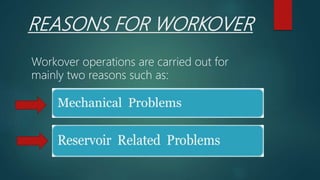
Workover operations are carried out for
mainly two reasons such as:
OTHER CAUSES FOR THE
WORKOVER
Unsatisfactory production or injection rates
Supplemental recovery project requirements
Regulatory requirements
Competitive drainage
Reservoir data gathering
Lease requirements
Abandonments
MECHANICAL PROBLEMS
Repair/Replacement of damaged equipment
Replace artificial lift equipment
Cement and Casing problems
RESERVOIR RELATED REASONS
Repair natural damage within the well
Zone transfer
Stimulation
Convert well from production to injection
Recompletion
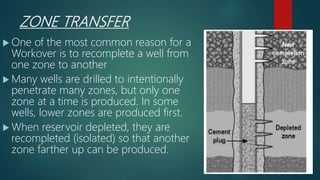
ZONE TRANSFER
 One of the most common reason for a
Workover is to recomplete a well from
one zone to another
 Many wells are drilled to intentionally
penetrate many zones, but only one
zone at a time is produced. In some
wells, lower zones are produced first.
 When reservoir depleted, they are
recompleted (isolated) so that another
zone farther up can be produced.
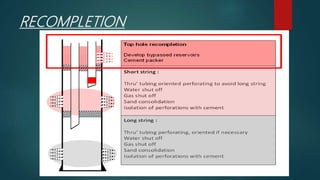
RECOMPLETION
REPLACE ARTIFICIAL LIFT
EQUIPMENTWhen a reservoir does not have,or cannot
maintain, sufficient drive energy to produce at
an economical rate, assistance through artificial
lift is required. There are four basic types of
artificial lift:
1. Sucker rod pump
2. Hydraulic pump
3. Electric submersible pump (ESP).
4. Gas lift.
STIMULATION
 Stimulation is general term describing variety of
operations performed on a well to improve its
productivity.
 It plays a vital role in production operations
 Production in a damaged or low-producing
zone can be increased by some techniques as
follow:
 Acid Stimulation
 Hydraulic Fracturing
CONVERT WELL FROM
PRODUCTION TO INJECTION
 Workover are done to convert producing
well to injection well.In this type of workover
water , gas , Chemical etc can be injected
into the reservoir
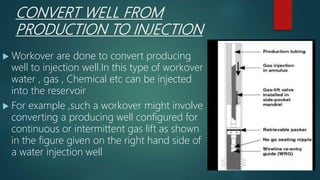
 For example ,such a workover might involve
converting a producing well configured for
continuous or intermittent gas lift as shown
in the figure given on the right hand side of
a water injection well
WORKOVER TOOLS #1
 Workovers can be done with conventional rigs or
nonconventional systems.
 Conventional rigs can be equipped to handle
almost all types of work that may be required
 Nonconventional systems allow specific types of
work to be done without pulling the tubing,
disassembling the Christmas tree, or even killing
the well.
 This is accomplished by using lubricators and
packoff equipment at the surface and by running
the required equipment inside the production
tubing.
 Common types of nonconventional systems are
wireline units, coiled tubing units, and snubbing
units.
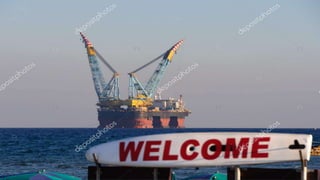
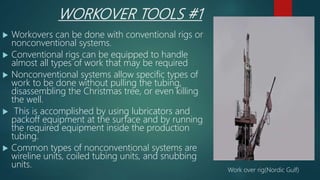
Work over rig(Nordic Gulf)
WORKOVER TOOLS-wireline units
 Wireline units use special equipment on a
solid wireline to gather data (pressure,
temperature, and depth) and to set,
manipulate, and/or retrieve tubing plugs,
sliding sleeves, flow regulators, gas lift valves,
safety valves, and wireline fishing tools.
 Wireline equipment can also be used to cut
paraffin and remove wellbore fill. Prior
planning, good operators, good equipment,
and reasonable well conditions are
prerequisites to the success of this method
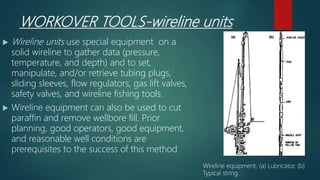
Wireline equipment, (a) Lubricator, (b)
Typical string.
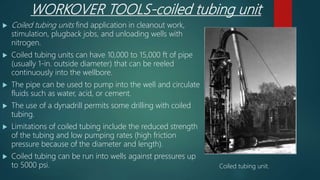
WORKOVER TOOLS-coiled tubing unit
 Coiled tubing units find application in cleanout work,
stimulation, plugback jobs, and unloading wells with
nitrogen.
 Coiled tubing units can have 10,000 to 15,000 ft of pipe
(usually 1-in. outside diameter) that can be reeled
continuously into the wellbore.
 The pipe can be used to pump into the well and circulate
fluids such as water, acid, or cement.
 The use of a dynadrill permits some drilling with coiled
tubing.
 Limitations of coiled tubing include the reduced strength
of the tubing and low pumping rates (high friction
pressure because of the diameter and length).
 Coiled tubing can be run into wells against pressures up
to 5000 psi. Coiled tubing unit.
WORKOVER TOOLS-snubbing tools
 Snubbing units use hydraulic pressure and
rams to introduce small, coupled tubing into
the well, if necessary, against pressures
above 5000 psi.
 The tubing is stronger and can be rotated so
that tougher cleanout or fishing jobs can be
accomplished.
 Snubbing units are used for the same type
of jobs as are coiled tubing units, but their
compactness is an advantage in offshore
work.
 They are slow and expensive, but in the right
applications, they are the more economical
way to accomplish the task. Snubbing unit.
CONCLUSION
 The profitability of a well as an investment venture depends on how
long it is on stream and on how much it produces. Its lifetime and
output are naturally due to the reservoir’s initial characteristics. However,
they are also dependent on keeping the well maintained in good
working order and adapting completion properly to the constantly
varying conditions prevailing in the reservoir and around the welIbore .
 Although proper drilling, cementing, and completion practices minimize
the need, virtually every well may need several workovers during its life
time to satisfactorily fullfil its purpose
Well work over
Well work over

Well work over

  • 2.
    Well work-over BY ELIOT .S . WILLIAM FINAL YEAR PETROLEUM ENGINEER
  • 3.
    WORK OVER DEFINITION A workover is any operation done on, within, or through the wellbore after the initial completion. Although proper drilling, cementing, and completion practices minimize the need, virtually every well will need several workovers during its lifetime to satisfactorily fulfill its purpose.  If the reservoir still contains a reasonable amount of hydrocarbon something has to be done to improve the performance of the well or reservoir.
  • 4.
    WORK OVER DEFINITION The term Work-over, is used to refer to a kind of well intervention that is aimed at enhancing the performance of a well. It involves recompleting already completed well for improved performance.  The process of performing major maintenance or remedial treatments on an oil or gas well after initial completion . In many cases, work-over implies the removal and replacement of the production tubing string after the well has been killed and a work-over rig has been placed on location.
  • 5.
    REASONS FOR WORKOVER Workoveroperations are carried out for mainly two reasons such as:
  • 6.
    OTHER CAUSES FORTHE WORKOVER Unsatisfactory production or injection rates Supplemental recovery project requirements Regulatory requirements Competitive drainage Reservoir data gathering Lease requirements Abandonments
  • 7.
    MECHANICAL PROBLEMS Repair/Replacement ofdamaged equipment Replace artificial lift equipment Cement and Casing problems
  • 8.
    RESERVOIR RELATED REASONS Repairnatural damage within the well Zone transfer Stimulation Convert well from production to injection Recompletion
  • 9.
    ZONE TRANSFER  Oneof the most common reason for a Workover is to recomplete a well from one zone to another  Many wells are drilled to intentionally penetrate many zones, but only one zone at a time is produced. In some wells, lower zones are produced first.  When reservoir depleted, they are recompleted (isolated) so that another zone farther up can be produced.
  • 10.
  • 11.
    REPLACE ARTIFICIAL LIFT EQUIPMENTWhena reservoir does not have,or cannot maintain, sufficient drive energy to produce at an economical rate, assistance through artificial lift is required. There are four basic types of artificial lift: 1. Sucker rod pump 2. Hydraulic pump 3. Electric submersible pump (ESP). 4. Gas lift.
  • 12.
    STIMULATION  Stimulation isgeneral term describing variety of operations performed on a well to improve its productivity.  It plays a vital role in production operations  Production in a damaged or low-producing zone can be increased by some techniques as follow:  Acid Stimulation  Hydraulic Fracturing
  • 13.
    CONVERT WELL FROM PRODUCTIONTO INJECTION  Workover are done to convert producing well to injection well.In this type of workover water , gas , Chemical etc can be injected into the reservoir  For example ,such a workover might involve converting a producing well configured for continuous or intermittent gas lift as shown in the figure given on the right hand side of a water injection well
  • 14.
    WORKOVER TOOLS #1 Workovers can be done with conventional rigs or nonconventional systems.  Conventional rigs can be equipped to handle almost all types of work that may be required  Nonconventional systems allow specific types of work to be done without pulling the tubing, disassembling the Christmas tree, or even killing the well.  This is accomplished by using lubricators and packoff equipment at the surface and by running the required equipment inside the production tubing.  Common types of nonconventional systems are wireline units, coiled tubing units, and snubbing units. Work over rig(Nordic Gulf)
  • 15.
    WORKOVER TOOLS-wireline units Wireline units use special equipment on a solid wireline to gather data (pressure, temperature, and depth) and to set, manipulate, and/or retrieve tubing plugs, sliding sleeves, flow regulators, gas lift valves, safety valves, and wireline fishing tools.  Wireline equipment can also be used to cut paraffin and remove wellbore fill. Prior planning, good operators, good equipment, and reasonable well conditions are prerequisites to the success of this method Wireline equipment, (a) Lubricator, (b) Typical string.
  • 16.
    WORKOVER TOOLS-coiled tubingunit  Coiled tubing units find application in cleanout work, stimulation, plugback jobs, and unloading wells with nitrogen.  Coiled tubing units can have 10,000 to 15,000 ft of pipe (usually 1-in. outside diameter) that can be reeled continuously into the wellbore.  The pipe can be used to pump into the well and circulate fluids such as water, acid, or cement.  The use of a dynadrill permits some drilling with coiled tubing.  Limitations of coiled tubing include the reduced strength of the tubing and low pumping rates (high friction pressure because of the diameter and length).  Coiled tubing can be run into wells against pressures up to 5000 psi. Coiled tubing unit.
  • 17.
    WORKOVER TOOLS-snubbing tools Snubbing units use hydraulic pressure and rams to introduce small, coupled tubing into the well, if necessary, against pressures above 5000 psi.  The tubing is stronger and can be rotated so that tougher cleanout or fishing jobs can be accomplished.  Snubbing units are used for the same type of jobs as are coiled tubing units, but their compactness is an advantage in offshore work.  They are slow and expensive, but in the right applications, they are the more economical way to accomplish the task. Snubbing unit.
  • 18.
    CONCLUSION  The profitabilityof a well as an investment venture depends on how long it is on stream and on how much it produces. Its lifetime and output are naturally due to the reservoir’s initial characteristics. However, they are also dependent on keeping the well maintained in good working order and adapting completion properly to the constantly varying conditions prevailing in the reservoir and around the welIbore .  Although proper drilling, cementing, and completion practices minimize the need, virtually every well may need several workovers during its life time to satisfactorily fullfil its purpose