![Presentation By: - Akhil Gupta Roll No.-PG-06-01 PGPIMC 06-08 Maggi Takes The Health Route Term Assessment Task - 6 [email_address] 14-December-2007](https://image.slidesharecdn.com/nestle-maggi-1199699213349697-4/85/Nestle-Maggi-1-320.jpg)
![Presentation By: - Akhil Gupta Roll No.-PG-06-01 PGPIMC 06-08 Maggi Takes The Health Route Term Assessment Task - 6 [email_address] 14-December-2007](https://image.slidesharecdn.com/nestle-maggi-1199699213349697-4/75/Nestle-Maggi-1-2048.jpg)
![Introduction to Case This case looks at the various phases in the product life cycle of Maggi noodles in India. It talks about the various measures taken by NIL to keep the Maggi brand fresh in the minds of Indian consumers. The case also talks about the various extensions of the Maggi brand and tries to analyze why only the sauces and ketchups category, among all the other product extensions, managed to succeed. It further discusses the measures taken by NIL to reposition Maggi as a 'health product'. The case ends with a discussion whether NIL would be successful in sustaining this new image for Maggi in the market. 1 [email_address] 14-December-2007](https://image.slidesharecdn.com/nestle-maggi-1199699213349697-4/85/Nestle-Maggi-2-320.jpg)
![Introduction to Nestle 2 [email_address] 14-December-2007](https://image.slidesharecdn.com/nestle-maggi-1199699213349697-4/85/Nestle-Maggi-3-320.jpg)
![Introduction to Nestle 3 [email_address] 14-December-2007](https://image.slidesharecdn.com/nestle-maggi-1199699213349697-4/85/Nestle-Maggi-4-320.jpg)
![Introduction to Nestle 4 [email_address] 14-December-2007](https://image.slidesharecdn.com/nestle-maggi-1199699213349697-4/85/Nestle-Maggi-5-320.jpg)
![Introduction to Nestle 5 [email_address] 14-December-2007](https://image.slidesharecdn.com/nestle-maggi-1199699213349697-4/85/Nestle-Maggi-6-320.jpg)
![Introduction to Nestle 6 [email_address] 14-December-2007](https://image.slidesharecdn.com/nestle-maggi-1199699213349697-4/85/Nestle-Maggi-7-320.jpg)
![Introduction to Nestle 7 [email_address] 14-December-2007](https://image.slidesharecdn.com/nestle-maggi-1199699213349697-4/85/Nestle-Maggi-8-320.jpg)
![Maggi in India Nestlé India Ltd. (NIL), the Indian subsidiary of the global FMCG major, Nestlé SA, introduced the Maggi brand in India in 1982. With the launch of Maggi noodles, NIL created an entirely new food category - instant noodles - in the Indian packaged food market. Being the first-mover, NIL successfully managed to retain its leadership in the instant noodles category even until the early 2000s. In 2005, NIL started offering a range of new 'healthy' products under the Maggi brand, in a bid to attract health-conscious consumers. 8 [email_address] 14-December-2007](https://image.slidesharecdn.com/nestle-maggi-1199699213349697-4/85/Nestle-Maggi-9-320.jpg)
![Maggi takes the Health Route In May 2006, Nestlé India Ltd. (NIL), launched a new instant noodles product called Maggi Dal Atta Noodles (Dal Atta Noodles) under the popular Maggi brand. The Dal Atta Noodles were made of whole wheat and contained pulses, and positioned as a 'healthy‘ instant noodles. NIL offered a variety of culinary products such as instant noodles, soups, sauces and ketchups, cooking aids (seasonings), etc., under the Maggi brand. Over the years, Maggi noodles became a popular snack food product in India. 9 [email_address] 14-December-2007](https://image.slidesharecdn.com/nestle-maggi-1199699213349697-4/85/Nestle-Maggi-10-320.jpg)
![Competition During 1990s, the sales of Maggi noodles declined, and this was attributed partly to the growing popularity of Top Ramen. Also they are having a strong competition with local manufacturers. Maggi is also facing competition with the chowmin. 10 [email_address] 14-December-2007](https://image.slidesharecdn.com/nestle-maggi-1199699213349697-4/85/Nestle-Maggi-11-320.jpg)
![Competitive Strategy To beat the competition: - NIL changed the formulation of Maggi noodles in 1997. However, this proved to be a mistake, as consumers did not like the taste of the new noodles. In March 1999, NIL reintroduced the old formulation of the noodles, after which the sales revived. NIL also introduced several other products like soups and cooking aids under the Maggi brand. In the early 2000s, Maggi was the leader in the branded instant noodles segment, and the company faced little serious competition in this segment. 11 [email_address] 14-December-2007](https://image.slidesharecdn.com/nestle-maggi-1199699213349697-4/85/Nestle-Maggi-12-320.jpg)
![Competitive Strategy NIL also adopted the same strategy for the Maggi brand with the launch of the Maggi Vegetable Atta Noodles (Vegetable Atta Noodles) in 2005. The Dal Atta Noodles were another variant of Maggi's healthy instant noodles. proved to be a mistake, as consumers did not like the taste of the new noodles. In March 1999, NIL reintroduced the old formulation of the noodles, after which the sales revived. 12 [email_address] 14-December-2007](https://image.slidesharecdn.com/nestle-maggi-1199699213349697-4/85/Nestle-Maggi-13-320.jpg)
![Various Tag Lines of Maggi Through its ads, NIL positioned Maggi as a 'fun' food for kids which mothers could prepare easily. Tag lines of Maggi from their various ads: - ‘ Mummy, bhookh lagi hai’ (Mom, I'm hungry), ‘ Bas 2-Minute,’ (Only 2 minutes) ‘ Fast to Cook Good to Eat’ ‘ Health Bhi, taste Bhi’ 13 [email_address] 14-December-2007](https://image.slidesharecdn.com/nestle-maggi-1199699213349697-4/85/Nestle-Maggi-14-320.jpg)
![Trends in Food Industry The demand for convenience food was increasing in India in the early 2000s. The survey also revealed that the market for branded food products was growing at a healthy rate of around 15 percent in the early 2000s. The changing lifestyles and eating habits of Indian consumers and the increasing purchasing power of the growing middle income group were thought to be the reasons behind this growth. 14 [email_address] 14-December-2007](https://image.slidesharecdn.com/nestle-maggi-1199699213349697-4/85/Nestle-Maggi-15-320.jpg)
![Maggi’s Demand Chart 15 [email_address] 14-December-2007](https://image.slidesharecdn.com/nestle-maggi-1199699213349697-4/85/Nestle-Maggi-16-320.jpg)
![SWOT Analysis 16 [email_address] 14-December-2007 Strengths Weaknesses Opportunities Threats Market leader Heavily dependent on One flavour Unexploited rural markets Strong presence of regional competitors Brand loyalty Minor distribution problems Increasing number of working youth Competitive pricing (Top Ramen) Distribution channels Health related issues Affinity of Indians to Chinese food Innovative flavours for Indian taste buds Advertising strategy](https://image.slidesharecdn.com/nestle-maggi-1199699213349697-4/85/Nestle-Maggi-17-320.jpg)
![STPD Analysis Segmentation:- Based on lifestyle and habits of urban families Targeting:- Kids, Office goers Positioning:- With statements such as “2 minute noodles” and “Easy to cook, good to eat” Differentiation:- Taste, Flavours, Packaging 17 [email_address] 14-December-2007](https://image.slidesharecdn.com/nestle-maggi-1199699213349697-4/85/Nestle-Maggi-18-320.jpg)
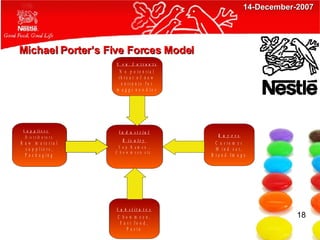
![Market Penetration Strategies Of Maggi Noodles Promotional campaigns in schools Advertising Strategies Availability in different pack sizes New product innovations 19 [email_address] 14-December-2007](https://image.slidesharecdn.com/nestle-maggi-1199699213349697-4/85/Nestle-Maggi-20-320.jpg)
![Question-1 Discuss the strategies undertaken by Nestle India Ltd. to create and establish a new product category? 20 [email_address] 14-December-2007](https://image.slidesharecdn.com/nestle-maggi-1199699213349697-4/85/Nestle-Maggi-21-320.jpg)
![Product Categories of Nestle NIL offered a variety of culinary products such as: - Instant Noodles Soups Sauces Cooking Aids Pickles 21 [email_address] 14-December-2007](https://image.slidesharecdn.com/nestle-maggi-1199699213349697-4/85/Nestle-Maggi-22-320.jpg)
![Strategies Of Nestle to form a new product category They want to be seen as health product in the minds of the customers. NIL also adopted the same strategy for the Maggi brand with the launch of the Maggi Vegetable Atta Noodles (Vegetable Atta Noodles). They establish the new product categories to take the first mover advantage. To capture he untapped market. 22 [email_address] 14-December-2007](https://image.slidesharecdn.com/nestle-maggi-1199699213349697-4/85/Nestle-Maggi-23-320.jpg)
![Question-2 What measures were undertaken in sustaining the image of a popular brand (maggi noodles) and the reason behind the brand extension of the same? 23 [email_address] 14-December-2007](https://image.slidesharecdn.com/nestle-maggi-1199699213349697-4/85/Nestle-Maggi-24-320.jpg)
![Image of Brand Maggi To sustain the image of the brand maggi, Nestle had adopted the 360 degree marketing strategy: - Promote themselves as a health product. They promote the product with whom consumer’s can play with, according to their taste. They also give the opportunity, of posting the recipe, to the women. They also have organised the various small events for the kids. They have spend the huge amount on the advertising of the maggi like electronic and print advertising. 24 [email_address] 14-December-2007](https://image.slidesharecdn.com/nestle-maggi-1199699213349697-4/85/Nestle-Maggi-25-320.jpg)
![Brand Extension In order to obtain cost economies, companies leverage the strength of the existing brand to launch new variants and product lines. Nestlé's Maggi is the classic example, which extended the brand Maggi to sauces, noodles, seasonings and pickle. They want to cash the image of the mother brand to make their new product’s successful and acceptable in the market. (e.g.-Nivea, Colgate etc.) Customer’s have a relationship and emotional feeling with brand maggi. 25 [email_address] 14-December-2007](https://image.slidesharecdn.com/nestle-maggi-1199699213349697-4/85/Nestle-Maggi-26-320.jpg)
![Question-3 What strategies were adopted by NIL in repositioning Maggi noodles? 26 [email_address] 14-December-2007](https://image.slidesharecdn.com/nestle-maggi-1199699213349697-4/85/Nestle-Maggi-27-320.jpg)
![Target Customer NIL was trying to create an entirely new food category, instant noodles, in India. Initially, the company targeted working women on the premise that Maggi noodles were fast to cook and hence offered convenience. ( Wrong Approach ) To get to the root of the problem, NIL conducted a research, which revealed that it was children who liked the taste of Maggi noodles and who were the largest consumers of the product. ( Correct Approach “Repositioning Strategy” ) 27 [email_address] 14-December-2007](https://image.slidesharecdn.com/nestle-maggi-1199699213349697-4/85/Nestle-Maggi-28-320.jpg)
![New Positioning Strategy NIL shifted its focus from working women and targeted children and their mothers through its marketing. NIL's promotions positioned the noodles as a 'convenience product', for mothers and as a 'fun' product for children. NIL aggressively promoted Maggi noodles through several schemes like: - distributing free samples. giving gifts on the return of empty packs. NIL's advertising too played a great role in communicating the benefits of the product to target consumers. 28 [email_address] 14-December-2007](https://image.slidesharecdn.com/nestle-maggi-1199699213349697-4/85/Nestle-Maggi-29-320.jpg)
![Thank You! [email_address] 14-December-2007](https://image.slidesharecdn.com/nestle-maggi-1199699213349697-4/85/Nestle-Maggi-30-320.jpg)


The document discusses strategies undertaken by Nestle India Ltd. (NIL) to establish and sustain the Maggi brand in India. It describes how NIL initially targeted working women but later shifted focus to children and mothers through marketing Maggi as a convenient and fun product. NIL repositioned Maggi as a healthy product by launching whole wheat and pulse variants. The document also examines brand extensions and NIL's efforts to maintain Maggi's popularity through various promotional campaigns.


