Arun Jagannathan MD
Vascular & Interventional Radiology
Central Illinois Radiological Associates
It’s all plumbing…
www.radclinic.com
Introduction
Arteriovenous graft or fistula
Direct communication between artery and vein without
an intervening capillary bed
Etiology
 Congenital
 Acquired
 Surgically created dialysis graft/fistula
 Traumatically created
 Iatrogenically created during cannulation/treatment of
artery/vein
www.radclinic.com
Traumatic AV Fistula
www.radclinic.com
What is KDOQI?
Kidney Disease Outcomes Quality Initiative
Evidence-based clinical practice guidelines developed
by volunteer physicians and health care providers for all
stages of chronic kidney disease and related
complications, from diagnosis to monitoring and
management
This presentation utilizes the National Kidney
Foundation (NKF) KDOQI Clinical Practice Guidelines
2006 update
www.kidney.org
www.radclinic.com
AV Access for Dialysis
Advent of hemodialysis in the early 60s has provided
significantly improved longevity for CKD patients
Initially used external AV shunt by Scribner and
Quinton
Currently provided by catheter, AV fistula, or AV
graft
Over 250k pts on permanent HD in US currently
www.radclinic.com
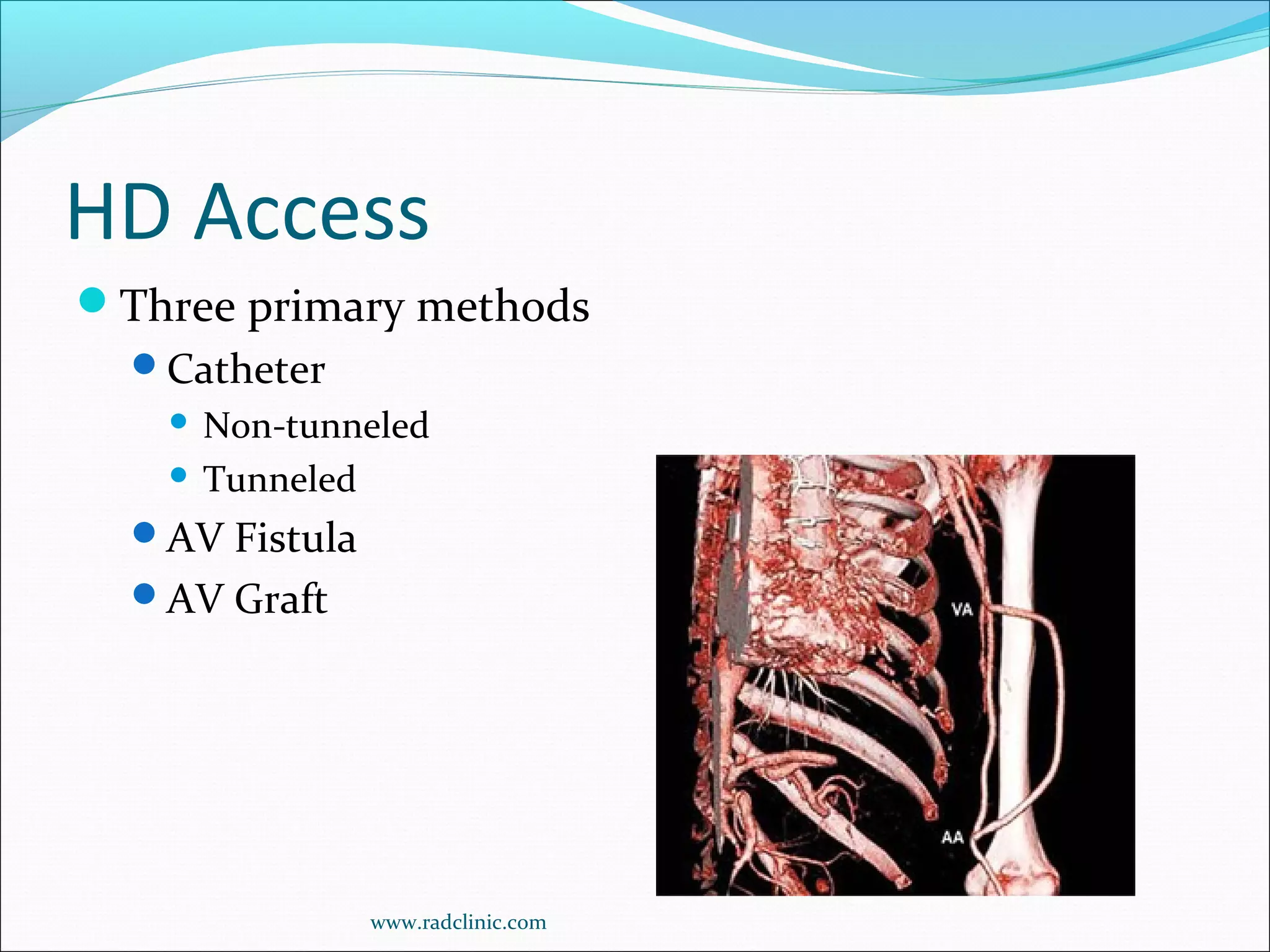
HD Access
Three primary methods
Catheter
 Non-tunneled
 Tunneled
AV Fistula
AV Graft
www.radclinic.com
www.radclinic.com
Catheter Access
Advantages
Immediate access
Easy to place if central veins are patent
Disadvantages
Infection (greater w/ noncuffed/nontunneled)
Potential Thrombosis/Occlusion Risks
Flow rates limited
www.radclinic.com
www.radclinic.com
Catheter Access
Vein selection, order of preference
Right Internal/External Jugular Vein
Left Internal/External Jugular Vein
Femoral veins (higher infection rates)
IVC (tunneled translumbar or transhepatic)
Subclavian (LAST RESORT as it may compromise
future upper extremity fistula/graft creation)
www.radclinic.com
Subclavian Occlusion
www.radclinic.com
Nontunneled HD Catheter
www.radclinic.com
Catheter Access
Nontunneled (Mahurkar, etc.)
SHORT term access (up to 10 days)
Tunneled Cuffed
Short to medium term access (weeks to months)
Bridge to more durable access (AVF, AVG, PD)
If a patient with acute onset renal failure is likely to
require more than 7-10 days of access, primarily place
a tunneled HD catheter
www.radclinic.com
Tunneled Cuffed HD Catheter
www.radclinic.com
Catheter Complications
Treat when dialyzer blood flow of 300 cc/min not
being attained in a catheter previously able to deliver
greater than 350 at prepump pressure -250 torr
Dysfunctional catheter (<300) for 2 treatments should
be treated in HD unit w/ intraluminal interdialytic
thrombolytic lock protocol between 2 treatments
If the above fails, send for radiological evaluation
www.radclinic.com
IR Evaluation of HD Catheter
Catheter imaging w/ contrast can identify and treat
various issues
Residual lumen thrombus -> pharmacologic or
mechanical thrombolysis
Malpositioned catheter tip -> reposition or exchange
Fibrin sheath at tip -> angioplasty/exchange/stripping
SVC thrombosis/stenosis ->
thrombolysis/angioplasty/stent
www.radclinic.com
SVC Thrombosis
www.radclinic.com
SVC Stenosis (tip malposition)
www.radclinic.com
Fibrin Sheath
www.radclinic.com
Catheter Infections
Treatment
Catheter exit-site, no tunnel infection
 Treat w/ topical and/or oral Abx, not necessary to remove
catheter
 If bacteremic pt is afebrile w/in 48 hrs and stable, catheter
salvage might be considered w/ interdialytic Abx lock
solution and 3wks of parenteral Abx, f/u Blood Cx in 1 wk
 Abx lock when f/u cultures indicate reinfection w/ same
organism in pt w/ limited access
 Short-term catheters should be removed when infected
www.radclinic.com
Save the veins!
CKD 3b or worse (eGFR < 45) pts are predialysis
Veins of dorsum of hand preferred IV site
Rotate sites if arm veins necessary
PICC lines are NOT benign!
 Incidence of central vein stenosis and occlusion after
PICC/Port is 7%
 Do NOT use PICC lines in predialysis patients (small bore
central catheter via IJV for medium term access instead)
www.radclinic.com
If at all possible…
www.radclinic.com
www.radclinic.com
Surgical Access: AV Fistulas and
Grafts
Fistulas have a superior longevity compared to grafts
(85% vs 50% patency at 2 yrs) but take longer to
mature
Up to 1/3 of fistulas fail to mature
Fistulas can remain patient at flow rates of as low as
80 cc/min
Grafts require flow rates of > 450 cc/min to prevent
thrombosis
www.radclinic.com
AV Fistula Creation
Usually nondominant arm
Radiocephalic or Brescia-Cimino is anastamosis of
radial artery to cephalic vein
Braciocephalic fistula is brachial artery to cephalic
vein in the antecubital region
Average of 4-6 wks for maturation
Preferred sites radiocephalic > braciocephalic >
transposed brachial basilic
www.radclinic.com
AV Fistula
Fistula
Advantages
 Lower infection rates
 Higher blood flow rates
 Lower thrombosis/stenosis rates
Disadvantages
 Longer maturation time
 Potential for steal syndrome
 Aneurysm formation
www.radclinic.com
AV Fistula
www.radclinic.com
AV Graft Creation
Artificial vessel (graft) made of synthetic material
such as PTFE or sterilized animal vessel connects the
native artery to vein
Preferred sites forearm loop > forearm straight >
upper arm > chest wall > lower extremity
www.radclinic.com
AV Graft
Advantage
Can be used much sooner
Disadvantages
Higher restenosis rates
 usually at venous anastomosis
Higher thrombosis rates
Higher infection rates
Potential steal
Pseudoaneurysms
www.radclinic.com
AV Graft
www.radclinic.com
Dialysis Unit
www.radclinic.com
Detection of Access Dysfunction
Prospective surveillance of fistulae/grafts for
hemodynamically significant stenosis, combined with
correction of anatomic stenosis, improves patency
rates and reduces incidence of thrombosis
www.radclinic.com
Physical Examination
Look (inspection)
Aneurysms
Fistula that does not collapse w/ arm elevation likely
has outflow stenosis
Palpable strictures
Downstream stenosis can produce venous dilatation
Arm edema
Prolonged bleeding after needle withdrawal
www.radclinic.com
www.radclinic.com
Physical Examination
Touch (palpation) and listen (auscultate)
Strong pulse is NOT evidence of good flow!
Bruit over access system that is only systolic is
abnormal, should be continuous
Palpable thrill at the arterial, middle, and venous
segments of graft predicts flow > 450 cc/min
Palpable thrill at axilla predicts > 500 cc/min
www.radclinic.com
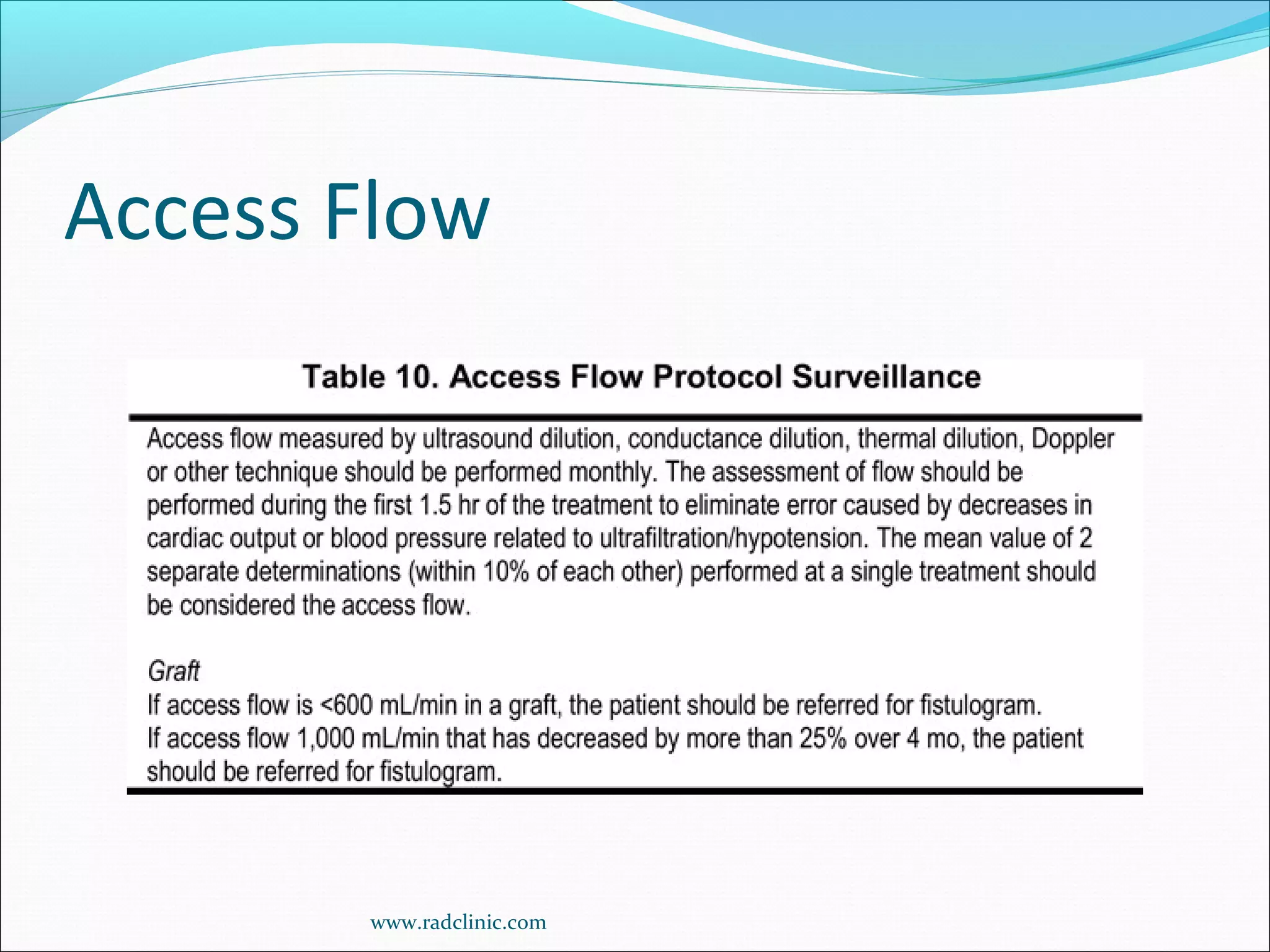
Access Flow
Number of techniques to measure
www.radclinic.com
Access Flow
www.radclinic.com
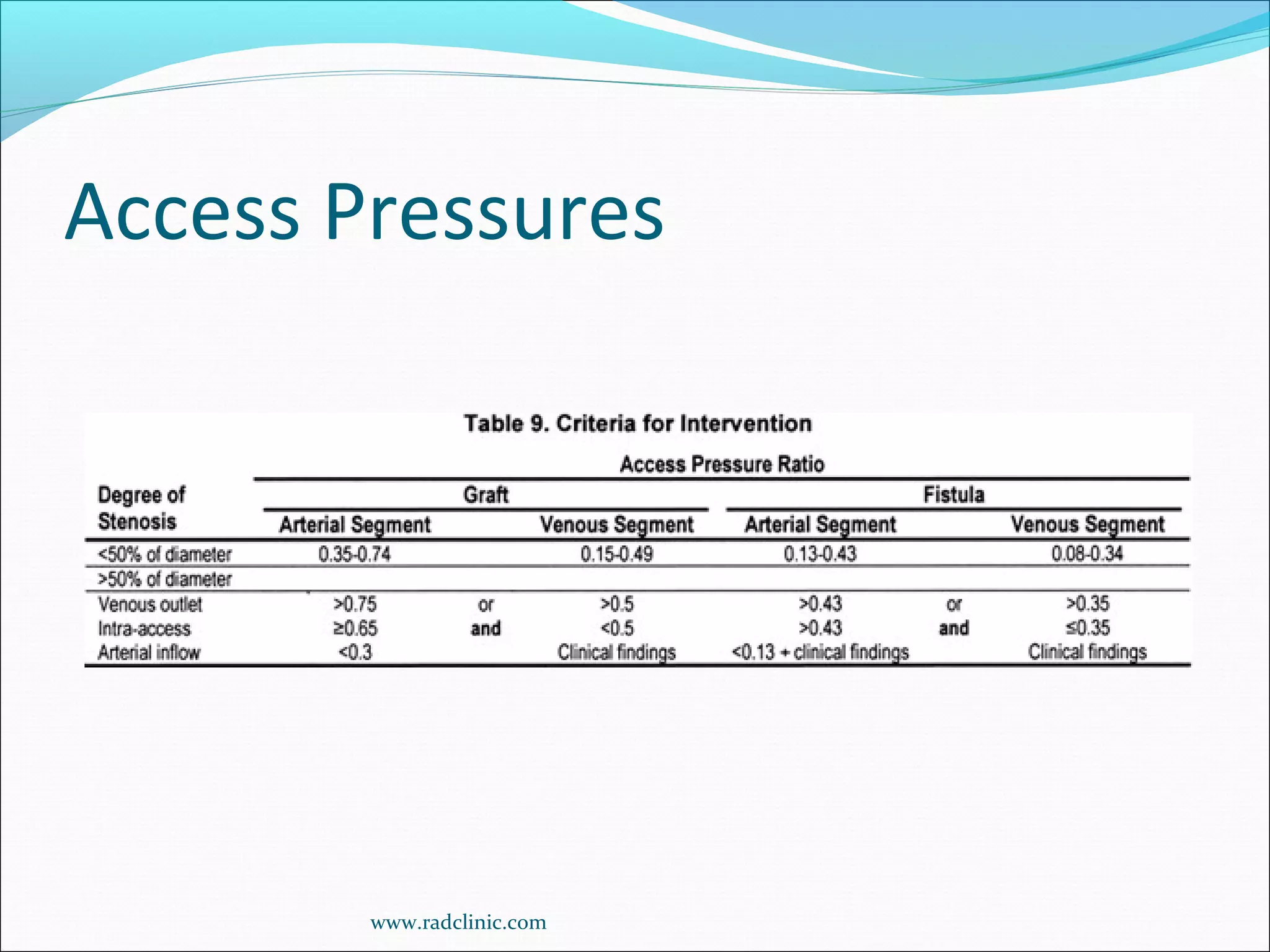
Access Pressures
www.radclinic.com
www.radclinic.com
Recirculation
Return of dialyzed blood to dialyzer without
equilibration with systemic arterial circulation
Not a recommended technique for assessing grafts
Up to 1/3 of dysfunctional fistulae will show increased
recirculation, but often occurs late
www.radclinic.com
When to refer for evaluation
Do not respond to a single isolated abnormal value,
trend analysis is the key
Flow rate < 600 in grafts and < 400-500 in fistulae
Venous segment static pressure ratio greater than 0.5
in grafts or fistulae
Arterial segment static pressure ratio greater than
0.75 in grafts
Persistent abnormalities -> graftogram/fistulogram!
www.radclinic.com
Treatment of Fistulae
Complications
Intervene for
Inadequate flow
Significant venous stenosis
Aneurysm formation in primary fistula (also correct
postaneurysmal stenosis)
Ischemia
www.radclinic.com
www.radclinic.com
Access Evaluation for Ischemia
Patients prone to develop ischemia
Elderly
Hypertensive
History of PAD
Diabetes
Not common (1-4%) but critical to recognize
Most occur early, but up to a quarter develop months
to years later
www.radclinic.com
Access Evaluation for Ischemia
Stage I, pale/blue and/or cold hand without pain
Stage II, pain during exercise and/or HD
Stage III, pain at rest
Stage IV, ulcers/necrosis/gangrene
www.radclinic.com
Stage IV
www.radclinic.com
Ischemia -- Emergent Referral to
Vascular Access Surgeon
Treatments
Angioplasty of arterial stenosis proximal to anastomosis
Ligation of peripheral radial artery
DRIL (distal revascularization—interval ligation)
 Pts w/ venous anastomosis to brachial artery, anastomosis is
bridged by venous bypass, after which the artery is ligated
closely peripheral to the anastomosis
Low flow rates and ischemia, proximal AV anastomosis
technique with ligation of the previous anastomosis and
placement of a new more proximal one with blood
brought to the vein by an interposed vein graft or small
caliber PTFE graft
www.radclinic.com
Surgical Steal Tx
DRIL – distal revascularization with interval ligation
RUDI – revision using distal inflow
www.radclinic.com
Infection
Rare, but potentially lethal
If at anastomosis, immediate surgery w/ resection
More often at cannulation sites, rest and treat w/ Abx
(treat like subacute bacterial endocarditis, 6 wks)
www.radclinic.com
Graft Complications
Extremity edema
Persisting > 2 wks require contrast imaging to evaluate
central veins with plasty as necessary
 Stent placement if acute elastic recoil after plasty or if
stenosis recurs within 3 months
Indicators of risk for graft rupture (evaluate urgently)
Poor eschar formation
Spontaneous bleeding
Rapid expansion of pseudoaneurysm
Severe degeneration of graft material
www.radclinic.com
Graft Complications
Indications for revision/repair
AVGs w/ severe degeneration or pseudoaneurysm
(PSA) should be repaired if…
 Number of cannulation sites limited by large or multiple
PSAs
 PSA threatens viability of overlying skin
 PSA is symptomatic
 Possible infection
AVOID cannulation of PSA, especially if enlarging
www.radclinic.com
Graft Complications
Treat stenosis w/ angioplasty or surgery if > 50% in
diameter and…
Abnormal physical exam
Decreasing intragraft flow (< 600)
Elevated static pressure within graft
www.radclinic.com
Take Home Points
Save the veins!
PICC lines and subclavian catheters are NOT benign,
and should almost NEVER be used in dialysis or
predialysis patients
Surveillance of AV fistulae and grafts is crucial in
order to intervene early and prevent loss of a potential
access site
Open line of communication between dialysis center,
radiology, and surgical services is imperative
www.radclinic.com
Infrascrotal Femoro-Femoral
Perineal Bypass Graft
Not to be wished upon your worst enemy!
www.radclinic.com
The End
www.radclinic.com

Dialysis access interventions

  • 1.
    Arun Jagannathan MD Vascular& Interventional Radiology Central Illinois Radiological Associates
  • 2.
  • 3.
    Introduction Arteriovenous graft orfistula Direct communication between artery and vein without an intervening capillary bed Etiology  Congenital  Acquired  Surgically created dialysis graft/fistula  Traumatically created  Iatrogenically created during cannulation/treatment of artery/vein www.radclinic.com
  • 4.
  • 5.
    What is KDOQI? KidneyDisease Outcomes Quality Initiative Evidence-based clinical practice guidelines developed by volunteer physicians and health care providers for all stages of chronic kidney disease and related complications, from diagnosis to monitoring and management This presentation utilizes the National Kidney Foundation (NKF) KDOQI Clinical Practice Guidelines 2006 update www.kidney.org www.radclinic.com
  • 6.
    AV Access forDialysis Advent of hemodialysis in the early 60s has provided significantly improved longevity for CKD patients Initially used external AV shunt by Scribner and Quinton Currently provided by catheter, AV fistula, or AV graft Over 250k pts on permanent HD in US currently www.radclinic.com
  • 7.
    HD Access Three primarymethods Catheter  Non-tunneled  Tunneled AV Fistula AV Graft www.radclinic.com
  • 8.
  • 9.
    Catheter Access Advantages Immediate access Easyto place if central veins are patent Disadvantages Infection (greater w/ noncuffed/nontunneled) Potential Thrombosis/Occlusion Risks Flow rates limited www.radclinic.com
  • 10.
  • 11.
    Catheter Access Vein selection,order of preference Right Internal/External Jugular Vein Left Internal/External Jugular Vein Femoral veins (higher infection rates) IVC (tunneled translumbar or transhepatic) Subclavian (LAST RESORT as it may compromise future upper extremity fistula/graft creation) www.radclinic.com
  • 12.
  • 13.
  • 14.
    Catheter Access Nontunneled (Mahurkar,etc.) SHORT term access (up to 10 days) Tunneled Cuffed Short to medium term access (weeks to months) Bridge to more durable access (AVF, AVG, PD) If a patient with acute onset renal failure is likely to require more than 7-10 days of access, primarily place a tunneled HD catheter www.radclinic.com
  • 15.
    Tunneled Cuffed HDCatheter www.radclinic.com
  • 16.
    Catheter Complications Treat whendialyzer blood flow of 300 cc/min not being attained in a catheter previously able to deliver greater than 350 at prepump pressure -250 torr Dysfunctional catheter (<300) for 2 treatments should be treated in HD unit w/ intraluminal interdialytic thrombolytic lock protocol between 2 treatments If the above fails, send for radiological evaluation www.radclinic.com
  • 17.
    IR Evaluation ofHD Catheter Catheter imaging w/ contrast can identify and treat various issues Residual lumen thrombus -> pharmacologic or mechanical thrombolysis Malpositioned catheter tip -> reposition or exchange Fibrin sheath at tip -> angioplasty/exchange/stripping SVC thrombosis/stenosis -> thrombolysis/angioplasty/stent www.radclinic.com
  • 18.
  • 19.
    SVC Stenosis (tipmalposition) www.radclinic.com
  • 20.
  • 21.
    Catheter Infections Treatment Catheter exit-site,no tunnel infection  Treat w/ topical and/or oral Abx, not necessary to remove catheter  If bacteremic pt is afebrile w/in 48 hrs and stable, catheter salvage might be considered w/ interdialytic Abx lock solution and 3wks of parenteral Abx, f/u Blood Cx in 1 wk  Abx lock when f/u cultures indicate reinfection w/ same organism in pt w/ limited access  Short-term catheters should be removed when infected www.radclinic.com
  • 22.
    Save the veins! CKD3b or worse (eGFR < 45) pts are predialysis Veins of dorsum of hand preferred IV site Rotate sites if arm veins necessary PICC lines are NOT benign!  Incidence of central vein stenosis and occlusion after PICC/Port is 7%  Do NOT use PICC lines in predialysis patients (small bore central catheter via IJV for medium term access instead) www.radclinic.com
  • 23.
    If at allpossible… www.radclinic.com
  • 24.
  • 25.
    Surgical Access: AVFistulas and Grafts Fistulas have a superior longevity compared to grafts (85% vs 50% patency at 2 yrs) but take longer to mature Up to 1/3 of fistulas fail to mature Fistulas can remain patient at flow rates of as low as 80 cc/min Grafts require flow rates of > 450 cc/min to prevent thrombosis www.radclinic.com
  • 26.
    AV Fistula Creation Usuallynondominant arm Radiocephalic or Brescia-Cimino is anastamosis of radial artery to cephalic vein Braciocephalic fistula is brachial artery to cephalic vein in the antecubital region Average of 4-6 wks for maturation Preferred sites radiocephalic > braciocephalic > transposed brachial basilic www.radclinic.com
  • 27.
    AV Fistula Fistula Advantages  Lowerinfection rates  Higher blood flow rates  Lower thrombosis/stenosis rates Disadvantages  Longer maturation time  Potential for steal syndrome  Aneurysm formation www.radclinic.com
  • 28.
  • 29.
    AV Graft Creation Artificialvessel (graft) made of synthetic material such as PTFE or sterilized animal vessel connects the native artery to vein Preferred sites forearm loop > forearm straight > upper arm > chest wall > lower extremity www.radclinic.com
  • 30.
    AV Graft Advantage Can beused much sooner Disadvantages Higher restenosis rates  usually at venous anastomosis Higher thrombosis rates Higher infection rates Potential steal Pseudoaneurysms www.radclinic.com
  • 31.
  • 32.
  • 33.
    Detection of AccessDysfunction Prospective surveillance of fistulae/grafts for hemodynamically significant stenosis, combined with correction of anatomic stenosis, improves patency rates and reduces incidence of thrombosis www.radclinic.com
  • 34.
    Physical Examination Look (inspection) Aneurysms Fistulathat does not collapse w/ arm elevation likely has outflow stenosis Palpable strictures Downstream stenosis can produce venous dilatation Arm edema Prolonged bleeding after needle withdrawal www.radclinic.com
  • 35.
  • 36.
    Physical Examination Touch (palpation)and listen (auscultate) Strong pulse is NOT evidence of good flow! Bruit over access system that is only systolic is abnormal, should be continuous Palpable thrill at the arterial, middle, and venous segments of graft predicts flow > 450 cc/min Palpable thrill at axilla predicts > 500 cc/min www.radclinic.com
  • 37.
    Access Flow Number oftechniques to measure www.radclinic.com
  • 38.
  • 39.
  • 40.
  • 41.
    Recirculation Return of dialyzedblood to dialyzer without equilibration with systemic arterial circulation Not a recommended technique for assessing grafts Up to 1/3 of dysfunctional fistulae will show increased recirculation, but often occurs late www.radclinic.com
  • 42.
    When to referfor evaluation Do not respond to a single isolated abnormal value, trend analysis is the key Flow rate < 600 in grafts and < 400-500 in fistulae Venous segment static pressure ratio greater than 0.5 in grafts or fistulae Arterial segment static pressure ratio greater than 0.75 in grafts Persistent abnormalities -> graftogram/fistulogram! www.radclinic.com
  • 43.
    Treatment of Fistulae Complications Intervenefor Inadequate flow Significant venous stenosis Aneurysm formation in primary fistula (also correct postaneurysmal stenosis) Ischemia www.radclinic.com
  • 44.
  • 45.
    Access Evaluation forIschemia Patients prone to develop ischemia Elderly Hypertensive History of PAD Diabetes Not common (1-4%) but critical to recognize Most occur early, but up to a quarter develop months to years later www.radclinic.com
  • 46.
    Access Evaluation forIschemia Stage I, pale/blue and/or cold hand without pain Stage II, pain during exercise and/or HD Stage III, pain at rest Stage IV, ulcers/necrosis/gangrene www.radclinic.com
  • 47.
  • 48.
    Ischemia -- EmergentReferral to Vascular Access Surgeon Treatments Angioplasty of arterial stenosis proximal to anastomosis Ligation of peripheral radial artery DRIL (distal revascularization—interval ligation)  Pts w/ venous anastomosis to brachial artery, anastomosis is bridged by venous bypass, after which the artery is ligated closely peripheral to the anastomosis Low flow rates and ischemia, proximal AV anastomosis technique with ligation of the previous anastomosis and placement of a new more proximal one with blood brought to the vein by an interposed vein graft or small caliber PTFE graft www.radclinic.com
  • 49.
    Surgical Steal Tx DRIL– distal revascularization with interval ligation RUDI – revision using distal inflow www.radclinic.com
  • 50.
    Infection Rare, but potentiallylethal If at anastomosis, immediate surgery w/ resection More often at cannulation sites, rest and treat w/ Abx (treat like subacute bacterial endocarditis, 6 wks) www.radclinic.com
  • 51.
    Graft Complications Extremity edema Persisting> 2 wks require contrast imaging to evaluate central veins with plasty as necessary  Stent placement if acute elastic recoil after plasty or if stenosis recurs within 3 months Indicators of risk for graft rupture (evaluate urgently) Poor eschar formation Spontaneous bleeding Rapid expansion of pseudoaneurysm Severe degeneration of graft material www.radclinic.com
  • 52.
    Graft Complications Indications forrevision/repair AVGs w/ severe degeneration or pseudoaneurysm (PSA) should be repaired if…  Number of cannulation sites limited by large or multiple PSAs  PSA threatens viability of overlying skin  PSA is symptomatic  Possible infection AVOID cannulation of PSA, especially if enlarging www.radclinic.com
  • 53.
    Graft Complications Treat stenosisw/ angioplasty or surgery if > 50% in diameter and… Abnormal physical exam Decreasing intragraft flow (< 600) Elevated static pressure within graft www.radclinic.com
  • 54.
    Take Home Points Savethe veins! PICC lines and subclavian catheters are NOT benign, and should almost NEVER be used in dialysis or predialysis patients Surveillance of AV fistulae and grafts is crucial in order to intervene early and prevent loss of a potential access site Open line of communication between dialysis center, radiology, and surgical services is imperative www.radclinic.com
  • 55.
    Infrascrotal Femoro-Femoral Perineal BypassGraft Not to be wished upon your worst enemy! www.radclinic.com
  • 56.