SIALOGRAPHY
DACROCYSTOGRAPHY
SIALOGRAPHY
INTRODUCTION
 A radiographic examination of the
salivary glands(PAROTID &
Submandibular GLAND) and ducts
using contrast media
 Cannulation of Sublingual gland ducts is
almost impossible
INDICATIONS FOR EXAM
 Stones (Calculi) sialolithiasis
 Obstruction / Strictures
 Pain & Swelling (esp when recurrent)
 Infection
 Masses / Tumors
 Changes secondary to trauma
 When plain radiography is inconclusive
CONTRAINDICATIONS FOR EXAM
 History of contrast media allergies
 Severe inflammation of the salivary
ducts
ANATOMY OF THE SALIVARY
GLANDS
 3 pairs---Parotid
SM
SL
 Situated adjacent to OC, aid in initial
digestion
ANATOMY OF THE SALIVARY
GLANDS
PAROTID GLAND
Largest salivary gland
 Lies just below the ZYG arch in front & below
the ear
Parotid duct(Stensons duct) is 5cm long, runs
over the messeter & opens into oral vestibule
opposite 2nd upper molar
SUBMANDIBULAR
GLANDS
Extends posteriorly from below
1st lower molar to angle of mandible
Forms part of soft tissues on the medial margin
of the mandible & the hyoid bone
Submandibular duct(whartsons duct ) is 5 cm
long, runs forward ,medially and upward &
opens into mouth on side of frenulum
SUB LINGUAL GLANDS
Smallest pair
Located in floor of mouth on the surface of
mylohyoid muscle.
Numerous, small sublingual ducts(ducts of
Rivinus) open into floor of mouth
Ducts may join to form a single(duct of
Bartholin) which empties into the submandibular
duct.
SALIVARY GLAND IMAGING
 PLAIN RADIOGRAPHS
 SIALOGRAPHY
 CT(Glandular enlargement , tumors)
 RADIONUCLIDE IMAGING(to provide
additional physiological info in cases of
over or under secretion )
 MRI
SIALOGRAPHY
 Radiologic exam of salivary glands and
ducts using contrast media
 CT and MRI have largely replaced this
exam
PROCEDURE
 Preliminary radiographs
Detect conditions that do not require contrast
 Give pt secretory stimulant 2 to 3 minutes before
contrast administration
Pt asked to suck on lemon wedge
-Opens duct for easy identification
 Duct orifice is sprayed with topical anaesthetic
 Duct is cannulated, (dialator may be required),
contrast introduced with fluoroscopic guidance
 Contrast (oil based or water soluble iodinated)
(conc = 240mg/ml)
 Should be injected manually until pt feels
discomfort
 Quantity needed may vary btw 1-2 ml
 Images taken immediately after contrast is
complete
 After taking req. images ,pt sucks on a
lemon wedge again to evacuate contrast
 Take post-procedure(delayed) radiographs
after 5 minutes to confirm evacuation of
contrast/ demonstrate any residual contrast
Dilation with probe of Wharton’s duct of
the submandibular gland.
Cannulation of duct with intravenous
catheter (22 gauge).
FILMS
 Parotid----Control Films
- PA
- LAT
- LAT OBLIQUE
 Parotid -----Sialography Film
- PA
- LAT
- LAT OBLIQUE
FILMS
 SM----Control Films
- INFEROSUPERIOR/OCCLUSAL 1
- INFEROSUPERIOR/OCCLUSAL 2
- LAT
 SM -----Sialography Film
- LAT
- LAT OBLIQUE
Normal salivary gland visualized by sialography.
Lateral Submandibular radiographs
Sialogram of the right parotid gland showing multiple
punctate glandular collections, 1 mm in diameter,
suggestive of punctate sialectasis
Sialoectasis
Sialogram of the parotid gland; lat. projection. In the glandular
parenchyma pools of contrast can be seen. The accessory parotid
gland is also affected (arrow).
Salivary Gland Swelling with Ductal Narrowing
DACROCYSTOGRAPHY
Introduction
 A Radiographic examination of the
Naso lacrimal duct(s) following
administration of a contrast medium to
define the Lacrimal gland & NLD
system anatomically in search of
stenosis or obstruction
Indications
 Lacrimal duct obstruction/stricture
Contra-indications
Non-consent by patient to procedure
Contrast media or iodine allergy
Pregnancy (risk is minimal but patient may
wish to delay procedure)
Anatomy
Tears (lacrimal fluid) are produced by
the lacrimal gland which is located at the
supero-lateral aspect of the orbit.
 Drainage of the lacrimal fluid is achieved
by the lacrimal canaliculi, lacrimal sac,
and nasolacrimal duct.
 The lacrimal fluid drains from the
nasolacrimal duct into the nasal cavity
via the inferior meatus
Preparation
 Patient identification (3 'C's- correct
patient, correct side, correct procedure)
 Completed consent form
 No diet restrictions
 Collect/review relevant previous imaging
for ease of access prior to procedure
TECHNIQUE
 The patient lies supine on the
fluoroscopy table with the head in a
reverse occipito-mental position.
 Support either side of the patient's head
by immobilization device, particularly if a
subtraction technique is employed.
 Select a small field of view and fine
focus
 Control images taken
TECHNIQUE(cont)
 Anaesthetic eye drops are used for
patient comfort
 A fine cannula is inserted into the puncta
of each eye, then the eye is closed and
the catheter taped to the patient's cheek
 It may be necessary to dilate the puncta
to facilitate insertion of the cannula
TECHNIQUE(cont)
 After the mask is acquired, commence
injection
 Images are taken immediately after
injection
 A drainage image can be taken after 15
minutes if considered necessary
Unilateral dacrocystogram demonstrating a normal lacrimal duct
Subtraction has been utilized
minimal reflux into superior lacrimal canal
Bilateral dacrocystogram with subtraction
Normal lacrimal duct on the left
Slower flow of contrast on the right (this may not be pathological- may reflect
note the amount of extravisated contrast medium on the right)
Demonstrated right duct appears normal
Reflux into superior lacrimal canal on right
Perfect X-ray beam collimation
adequate subtraction
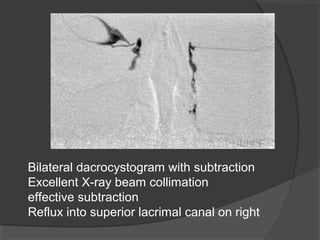
Bilateral dacrocystogram with subtraction
Excellent X-ray beam collimation
effective subtraction
Reflux into superior lacrimal canal on right
Bilateral dacrocystogram without subtraction
Delayed drainage image
Abnormal accumulation of contrast on the left
Unilateral injection
Abnormal pooling of contrast proximally
Unilateral injection
Subtraction technique
Minimal contrast filling of right lacrimal sac
Contrast reflux into superior lacrimal canal
Contrast or Subtraction Artifact?
It will not always be clear whether you have demonstrated contrast filling or
subtraction artifact
The consistency of the arrowed structure and its similarity to the other
subtraction artifacts suggests that it is not contrast medium
(Experience Required!!!)
Technique Notes
It is normal practice to image both sides
(comparison/increased incidence of bil. abns)
It is preferable to inject both sides at the same time
Collimate the X-ray beam to include the orbits
superiorly and laterally and the maxillary PNS
inferiorly
A sialogram needle (metal or plastic tip) can be
used for cannulation of the puncta (16 gauge or
similar)
A focused spotlight can be a useful aid for the
radiologist in locating the lacrimal punctum
Inferior punctum is often easier to canulate
Catheter should not be inserted too far into the
canaliculus
Dacrocystogram protocol may include adjunct
nuclear medicine study
Thank you

Sialography & dacrocystography

  • 1.
  • 2.
    SIALOGRAPHY INTRODUCTION  A radiographicexamination of the salivary glands(PAROTID & Submandibular GLAND) and ducts using contrast media  Cannulation of Sublingual gland ducts is almost impossible
  • 3.
    INDICATIONS FOR EXAM Stones (Calculi) sialolithiasis  Obstruction / Strictures  Pain & Swelling (esp when recurrent)  Infection  Masses / Tumors  Changes secondary to trauma  When plain radiography is inconclusive
  • 4.
    CONTRAINDICATIONS FOR EXAM History of contrast media allergies  Severe inflammation of the salivary ducts
  • 5.
    ANATOMY OF THESALIVARY GLANDS  3 pairs---Parotid SM SL  Situated adjacent to OC, aid in initial digestion
  • 6.
    ANATOMY OF THESALIVARY GLANDS
  • 9.
    PAROTID GLAND Largest salivarygland  Lies just below the ZYG arch in front & below the ear Parotid duct(Stensons duct) is 5cm long, runs over the messeter & opens into oral vestibule opposite 2nd upper molar
  • 11.
    SUBMANDIBULAR GLANDS Extends posteriorly frombelow 1st lower molar to angle of mandible Forms part of soft tissues on the medial margin of the mandible & the hyoid bone Submandibular duct(whartsons duct ) is 5 cm long, runs forward ,medially and upward & opens into mouth on side of frenulum
  • 12.
    SUB LINGUAL GLANDS Smallestpair Located in floor of mouth on the surface of mylohyoid muscle. Numerous, small sublingual ducts(ducts of Rivinus) open into floor of mouth Ducts may join to form a single(duct of Bartholin) which empties into the submandibular duct.
  • 13.
    SALIVARY GLAND IMAGING PLAIN RADIOGRAPHS  SIALOGRAPHY  CT(Glandular enlargement , tumors)  RADIONUCLIDE IMAGING(to provide additional physiological info in cases of over or under secretion )  MRI
  • 14.
    SIALOGRAPHY  Radiologic examof salivary glands and ducts using contrast media  CT and MRI have largely replaced this exam
  • 15.
    PROCEDURE  Preliminary radiographs Detectconditions that do not require contrast  Give pt secretory stimulant 2 to 3 minutes before contrast administration Pt asked to suck on lemon wedge -Opens duct for easy identification
  • 16.
     Duct orificeis sprayed with topical anaesthetic  Duct is cannulated, (dialator may be required), contrast introduced with fluoroscopic guidance  Contrast (oil based or water soluble iodinated) (conc = 240mg/ml)  Should be injected manually until pt feels discomfort  Quantity needed may vary btw 1-2 ml
  • 17.
     Images takenimmediately after contrast is complete  After taking req. images ,pt sucks on a lemon wedge again to evacuate contrast  Take post-procedure(delayed) radiographs after 5 minutes to confirm evacuation of contrast/ demonstrate any residual contrast
  • 18.
    Dilation with probeof Wharton’s duct of the submandibular gland. Cannulation of duct with intravenous catheter (22 gauge).
  • 19.
    FILMS  Parotid----Control Films -PA - LAT - LAT OBLIQUE  Parotid -----Sialography Film - PA - LAT - LAT OBLIQUE
  • 20.
    FILMS  SM----Control Films -INFEROSUPERIOR/OCCLUSAL 1 - INFEROSUPERIOR/OCCLUSAL 2 - LAT  SM -----Sialography Film - LAT - LAT OBLIQUE
  • 21.
    Normal salivary glandvisualized by sialography.
  • 22.
  • 24.
    Sialogram of theright parotid gland showing multiple punctate glandular collections, 1 mm in diameter, suggestive of punctate sialectasis
  • 25.
    Sialoectasis Sialogram of theparotid gland; lat. projection. In the glandular parenchyma pools of contrast can be seen. The accessory parotid gland is also affected (arrow).
  • 26.
    Salivary Gland Swellingwith Ductal Narrowing
  • 27.
    DACROCYSTOGRAPHY Introduction  A Radiographicexamination of the Naso lacrimal duct(s) following administration of a contrast medium to define the Lacrimal gland & NLD system anatomically in search of stenosis or obstruction
  • 28.
    Indications  Lacrimal ductobstruction/stricture
  • 29.
    Contra-indications Non-consent by patientto procedure Contrast media or iodine allergy Pregnancy (risk is minimal but patient may wish to delay procedure)
  • 30.
    Anatomy Tears (lacrimal fluid)are produced by the lacrimal gland which is located at the supero-lateral aspect of the orbit.
  • 31.
     Drainage ofthe lacrimal fluid is achieved by the lacrimal canaliculi, lacrimal sac, and nasolacrimal duct.  The lacrimal fluid drains from the nasolacrimal duct into the nasal cavity via the inferior meatus
  • 36.
    Preparation  Patient identification(3 'C's- correct patient, correct side, correct procedure)  Completed consent form  No diet restrictions  Collect/review relevant previous imaging for ease of access prior to procedure
  • 37.
    TECHNIQUE  The patientlies supine on the fluoroscopy table with the head in a reverse occipito-mental position.  Support either side of the patient's head by immobilization device, particularly if a subtraction technique is employed.  Select a small field of view and fine focus  Control images taken
  • 38.
    TECHNIQUE(cont)  Anaesthetic eyedrops are used for patient comfort  A fine cannula is inserted into the puncta of each eye, then the eye is closed and the catheter taped to the patient's cheek  It may be necessary to dilate the puncta to facilitate insertion of the cannula
  • 39.
    TECHNIQUE(cont)  After themask is acquired, commence injection  Images are taken immediately after injection  A drainage image can be taken after 15 minutes if considered necessary
  • 40.
    Unilateral dacrocystogram demonstratinga normal lacrimal duct Subtraction has been utilized minimal reflux into superior lacrimal canal
  • 41.
    Bilateral dacrocystogram withsubtraction Normal lacrimal duct on the left Slower flow of contrast on the right (this may not be pathological- may reflect note the amount of extravisated contrast medium on the right) Demonstrated right duct appears normal Reflux into superior lacrimal canal on right Perfect X-ray beam collimation adequate subtraction
  • 42.
    Bilateral dacrocystogram withsubtraction Excellent X-ray beam collimation effective subtraction Reflux into superior lacrimal canal on right
  • 43.
    Bilateral dacrocystogram withoutsubtraction Delayed drainage image Abnormal accumulation of contrast on the left
  • 44.
  • 45.
    Unilateral injection Subtraction technique Minimalcontrast filling of right lacrimal sac Contrast reflux into superior lacrimal canal
  • 46.
    Contrast or SubtractionArtifact? It will not always be clear whether you have demonstrated contrast filling or subtraction artifact The consistency of the arrowed structure and its similarity to the other subtraction artifacts suggests that it is not contrast medium (Experience Required!!!)
  • 47.
    Technique Notes It isnormal practice to image both sides (comparison/increased incidence of bil. abns) It is preferable to inject both sides at the same time Collimate the X-ray beam to include the orbits superiorly and laterally and the maxillary PNS inferiorly A sialogram needle (metal or plastic tip) can be used for cannulation of the puncta (16 gauge or similar)
  • 48.
    A focused spotlightcan be a useful aid for the radiologist in locating the lacrimal punctum Inferior punctum is often easier to canulate Catheter should not be inserted too far into the canaliculus Dacrocystogram protocol may include adjunct nuclear medicine study
  • 49.