



MAGNETIC PARTICLE TESTING
Introduction
• This module is intended to present
information on the widely used method of
magnetic particle inspection.
• Magnetic particle inspection can detect
both production discontinuities (seams,
laps, grinding cracks and quenching
cracks) and in-service damage (fatigue
and overload cracks).
Outline
• Magnetism and Ferromagnetic Materials
• Introduction of Magnetic Particle
Inspection
• Basic Procedure and Important
Considerations
1. Component pre-cleaning
2. Introduction of magnetic field
3. Application of magnetic media
4. Interpretation of magnetic particle
indications
• Examples of MPI Indications
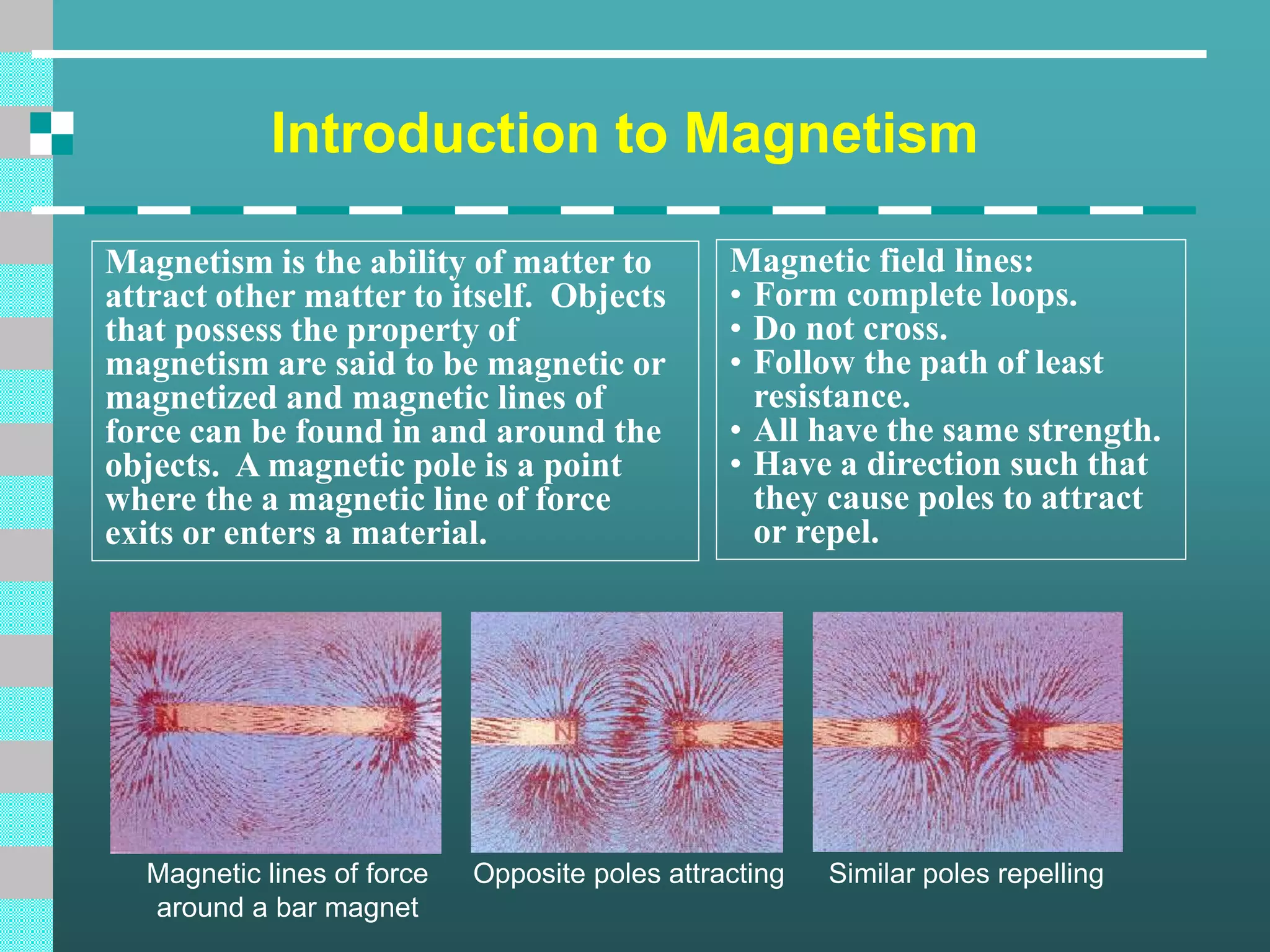
Magnetic lines of force
around a bar magnet
Opposite poles attracting Similar poles repelling
Introduction to Magnetism
Magnetism is the ability of matter to
attract other matter to itself. Objects
that possess the property of
magnetism are said to be magnetic or
magnetized and magnetic lines of
force can be found in and around the
objects. A magnetic pole is a point
where the a magnetic line of force
exits or enters a material.
Magnetic field lines:
• Form complete loops.
• Do not cross.
• Follow the path of least
resistance.
• All have the same strength.
• Have a direction such that
they cause poles to attract
or repel.
How Does Magnetic Particle
Inspection Work?
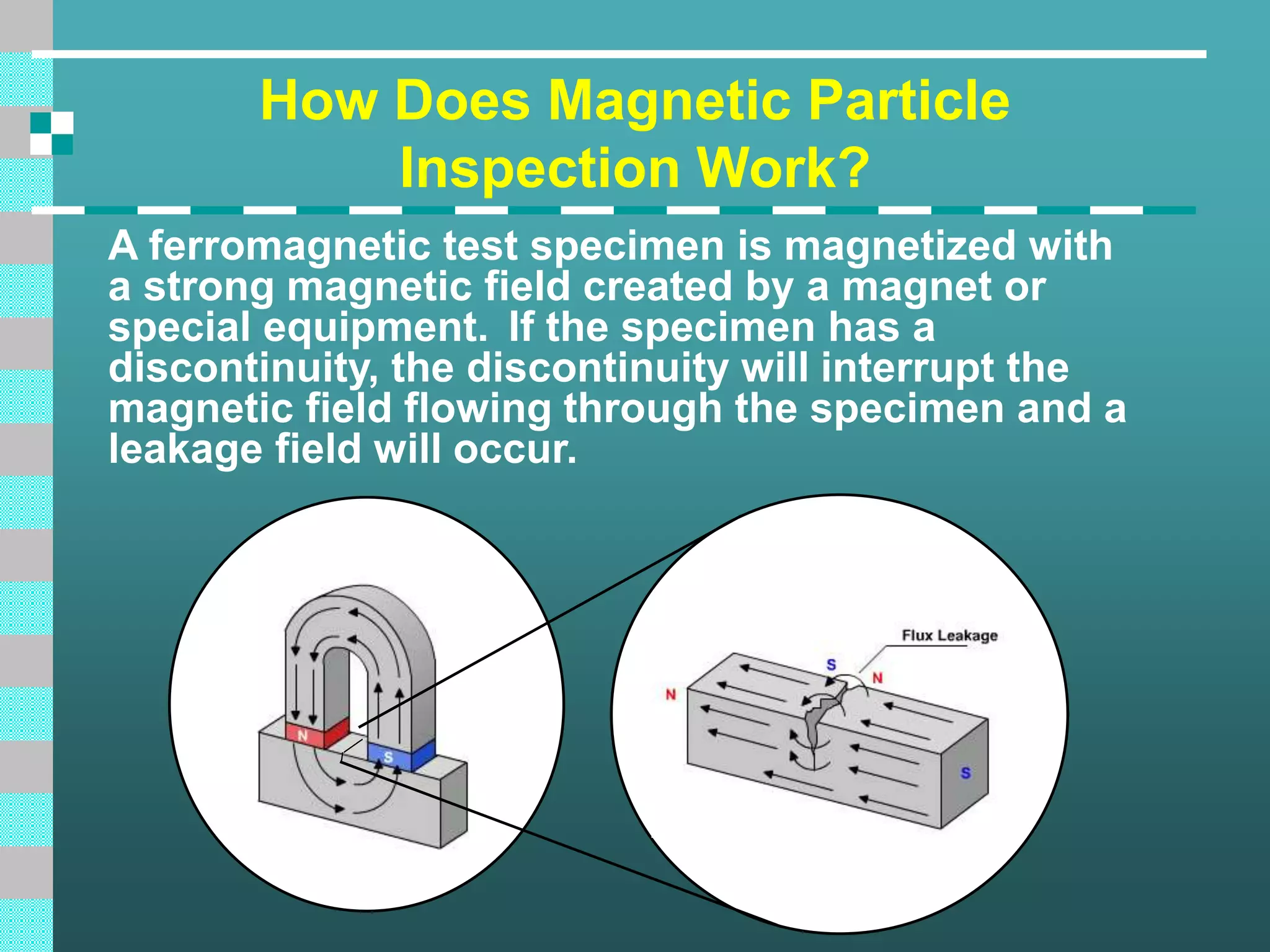
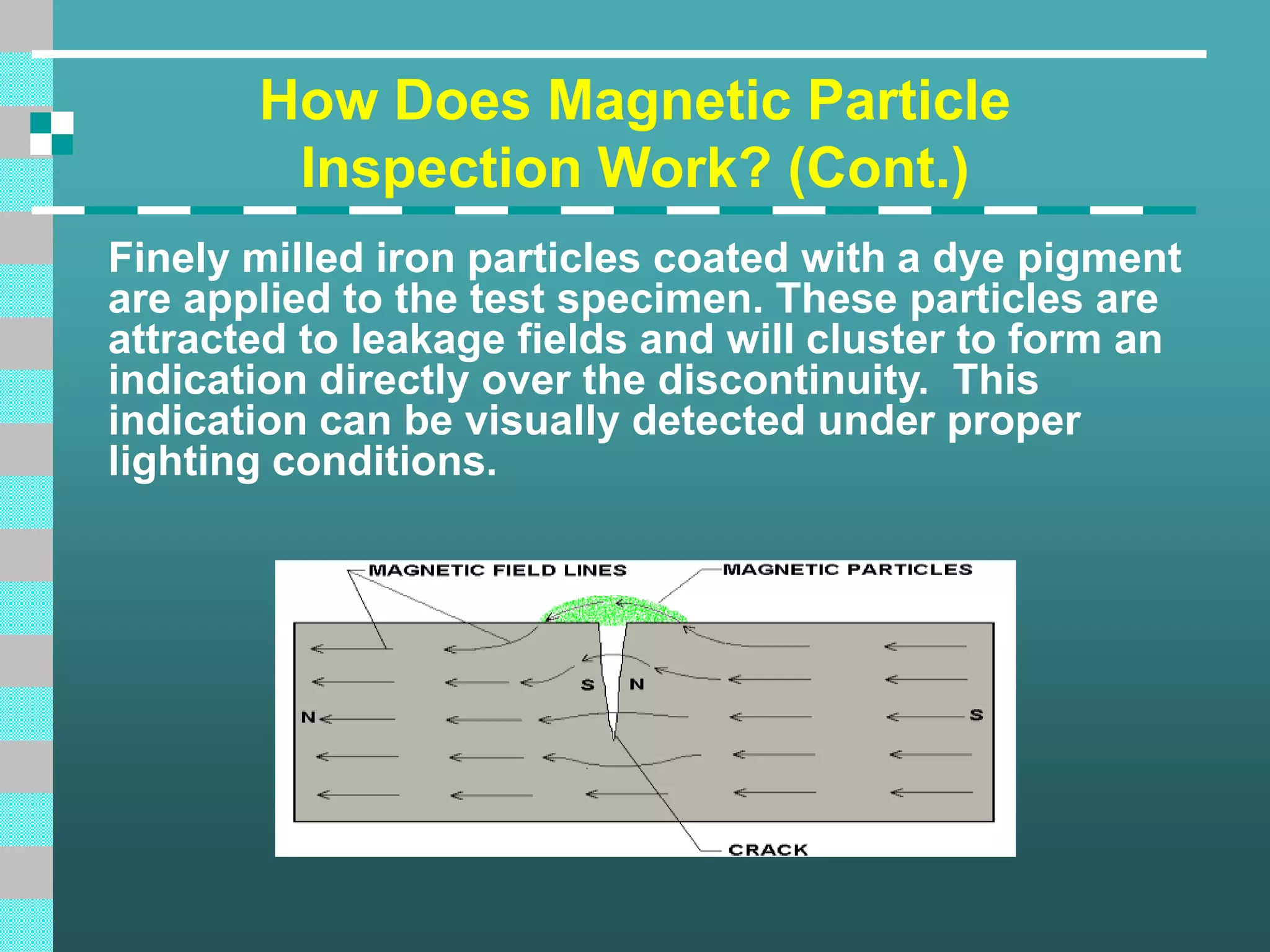
A ferromagnetic test specimen is magnetized with
a strong magnetic field created by a magnet or
special equipment. If the specimen has a
discontinuity, the discontinuity will interrupt the
magnetic field flowing through the specimen and a
leakage field will occur.
How Does Magnetic Particle
Inspection Work? (Cont.)
Finely milled iron particles coated with a dye pigment
are applied to the test specimen. These particles are
attracted to leakage fields and will cluster to form an
indication directly over the discontinuity. This
indication can be visually detected under proper
lighting conditions.
Basic Procedure
Basic steps involved:
1. Component pre-cleaning
2. Introduction of magnetic field
3. Application of magnetic media
4. Interpretation of magnetic particle indications
Pre-cleaning
When inspecting a test part with the magnetic
particle method it is essential for the particles to
have an unimpeded path for migration to both
strong and weak leakage fields alike. The part’s
surface should be clean and dry before
inspection.
Contaminants such as oil,
grease, or scale may not
only prevent particles from
being attracted to leakage
fields, they may also
interfere with interpretation
of indications.
Introduction of the Magnetic Field
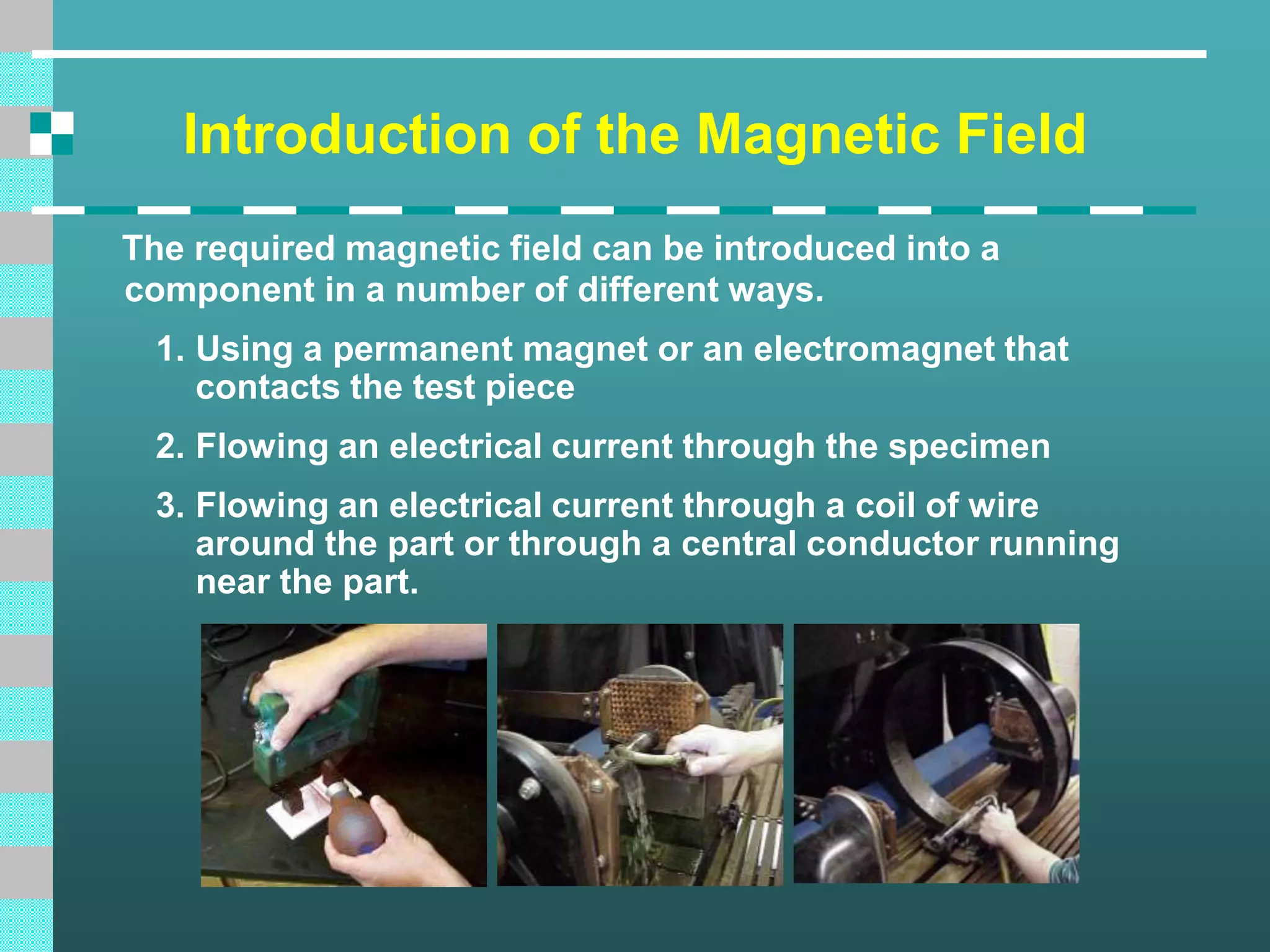
The required magnetic field can be introduced into a
component in a number of different ways.
1. Using a permanent magnet or an electromagnet that
contacts the test piece
2. Flowing an electrical current through the specimen
3. Flowing an electrical current through a coil of wire
around the part or through a central conductor running
near the part.
Direction of the Magnetic Field
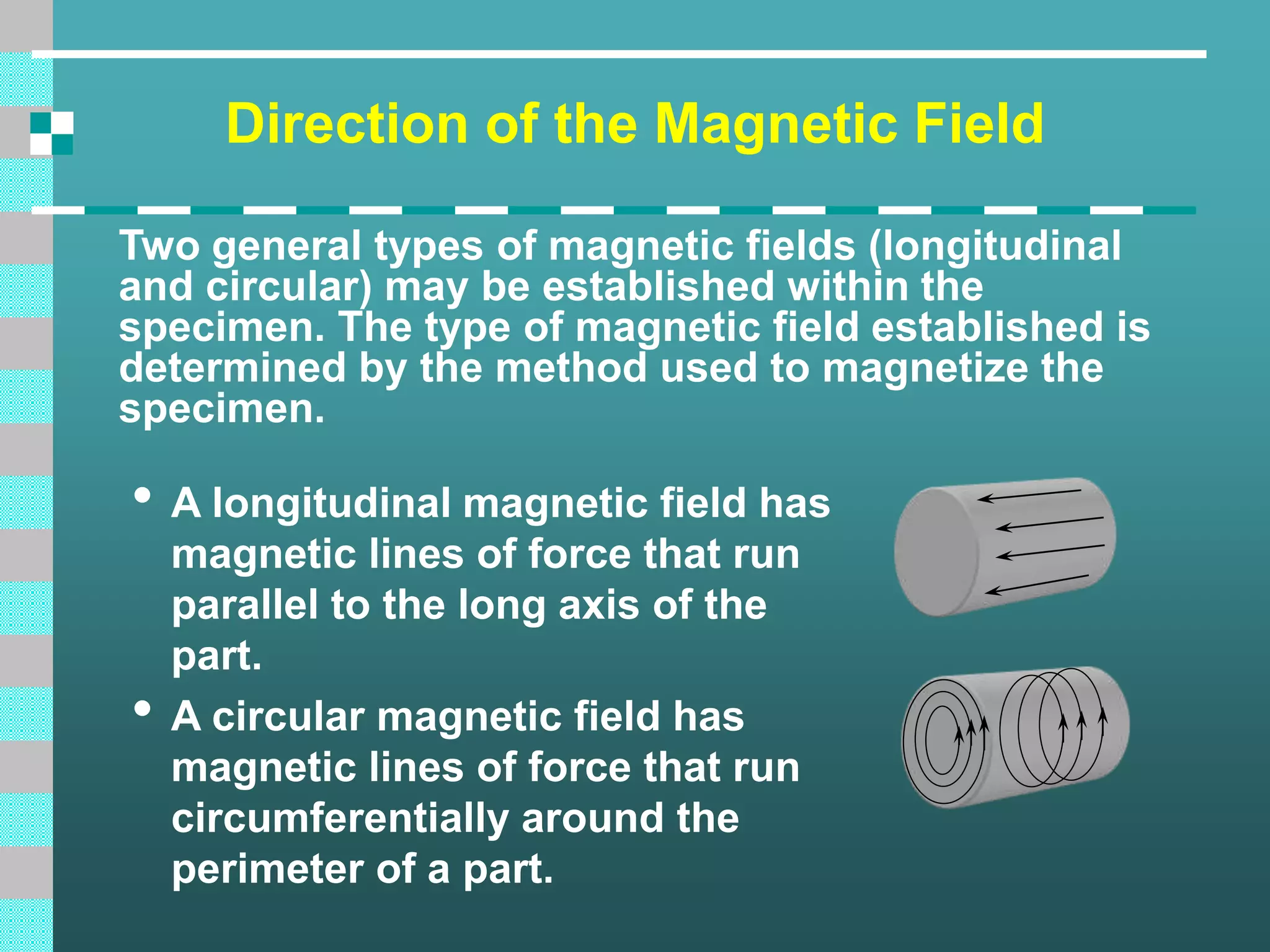
Two general types of magnetic fields (longitudinal
and circular) may be established within the
specimen. The type of magnetic field established is
determined by the method used to magnetize the
specimen.
• A longitudinal magnetic field has
magnetic lines of force that run
parallel to the long axis of the
part.
• A circular magnetic field has
magnetic lines of force that run
circumferentially around the
perimeter of a part.
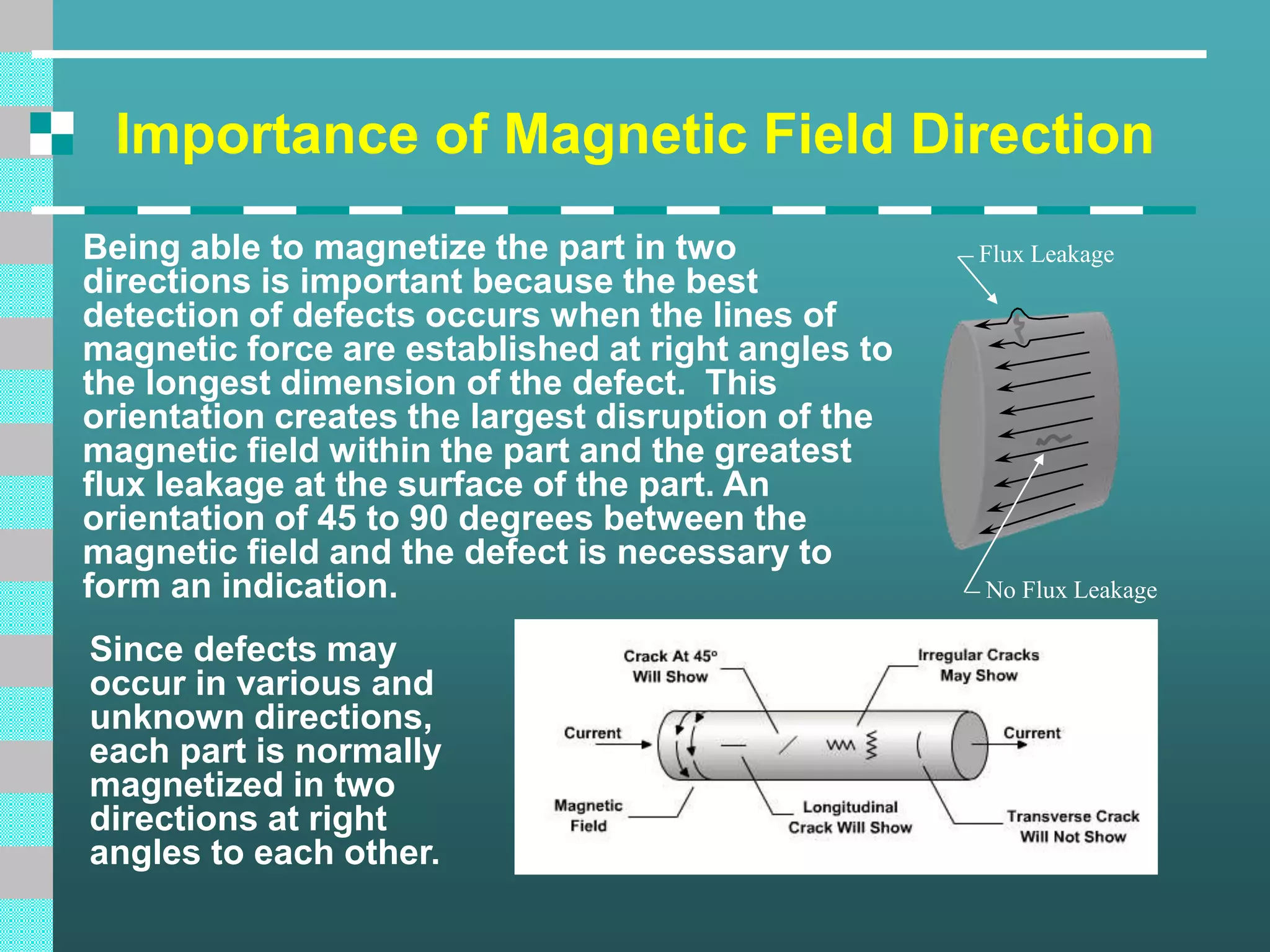
Importance of Magnetic Field Direction
Being able to magnetize the part in two
directions is important because the best
detection of defects occurs when the lines of
magnetic force are established at right angles to
the longest dimension of the defect. This
orientation creates the largest disruption of the
magnetic field within the part and the greatest
flux leakage at the surface of the part. An
orientation of 45 to 90 degrees between the
magnetic field and the defect is necessary to
form an indication.
Since defects may
occur in various and
unknown directions,
each part is normally
magnetized in two
directions at right
angles to each other.
Flux Leakage
No Flux Leakage
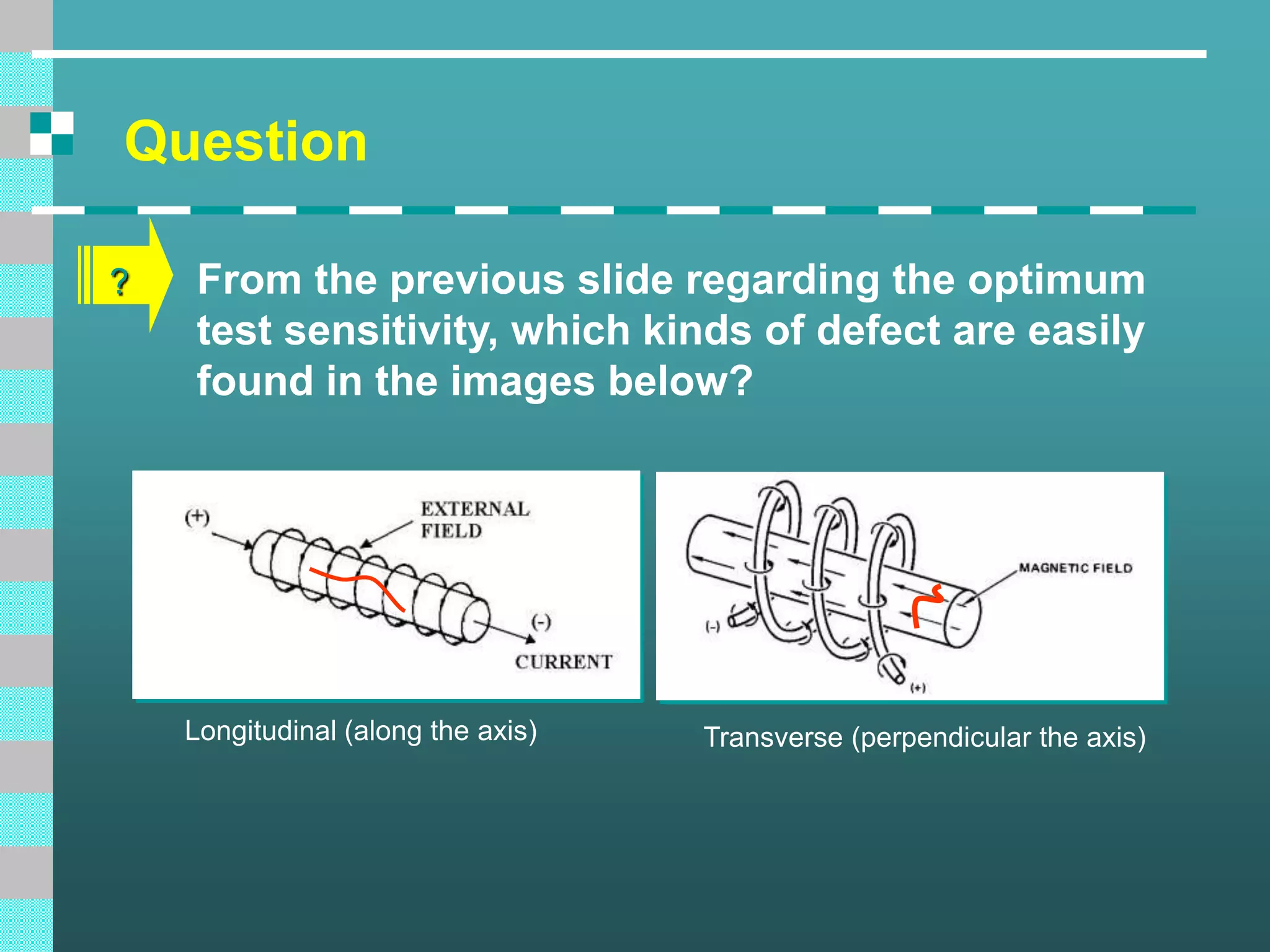
Question
? From the previous slide regarding the optimum
test sensitivity, which kinds of defect are easily
found in the images below?
Longitudinal (along the axis) Transverse (perpendicular the axis)
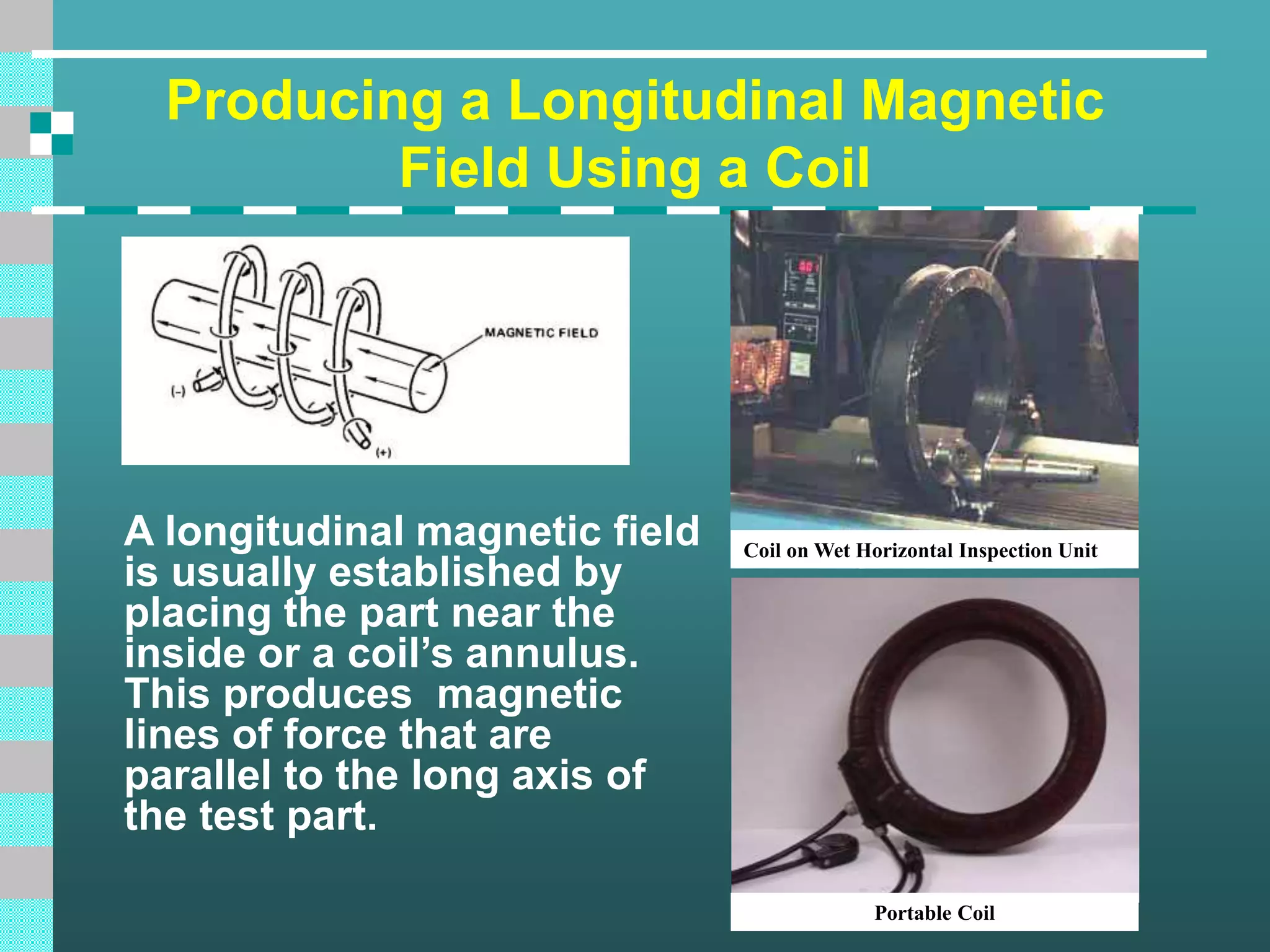
Producing a Longitudinal Magnetic
Field Using a Coil
A longitudinal magnetic field
is usually established by
placing the part near the
inside or a coil’s annulus.
This produces magnetic
lines of force that are
parallel to the long axis of
the test part.
Coil on Wet Horizontal Inspection Unit
Portable Coil
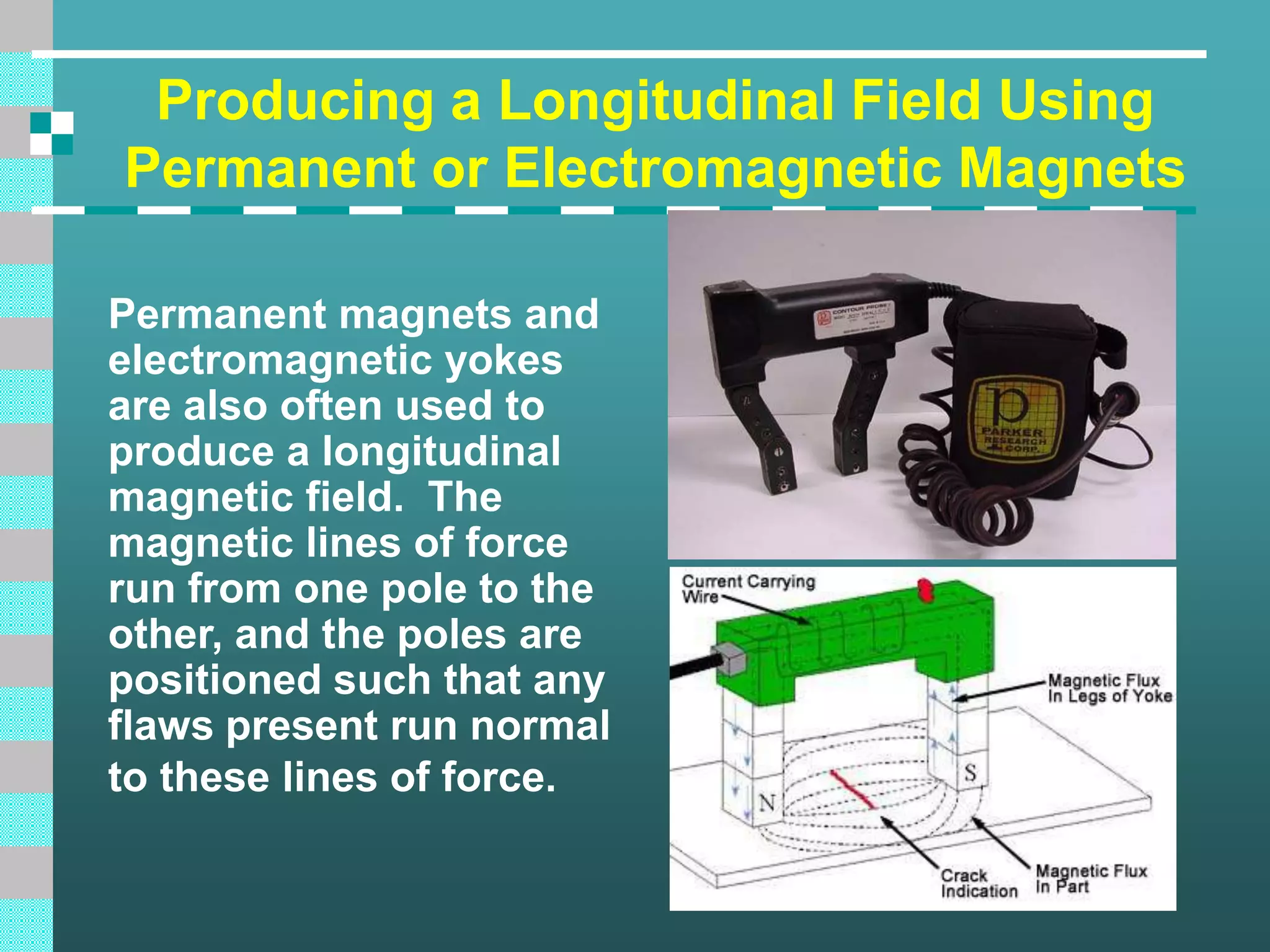
Producing a Longitudinal Field Using
Permanent or Electromagnetic Magnets
Permanent magnets and
electromagnetic yokes
are also often used to
produce a longitudinal
magnetic field. The
magnetic lines of force
run from one pole to the
other, and the poles are
positioned such that any
flaws present run normal
to these lines of force.
Circular Magnetic Fields
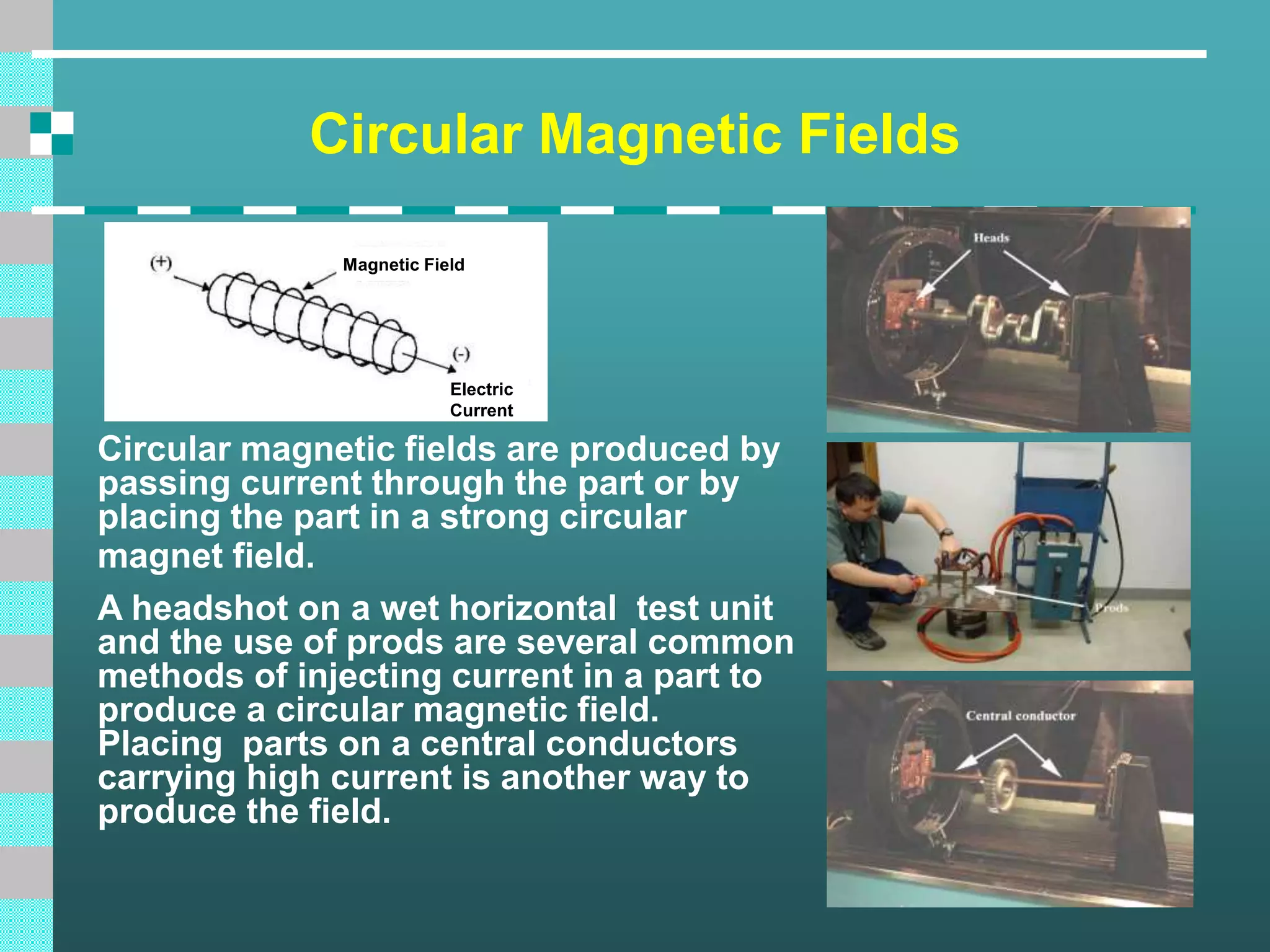
Circular magnetic fields are produced by
passing current through the part or by
placing the part in a strong circular
magnet field.
A headshot on a wet horizontal test unit
and the use of prods are several common
methods of injecting current in a part to
produce a circular magnetic field.
Placing parts on a central conductors
carrying high current is another way to
produce the field.
Magnetic Field
Electric
Current
Application of Magnetic
Media (Wet Versus Dry)
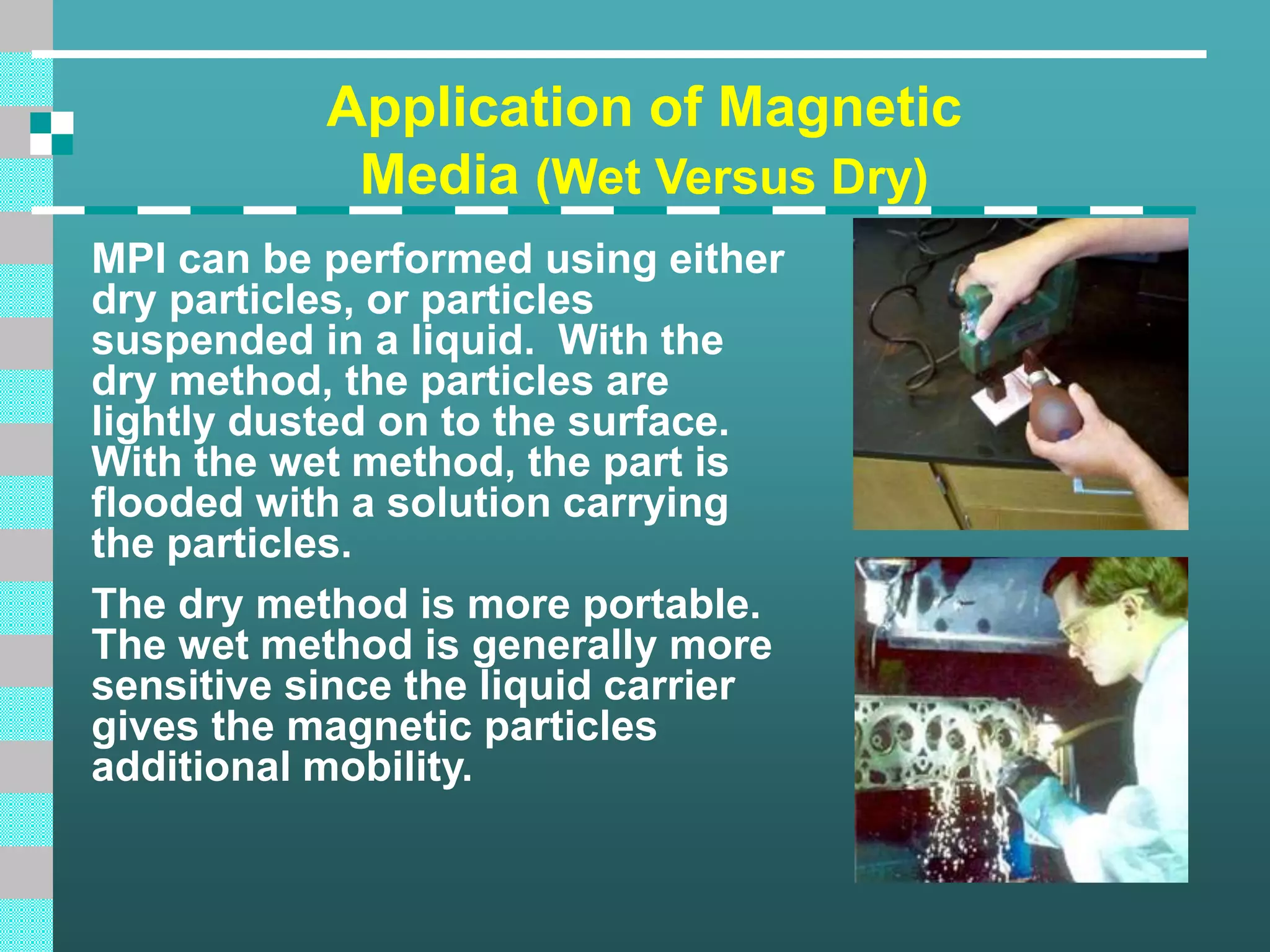
MPI can be performed using either
dry particles, or particles
suspended in a liquid. With the
dry method, the particles are
lightly dusted on to the surface.
With the wet method, the part is
flooded with a solution carrying
the particles.
The dry method is more portable.
The wet method is generally more
sensitive since the liquid carrier
gives the magnetic particles
additional mobility.
Dry Magnetic Particles
Magnetic particles come in a variety of colors. A
color that produces a high level of contrast
against the background should be used.
Wet Magnetic Particles
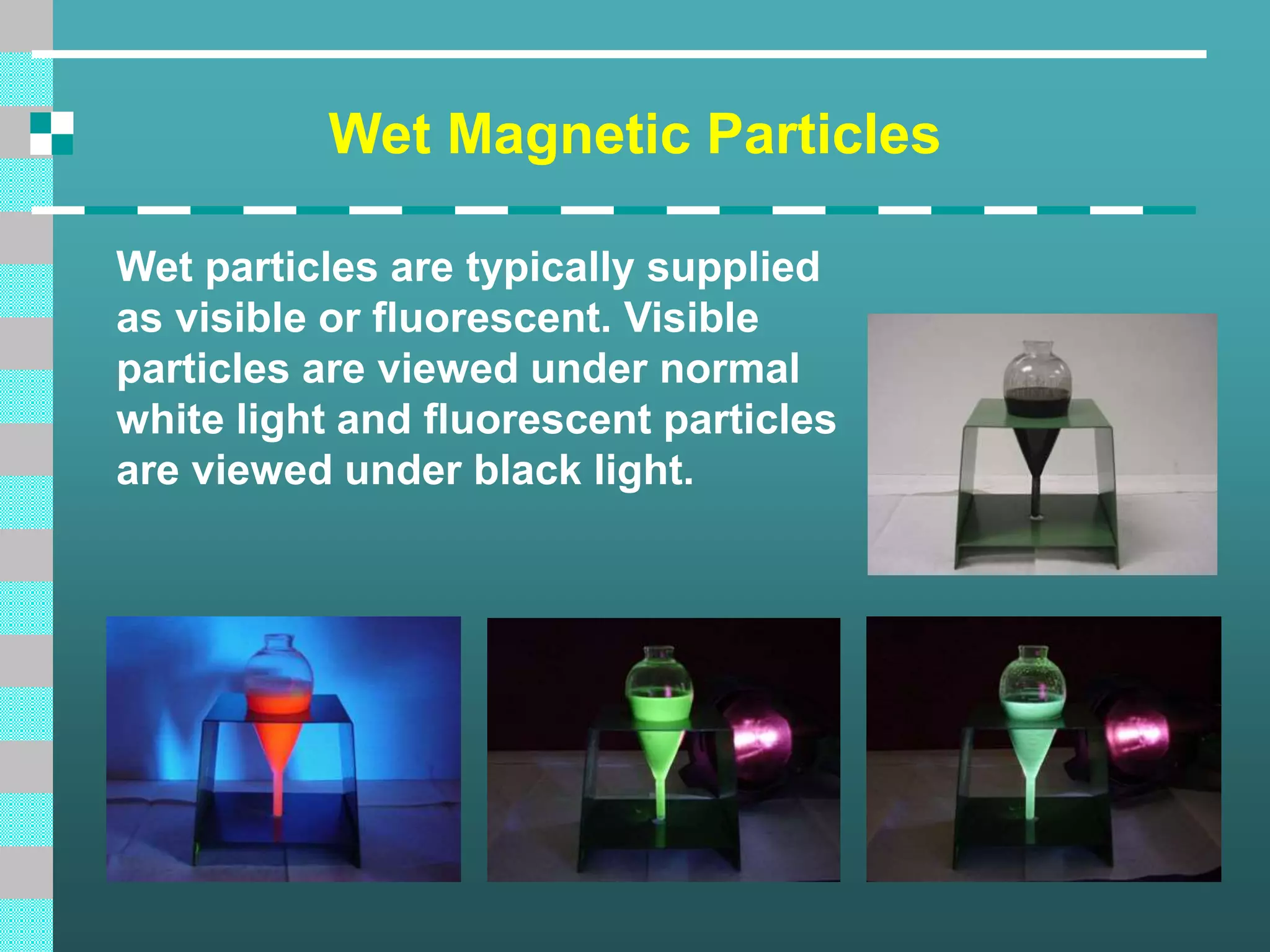
Wet particles are typically supplied
as visible or fluorescent. Visible
particles are viewed under normal
white light and fluorescent particles
are viewed under black light.
Interpretation of Indications
After applying the magnetic field, indications that
form must interpreted. This process requires that
the inspector distinguish between relevant and
non-relevant indications.
The following series of images depict
relevant indications produced from a
variety of components inspected
with the magnetic particle method.
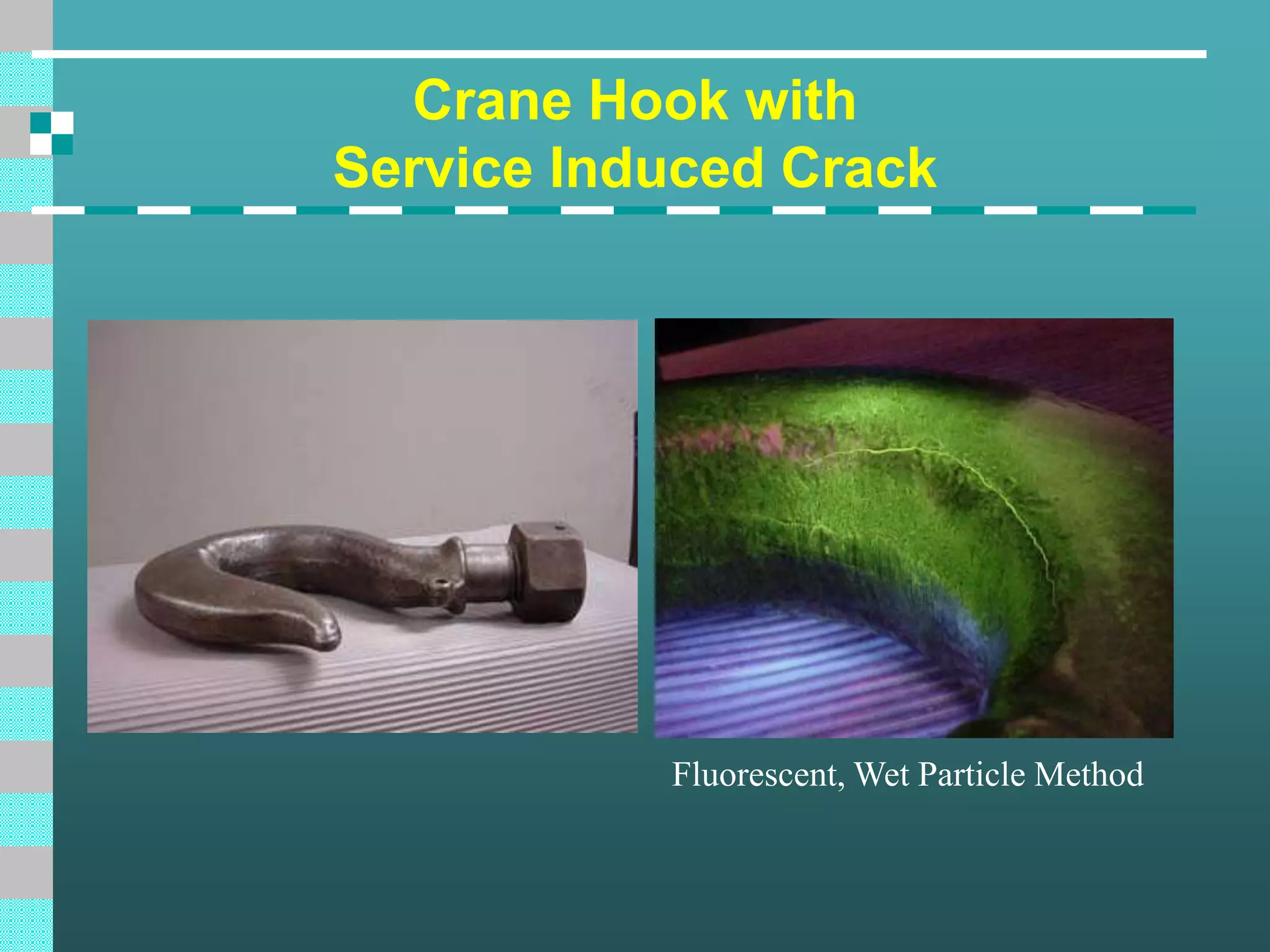
Crane Hook with
Service Induced Crack
Fluorescent, Wet Particle Method
Gear with
Service Induced Crack
Fluorescent, Wet Particle Method
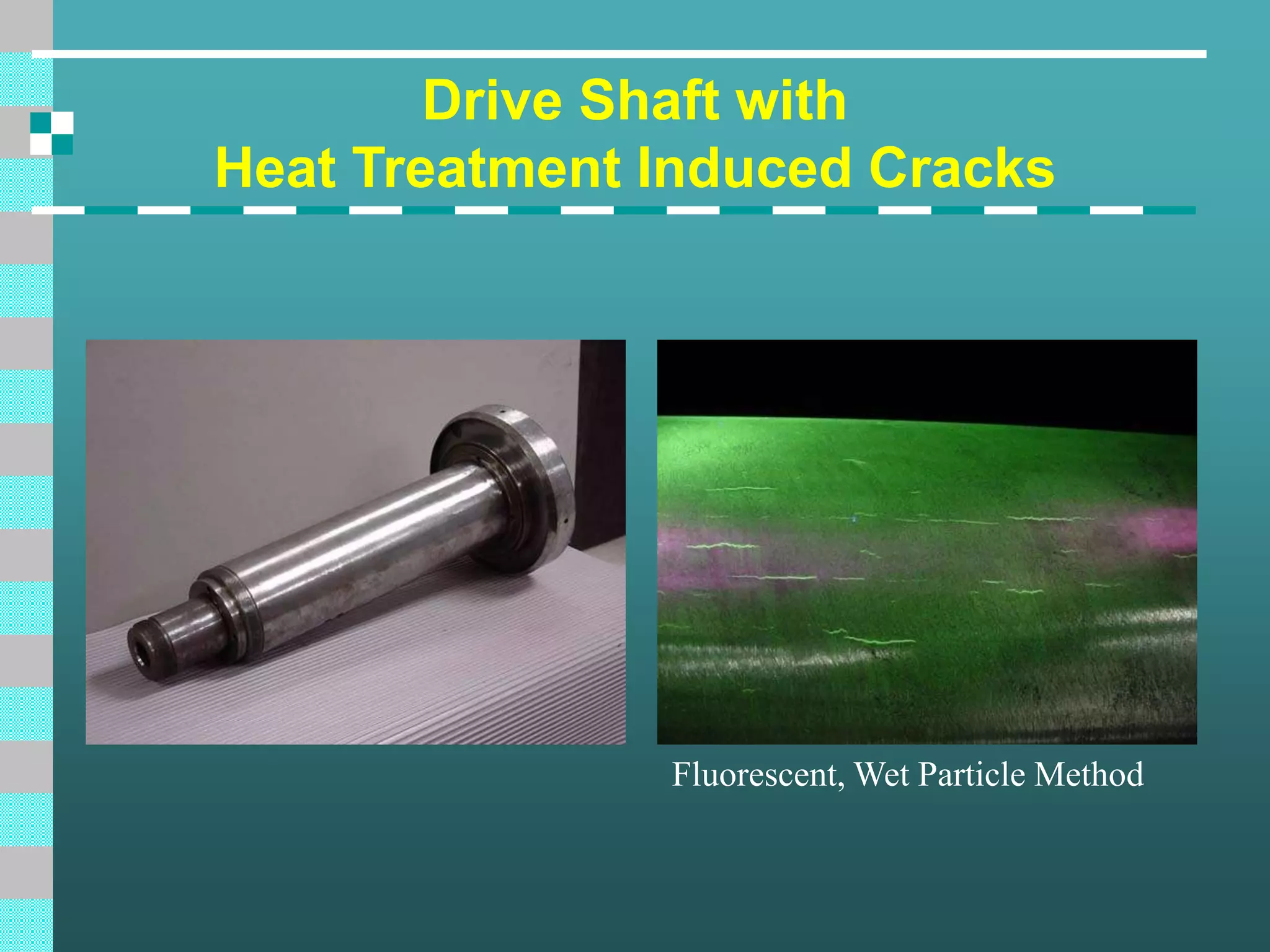
Drive Shaft with
Heat Treatment Induced Cracks
Fluorescent, Wet Particle Method
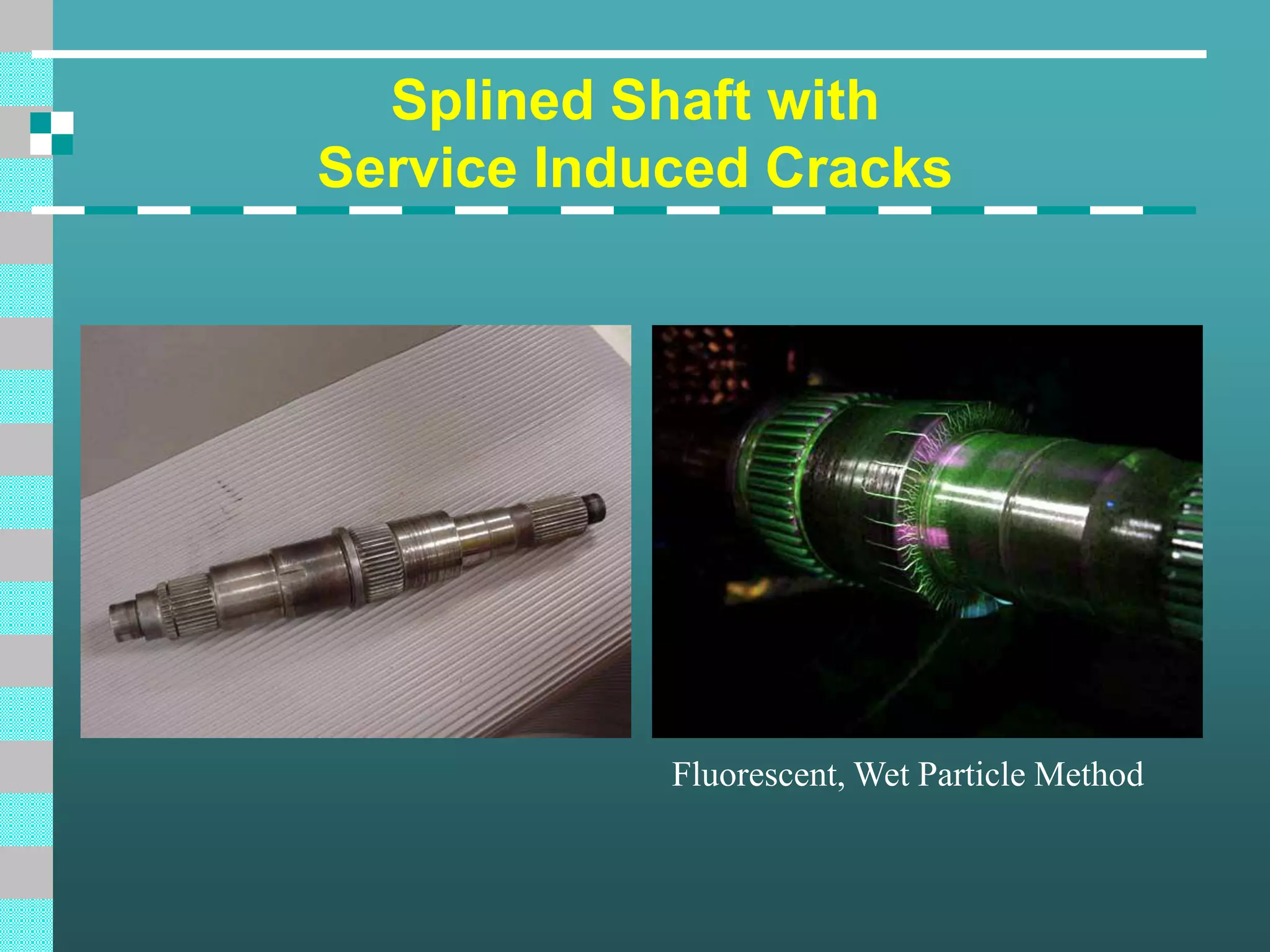
Splined Shaft with
Service Induced Cracks
Fluorescent, Wet Particle Method
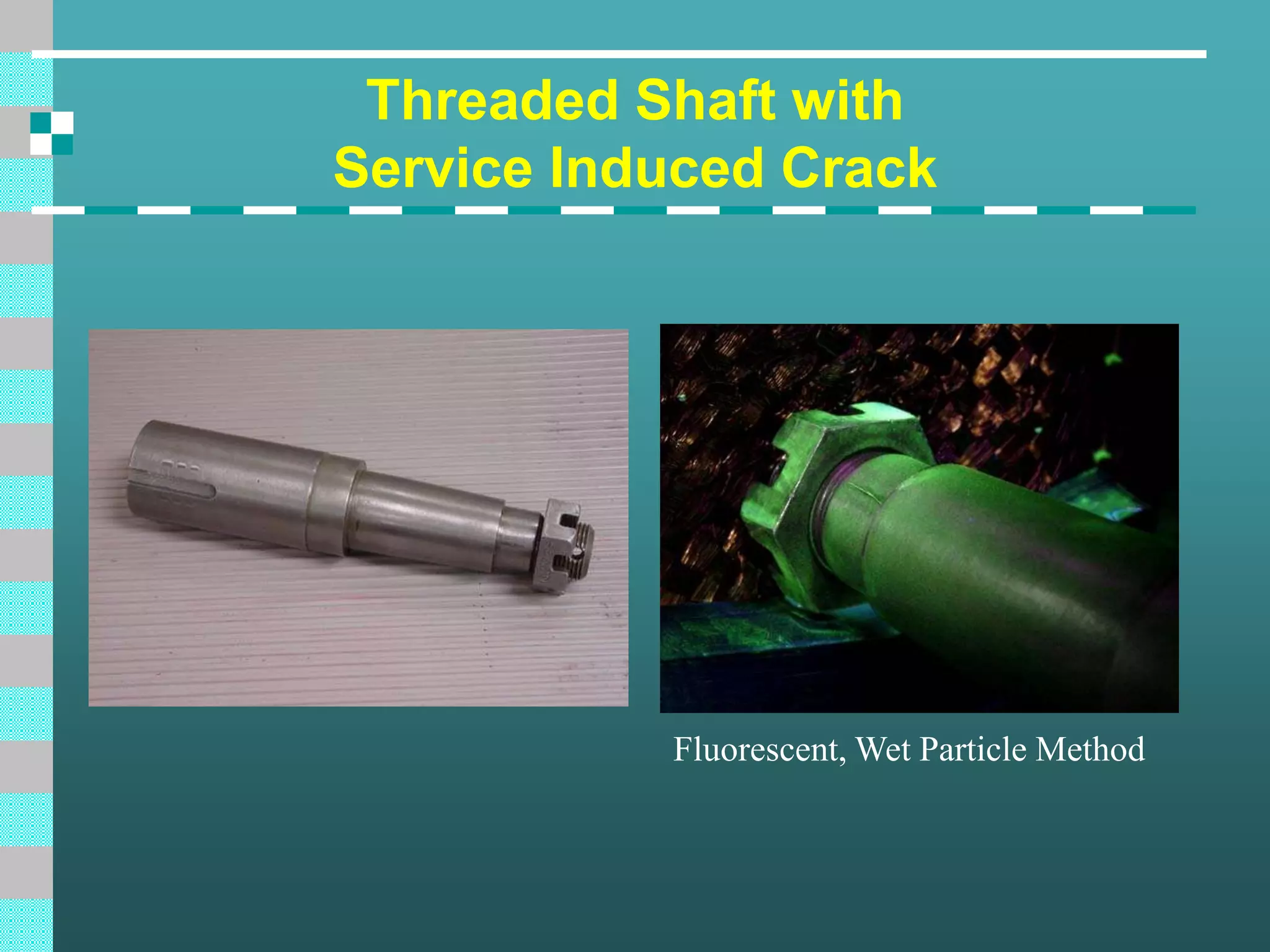
Threaded Shaft with
Service Induced Crack
Fluorescent, Wet Particle Method
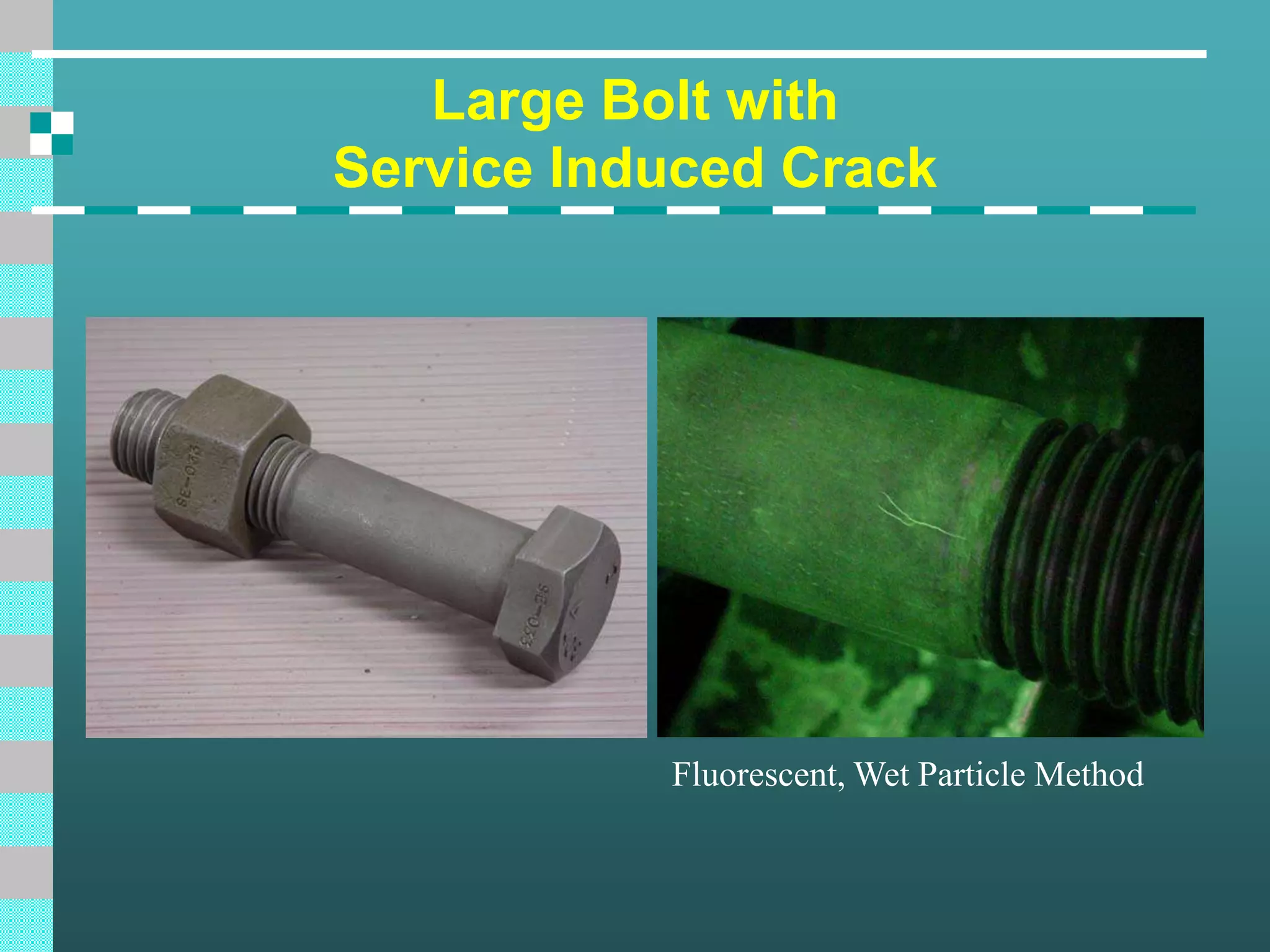
Large Bolt with
Service Induced Crack
Fluorescent, Wet Particle Method
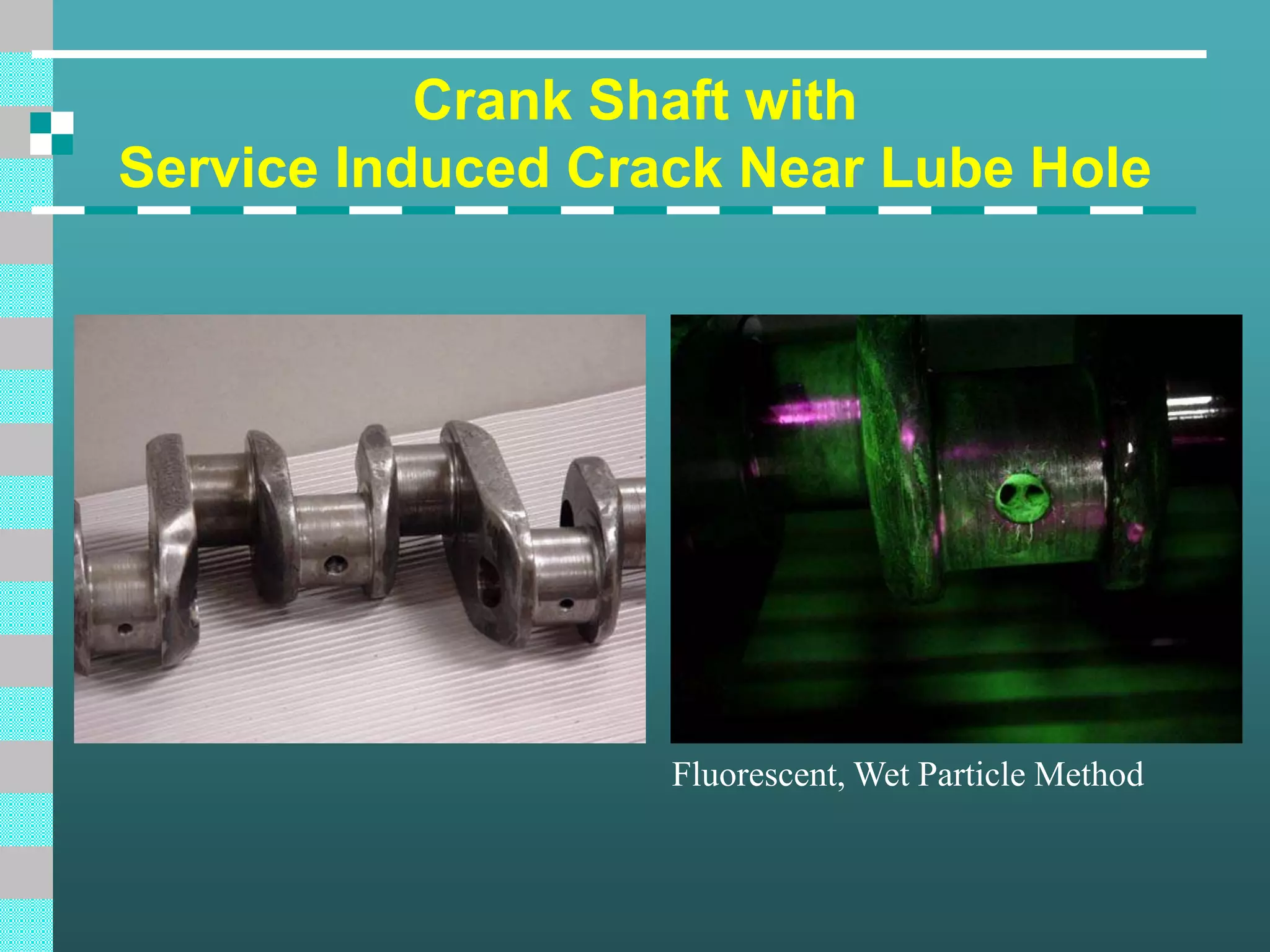
Crank Shaft with
Service Induced Crack Near Lube Hole
Fluorescent, Wet Particle Method
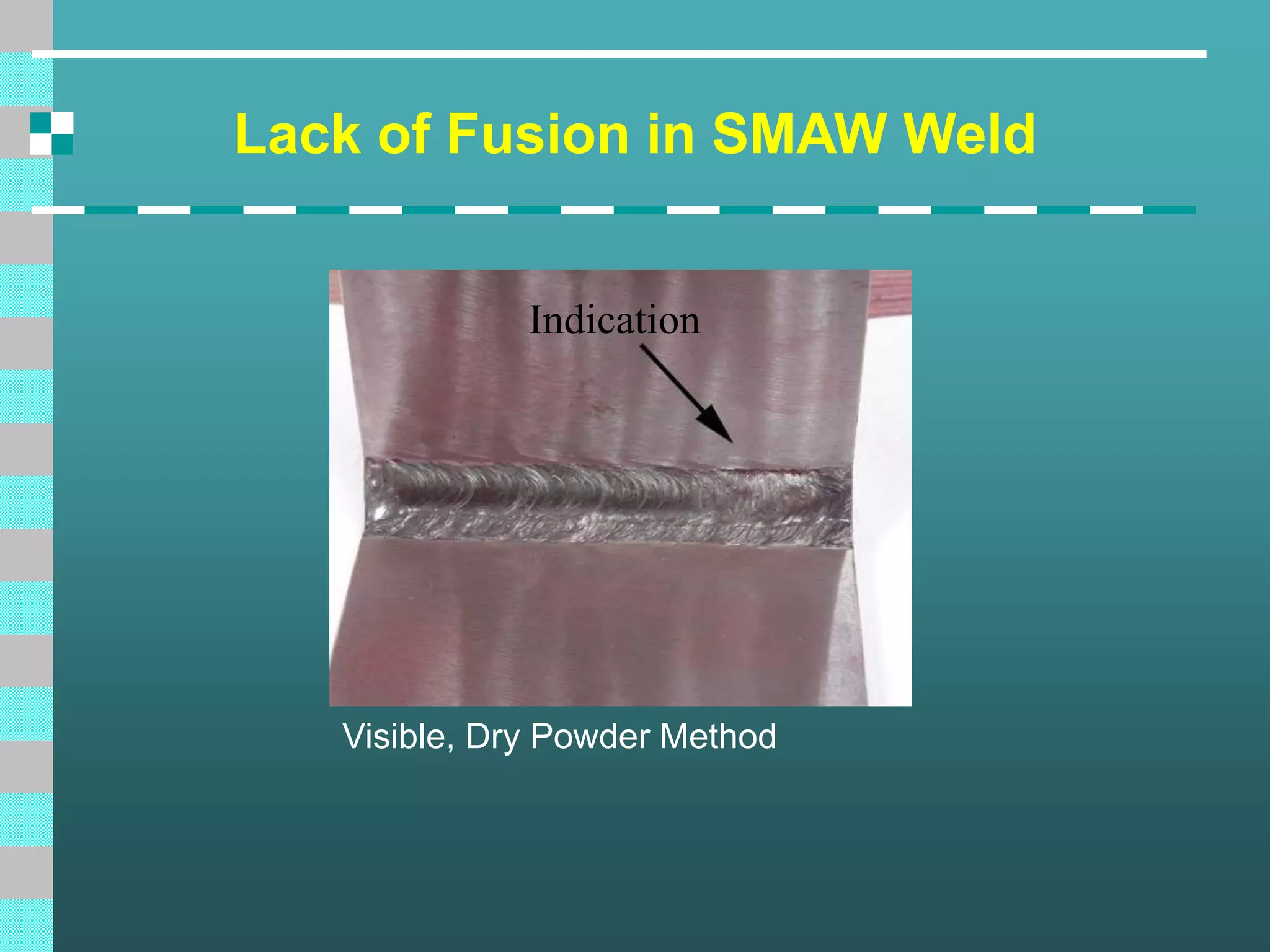
Lack of Fusion in SMAW Weld
Visible, Dry Powder Method
Indication
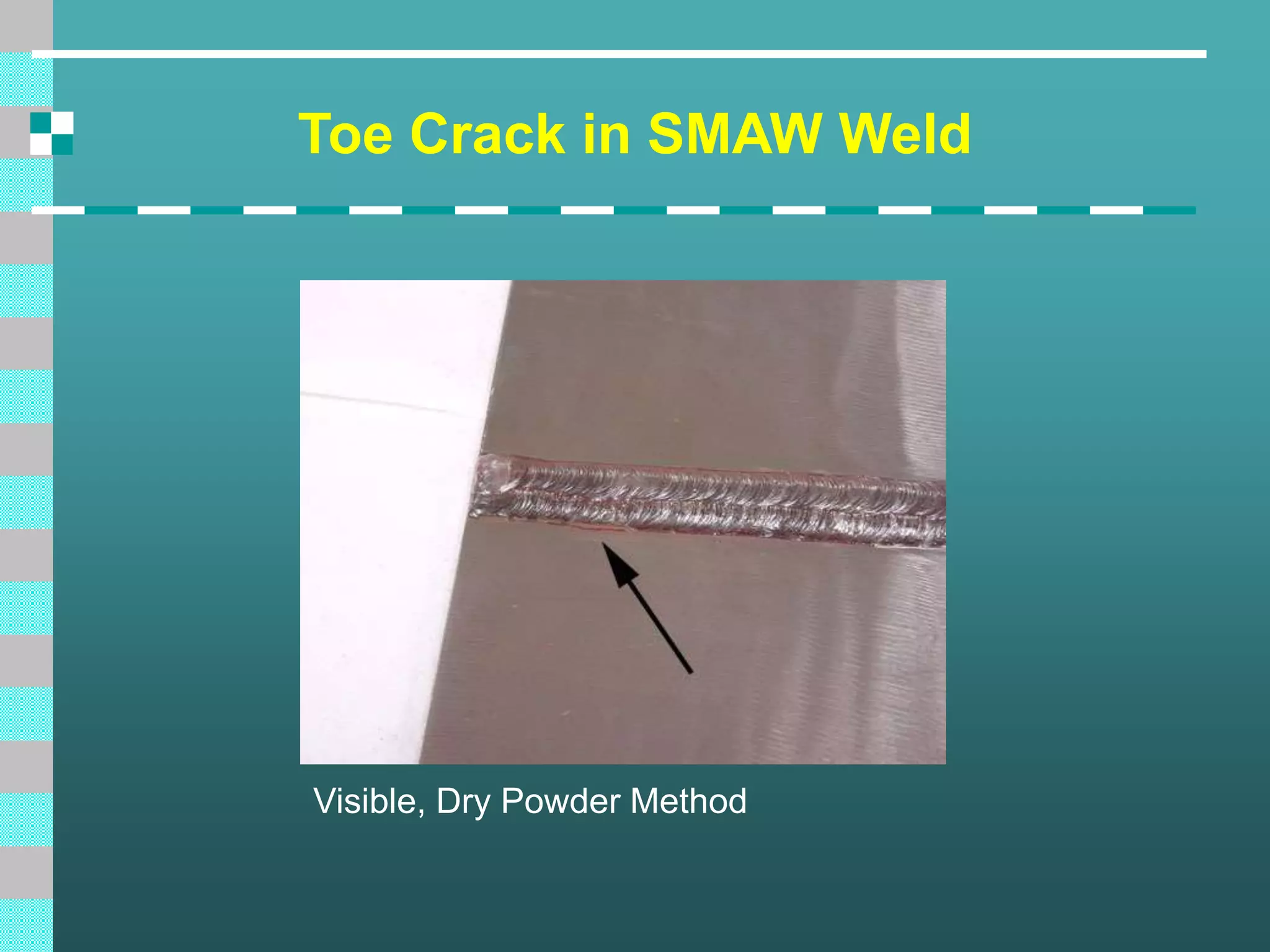
Toe Crack in SMAW Weld
Visible, Dry Powder Method
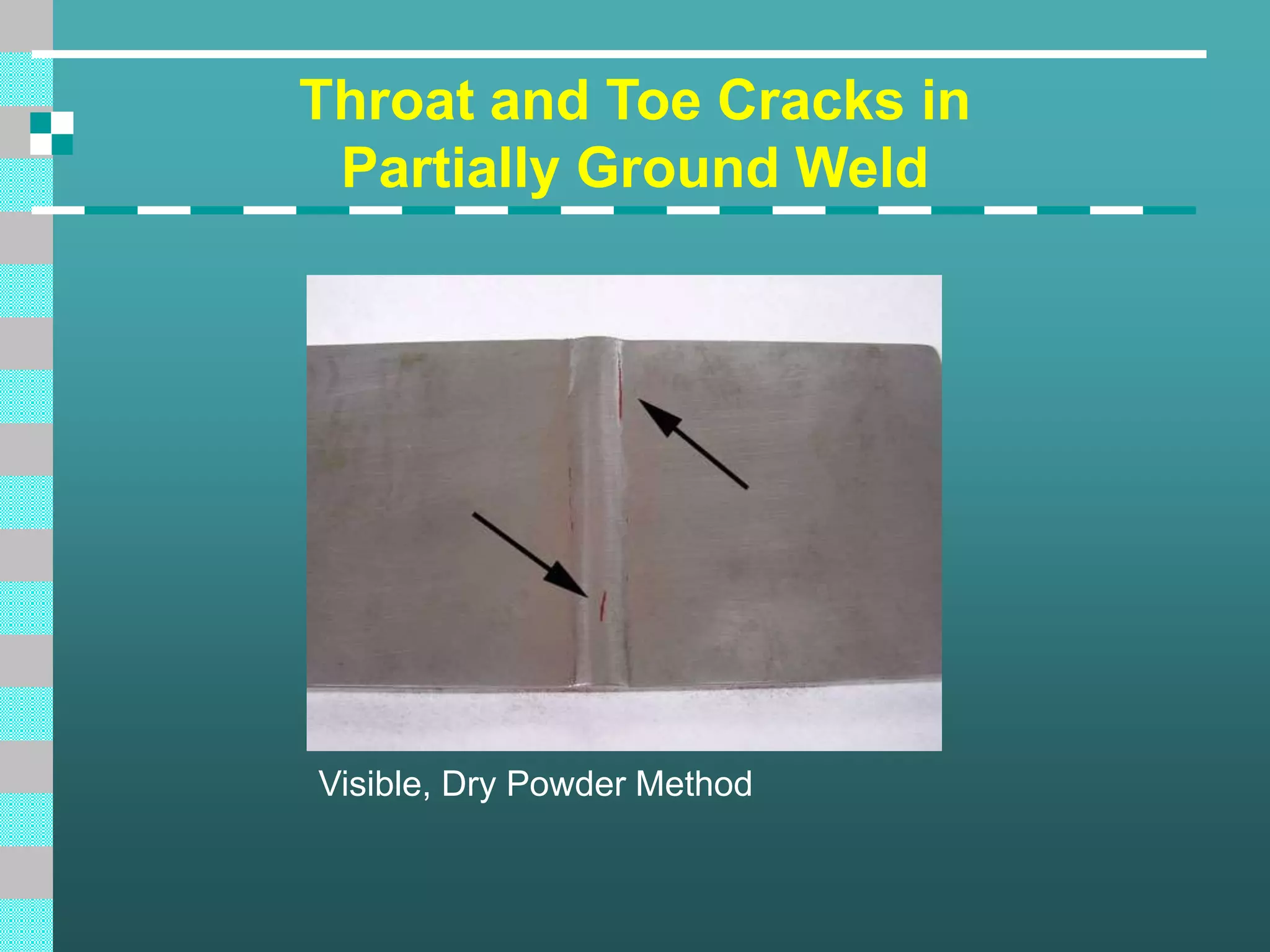
Throat and Toe Cracks in
Partially Ground Weld
Visible, Dry Powder Method
Demagnetization
• Parts inspected by the magnetic particle method
may sometimes have an objectionable residual
magnetic field that may interfere with subsequent
manufacturing operations or service of the
component.
• Possible reasons for demagnetization include:
– May interfere with welding and/or machining
operations
– Can effect gauges that are sensitive to
magnetic fields if placed in close proximity.
– Abrasive particles may adhere to components
surface and cause and increase in wear to
engines components, gears, bearings etc.
Demagnetization (Cont.)
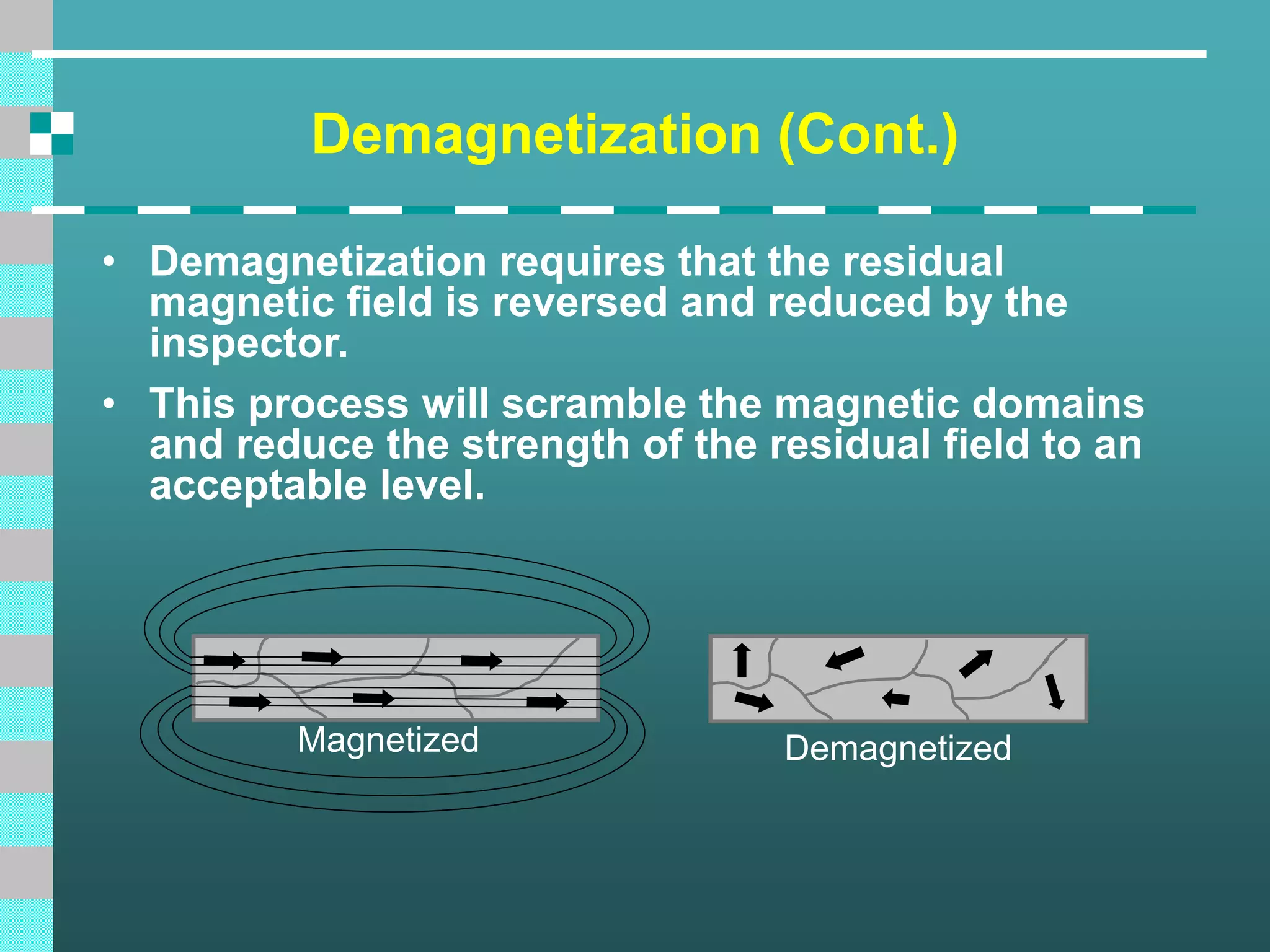
• Demagnetization requires that the residual
magnetic field is reversed and reduced by the
inspector.
• This process will scramble the magnetic domains
and reduce the strength of the residual field to an
acceptable level.
DemagnetizedMagnetized
Advantages of
Magnetic Particle Inspection
• Can detect both surface and near sub-surface
defects.
• Can inspect parts with irregular shapes easily.
• Precleaning of components is not as critical as it
is for some other inspection methods. Most
contaminants within a flaw will not hinder flaw
detectability.
• Fast method of inspection and indications are
visible directly on the specimen surface.
• Considered low cost compared to many other
NDT methods.
• Is a very portable inspection method especially
when used with battery powered equipment.
Limitations of
Magnetic Particle Inspection
•Cannot inspect non-ferrous materials such as
aluminum, magnesium or most stainless steels.
•Inspection of large parts may require use of
equipment with special power requirements.
•Some parts may require removal of coating or
plating to achieve desired inspection sensitivity.
•Limited subsurface discontinuity detection
capabilities. Maximum depth sensitivity is approximately
0.6” (under ideal conditions).
•Post cleaning, and post demagnetization is often
necessary.
•Alignment between magnetic flux and defect is
important
Glossary of Terms
• Black Light: ultraviolet light which is filtered to
produce a wavelength of approximately 365
nanometers. Black light will cause certain materials to
fluoresce.
• Central conductor: an electrically conductive bar
usually made of copper used to introduce a circular
magnetic field in to a test specimen.
• Coil: an electrical conductor such a copper wire or
cable that is wrapped in several or many loops that
are brought close to one another to form a strong
longitudinal magnetic field.
Glossary of Terms
• Discontinuity: an interruption in the structure of the
material such as a crack.
• Ferromagnetic: a material such as iron, nickel and
cobalt or one of it’s alloys that is strongly attracted to
a magnetic field.
• Heads: electrical contact pads on a wet horizontal
magnetic particle inspection machine. The part to be
inspected is clamped and held in place between the
heads and shot of current is sent through the part
from the heads to create a circular magnetic field in
the part.
• Leakage field: a disruption in the magnetic field.
This disruption must extend to the surface of the part
for particles to be attracted.
Glossary of Terms
• Non-relevant indications: indications produced due
to some intended design feature of a specimen such
a keyways, splines or press fits.
• Prods: two electrodes usually made of copper or
aluminum that are used to introduce current in to a
test part. This current in turn creates a circular
magnetic field where each prod touches the part.
(Similar in principal to a welding electrode and
ground clamp).
• Relevant indications: indications produced from
something other than a design feature of a test
specimen. Cracks, stringers, or laps are examples of
relevant indications.
Glossary of Terms
• Suspension: a bath created by mixing particles with
either oil or water.
• Yoke: a horseshoe magnet used to create a
longitudinal magnetic field. Yokes may be made from
permanent magnets or electromagnets.

Magnetic Particle Testing

  • 1.
  • 2.
    Introduction • This moduleis intended to present information on the widely used method of magnetic particle inspection. • Magnetic particle inspection can detect both production discontinuities (seams, laps, grinding cracks and quenching cracks) and in-service damage (fatigue and overload cracks).
  • 3.
    Outline • Magnetism andFerromagnetic Materials • Introduction of Magnetic Particle Inspection • Basic Procedure and Important Considerations 1. Component pre-cleaning 2. Introduction of magnetic field 3. Application of magnetic media 4. Interpretation of magnetic particle indications • Examples of MPI Indications
  • 4.
    Magnetic lines offorce around a bar magnet Opposite poles attracting Similar poles repelling Introduction to Magnetism Magnetism is the ability of matter to attract other matter to itself. Objects that possess the property of magnetism are said to be magnetic or magnetized and magnetic lines of force can be found in and around the objects. A magnetic pole is a point where the a magnetic line of force exits or enters a material. Magnetic field lines: • Form complete loops. • Do not cross. • Follow the path of least resistance. • All have the same strength. • Have a direction such that they cause poles to attract or repel.
  • 5.
    How Does MagneticParticle Inspection Work? A ferromagnetic test specimen is magnetized with a strong magnetic field created by a magnet or special equipment. If the specimen has a discontinuity, the discontinuity will interrupt the magnetic field flowing through the specimen and a leakage field will occur.
  • 6.
    How Does MagneticParticle Inspection Work? (Cont.) Finely milled iron particles coated with a dye pigment are applied to the test specimen. These particles are attracted to leakage fields and will cluster to form an indication directly over the discontinuity. This indication can be visually detected under proper lighting conditions.
  • 7.
    Basic Procedure Basic stepsinvolved: 1. Component pre-cleaning 2. Introduction of magnetic field 3. Application of magnetic media 4. Interpretation of magnetic particle indications
  • 8.
    Pre-cleaning When inspecting atest part with the magnetic particle method it is essential for the particles to have an unimpeded path for migration to both strong and weak leakage fields alike. The part’s surface should be clean and dry before inspection. Contaminants such as oil, grease, or scale may not only prevent particles from being attracted to leakage fields, they may also interfere with interpretation of indications.
  • 9.
    Introduction of theMagnetic Field The required magnetic field can be introduced into a component in a number of different ways. 1. Using a permanent magnet or an electromagnet that contacts the test piece 2. Flowing an electrical current through the specimen 3. Flowing an electrical current through a coil of wire around the part or through a central conductor running near the part.
  • 10.
    Direction of theMagnetic Field Two general types of magnetic fields (longitudinal and circular) may be established within the specimen. The type of magnetic field established is determined by the method used to magnetize the specimen. • A longitudinal magnetic field has magnetic lines of force that run parallel to the long axis of the part. • A circular magnetic field has magnetic lines of force that run circumferentially around the perimeter of a part.
  • 11.
    Importance of MagneticField Direction Being able to magnetize the part in two directions is important because the best detection of defects occurs when the lines of magnetic force are established at right angles to the longest dimension of the defect. This orientation creates the largest disruption of the magnetic field within the part and the greatest flux leakage at the surface of the part. An orientation of 45 to 90 degrees between the magnetic field and the defect is necessary to form an indication. Since defects may occur in various and unknown directions, each part is normally magnetized in two directions at right angles to each other. Flux Leakage No Flux Leakage
  • 12.
    Question ? From theprevious slide regarding the optimum test sensitivity, which kinds of defect are easily found in the images below? Longitudinal (along the axis) Transverse (perpendicular the axis)
  • 13.
    Producing a LongitudinalMagnetic Field Using a Coil A longitudinal magnetic field is usually established by placing the part near the inside or a coil’s annulus. This produces magnetic lines of force that are parallel to the long axis of the test part. Coil on Wet Horizontal Inspection Unit Portable Coil
  • 14.
    Producing a LongitudinalField Using Permanent or Electromagnetic Magnets Permanent magnets and electromagnetic yokes are also often used to produce a longitudinal magnetic field. The magnetic lines of force run from one pole to the other, and the poles are positioned such that any flaws present run normal to these lines of force.
  • 15.
    Circular Magnetic Fields Circularmagnetic fields are produced by passing current through the part or by placing the part in a strong circular magnet field. A headshot on a wet horizontal test unit and the use of prods are several common methods of injecting current in a part to produce a circular magnetic field. Placing parts on a central conductors carrying high current is another way to produce the field. Magnetic Field Electric Current
  • 16.
    Application of Magnetic Media(Wet Versus Dry) MPI can be performed using either dry particles, or particles suspended in a liquid. With the dry method, the particles are lightly dusted on to the surface. With the wet method, the part is flooded with a solution carrying the particles. The dry method is more portable. The wet method is generally more sensitive since the liquid carrier gives the magnetic particles additional mobility.
  • 17.
    Dry Magnetic Particles Magneticparticles come in a variety of colors. A color that produces a high level of contrast against the background should be used.
  • 18.
    Wet Magnetic Particles Wetparticles are typically supplied as visible or fluorescent. Visible particles are viewed under normal white light and fluorescent particles are viewed under black light.
  • 19.
    Interpretation of Indications Afterapplying the magnetic field, indications that form must interpreted. This process requires that the inspector distinguish between relevant and non-relevant indications. The following series of images depict relevant indications produced from a variety of components inspected with the magnetic particle method.
  • 20.
    Crane Hook with ServiceInduced Crack Fluorescent, Wet Particle Method
  • 21.
    Gear with Service InducedCrack Fluorescent, Wet Particle Method
  • 22.
    Drive Shaft with HeatTreatment Induced Cracks Fluorescent, Wet Particle Method
  • 23.
    Splined Shaft with ServiceInduced Cracks Fluorescent, Wet Particle Method
  • 24.
    Threaded Shaft with ServiceInduced Crack Fluorescent, Wet Particle Method
  • 25.
    Large Bolt with ServiceInduced Crack Fluorescent, Wet Particle Method
  • 26.
    Crank Shaft with ServiceInduced Crack Near Lube Hole Fluorescent, Wet Particle Method
  • 27.
    Lack of Fusionin SMAW Weld Visible, Dry Powder Method Indication
  • 28.
    Toe Crack inSMAW Weld Visible, Dry Powder Method
  • 29.
    Throat and ToeCracks in Partially Ground Weld Visible, Dry Powder Method
  • 30.
    Demagnetization • Parts inspectedby the magnetic particle method may sometimes have an objectionable residual magnetic field that may interfere with subsequent manufacturing operations or service of the component. • Possible reasons for demagnetization include: – May interfere with welding and/or machining operations – Can effect gauges that are sensitive to magnetic fields if placed in close proximity. – Abrasive particles may adhere to components surface and cause and increase in wear to engines components, gears, bearings etc.
  • 31.
    Demagnetization (Cont.) • Demagnetizationrequires that the residual magnetic field is reversed and reduced by the inspector. • This process will scramble the magnetic domains and reduce the strength of the residual field to an acceptable level. DemagnetizedMagnetized
  • 32.
    Advantages of Magnetic ParticleInspection • Can detect both surface and near sub-surface defects. • Can inspect parts with irregular shapes easily. • Precleaning of components is not as critical as it is for some other inspection methods. Most contaminants within a flaw will not hinder flaw detectability. • Fast method of inspection and indications are visible directly on the specimen surface. • Considered low cost compared to many other NDT methods. • Is a very portable inspection method especially when used with battery powered equipment.
  • 33.
    Limitations of Magnetic ParticleInspection •Cannot inspect non-ferrous materials such as aluminum, magnesium or most stainless steels. •Inspection of large parts may require use of equipment with special power requirements. •Some parts may require removal of coating or plating to achieve desired inspection sensitivity. •Limited subsurface discontinuity detection capabilities. Maximum depth sensitivity is approximately 0.6” (under ideal conditions). •Post cleaning, and post demagnetization is often necessary. •Alignment between magnetic flux and defect is important
  • 34.
    Glossary of Terms •Black Light: ultraviolet light which is filtered to produce a wavelength of approximately 365 nanometers. Black light will cause certain materials to fluoresce. • Central conductor: an electrically conductive bar usually made of copper used to introduce a circular magnetic field in to a test specimen. • Coil: an electrical conductor such a copper wire or cable that is wrapped in several or many loops that are brought close to one another to form a strong longitudinal magnetic field.
  • 35.
    Glossary of Terms •Discontinuity: an interruption in the structure of the material such as a crack. • Ferromagnetic: a material such as iron, nickel and cobalt or one of it’s alloys that is strongly attracted to a magnetic field. • Heads: electrical contact pads on a wet horizontal magnetic particle inspection machine. The part to be inspected is clamped and held in place between the heads and shot of current is sent through the part from the heads to create a circular magnetic field in the part. • Leakage field: a disruption in the magnetic field. This disruption must extend to the surface of the part for particles to be attracted.
  • 36.
    Glossary of Terms •Non-relevant indications: indications produced due to some intended design feature of a specimen such a keyways, splines or press fits. • Prods: two electrodes usually made of copper or aluminum that are used to introduce current in to a test part. This current in turn creates a circular magnetic field where each prod touches the part. (Similar in principal to a welding electrode and ground clamp). • Relevant indications: indications produced from something other than a design feature of a test specimen. Cracks, stringers, or laps are examples of relevant indications.
  • 37.
    Glossary of Terms •Suspension: a bath created by mixing particles with either oil or water. • Yoke: a horseshoe magnet used to create a longitudinal magnetic field. Yokes may be made from permanent magnets or electromagnets.