Previous SlidePrevious Slide Next SlideNext Slide
Isolation PrecautionsIsolation Precautions
Prepared by:Prepared by:
Dr/AHMED BESHIRDr/AHMED BESHIR
PulmonologistPulmonologist
DTQM (AUC)DTQM (AUC)
CPHQCPHQ
IPC DIRECTORIPC DIRECTOR
Previous SlidePrevious Slide Next SlideNext Slide
Learning ObjectivesLearning Objectives
 Discuss chain of infection and different types ofDiscuss chain of infection and different types of
mode of transmissionmode of transmission
 Define isolation precautions and describe differentDefine isolation precautions and describe different
types isolation precautions.types isolation precautions.
 Describe how to use contact precautions.Describe how to use contact precautions.
 Describe how to use droplet precautions.Describe how to use droplet precautions.
 Describe how to use airborne precautions.Describe how to use airborne precautions.
Previous SlidePrevious Slide Next SlideNext Slide
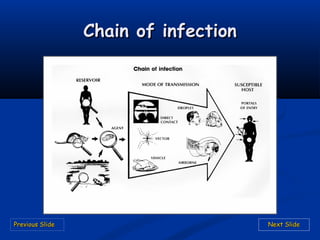
Chain of infectionChain of infection
Previous SlidePrevious Slide Next SlideNext Slide
Mode of transmissionMode of transmission
 A microorganism may be spread by a single orA microorganism may be spread by a single or
multiple routes.multiple routes.
 Contact, direct or indirectContact, direct or indirect
 DropletDroplet
 AirborneAirborne
 Vector-borne (usually arthropod) andVector-borne (usually arthropod) and
 Common environmental sources or vehicles - includes food-Common environmental sources or vehicles - includes food-
borne and waterborne, medications e.g., contaminated IVborne and waterborne, medications e.g., contaminated IV
fluidsfluids
Previous SlidePrevious Slide Next SlideNext Slide
Contact transmissionContact transmission
 Direct-contactDirect-contact
 Direct body surface-to-body surface contact andDirect body surface-to-body surface contact and
 Physical transfer of microorganisms between aPhysical transfer of microorganisms between a
susceptible host and an infected or colonized personsusceptible host and an infected or colonized person
 Indirect-contactIndirect-contact
 Contact of a susceptible host with a contaminatedContact of a susceptible host with a contaminated
intermediate object, usually inanimate, such asintermediate object, usually inanimate, such as
contaminated instruments, needles, or dressings, orcontaminated instruments, needles, or dressings, or
contaminated hands or glovescontaminated hands or gloves
5
Previous SlidePrevious Slide Next SlideNext Slide
droplet transmissiondroplet transmission
 Droplet generationDroplet generation
 coughing,coughing,
 sneezing,sneezing,
 talking,talking,
 procedures such as suctioning and bronchoscopyprocedures such as suctioning and bronchoscopy
 Droplet transmissionDroplet transmission
 Droplet deposited on the host’s conjunctivae, nasalDroplet deposited on the host’s conjunctivae, nasal
mucosa, or mouth.mucosa, or mouth.
6
Previous SlidePrevious Slide Next SlideNext Slide
Airborne transmissionAirborne transmission
 Small-particle residue {5µm or smaller} ofSmall-particle residue {5µm or smaller} of
evaporated droplets containing microorganismsevaporated droplets containing microorganisms
 Suspended in the air for long periods of timeSuspended in the air for long periods of time
 Dispersed by air currentsDispersed by air currents
 Inhaled by a susceptible host within the same roomInhaled by a susceptible host within the same room
or over a longer distanceor over a longer distance
7
Previous SlidePrevious Slide Next SlideNext Slide
What are Isolation Precautions?What are Isolation Precautions?
 PracticesPractices that prevent transmission of certainthat prevent transmission of certain
diseases from patients to staff, and from staff todiseases from patients to staff, and from staff to
other patientsother patients
 Type of isolation precautions is determined by how aType of isolation precautions is determined by how a
disease is transmitted (passed)disease is transmitted (passed)
 Isolation Precautions are doneIsolation Precautions are done in additionin addition to Standardto Standard
Precautions and include:Precautions and include:
 Strict adherence to hand hygieneStrict adherence to hand hygiene
 Personal protective equipment (PPE) appropriate for the type ofPersonal protective equipment (PPE) appropriate for the type of
isolation precautions in placeisolation precautions in place
 Environmental disinfectionEnvironmental disinfection
 Respiratory Hygiene and Cough EtiquetteRespiratory Hygiene and Cough Etiquette
 safe injection practicessafe injection practices
Previous SlidePrevious Slide Next SlideNext Slide
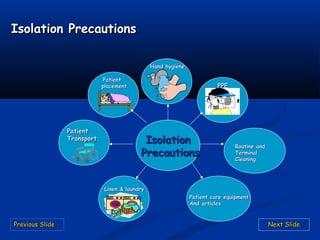
IsolationIsolation
PrecautionsPrecautions
PatientPatient
TransportTransport
Linen & laundryLinen & laundry
Patient care equipmentPatient care equipment
And articlesAnd articles
Routine andRoutine and
TerminalTerminal
CleaningCleaning
PPEPPE
Hand hygieneHand hygiene
PatientPatient
placementplacement
Isolation PrecautionsIsolation Precautions
Previous SlidePrevious Slide Next SlideNext Slide
I - Contact PrecautionsI - Contact Precautions
Previous SlidePrevious Slide Next SlideNext Slide
Contact PrecautionsContact Precautions
 Contact PrecautionsContact Precautions apply to diseasesapply to diseases
transmitted bytransmitted by direct contactdirect contact with thewith the
patient’s skin and/or infectious substancepatient’s skin and/or infectious substance
and byand by indirect contactindirect contact with the patient’swith the patient’s
environmentenvironment
 GlovesGloves andand gowns are usedgowns are used
 Masks are used in certain circumstancesMasks are used in certain circumstances
Previous SlidePrevious Slide Next SlideNext Slide
Diseases RequiringDiseases Requiring
Contact PrecautionsContact Precautions
 Clostridium difficileClostridium difficile
 Congenital rubellaCongenital rubella
 LiceLice
 ScabiesScabies
 Large woundsLarge wounds
 Burn patients in ICUBurn patients in ICU
Previous SlidePrevious Slide Next SlideNext Slide
Specific Information onSpecific Information on
AcinetobacterAcinetobacter
 Acinetobacter is a group of bacteria commonly foundAcinetobacter is a group of bacteria commonly found
in soil, water, food, and sewagein soil, water, food, and sewage
 Loves the GI tract – the “gut” flora/bugLoves the GI tract – the “gut” flora/bug
 May also be found on the skin of healthy people,May also be found on the skin of healthy people,
especially healthcare workersespecially healthcare workers
 Resulting infections are often resistant to manyResulting infections are often resistant to many
commonly prescribed antibiotics – treatment may becommonly prescribed antibiotics – treatment may be
limited to very toxic drugslimited to very toxic drugs
Previous SlidePrevious Slide Next SlideNext Slide
Specific Information onSpecific Information on
AcinetobacterAcinetobacter
 Outbreaks of Acinetobacter may occur in ICUs and inOutbreaks of Acinetobacter may occur in ICUs and in
other hospital units that house patients with weakenedother hospital units that house patients with weakened
immune systems or chronic illnessesimmune systems or chronic illnesses
 May cause pneumonia, bloodstream or urinary tractMay cause pneumonia, bloodstream or urinary tract
infections, and skin/wound infectionsinfections, and skin/wound infections
 Endocarditits, secondary meningitis, and ventriculitisEndocarditits, secondary meningitis, and ventriculitis
may also resultmay also result
 Patients placed onPatients placed on Contact PrecautionsContact Precautions for Acinetobacterfor Acinetobacter
infection remain on isolation precautions throughout theirinfection remain on isolation precautions throughout their
hospitalizationhospitalization
Previous SlidePrevious Slide Next SlideNext Slide
Specific InformationSpecific Information
on MRSAon MRSA
 Methicillin-resistantMethicillin-resistant Staphylococcus aureusStaphylococcus aureus (MRSA)(MRSA)
is the commonly called “staph” bacteria that hasis the commonly called “staph” bacteria that has
become resistant to many antibioticsbecome resistant to many antibiotics
 Patients who have invasive procedures, lengthyPatients who have invasive procedures, lengthy
hospital stays, weakened immune systems, or whohospital stays, weakened immune systems, or who
receive dialysis are at increased risk of developingreceive dialysis are at increased risk of developing
MRSAMRSA
 Community-acquired MRSA (CA-MRSA) is increasingCommunity-acquired MRSA (CA-MRSA) is increasing
among patients who haveamong patients who have nevernever been hospitalizedbeen hospitalized
Previous SlidePrevious Slide Next SlideNext Slide
 About 30% of the US population have “staph”About 30% of the US population have “staph”
bacteria that normally live on the skin and in nasalbacteria that normally live on the skin and in nasal
passages without causing harm (colonized)passages without causing harm (colonized)
 Common infections caused by MRSA include skinCommon infections caused by MRSA include skin
abscesses, boils, and impetigoabscesses, boils, and impetigo
 More serious infections that may develop includeMore serious infections that may develop include
deep soft tissue abscess, blood stream infections,deep soft tissue abscess, blood stream infections,
pneumonia, endocarditis (heart valves, inner lining ofpneumonia, endocarditis (heart valves, inner lining of
the heart), and toxic shockthe heart), and toxic shock
Specific InformationSpecific Information
on MRSAon MRSA
Previous SlidePrevious Slide Next SlideNext Slide
 MRSA is spread by worker hands that pick up theMRSA is spread by worker hands that pick up the
bacteria from skin-to-skin contact with abacteria from skin-to-skin contact with a
colonized or infected patient, then care forcolonized or infected patient, then care for
another patient without first performinganother patient without first performing
adequate hand hygieneadequate hand hygiene
 Contact with contaminated substances or itemsContact with contaminated substances or items
such as computer keyboards, bedrails, or medicalsuch as computer keyboards, bedrails, or medical
equipment can also lead to transmissionequipment can also lead to transmission
 MRSA may survive for weeks to months onMRSA may survive for weeks to months on
various surfaces!various surfaces!
Specific InformationSpecific Information
on MRSAon MRSA
Previous SlidePrevious Slide Next SlideNext Slide
Specific InformationSpecific Information
on VREon VRE
 Enterococci bacteria are normally found in theEnterococci bacteria are normally found in the
human intestines, the female genital tract, andhuman intestines, the female genital tract, and
the environment and may not cause diseasethe environment and may not cause disease
 Vancomycin is a drug commonly used to treatVancomycin is a drug commonly used to treat
enterococci infections. In some instances theenterococci infections. In some instances the
bacteria is resistant to the drug and is thereforebacteria is resistant to the drug and is therefore
called vancomycin-resistant entercocci (VRE)called vancomycin-resistant entercocci (VRE)
 Patients can be colonizedPatients can be colonized oror have an activehave an active
infection involving the urinary tract, blood streaminfection involving the urinary tract, blood stream
or woundsor wounds
Previous SlidePrevious Slide Next SlideNext Slide
 Risk factors for developing VRE include: personsRisk factors for developing VRE include: persons
previously treated with vancomycin or combinations ofpreviously treated with vancomycin or combinations of
other drugs, persons receiving prolonged antibioticother drugs, persons receiving prolonged antibiotic
therapy, weak immune system, surgery to abdomen ortherapy, weak immune system, surgery to abdomen or
chest, and use of indwelling catheterschest, and use of indwelling catheters
 VRE is spread by direct contact with infected stool,VRE is spread by direct contact with infected stool,
urine, or blood containing VREurine, or blood containing VRE
 Can also spread indirectly by hands or via contaminatedCan also spread indirectly by hands or via contaminated
environmental surfacesenvironmental surfaces
Specific InformationSpecific Information
on VREon VRE
Previous SlidePrevious Slide Next SlideNext Slide
II - Airborne PrecautionsII - Airborne Precautions
Previous SlidePrevious Slide Next SlideNext Slide
Airborne PrecautionsAirborne Precautions
 Airborne PrecautionsAirborne Precautions apply to diseases transmittedapply to diseases transmitted
by the airborne routeby the airborne route
 Bacteria or viruses are released into the air whenBacteria or viruses are released into the air when
an infected patient talks, coughs, or sneezesan infected patient talks, coughs, or sneezes
 These droplets float on air currents and/or remain inThese droplets float on air currents and/or remain in
the air for long periods of timethe air for long periods of time
 A susceptible person who does not wear respiratoryA susceptible person who does not wear respiratory
protection can breathe in the droplets and potentiallyprotection can breathe in the droplets and potentially
become infectedbecome infected
Previous SlidePrevious Slide Next SlideNext Slide
Diseases RequiringDiseases Requiring
Airborne PrecautionsAirborne Precautions
1. Pulmonary Tuberculosis (TB)1. Pulmonary Tuberculosis (TB)
2. Measles2. Measles
3. Chicken Pox3. Chicken Pox
Unusual bioterrorism agents and others such as …Unusual bioterrorism agents and others such as …
- Smallpox (Bioterrorism)- Smallpox (Bioterrorism)
- Viral hemorrhagic fevers- Viral hemorrhagic fevers (Bioterrorism)(Bioterrorism)
- SARS- SARS
 Patients are placed on droplet precautions when any of thesePatients are placed on droplet precautions when any of these
diseases are suspecteddiseases are suspected oror confirmedconfirmed
Previous SlidePrevious Slide Next SlideNext Slide
N-95 RespiratorsN-95 Respirators
 ALLALL STAFFSTAFF providing care to patients onproviding care to patients on
Airborne PrecautionsAirborne Precautions mustmust wear anwear an
N-95 respiratorN-95 respirator!!!!
 N-95 respirators must be fit tested annually–N-95 respirators must be fit tested annually–
your mask size can change over timeyour mask size can change over time
Previous SlidePrevious Slide Next SlideNext Slide
Airborne PrecautionsAirborne Precautions
 Patients should be placed in negative pressure roomsPatients should be placed in negative pressure rooms
AIIR while on their designated floor/unitAIIR while on their designated floor/unit
 Keep the door closed!!!Keep the door closed!!!
 Limit transport of patient from room except forLimit transport of patient from room except for
essential purposesessential purposes
 Have the patient wear a regular surgical mask anyHave the patient wear a regular surgical mask any
time they are transported from their roomtime they are transported from their room
 Inform the receiving department of the patient’sInform the receiving department of the patient’s
isolation statusisolation status prior to transferring the patientprior to transferring the patient
Previous SlidePrevious Slide Next SlideNext Slide
III - Droplet PrecautionsIII - Droplet Precautions
Previous SlidePrevious Slide Next SlideNext Slide
Droplet PrecautionsDroplet Precautions
 Applies to diseases transmitted by closeApplies to diseases transmitted by close
contact with respiratory secretionscontact with respiratory secretions
 Infectious droplets are expelled when aInfectious droplets are expelled when a
patient coughs or sneezespatient coughs or sneezes
 Droplets remain airborne for about 3 feet,Droplets remain airborne for about 3 feet,
then fall to the floorthen fall to the floor
Previous SlidePrevious Slide Next SlideNext Slide
Diseases RequiringDiseases Requiring
Droplet PrecautionsDroplet Precautions
 InfluenzaInfluenza
 Pertussis (Whooping Cough)Pertussis (Whooping Cough)
 MumpsMumps
 Meningitis caused byMeningitis caused by H. influenzaeH. influenzae oror N.N.
meningiditismeningiditis
 Fifth Disease (Parvovirus B-19)Fifth Disease (Parvovirus B-19)
 Patients are placed on droplet precautions when any of thesePatients are placed on droplet precautions when any of these
diseases are suspecteddiseases are suspected oror confirmedconfirmed
Previous SlidePrevious Slide Next SlideNext Slide
More onMore on Droplet PrecautionsDroplet Precautions
 Wear gloves when handling itemsWear gloves when handling items
contaminated with respiratory secretionscontaminated with respiratory secretions
 Wash hands after removing glovesWash hands after removing gloves
Previous SlidePrevious Slide Next SlideNext Slide
More onMore on Droplet PrecautionsDroplet Precautions
 the room can be cleaned with the standard germicidalthe room can be cleaned with the standard germicidal
agentagent
 Patients should be placed in private rooms while onPatients should be placed in private rooms while on
their designated floor/unit, but negative pressuretheir designated floor/unit, but negative pressure
rooms are unnecessaryrooms are unnecessary
 During transport, patients wear a regular surgicalDuring transport, patients wear a regular surgical
maskmask
Previous SlidePrevious Slide Next SlideNext Slide
Questions or Concerns?Questions or Concerns?
ContactContact
Infection Control & PreventionInfection Control & Prevention
Phone: 260Phone: 260
Previous SlidePrevious Slide Next SlideNext Slide

Isolation precautions in clinical practice

  • 1.
    Previous SlidePrevious SlideNext SlideNext Slide Isolation PrecautionsIsolation Precautions Prepared by:Prepared by: Dr/AHMED BESHIRDr/AHMED BESHIR PulmonologistPulmonologist DTQM (AUC)DTQM (AUC) CPHQCPHQ IPC DIRECTORIPC DIRECTOR
  • 2.
    Previous SlidePrevious SlideNext SlideNext Slide Learning ObjectivesLearning Objectives  Discuss chain of infection and different types ofDiscuss chain of infection and different types of mode of transmissionmode of transmission  Define isolation precautions and describe differentDefine isolation precautions and describe different types isolation precautions.types isolation precautions.  Describe how to use contact precautions.Describe how to use contact precautions.  Describe how to use droplet precautions.Describe how to use droplet precautions.  Describe how to use airborne precautions.Describe how to use airborne precautions.
  • 3.
    Previous SlidePrevious SlideNext SlideNext Slide Chain of infectionChain of infection
  • 4.
    Previous SlidePrevious SlideNext SlideNext Slide Mode of transmissionMode of transmission  A microorganism may be spread by a single orA microorganism may be spread by a single or multiple routes.multiple routes.  Contact, direct or indirectContact, direct or indirect  DropletDroplet  AirborneAirborne  Vector-borne (usually arthropod) andVector-borne (usually arthropod) and  Common environmental sources or vehicles - includes food-Common environmental sources or vehicles - includes food- borne and waterborne, medications e.g., contaminated IVborne and waterborne, medications e.g., contaminated IV fluidsfluids
  • 5.
    Previous SlidePrevious SlideNext SlideNext Slide Contact transmissionContact transmission  Direct-contactDirect-contact  Direct body surface-to-body surface contact andDirect body surface-to-body surface contact and  Physical transfer of microorganisms between aPhysical transfer of microorganisms between a susceptible host and an infected or colonized personsusceptible host and an infected or colonized person  Indirect-contactIndirect-contact  Contact of a susceptible host with a contaminatedContact of a susceptible host with a contaminated intermediate object, usually inanimate, such asintermediate object, usually inanimate, such as contaminated instruments, needles, or dressings, orcontaminated instruments, needles, or dressings, or contaminated hands or glovescontaminated hands or gloves 5
  • 6.
    Previous SlidePrevious SlideNext SlideNext Slide droplet transmissiondroplet transmission  Droplet generationDroplet generation  coughing,coughing,  sneezing,sneezing,  talking,talking,  procedures such as suctioning and bronchoscopyprocedures such as suctioning and bronchoscopy  Droplet transmissionDroplet transmission  Droplet deposited on the host’s conjunctivae, nasalDroplet deposited on the host’s conjunctivae, nasal mucosa, or mouth.mucosa, or mouth. 6
  • 7.
    Previous SlidePrevious SlideNext SlideNext Slide Airborne transmissionAirborne transmission  Small-particle residue {5µm or smaller} ofSmall-particle residue {5µm or smaller} of evaporated droplets containing microorganismsevaporated droplets containing microorganisms  Suspended in the air for long periods of timeSuspended in the air for long periods of time  Dispersed by air currentsDispersed by air currents  Inhaled by a susceptible host within the same roomInhaled by a susceptible host within the same room or over a longer distanceor over a longer distance 7
  • 8.
    Previous SlidePrevious SlideNext SlideNext Slide What are Isolation Precautions?What are Isolation Precautions?  PracticesPractices that prevent transmission of certainthat prevent transmission of certain diseases from patients to staff, and from staff todiseases from patients to staff, and from staff to other patientsother patients  Type of isolation precautions is determined by how aType of isolation precautions is determined by how a disease is transmitted (passed)disease is transmitted (passed)  Isolation Precautions are doneIsolation Precautions are done in additionin addition to Standardto Standard Precautions and include:Precautions and include:  Strict adherence to hand hygieneStrict adherence to hand hygiene  Personal protective equipment (PPE) appropriate for the type ofPersonal protective equipment (PPE) appropriate for the type of isolation precautions in placeisolation precautions in place  Environmental disinfectionEnvironmental disinfection  Respiratory Hygiene and Cough EtiquetteRespiratory Hygiene and Cough Etiquette  safe injection practicessafe injection practices
  • 9.
    Previous SlidePrevious SlideNext SlideNext Slide IsolationIsolation PrecautionsPrecautions PatientPatient TransportTransport Linen & laundryLinen & laundry Patient care equipmentPatient care equipment And articlesAnd articles Routine andRoutine and TerminalTerminal CleaningCleaning PPEPPE Hand hygieneHand hygiene PatientPatient placementplacement Isolation PrecautionsIsolation Precautions
  • 10.
    Previous SlidePrevious SlideNext SlideNext Slide I - Contact PrecautionsI - Contact Precautions
  • 11.
    Previous SlidePrevious SlideNext SlideNext Slide Contact PrecautionsContact Precautions  Contact PrecautionsContact Precautions apply to diseasesapply to diseases transmitted bytransmitted by direct contactdirect contact with thewith the patient’s skin and/or infectious substancepatient’s skin and/or infectious substance and byand by indirect contactindirect contact with the patient’swith the patient’s environmentenvironment  GlovesGloves andand gowns are usedgowns are used  Masks are used in certain circumstancesMasks are used in certain circumstances
  • 12.
    Previous SlidePrevious SlideNext SlideNext Slide Diseases RequiringDiseases Requiring Contact PrecautionsContact Precautions  Clostridium difficileClostridium difficile  Congenital rubellaCongenital rubella  LiceLice  ScabiesScabies  Large woundsLarge wounds  Burn patients in ICUBurn patients in ICU
  • 13.
    Previous SlidePrevious SlideNext SlideNext Slide Specific Information onSpecific Information on AcinetobacterAcinetobacter  Acinetobacter is a group of bacteria commonly foundAcinetobacter is a group of bacteria commonly found in soil, water, food, and sewagein soil, water, food, and sewage  Loves the GI tract – the “gut” flora/bugLoves the GI tract – the “gut” flora/bug  May also be found on the skin of healthy people,May also be found on the skin of healthy people, especially healthcare workersespecially healthcare workers  Resulting infections are often resistant to manyResulting infections are often resistant to many commonly prescribed antibiotics – treatment may becommonly prescribed antibiotics – treatment may be limited to very toxic drugslimited to very toxic drugs
  • 14.
    Previous SlidePrevious SlideNext SlideNext Slide Specific Information onSpecific Information on AcinetobacterAcinetobacter  Outbreaks of Acinetobacter may occur in ICUs and inOutbreaks of Acinetobacter may occur in ICUs and in other hospital units that house patients with weakenedother hospital units that house patients with weakened immune systems or chronic illnessesimmune systems or chronic illnesses  May cause pneumonia, bloodstream or urinary tractMay cause pneumonia, bloodstream or urinary tract infections, and skin/wound infectionsinfections, and skin/wound infections  Endocarditits, secondary meningitis, and ventriculitisEndocarditits, secondary meningitis, and ventriculitis may also resultmay also result  Patients placed onPatients placed on Contact PrecautionsContact Precautions for Acinetobacterfor Acinetobacter infection remain on isolation precautions throughout theirinfection remain on isolation precautions throughout their hospitalizationhospitalization
  • 15.
    Previous SlidePrevious SlideNext SlideNext Slide Specific InformationSpecific Information on MRSAon MRSA  Methicillin-resistantMethicillin-resistant Staphylococcus aureusStaphylococcus aureus (MRSA)(MRSA) is the commonly called “staph” bacteria that hasis the commonly called “staph” bacteria that has become resistant to many antibioticsbecome resistant to many antibiotics  Patients who have invasive procedures, lengthyPatients who have invasive procedures, lengthy hospital stays, weakened immune systems, or whohospital stays, weakened immune systems, or who receive dialysis are at increased risk of developingreceive dialysis are at increased risk of developing MRSAMRSA  Community-acquired MRSA (CA-MRSA) is increasingCommunity-acquired MRSA (CA-MRSA) is increasing among patients who haveamong patients who have nevernever been hospitalizedbeen hospitalized
  • 16.
    Previous SlidePrevious SlideNext SlideNext Slide  About 30% of the US population have “staph”About 30% of the US population have “staph” bacteria that normally live on the skin and in nasalbacteria that normally live on the skin and in nasal passages without causing harm (colonized)passages without causing harm (colonized)  Common infections caused by MRSA include skinCommon infections caused by MRSA include skin abscesses, boils, and impetigoabscesses, boils, and impetigo  More serious infections that may develop includeMore serious infections that may develop include deep soft tissue abscess, blood stream infections,deep soft tissue abscess, blood stream infections, pneumonia, endocarditis (heart valves, inner lining ofpneumonia, endocarditis (heart valves, inner lining of the heart), and toxic shockthe heart), and toxic shock Specific InformationSpecific Information on MRSAon MRSA
  • 17.
    Previous SlidePrevious SlideNext SlideNext Slide  MRSA is spread by worker hands that pick up theMRSA is spread by worker hands that pick up the bacteria from skin-to-skin contact with abacteria from skin-to-skin contact with a colonized or infected patient, then care forcolonized or infected patient, then care for another patient without first performinganother patient without first performing adequate hand hygieneadequate hand hygiene  Contact with contaminated substances or itemsContact with contaminated substances or items such as computer keyboards, bedrails, or medicalsuch as computer keyboards, bedrails, or medical equipment can also lead to transmissionequipment can also lead to transmission  MRSA may survive for weeks to months onMRSA may survive for weeks to months on various surfaces!various surfaces! Specific InformationSpecific Information on MRSAon MRSA
  • 18.
    Previous SlidePrevious SlideNext SlideNext Slide Specific InformationSpecific Information on VREon VRE  Enterococci bacteria are normally found in theEnterococci bacteria are normally found in the human intestines, the female genital tract, andhuman intestines, the female genital tract, and the environment and may not cause diseasethe environment and may not cause disease  Vancomycin is a drug commonly used to treatVancomycin is a drug commonly used to treat enterococci infections. In some instances theenterococci infections. In some instances the bacteria is resistant to the drug and is thereforebacteria is resistant to the drug and is therefore called vancomycin-resistant entercocci (VRE)called vancomycin-resistant entercocci (VRE)  Patients can be colonizedPatients can be colonized oror have an activehave an active infection involving the urinary tract, blood streaminfection involving the urinary tract, blood stream or woundsor wounds
  • 19.
    Previous SlidePrevious SlideNext SlideNext Slide  Risk factors for developing VRE include: personsRisk factors for developing VRE include: persons previously treated with vancomycin or combinations ofpreviously treated with vancomycin or combinations of other drugs, persons receiving prolonged antibioticother drugs, persons receiving prolonged antibiotic therapy, weak immune system, surgery to abdomen ortherapy, weak immune system, surgery to abdomen or chest, and use of indwelling catheterschest, and use of indwelling catheters  VRE is spread by direct contact with infected stool,VRE is spread by direct contact with infected stool, urine, or blood containing VREurine, or blood containing VRE  Can also spread indirectly by hands or via contaminatedCan also spread indirectly by hands or via contaminated environmental surfacesenvironmental surfaces Specific InformationSpecific Information on VREon VRE
  • 20.
    Previous SlidePrevious SlideNext SlideNext Slide II - Airborne PrecautionsII - Airborne Precautions
  • 21.
    Previous SlidePrevious SlideNext SlideNext Slide Airborne PrecautionsAirborne Precautions  Airborne PrecautionsAirborne Precautions apply to diseases transmittedapply to diseases transmitted by the airborne routeby the airborne route  Bacteria or viruses are released into the air whenBacteria or viruses are released into the air when an infected patient talks, coughs, or sneezesan infected patient talks, coughs, or sneezes  These droplets float on air currents and/or remain inThese droplets float on air currents and/or remain in the air for long periods of timethe air for long periods of time  A susceptible person who does not wear respiratoryA susceptible person who does not wear respiratory protection can breathe in the droplets and potentiallyprotection can breathe in the droplets and potentially become infectedbecome infected
  • 22.
    Previous SlidePrevious SlideNext SlideNext Slide Diseases RequiringDiseases Requiring Airborne PrecautionsAirborne Precautions 1. Pulmonary Tuberculosis (TB)1. Pulmonary Tuberculosis (TB) 2. Measles2. Measles 3. Chicken Pox3. Chicken Pox Unusual bioterrorism agents and others such as …Unusual bioterrorism agents and others such as … - Smallpox (Bioterrorism)- Smallpox (Bioterrorism) - Viral hemorrhagic fevers- Viral hemorrhagic fevers (Bioterrorism)(Bioterrorism) - SARS- SARS  Patients are placed on droplet precautions when any of thesePatients are placed on droplet precautions when any of these diseases are suspecteddiseases are suspected oror confirmedconfirmed
  • 23.
    Previous SlidePrevious SlideNext SlideNext Slide N-95 RespiratorsN-95 Respirators  ALLALL STAFFSTAFF providing care to patients onproviding care to patients on Airborne PrecautionsAirborne Precautions mustmust wear anwear an N-95 respiratorN-95 respirator!!!!  N-95 respirators must be fit tested annually–N-95 respirators must be fit tested annually– your mask size can change over timeyour mask size can change over time
  • 24.
    Previous SlidePrevious SlideNext SlideNext Slide Airborne PrecautionsAirborne Precautions  Patients should be placed in negative pressure roomsPatients should be placed in negative pressure rooms AIIR while on their designated floor/unitAIIR while on their designated floor/unit  Keep the door closed!!!Keep the door closed!!!  Limit transport of patient from room except forLimit transport of patient from room except for essential purposesessential purposes  Have the patient wear a regular surgical mask anyHave the patient wear a regular surgical mask any time they are transported from their roomtime they are transported from their room  Inform the receiving department of the patient’sInform the receiving department of the patient’s isolation statusisolation status prior to transferring the patientprior to transferring the patient
  • 25.
    Previous SlidePrevious SlideNext SlideNext Slide III - Droplet PrecautionsIII - Droplet Precautions
  • 26.
    Previous SlidePrevious SlideNext SlideNext Slide Droplet PrecautionsDroplet Precautions  Applies to diseases transmitted by closeApplies to diseases transmitted by close contact with respiratory secretionscontact with respiratory secretions  Infectious droplets are expelled when aInfectious droplets are expelled when a patient coughs or sneezespatient coughs or sneezes  Droplets remain airborne for about 3 feet,Droplets remain airborne for about 3 feet, then fall to the floorthen fall to the floor
  • 27.
    Previous SlidePrevious SlideNext SlideNext Slide Diseases RequiringDiseases Requiring Droplet PrecautionsDroplet Precautions  InfluenzaInfluenza  Pertussis (Whooping Cough)Pertussis (Whooping Cough)  MumpsMumps  Meningitis caused byMeningitis caused by H. influenzaeH. influenzae oror N.N. meningiditismeningiditis  Fifth Disease (Parvovirus B-19)Fifth Disease (Parvovirus B-19)  Patients are placed on droplet precautions when any of thesePatients are placed on droplet precautions when any of these diseases are suspecteddiseases are suspected oror confirmedconfirmed
  • 28.
    Previous SlidePrevious SlideNext SlideNext Slide More onMore on Droplet PrecautionsDroplet Precautions  Wear gloves when handling itemsWear gloves when handling items contaminated with respiratory secretionscontaminated with respiratory secretions  Wash hands after removing glovesWash hands after removing gloves
  • 29.
    Previous SlidePrevious SlideNext SlideNext Slide More onMore on Droplet PrecautionsDroplet Precautions  the room can be cleaned with the standard germicidalthe room can be cleaned with the standard germicidal agentagent  Patients should be placed in private rooms while onPatients should be placed in private rooms while on their designated floor/unit, but negative pressuretheir designated floor/unit, but negative pressure rooms are unnecessaryrooms are unnecessary  During transport, patients wear a regular surgicalDuring transport, patients wear a regular surgical maskmask
  • 30.
    Previous SlidePrevious SlideNext SlideNext Slide Questions or Concerns?Questions or Concerns? ContactContact Infection Control & PreventionInfection Control & Prevention Phone: 260Phone: 260
  • 31.
    Previous SlidePrevious SlideNext SlideNext Slide
  • 32.
    Previous SlidePrevious SlideNext SlideNext Slide
  • 33.
    Previous SlidePrevious SlideNext SlideNext Slide

Editor's Notes

  • #6 The most important and frequent mode of transmission of nosocomial infection Two subgroups: Direct-contact Direct body surface-to-body surface contact and Physical transfer of microorganisms between a susceptible host and an infected or colonized person Indirect-contact Contact of a susceptible host with a contaminated intermediate object, usually inanimate, such as contaminated instruments, needles, or dressings, or contaminated hands or gloves
  • #7 Droplets – generated from the source person primarily during coughing, sneezing, and talking, and during the performance of certain procedures such as suctioning and bronchoscopy Droplet transmission occurs when droplets containing microorganisms generated from the infected person are propelled a short distance through the air and deposited on the host’s conjunctivae, nasal mucosa, or mouth.
  • #8 Occurs by dissemination of either airborne droplet nuclei (small-particle residue {5µm or smaller in size) of evaporated droplets containing microorganisms that remain suspended in the air for long periods of time) or dust particles containing the infectious agent Microorganisms can be dispersed by air currents and may become inhaled by a susceptible host within the same room or over a longer distance from the source patient, depending on environment factors Therefore, special air handling and ventilation are required to prevent airborne transmission. E.g. Mycobactarium tuberculosis and the rubeola and varicella viruses
  • #9 Isolation is the use of personal protective equipment or PPEs to protect yourself from the germs that the patients have. Some diseases need special rooms called negative air pressure rooms. These have air flow that brings air from the hallway into the room. The air exhausts out of the room through special filters called HEPA filters.
  • #10 In HA hospitals, isolation precautions should be implemented to break the transmission of infections. The elements includes hand hygiene, PPE, patient placement, decontamination, waste management, linen and laundry, and patient transport. Each of them will be discussed in the following presentation. Reference: HA Infection Control Plan for Avian Influenza Jul 2006
  • #12 The third transmission based isolation category is Contact Precautions. These precautions apply to diseases transmitted by direct contact with the infectious substance. Generally gloves are used. Masks may be used in certain circumstances such as pneumonia in a patient with a multiply resistant organism. Gowns are used if the health care worker may soil his or her uniform or clothing.
  • #21 Place this sign on the door of the patient’s room. The sign will remind everyone to wear respiratory protection prior to entering the room. A matching sticker should be placed on the patient’s chart.
  • #23 There are really three main diseases that require Airborne Precautions: pulmonary TB, Measles, and Varicella or chicken pox. Recently, diseases associated with Bioterrorism have acquired public attention. The occurrence of these diseases would be very rare. Two of the agents used in Bioterrorism would also be considered under the umbrella of Airborne Precautions: Smallpox and viral hemorrhagic fevers such as Ebola.
  • #26 Place this sign on the door to the patient’s room and place a matching sticker on the chart.
  • #27 The second transmission based isolation category is Droplet Precautions. Many respiratory disease are transmitted by the droplet route. A patient coughs or sneezes and the bacteria and virus laden droplets become airborne, but only for about three feet. Then they fall harmlessly to the floor. These patients need to be placed in a private room, but not a negative pressure room. With Droplet Precautions, the health care workers wears a regular surgical mask, not the N-95 respirator. These patients do need private rooms, but not the negative pressure rooms. The health care worker who enters the room can wear a regular surgical mask.
  • #28 Common diseases that you may see at Vanderbilt requiring Droplet Precautions include: Influenza, Pertussis or Whooping Cough, Mumps, Meningitis caused by Neiserria meningiditis or Hemophilus influenzae. and Parvovirus B-19 also known as Fifth Disease
  • #29 HCW providing patient care need to wear a regular surgical mask when providing patient care. Wear gloves if handling items contaminated with respiratory secretions like tissues. When gloves are removed, wash your hands.