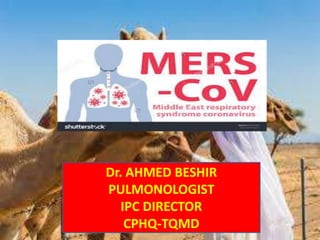
Dr. AHMED BESHIR
PULMONOLOGIST
IPC DIRECTOR
CPHQ-TQMD
§Coronaviruses primarily infect the upper respiratory and
gastrointestinal tract of mammals and bird.
§ Coronaviruses are believed to cause a significat
percentage of all common colds in human adults.
§ Coronaviruses can even cause pneumonia, either
.viral pneumonia or a secondary bacterial pneumonia
§ Coronaviruses also cause a range of diseases in farm
.animals and domesticated pets
Corona
Virus
Corona Virus
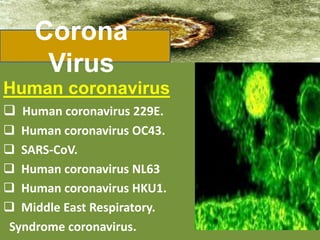
Human coronavirus
 Human coronavirus 229E.
 Human coronavirus OC43.
 SARS-CoV.
 Human coronavirus NL63
 Human coronavirus HKU1.
 Middle East Respiratory.
Syndrome coronavirus.
Corona
Virus
Survival of Coronaviruses
Coronaviruses are fairly fragile, surviving
outside the body for only about 24 hours;
They are easily destroyed by detergents
and cleaning agents;
Cleaning environmental surfaces with
water and detergent and applying
commonly used disinfectants (such as
hypochlorite) is an effective and sufficient
procedure.
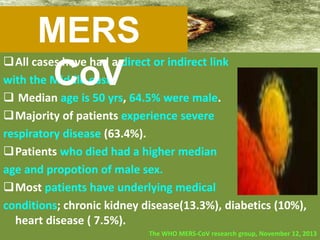
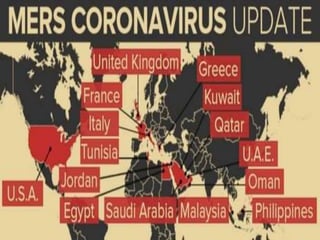
All cases have had a direct or indirect link
with the Middle east.
 Median age is 50 yrs, 64.5% were male.
Majority of patients experience severe
respiratory disease (63.4%).
Patients who died had a higher median
age and propotion of male sex.
Most patients have underlying medical
conditions; chronic kidney disease(13.3%), diabetics (10%),
heart disease ( 7.5%).
The WHO MERS-CoV research group, November 12, 2013
MERS
CoV
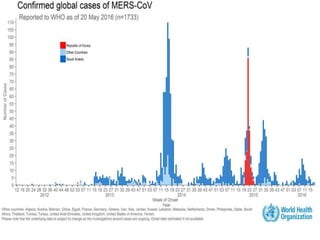
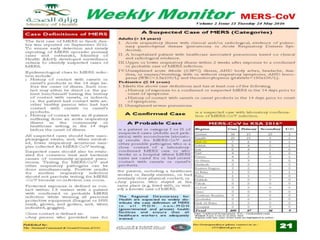
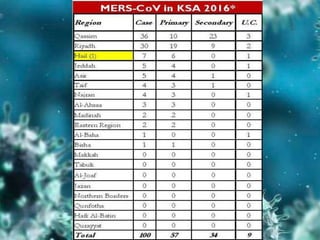
• Since April 2012 and as of 18 May 2016,
1 751 cases of MERS, including 680 deaths, have been
reported by health authorities worldwide. The source of
the virus remains unknown, but the pattern of
transmission and virological studies point towards camels
in the Middle East as being a reservoir from which
humans sporadically become infected through zoonotic
transmission.
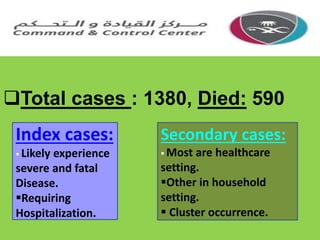
Total cases : 1380, Died: 590
Index cases:
 Likely experience
severe and fatal
Disease.
Requiring
Hospitalization.
Secondary cases:
 Most are healthcare
setting.
Other in household
setting.
 Cluster occurrence.
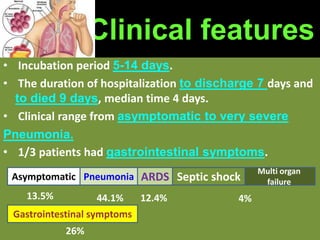
• Incubation period 5-14 days.
• The duration of hospitalization to discharge 7 days and
to died 9 days, median time 4 days.
• Clinical range from asymptomatic to very severe
Pneumonia.
• 1/3 patients had gastrointestinal symptoms.
Clinical features
Asymptomatic Pneumonia ARDS Septic shock
Multi organ
failure
Gastrointestinal symptoms
13.5% 44.1% 12.4%
26%
4%
Clinical features
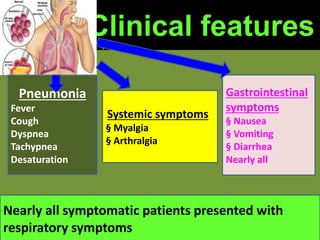
•Nearly all symptomatic patients presented with
respiratory symptoms
Pneumonia
Fever
Cough
Dyspnea
Tachypnea
Desaturation
Systemic symptoms
§ Myalgia
§ Arthralgia
Gastrointestinal
symptoms
§ Nausea
§ Vomiting
§ Diarrhea
Nearly all
Nearly all symptomatic patients presented with
respiratory symptoms
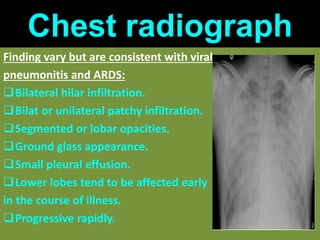
Chest radiograph
Finding vary but are consistent with viral
pneumonitis and ARDS:
Bilateral hilar infiltration.
Bilat or unilateral patchy infiltration.
Segmented or lobar opacities.
Ground glass appearance.
Small pleural effusion.
Lower lobes tend to be affected early
in the course of illness.
Progressive rapidly.
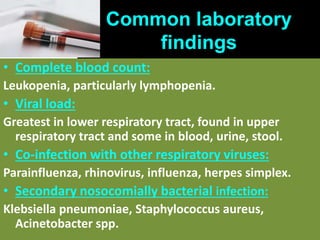
Common laboratory
findings
• Complete blood count:
Leukopenia, particularly lymphopenia.
• Viral load:
Greatest in lower respiratory tract, found in upper
respiratory tract and some in blood, urine, stool.
• Co-infection with other respiratory viruses:
Parainfluenza, rhinovirus, influenza, herpes simplex.
• Secondary nosocomially bacterial infection:
Klebsiella pneumoniae, Staphylococcus aureus,
Acinetobacter spp.
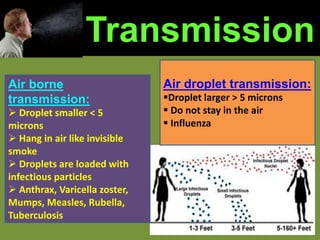
Transmission
Air droplet transmission:
Droplet larger > 5 microns
 Do not stay in the air
 Influenza
Air borne
transmission:
 Droplet smaller < 5
microns
 Hang in air like invisible
smoke
 Droplets are loaded with
infectious particles
 Anthrax, Varicella zoster,
Mumps, Measles, Rubella,
Tuberculosis
• Zoonosis in sporadic case:
Camel and bat
• Human to human transmission in secondary case:
- Small air droplet.
- Transmission did not extend beyond close contacts
into the community.
- Secondary attack rates among family members of
patients appear to be low.
• Cluster:
Defined as two or more persons with onset of
symptoms within 14 day period and are associated
with specific setting.
Transmission
MERS-nCoV
Transmission
• Transmitted through the air through
droplets from coughing or sneezing
• Transmitted through close personal
contact: touching or shaking hands
• Spread by touching contaminated
objects or surfaces and then touching
your eyes, nose, or mouth
History……. important
History of travel to Middle Eastern
Countries where MERS-nCoV is
prevalent.
MERS-CoV can survive for a long time
in milk and suggested that
consumption of unpasteurized milk,
common on the Arabian Peninsula,
could be a source of infection.
Symptoms usually develop 2 – 14 days after
exposure to person infected with MERS-CoV.
OR
Following travel from countries in or near
Arabian Peninsula within 14 days before
onset of symptoms.
There is no evidence of
transmission of MERS-CoV in the
general public
Am I At Risk For Developing
MERS-CoV…?
The groups of highest risk for
devoloping MERS-CoV are:
*Infants/Children
*Elderly
*People with immune system problems
*Chronic heart, lung and kidney problems
*Pregnant women
*Diabetics
A person who has traveled to a
location that has had confirmed
positive cases for MERS-CoV.
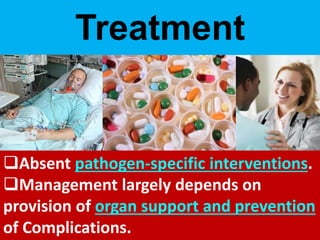
Treatment
Absent pathogen-specific interventions.
Management largely depends on
provision of organ support and prevention
of Complications.
Treatment
Organ support and prevention of complication
 Lung-protective ventilatory strategies for ARDS.
Sepsis early directed goal therapy.
Antimicrobial treatment for co-infection.
 Renal replacement therapy.
Cardiovascular support.
ECMO.
Non useful drug:
• High dose corticosteroid.
• Interferons, Cyclosporin A, Ribavirin,
Nitazoxanide,Immunoglobulins,
Lopinavir.
•SARS CoV convalescent plasma.
•MERS - CoV
case definition
:Suspect case
patients who should be tested for
.MERS-CoV
I.A person with: Acute respiratory illness with
clinical and/or radiological, evidence of
pulmonary parenchymal disease (pneumonia or
Acute Respiratory Distress Syndrome).
OR
II.A hospitalized patient with: healthcare
associated pneumonia based on clinical and
radiological evidence.
OR
III.A person with: Upper or lower respiratory illness
within 2 weeks after exposure to a confirmed or probable
case of MERS-CoV infection.
OR
IV.A person 1)Acute febrile (≥38°C) illness AND
2)Body aches, headache, diarrhea, or nausea/vomiting, with
or without respiratory symptoms AND
3)Unexplained leucopenia(WBC<3.5x10/L) and
thrombocytopenia (platelets<150x10/L).
A probable case
• Is a patient in category I or II with absent or
inconclusive laboratory results for MERS-CoV and
other possible pathogens who is a close contact of
a laboratory-confirmed MERS-CoV case or who
works in a hospital where MERS-CoV cases are
cared for.
A confirmed case
Is a person with laboratory confirmation
of MERS-CoV infection.
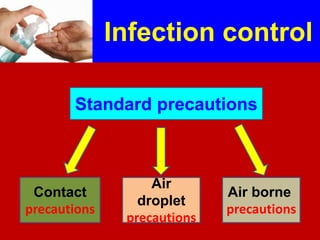
Infection control
Standard precautions
Contact
precautions
Air
droplet
precautions
Air borne
precautions
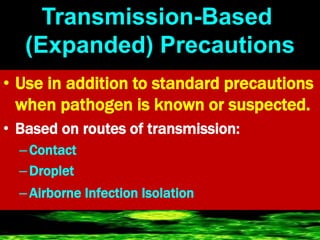
Transmission-Based
(Expanded) Precautions
• Use in addition to standard precautions
when pathogen is known or suspected.
• Based on routes of transmission:
–Contact
–Droplet
–Airborne Infection Isolation
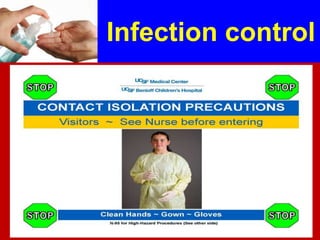
Infection control
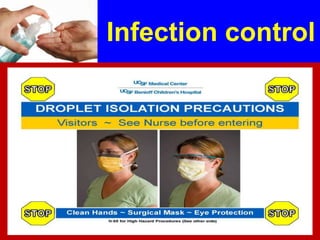
Infection control
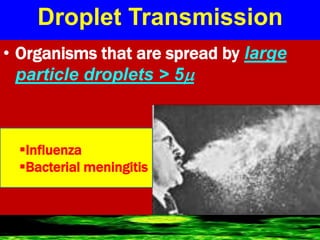
Droplet Transmission
• Organisms that are spread by large
particle droplets > 5
Influenza
Bacterial meningitis
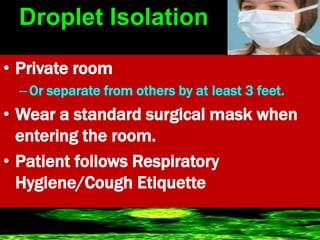
Droplet Isolation
• Private room
–Or separate from others by at least 3 feet.
• Wear a standard surgical mask when
entering the room.
• Patient follows Respiratory
Hygiene/Cough Etiquette
Infection control
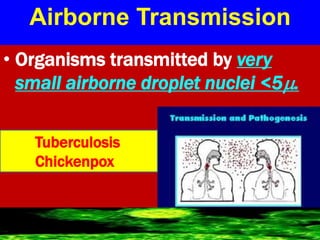
Airborne Transmission
• Organisms transmitted by very
small airborne droplet nuclei <5.
Tuberculosis
Chickenpox
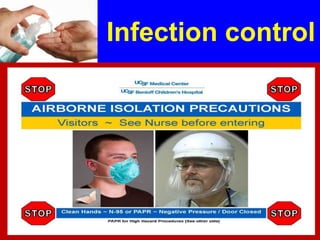
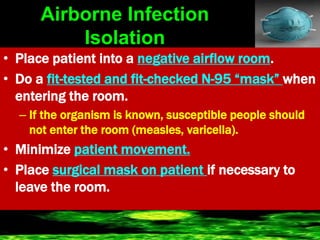
Airborne Infection
Isolation
• Place patient into a negative airflow room.
• Do a fit-tested and fit-checked N-95 “mask” when
entering the room.
– If the organism is known, susceptible people should
not enter the room (measles, varicella).
• Minimize patient movement.
• Place surgical mask on patient if necessary to
leave the room.
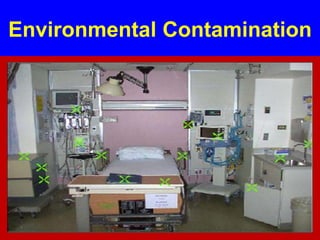
Environmental Contamination
Environmental Cleaning
• The inanimate environment plays a role in facilitating
transmission of organisms.
• Cleaning and disinfection reduces the numbers of
microorganisms in the environment.
• Cleaning not always seen as a high priority.
• Germs can survive for days → weeks → months on
surfaces.
• Cleaning/disinfecting priorities might be upside-down
(high-touch vs. low-touch).
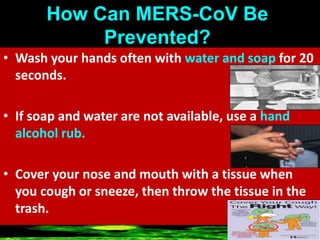
How Can MERS-CoV Be
Prevented?
• Wash your hands often with water and soap for 20
seconds.
• If soap and water are not available, use a hand
alcohol rub.
• Cover your nose and mouth with a tissue when
you cough or sneeze, then throw the tissue in the
trash.
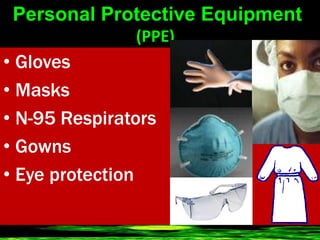
Personal Protective Equipment
(PPE)
• Gloves
• Masks
• N-95 Respirators
• Gowns
• Eye protection
Prevention of Transmission to
Healthcare Providers
• Airborne Infection Isolation Room (AIIR)
• Limit the number of healthcare providers to only those essential
for patient care and support.
• Conduct the procedures in a private room and ideally in an AIIR
• Gloves
• Gowns
• Eye protection (goggles or face shield)
• a fit-tested N95 filtering face piece respirator.
• If a respirator is unavailable, a facemask should be worn.
• Monitor healthcare providers for 14 days after the last known
contact with the sick patient.
• Healthcare providers should stay home when sick!
MERS-Cov

MERS-Cov

  • 1.
  • 2.
    §Coronaviruses primarily infectthe upper respiratory and gastrointestinal tract of mammals and bird. § Coronaviruses are believed to cause a significat percentage of all common colds in human adults. § Coronaviruses can even cause pneumonia, either .viral pneumonia or a secondary bacterial pneumonia § Coronaviruses also cause a range of diseases in farm .animals and domesticated pets Corona Virus
  • 3.
    Corona Virus Human coronavirus Human coronavirus 229E.  Human coronavirus OC43.  SARS-CoV.  Human coronavirus NL63  Human coronavirus HKU1.  Middle East Respiratory. Syndrome coronavirus. Corona Virus
  • 4.
    Survival of Coronaviruses Coronavirusesare fairly fragile, surviving outside the body for only about 24 hours; They are easily destroyed by detergents and cleaning agents; Cleaning environmental surfaces with water and detergent and applying commonly used disinfectants (such as hypochlorite) is an effective and sufficient procedure.
  • 5.
    All cases havehad a direct or indirect link with the Middle east.  Median age is 50 yrs, 64.5% were male. Majority of patients experience severe respiratory disease (63.4%). Patients who died had a higher median age and propotion of male sex. Most patients have underlying medical conditions; chronic kidney disease(13.3%), diabetics (10%), heart disease ( 7.5%). The WHO MERS-CoV research group, November 12, 2013 MERS CoV
  • 7.
    • Since April2012 and as of 18 May 2016, 1 751 cases of MERS, including 680 deaths, have been reported by health authorities worldwide. The source of the virus remains unknown, but the pattern of transmission and virological studies point towards camels in the Middle East as being a reservoir from which humans sporadically become infected through zoonotic transmission.
  • 9.
    Total cases :1380, Died: 590 Index cases:  Likely experience severe and fatal Disease. Requiring Hospitalization. Secondary cases:  Most are healthcare setting. Other in household setting.  Cluster occurrence.
  • 12.
    • Incubation period5-14 days. • The duration of hospitalization to discharge 7 days and to died 9 days, median time 4 days. • Clinical range from asymptomatic to very severe Pneumonia. • 1/3 patients had gastrointestinal symptoms. Clinical features Asymptomatic Pneumonia ARDS Septic shock Multi organ failure Gastrointestinal symptoms 13.5% 44.1% 12.4% 26% 4%
  • 13.
    Clinical features •Nearly allsymptomatic patients presented with respiratory symptoms Pneumonia Fever Cough Dyspnea Tachypnea Desaturation Systemic symptoms § Myalgia § Arthralgia Gastrointestinal symptoms § Nausea § Vomiting § Diarrhea Nearly all Nearly all symptomatic patients presented with respiratory symptoms
  • 14.
    Chest radiograph Finding varybut are consistent with viral pneumonitis and ARDS: Bilateral hilar infiltration. Bilat or unilateral patchy infiltration. Segmented or lobar opacities. Ground glass appearance. Small pleural effusion. Lower lobes tend to be affected early in the course of illness. Progressive rapidly.
  • 15.
    Common laboratory findings • Completeblood count: Leukopenia, particularly lymphopenia. • Viral load: Greatest in lower respiratory tract, found in upper respiratory tract and some in blood, urine, stool. • Co-infection with other respiratory viruses: Parainfluenza, rhinovirus, influenza, herpes simplex. • Secondary nosocomially bacterial infection: Klebsiella pneumoniae, Staphylococcus aureus, Acinetobacter spp.
  • 16.
    Transmission Air droplet transmission: Dropletlarger > 5 microns  Do not stay in the air  Influenza Air borne transmission:  Droplet smaller < 5 microns  Hang in air like invisible smoke  Droplets are loaded with infectious particles  Anthrax, Varicella zoster, Mumps, Measles, Rubella, Tuberculosis
  • 17.
    • Zoonosis insporadic case: Camel and bat • Human to human transmission in secondary case: - Small air droplet. - Transmission did not extend beyond close contacts into the community. - Secondary attack rates among family members of patients appear to be low. • Cluster: Defined as two or more persons with onset of symptoms within 14 day period and are associated with specific setting. Transmission
  • 18.
    MERS-nCoV Transmission • Transmitted throughthe air through droplets from coughing or sneezing • Transmitted through close personal contact: touching or shaking hands • Spread by touching contaminated objects or surfaces and then touching your eyes, nose, or mouth
  • 19.
    History……. important History oftravel to Middle Eastern Countries where MERS-nCoV is prevalent. MERS-CoV can survive for a long time in milk and suggested that consumption of unpasteurized milk, common on the Arabian Peninsula, could be a source of infection.
  • 20.
    Symptoms usually develop2 – 14 days after exposure to person infected with MERS-CoV. OR Following travel from countries in or near Arabian Peninsula within 14 days before onset of symptoms. There is no evidence of transmission of MERS-CoV in the general public
  • 21.
    Am I AtRisk For Developing MERS-CoV…? The groups of highest risk for devoloping MERS-CoV are: *Infants/Children *Elderly *People with immune system problems *Chronic heart, lung and kidney problems *Pregnant women *Diabetics A person who has traveled to a location that has had confirmed positive cases for MERS-CoV.
  • 22.
    Treatment Absent pathogen-specific interventions. Managementlargely depends on provision of organ support and prevention of Complications.
  • 23.
    Treatment Organ support andprevention of complication  Lung-protective ventilatory strategies for ARDS. Sepsis early directed goal therapy. Antimicrobial treatment for co-infection.  Renal replacement therapy. Cardiovascular support. ECMO. Non useful drug: • High dose corticosteroid. • Interferons, Cyclosporin A, Ribavirin, Nitazoxanide,Immunoglobulins, Lopinavir. •SARS CoV convalescent plasma.
  • 24.
  • 25.
    :Suspect case patients whoshould be tested for .MERS-CoV I.A person with: Acute respiratory illness with clinical and/or radiological, evidence of pulmonary parenchymal disease (pneumonia or Acute Respiratory Distress Syndrome). OR II.A hospitalized patient with: healthcare associated pneumonia based on clinical and radiological evidence.
  • 26.
    OR III.A person with:Upper or lower respiratory illness within 2 weeks after exposure to a confirmed or probable case of MERS-CoV infection. OR IV.A person 1)Acute febrile (≥38°C) illness AND 2)Body aches, headache, diarrhea, or nausea/vomiting, with or without respiratory symptoms AND 3)Unexplained leucopenia(WBC<3.5x10/L) and thrombocytopenia (platelets<150x10/L).
  • 27.
    A probable case •Is a patient in category I or II with absent or inconclusive laboratory results for MERS-CoV and other possible pathogens who is a close contact of a laboratory-confirmed MERS-CoV case or who works in a hospital where MERS-CoV cases are cared for.
  • 28.
    A confirmed case Isa person with laboratory confirmation of MERS-CoV infection.
  • 29.
  • 30.
    Transmission-Based (Expanded) Precautions • Usein addition to standard precautions when pathogen is known or suspected. • Based on routes of transmission: –Contact –Droplet –Airborne Infection Isolation
  • 31.
  • 32.
  • 33.
    Droplet Transmission • Organismsthat are spread by large particle droplets > 5 Influenza Bacterial meningitis
  • 34.
    Droplet Isolation • Privateroom –Or separate from others by at least 3 feet. • Wear a standard surgical mask when entering the room. • Patient follows Respiratory Hygiene/Cough Etiquette
  • 35.
  • 36.
    Airborne Transmission • Organismstransmitted by very small airborne droplet nuclei <5. Tuberculosis Chickenpox
  • 37.
    Airborne Infection Isolation • Placepatient into a negative airflow room. • Do a fit-tested and fit-checked N-95 “mask” when entering the room. – If the organism is known, susceptible people should not enter the room (measles, varicella). • Minimize patient movement. • Place surgical mask on patient if necessary to leave the room.
  • 38.
  • 39.
    Environmental Cleaning • Theinanimate environment plays a role in facilitating transmission of organisms. • Cleaning and disinfection reduces the numbers of microorganisms in the environment. • Cleaning not always seen as a high priority. • Germs can survive for days → weeks → months on surfaces. • Cleaning/disinfecting priorities might be upside-down (high-touch vs. low-touch).
  • 40.
    How Can MERS-CoVBe Prevented? • Wash your hands often with water and soap for 20 seconds. • If soap and water are not available, use a hand alcohol rub. • Cover your nose and mouth with a tissue when you cough or sneeze, then throw the tissue in the trash.
  • 41.
    Personal Protective Equipment (PPE) •Gloves • Masks • N-95 Respirators • Gowns • Eye protection
  • 42.
    Prevention of Transmissionto Healthcare Providers • Airborne Infection Isolation Room (AIIR) • Limit the number of healthcare providers to only those essential for patient care and support. • Conduct the procedures in a private room and ideally in an AIIR • Gloves • Gowns • Eye protection (goggles or face shield) • a fit-tested N95 filtering face piece respirator. • If a respirator is unavailable, a facemask should be worn. • Monitor healthcare providers for 14 days after the last known contact with the sick patient. • Healthcare providers should stay home when sick!