




Types of Websites
What are the different types of website?
 Websites have many functions and can be used in various fashions; a website can be a personal
website, a commercial website, a government website or a non-profit organization website. Websites can
be the work of an individual, a business or other organization, and are typically dedicated to a particular
topic or purpose.
 This PPT aims to discuss the types of website available and what they are suitable for.
Let’s see………………….
Based on Functionality
Based on Purpose
Static and Dynamic
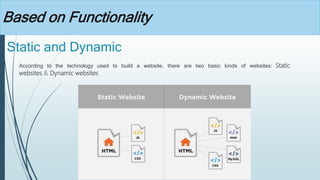
According to the technology used to build a website, there are two basic kinds of websites: Static
websites & Dynamic websites
Based on Functionality
Static websites
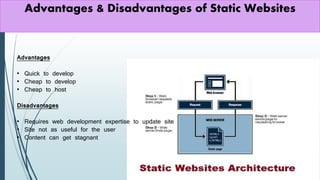
Static websites have web pages stored on the server in the format
that is sent to a client web browser. It is primarily coded in HTML,
and you can update each web page independently in an HTML editor
program. Static websites display fixed static content and information to
the user. For example, small one-page or five-page websites or
brochure websites are often static. Those types of websites may
include information about a company and services. They usually
contain texts, images, audio/video, simple navigation menus. Static
websites are very easy to create, maintain and update
Advantages & Disadvantages of Static Websites
Advantages
• Quick to develop
• Cheap to develop
• Cheap to host
Disadvantages
• Requires web development expertise to update site
• Site not as useful for the user
• Content can get stagnant
Dynamic websites
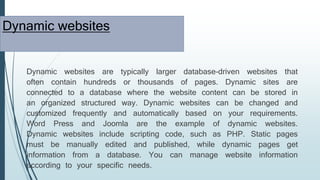
Dynamic websites are typically larger database-driven websites that
often contain hundreds or thousands of pages. Dynamic sites are
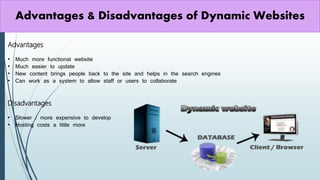
connected to a database where the website content can be stored in
an organized structured way. Dynamic websites can be changed and
customized frequently and automatically based on your requirements.
Word Press and Joomla are the example of dynamic websites.
Dynamic websites include scripting code, such as PHP. Static pages
must be manually edited and published, while dynamic pages get
information from a database. You can manage website information
according to your specific needs.
Advantages & Disadvantages of Dynamic Websites
Advantages
• Much more functional website
• Much easier to update
• New content brings people back to the site and helps in the search engines
• Can work as a system to allow staff or users to collaborate
Disadvantages
• Slower / more expensive to develop
• Hosting costs a little more
Responsive Websites
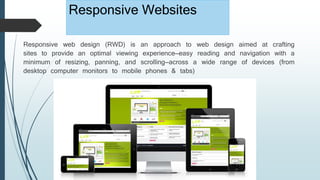
Responsive web design (RWD) is an approach to web design aimed at crafting
sites to provide an optimal viewing experience—easy reading and navigation with a
minimum of resizing, panning, and scrolling—across a wide range of devices (from
desktop computer monitors to mobile phones & tabs)
Types
 PERSONAL WEBSITES
 INFORMATIVE WEBSITES
 BUSINESS WEBSITES E-COMMERCE WEBSITE
 SOCIAL NETWORKING WEBSITES
Based on Purpose
PERSONAL WEBSITES
For Personal CV/Resume
Art work & Hobbies
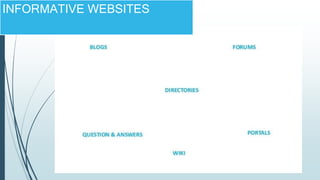
INFORMATIVE WEBSITES
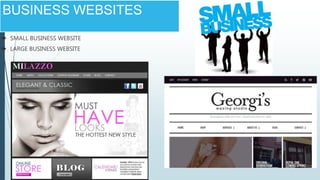
BUSINESS WEBSITES
 SMALL BUSINESS WEBSITE
 LARGE BUSINESS WEBSITE
E-COMMERCE WEBSITE
Electronic commerce websites, commonly known as e-commerce websites, are
associated with buying and selling of products or services over the internet.
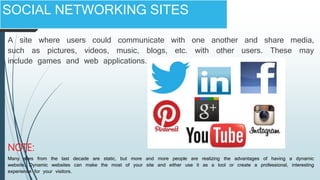
SOCIAL NETWORKING SITES
A site where users could communicate with one another and share media,
such as pictures, videos, music, blogs, etc. with other users. These may
include games and web applications.
Many sites from the last decade are static, but more and more people are realizing the advantages of having a dynamic
website. Dynamic websites can make the most of your site and either use it as a tool or create a professional, interesting
experience for your visitors.
NOTE:
Afzal Hameed
Author

Different Types Of Websites - With Basic Information

  • 1.
  • 2.
    What are thedifferent types of website?  Websites have many functions and can be used in various fashions; a website can be a personal website, a commercial website, a government website or a non-profit organization website. Websites can be the work of an individual, a business or other organization, and are typically dedicated to a particular topic or purpose.  This PPT aims to discuss the types of website available and what they are suitable for. Let’s see………………….
  • 3.
  • 4.
    Static and Dynamic Accordingto the technology used to build a website, there are two basic kinds of websites: Static websites & Dynamic websites Based on Functionality
  • 5.
    Static websites Static websiteshave web pages stored on the server in the format that is sent to a client web browser. It is primarily coded in HTML, and you can update each web page independently in an HTML editor program. Static websites display fixed static content and information to the user. For example, small one-page or five-page websites or brochure websites are often static. Those types of websites may include information about a company and services. They usually contain texts, images, audio/video, simple navigation menus. Static websites are very easy to create, maintain and update
  • 6.
    Advantages & Disadvantagesof Static Websites Advantages • Quick to develop • Cheap to develop • Cheap to host Disadvantages • Requires web development expertise to update site • Site not as useful for the user • Content can get stagnant
  • 7.
    Dynamic websites Dynamic websitesare typically larger database-driven websites that often contain hundreds or thousands of pages. Dynamic sites are connected to a database where the website content can be stored in an organized structured way. Dynamic websites can be changed and customized frequently and automatically based on your requirements. Word Press and Joomla are the example of dynamic websites. Dynamic websites include scripting code, such as PHP. Static pages must be manually edited and published, while dynamic pages get information from a database. You can manage website information according to your specific needs.
  • 8.
    Advantages & Disadvantagesof Dynamic Websites Advantages • Much more functional website • Much easier to update • New content brings people back to the site and helps in the search engines • Can work as a system to allow staff or users to collaborate Disadvantages • Slower / more expensive to develop • Hosting costs a little more
  • 9.
    Responsive Websites Responsive webdesign (RWD) is an approach to web design aimed at crafting sites to provide an optimal viewing experience—easy reading and navigation with a minimum of resizing, panning, and scrolling—across a wide range of devices (from desktop computer monitors to mobile phones & tabs)
  • 10.
    Types  PERSONAL WEBSITES INFORMATIVE WEBSITES  BUSINESS WEBSITES E-COMMERCE WEBSITE  SOCIAL NETWORKING WEBSITES Based on Purpose
  • 11.
    PERSONAL WEBSITES For PersonalCV/Resume Art work & Hobbies
  • 12.
  • 13.
    BUSINESS WEBSITES  SMALLBUSINESS WEBSITE  LARGE BUSINESS WEBSITE
  • 14.
    E-COMMERCE WEBSITE Electronic commercewebsites, commonly known as e-commerce websites, are associated with buying and selling of products or services over the internet.
  • 15.
    SOCIAL NETWORKING SITES Asite where users could communicate with one another and share media, such as pictures, videos, music, blogs, etc. with other users. These may include games and web applications. Many sites from the last decade are static, but more and more people are realizing the advantages of having a dynamic website. Dynamic websites can make the most of your site and either use it as a tool or create a professional, interesting experience for your visitors. NOTE:
  • 16.