
University of Khemis Miliana
Faculty of Law & Political Science
Department of Political Science
HOW TO WRITE AN ABSTRACT
BY
MESTEK YAHIA MOHAMED LAMINE
m.mestek-yahia@univ-dbkm.dz
@laminemestek
lamine.mestek
Lamine.mestek
HOW TO WRITE AN ABSTRACT
IN THIS LESSON
• WHAT IS AN ABSTRACT
• FOR WHAT PURPOSES
• DIFFERENT TYPES OF ABSTRACT
• WHAT TO INCLUDE
• WHAT NOT TO INCLUDE
• SOME EXAMPLES
WHAT IS AN ABSTRACT?
• A short, self-contained, powerful summary of
an article, paper or thesis;
• Length: between 150 and 250 words;
• Layout: usually one single paragraph; font size
is different from the main text;
• Position: usually at the beginning of the paper
FOR WHAT PURPOSES?
• TO PERSUADE THE READER TO SEE THE FULL TEXT
• TO HELP READERS DECIDE IF THE ARTICLE IS
RELEVANT FOR THEIR PURPOSES
• TO ANSWER A CALL OF PAPER IN A CONFERENCE
DIFFERENT TYPES OF ABSTRACT
• Abstracts are usually divided into two main
categories:
• DESCRIPTIVE AND INFORMATIVE
1/ Descriptive abstracts describe:
– What the text is about
– The issues or problems explored
– The purpose and methodology of the research
DIFFERENT TYPES OF ABSTRACT (continued)
2/Informative abstracts describe:
– What the text is about
– The issues or problems explored
– The purpose and methodology of the research
– The results
– The conclusion and recommendations
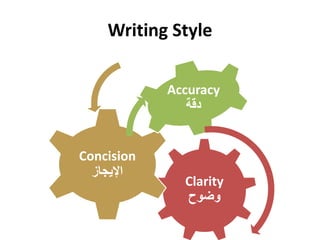
Writing Style
Clarity
‫وضوح‬
Concision
‫اإليجاز‬
Accuracy
‫دقة‬
WHAT TO INCLUDE
• Reason for writing:
What is the importance of the research? Why
would a reader be interested in the larger
work?
• Problem:
What problem does this work attempt to
solve? What is the scope of the project? What
is the main argument/thesis/claim?
WHAT TO INCLUDE (continued)
• Methodology:
An abstract may include specific models or
approaches used in the larger study.
• Results:
Again, an abstract may include specific data
that indicates the results of the project. Other
abstracts may discuss the findings in a more
general way.
WHAT NOT TO INCLUDE
• Information not contained in the original work;
• References to other work;
• Quotations from the original work or from other
works;
• Lengthy explanations of words and concepts;
• Unexplained acronyms or abbreviations;
• Tables and maps.
Abstract Language
Introduction (usually in present, could also be in present
perfect or simple past tense):
The purpose of this study is to investigate the effects of ... on ...
The goals of this study are to determine …
The primary purpose of this study is to determine …
This study is specifically concerned with the effect of … on …
This study is an initial attempt to investigate the relationship …
This study has two major purposes: (1) to investigate ... (2) to
demonstrate …
This thesis discusses/describes/analyses/studies/focuses
on/deals with …
Abstract Language
Materials and Methods (in past tense):
The subjects of this study were …
This study was conducted in Khemis Miliana/ at Emir Abdel
Kader High School.
Data for this study/research were collected/gathered/obtained
from/by/through/with the help of/among …
A questionnaire was distributed/mailed/sent to …
Interviews were conducted by/with …
The interviews were recorded on audiotape.
Using local and national data, this study was designed to
investigate.
The empirical part of this study was conducted in May 2017.
Abstract Language
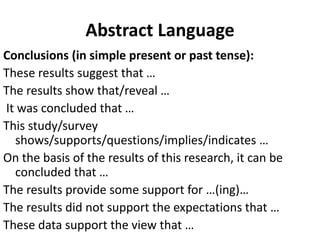
Conclusions (in simple present or past tense):
These results suggest that …
The results show that/reveal …
It was concluded that …
This study/survey
shows/supports/questions/implies/indicates …
On the basis of the results of this research, it can be
concluded that …
The results provide some support for …(ing)…
The results did not support the expectations that …
These data support the view that …
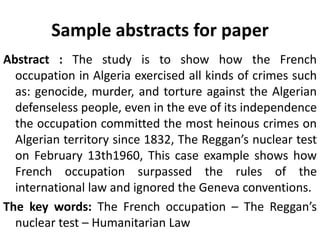
Sample abstracts for paper
Abstract : The study is to show how the French
occupation in Algeria exercised all kinds of crimes such
as: genocide, murder, and torture against the Algerian
defenseless people, even in the eve of its independence
the occupation committed the most heinous crimes on
Algerian territory since 1832, The Reggan’s nuclear test
on February 13th1960, This case example shows how
French occupation surpassed the rules of the
international law and ignored the Geneva conventions.
The key words: The French occupation – The Reggan’s
nuclear test – Humanitarian Law
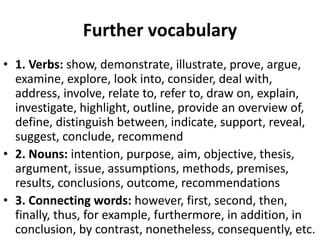
Further vocabulary
• 1. Verbs: show, demonstrate, illustrate, prove, argue,
examine, explore, look into, consider, deal with,
address, involve, relate to, refer to, draw on, explain,
investigate, highlight, outline, provide an overview of,
define, distinguish between, indicate, support, reveal,
suggest, conclude, recommend
• 2. Nouns: intention, purpose, aim, objective, thesis,
argument, issue, assumptions, methods, premises,
results, conclusions, outcome, recommendations
• 3. Connecting words: however, first, second, then,
finally, thus, for example, furthermore, in addition, in
conclusion, by contrast, nonetheless, consequently, etc.
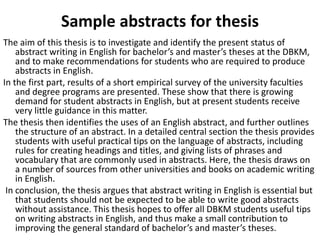
Sample abstracts for thesis
The aim of this thesis is to investigate and identify the present status of
abstract writing in English for bachelor’s and master’s theses at the DBKM,
and to make recommendations for students who are required to produce
abstracts in English.
In the first part, results of a short empirical survey of the university faculties
and degree programs are presented. These show that there is growing
demand for student abstracts in English, but at present students receive
very little guidance in this matter.
The thesis then identifies the uses of an English abstract, and further outlines
the structure of an abstract. In a detailed central section the thesis provides
students with useful practical tips on the language of abstracts, including
rules for creating headings and titles, and giving lists of phrases and
vocabulary that are commonly used in abstracts. Here, the thesis draws on
a number of sources from other universities and books on academic writing
in English.
In conclusion, the thesis argues that abstract writing in English is essential but
that students should not be expected to be able to write good abstracts
without assistance. This thesis hopes to offer all DBKM students useful tips
on writing abstracts in English, and thus make a small contribution to
improving the general standard of bachelor’s and master’s theses.

HOW TO WRITE AN ABSTRACT

  • 1.
    University of KhemisMiliana Faculty of Law & Political Science Department of Political Science HOW TO WRITE AN ABSTRACT BY MESTEK YAHIA MOHAMED LAMINE m.mestek-yahia@univ-dbkm.dz @laminemestek lamine.mestek Lamine.mestek
  • 2.
    HOW TO WRITEAN ABSTRACT
  • 3.
    IN THIS LESSON •WHAT IS AN ABSTRACT • FOR WHAT PURPOSES • DIFFERENT TYPES OF ABSTRACT • WHAT TO INCLUDE • WHAT NOT TO INCLUDE • SOME EXAMPLES
  • 4.
    WHAT IS ANABSTRACT? • A short, self-contained, powerful summary of an article, paper or thesis; • Length: between 150 and 250 words; • Layout: usually one single paragraph; font size is different from the main text; • Position: usually at the beginning of the paper
  • 5.
    FOR WHAT PURPOSES? •TO PERSUADE THE READER TO SEE THE FULL TEXT • TO HELP READERS DECIDE IF THE ARTICLE IS RELEVANT FOR THEIR PURPOSES • TO ANSWER A CALL OF PAPER IN A CONFERENCE
  • 6.
    DIFFERENT TYPES OFABSTRACT • Abstracts are usually divided into two main categories: • DESCRIPTIVE AND INFORMATIVE 1/ Descriptive abstracts describe: – What the text is about – The issues or problems explored – The purpose and methodology of the research
  • 7.
    DIFFERENT TYPES OFABSTRACT (continued) 2/Informative abstracts describe: – What the text is about – The issues or problems explored – The purpose and methodology of the research – The results – The conclusion and recommendations
  • 8.
  • 9.
    WHAT TO INCLUDE •Reason for writing: What is the importance of the research? Why would a reader be interested in the larger work? • Problem: What problem does this work attempt to solve? What is the scope of the project? What is the main argument/thesis/claim?
  • 10.
    WHAT TO INCLUDE(continued) • Methodology: An abstract may include specific models or approaches used in the larger study. • Results: Again, an abstract may include specific data that indicates the results of the project. Other abstracts may discuss the findings in a more general way.
  • 11.
    WHAT NOT TOINCLUDE • Information not contained in the original work; • References to other work; • Quotations from the original work or from other works; • Lengthy explanations of words and concepts; • Unexplained acronyms or abbreviations; • Tables and maps.
  • 12.
    Abstract Language Introduction (usuallyin present, could also be in present perfect or simple past tense): The purpose of this study is to investigate the effects of ... on ... The goals of this study are to determine … The primary purpose of this study is to determine … This study is specifically concerned with the effect of … on … This study is an initial attempt to investigate the relationship … This study has two major purposes: (1) to investigate ... (2) to demonstrate … This thesis discusses/describes/analyses/studies/focuses on/deals with …
  • 13.
    Abstract Language Materials andMethods (in past tense): The subjects of this study were … This study was conducted in Khemis Miliana/ at Emir Abdel Kader High School. Data for this study/research were collected/gathered/obtained from/by/through/with the help of/among … A questionnaire was distributed/mailed/sent to … Interviews were conducted by/with … The interviews were recorded on audiotape. Using local and national data, this study was designed to investigate. The empirical part of this study was conducted in May 2017.
  • 14.
    Abstract Language Conclusions (insimple present or past tense): These results suggest that … The results show that/reveal … It was concluded that … This study/survey shows/supports/questions/implies/indicates … On the basis of the results of this research, it can be concluded that … The results provide some support for …(ing)… The results did not support the expectations that … These data support the view that …
  • 15.
    Sample abstracts forpaper Abstract : The study is to show how the French occupation in Algeria exercised all kinds of crimes such as: genocide, murder, and torture against the Algerian defenseless people, even in the eve of its independence the occupation committed the most heinous crimes on Algerian territory since 1832, The Reggan’s nuclear test on February 13th1960, This case example shows how French occupation surpassed the rules of the international law and ignored the Geneva conventions. The key words: The French occupation – The Reggan’s nuclear test – Humanitarian Law
  • 16.
    Further vocabulary • 1.Verbs: show, demonstrate, illustrate, prove, argue, examine, explore, look into, consider, deal with, address, involve, relate to, refer to, draw on, explain, investigate, highlight, outline, provide an overview of, define, distinguish between, indicate, support, reveal, suggest, conclude, recommend • 2. Nouns: intention, purpose, aim, objective, thesis, argument, issue, assumptions, methods, premises, results, conclusions, outcome, recommendations • 3. Connecting words: however, first, second, then, finally, thus, for example, furthermore, in addition, in conclusion, by contrast, nonetheless, consequently, etc.
  • 17.
    Sample abstracts forthesis The aim of this thesis is to investigate and identify the present status of abstract writing in English for bachelor’s and master’s theses at the DBKM, and to make recommendations for students who are required to produce abstracts in English. In the first part, results of a short empirical survey of the university faculties and degree programs are presented. These show that there is growing demand for student abstracts in English, but at present students receive very little guidance in this matter. The thesis then identifies the uses of an English abstract, and further outlines the structure of an abstract. In a detailed central section the thesis provides students with useful practical tips on the language of abstracts, including rules for creating headings and titles, and giving lists of phrases and vocabulary that are commonly used in abstracts. Here, the thesis draws on a number of sources from other universities and books on academic writing in English. In conclusion, the thesis argues that abstract writing in English is essential but that students should not be expected to be able to write good abstracts without assistance. This thesis hopes to offer all DBKM students useful tips on writing abstracts in English, and thus make a small contribution to improving the general standard of bachelor’s and master’s theses.