An overview
Australian Legal System
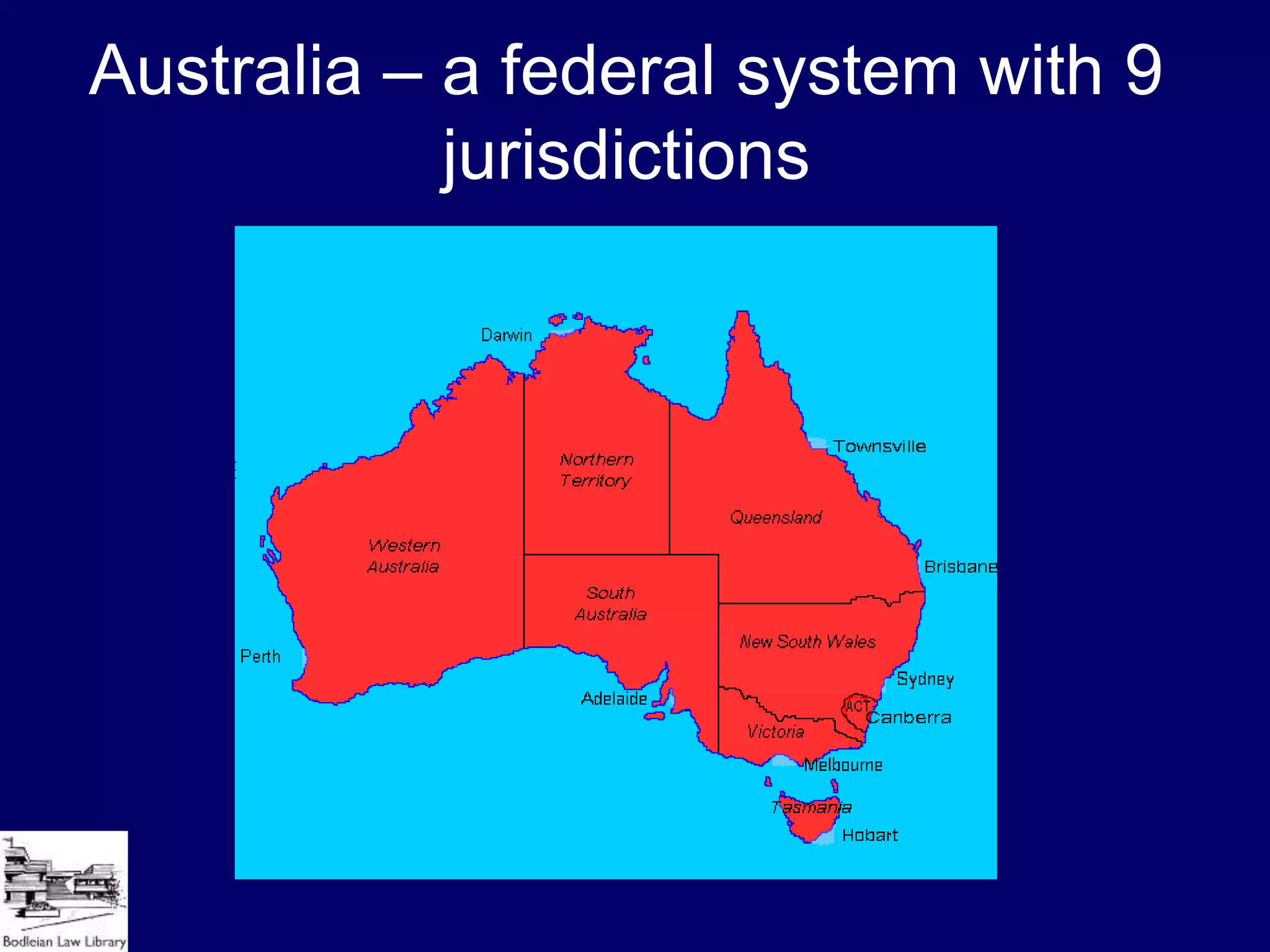
Australia – a federal system with 9
jurisdictions
Structure of government
The Constitution
Constitution
 An Act to constitute the Commonwealth of
Australia [9th July 1900](63 & 64 Victoria -
Chapter 12)
 No Bill of Rights
 Changes can only be by referendum carried by
majority of voters and majority of states
Federal Government
 Parliament - bicameral
 Senate - States house – 12 senators per state, 2 per
territory – 76 total
• Proportional representation voting system
 House of Representatives – People’s house – 150
members, 1 per electorate based on population
• Preferential voting system
Division of powers
 Australian Constitution s. 51 defines federal powers:
 interstate trade and commerce power
 corporations power
 external affairs power
 taxation power
 military defence
 quarantine
 census
 currency
 weights and measures
..more federal powers
 Service and execution of court processes and the recognition of
judgements
 Naturalisation and aliens and immigration
 Powers for implementation of a uniform railway system
 Postal, telegraphic, telephonic, and like services
 Pensions and social services
 Pacific relations
 The influx of criminals
 ‘Special laws’ for people of any race
 Marriage and divorce
 Copyright, patents, and trade marks
 Bankruptcy
 Bills of exchange
 Banking (other than state banking)
 Insurance other than state insurance
 Conciliation and arbitration of industrial disputes
Executive power
 Executive power – vested in the Queen of
Australia, represented by the Governor General
(Federal) or Governor (each state).
 Legislation must be signed by the Governor in
Council
 Executive Council – in theory all ministers of the
Crown
State government
 Each State and 2 territories (NT & ACT) has a
parliament – lower house usually named
Legislative Assembly; upper house is Legislative
Council
 All bicameral apart from Qld
 Leader of government is called Premier
 Preferential voting
State powers
 States have all powers that are not specified in
the Constitution – the residual powers, eg
policing, public schools, roads and traffic, public
hospitals (through an agreement with the federal
government), public housing, and business
regulation.
 Uniform laws in some areas between States
 Federal law takes precedence where there is
overlap
 States receive GST tax
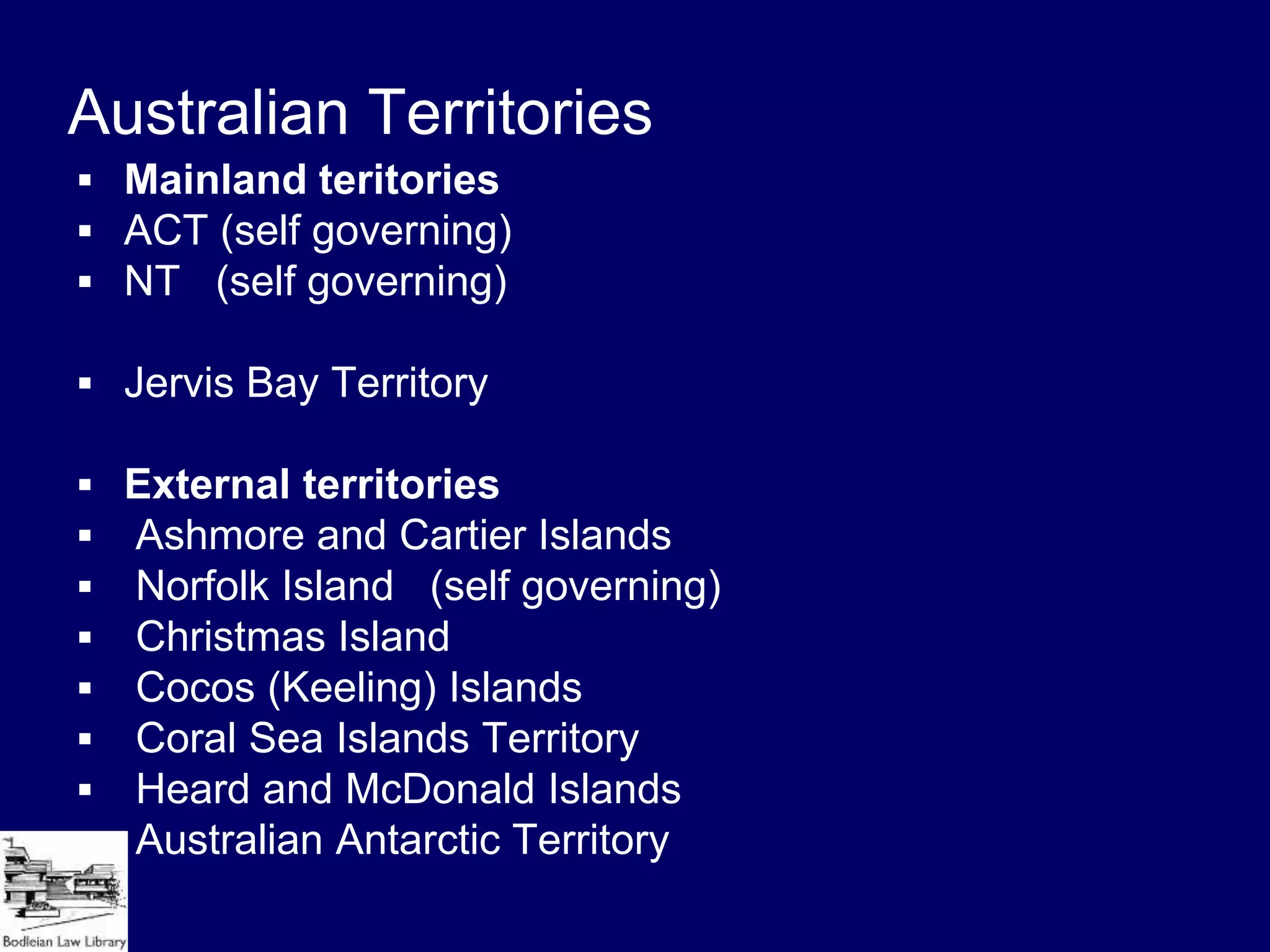
Australian Territories
 Mainland teritories
 ACT (self governing)
 NT (self governing)
 Jervis Bay Territory
 External territories
 Ashmore and Cartier Islands
 Norfolk Island (self governing)
 Christmas Island
 Cocos (Keeling) Islands
 Coral Sea Islands Territory
 Heard and McDonald Islands
 Australian Antarctic Territory
Local government
 565 local government bodies in Australia - a diverse
range of metropolitan, regional, rural, and Indigenous
communities.
 Responsibilities can include:
 infrastructure and property services, including local roads,
bridges, footpaths, drainage, waste collection and management
 provision of recreation facilities, such as parks, sports fields and
stadiums, golf courses, swimming pools, sport centres, halls,
camping grounds and caravan parks
 health services such as water and food inspection, immunisation
services, toilet facilities, noise control and meat inspection and
animal control
continued…
 community services, such as child care, aged care and
accommodation, community care and welfare services
 building services, including inspections, licensing, certification
and enforcement
 planning and development approval
 administration of facilities, such as airports and aerodromes,
ports and marinas, cemeteries, parking facilities and street
parking;
 cultural facilities and services, such as libraries, art galleries and
museums
 water and sewerage services in some states
 other services, such as abattoirs, sale-yards and group
purchasing schemes
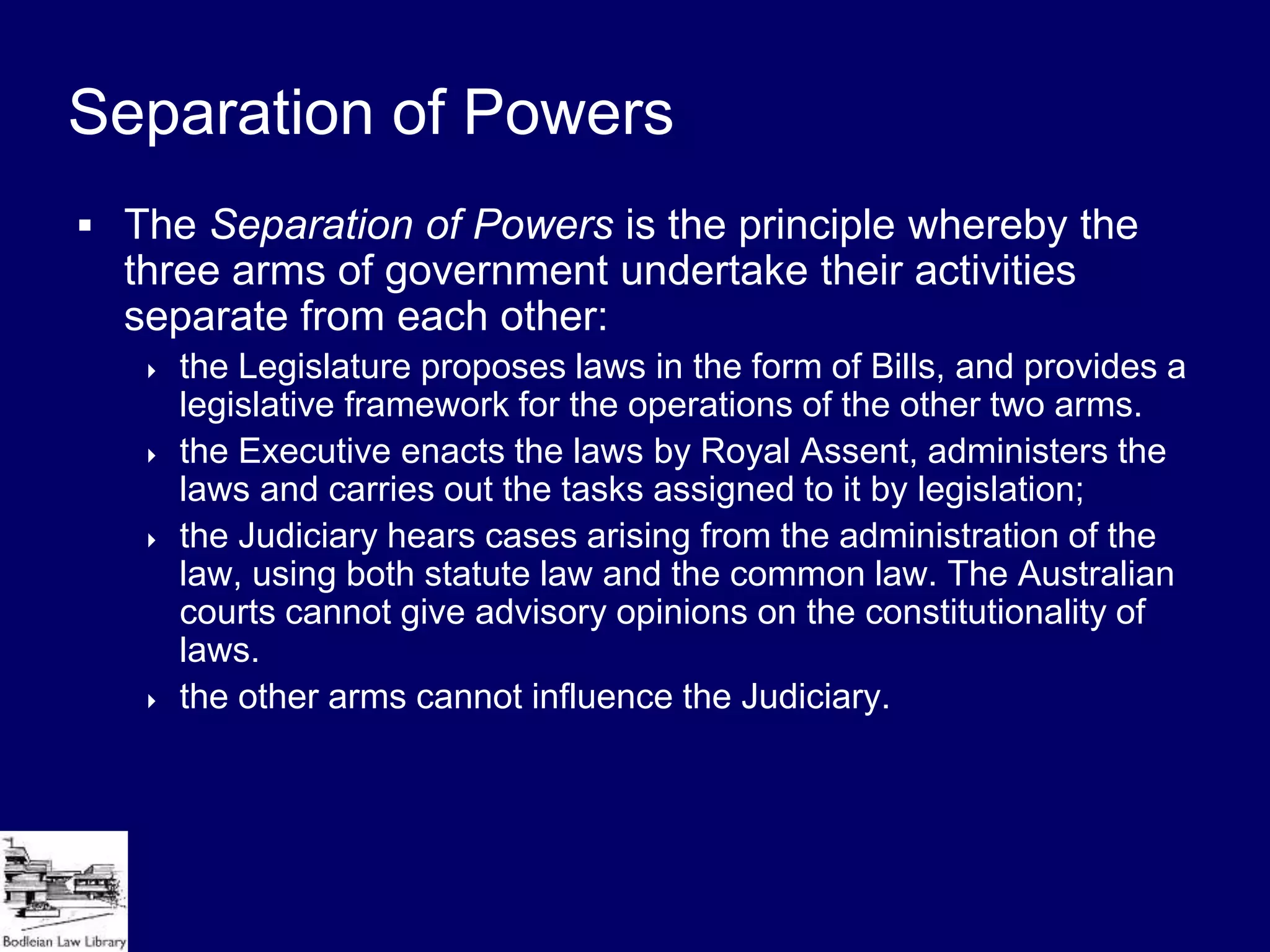
Separation of Powers
 The Separation of Powers is the principle whereby the
three arms of government undertake their activities
separate from each other:
 the Legislature proposes laws in the form of Bills, and provides a
legislative framework for the operations of the other two arms.
 the Executive enacts the laws by Royal Assent, administers the
laws and carries out the tasks assigned to it by legislation;
 the Judiciary hears cases arising from the administration of the
law, using both statute law and the common law. The Australian
courts cannot give advisory opinions on the constitutionality of
laws.
 the other arms cannot influence the Judiciary.
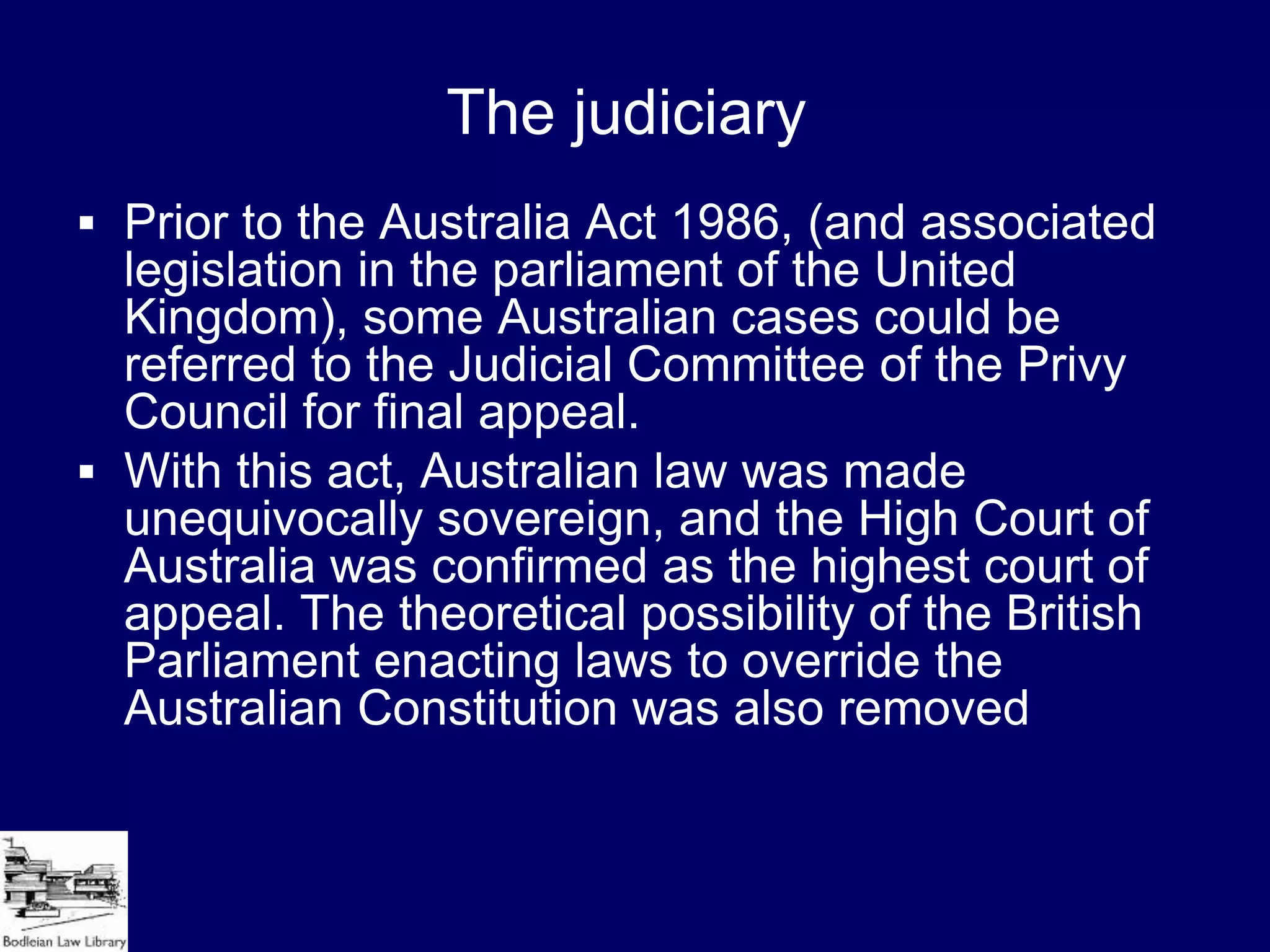
The judiciary
 Prior to the Australia Act 1986, (and associated
legislation in the parliament of the United
Kingdom), some Australian cases could be
referred to the Judicial Committee of the Privy
Council for final appeal.
 With this act, Australian law was made
unequivocally sovereign, and the High Court of
Australia was confirmed as the highest court of
appeal. The theoretical possibility of the British
Parliament enacting laws to override the
Australian Constitution was also removed
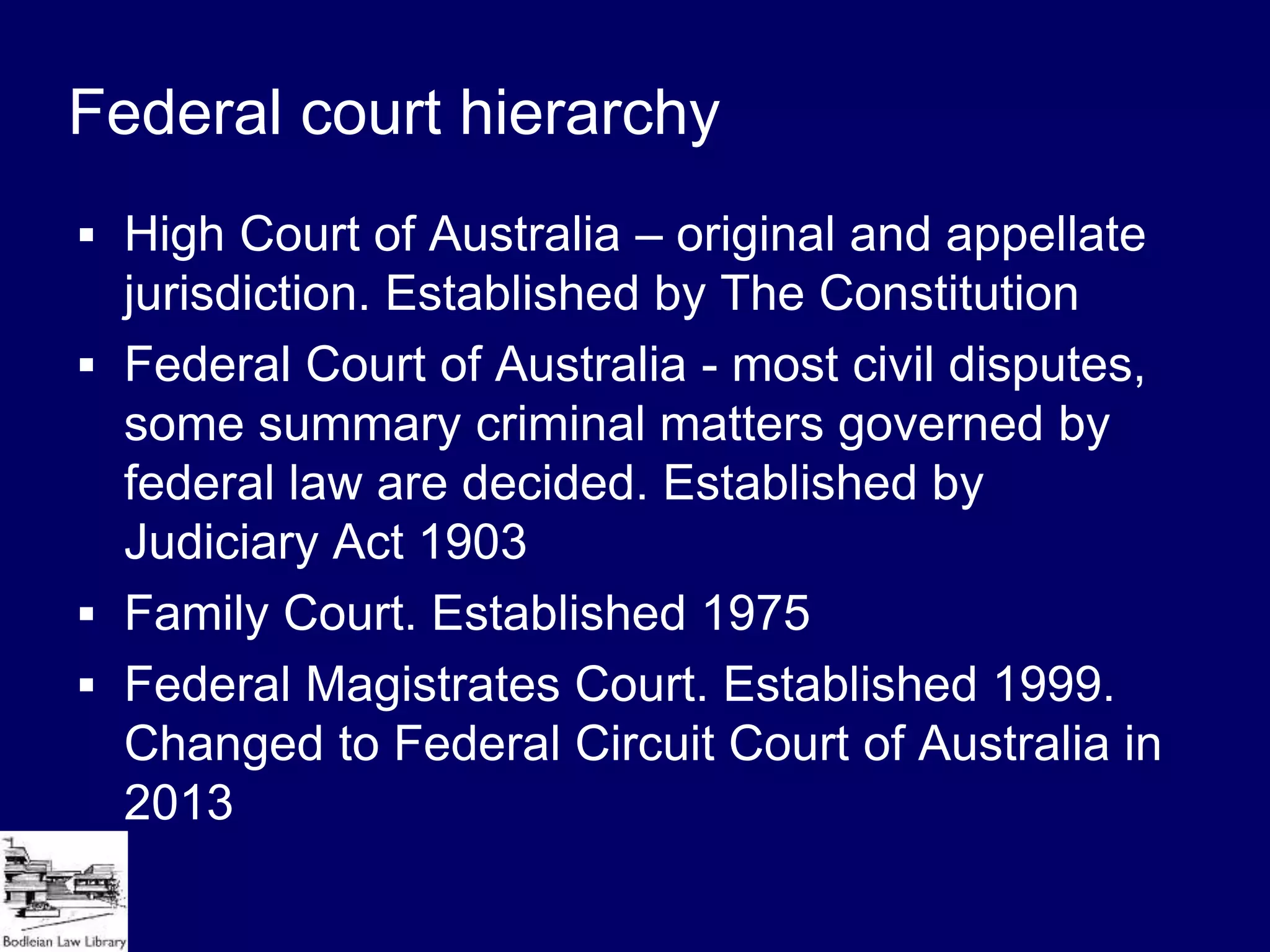
Federal court hierarchy
 High Court of Australia – original and appellate
jurisdiction. Established by The Constitution
 Federal Court of Australia - most civil disputes,
some summary criminal matters governed by
federal law are decided. Established by
Judiciary Act 1903
 Family Court. Established 1975
 Federal Magistrates Court. Established 1999.
Changed to Federal Circuit Court of Australia in
2013
State Court hierarchy
 Supreme Court in each State, with original and
appellate jurisdiction.
 District or County Courts
 Magistrates Courts
 Small claims courts
 Cross vesting powers apply – Full HC decisions
are binding on Full Court of each Supreme Court
Other bodies
 Administrative Appeals Tribunal
 Native Title Tribunal
 Industrial bodies
Court reports
 High Court – Commonwealth Law Reports
(authorised) & Australian Law Reports
(unauthorised)
 Federal Court – Federal Court Reports
(authorised) & Federal Law Reports
(unauthorised)
 Each State Supreme Court produces an
authorised series of law reports
Parliament – www.aph.gov.au
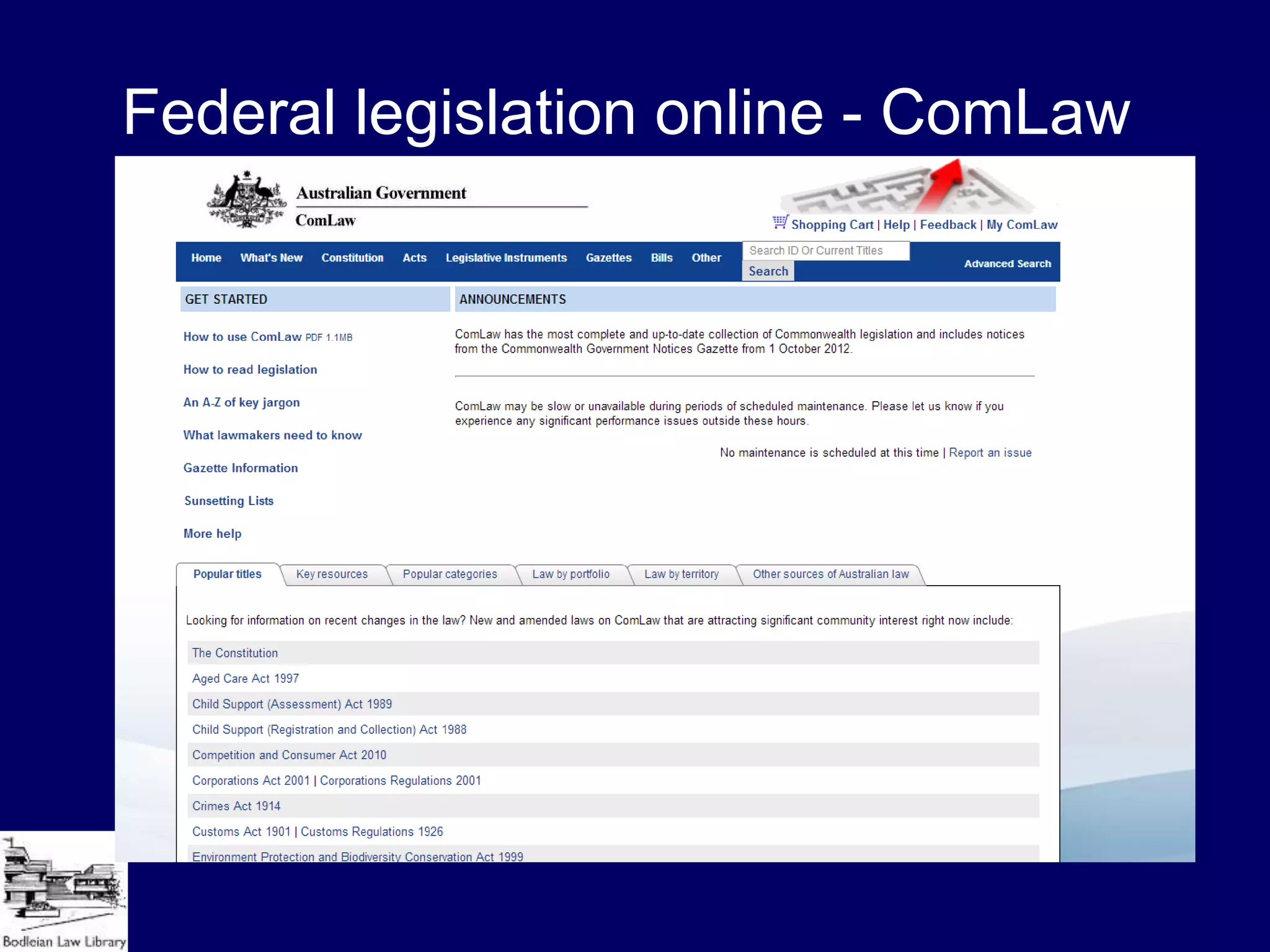
Federal legislation online - ComLaw
State governments, eg:
Caselaw online via Austlii

Australian legal system

  • 1.
  • 3.
    Australia – afederal system with 9 jurisdictions
  • 4.
  • 5.
    Constitution  An Actto constitute the Commonwealth of Australia [9th July 1900](63 & 64 Victoria - Chapter 12)  No Bill of Rights  Changes can only be by referendum carried by majority of voters and majority of states
  • 6.
    Federal Government  Parliament- bicameral  Senate - States house – 12 senators per state, 2 per territory – 76 total • Proportional representation voting system  House of Representatives – People’s house – 150 members, 1 per electorate based on population • Preferential voting system
  • 7.
    Division of powers Australian Constitution s. 51 defines federal powers:  interstate trade and commerce power  corporations power  external affairs power  taxation power  military defence  quarantine  census  currency  weights and measures
  • 8.
    ..more federal powers Service and execution of court processes and the recognition of judgements  Naturalisation and aliens and immigration  Powers for implementation of a uniform railway system  Postal, telegraphic, telephonic, and like services  Pensions and social services  Pacific relations  The influx of criminals  ‘Special laws’ for people of any race  Marriage and divorce  Copyright, patents, and trade marks  Bankruptcy  Bills of exchange  Banking (other than state banking)  Insurance other than state insurance  Conciliation and arbitration of industrial disputes
  • 9.
    Executive power  Executivepower – vested in the Queen of Australia, represented by the Governor General (Federal) or Governor (each state).  Legislation must be signed by the Governor in Council  Executive Council – in theory all ministers of the Crown
  • 10.
    State government  EachState and 2 territories (NT & ACT) has a parliament – lower house usually named Legislative Assembly; upper house is Legislative Council  All bicameral apart from Qld  Leader of government is called Premier  Preferential voting
  • 11.
    State powers  Stateshave all powers that are not specified in the Constitution – the residual powers, eg policing, public schools, roads and traffic, public hospitals (through an agreement with the federal government), public housing, and business regulation.  Uniform laws in some areas between States  Federal law takes precedence where there is overlap  States receive GST tax
  • 12.
    Australian Territories  Mainlandteritories  ACT (self governing)  NT (self governing)  Jervis Bay Territory  External territories  Ashmore and Cartier Islands  Norfolk Island (self governing)  Christmas Island  Cocos (Keeling) Islands  Coral Sea Islands Territory  Heard and McDonald Islands  Australian Antarctic Territory
  • 13.
    Local government  565local government bodies in Australia - a diverse range of metropolitan, regional, rural, and Indigenous communities.  Responsibilities can include:  infrastructure and property services, including local roads, bridges, footpaths, drainage, waste collection and management  provision of recreation facilities, such as parks, sports fields and stadiums, golf courses, swimming pools, sport centres, halls, camping grounds and caravan parks  health services such as water and food inspection, immunisation services, toilet facilities, noise control and meat inspection and animal control
  • 14.
    continued…  community services,such as child care, aged care and accommodation, community care and welfare services  building services, including inspections, licensing, certification and enforcement  planning and development approval  administration of facilities, such as airports and aerodromes, ports and marinas, cemeteries, parking facilities and street parking;  cultural facilities and services, such as libraries, art galleries and museums  water and sewerage services in some states  other services, such as abattoirs, sale-yards and group purchasing schemes
  • 15.
    Separation of Powers The Separation of Powers is the principle whereby the three arms of government undertake their activities separate from each other:  the Legislature proposes laws in the form of Bills, and provides a legislative framework for the operations of the other two arms.  the Executive enacts the laws by Royal Assent, administers the laws and carries out the tasks assigned to it by legislation;  the Judiciary hears cases arising from the administration of the law, using both statute law and the common law. The Australian courts cannot give advisory opinions on the constitutionality of laws.  the other arms cannot influence the Judiciary.
  • 16.
    The judiciary  Priorto the Australia Act 1986, (and associated legislation in the parliament of the United Kingdom), some Australian cases could be referred to the Judicial Committee of the Privy Council for final appeal.  With this act, Australian law was made unequivocally sovereign, and the High Court of Australia was confirmed as the highest court of appeal. The theoretical possibility of the British Parliament enacting laws to override the Australian Constitution was also removed
  • 17.
    Federal court hierarchy High Court of Australia – original and appellate jurisdiction. Established by The Constitution  Federal Court of Australia - most civil disputes, some summary criminal matters governed by federal law are decided. Established by Judiciary Act 1903  Family Court. Established 1975  Federal Magistrates Court. Established 1999. Changed to Federal Circuit Court of Australia in 2013
  • 18.
    State Court hierarchy Supreme Court in each State, with original and appellate jurisdiction.  District or County Courts  Magistrates Courts  Small claims courts  Cross vesting powers apply – Full HC decisions are binding on Full Court of each Supreme Court
  • 19.
    Other bodies  AdministrativeAppeals Tribunal  Native Title Tribunal  Industrial bodies
  • 20.
    Court reports  HighCourt – Commonwealth Law Reports (authorised) & Australian Law Reports (unauthorised)  Federal Court – Federal Court Reports (authorised) & Federal Law Reports (unauthorised)  Each State Supreme Court produces an authorised series of law reports
  • 21.
  • 22.
  • 23.
  • 24.