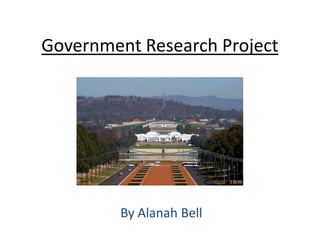
Government Research Project


         By Alanah Bell
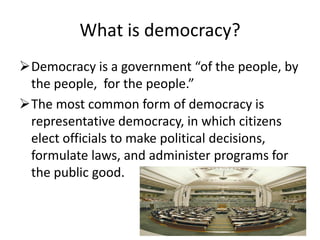
What is democracy?
Democracy is a government “of the people, by
 the people, for the people.”
The most common form of democracy is
 representative democracy, in which citizens
 elect officials to make political decisions,
 formulate laws, and administer programs for
 the public good.
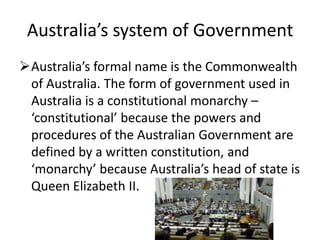
Australia’s system of Government
Australia’s formal name is the Commonwealth
 of Australia. The form of government used in
 Australia is a constitutional monarchy –
 ‘constitutional’ because the powers and
 procedures of the Australian Government are
 defined by a written constitution, and
 ‘monarchy’ because Australia’s head of state is
 Queen Elizabeth II.
Federal Government
Roles & Responsibilities:
There are three ‘arms’ of the Australian Government:
 The parliament is responsible for debating and voting
  on new laws to be introduced.
 The executive is responsible for enacting and upholding
  the laws established by the parliament.
 The judiciary is the legal arm of the Australian
  Government. It is independent of the other two arms,
  and is responsible for enforcing the laws and deciding
  whether the other two arms are acting within their
  powers.
State Government
Roles & Responsibilities:
 Each state has its own state Constitution, which divides
  the state's government into the same divisions of
  legislature (parliament), executive, and judiciary as the
  Australian Government.
 The six state parliaments are permitted to pass laws
  related to any matter that is not controlled by the
  Commonwealth.
 The monarch's powers over state matters are exercised
  by a Governor in each state. The head of each state
  government is known as the Premier.
Local Government
Roles & Responsibilities:
 The six states and the Northern Territory have
   established one further level of government.
 Local governments (also known as local councils)
   handle community needs like:
   waste collection
   public recreation facilities
   town planning
How are Australian laws made?
 The parliaments in Australia are responsible for making laws. The
  Australian system is based on the process developed in England
  within what is called the Westminster System.
 Westminster Parliaments are divided into a lower house and an
  upper house.
 At a federal level, the lower house is known as the House of
  Representatives and the upper house is known as the Senate
 Before an item of legislation becomes a law, it exists as a bill
  proposed to parliament. A bill is a proposal for a new law, or a
  proposal to change an existing law.
 In most cases, bills are introduced into the lower house of
  parliament.
 Bills are then discussed and either rejected or passed to the upper
  house. In the upper house the bill is discussed again and is either
  made a new law or thrown out.
How does the Australian voting system
              work?
 Australia uses a voting system called preferential
  voting. Under this system, voters rank each candidate
  in order of their preference.
 When votes are tallied, if no candidate has a majority
  of votes, the candidate with the fewest first
  preferences is eliminated from the count, and his or
  her votes are re-allocated according to the preferences
  on the ballot papers.
 After this has occurred, the process is repeated until
  one candidate receives a majority of all votes cast, at
  which point they are declared elected.
How does the Australian voting system
       support democracy?
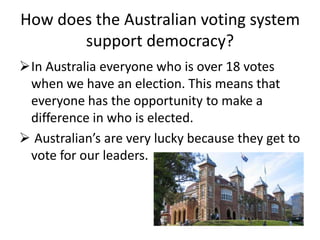
In Australia everyone who is over 18 votes
 when we have an election. This means that
 everyone has the opportunity to make a
 difference in who is elected.
 Australian’s are very lucky because they get to
 vote for our leaders.

Government Research Project

  • 1.
  • 2.
    What is democracy? Democracyis a government “of the people, by the people, for the people.” The most common form of democracy is representative democracy, in which citizens elect officials to make political decisions, formulate laws, and administer programs for the public good.
  • 3.
    Australia’s system ofGovernment Australia’s formal name is the Commonwealth of Australia. The form of government used in Australia is a constitutional monarchy – ‘constitutional’ because the powers and procedures of the Australian Government are defined by a written constitution, and ‘monarchy’ because Australia’s head of state is Queen Elizabeth II.
  • 4.
    Federal Government Roles &Responsibilities: There are three ‘arms’ of the Australian Government:  The parliament is responsible for debating and voting on new laws to be introduced.  The executive is responsible for enacting and upholding the laws established by the parliament.  The judiciary is the legal arm of the Australian Government. It is independent of the other two arms, and is responsible for enforcing the laws and deciding whether the other two arms are acting within their powers.
  • 5.
    State Government Roles &Responsibilities:  Each state has its own state Constitution, which divides the state's government into the same divisions of legislature (parliament), executive, and judiciary as the Australian Government.  The six state parliaments are permitted to pass laws related to any matter that is not controlled by the Commonwealth.  The monarch's powers over state matters are exercised by a Governor in each state. The head of each state government is known as the Premier.
  • 6.
    Local Government Roles &Responsibilities:  The six states and the Northern Territory have established one further level of government.  Local governments (also known as local councils) handle community needs like:  waste collection  public recreation facilities  town planning
  • 7.
    How are Australianlaws made?  The parliaments in Australia are responsible for making laws. The Australian system is based on the process developed in England within what is called the Westminster System.  Westminster Parliaments are divided into a lower house and an upper house.  At a federal level, the lower house is known as the House of Representatives and the upper house is known as the Senate  Before an item of legislation becomes a law, it exists as a bill proposed to parliament. A bill is a proposal for a new law, or a proposal to change an existing law.  In most cases, bills are introduced into the lower house of parliament.  Bills are then discussed and either rejected or passed to the upper house. In the upper house the bill is discussed again and is either made a new law or thrown out.
  • 8.
    How does theAustralian voting system work?  Australia uses a voting system called preferential voting. Under this system, voters rank each candidate in order of their preference.  When votes are tallied, if no candidate has a majority of votes, the candidate with the fewest first preferences is eliminated from the count, and his or her votes are re-allocated according to the preferences on the ballot papers.  After this has occurred, the process is repeated until one candidate receives a majority of all votes cast, at which point they are declared elected.
  • 9.
    How does theAustralian voting system support democracy? In Australia everyone who is over 18 votes when we have an election. This means that everyone has the opportunity to make a difference in who is elected.  Australian’s are very lucky because they get to vote for our leaders.