1.Introduction
2. History of Brazil and Sugar Age
3. Political Background
4. Government system, Institutions and Branches
5. Political parties
6.Interest Group
History of Brazil
• A country made up of many ethnic backgrounds
• Immigrants who came to Brazil were Portuguese or Italian
• The first person to discover Brazil was the Portuguese
explorer, Pedro Alvaras Cabral
• It remained a colony of Portugal until September 7, 1822.
Brazil declared its independence from Portugal.
Sugar Age
• Brazil was of little interest to Portugal for resources profit
• In the beginning of sixteenth century, planting sugar cane
became the biggest economy for Brazilian
• 35 percent of all slaves exported in the Atlantic slave trade
were brought to Brazil
Brazil Political Background
• 26 states
• The president leads to three branches
• The presidential system was established in 1889
• The Constitution of Brazil, along with several constitutional
amendment
• Brazil became military dictatorship in 1964 to 1985 and new
democratic constitution took effect in 1988 and it had
replace.
Three types of federal tiers Of Brazil
1. The Central Government (Unions)
1. The state Government
1. Local government (municipality)
Each 26 states elect governors, representatives of state legislature called
Legislative assembly.
President is both The head of state and the
head of Government.
The president and vice president serve for 4
years term.
The Senate
The Senate represents the 26 states and
the Federal District. Each state and the
Federal District has a representation of three
Senators, who are elected by popular ballot
for a term of eight years.
Seats are allotted proportionally according to
each state's population, with each state
eligible for a minimum of 8 seats (least
populous) and a maximum of 70 seats (most
populous). Unlike the Senate, the whole of
the Chamber of Deputies is renewed every
four years.
President is both The head of state and the head
of Government.
The Executive Branch
- Modify the number of troops in the Armed Forces
- Appoint and dismiss Ministers
- Maintain relations with foreign States and accredit
their diplomatic representatives;
Power
- Has to be a citizen of Brazil above 21 years
- Assist the president
- Submit the annual report on his administration of
Ministry of the president of the Republic
Ministers
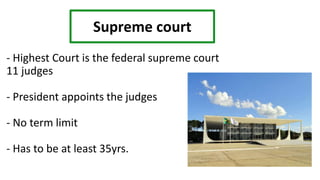
- Highest Court is the federal supreme court
11 judges
- President appoints the judges
- No term limit
- Has to be at least 35yrs.
Supreme court
- Protects and safeguards the constitution.
Possess direct action against the other two branches.
- Can dismiss President.
Functions Of Judiciary Branch
Federal Supreme Court
The National Council of Justice
The Superior Tribunal of Justice
Federal Justice
Labor Justice
Electoral Justice
Military Justice and the state Justice
Judiciary
President
Requirements.
- Native-born citizen of Brazil, at least 35 years of age
- Resident of Brazil in full exercise of their electoral rights
- Registered voter
- Member of a political party
Term limit
- The president of Brazil serves for a term of four years, elected for a single
consecutive term.
Executive branch
- The president is elected by ballot votes and he or she will hold executive
power.
- Executive power is exercised by the executive, headed by the President
- Advised by a Cabinet of Ministers
Chamber of Deputies
- 513 members
- Elected by a direct ballot
- Term of eight years
- Having districts assigned by
proportion to the population.
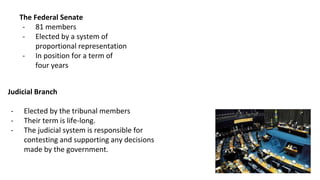
The Federal Senate
- 81 members
- Elected by a system of
proportional representation
- In position for a term of
four years
Judicial Branch
- Elected by the tribunal members
- Their term is life-long.
- The judicial system is responsible for
contesting and supporting any decisions
made by the government.
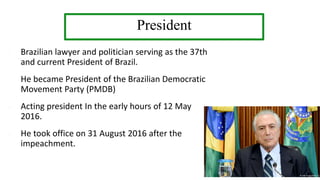
President
- Brazilian lawyer and politician serving as the 37th
and current President of Brazil.
- He became President of the Brazilian Democratic
Movement Party (PMDB)
- Acting president In the early hours of 12 May
2016.
- He took office on 31 August 2016 after the
impeachment.
Background
● In 1965, military transformed the multiparty system into a two party
system ( DN and PSD)
● 1974 election, to hold onto votes, military stepped up spending for
agricultural credit,, low-income housing, and basic sanitation program.
● In1979, it ease the restriction on the formation of political party in order to
split advancing MDB.
● ARENA leader formed the Party of the Brazilian Democratic Movement (
PMDB). Others small parties were competing within opposition.
● After democracy transition, brazil’s communist parties were legalized and
many more parties were found.
What do we need to Know ?
● Has own Republican Party and intrastate
● State oligarchies were supported by powerful local bosses
and largest landowners
● Coronelismo
● Pro and anti – Vargas lines.
● PTB espoused a vague platform of nationalism and
populism.
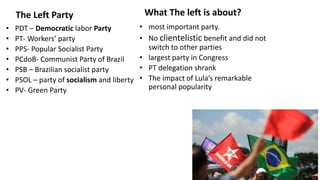
The Left Party What The left is about?
• PDT – Democratic labor Party
• PT- Workers’ party
• PPS- Popular Socialist Party
• PCdoB- Communist Party of Brazil
• PSB – Brazilian socialist party
• PSOL – party of socialism and liberty
• PV- Green Party
• most important party.
• No clientelistic benefit and did not
switch to other parties
• largest party in Congress
• PT delegation shrank
• The impact of Lula’s remarkable
personal popularity
The Centre What the Centre is about
• PMDB party of the Brazilian
Democratic movement
• PSDB Party of Brazilian social
democracy
• Brazilian Democratic movement
• largest party
• has no ideology and organized as a
loose federation of regional party
branches run by political bosses
• PSDB broke of PMDB in 1988. later, the
PSDB became center- left party
• It is third largest party in Congress
• major political figures in the state of
Sao Paulo,
The Right What the Right is about
• Dem- Democrats
• PP- Progressive Party
• RTB- Brazilian Labor Party
• PR- Party of the Republic
• PSD- Social Democratic Party
• PSC – Social Christian Party
• Others
• Prominent party is Dem and called (PEL ) -
Party of the Liberal Front (PEL )
• Allied with the PSDP in almost all elections
since 1994
• Only two state governors, but it had the
fourth largest delegation in Congress with
51 members.
• The new Social democratic party ( PSD) in
2011
Some other information
• Progressive party, is significant conservative party. It is pro-business and economic
reform party root in PDS)
• Other parties in the right include PTB and and PR, which was reformed in the take of
the 1979 party reform law, shared of legislative seats shrink steadily over the years to
less than 5%.
• It absorbed 2 minor parties after the 2006 election. PR resulted from the merge of the
PL ( liberal party) that later allied with PT government and suffered from the
corruption scandal that engulfed the government and the rightist party of the
reconstruction of national Order ( PRONA). Several very small parties on the right
remain including ultra conservative ones.
• Party of the right have opposed agrarian reform, liberalization of abortion laws, and
tend to adopt a strong law and order stance. Since they are small they support PSDB
Cardoso and Lula ( PT ) government. Telling party share decrease in the same period
from 45 percent to 36 percent.
Electoral System
Three different electoral systems
1. Presidential election and Runoff
2. “First past the post”
They need only win a plurality of the vote to gain office and no
runoff election.
3. open list proportional representation with multimember
districts
Presidential election and Runoff
● The president , state governors and mayors of cities with at
least 200,000 voters are elected by majority vote.
● In the event that no candidate captures 50 percent of the vote
in a first round, a runoff election is held between the top two
vote getters.
Open list proportional representation with
multimember districts
Federal and State deputies and local
More than one representative is elected per district which in
federal and state races is the state itself. Deputies represent and
draw votes from their entire states councilors proportional
representation system, the number of seats in a legislature or
local council awarded to each party is based on the share of the
total vote that candidates for each party receive.
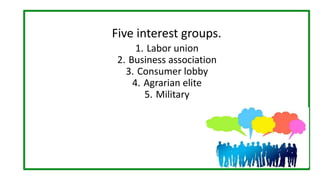
Five interest groups.
1. Labor union
2. Business association
3. Consumer lobby
4. Agrarian elite
5. Military
Labor union.
1. The purpose of the labor union is to promote a certain
balance between exploiter and exploited (employer and
employee).
2. They want to stop exploitation of women and Children.
3. Their activities was to attempt to stand up for
themselves against employer’s abuses.
Benefits from labor union.
1. College tuition discount
2. Health insurance
3. Partnership with several educational institutions
4. Drug stores discounts
Business association
Three types of business association
I. Commercial association
II. Factory association.
III. Industry association.
Purpose of association
Increasing prosperity and complexity of Brazil's international
trade and later the significant growth of manufacturing.
Intermediaries between the overseas merchant and the
export producer.
Consumer organization.
THE CONSUMER PROTECTION CODE (CDC)
The CDC was created by legal order, actually from a constitutional
commandment, and not as a result of a social movement.
Their main aim is to : “The National Consumption Relationship Policies
have as their objective, the service of consumer’s needs, the respect to
their dignity, health and safety, the protection of their economic
interests, the improvement of their quality of life, as well as the
transparency and harmony of consumption relations.”
Agrarian Elite
1. The most powerful association in Brazil.
2. Agriculture elites have network of sect-oral Federation
such as the Federation of sugar industry that belong to
the official system of interest groups.
3. Large landowners organized public demonstration to
defeat an amendment to the constitution reform.
4. Landowner are playing crucial role in shaping live of rural
people in countryside.
Military
1. The military is one if the most powerful and lest
effective one.
2. They are considered as less civil authorities to supervise
its expenditure, arms procurement.
3. Military prestige and budget have decline and military
ideology were influenced by cold war.
4. GDP fell 2.7% in 1989 and 1.5% in 1992. salaries fell,
equipment aged, and moral sagged.
5. Fight within subversion of the Brazil border.
SUCCESS OF MILITARY
1. Human right initiatives by the Cardoso and Lula administration,
revisiting those torture and disappearing of political prisoner under the
military regime in 1964 to 1985.
2. Lula government went further and awarding posthumous pardons to
army officer who left to post to join opposition in 1960s.
3. 2012, there finance improved much more, but still spent 1.5% on the
arm force.
4. With re-democratization, the military tried reorient its mission towards
external affairs.
What do we learn ?
1. The history of Brazil and how the system of government form
2. The deeper vision of political framework of Brazil and Important
branches
3. Political Parties and their major work
4. Current political system and presidential details
5. Interest groups that played role in politic
Brazil : Comparative Political Systems

Brazil : Comparative Political Systems

  • 2.
    1.Introduction 2. History ofBrazil and Sugar Age 3. Political Background 4. Government system, Institutions and Branches 5. Political parties 6.Interest Group
  • 3.
    History of Brazil •A country made up of many ethnic backgrounds • Immigrants who came to Brazil were Portuguese or Italian • The first person to discover Brazil was the Portuguese explorer, Pedro Alvaras Cabral • It remained a colony of Portugal until September 7, 1822. Brazil declared its independence from Portugal.
  • 4.
    Sugar Age • Brazilwas of little interest to Portugal for resources profit • In the beginning of sixteenth century, planting sugar cane became the biggest economy for Brazilian • 35 percent of all slaves exported in the Atlantic slave trade were brought to Brazil
  • 5.
    Brazil Political Background •26 states • The president leads to three branches • The presidential system was established in 1889 • The Constitution of Brazil, along with several constitutional amendment • Brazil became military dictatorship in 1964 to 1985 and new democratic constitution took effect in 1988 and it had replace.
  • 7.
    Three types offederal tiers Of Brazil 1. The Central Government (Unions) 1. The state Government 1. Local government (municipality) Each 26 states elect governors, representatives of state legislature called Legislative assembly.
  • 8.
    President is bothThe head of state and the head of Government. The president and vice president serve for 4 years term.
  • 9.
    The Senate The Senaterepresents the 26 states and the Federal District. Each state and the Federal District has a representation of three Senators, who are elected by popular ballot for a term of eight years.
  • 10.
    Seats are allottedproportionally according to each state's population, with each state eligible for a minimum of 8 seats (least populous) and a maximum of 70 seats (most populous). Unlike the Senate, the whole of the Chamber of Deputies is renewed every four years.
  • 11.
    President is bothThe head of state and the head of Government. The Executive Branch
  • 12.
    - Modify thenumber of troops in the Armed Forces - Appoint and dismiss Ministers - Maintain relations with foreign States and accredit their diplomatic representatives; Power
  • 13.
    - Has tobe a citizen of Brazil above 21 years - Assist the president - Submit the annual report on his administration of Ministry of the president of the Republic Ministers
  • 14.
    - Highest Courtis the federal supreme court 11 judges - President appoints the judges - No term limit - Has to be at least 35yrs. Supreme court
  • 15.
    - Protects andsafeguards the constitution. Possess direct action against the other two branches. - Can dismiss President. Functions Of Judiciary Branch
  • 16.
    Federal Supreme Court TheNational Council of Justice The Superior Tribunal of Justice Federal Justice Labor Justice Electoral Justice Military Justice and the state Justice Judiciary
  • 18.
    President Requirements. - Native-born citizenof Brazil, at least 35 years of age - Resident of Brazil in full exercise of their electoral rights - Registered voter - Member of a political party Term limit - The president of Brazil serves for a term of four years, elected for a single consecutive term.
  • 19.
    Executive branch - Thepresident is elected by ballot votes and he or she will hold executive power. - Executive power is exercised by the executive, headed by the President - Advised by a Cabinet of Ministers
  • 20.
    Chamber of Deputies -513 members - Elected by a direct ballot - Term of eight years - Having districts assigned by proportion to the population. The Federal Senate - 81 members - Elected by a system of proportional representation - In position for a term of four years Judicial Branch - Elected by the tribunal members - Their term is life-long. - The judicial system is responsible for contesting and supporting any decisions made by the government.
  • 21.
    President - Brazilian lawyerand politician serving as the 37th and current President of Brazil. - He became President of the Brazilian Democratic Movement Party (PMDB) - Acting president In the early hours of 12 May 2016. - He took office on 31 August 2016 after the impeachment.
  • 22.
    Background ● In 1965,military transformed the multiparty system into a two party system ( DN and PSD) ● 1974 election, to hold onto votes, military stepped up spending for agricultural credit,, low-income housing, and basic sanitation program. ● In1979, it ease the restriction on the formation of political party in order to split advancing MDB. ● ARENA leader formed the Party of the Brazilian Democratic Movement ( PMDB). Others small parties were competing within opposition. ● After democracy transition, brazil’s communist parties were legalized and many more parties were found.
  • 23.
    What do weneed to Know ? ● Has own Republican Party and intrastate ● State oligarchies were supported by powerful local bosses and largest landowners ● Coronelismo ● Pro and anti – Vargas lines. ● PTB espoused a vague platform of nationalism and populism.
  • 24.
    The Left PartyWhat The left is about? • PDT – Democratic labor Party • PT- Workers’ party • PPS- Popular Socialist Party • PCdoB- Communist Party of Brazil • PSB – Brazilian socialist party • PSOL – party of socialism and liberty • PV- Green Party • most important party. • No clientelistic benefit and did not switch to other parties • largest party in Congress • PT delegation shrank • The impact of Lula’s remarkable personal popularity
  • 25.
    The Centre Whatthe Centre is about • PMDB party of the Brazilian Democratic movement • PSDB Party of Brazilian social democracy • Brazilian Democratic movement • largest party • has no ideology and organized as a loose federation of regional party branches run by political bosses • PSDB broke of PMDB in 1988. later, the PSDB became center- left party • It is third largest party in Congress • major political figures in the state of Sao Paulo,
  • 26.
    The Right Whatthe Right is about • Dem- Democrats • PP- Progressive Party • RTB- Brazilian Labor Party • PR- Party of the Republic • PSD- Social Democratic Party • PSC – Social Christian Party • Others • Prominent party is Dem and called (PEL ) - Party of the Liberal Front (PEL ) • Allied with the PSDP in almost all elections since 1994 • Only two state governors, but it had the fourth largest delegation in Congress with 51 members. • The new Social democratic party ( PSD) in 2011
  • 27.
    Some other information •Progressive party, is significant conservative party. It is pro-business and economic reform party root in PDS) • Other parties in the right include PTB and and PR, which was reformed in the take of the 1979 party reform law, shared of legislative seats shrink steadily over the years to less than 5%. • It absorbed 2 minor parties after the 2006 election. PR resulted from the merge of the PL ( liberal party) that later allied with PT government and suffered from the corruption scandal that engulfed the government and the rightist party of the reconstruction of national Order ( PRONA). Several very small parties on the right remain including ultra conservative ones. • Party of the right have opposed agrarian reform, liberalization of abortion laws, and tend to adopt a strong law and order stance. Since they are small they support PSDB Cardoso and Lula ( PT ) government. Telling party share decrease in the same period from 45 percent to 36 percent.
  • 28.
    Electoral System Three differentelectoral systems 1. Presidential election and Runoff 2. “First past the post” They need only win a plurality of the vote to gain office and no runoff election. 3. open list proportional representation with multimember districts
  • 29.
    Presidential election andRunoff ● The president , state governors and mayors of cities with at least 200,000 voters are elected by majority vote. ● In the event that no candidate captures 50 percent of the vote in a first round, a runoff election is held between the top two vote getters.
  • 30.
    Open list proportionalrepresentation with multimember districts Federal and State deputies and local More than one representative is elected per district which in federal and state races is the state itself. Deputies represent and draw votes from their entire states councilors proportional representation system, the number of seats in a legislature or local council awarded to each party is based on the share of the total vote that candidates for each party receive.
  • 31.
    Five interest groups. 1.Labor union 2. Business association 3. Consumer lobby 4. Agrarian elite 5. Military
  • 32.
    Labor union. 1. Thepurpose of the labor union is to promote a certain balance between exploiter and exploited (employer and employee). 2. They want to stop exploitation of women and Children. 3. Their activities was to attempt to stand up for themselves against employer’s abuses.
  • 33.
    Benefits from laborunion. 1. College tuition discount 2. Health insurance 3. Partnership with several educational institutions 4. Drug stores discounts
  • 34.
    Business association Three typesof business association I. Commercial association II. Factory association. III. Industry association. Purpose of association Increasing prosperity and complexity of Brazil's international trade and later the significant growth of manufacturing. Intermediaries between the overseas merchant and the export producer.
  • 35.
    Consumer organization. THE CONSUMERPROTECTION CODE (CDC) The CDC was created by legal order, actually from a constitutional commandment, and not as a result of a social movement. Their main aim is to : “The National Consumption Relationship Policies have as their objective, the service of consumer’s needs, the respect to their dignity, health and safety, the protection of their economic interests, the improvement of their quality of life, as well as the transparency and harmony of consumption relations.”
  • 36.
    Agrarian Elite 1. Themost powerful association in Brazil. 2. Agriculture elites have network of sect-oral Federation such as the Federation of sugar industry that belong to the official system of interest groups. 3. Large landowners organized public demonstration to defeat an amendment to the constitution reform. 4. Landowner are playing crucial role in shaping live of rural people in countryside.
  • 37.
    Military 1. The militaryis one if the most powerful and lest effective one. 2. They are considered as less civil authorities to supervise its expenditure, arms procurement. 3. Military prestige and budget have decline and military ideology were influenced by cold war. 4. GDP fell 2.7% in 1989 and 1.5% in 1992. salaries fell, equipment aged, and moral sagged. 5. Fight within subversion of the Brazil border.
  • 38.
    SUCCESS OF MILITARY 1.Human right initiatives by the Cardoso and Lula administration, revisiting those torture and disappearing of political prisoner under the military regime in 1964 to 1985. 2. Lula government went further and awarding posthumous pardons to army officer who left to post to join opposition in 1960s. 3. 2012, there finance improved much more, but still spent 1.5% on the arm force. 4. With re-democratization, the military tried reorient its mission towards external affairs.
  • 39.
    What do welearn ? 1. The history of Brazil and how the system of government form 2. The deeper vision of political framework of Brazil and Important branches 3. Political Parties and their major work 4. Current political system and presidential details 5. Interest groups that played role in politic