Introduction to the Australian
        Legal System
    Stuff happens – ‘ci mi jiak tok’
  (in Nuer as provided by Peter Pal)
Two ways of making law
1. Statute Law
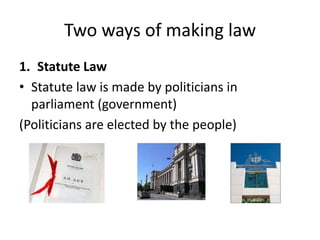
• Statute law is made by politicians in
  parliament (government)
(Politicians are elected by the people)
Two ways of making law
2. Common Law
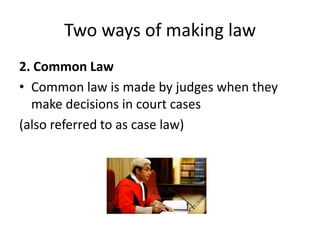
• Common law is made by judges when they
  make decisions in court cases
(also referred to as case law)
Different types of law
         Criminal and Civil

Criminal law
• Set out in the Crimes Act and enforced by the
  police. The government acts for everyone
  against (versus) a person who breaks the law.
Aim
• to punish the person who broke the law
(called the accused before decision by the court)
Criminal law-examples
• Crimes against the person – assault, rape,
  manslaughter, murder
• Crimes against property – theft, vandalism,
  robbery, fraud
• Crimes against morality – illegal drugs,
  prostitution
• Traffic Law – speeding, drink-driving.????
Different types of law
Civil Law (part of Common law)
• Used by individuals or companies who have a
  problem (dispute) with other individuals,
  companies or governments – often involves
  money
Aim
• to solve the problem by restoring rights to the
  person who has lost them or who has suffered in
  some way e.g. negligence by an employer
(person who starts the action is called the plaintiff)
Civil law-examples
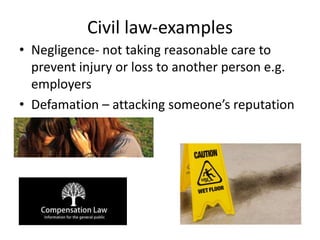
• Negligence- not taking reasonable care to
  prevent injury or loss to another person e.g.
  employers
• Defamation – attacking someone’s reputation
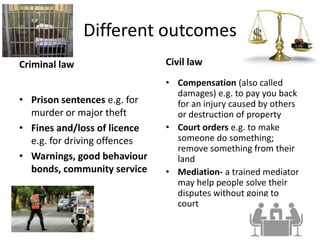
Different outcomes
Criminal law                  Civil law
                              • Compensation (also called
                                damages) e.g. to pay you back
• Prison sentences e.g. for     for an injury caused by others
  murder or major theft         or destruction of property
• Fines and/loss of licence   • Court orders e.g. to make
  e.g. for driving offences     someone do something;
                                remove something from their
• Warnings, good behaviour      land
  bonds, community service    • Mediation- a trained mediator
                                may help people solve their
                                disputes without going to
                                court
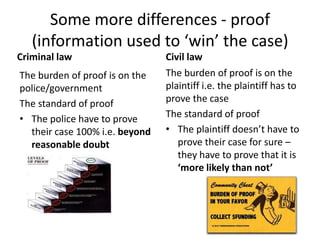
Some more differences - proof
   (information used to ‘win’ the case)
Criminal law                    Civil law
The burden of proof is on the   The burden of proof is on the
police/government               plaintiff i.e. the plaintiff has to
The standard of proof           prove the case
• The police have to prove      The standard of proof
  their case 100% i.e. beyond   • The plaintiff doesn’t have to
  reasonable doubt                 prove their case for sure –
                                   they have to prove that it is
                                   ‘more likely than not’
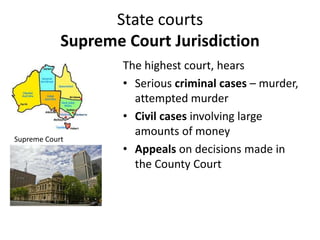
State courts
            Supreme Court Jurisdiction
                    The highest court, hears
                    • Serious criminal cases – murder,
                      attempted murder
                    • Civil cases involving large
                      amounts of money
Supreme Court
                    • Appeals on decisions made in
                      the County Court
State courts
County Court Jurisdiction

      • Less serious criminal cases – drug
        trafficking, serious assaults, rape
      • Civil cases which involve
        substantial amounts of money
      • Appeals against decisions by the
        Magistrates’ Court
State courts
Magistrates’ Court Jurisdiction
        • Less serious criminal cases- robbery,
          theft
        • Less serious civil cases – up to $100,
          000- negligence, contract disputes,
          neighbourhood disputes
        • deals with over 90% of criminal and civil
          matters. The first stop for most cases
          and then refers them to higher courts if
          there is enough evidence
        • Summary offences – traffic fines, minor
          assaults, property damage, offensive
          behaviour
        • No jury, one judge
State courts
              Magistrates’ Court
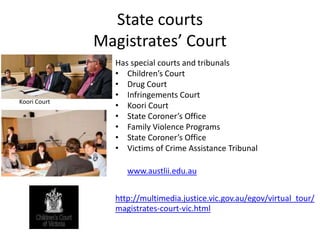
                Has special courts and tribunals
                • Children’s Court
                • Drug Court
                • Infringements Court
Koori Court
                • Koori Court
                • State Coroner’s Office
                • Family Violence Programs
                • State Coroner’s Office
                • Victims of Crime Assistance Tribunal

                   www.austlii.edu.au


                http://multimedia.justice.vic.gov.au/egov/virtual_tour/
                magistrates-court-vic.html
A quick test
A criminal case                         A civil case
Scenario                                Scenario
You come home and find that
someone has stolen $2000 from your      You lend someone $200 and they
bedroom cupboard                        say that they do not owe you the
Questions                               money. Can you get it back?
1. Who can help you with your
    case?                               Questions
2. What do you need to win your         1. Who can help you with your
    case? What are some examples?
                                            case?
You can find answers here
Remember, even if you win a             2. What do you need to win
criminal case, you might not get your       your case? What could be
money back!                                 some examples?
Quick test-Answers
Criminal case                      Civil case
1. The police. If the police are   1. You could pay lawyers to
   involved it is a criminal           help you.
   NOT a civil matter. The         2. You need evidence e.g.
   police could charge the            – A receipt for the money
   person with theft. The             – A signed contract in which the
   government will provide              other person agrees to pay
   lawyers as well.                     you back
2. You need evidence e.g. a           – Witnesses to the loan
   witness (someone who
   saw the money taken)
A scenario – is this a civil or a criminal
                  case?
You have just returned home after shopping at the local
shopping centre. You were walking home but tripped
and fell and much of the shopping fell on to the road and
has been spoiled.
You have hurt your back. Just before you fell, you were
distracted by a dog that jumped up on you before it was
called away by its owner (you are frightened of dogs).
The footpath where you fell was uneven. You are not
sure whether you fell because the footpath was uneven
or because of the dog. You were probably carrying too
much shopping and you already have back problems.
Is this a civil or a criminal case?
                    Answer
• It is a civil case – you might be able to sue
  (make a claim against) either the council for
  not looking after the footpath OR the dog
  owner for not controlling their dog
What do you need to sue?
Good evidence- for example:
• A doctor’s report after the accident
• A witness (someone who saw the incident),
  maybe they saw the dog off the leash?
• Did you get the dog owner’s name? (evidence)
• A report of the uneven footpath to local
  government – maybe there had been other
  complaints?
Deciding to sue

Questions to ask
• Why sue? To get a legal outcome
Do you remember the legal outcomes for civil law?
• Will I be successful? Do you remember what is
  needed to win your case?
• Is it worth it? Even if you think you might win, it
  might cost you more money to pay lawyers than
  you get back in compensation.

2013 session1 introduction-to-australian-legal-system2

  • 1.
    Introduction to theAustralian Legal System Stuff happens – ‘ci mi jiak tok’ (in Nuer as provided by Peter Pal)
  • 2.
    Two ways ofmaking law 1. Statute Law • Statute law is made by politicians in parliament (government) (Politicians are elected by the people)
  • 3.
    Two ways ofmaking law 2. Common Law • Common law is made by judges when they make decisions in court cases (also referred to as case law)
  • 4.
    Different types oflaw Criminal and Civil Criminal law • Set out in the Crimes Act and enforced by the police. The government acts for everyone against (versus) a person who breaks the law. Aim • to punish the person who broke the law (called the accused before decision by the court)
  • 5.
    Criminal law-examples • Crimesagainst the person – assault, rape, manslaughter, murder • Crimes against property – theft, vandalism, robbery, fraud • Crimes against morality – illegal drugs, prostitution • Traffic Law – speeding, drink-driving.????
  • 6.
    Different types oflaw Civil Law (part of Common law) • Used by individuals or companies who have a problem (dispute) with other individuals, companies or governments – often involves money Aim • to solve the problem by restoring rights to the person who has lost them or who has suffered in some way e.g. negligence by an employer (person who starts the action is called the plaintiff)
  • 7.
    Civil law-examples • Negligence-not taking reasonable care to prevent injury or loss to another person e.g. employers • Defamation – attacking someone’s reputation
  • 8.
    Different outcomes Criminal law Civil law • Compensation (also called damages) e.g. to pay you back • Prison sentences e.g. for for an injury caused by others murder or major theft or destruction of property • Fines and/loss of licence • Court orders e.g. to make e.g. for driving offences someone do something; remove something from their • Warnings, good behaviour land bonds, community service • Mediation- a trained mediator may help people solve their disputes without going to court
  • 9.
    Some more differences- proof (information used to ‘win’ the case) Criminal law Civil law The burden of proof is on the The burden of proof is on the police/government plaintiff i.e. the plaintiff has to The standard of proof prove the case • The police have to prove The standard of proof their case 100% i.e. beyond • The plaintiff doesn’t have to reasonable doubt prove their case for sure – they have to prove that it is ‘more likely than not’
  • 10.
    State courts Supreme Court Jurisdiction The highest court, hears • Serious criminal cases – murder, attempted murder • Civil cases involving large amounts of money Supreme Court • Appeals on decisions made in the County Court
  • 11.
    State courts County CourtJurisdiction • Less serious criminal cases – drug trafficking, serious assaults, rape • Civil cases which involve substantial amounts of money • Appeals against decisions by the Magistrates’ Court
  • 12.
    State courts Magistrates’ CourtJurisdiction • Less serious criminal cases- robbery, theft • Less serious civil cases – up to $100, 000- negligence, contract disputes, neighbourhood disputes • deals with over 90% of criminal and civil matters. The first stop for most cases and then refers them to higher courts if there is enough evidence • Summary offences – traffic fines, minor assaults, property damage, offensive behaviour • No jury, one judge
  • 13.
    State courts Magistrates’ Court Has special courts and tribunals • Children’s Court • Drug Court • Infringements Court Koori Court • Koori Court • State Coroner’s Office • Family Violence Programs • State Coroner’s Office • Victims of Crime Assistance Tribunal www.austlii.edu.au http://multimedia.justice.vic.gov.au/egov/virtual_tour/ magistrates-court-vic.html
  • 14.
    A quick test Acriminal case A civil case Scenario Scenario You come home and find that someone has stolen $2000 from your You lend someone $200 and they bedroom cupboard say that they do not owe you the Questions money. Can you get it back? 1. Who can help you with your case? Questions 2. What do you need to win your 1. Who can help you with your case? What are some examples? case? You can find answers here Remember, even if you win a 2. What do you need to win criminal case, you might not get your your case? What could be money back! some examples?
  • 15.
    Quick test-Answers Criminal case Civil case 1. The police. If the police are 1. You could pay lawyers to involved it is a criminal help you. NOT a civil matter. The 2. You need evidence e.g. police could charge the – A receipt for the money person with theft. The – A signed contract in which the government will provide other person agrees to pay lawyers as well. you back 2. You need evidence e.g. a – Witnesses to the loan witness (someone who saw the money taken)
  • 16.
    A scenario –is this a civil or a criminal case? You have just returned home after shopping at the local shopping centre. You were walking home but tripped and fell and much of the shopping fell on to the road and has been spoiled. You have hurt your back. Just before you fell, you were distracted by a dog that jumped up on you before it was called away by its owner (you are frightened of dogs). The footpath where you fell was uneven. You are not sure whether you fell because the footpath was uneven or because of the dog. You were probably carrying too much shopping and you already have back problems.
  • 17.
    Is this acivil or a criminal case? Answer • It is a civil case – you might be able to sue (make a claim against) either the council for not looking after the footpath OR the dog owner for not controlling their dog
  • 18.
    What do youneed to sue? Good evidence- for example: • A doctor’s report after the accident • A witness (someone who saw the incident), maybe they saw the dog off the leash? • Did you get the dog owner’s name? (evidence) • A report of the uneven footpath to local government – maybe there had been other complaints?
  • 19.
    Deciding to sue Questionsto ask • Why sue? To get a legal outcome Do you remember the legal outcomes for civil law? • Will I be successful? Do you remember what is needed to win your case? • Is it worth it? Even if you think you might win, it might cost you more money to pay lawyers than you get back in compensation.