































Resolving Disputes
Section 2 - Individual and the Law
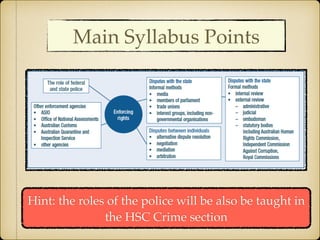
Main Syllabus Points
Hint: the roles of the police will be also be taught in
the HSC Crime section
Law Enforcement
Agencies
The main law enforcement agencies in
Australia are the state and federal police
The difference between the two:
State police enforce the criminal law of the
state within the state’s borders
Federal police enforce federal criminal law, and
criminal law where it crosses state boundaries
Law Enforcement (Powers
and Responsibilities) Act 2002
(NSW). This code covers:
police powers to stop,
search and detain people
police powers to enter and
search premises and seize
property
police powers to arrest,
detain and question
suspects
NSW Police
NSW Police are mainly concerned with criminal
law covered under The Crimes Act 1900 (NSW)
NSW Police also assist with Apprehended Violence
Orders (AVO’s) involving disputes between people
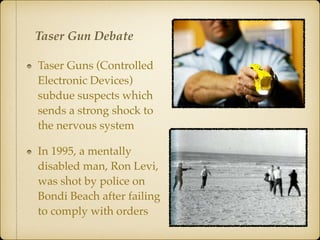
Taser Guns (Controlled
Electronic Devices)
subdue suspects which
sends a strong shock to
the nervous system
In 1995, a mentally
disabled man, Ron Levi,
was shot by police on
Bondi Beach after failing
to comply with orders
Taser Gun Debate
Taser Gun Debate
Roberto Curti Taser Death
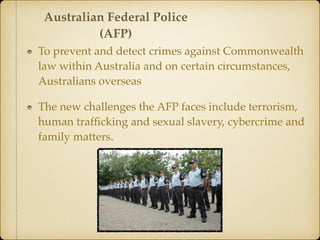
To prevent and detect crimes against Commonwealth
law within Australia and on certain circumstances,
Australians overseas
The new challenges the AFP faces include terrorism,
human trafficking and sexual slavery, cybercrime and
family matters.
Australian Federal Police
(AFP)
The main concerns:
Immigration
Quarantine
Family Law
Law Enforcement
Australian Customs and
Border Security
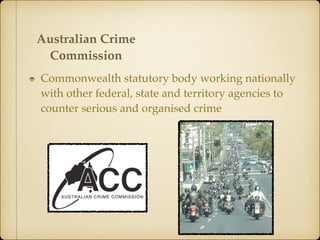
Commonwealth statutory body working nationally
with other federal, state and territory agencies to
counter serious and organised crime
Australian Crime
Commission
Hosted by the AFP
combat serious and complex
crimes involving computer
technology, such as online
fraud, mule recruitment, and
offensive and prohibited
internet content
Computer crime is protected
under the Criminal Code
1995 (Cth)
Australian High
Tech Crime Centre
Established in 1949 acting under the ASIO Act
1979 (Cth)
Espionage (spying), sabotage, politically
motivated violence, and attacks on our nation’s
defence systems
Australian Security
Intelligence Organisation
(ASIO)
ASIO
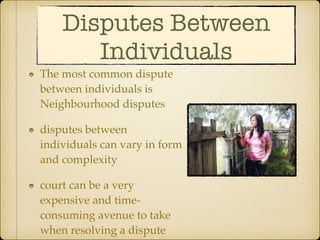
Disputes Between
Individuals
The most common dispute
between individuals is
Neighbourhood disputes
disputes between
individuals can vary in form
and complexity
court can be a very
expensive and time-
consuming avenue to take
when resolving a dispute
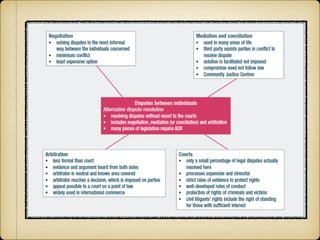
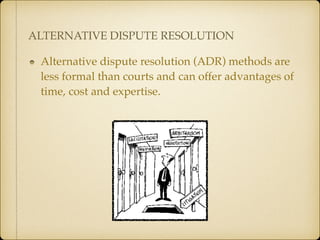
Alternative dispute resolution (ADR) methods are
less formal than courts and can offer advantages
of time, cost and expertise.
ALTERNATIVE DISPUTE RESOLUTION
Neighbour Disputes
Discussion between
two or more parties
with the aim of
reaching a mutually
beneficial outcome
The first stage of
resolving a dispute
between parties
1. NEGOTIATION
Mediation and conciliation
are similar processes and
are usually confidential
Both processes involve a
neutral third party who
helps the parties to
negotiate and reach a
decision
The parties may also have
their own legal advisers
2. MEDIATION AND
CONCILIATION
Arbitration is a formal dispute resolution
process in which two or more parties refer
their dispute to an independent third person
(the arbitrator) for determination
EXAMPLE: The NSW teachers’ dispute
with the Department of Education and
Training in 2008–09
3. ARBITRATION
ACA Media Perspective
Specialised court with the same jurisdiction
as the supreme court. The LEC hears cases
involving local council, criminal law to the
environment and planning disputes. ADR is
integrated within this court.
Trees (Disputes Between Neighbours) Act
2006 (NSW). 

Land and Environment Court
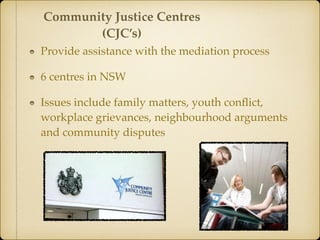
Provide assistance with the mediation process
6 centres in NSW
Issues include family matters, youth conflict,
workplace grievances, neighbourhood arguments
and community disputes
Community Justice Centres
(CJC’s)
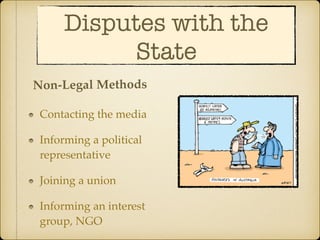
Disputes with the
State
Contacting the media
Informing a political
representative
Joining a union
Informing an interest
group, NGO
Non-Legal Methods
Disputes with the
State
`
1. The Media
Alan Jones Life and Times
What Alan has said……
Alan Jones Influence on Politics
click here for 2016 radio ratings
Interview with Alan
Jones
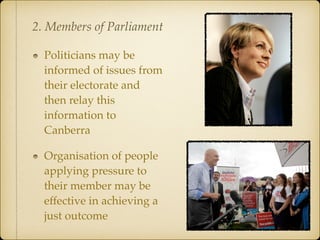
Politicians may be
informed of issues from
their electorate and
then relay this
information to
Canberra
Organisation of people
applying pressure to
their member may be
effective in achieving a
just outcome
2. Members of Parliament
Support workers rights
with their employer
Help negotiate workplace
agreements
Strikes are considered a
last resort if conciliation
and arbitration fail
3. Trade Unions
People can join interest groups that share the
same political views
4. Interest Groups, NGO’s
Get Up - Lobby Group
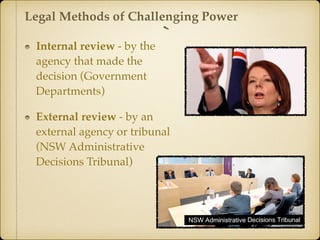
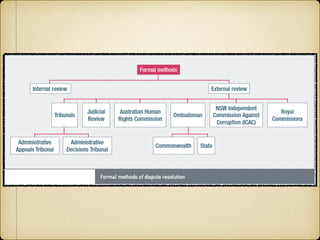
`Internal review - by the
agency that made the
decision (Government
Departments)
External review - by an
external agency or tribunal
(NSW Administrative
Decisions Tribunal)
Legal Methods of Challenging Power
Internal Review - Govt
Established after
the Wood Royal
Commission in
1996. Independent
from the NSW
police force
Its prime function is
to detect,
investigate and
prevent police
misconduct
Police Integrity Commission
Four Corners - Internal Review PIC
Administrative decisions made by the Australian
Government and has quasi-judicial review powers
It can be reviewed by the Australian Federal Court
Established under the Administrative Appeals
Tribunal Act 1975 (Cth)
The Administrative
Appeals Tribunal
Has been in operation since 1998 and operates under
the Administrative Decisions Tribunal Act 1997
(NSW)
Its main purpose is to hear discrimination disputes
within Government Departments
The Administrative
Decisions Tribunal
of NSW
‘citizens’ defender’
Formal external control, with legal power to
investigate complaints made by citizens
Complaints are taken seriously, but are only
followed through if a prima facie case exists
The Ombudsman
The Ombudsman NSW
1. Anti-Discrimination Board of NSW (ADB)
Part of the NSW Attorney General’s
Department
Anti-Discrimination Act 1977 (NSW)
disability, age, race and sex
Statutory Bodies
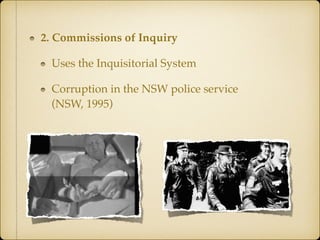
2. Commissions of Inquiry
Uses the Inquisitorial System
Corruption in the NSW police service
(NSW, 1995)
Royal Commission into Institutional
Responses to Child Sexual Abuse 2013
3. Independent Commission Against Corruption
(ICAC)
Protect the interests of the public, prevent
breaches of public trust, and influence the
behaviour of public officials. E.G. The Obeid
case.
Eddie Obeid ICAC
NSW Govt ICAC
Barry O’Farrell ICAC
Andrew Bolt ICAC
4. Human Rights Commission (AHRC)
The Human Rights and Equal Opportunity
Commission Act 1986 (Cth)
Promotes tolerant, equitable and democratic
society, promoting areas of Human Rights

Resolving Disputes

  • 1.
    Resolving Disputes Section 2- Individual and the Law
  • 2.
    Main Syllabus Points Hint:the roles of the police will be also be taught in the HSC Crime section
  • 4.
    Law Enforcement Agencies The mainlaw enforcement agencies in Australia are the state and federal police The difference between the two: State police enforce the criminal law of the state within the state’s borders Federal police enforce federal criminal law, and criminal law where it crosses state boundaries
  • 5.
    Law Enforcement (Powers andResponsibilities) Act 2002 (NSW). This code covers: police powers to stop, search and detain people police powers to enter and search premises and seize property police powers to arrest, detain and question suspects NSW Police
  • 6.
    NSW Police aremainly concerned with criminal law covered under The Crimes Act 1900 (NSW) NSW Police also assist with Apprehended Violence Orders (AVO’s) involving disputes between people
  • 7.
    Taser Guns (Controlled ElectronicDevices) subdue suspects which sends a strong shock to the nervous system In 1995, a mentally disabled man, Ron Levi, was shot by police on Bondi Beach after failing to comply with orders Taser Gun Debate
  • 8.
  • 9.
  • 10.
    To prevent anddetect crimes against Commonwealth law within Australia and on certain circumstances, Australians overseas The new challenges the AFP faces include terrorism, human trafficking and sexual slavery, cybercrime and family matters. Australian Federal Police (AFP)
  • 11.
    The main concerns: Immigration Quarantine FamilyLaw Law Enforcement Australian Customs and Border Security
  • 12.
    Commonwealth statutory bodyworking nationally with other federal, state and territory agencies to counter serious and organised crime Australian Crime Commission
  • 13.
    Hosted by theAFP combat serious and complex crimes involving computer technology, such as online fraud, mule recruitment, and offensive and prohibited internet content Computer crime is protected under the Criminal Code 1995 (Cth) Australian High Tech Crime Centre
  • 14.
    Established in 1949acting under the ASIO Act 1979 (Cth) Espionage (spying), sabotage, politically motivated violence, and attacks on our nation’s defence systems Australian Security Intelligence Organisation (ASIO)
  • 15.
  • 16.
    Disputes Between Individuals The mostcommon dispute between individuals is Neighbourhood disputes disputes between individuals can vary in form and complexity court can be a very expensive and time- consuming avenue to take when resolving a dispute
  • 18.
    Alternative dispute resolution(ADR) methods are less formal than courts and can offer advantages of time, cost and expertise. ALTERNATIVE DISPUTE RESOLUTION
  • 19.
  • 20.
    Discussion between two ormore parties with the aim of reaching a mutually beneficial outcome The first stage of resolving a dispute between parties 1. NEGOTIATION
  • 21.
    Mediation and conciliation aresimilar processes and are usually confidential Both processes involve a neutral third party who helps the parties to negotiate and reach a decision The parties may also have their own legal advisers 2. MEDIATION AND CONCILIATION
  • 22.
    Arbitration is aformal dispute resolution process in which two or more parties refer their dispute to an independent third person (the arbitrator) for determination EXAMPLE: The NSW teachers’ dispute with the Department of Education and Training in 2008–09 3. ARBITRATION
  • 23.
  • 24.
    Specialised court withthe same jurisdiction as the supreme court. The LEC hears cases involving local council, criminal law to the environment and planning disputes. ADR is integrated within this court. Trees (Disputes Between Neighbours) Act 2006 (NSW). 
 Land and Environment Court
  • 26.
    Provide assistance withthe mediation process 6 centres in NSW Issues include family matters, youth conflict, workplace grievances, neighbourhood arguments and community disputes Community Justice Centres (CJC’s)
  • 27.
    Disputes with the State Contactingthe media Informing a political representative Joining a union Informing an interest group, NGO Non-Legal Methods Disputes with the State
  • 28.
  • 29.
    Alan Jones Lifeand Times
  • 30.
    What Alan hassaid……
  • 31.
  • 32.
    click here for2016 radio ratings
  • 33.
  • 34.
    Politicians may be informedof issues from their electorate and then relay this information to Canberra Organisation of people applying pressure to their member may be effective in achieving a just outcome 2. Members of Parliament
  • 35.
    Support workers rights withtheir employer Help negotiate workplace agreements Strikes are considered a last resort if conciliation and arbitration fail 3. Trade Unions
  • 36.
    People can joininterest groups that share the same political views 4. Interest Groups, NGO’s
  • 38.
    Get Up -Lobby Group
  • 39.
    `Internal review -by the agency that made the decision (Government Departments) External review - by an external agency or tribunal (NSW Administrative Decisions Tribunal) Legal Methods of Challenging Power
  • 40.
  • 42.
    Established after the WoodRoyal Commission in 1996. Independent from the NSW police force Its prime function is to detect, investigate and prevent police misconduct Police Integrity Commission
  • 43.
    Four Corners -Internal Review PIC
  • 44.
    Administrative decisions madeby the Australian Government and has quasi-judicial review powers It can be reviewed by the Australian Federal Court Established under the Administrative Appeals Tribunal Act 1975 (Cth) The Administrative Appeals Tribunal
  • 45.
    Has been inoperation since 1998 and operates under the Administrative Decisions Tribunal Act 1997 (NSW) Its main purpose is to hear discrimination disputes within Government Departments The Administrative Decisions Tribunal of NSW
  • 46.
    ‘citizens’ defender’ Formal externalcontrol, with legal power to investigate complaints made by citizens Complaints are taken seriously, but are only followed through if a prima facie case exists The Ombudsman
  • 47.
  • 48.
    1. Anti-Discrimination Boardof NSW (ADB) Part of the NSW Attorney General’s Department Anti-Discrimination Act 1977 (NSW) disability, age, race and sex Statutory Bodies
  • 49.
    2. Commissions ofInquiry Uses the Inquisitorial System Corruption in the NSW police service (NSW, 1995) Royal Commission into Institutional Responses to Child Sexual Abuse 2013
  • 50.
    3. Independent CommissionAgainst Corruption (ICAC) Protect the interests of the public, prevent breaches of public trust, and influence the behaviour of public officials. E.G. The Obeid case.
  • 51.
  • 52.
  • 53.
  • 54.
  • 55.
    4. Human RightsCommission (AHRC) The Human Rights and Equal Opportunity Commission Act 1986 (Cth) Promotes tolerant, equitable and democratic society, promoting areas of Human Rights