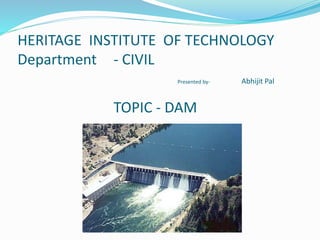
HERITAGE INSTITUTE OF TECHNOLOGY
Department - CIVIL
Presented by- Abhijit Pal
TOPIC - DAM
OUTLINE
 What is a Dam
 Structure of Dam
 Purposes of Dam
 Selection of Dam sites
 Classification of Dam
 On structure
 Dam failure
 Disadvantages of Dams
 Conclusion
 Bibliography
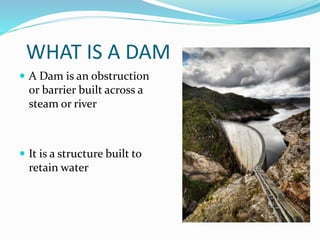
WHAT IS A DAM
 A Dam is an obstruction
or barrier built across a
steam or river
 It is a structure built to
retain water
STRUCTURE OF DAM
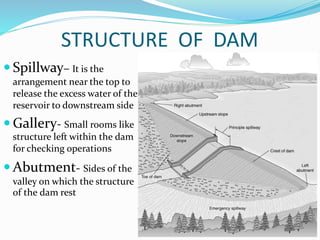
 Heel- contact with
the ground on the
upstream side
 Toe– contact on the
downstream side
 Sluiceway- An
opening in the dam near
the ground level, which
is used to clear the silt
accumulation in the
reservoir side
STRUCTURE OF DAM
 Spillway– It is the
arrangement near the top to
release the excess water of the
reservoir to downstream side
 Gallery- Small rooms like
structure left within the dam
for checking operations
 Abutment- Sides of the
valley on which the structure
of the dam rest
PURPOSES OF DAM
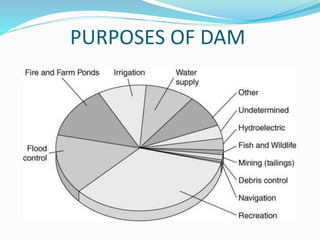
 Water supply- Dams gather drinking water for people
 Flood control- Dams keep areas from flooding
 Irrigation- Dams help farmers bring water to their farms
 Hydroelectric- Dams help create power and electricity
from water
 Navigation- Dams create lakes for people to sail on from
one part to another
 Recreation- Dams can be used for swimming
PURPOSES OF DAM
SELECTION OF DAM SITES
 Topography
 Geology
 Material availability
 Spillway size and location
 Communication
 Locality land and population
CLASSIFICATION OF DAM
ON STRUCTURE
 Arch Dam
 Gravity Dam
 Buttress Dam
 Embankment Dam
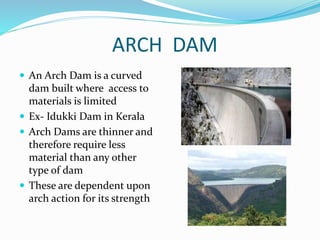
ARCH DAM
 An Arch Dam is a curved
dam built where access to
materials is limited
 Ex- Idukki Dam in Kerala
 Arch Dams are thinner and
therefore require less
material than any other
type of dam
 These are dependent upon
arch action for its strength
ARC DAM
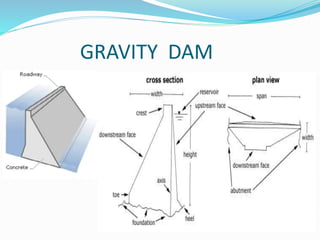
GRAVITY DAM
 Gravity Dams resist the
horizontal thrust of the
water entirely by their own
weight
 Ex- Dworshak Dam in
Idaho
 Gravity Dams are typically
used to block streams
through narrow gorges
GRAVITY DAM
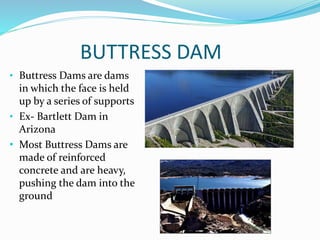
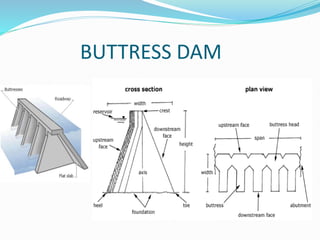
BUTTRESS DAM
• Buttress Dams are dams
in which the face is held
up by a series of supports
• Ex- Bartlett Dam in
Arizona
• Most Buttress Dams are
made of reinforced
concrete and are heavy,
pushing the dam into the
ground
BUTTRESS DAM
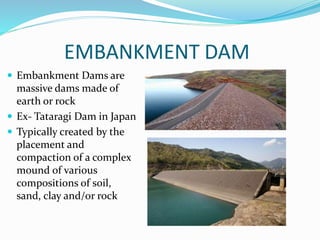
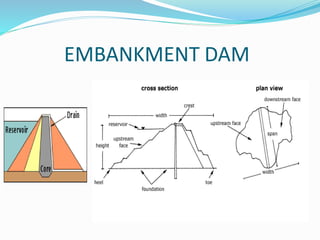
EMBANKMENT DAM
 Embankment Dams are
massive dams made of
earth or rock
 Ex- Tataragi Dam in Japan
 Typically created by the
placement and
compaction of a complex
mound of various
compositions of soil,
sand, clay and/or rock
EMBANKMENT DAM
DAM FAILURE
 Faults in construction
methods eg-Teton Dam in
Idaho, USA in 1976
 Geological problems with the
dam foundation eg- St.Francis
dam
 Landslides which fall into the
storage reservoir eg- Vaiont
Dam in Italy in 1963
DAM FAILURE
 Earthquakes can certainly
cause damage to dams eg-
Lower San Fernando Dam
 Dangerous alterations to the
operation of the dam and/or
its structure may lead to
failure eg- South Fork
Dam (Johnstown) in 1889
DISADVANTAGES OF DAMS
The natural environment
is destroyed
The building of large dams
can cause serious
geological damage
Dams have endangered
some species of fish,
inhibited the seasonal
migration of fish
Displaces people
CONCLUSION
 Dams support 30%-40% of the irrigated area and 12%-
16% of the global food production
 Thus dams can be a source of huge profit both in terms
of fresh water resource and generation of electric
power
 Therefore construction of dams should be made
keeping in mind its long terms of service
BIBLIOGRAPHY
 Engineering Geology by Parbin Singh
 www.dams.com
 www.google.com/dams

Dam - Classification based on structure

  • 1.
    HERITAGE INSTITUTE OFTECHNOLOGY Department - CIVIL Presented by- Abhijit Pal TOPIC - DAM
  • 2.
    OUTLINE  What isa Dam  Structure of Dam  Purposes of Dam  Selection of Dam sites  Classification of Dam  On structure  Dam failure  Disadvantages of Dams  Conclusion  Bibliography
  • 3.
    WHAT IS ADAM  A Dam is an obstruction or barrier built across a steam or river  It is a structure built to retain water
  • 4.
    STRUCTURE OF DAM Heel- contact with the ground on the upstream side  Toe– contact on the downstream side  Sluiceway- An opening in the dam near the ground level, which is used to clear the silt accumulation in the reservoir side
  • 5.
    STRUCTURE OF DAM Spillway– It is the arrangement near the top to release the excess water of the reservoir to downstream side  Gallery- Small rooms like structure left within the dam for checking operations  Abutment- Sides of the valley on which the structure of the dam rest
  • 6.
    PURPOSES OF DAM Water supply- Dams gather drinking water for people  Flood control- Dams keep areas from flooding  Irrigation- Dams help farmers bring water to their farms  Hydroelectric- Dams help create power and electricity from water  Navigation- Dams create lakes for people to sail on from one part to another  Recreation- Dams can be used for swimming
  • 7.
  • 8.
    SELECTION OF DAMSITES  Topography  Geology  Material availability  Spillway size and location  Communication  Locality land and population
  • 9.
    CLASSIFICATION OF DAM ONSTRUCTURE  Arch Dam  Gravity Dam  Buttress Dam  Embankment Dam
  • 10.
    ARCH DAM  AnArch Dam is a curved dam built where access to materials is limited  Ex- Idukki Dam in Kerala  Arch Dams are thinner and therefore require less material than any other type of dam  These are dependent upon arch action for its strength
  • 11.
  • 12.
    GRAVITY DAM  GravityDams resist the horizontal thrust of the water entirely by their own weight  Ex- Dworshak Dam in Idaho  Gravity Dams are typically used to block streams through narrow gorges
  • 13.
  • 14.
    BUTTRESS DAM • ButtressDams are dams in which the face is held up by a series of supports • Ex- Bartlett Dam in Arizona • Most Buttress Dams are made of reinforced concrete and are heavy, pushing the dam into the ground
  • 15.
  • 16.
    EMBANKMENT DAM  EmbankmentDams are massive dams made of earth or rock  Ex- Tataragi Dam in Japan  Typically created by the placement and compaction of a complex mound of various compositions of soil, sand, clay and/or rock
  • 17.
  • 18.
    DAM FAILURE  Faultsin construction methods eg-Teton Dam in Idaho, USA in 1976  Geological problems with the dam foundation eg- St.Francis dam  Landslides which fall into the storage reservoir eg- Vaiont Dam in Italy in 1963
  • 19.
    DAM FAILURE  Earthquakescan certainly cause damage to dams eg- Lower San Fernando Dam  Dangerous alterations to the operation of the dam and/or its structure may lead to failure eg- South Fork Dam (Johnstown) in 1889
  • 20.
    DISADVANTAGES OF DAMS Thenatural environment is destroyed The building of large dams can cause serious geological damage Dams have endangered some species of fish, inhibited the seasonal migration of fish Displaces people
  • 21.
    CONCLUSION  Dams support30%-40% of the irrigated area and 12%- 16% of the global food production  Thus dams can be a source of huge profit both in terms of fresh water resource and generation of electric power  Therefore construction of dams should be made keeping in mind its long terms of service
  • 22.
    BIBLIOGRAPHY  Engineering Geologyby Parbin Singh  www.dams.com  www.google.com/dams