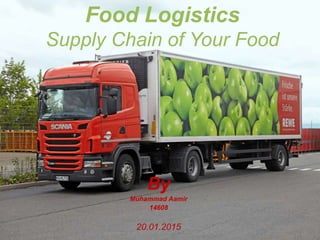
Food Logistics
Supply Chain of Your Food
By
Muhammad Aamir
14608
20.01.2015
Content List
2
1. Introduction
2. What is Supply Chain Management
3. Food Supply Chain
4. Food Catagories
5. Warehousing
6. Processing and Pakaging
7. Transportation
8. Cold Chain Management
9. Usage of Technology in Food Logistics
10. Conclusion
Refrences
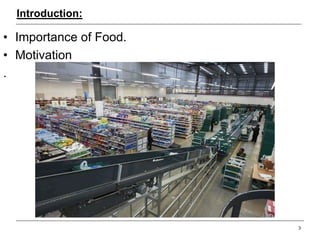
Introduction:
• Importance of Food.
• Motivation
.
3
Supply Chain Management
What is Supply-Chain Management (SCM) ?
 Management of the flow of goods
 Movement and storage of raw materials, work-in-
process inventory, and finished goods from point of
origin to point of consumption.
4
Supply Chain Management
It’s the design, planning, execution, control, and monitoring
of supply chain activities with the objective of creating net
value, building a competitive infrastructure, leveraging
worldwide logistics, synchronizing supply with demand and
measuring performance globally”
5
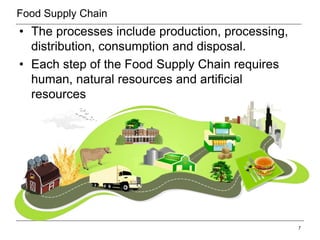
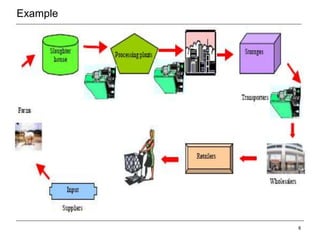
Food Supply Chain:
• Food Supply Chain or Food System refers
to the processes that describe how food
from a farm ends up on our tables.
6
Food Supply Chain
• The processes include production, processing,
distribution, consumption and disposal.
• Each step of the Food Supply Chain requires
human, natural resources and artificial
resources
7
Example
8
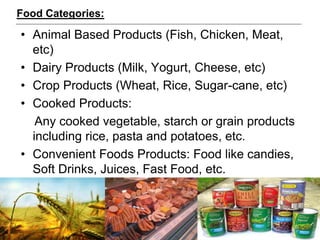
Food Categories:
• Animal Based Products (Fish, Chicken, Meat,
etc)
• Dairy Products (Milk, Yogurt, Cheese, etc)
• Crop Products (Wheat, Rice, Sugar-cane, etc)
• Cooked Products:
Any cooked vegetable, starch or grain products
including rice, pasta and potatoes, etc.
• Convenient Foods Products: Food like candies,
Soft Drinks, Juices, Fast Food, etc.
9
Food Categories
• Frozen Foods
Needs to be to rapid freezing and is kept frozen until
used. Freezing decreases the ability of bacteria’s to
duplicate.
10
Challenges to handle Frozen Food:
• Frozen Foods need special treatment
when they should be transported:
• Always a low or freezing temperature
• Hygienic conditions
• Fast Distribution and JIT – Transportation
to keep the food fresh
11
Warehousing:
12
Food Warehousing:
13
A food warehouse can be a food storage facility of any size,
storing any amount of food for either long or short periods of
time, for distribution in normal food channels. Food
warehouses serve as a critical link in the food chain from the
farmer to processor to distributor to retailer and ultimately to
the consumer.
Types of Warehouses:
1. Dry Storage Warehouses
• Items which need to be kept away from moisture and Humidity
• Temperature is always between 50 and 70 degrees Fahrenheit.
• Temperature Variation can cause damage. Etc canned foods
• Examples rice, oats and grain
14
Food Warehousing
2. Cold or Frozen Warehouses
 Refrigerated or deep-freeze storage facility for perishable goods
such as fruits, vegetables, meats, beverages to prevent rotting,
sprouting, insect damage, and other forms of degradation..
 It maintains a controlled interior temperature as low as - 25°C
 Necessary for logistical reasons, cold storage also enables
seasonal agricultural products to be distributed to retailers across a
much longer season or possibly year-round.
15
KPI´S In Food Warehousing
 Cleanliness..does not grow bacteria, fungus or create any other
health hazardous situations
 Condition of the building... well maintained the building is, the less
likely there will be pests or rodents to contaminate the food,should
not have holes, cracks or other ways for unwanted critters to enter:
 A pest control plan is a must for food grade warehousing inside and
outside of the building
 Building and staff play a big role in finding the right food grade
warehouse
 Food grade warehouses should be registered with the Food
Authorities and up to date with local food safety inspections.
16
Food Processing and Packaging:
Processsing:
 Transformation of ingredients into Food.
 Produce marketable Food Products for Consumer
 Involves activites like Mincing, Liquefication, Cooking;
Preservation, Freezing etc
17
Food Processing and Pakacging
18
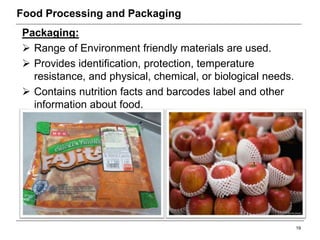
Food Processing and Packaging
Packaging:
 Range of Environment friendly materials are used.
 Provides identification, protection, temperature
resistance, and physical, chemical, or biological needs.
 Contains nutrition facts and barcodes label and other
information about food.
19
Food Processing and Packaging
Some more functions of Packaging:
 Physical Protection.. Shock, Viberation, compression
 Barrier Protection.. Oxygen,Water, Dust
 Contamination..for Small items not to mix etc.Liquids
 Information.. For Use, Transport Recycle etc
 Marketing, Convinience for Distribution, Handling
Stacking
20
Food Processing and Packaging:
Packaging Types:
Primary..provides protecion to the food and information
Secondary..middle Layer of Packaging
Tertiary/ Transit...outer boxes or pallets for Transportation
and distribution
21
Food Processing and Packaging:
22
Example:
Food Processing and Packaging
• https://www.youtube.com/watch?v=OfyNe
VJGJfk
23
Transportaion
 For Farm to Fork transportation is essential
 A vast global transportation network is required
 Include suppliers, manufacturers, warehouses, retailers and the end
consumers
 It is middlemen responsible for getting food from field to retail.
 All means of transport are used
24
Transportation
Whether the food is transported by road, rail, air or
sea. Some key points needs to be followed..
 Restricting transportation of cargo food and hazardous
materials
 Regular information-sharing between shippers and carriers
about food handling
 Mandating specific requirements for shippers and carriers
concerning record-keeping, reporting, and inspections.
 Keep ready-to-eat food items that are being transported
separate from raw food.
 Food is covered, Vehicle and transport boxes are cleaned
 Use a cooling system to ensure that cold food is
transported below 5°C or colder by cold chain.
25
TRANSPORTATION
What is Cold Chain Transportation
26
TRANSPORTATION
TEMPERATURE
CONTROL
(REFRIGERATION)
COLD CHAIN
TRANSPORTATION
•A cold chain is a temperature-controlled supply chain.
•An unbroken cold chain is an uninterrupted series of
storage and distribution activities which maintain a
given temperature range.
•It is used to help extend and ensure the shelf life of
products such as fresh
agricultural products, seafood, frozen food,
photographic film, chemicals and pharmaceutical
drugs
Transportation
27
Cold Chain is a process since a series of
tasks must be performed for temperature
sensitive products at every step.
Cold Chain
Means of Cold Chain Transport
There are several means in which cold chain
products can be transported, including refrigerated
trucks and railcars, refrigerated cargo ships as well
as by air cargo.
.
28
Cold Storage Management System
How Cold Chain is managed?
A cold chain can be managed by a quality
management system. It should be analyzed,
measured, controlled, documented, and validated.
29
Cold Storage Management System:
What are its functionalities?
 It manages the Time how long a the good is going to be
stored in the cold storage
 Offers Services like Temperature tracking– Offers the
location of the stored goods
 Managing a cold Storage could be easily done
with i.e. Datex Foot Print Warehouse Management
System
 It includes temperature capture, the ability to restrict
inventory to specific temperature zones; catch weight;
track and trace inventory by Lot, VAT code
30
Cold Chain Management System
https://www.youtube.com/watch?v=xgXqsajb
wvo
31
Cold Chain Management System
IMPORTANT FACTORS WHILE HANDLING
COLD CHAIN LOGISTICS
32
• Shipment in insulated shipping containers or other
specialised packaging.
• Temperature data loggers and RFID tags help monitor the
temperature history of the truck, warehouse, etc. and the
temperature history of the product being shipped. They also
can help determine the remaining shelf life.
• Documentation is critical. Customs delays occur due to
inaccurate or incomplete customs paperwork, so basic
guidelines for creating a commercial invoice should be
followed:
Cold Chain Management System
Global Cold Chain Facts: Food Sector
33
Fruits &
Vegetables
Meat Fish &
Seafood
Dairy
Products
Beverages
In European countries and American, the rate of
refrigerated transport is up to 80-90%,
pre-cooling preservation is up to 80-100%,
and the loss rate is below 5%.
25% of the total food production is processed foods.
Question
If you are of logistical company and your major product is
fresh food
To presevere the fressnessh of food as supplier to your
retailers what would you do?
• Build more cold storage Warehouses
• Invest on your Transportation
• Anyother Suggestion
34
Usage of Technology in Food Logistics:
Computers and Technlogy are essential in development of
food Products.. Need to be updated with latest Technology
 Especially in Food manfacturing etc.Desinging ,
Processing managing operations, resources of plants.
 Most commanly used softwares are CAD, CAM,MRIPII
and CIM:
35
Usage of Technology in Food Logistics
CAD
• Nutritional analysis
• Calculate costs, amounts
• Packaging desingns
• Production Flowcharts
• HACCP Requirements
CAM
• Monitor temperature ,
Weight,PH, quantites
• Controlling Conveyorbelt
speed
MRPII
• A method for the effective
planning of all resources
of a manufacturing
company.
CIM
• CAD/CAM, process
controls, groups
technology systems,
MRPII, financial systems,
etc., are linked and
interfaced.
36
Conclusion:
 Farmers problems... restiected markets...short term
contratcs food processeors and marketers receive big
share a trust needs to built up between these strategic
partners
 Safety and environmental attributes should be cared
 CAD,CAM difficult to set up need skilled workers.
37
Conclusion:
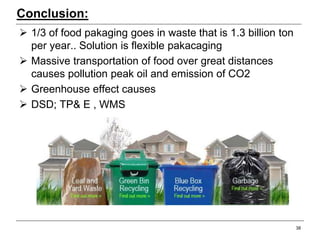
 1/3 of food pakaging goes in waste that is 1.3 billion ton
per year.. Solution is flexible pakacaging
 Massive transportation of food over great distances
causes pollution peak oil and emission of CO2
 Greenhouse effect causes
 DSD; TP& E , WMS
38
39
http://logistics.about.com/od/operationalsupplychain/a/Warehouse-Zone-
Storage.htm
http://www.evansdist.com/blog/2013/07/food-grade-warehouse/
http://www.refrigeration-equipment.com/walkins_manufacturing/web-6.jpg
http://en.wikipedia.org/wiki/Food_packaging
http://www.bbc.co.uk/schools/gcsebitesize/design/foodtech/packaginglabellingr
ev4.shtml
http://www.bbc.co.uk/schools/gcsebitesize/design/foodtech/systemspracticesre
v3.shtml
http://www.ift.org/knowledge-center/learn-about-food-science/become-a-food-
scientist/introduction-to-the-food-industry/lesson-4/computers-in-design-and-
manufacturing.aspx
http://www.foodsafetymagazine.com/magazine-archive1/octobernovember-
2003/transportation-the-squeaky-wheel-of-the-food-safety-system/
http://www.economywatch.com/world-industries/food-industry.html
http://www.manh.com/resources/news/future-food-logistics
40
Reference Links:
Reference Links:
• http://candostreet.com/blog-parents/wp-
content/uploads/2011/10/1782_fast_food_hamburger_drink_and_french_fri
es.jpg
• http://thisfitsme.com/2014/07/28/list-of-acidic-fruits-to-add-to-juicing-
smoothies/
• http://www.ediindia.org/Creed/data/Ramesh%20Mittal_files/image005.jpg
• http://www.medwelljournals.com/fulltext/?doi=jftech.2010.74.81
• http://www.rajkotfoodie.com/fast-foods.html
• http://smartaldishopper.com/i-just-dont-get-it-why-pay-more-for-canned-
vegetables/
• http://www.frozenfoodeurope.com/article/markets/eastern-
europe%E2%80%99s-emerging-frozen-food-market
• http://www.foodproductiondaily.com/var/plain_site/storage/images
• http://www.fwwarehousing.com/blog/fw-warehousing-food-grade-
warehousing-st-louis-mo-il-indianapolis-in-2/
• http://logistics.about.com/od/operationalsupplychain/a/Warehouse-Zone-
Storage.html
41

Food logistic

  • 1.
    Food Logistics Supply Chainof Your Food By Muhammad Aamir 14608 20.01.2015
  • 2.
    Content List 2 1. Introduction 2.What is Supply Chain Management 3. Food Supply Chain 4. Food Catagories 5. Warehousing 6. Processing and Pakaging 7. Transportation 8. Cold Chain Management 9. Usage of Technology in Food Logistics 10. Conclusion Refrences
  • 3.
    Introduction: • Importance ofFood. • Motivation . 3
  • 4.
    Supply Chain Management Whatis Supply-Chain Management (SCM) ?  Management of the flow of goods  Movement and storage of raw materials, work-in- process inventory, and finished goods from point of origin to point of consumption. 4
  • 5.
    Supply Chain Management It’sthe design, planning, execution, control, and monitoring of supply chain activities with the objective of creating net value, building a competitive infrastructure, leveraging worldwide logistics, synchronizing supply with demand and measuring performance globally” 5
  • 6.
    Food Supply Chain: •Food Supply Chain or Food System refers to the processes that describe how food from a farm ends up on our tables. 6
  • 7.
    Food Supply Chain •The processes include production, processing, distribution, consumption and disposal. • Each step of the Food Supply Chain requires human, natural resources and artificial resources 7
  • 8.
  • 9.
    Food Categories: • AnimalBased Products (Fish, Chicken, Meat, etc) • Dairy Products (Milk, Yogurt, Cheese, etc) • Crop Products (Wheat, Rice, Sugar-cane, etc) • Cooked Products: Any cooked vegetable, starch or grain products including rice, pasta and potatoes, etc. • Convenient Foods Products: Food like candies, Soft Drinks, Juices, Fast Food, etc. 9
  • 10.
    Food Categories • FrozenFoods Needs to be to rapid freezing and is kept frozen until used. Freezing decreases the ability of bacteria’s to duplicate. 10
  • 11.
    Challenges to handleFrozen Food: • Frozen Foods need special treatment when they should be transported: • Always a low or freezing temperature • Hygienic conditions • Fast Distribution and JIT – Transportation to keep the food fresh 11
  • 12.
  • 13.
    Food Warehousing: 13 A foodwarehouse can be a food storage facility of any size, storing any amount of food for either long or short periods of time, for distribution in normal food channels. Food warehouses serve as a critical link in the food chain from the farmer to processor to distributor to retailer and ultimately to the consumer.
  • 14.
    Types of Warehouses: 1.Dry Storage Warehouses • Items which need to be kept away from moisture and Humidity • Temperature is always between 50 and 70 degrees Fahrenheit. • Temperature Variation can cause damage. Etc canned foods • Examples rice, oats and grain 14
  • 15.
    Food Warehousing 2. Coldor Frozen Warehouses  Refrigerated or deep-freeze storage facility for perishable goods such as fruits, vegetables, meats, beverages to prevent rotting, sprouting, insect damage, and other forms of degradation..  It maintains a controlled interior temperature as low as - 25°C  Necessary for logistical reasons, cold storage also enables seasonal agricultural products to be distributed to retailers across a much longer season or possibly year-round. 15
  • 16.
    KPI´S In FoodWarehousing  Cleanliness..does not grow bacteria, fungus or create any other health hazardous situations  Condition of the building... well maintained the building is, the less likely there will be pests or rodents to contaminate the food,should not have holes, cracks or other ways for unwanted critters to enter:  A pest control plan is a must for food grade warehousing inside and outside of the building  Building and staff play a big role in finding the right food grade warehouse  Food grade warehouses should be registered with the Food Authorities and up to date with local food safety inspections. 16
  • 17.
    Food Processing andPackaging: Processsing:  Transformation of ingredients into Food.  Produce marketable Food Products for Consumer  Involves activites like Mincing, Liquefication, Cooking; Preservation, Freezing etc 17
  • 18.
    Food Processing andPakacging 18
  • 19.
    Food Processing andPackaging Packaging:  Range of Environment friendly materials are used.  Provides identification, protection, temperature resistance, and physical, chemical, or biological needs.  Contains nutrition facts and barcodes label and other information about food. 19
  • 20.
    Food Processing andPackaging Some more functions of Packaging:  Physical Protection.. Shock, Viberation, compression  Barrier Protection.. Oxygen,Water, Dust  Contamination..for Small items not to mix etc.Liquids  Information.. For Use, Transport Recycle etc  Marketing, Convinience for Distribution, Handling Stacking 20
  • 21.
    Food Processing andPackaging: Packaging Types: Primary..provides protecion to the food and information Secondary..middle Layer of Packaging Tertiary/ Transit...outer boxes or pallets for Transportation and distribution 21
  • 22.
    Food Processing andPackaging: 22 Example:
  • 23.
    Food Processing andPackaging • https://www.youtube.com/watch?v=OfyNe VJGJfk 23
  • 24.
    Transportaion  For Farmto Fork transportation is essential  A vast global transportation network is required  Include suppliers, manufacturers, warehouses, retailers and the end consumers  It is middlemen responsible for getting food from field to retail.  All means of transport are used 24
  • 25.
    Transportation Whether the foodis transported by road, rail, air or sea. Some key points needs to be followed..  Restricting transportation of cargo food and hazardous materials  Regular information-sharing between shippers and carriers about food handling  Mandating specific requirements for shippers and carriers concerning record-keeping, reporting, and inspections.  Keep ready-to-eat food items that are being transported separate from raw food.  Food is covered, Vehicle and transport boxes are cleaned  Use a cooling system to ensure that cold food is transported below 5°C or colder by cold chain. 25
  • 26.
    TRANSPORTATION What is ColdChain Transportation 26 TRANSPORTATION TEMPERATURE CONTROL (REFRIGERATION) COLD CHAIN TRANSPORTATION •A cold chain is a temperature-controlled supply chain. •An unbroken cold chain is an uninterrupted series of storage and distribution activities which maintain a given temperature range. •It is used to help extend and ensure the shelf life of products such as fresh agricultural products, seafood, frozen food, photographic film, chemicals and pharmaceutical drugs
  • 27.
    Transportation 27 Cold Chain isa process since a series of tasks must be performed for temperature sensitive products at every step.
  • 28.
    Cold Chain Means ofCold Chain Transport There are several means in which cold chain products can be transported, including refrigerated trucks and railcars, refrigerated cargo ships as well as by air cargo. . 28
  • 29.
    Cold Storage ManagementSystem How Cold Chain is managed? A cold chain can be managed by a quality management system. It should be analyzed, measured, controlled, documented, and validated. 29
  • 30.
    Cold Storage ManagementSystem: What are its functionalities?  It manages the Time how long a the good is going to be stored in the cold storage  Offers Services like Temperature tracking– Offers the location of the stored goods  Managing a cold Storage could be easily done with i.e. Datex Foot Print Warehouse Management System  It includes temperature capture, the ability to restrict inventory to specific temperature zones; catch weight; track and trace inventory by Lot, VAT code 30
  • 31.
    Cold Chain ManagementSystem https://www.youtube.com/watch?v=xgXqsajb wvo 31
  • 32.
    Cold Chain ManagementSystem IMPORTANT FACTORS WHILE HANDLING COLD CHAIN LOGISTICS 32 • Shipment in insulated shipping containers or other specialised packaging. • Temperature data loggers and RFID tags help monitor the temperature history of the truck, warehouse, etc. and the temperature history of the product being shipped. They also can help determine the remaining shelf life. • Documentation is critical. Customs delays occur due to inaccurate or incomplete customs paperwork, so basic guidelines for creating a commercial invoice should be followed:
  • 33.
    Cold Chain ManagementSystem Global Cold Chain Facts: Food Sector 33 Fruits & Vegetables Meat Fish & Seafood Dairy Products Beverages In European countries and American, the rate of refrigerated transport is up to 80-90%, pre-cooling preservation is up to 80-100%, and the loss rate is below 5%. 25% of the total food production is processed foods.
  • 34.
    Question If you areof logistical company and your major product is fresh food To presevere the fressnessh of food as supplier to your retailers what would you do? • Build more cold storage Warehouses • Invest on your Transportation • Anyother Suggestion 34
  • 35.
    Usage of Technologyin Food Logistics: Computers and Technlogy are essential in development of food Products.. Need to be updated with latest Technology  Especially in Food manfacturing etc.Desinging , Processing managing operations, resources of plants.  Most commanly used softwares are CAD, CAM,MRIPII and CIM: 35
  • 36.
    Usage of Technologyin Food Logistics CAD • Nutritional analysis • Calculate costs, amounts • Packaging desingns • Production Flowcharts • HACCP Requirements CAM • Monitor temperature , Weight,PH, quantites • Controlling Conveyorbelt speed MRPII • A method for the effective planning of all resources of a manufacturing company. CIM • CAD/CAM, process controls, groups technology systems, MRPII, financial systems, etc., are linked and interfaced. 36
  • 37.
    Conclusion:  Farmers problems...restiected markets...short term contratcs food processeors and marketers receive big share a trust needs to built up between these strategic partners  Safety and environmental attributes should be cared  CAD,CAM difficult to set up need skilled workers. 37
  • 38.
    Conclusion:  1/3 offood pakaging goes in waste that is 1.3 billion ton per year.. Solution is flexible pakacaging  Massive transportation of food over great distances causes pollution peak oil and emission of CO2  Greenhouse effect causes  DSD; TP& E , WMS 38
  • 39.
  • 40.
    http://logistics.about.com/od/operationalsupplychain/a/Warehouse-Zone- Storage.htm http://www.evansdist.com/blog/2013/07/food-grade-warehouse/ http://www.refrigeration-equipment.com/walkins_manufacturing/web-6.jpg http://en.wikipedia.org/wiki/Food_packaging http://www.bbc.co.uk/schools/gcsebitesize/design/foodtech/packaginglabellingr ev4.shtml http://www.bbc.co.uk/schools/gcsebitesize/design/foodtech/systemspracticesre v3.shtml http://www.ift.org/knowledge-center/learn-about-food-science/become-a-food- scientist/introduction-to-the-food-industry/lesson-4/computers-in-design-and- manufacturing.aspx http://www.foodsafetymagazine.com/magazine-archive1/octobernovember- 2003/transportation-the-squeaky-wheel-of-the-food-safety-system/ http://www.economywatch.com/world-industries/food-industry.html http://www.manh.com/resources/news/future-food-logistics 40 Reference Links:
  • 41.
    Reference Links: • http://candostreet.com/blog-parents/wp- content/uploads/2011/10/1782_fast_food_hamburger_drink_and_french_fri es.jpg •http://thisfitsme.com/2014/07/28/list-of-acidic-fruits-to-add-to-juicing- smoothies/ • http://www.ediindia.org/Creed/data/Ramesh%20Mittal_files/image005.jpg • http://www.medwelljournals.com/fulltext/?doi=jftech.2010.74.81 • http://www.rajkotfoodie.com/fast-foods.html • http://smartaldishopper.com/i-just-dont-get-it-why-pay-more-for-canned- vegetables/ • http://www.frozenfoodeurope.com/article/markets/eastern- europe%E2%80%99s-emerging-frozen-food-market • http://www.foodproductiondaily.com/var/plain_site/storage/images • http://www.fwwarehousing.com/blog/fw-warehousing-food-grade- warehousing-st-louis-mo-il-indianapolis-in-2/ • http://logistics.about.com/od/operationalsupplychain/a/Warehouse-Zone- Storage.html 41