Ensuring Food Safety Through Efficient Cold Chain
Management
Food safety is a critical global issue, with billions of people depending on the secure
transportation and storage of perishable goods. The journey of food from farms to consumers
involves multiple steps, and each one is vital for ensuring quality, freshness, and safety. In this
intricate process, cold chain management plays a pivotal role in maintaining the integrity of
food products.
Understanding Cold Chain Management
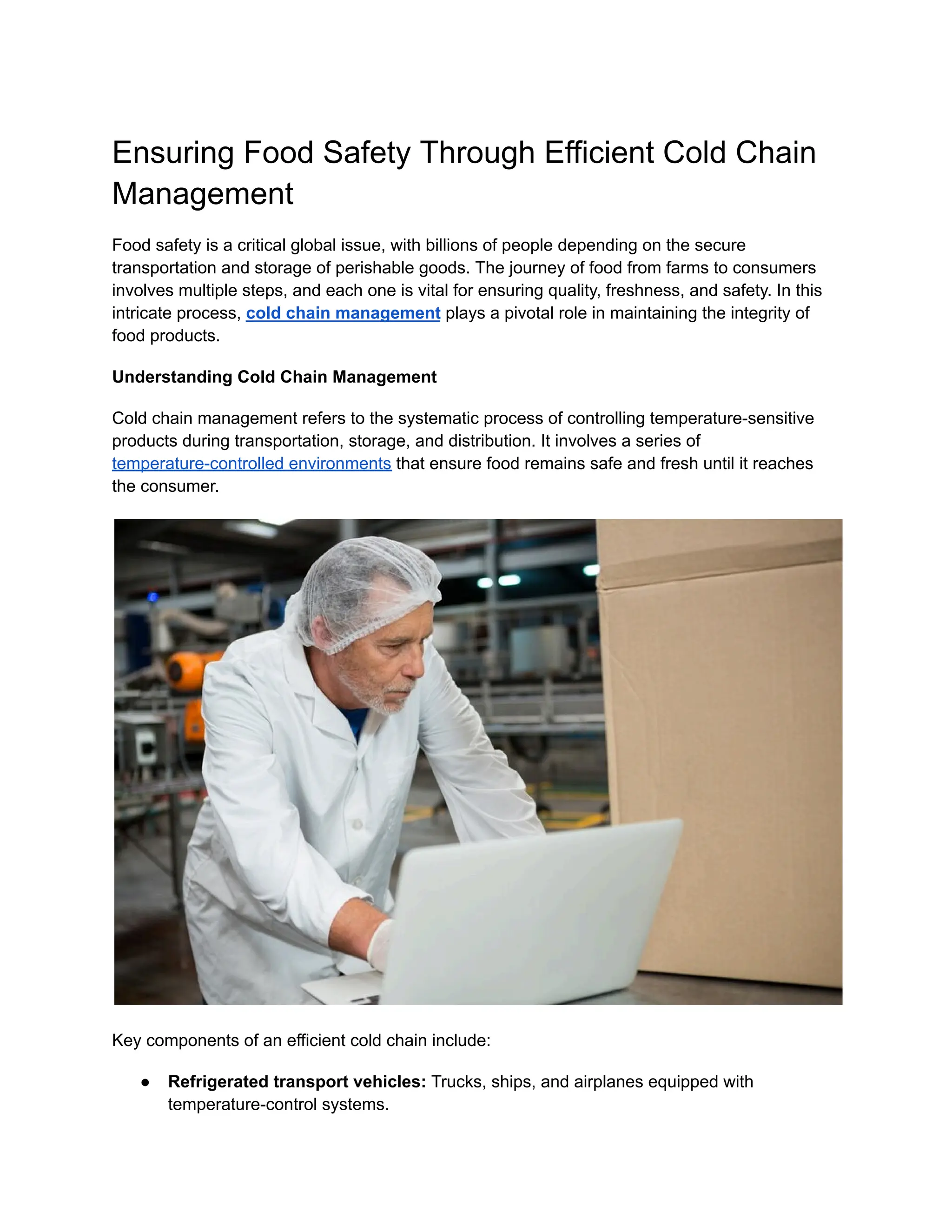
Cold chain management refers to the systematic process of controlling temperature-sensitive
products during transportation, storage, and distribution. It involves a series of
temperature-controlled environments that ensure food remains safe and fresh until it reaches
the consumer.
Key components of an efficient cold chain include:
●​ Refrigerated transport vehicles: Trucks, ships, and airplanes equipped with
temperature-control systems.
●​ Cold storage facilities: Warehouses with refrigeration and freezing capabilities.
●​ Monitoring systems: Sensors and software to track temperature and humidity in real
time.
The Importance of Food Safety in Cold Chain Management
Food safety is a growing concern worldwide due to the risks of contamination, spoilage, and
foodborne illnesses. When perishable products, such as dairy, meat, seafood, and fresh
produce, are not stored or transported at the correct temperature, harmful bacteria can grow,
compromising the safety and quality of the food.
Cold chain management helps mitigate these risks by:
1.​ Preventing spoilage: Keeping food at the optimal temperature reduces the risk of
spoilage, preserving freshness and nutritional value.
2.​ Reducing foodborne illnesses: Proper temperature control minimizes the growth of
pathogens, such as Salmonella and Listeria.
3.​ Ensuring compliance: Regulatory bodies, such as the FDA and WHO, mandate strict
temperature requirements for perishable goods. An efficient cold chain ensures
compliance with these standards.
Key Challenges in Cold Chain Management
Despite its critical importance, cold chain management faces several challenges:
1.​ Temperature fluctuations: Maintaining consistent temperatures during transit is one of
the biggest hurdles. Variations can occur due to equipment failure, poor handling, or
environmental factors.
2.​ Energy consumption: Refrigerated transportation and storage consume significant
energy, raising concerns about cost and environmental impact.
3.​ Infrastructure gaps: In developing regions, the lack of proper cold chain infrastructure
limits access to safe and fresh food.
4.​ Supply chain complexity: Multiple stakeholders and handoffs increase the risk of
mismanagement, delays, and temperature deviations.
5.​ Technological barriers: Not all companies have access to advanced tracking and
monitoring systems, making it harder to ensure temperature compliance.
Best Practices for Efficient Cold Chain Management
To overcome these challenges and ensure food safety, companies must adopt best practices in
cold chain management:
1.​ Implement Real-Time Monitoring Systems​
Modern cold chains rely on IoT-enabled sensors that track temperature, humidity, and
location throughout the supply chain. These systems provide real-time alerts in case of
deviations, allowing for immediate corrective action.
2.​ Use Data Analytics and Predictive Maintenance​
Advanced analytics can identify patterns and predict potential issues, such as equipment
failure or temperature breaches. Predictive maintenance ensures that refrigeration
systems are serviced before problems arise, reducing downtime and spoilage.
3.​ Optimize Packaging​
High-quality, insulated packaging minimizes temperature fluctuations during transit.
Using phase-change materials (PCMs) or vacuum-insulated panels (VIPs) can enhance
temperature retention for longer durations.
4.​ Train Staff and Stakeholders​
Proper training for everyone involved in the supply chain is essential. Employees must
understand the importance of maintaining temperature integrity and know how to handle
equipment and products safely.
5.​ Leverage Blockchain Technology​
Blockchain ensures transparency and traceability across the supply chain. By recording
every step of the journey, it provides a tamper-proof record of temperature data and
handling conditions, building trust with consumers.
6.​ Develop Contingency Plans​
Unforeseen events, such as power outages or transportation delays, can disrupt the cold
chain. Having contingency plans, including backup generators and alternate shipping
routes, can mitigate these risks.
The Role of Sustainability in Cold Chain Management
With the increasing focus on sustainability, cold chain management must balance food safety
with environmental responsibility. This involves:
1.​ Energy-efficient refrigeration: Investing in energy-saving technologies and renewable
energy sources reduces the carbon footprint of cold storage facilities.
2.​ Reducing food waste: Efficient cold chains minimize spoilage, reducing food waste and
its environmental impact.
3.​ Eco-friendly packaging: Using biodegradable or recyclable materials for insulation and
packaging contributes to sustainability goals.
4.​ Collaborative logistics: Sharing resources, such as transport and storage facilities,
among companies can improve efficiency and reduce emissions.
Case Studies: Success Stories in Cold Chain Management
1.​ Dairy Industry in India​
India is the largest producer of milk globally, and cold chain management is essential for
preserving its quality. Companies like Amul have implemented advanced refrigeration
and transport systems to ensure milk reaches consumers fresh and safe.
2.​ Seafood Exports in Norway​
Norway’s seafood industry relies on efficient cold chains to export products worldwide.
Real-time monitoring and advanced packaging have helped maintain the freshness of
salmon and other seafood, meeting stringent international standards.
3.​ Vaccine Distribution During COVID-19​
The COVID-19 pandemic highlighted the importance of cold chains in healthcare.
Vaccines, especially those requiring ultra-cold storage, were transported globally using
specialized cold chain solutions, ensuring their efficacy and safety.
The Future of Cold Chain Management
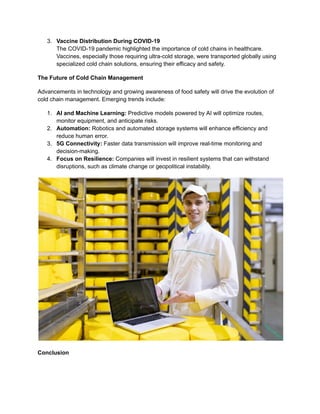
Advancements in technology and growing awareness of food safety will drive the evolution of
cold chain management. Emerging trends include:
1.​ AI and Machine Learning: Predictive models powered by AI will optimize routes,
monitor equipment, and anticipate risks.
2.​ Automation: Robotics and automated storage systems will enhance efficiency and
reduce human error.
3.​ 5G Connectivity: Faster data transmission will improve real-time monitoring and
decision-making.
4.​ Focus on Resilience: Companies will invest in resilient systems that can withstand
disruptions, such as climate change or geopolitical instability.
Conclusion
Efficient cold chain management is indispensable for ensuring food safety in a globalized world.
By embracing modern technologies, adopting best practices, and prioritizing sustainability,
companies can safeguard the integrity of perishable goods, reduce waste, and build consumer
trust. As the demand for fresh, high-quality food continues to rise, the importance of robust cold
chains will only grow, shaping the future of food logistics and safety.

Ensuring Food Safety Through Efficient Cold Chain Management.pdf

  • 1.
    Ensuring Food SafetyThrough Efficient Cold Chain Management Food safety is a critical global issue, with billions of people depending on the secure transportation and storage of perishable goods. The journey of food from farms to consumers involves multiple steps, and each one is vital for ensuring quality, freshness, and safety. In this intricate process, cold chain management plays a pivotal role in maintaining the integrity of food products. Understanding Cold Chain Management Cold chain management refers to the systematic process of controlling temperature-sensitive products during transportation, storage, and distribution. It involves a series of temperature-controlled environments that ensure food remains safe and fresh until it reaches the consumer. Key components of an efficient cold chain include: ●​ Refrigerated transport vehicles: Trucks, ships, and airplanes equipped with temperature-control systems.
  • 2.
    ●​ Cold storagefacilities: Warehouses with refrigeration and freezing capabilities. ●​ Monitoring systems: Sensors and software to track temperature and humidity in real time. The Importance of Food Safety in Cold Chain Management Food safety is a growing concern worldwide due to the risks of contamination, spoilage, and foodborne illnesses. When perishable products, such as dairy, meat, seafood, and fresh produce, are not stored or transported at the correct temperature, harmful bacteria can grow, compromising the safety and quality of the food. Cold chain management helps mitigate these risks by: 1.​ Preventing spoilage: Keeping food at the optimal temperature reduces the risk of spoilage, preserving freshness and nutritional value. 2.​ Reducing foodborne illnesses: Proper temperature control minimizes the growth of pathogens, such as Salmonella and Listeria. 3.​ Ensuring compliance: Regulatory bodies, such as the FDA and WHO, mandate strict temperature requirements for perishable goods. An efficient cold chain ensures compliance with these standards. Key Challenges in Cold Chain Management Despite its critical importance, cold chain management faces several challenges: 1.​ Temperature fluctuations: Maintaining consistent temperatures during transit is one of the biggest hurdles. Variations can occur due to equipment failure, poor handling, or environmental factors. 2.​ Energy consumption: Refrigerated transportation and storage consume significant energy, raising concerns about cost and environmental impact. 3.​ Infrastructure gaps: In developing regions, the lack of proper cold chain infrastructure limits access to safe and fresh food. 4.​ Supply chain complexity: Multiple stakeholders and handoffs increase the risk of mismanagement, delays, and temperature deviations. 5.​ Technological barriers: Not all companies have access to advanced tracking and monitoring systems, making it harder to ensure temperature compliance. Best Practices for Efficient Cold Chain Management To overcome these challenges and ensure food safety, companies must adopt best practices in cold chain management: 1.​ Implement Real-Time Monitoring Systems​ Modern cold chains rely on IoT-enabled sensors that track temperature, humidity, and location throughout the supply chain. These systems provide real-time alerts in case of deviations, allowing for immediate corrective action.
  • 3.
    2.​ Use DataAnalytics and Predictive Maintenance​ Advanced analytics can identify patterns and predict potential issues, such as equipment failure or temperature breaches. Predictive maintenance ensures that refrigeration systems are serviced before problems arise, reducing downtime and spoilage. 3.​ Optimize Packaging​ High-quality, insulated packaging minimizes temperature fluctuations during transit. Using phase-change materials (PCMs) or vacuum-insulated panels (VIPs) can enhance temperature retention for longer durations. 4.​ Train Staff and Stakeholders​ Proper training for everyone involved in the supply chain is essential. Employees must understand the importance of maintaining temperature integrity and know how to handle equipment and products safely. 5.​ Leverage Blockchain Technology​ Blockchain ensures transparency and traceability across the supply chain. By recording every step of the journey, it provides a tamper-proof record of temperature data and handling conditions, building trust with consumers. 6.​ Develop Contingency Plans​ Unforeseen events, such as power outages or transportation delays, can disrupt the cold chain. Having contingency plans, including backup generators and alternate shipping routes, can mitigate these risks. The Role of Sustainability in Cold Chain Management With the increasing focus on sustainability, cold chain management must balance food safety with environmental responsibility. This involves: 1.​ Energy-efficient refrigeration: Investing in energy-saving technologies and renewable energy sources reduces the carbon footprint of cold storage facilities. 2.​ Reducing food waste: Efficient cold chains minimize spoilage, reducing food waste and its environmental impact. 3.​ Eco-friendly packaging: Using biodegradable or recyclable materials for insulation and packaging contributes to sustainability goals. 4.​ Collaborative logistics: Sharing resources, such as transport and storage facilities, among companies can improve efficiency and reduce emissions. Case Studies: Success Stories in Cold Chain Management 1.​ Dairy Industry in India​ India is the largest producer of milk globally, and cold chain management is essential for preserving its quality. Companies like Amul have implemented advanced refrigeration and transport systems to ensure milk reaches consumers fresh and safe. 2.​ Seafood Exports in Norway​ Norway’s seafood industry relies on efficient cold chains to export products worldwide. Real-time monitoring and advanced packaging have helped maintain the freshness of salmon and other seafood, meeting stringent international standards.
  • 4.
    3.​ Vaccine DistributionDuring COVID-19​ The COVID-19 pandemic highlighted the importance of cold chains in healthcare. Vaccines, especially those requiring ultra-cold storage, were transported globally using specialized cold chain solutions, ensuring their efficacy and safety. The Future of Cold Chain Management Advancements in technology and growing awareness of food safety will drive the evolution of cold chain management. Emerging trends include: 1.​ AI and Machine Learning: Predictive models powered by AI will optimize routes, monitor equipment, and anticipate risks. 2.​ Automation: Robotics and automated storage systems will enhance efficiency and reduce human error. 3.​ 5G Connectivity: Faster data transmission will improve real-time monitoring and decision-making. 4.​ Focus on Resilience: Companies will invest in resilient systems that can withstand disruptions, such as climate change or geopolitical instability. Conclusion
  • 5.
    Efficient cold chainmanagement is indispensable for ensuring food safety in a globalized world. By embracing modern technologies, adopting best practices, and prioritizing sustainability, companies can safeguard the integrity of perishable goods, reduce waste, and build consumer trust. As the demand for fresh, high-quality food continues to rise, the importance of robust cold chains will only grow, shaping the future of food logistics and safety.