
BY: AKASH UGALE
8086 Microprocessor
Important Features Of 8086
Buses:-Address ,Data ,Control
8086 supports Pipelining.
8086 has 2 Operating Modes.
8086 provides Memory Banks.
8086 supports Memory Segmentation.
8086 supports 256 interrupts.
8086 has 16-bit IO address.
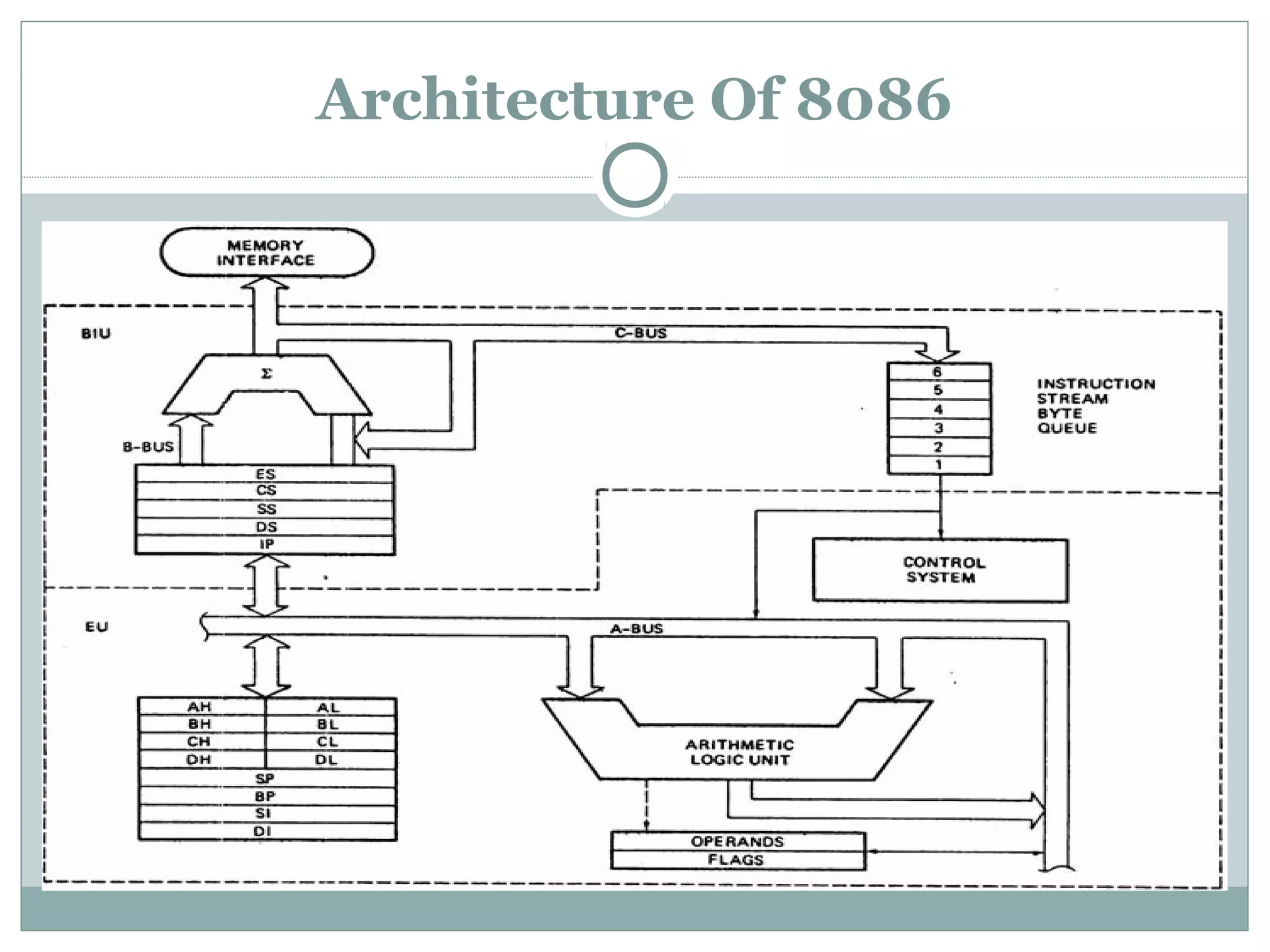
Architecture Of 8086
Bus Interface Unit(BIU)
Provide interface of 8086 to external memory &
IO devices.
Operates w.r.t Bus cycle
It generates 20-bit physical address.
Fetches Instruction from memory.
Transfer data to or from the memory and IO.
Supports Pipelining using the 6-byte instruction
queue.
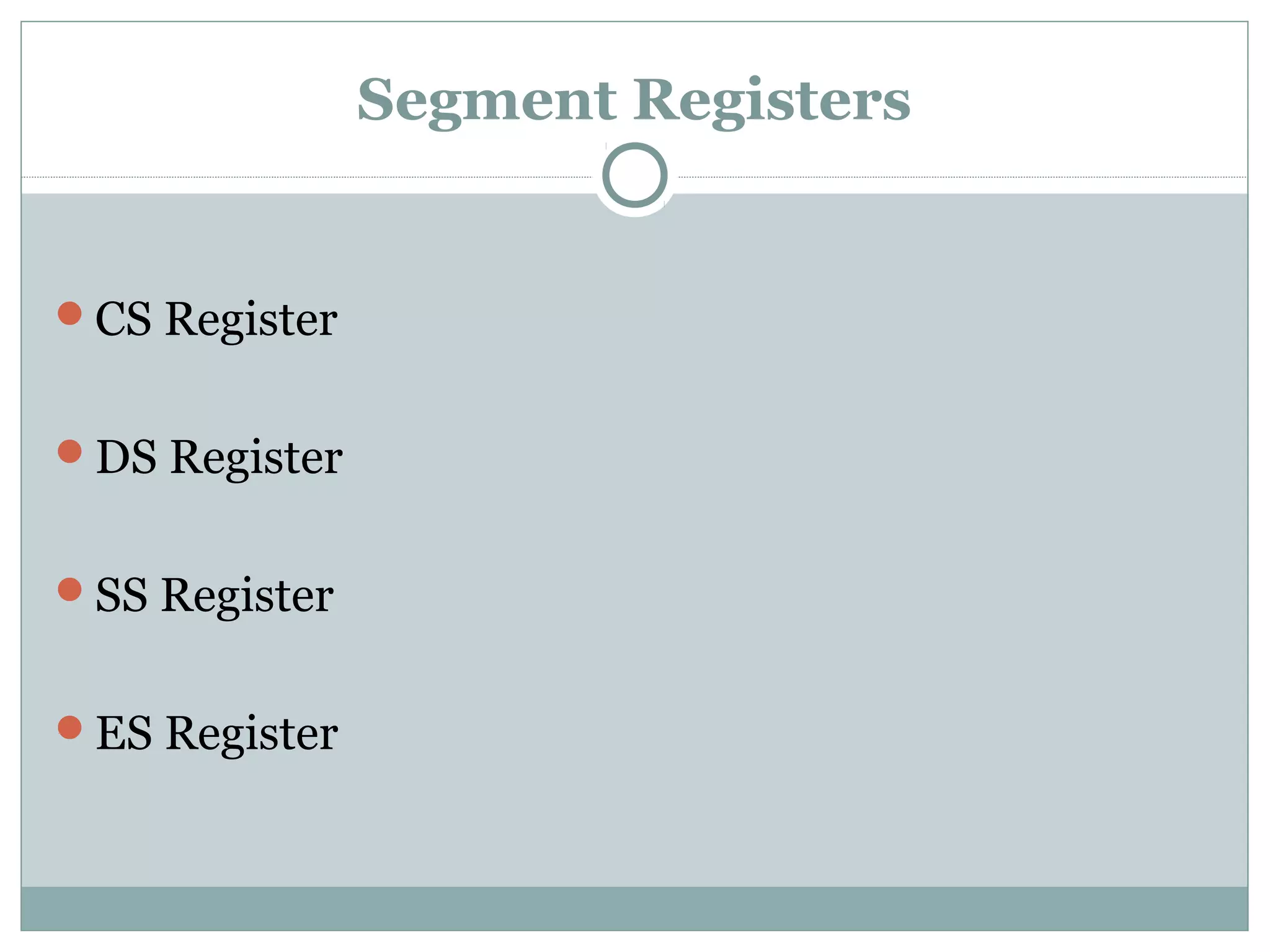
Segment Registers
CS Register
DS Register
SS Register
ES Register
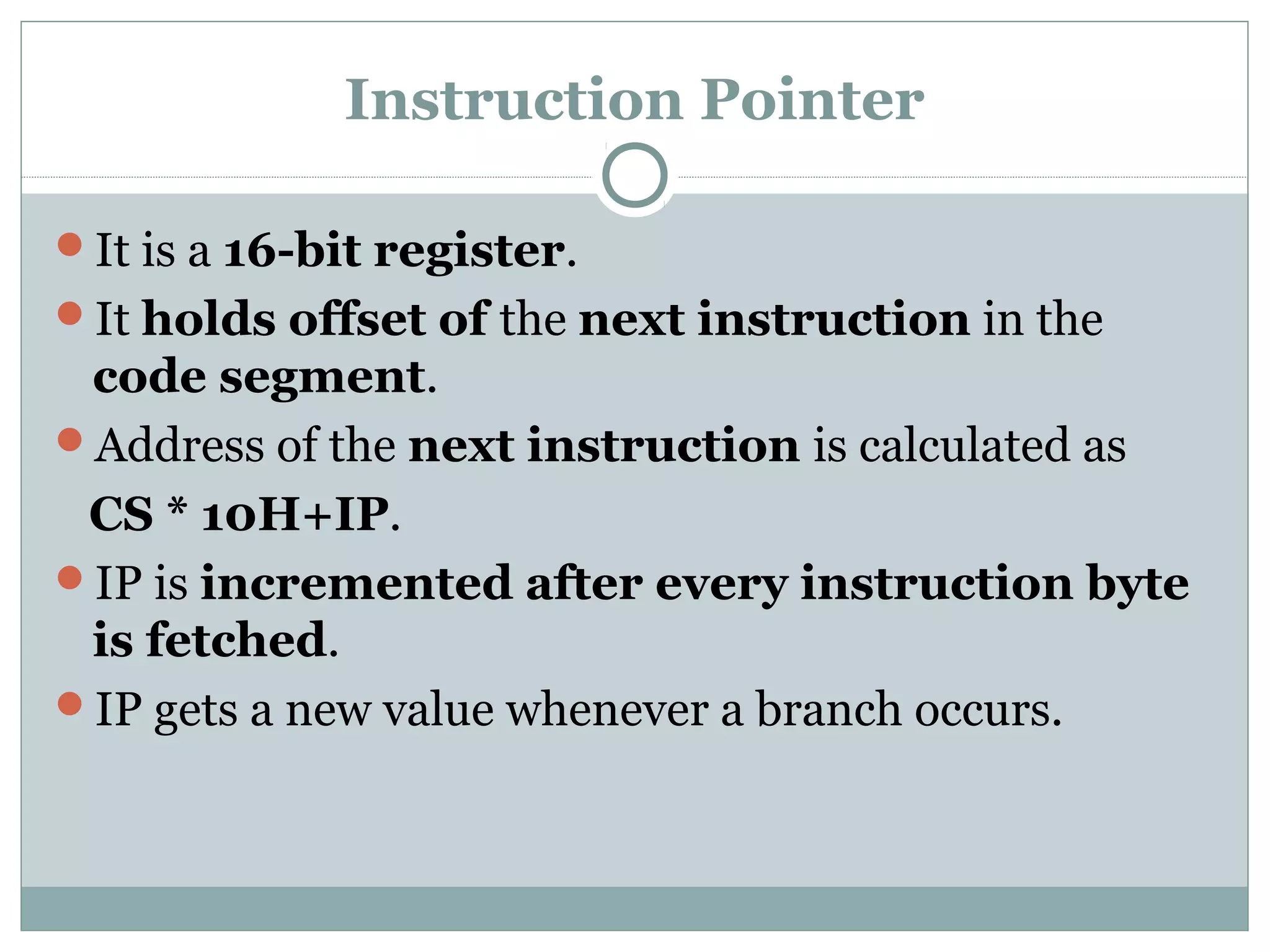
Instruction Pointer
It is a 16-bit register.
It holds offset of the next instruction in the
code segment.
Address of the next instruction is calculated as
CS * 10H+IP.
IP is incremented after every instruction byte
is fetched.
IP gets a new value whenever a branch occurs.
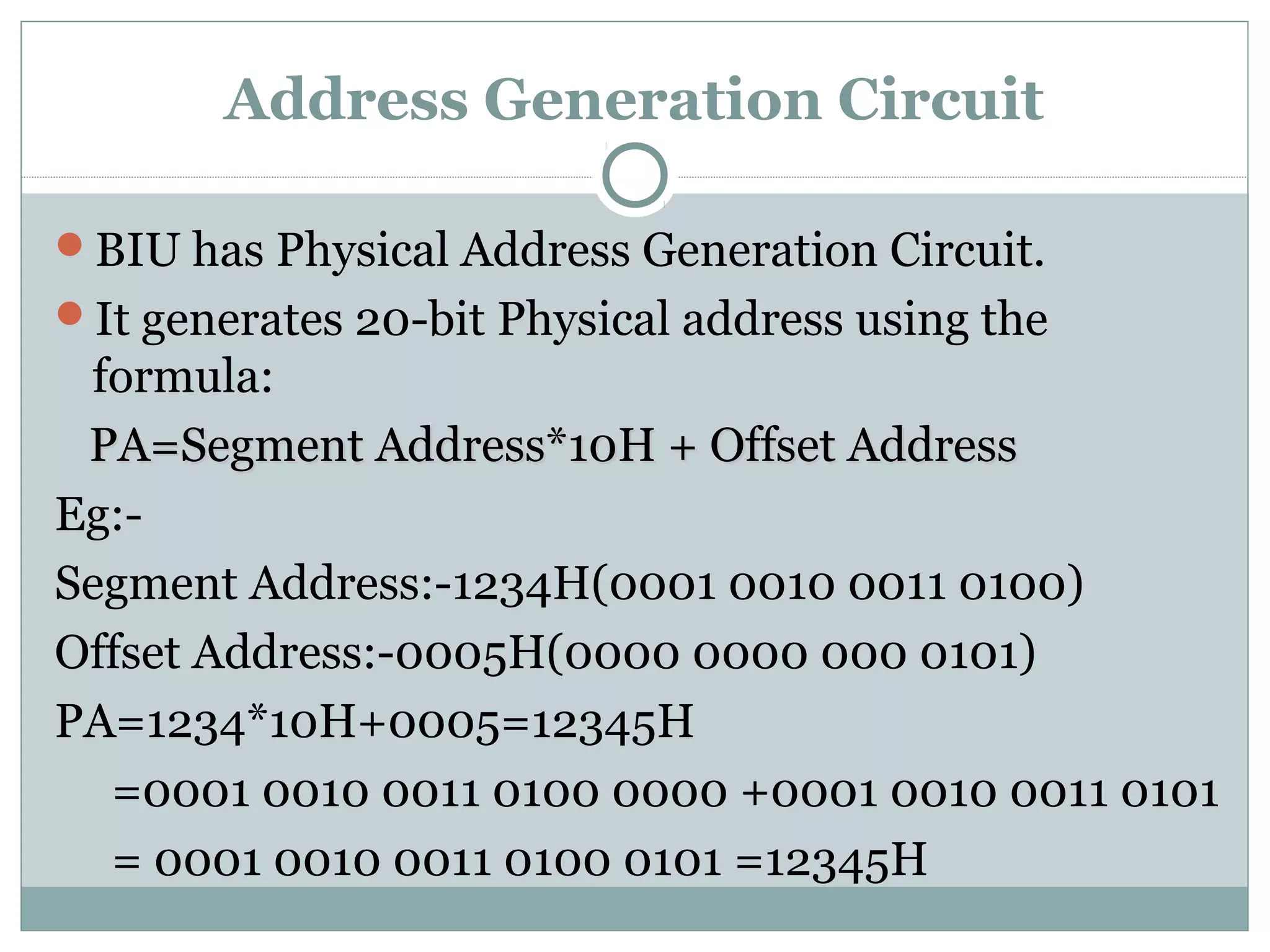
Address Generation Circuit
BIU has Physical Address Generation Circuit.
It generates 20-bit Physical address using the
formula:
PA=Segment Address*10H + Offset AddressPA=Segment Address*10H + Offset Address
Eg:-
Segment Address:-1234H(0001 0010 0011 0100)
Offset Address:-0005H(0000 0000 000 0101)
PA=1234*10H+0005=12345H
=0001 0010 0011 0100 0000 +0001 0010 0011 0101
= 0001 0010 0011 0100 0101 =12345H
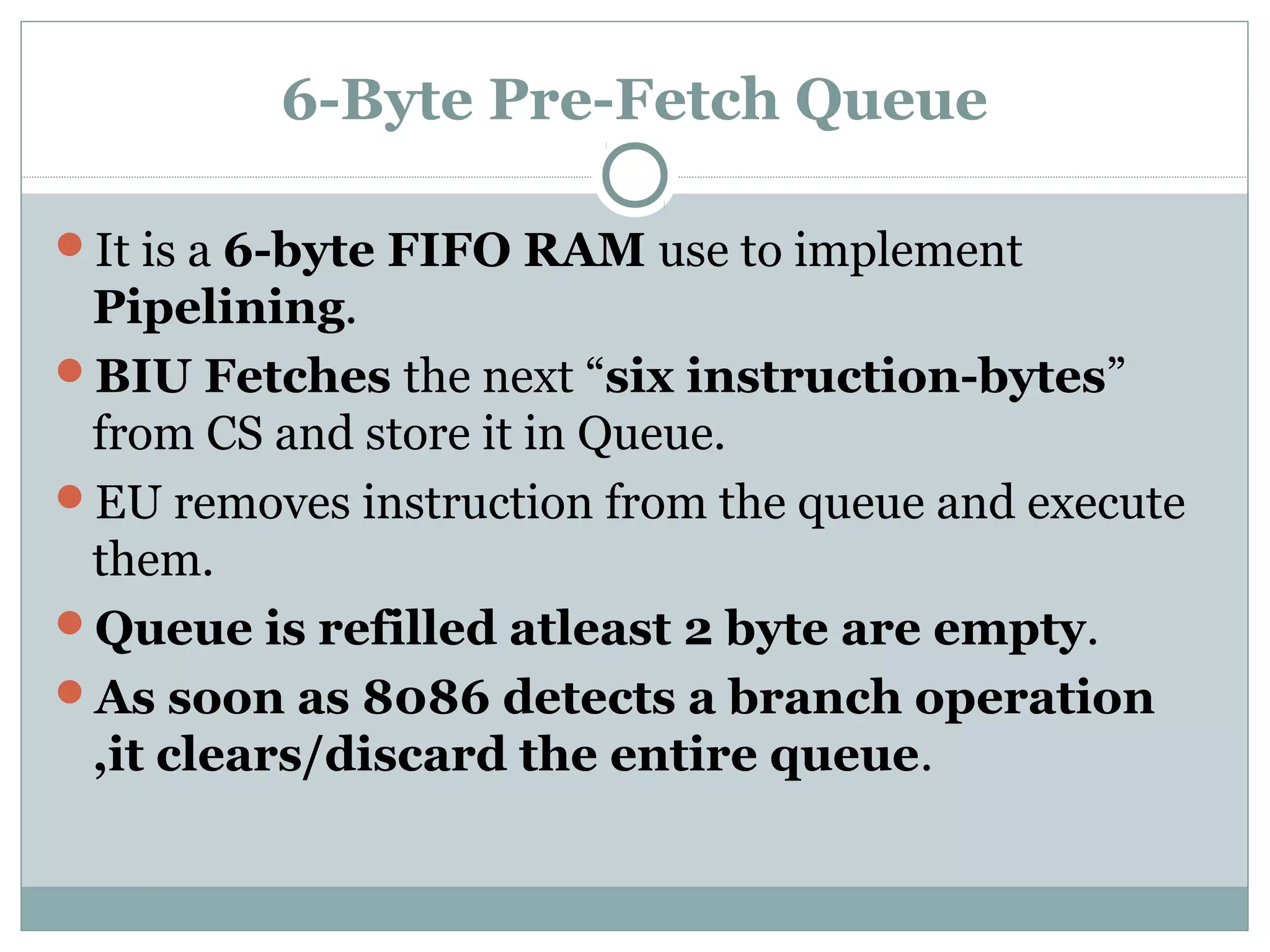
6-Byte Pre-Fetch Queue
It is a 6-byte FIFO RAM use to implement
Pipelining.
BIU Fetches the next “six instruction-bytes”
from CS and store it in Queue.
EU removes instruction from the queue and execute
them.
Queue is refilled atleast 2 byte are empty.
As soon as 8086 detects a branch operation
,it clears/discard the entire queue.
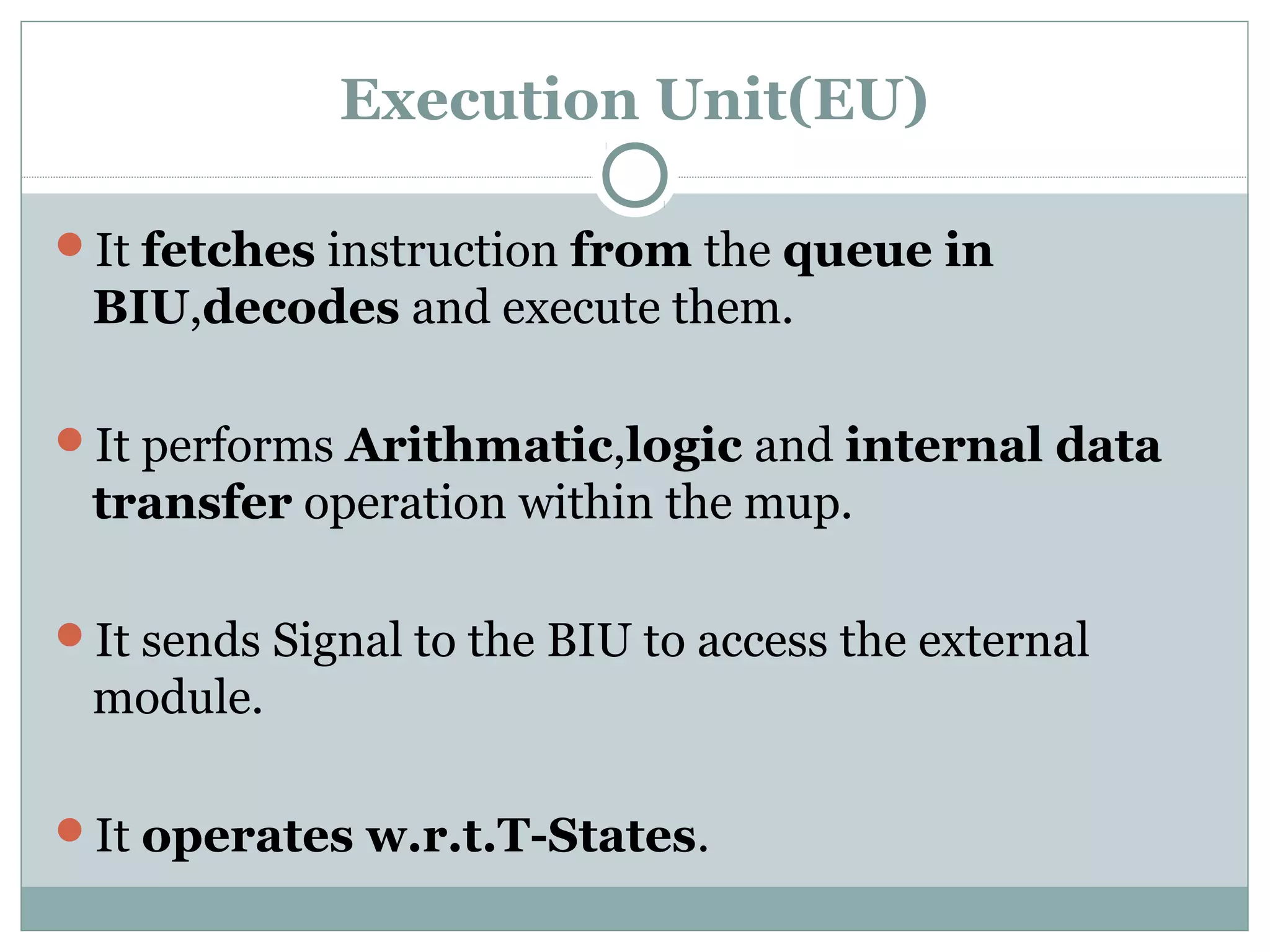
Execution Unit(EU)
It fetches instruction from the queue in
BIU,decodes and execute them.
It performs Arithmatic,logic and internal data
transfer operation within the mup.
It sends Signal to the BIU to access the external
module.
It operates w.r.t.T-States.
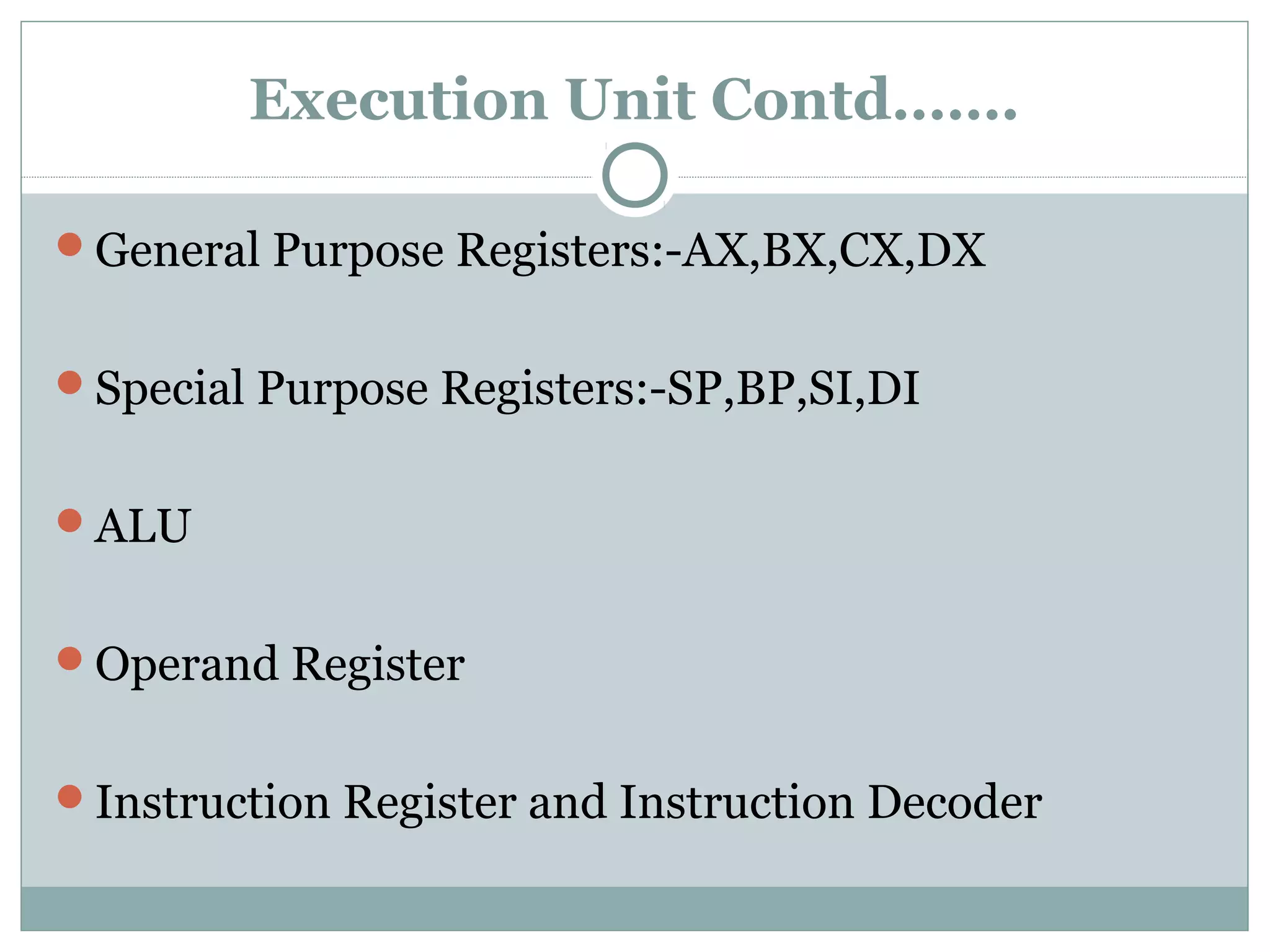
Execution Unit Contd…….
General Purpose Registers:-AX,BX,CX,DX
Special Purpose Registers:-SP,BP,SI,DI
ALU
Operand Register
Instruction Register and Instruction Decoder
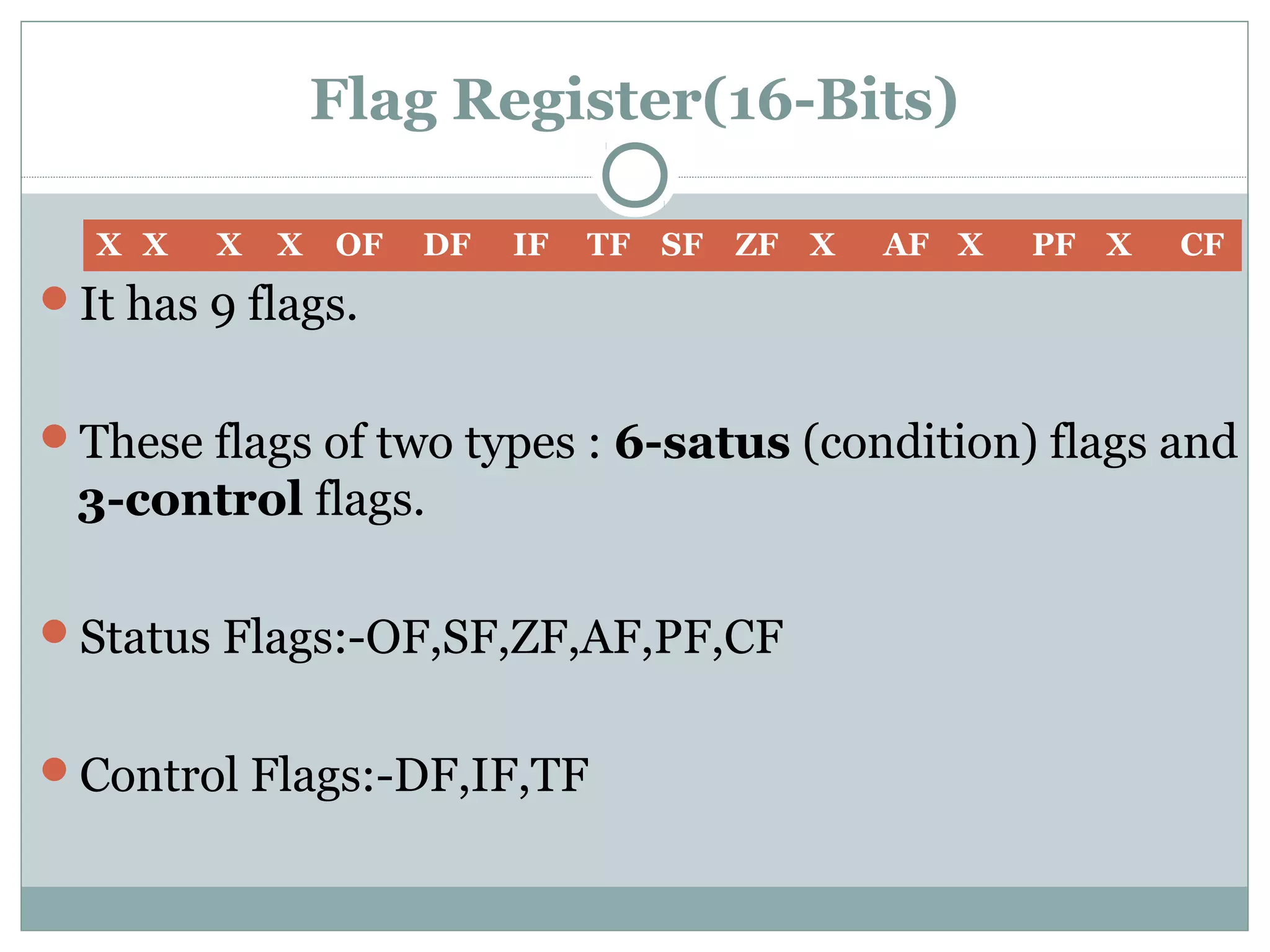
Flag Register(16-Bits)
It has 9 flags.
These flags of two types : 6-satus (condition) flags and
3-control flags.
Status Flags:-OF,SF,ZF,AF,PF,CF
Control Flags:-DF,IF,TF
X X X X OF DF IF TF SF ZF X AF X PF X CF
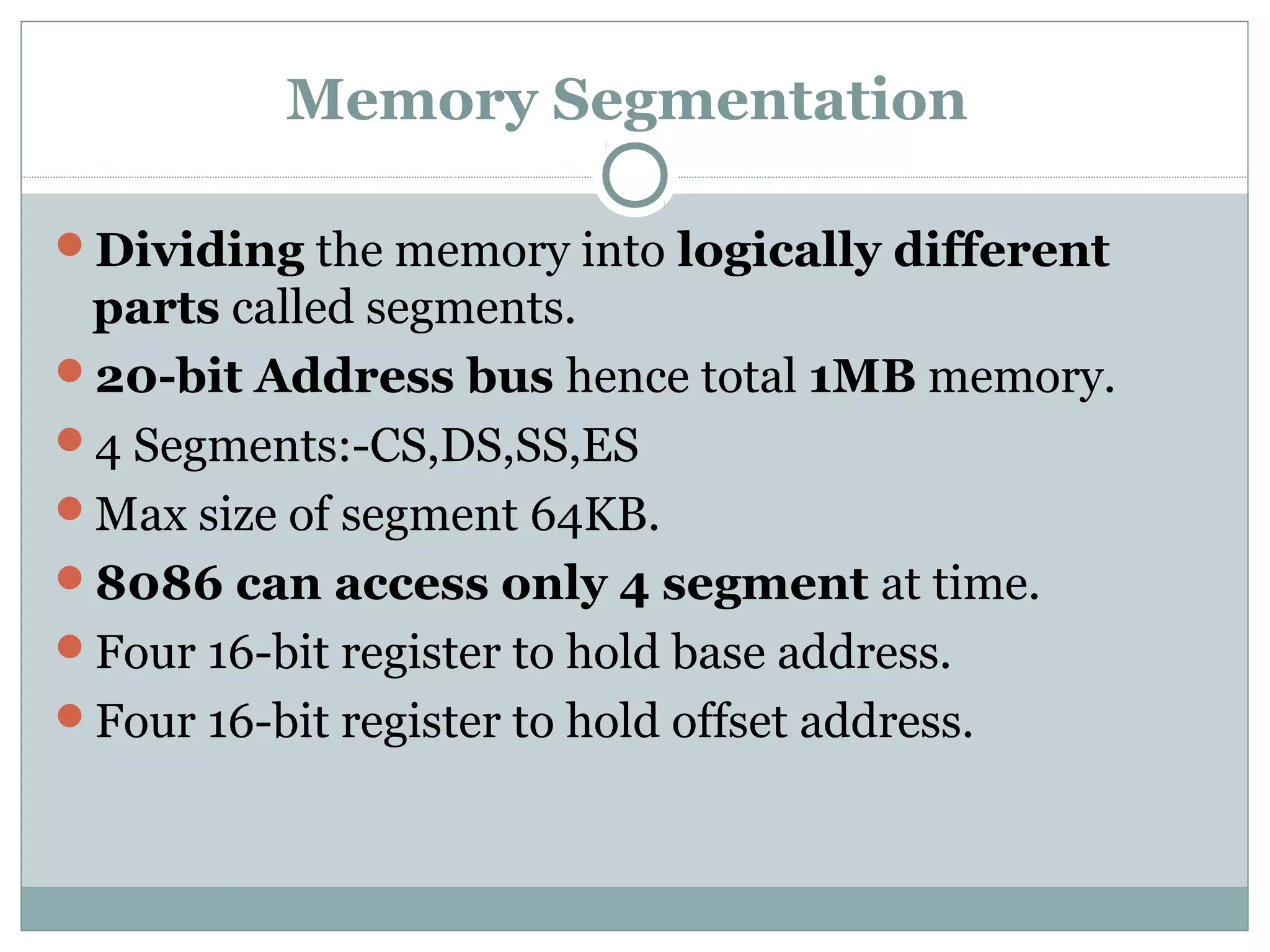
Memory Segmentation
Dividing the memory into logically different
parts called segments.
20-bit Address bus hence total 1MB memory.
4 Segments:-CS,DS,SS,ES
Max size of segment 64KB.
8086 can access only 4 segment at time.
Four 16-bit register to hold base address.
Four 16-bit register to hold offset address.
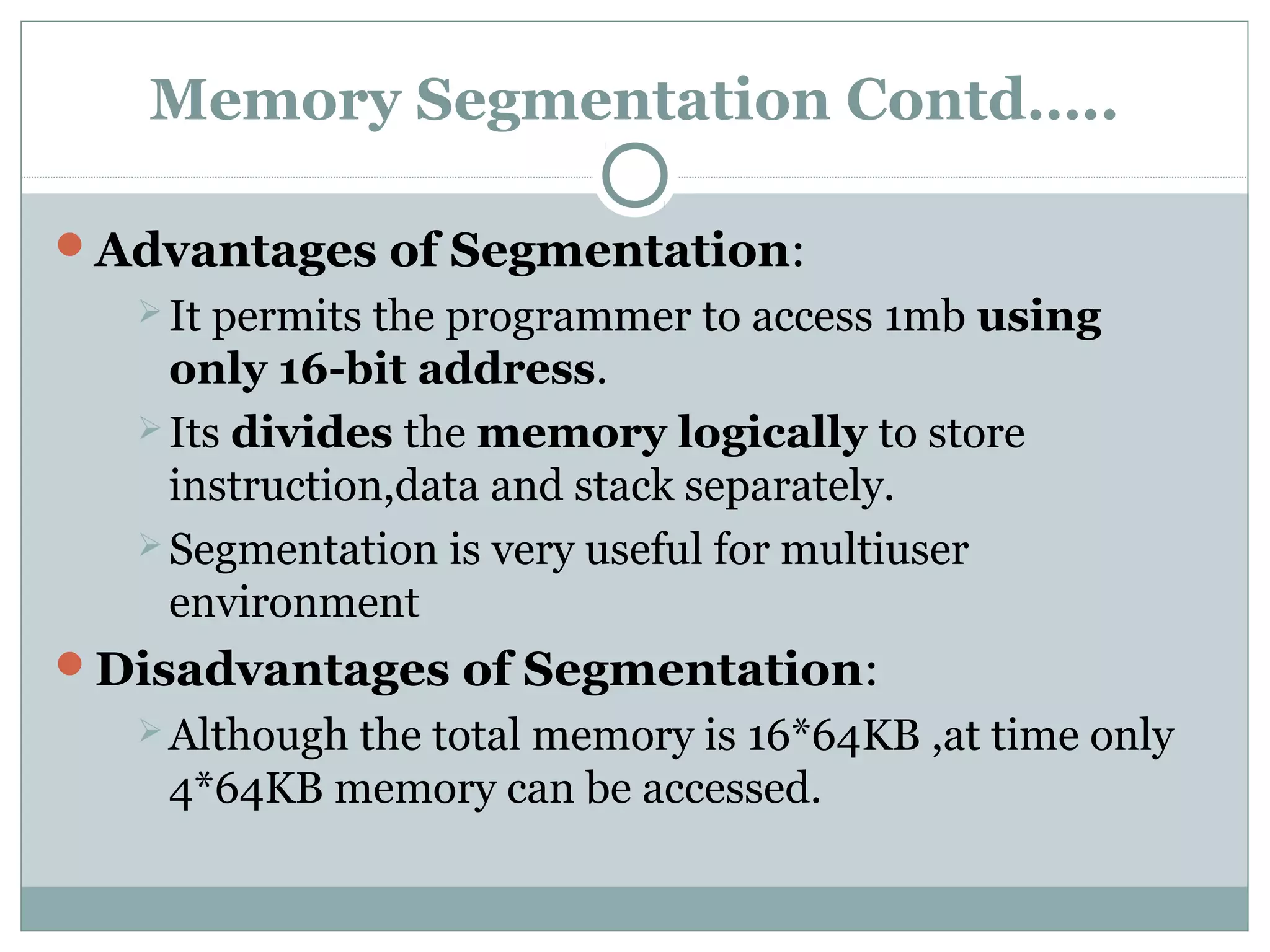
Memory Segmentation Contd…..
Advantages of Segmentation:
 It permits the programmer to access 1mb using
only 16-bit address.
 Its divides the memory logically to store
instruction,data and stack separately.
 Segmentation is very useful for multiuser
environment
Disadvantages of Segmentation:
 Although the total memory is 16*64KB ,at time only
4*64KB memory can be accessed.
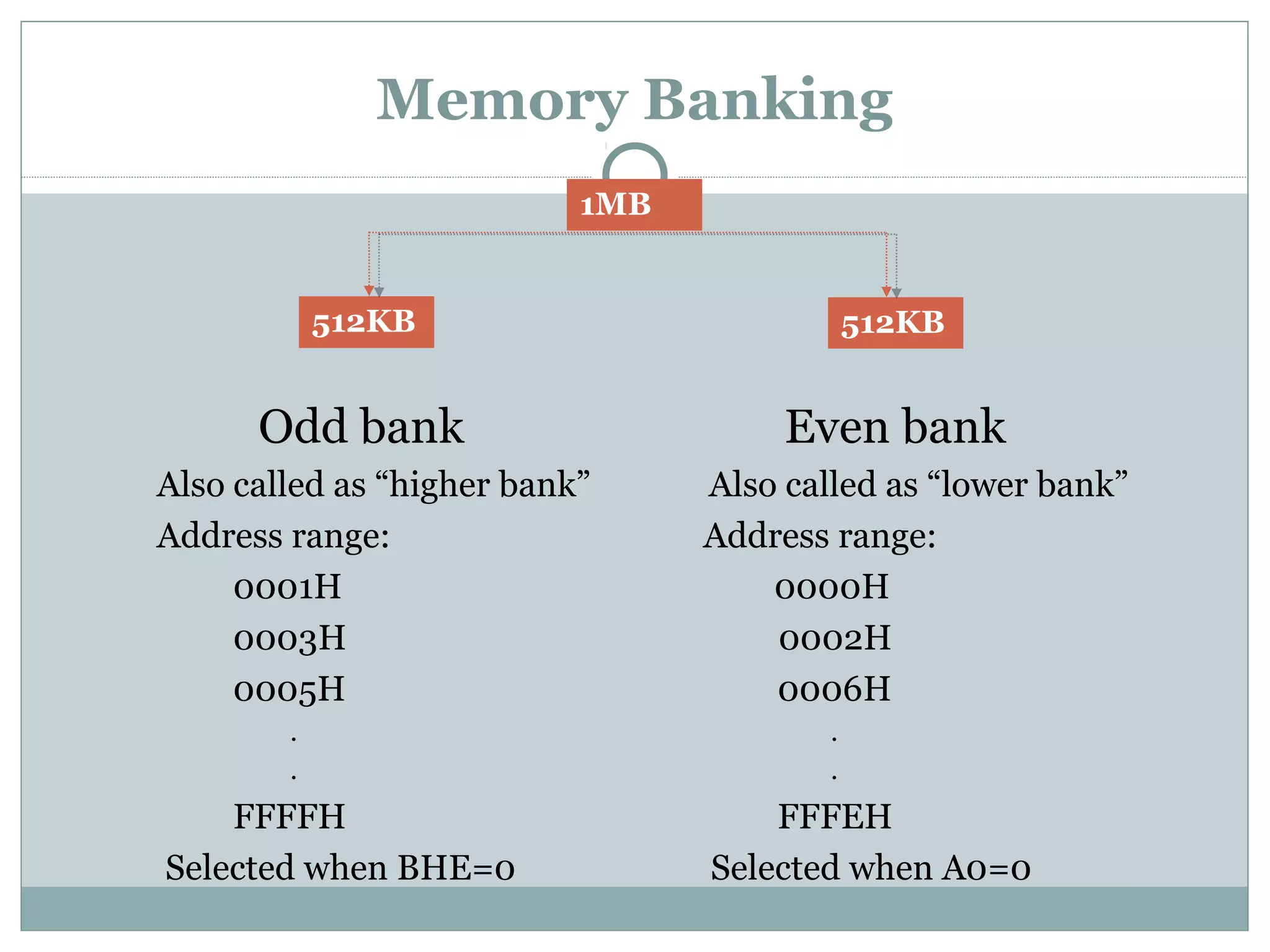
Memory Banking
Odd bank Even bank
Also called as “higher bank” Also called as “lower bank”
Address range: Address range:
0001H 0000H
0003H 0002H
0005H 0006H
. .
. .
FFFFH FFFEH
Selected when BHE=0 Selected when A0=0
512KB 512KB
1MB
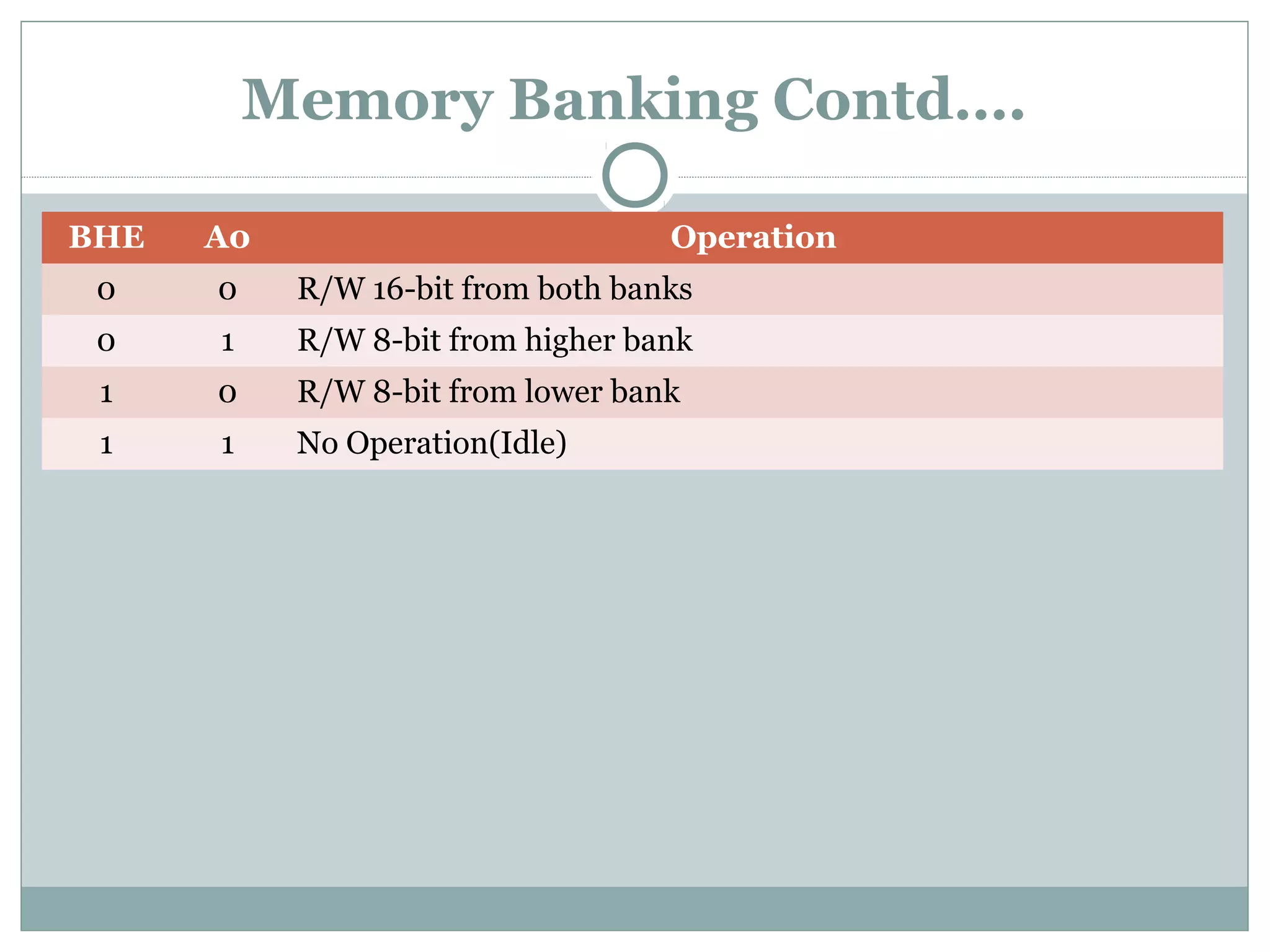
Memory Banking Contd….
BHE A0 Operation
0 0 R/W 16-bit from both banks
0 1 R/W 8-bit from higher bank
1 0 R/W 8-bit from lower bank
1 1 No Operation(Idle)
8086 microprocessor introduction

8086 microprocessor introduction

  • 1.
    BY: AKASH UGALE 8086Microprocessor
  • 2.
    Important Features Of8086 Buses:-Address ,Data ,Control 8086 supports Pipelining. 8086 has 2 Operating Modes. 8086 provides Memory Banks. 8086 supports Memory Segmentation. 8086 supports 256 interrupts. 8086 has 16-bit IO address.
  • 3.
  • 4.
    Bus Interface Unit(BIU) Provideinterface of 8086 to external memory & IO devices. Operates w.r.t Bus cycle It generates 20-bit physical address. Fetches Instruction from memory. Transfer data to or from the memory and IO. Supports Pipelining using the 6-byte instruction queue.
  • 5.
    Segment Registers CS Register DSRegister SS Register ES Register
  • 6.
    Instruction Pointer It isa 16-bit register. It holds offset of the next instruction in the code segment. Address of the next instruction is calculated as CS * 10H+IP. IP is incremented after every instruction byte is fetched. IP gets a new value whenever a branch occurs.
  • 7.
    Address Generation Circuit BIUhas Physical Address Generation Circuit. It generates 20-bit Physical address using the formula: PA=Segment Address*10H + Offset AddressPA=Segment Address*10H + Offset Address Eg:- Segment Address:-1234H(0001 0010 0011 0100) Offset Address:-0005H(0000 0000 000 0101) PA=1234*10H+0005=12345H =0001 0010 0011 0100 0000 +0001 0010 0011 0101 = 0001 0010 0011 0100 0101 =12345H
  • 8.
    6-Byte Pre-Fetch Queue Itis a 6-byte FIFO RAM use to implement Pipelining. BIU Fetches the next “six instruction-bytes” from CS and store it in Queue. EU removes instruction from the queue and execute them. Queue is refilled atleast 2 byte are empty. As soon as 8086 detects a branch operation ,it clears/discard the entire queue.
  • 9.
    Execution Unit(EU) It fetchesinstruction from the queue in BIU,decodes and execute them. It performs Arithmatic,logic and internal data transfer operation within the mup. It sends Signal to the BIU to access the external module. It operates w.r.t.T-States.
  • 10.
    Execution Unit Contd……. GeneralPurpose Registers:-AX,BX,CX,DX Special Purpose Registers:-SP,BP,SI,DI ALU Operand Register Instruction Register and Instruction Decoder
  • 11.
    Flag Register(16-Bits) It has9 flags. These flags of two types : 6-satus (condition) flags and 3-control flags. Status Flags:-OF,SF,ZF,AF,PF,CF Control Flags:-DF,IF,TF X X X X OF DF IF TF SF ZF X AF X PF X CF
  • 12.
    Memory Segmentation Dividing thememory into logically different parts called segments. 20-bit Address bus hence total 1MB memory. 4 Segments:-CS,DS,SS,ES Max size of segment 64KB. 8086 can access only 4 segment at time. Four 16-bit register to hold base address. Four 16-bit register to hold offset address.
  • 13.
    Memory Segmentation Contd….. Advantagesof Segmentation:  It permits the programmer to access 1mb using only 16-bit address.  Its divides the memory logically to store instruction,data and stack separately.  Segmentation is very useful for multiuser environment Disadvantages of Segmentation:  Although the total memory is 16*64KB ,at time only 4*64KB memory can be accessed.
  • 14.
    Memory Banking Odd bankEven bank Also called as “higher bank” Also called as “lower bank” Address range: Address range: 0001H 0000H 0003H 0002H 0005H 0006H . . . . FFFFH FFFEH Selected when BHE=0 Selected when A0=0 512KB 512KB 1MB
  • 15.
    Memory Banking Contd…. BHEA0 Operation 0 0 R/W 16-bit from both banks 0 1 R/W 8-bit from higher bank 1 0 R/W 8-bit from lower bank 1 1 No Operation(Idle)