ROHTAK
POWER POINT PRESENTATION ON – FORENSIC SEMEN ANALYSIS
SUBMITTED TO :-
FORENSIC SCIENCE DEPARTMENT
ASSIST. PROFESSOR- DR. SAPNA SHARMA
SUBMITTED BY :-
VIKAS JANGRA
ROLL NO. 2919
MSC. FORENSIC SCIENCE (F.)
SESSION – 2018-19
1.) INTRODUCTION
2.) MORPHOLOGY
3.) COMPOSITION
4.) EXAMINATION
5.) FORENSIC SIGNIFICANCE
 Semen, also known as seminal fluid, is an
organic fluid that may contain spermatozoa. It is
secreted by the gonads (sexual glands) and other
sexual organs
of male or hermaphroditic animals and
can fertilize female ova. In humans, seminal fluid
contains several components besides spermatozoa:
proteolytic and other enzymes as well as fructose are
elements of seminal fluid which promote the survival
of spermatozoa, and provide a azmedium through
which they can move or "swim". Semen is produced
and originates from the seminal vesicle, which is
located in the pelvis. The process that results in the
discharge of semen is called ejaculation. Semen is
also a form of genetic material. In animals, semen
has been collected for
cryoconservation. Cryoconservation of animal
genetic resources is a practice that calls for the
collection of genetic material in efforts for
conservation of a particular breed.
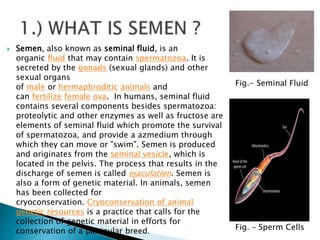
Fig.- Seminal Fluid
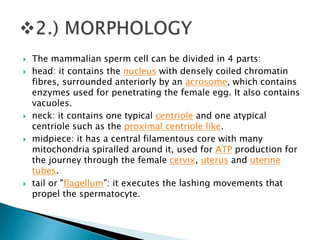
Fig. – Sperm Cells
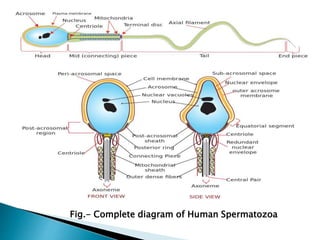
 The mammalian sperm cell can be divided in 4 parts:
 head: it contains the nucleus with densely coiled chromatin
fibres, surrounded anteriorly by an acrosome, which contains
enzymes used for penetrating the female egg. It also contains
vacuoles.
 neck: it contains one typical centriole and one atypical
centriole such as the proximal centriole like.
 midpiece: it has a central filamentous core with many
mitochondria spiralled around it, used for ATP production for
the journey through the female cervix, uterus and uterine
tubes.
 tail or "flagellum": it executes the lashing movements that
propel the spermatocyte.
Fig.- Complete diagram of Human Spermatozoa
 During the process of ejaculation, sperm passes
through the ejaculatory ducts and mixes with fluids
from the seminal vesicles, the prostate, and
the bulbourethral glands to form the semen. The
seminal vesicles produce a yellowish viscous fluid
rich in fructose and other substances that makes up
about 70% of human semen. The prostatic secretion,
influenced by dihydrotestosterone, is a whitish
(sometimes clear), thin fluid containing proteolytic
enzymes, citric acid, acid phosphatase and
lipids.[3] The bulbourethral glands secrete a clear
secretion into the lumen of the urethra to lubricate
it.
 Sertoli cells, which nurture and support
developing spermatocytes, secrete a fluid into
seminiferous tubules that helps transport sperm to
the genital ducts. The ductuli efferentes possess
cuboidal cells with microvilli and lysosomal granules
that modify the ductal fluid by reabsorbing some
fluid. Once the semen enters the ductus epididymis
the principal cells, which contain pinocytotic
vessels indicating fluid reabsorption, secrete
glycerophosphocholine which most likely inhibits
premature capacitation. The accessory genital ducts,
the seminal vesicle, prostate glands, and
the bulbourethral glands, produce most of the
seminal fluid.
HUMAN MALE REPRODUCTIVE SYSTEM
COLOUR WHITE OR
OPALESCENT
SPECIFIC GRAVITY 1.028
PH 7.35-7.50
VOLUME 3ml
B.) CHEMICAL PROPERTIES
GLAND/SITE VOLUME IN EJACULATE FEATURES
TESTIS/EPIDIDYMIS 0.15ML (5%) APPROX. 80 MILLION
SPERMATOZOA
SEMINAL VESICLE 1.5-2ML (50-65%) FRUCTOSE,
PHOSPHORYLCHOLINE
ETRGOTHINONEINE,
ASCORBIC ACID,
FLAVINS
PROSTAGLANDINS,
BICARBONATE
PROSTATE 0.6-0.9ML (20-30%) PROSTRATE, SPERMINE,
CITRIC ACID,
CHOLESTROL,
PHOSPHATEASE,
PHOSPHOLIPIDS,
FIBRINOLYSIN,
FIBINOGENASE, ZINC
ACID ,
PHOSPHATEASE,
PROSTATE SPECIFIC
 Color: Thick, yellowish white, glairy, opalescent,
secretion having a characteristic odor known as
seminal odour.
 Texture: On touch,Seminal stains are starchy.
 Appearance: Garments sent for forensic
examination are usually dirty having variety of
stains, in natural light some stains are reddish
coloured, while others are brown, yellow or faint
grey in colour. These are often mixed with stains of
blood vaginal discharge, urine and semen, so as to
restrict the investigation to seminal stains only,
preliminary examination is done und
oA.) PHYSICAL OR VISUAL EXAMINATION
 Microscopically, detection of
spermatozoa is also considered as
confirmatory evidence for the
presence of semen in a suspected
stain. In order to conduct
microscopic identification, part of
the stained garment should be
dissolved in acidulated water in
test tube.
 The Acid phosphate test is one of the best known
and most widely employed techniques for the
purpose of identification of semen. This test is
adopted because of high acid phosphatase activity
of semen. Thus by applying this test a suspected
azoospermic or Vasectomized person who is a
suspect of sexual offence may be identified.
Stability of acid phosphatase activity in seminal
stain depends on temperature. If the stain is
exposed to sunlight The acid phosphatase activity
is slowly reduced and if the stain is heated at 60C
for 5 min. this Activity is completely destroy.
1.) ACID PHOSPHATE TEST
The enzyme acid phosphatase of semen
hydrolyses the calcium alpha-napthyl
phosphoric acid that Liberate as alpha
naphthol. This couple with the age forming
material to give a purple colour.
REAGENT PREPRATION
oBUFFERS
Glacial Acetic acid 1ml
Sodium acetate anhydrous 2gm
Distilled water 100ml
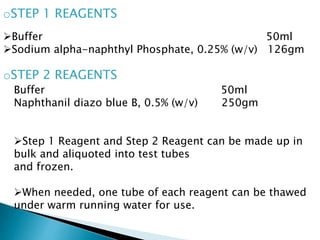
oSTEP 1 REAGENTS
oSTEP 2 REAGENTS
Buffer 50ml
Sodium alpha-naphthyl Phosphate, 0.25% (w/v) 126gm
Buffer 50ml
Naphthanil diazo blue B, 0.5% (w/v) 250gm
Step 1 Reagent and Step 2 Reagent can be made up in
bulk and aliquoted into test tubes
and frozen.
When needed, one tube of each reagent can be thawed
under warm running water for use.
Place a small piece (2 x 2 mm) of suspected seminal
stain
1.Stain material on Whatman filter paper or other
suitable test paper. Use proper standards and controls
including positive, negative and unstained controls.
2.Add 1-2 drops of Step 1 Reagent and allow to react for
30 seconds. (No colour should develop at this stage).
3.Add 1drop of Step 2 Reagent. Record the result after
10 seconds.
4. A positive reaction is recorded upon rapid
development of a purple colour, which is indicative of
semen.
This is not a confirmatory test for semen.
This method is used for the detection of choline
and spermine. In TLC, it is possible to detect
choline and Spermine simultaneously in seminal
stain. It has been possible to detect choline and
spermine in old seminal stains events after the
lapse of 5 years by this method. There are 2 types
of reagents used inTLC methods they are:-
 Dragendroff’s Reagent
 Potassium iodoplatinato Reagent
oThe fabric are classified into three groups :-
Bright (white, bright blue and pink).
Medium (blue, green, yellow, orange, red).
Dark (black, brown).
To test the excitation of the samples, we used a newly developed, very
high intensity Light source manufactured by Lumatec GmbH, Germany.
The portable system is suitable for heavy use at crime scenes because
of its low weight (approximately 6 kg), anunusually robust full metal
shell, compactness and a battery that allows 60 minutes of operation
away from an electrical outlet. A mercury lamp inside of the unit
produces a high intensity of UV (320-400nm) and visible light (400-
700nm) which was developed to detect biological stains even in
daylight. And at the end of the flexible light tube results in a beam
applicator focused on a spot or spread to a fan-like triangle.
Wavelengths can be chosen by eleven adjustable
filter positions (400-700,350-500,400-
500,320,400,415,440,460,490,550,570). In
combination with the eleven excitation settings,
white (>400 nm), Orange (>500 nm) and red
>590nm) goggles were used to Block the
excitation light and to visualize fluorescence more
precisely.
1.) CROSS-OVER ELECTROPHORESIS
Seminal Material can be identified by demonstrating the
presence of p30, a semen specific protein. One method of
doing this is Cross-Over Electrophoresis. An extract of the
suspected stain is placed in the cathode well of a gel plate
and anti p30 is placed in the anode well. Electrophoresis is
commenced for 20 minutes at 200 volts,forcing two
components together. When the antigen (p30) meets the
antibody, a precipitin band is formed. The presence of a
precipitin band within an extract of an unknown stain
proves that the stain contains seminal material,anti-p30.
oPLATE PREPRATION
Clean 1” x 3” or 2” x 3” microscope slides with detergent.
Rinse and polish dry. With a diamond tipped scribe,number
the slides in the upper right-hand corner. Slides should be
consecutively numbered
oCOATING PLATE WITH GEL
On a level surface, place a pre-coated slide onto a small
inverted beaker, allowing the slide edges to be suspended.
Place one or two tubes containing 3.5 ml each of1% agarose
gel in a water bath to liquefy.1 –3.5 ml tube for a 1” x 3”
slide 2 –3.5 ml tube for a 2” x 3” slide Pour the liquefied 1%
agarose onto the slide. Surface tension and pre-coating of
slide will prevent the liquid from overflowing the edges. A
smooth level surface is formed. Allow It to cool and harden.
This test was discovered by Dr.Florence in the year
1886. When Florence reagent
(PotassiumIodide+Iodine+Water) is applied to the
slide it produces rhomboidal shape dark crystals
of choline periodide. Similarly, any tissue or
biological material containing sufficient high
choline concentration would give positive Florence
Test.According to Davis and Wilson, if swab is
collected within one day of sexual act,choline can
be detected. At the same time if swab is taken
after 14 hours of intercourse, there is a possibility
of negative result.
Barberio’s test was invented by
Barberio in the year 1905. When
the questioned stain is allowed to
react with picric acid it leads to
the formation of yellow needle
shaped spermine picrate crystals,
including the presence of seminal
stain
1.) Semen analysis is an important laboratory
test and should be thought of in the same
way as any other diagnostic assay is used in
determining treatment plans for infertility.
2.) Semen analysis is very important in
assault cases as it is very Useful for
detection of semen in cloths.
3.) Isolation and identification of seminal
stain found on various suspected are asuch
as cloths, bed sheet, pillow, blanket, etc.
 4.) Analysis of various protein present
in semen or seminal stain.
 5.) Seminal stains are examined
generally in rape cases, Sodomy,
Bestiality, Buccal coitus and in cases of
Sexual perversions. .
 6.) Detection of sperm cell in Vagina
and other body parts.
 7.) Feacal matter examination.
Forensic semen analysis

Forensic semen analysis

  • 1.
    ROHTAK POWER POINT PRESENTATIONON – FORENSIC SEMEN ANALYSIS SUBMITTED TO :- FORENSIC SCIENCE DEPARTMENT ASSIST. PROFESSOR- DR. SAPNA SHARMA SUBMITTED BY :- VIKAS JANGRA ROLL NO. 2919 MSC. FORENSIC SCIENCE (F.) SESSION – 2018-19
  • 2.
    1.) INTRODUCTION 2.) MORPHOLOGY 3.)COMPOSITION 4.) EXAMINATION 5.) FORENSIC SIGNIFICANCE
  • 3.
     Semen, alsoknown as seminal fluid, is an organic fluid that may contain spermatozoa. It is secreted by the gonads (sexual glands) and other sexual organs of male or hermaphroditic animals and can fertilize female ova. In humans, seminal fluid contains several components besides spermatozoa: proteolytic and other enzymes as well as fructose are elements of seminal fluid which promote the survival of spermatozoa, and provide a azmedium through which they can move or "swim". Semen is produced and originates from the seminal vesicle, which is located in the pelvis. The process that results in the discharge of semen is called ejaculation. Semen is also a form of genetic material. In animals, semen has been collected for cryoconservation. Cryoconservation of animal genetic resources is a practice that calls for the collection of genetic material in efforts for conservation of a particular breed. Fig.- Seminal Fluid Fig. – Sperm Cells
  • 4.
     The mammaliansperm cell can be divided in 4 parts:  head: it contains the nucleus with densely coiled chromatin fibres, surrounded anteriorly by an acrosome, which contains enzymes used for penetrating the female egg. It also contains vacuoles.  neck: it contains one typical centriole and one atypical centriole such as the proximal centriole like.  midpiece: it has a central filamentous core with many mitochondria spiralled around it, used for ATP production for the journey through the female cervix, uterus and uterine tubes.  tail or "flagellum": it executes the lashing movements that propel the spermatocyte.
  • 5.
    Fig.- Complete diagramof Human Spermatozoa
  • 6.
     During theprocess of ejaculation, sperm passes through the ejaculatory ducts and mixes with fluids from the seminal vesicles, the prostate, and the bulbourethral glands to form the semen. The seminal vesicles produce a yellowish viscous fluid rich in fructose and other substances that makes up about 70% of human semen. The prostatic secretion, influenced by dihydrotestosterone, is a whitish (sometimes clear), thin fluid containing proteolytic enzymes, citric acid, acid phosphatase and lipids.[3] The bulbourethral glands secrete a clear secretion into the lumen of the urethra to lubricate it.
  • 7.
     Sertoli cells,which nurture and support developing spermatocytes, secrete a fluid into seminiferous tubules that helps transport sperm to the genital ducts. The ductuli efferentes possess cuboidal cells with microvilli and lysosomal granules that modify the ductal fluid by reabsorbing some fluid. Once the semen enters the ductus epididymis the principal cells, which contain pinocytotic vessels indicating fluid reabsorption, secrete glycerophosphocholine which most likely inhibits premature capacitation. The accessory genital ducts, the seminal vesicle, prostate glands, and the bulbourethral glands, produce most of the seminal fluid.
  • 8.
  • 9.
    COLOUR WHITE OR OPALESCENT SPECIFICGRAVITY 1.028 PH 7.35-7.50 VOLUME 3ml
  • 10.
    B.) CHEMICAL PROPERTIES GLAND/SITEVOLUME IN EJACULATE FEATURES TESTIS/EPIDIDYMIS 0.15ML (5%) APPROX. 80 MILLION SPERMATOZOA SEMINAL VESICLE 1.5-2ML (50-65%) FRUCTOSE, PHOSPHORYLCHOLINE ETRGOTHINONEINE, ASCORBIC ACID, FLAVINS PROSTAGLANDINS, BICARBONATE PROSTATE 0.6-0.9ML (20-30%) PROSTRATE, SPERMINE, CITRIC ACID, CHOLESTROL, PHOSPHATEASE, PHOSPHOLIPIDS, FIBRINOLYSIN, FIBINOGENASE, ZINC ACID , PHOSPHATEASE, PROSTATE SPECIFIC
  • 11.
     Color: Thick,yellowish white, glairy, opalescent, secretion having a characteristic odor known as seminal odour.  Texture: On touch,Seminal stains are starchy.  Appearance: Garments sent for forensic examination are usually dirty having variety of stains, in natural light some stains are reddish coloured, while others are brown, yellow or faint grey in colour. These are often mixed with stains of blood vaginal discharge, urine and semen, so as to restrict the investigation to seminal stains only, preliminary examination is done und oA.) PHYSICAL OR VISUAL EXAMINATION
  • 12.
     Microscopically, detectionof spermatozoa is also considered as confirmatory evidence for the presence of semen in a suspected stain. In order to conduct microscopic identification, part of the stained garment should be dissolved in acidulated water in test tube.
  • 13.
     The Acidphosphate test is one of the best known and most widely employed techniques for the purpose of identification of semen. This test is adopted because of high acid phosphatase activity of semen. Thus by applying this test a suspected azoospermic or Vasectomized person who is a suspect of sexual offence may be identified. Stability of acid phosphatase activity in seminal stain depends on temperature. If the stain is exposed to sunlight The acid phosphatase activity is slowly reduced and if the stain is heated at 60C for 5 min. this Activity is completely destroy. 1.) ACID PHOSPHATE TEST
  • 14.
    The enzyme acidphosphatase of semen hydrolyses the calcium alpha-napthyl phosphoric acid that Liberate as alpha naphthol. This couple with the age forming material to give a purple colour. REAGENT PREPRATION oBUFFERS Glacial Acetic acid 1ml Sodium acetate anhydrous 2gm Distilled water 100ml
  • 15.
    oSTEP 1 REAGENTS oSTEP2 REAGENTS Buffer 50ml Sodium alpha-naphthyl Phosphate, 0.25% (w/v) 126gm Buffer 50ml Naphthanil diazo blue B, 0.5% (w/v) 250gm Step 1 Reagent and Step 2 Reagent can be made up in bulk and aliquoted into test tubes and frozen. When needed, one tube of each reagent can be thawed under warm running water for use.
  • 16.
    Place a smallpiece (2 x 2 mm) of suspected seminal stain 1.Stain material on Whatman filter paper or other suitable test paper. Use proper standards and controls including positive, negative and unstained controls. 2.Add 1-2 drops of Step 1 Reagent and allow to react for 30 seconds. (No colour should develop at this stage). 3.Add 1drop of Step 2 Reagent. Record the result after 10 seconds. 4. A positive reaction is recorded upon rapid development of a purple colour, which is indicative of semen. This is not a confirmatory test for semen.
  • 17.
    This method isused for the detection of choline and spermine. In TLC, it is possible to detect choline and Spermine simultaneously in seminal stain. It has been possible to detect choline and spermine in old seminal stains events after the lapse of 5 years by this method. There are 2 types of reagents used inTLC methods they are:-  Dragendroff’s Reagent  Potassium iodoplatinato Reagent
  • 18.
    oThe fabric areclassified into three groups :- Bright (white, bright blue and pink). Medium (blue, green, yellow, orange, red). Dark (black, brown). To test the excitation of the samples, we used a newly developed, very high intensity Light source manufactured by Lumatec GmbH, Germany. The portable system is suitable for heavy use at crime scenes because of its low weight (approximately 6 kg), anunusually robust full metal shell, compactness and a battery that allows 60 minutes of operation away from an electrical outlet. A mercury lamp inside of the unit produces a high intensity of UV (320-400nm) and visible light (400- 700nm) which was developed to detect biological stains even in daylight. And at the end of the flexible light tube results in a beam applicator focused on a spot or spread to a fan-like triangle.
  • 19.
    Wavelengths can bechosen by eleven adjustable filter positions (400-700,350-500,400- 500,320,400,415,440,460,490,550,570). In combination with the eleven excitation settings, white (>400 nm), Orange (>500 nm) and red >590nm) goggles were used to Block the excitation light and to visualize fluorescence more precisely.
  • 20.
    1.) CROSS-OVER ELECTROPHORESIS SeminalMaterial can be identified by demonstrating the presence of p30, a semen specific protein. One method of doing this is Cross-Over Electrophoresis. An extract of the suspected stain is placed in the cathode well of a gel plate and anti p30 is placed in the anode well. Electrophoresis is commenced for 20 minutes at 200 volts,forcing two components together. When the antigen (p30) meets the antibody, a precipitin band is formed. The presence of a precipitin band within an extract of an unknown stain proves that the stain contains seminal material,anti-p30.
  • 21.
    oPLATE PREPRATION Clean 1”x 3” or 2” x 3” microscope slides with detergent. Rinse and polish dry. With a diamond tipped scribe,number the slides in the upper right-hand corner. Slides should be consecutively numbered oCOATING PLATE WITH GEL On a level surface, place a pre-coated slide onto a small inverted beaker, allowing the slide edges to be suspended. Place one or two tubes containing 3.5 ml each of1% agarose gel in a water bath to liquefy.1 –3.5 ml tube for a 1” x 3” slide 2 –3.5 ml tube for a 2” x 3” slide Pour the liquefied 1% agarose onto the slide. Surface tension and pre-coating of slide will prevent the liquid from overflowing the edges. A smooth level surface is formed. Allow It to cool and harden.
  • 22.
    This test wasdiscovered by Dr.Florence in the year 1886. When Florence reagent (PotassiumIodide+Iodine+Water) is applied to the slide it produces rhomboidal shape dark crystals of choline periodide. Similarly, any tissue or biological material containing sufficient high choline concentration would give positive Florence Test.According to Davis and Wilson, if swab is collected within one day of sexual act,choline can be detected. At the same time if swab is taken after 14 hours of intercourse, there is a possibility of negative result.
  • 23.
    Barberio’s test wasinvented by Barberio in the year 1905. When the questioned stain is allowed to react with picric acid it leads to the formation of yellow needle shaped spermine picrate crystals, including the presence of seminal stain
  • 24.
    1.) Semen analysisis an important laboratory test and should be thought of in the same way as any other diagnostic assay is used in determining treatment plans for infertility. 2.) Semen analysis is very important in assault cases as it is very Useful for detection of semen in cloths. 3.) Isolation and identification of seminal stain found on various suspected are asuch as cloths, bed sheet, pillow, blanket, etc.
  • 25.
     4.) Analysisof various protein present in semen or seminal stain.  5.) Seminal stains are examined generally in rape cases, Sodomy, Bestiality, Buccal coitus and in cases of Sexual perversions. .  6.) Detection of sperm cell in Vagina and other body parts.  7.) Feacal matter examination.