T.Y.B.Sc.C.S
Chapter 2 : Sensor Node Hardware and Network
Architecture
By
Mrs.Vidhi Khedekar
Assistant Professor,
Dnyandeep College of Science and Commerce,
Morvande-Boraj,Khed.
 Agenda:
1. What is Single-node architecture?
2. What are the hardware components & design constraints?
3. Introduction to TinyOS and nesC.
 A sensor is a device that detects and responds to some type of input from the physical
environment.
 The specific input could be light, heat, motion, moisture, pressure, or any one of a great number
of other environmental phenomena.
 The output is generally a signal that is converted to human-readable display at the sensor
location or transmitted electronically over a network for reading or further processing.
Example:
 In a mercury-based glass thermometer, the input is temperature. The liquid contained expands
and contracts in response, causing the level to be higher or lower on the marked gauge, which is
human-readable.
Sensor node:
 A sensor node, also known as a mote, is a node in a sensor network that is capable of performing
some processing, gathering sensory information and communicating with other connected nodes
in the network.
 A mote is a node but a node is not always a mote.
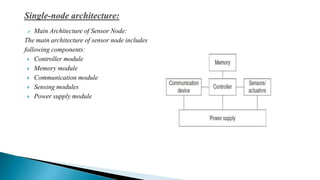
 Main Architecture of Sensor Node:
The main architecture of sensor node includes
following components:
 Controller module
 Memory module
 Communication module
 Sensing modules
 Power supply module
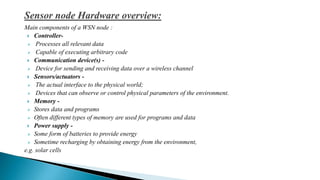
Main components of a WSN node :
 Controller-
 Processes all relevant data
 Capable of executing arbitrary code
 Communication device(s) -
 Device for sending and receiving data over a wireless channel
 Sensors/actuators -
 The actual interface to the physical world;
 Devices that can observe or control physical parameters of the environment.
 Memory -
 Stores data and programs
 Often different types of memory are used for programs and data
 Power supply -
 Some form of batteries to provide energy
 Sometime recharging by obtaining energy from the environment,
e.g. solar cells
 Controller-
 The controller is the core of a wireless sensor node, it process all relevant data, capable of
executing arbitrary code.
 It has to execute various programs, hence it is a Central Programming Unit (CPU) of the node.
 These,
-Collects data from the sensors
-Process the collected data
-Decides when and where to send the data
-Receives data from the other sensor nodes
-Decides on the actuator’s behavior
 Microcontroller:
◦ For the sensor nodes mostly microcontroller are used
◦ It is a general purpose processor, optimized for embedded applications, low power consumption
◦ Examples
 Intel StrongARM
- High-end processor often used in PDAs
- SA-1100 model: 32-bit RISC core, running @206MHz
 Texas Instruments MSP 430
- Intended for usage in embedded applications
- 16-bit RISC core, up to 4 MHz, 2-10 kB RAM, several DACs, RT clock
 Digital signal processor(DSPs)
- These are familiar because of their architecture and instruction set for processing large amount
of vector data
 FPGA(Field Programmable Gate Arrays)
- Flexible, can be reprogrammed to adapt to a changing set of requirements.
- But take time and energy.
 ASIC(Application Specific Integrated Circuit)
- These are used only when peak performance is needed
- Ex: High speed routers and switches
 Memory is required to store the programs and intermediate data; usually different types of
memory are used for program and data.
 RAM (Random Access Memory)
- To store intermediate sensor readings, packets from other nodes and so on.
- Is fast, but looses content if power supply is interrupted
 ROM (Read-Only Memory)
- To store fixed programs; not writeable
 EEPROM (Electrically Erasable Programmable)or Flash Memory
- Programs are stored
- Enables overwriting of data
- Can be used as intermediate storage if RAM is insufficient or if the RAM’s power supply should
be turned-off
- BUT: long read/write access delays, high energy requirement
 To turn nodes into a network a device is required for sending and receiving information over the
wireless channel.
 Communication device is used to exchange data between individual nodes.
 Choices of transmission medium:
 Wireless communication chooses any one of the following as transmission medium
- Radio frequencies(most used in WSN)
- Optical communication
- Ultra sound
- Magnetic inductance(less used)
 Among the above Radio Frequency(RF) is best because it provides,
-Long range
-High data rates
-Acceptable error rates at reasonable energy expenditure
-Does not require line of sight between sender and receiver
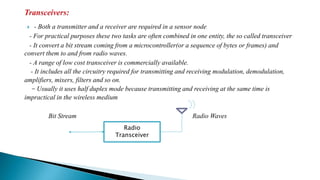
 - Both a transmitter and a receiver are required in a sensor node
- For practical purposes these two tasks are often combined in one entity, the so called transceiver
- It convert a bit stream coming from a microcontroller(or a sequence of bytes or frames) and
convert them to and from radio waves.
- A range of low cost transceiver is commercially available.
- It includes all the circuitry required for transmitting and receiving modulation, demodulation,
amplifiers, mixers, filters and so on.
- Usually it uses half duplex mode because transmitting and receiving at the same time is
impractical in the wireless medium
Bit Stream Radio Waves
Radio
Transceiver
 Transceivers can be put into different operational states:
 Transmit
- In this state transceiver is active and the antenna radiates energy
 Receive
- In this state receive part is active
 Idle
- In this state transceiver ready to receive but currently no receiving
 Sleep
- Significant parts of the receiver are switched off
 A fairly common structure of transceivers is into the Radio Frequency (RF) front end and the
baseband part:
- The radio frequency front end performs analog signal processing in the actual radio frequency
band.
- The baseband processor performs all signal processing in the digital domain and communicates
with a sensor node’s processor or other digital circuitry.
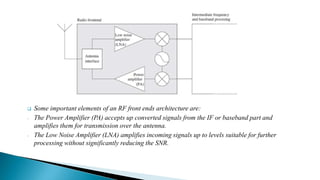
 Some important elements of an RF front ends architecture are:
- The Power Amplifier (PA) accepts up converted signals from the IF or baseband part and
amplifies them for transmission over the antenna.
- The Low Noise Amplifier (LNA) amplifies incoming signals up to levels suitable for further
processing without significantly reducing the SNR.
 The actual interface to the physical world: The devices that can observe or control physical
parameters of the environment.
 Sensors can be roughly categorized into three categories:
 Passive, omnidirectional sensors
 These sensors can measure a physical quantity at the point of the sensor node without actually
manipulating the environment by active probing -In this sense, they are passive.
 Passive, narrow-beam sensors
 These sensors are passive as well, but have a well-defined notion of direction of measurement.
 A typical example is a camera, which can “take measurements” in a given direction, but has to be
rotated if need be.
 Active sensors
 This last group of sensors actively probes the environment.
 For example, a sonar or radar sensor or some types of seismic sensors, which generate shock waves
by small explosions.
 Actuator:
 a device that converts an electrical signal to a physical output
 to open or close a switch or a relay or to set a value in some way. Whether this controls a motor, a
light bulb, or some other
There are essentially two aspects:
◦ First, storing energy and providing power in the required form;
◦ Second, attempting to replenish(refill) consumed energy by “scavenging” it from some node-external
power source over time.
1.Storing energy :Batteries
 Traditional batteries: The power source of a sensor node is a battery, eighter non-
rechargeable(Primary) or rechargeable (Secondary).
 Upon these batteries the requirements are
o Capacity
o Capacity under load
o Self-discharge
o Efficient recharging
o Relaxation
o DC-DC conversion: Unfortunately, batteries alone are not sufficient as a direct power source for a
sensor node.
 One typical problem is the reduction of a battery’s voltage as its capacity drops. Consequently, less
power is delivered to the sensor node’s circuits, – a node on a weak battery will have a smaller
transmission range than one with a full battery.
 For this energy scavenging is used which is the process of recharging the battery with energy
gathered from the environment like solar cells or vibration-based power generation.
1. Photovoltaics
◦ The well-known solar cells can be used to power sensor nodes
2. Temperature gradients
◦ Differences in temperature can be directly converted to electrical energy.
3. Vibrations
◦ General form of mechanical energy is vibrations.
4. Flow of air/liquid
◦ Another often-used power source is the flow of air or liquid in wind mills or turbines.
◦ The challenge here is again the miniaturization, but some of the work on millimeter scale.
• Why was TinyOS needed?
• Introduction to TinyOS
• Goals/Objectives behind TinyOS
• Requirements of WSN for Operating System
• TinyOS as a Solution
• TinyOS Model
▫ Data Model
▫ Thread Model
▫ Programming Model
▫ Component Model
▫ Network Model
• Example Application
 Problems with traditional OS
◦ Multithreaded Architecture not useful
◦ Large Memory Footprint
◦ Does not help to conserve energy and power
 Requirements for Wireless Sensor Networks
◦ Efficient utilization of energy and power
◦ Small Footprint
◦ Should support diversity in design and usage
◦ More emphasis on Concurrent execution
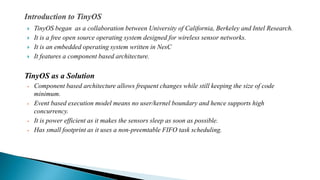
 TinyOS began as a collaboration between University of California, Berkeley and Intel Research.
 It is a free open source operating system designed for wireless sensor networks.
 It is an embedded operating system written in NesC
 It features a component based architecture.
TinyOS as a Solution
• Component based architecture allows frequent changes while still keeping the size of code
minimum.
• Event based execution model means no user/kernel boundary and hence supports high
concurrency.
• It is power efficient as it makes the sensors sleep as soon as possible.
• Has small footprint as it uses a non-preemtable FIFO task scheduling.
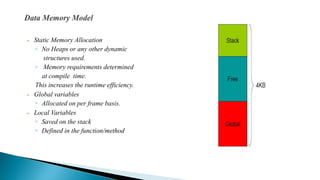
• Static Memory Allocation
▫ No Heaps or any other dynamic
structures used.
▫ Memory requirements determined
at compile time.
This increases the runtime efficiency.
• Global variables
▫ Allocated on per frame basis.
• Local Variables
▫ Saved on the stack
▫ Defined in the function/method
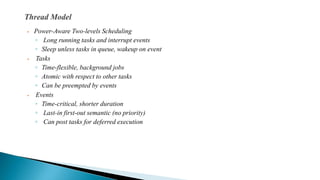
• Power-Aware Two-levels Scheduling
▫ Long running tasks and interrupt events
▫ Sleep unless tasks in queue, wakeup on event
• Tasks
▫ Time-flexible, background jobs
▫ Atomic with respect to other tasks
▫ Can be preempted by events
• Events
▫ Time-critical, shorter duration
▫ Last-in first-out semantic (no priority)
▫ Can post tasks for deferred execution
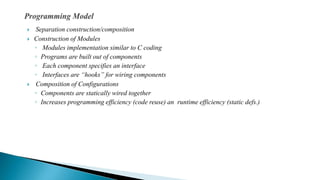
 Separation construction/composition
 Construction of Modules
◦ Modules implementation similar to C coding
◦ Programs are built out of components
◦ Each component specifies an interface
◦ Interfaces are “hooks” for wiring components
 Composition of Configurations
◦ Components are statically wired together
◦ Increases programming efficiency (code reuse) an runtime efficiency (static defs.)
 Components should use and provide bidirectional interfaces.
 Components should call and implement commands and signal and handle events.
 Components must handle events of used interfaces and also provide interfaces that must implement
commands.
Component Model : Hierarchy
 Commands
◦ Flow downwards
◦ Non Blocking requests
◦ Control returns to caller
 Events
◦ Flow upwards
◦ Post task, signal higher level events, call lower level cmds
◦ Control returns to signaler
 To avoid cycles
◦ Events can call commands
◦ Commands can NOT signal events
Sensor node hardware and network architecture

Sensor node hardware and network architecture

  • 1.
    T.Y.B.Sc.C.S Chapter 2 :Sensor Node Hardware and Network Architecture By Mrs.Vidhi Khedekar Assistant Professor, Dnyandeep College of Science and Commerce, Morvande-Boraj,Khed.
  • 2.
     Agenda: 1. Whatis Single-node architecture? 2. What are the hardware components & design constraints? 3. Introduction to TinyOS and nesC.
  • 3.
     A sensoris a device that detects and responds to some type of input from the physical environment.  The specific input could be light, heat, motion, moisture, pressure, or any one of a great number of other environmental phenomena.  The output is generally a signal that is converted to human-readable display at the sensor location or transmitted electronically over a network for reading or further processing. Example:  In a mercury-based glass thermometer, the input is temperature. The liquid contained expands and contracts in response, causing the level to be higher or lower on the marked gauge, which is human-readable. Sensor node:  A sensor node, also known as a mote, is a node in a sensor network that is capable of performing some processing, gathering sensory information and communicating with other connected nodes in the network.  A mote is a node but a node is not always a mote.
  • 4.
     Main Architectureof Sensor Node: The main architecture of sensor node includes following components:  Controller module  Memory module  Communication module  Sensing modules  Power supply module
  • 5.
    Main components ofa WSN node :  Controller-  Processes all relevant data  Capable of executing arbitrary code  Communication device(s) -  Device for sending and receiving data over a wireless channel  Sensors/actuators -  The actual interface to the physical world;  Devices that can observe or control physical parameters of the environment.  Memory -  Stores data and programs  Often different types of memory are used for programs and data  Power supply -  Some form of batteries to provide energy  Sometime recharging by obtaining energy from the environment, e.g. solar cells
  • 6.
     Controller-  Thecontroller is the core of a wireless sensor node, it process all relevant data, capable of executing arbitrary code.  It has to execute various programs, hence it is a Central Programming Unit (CPU) of the node.  These, -Collects data from the sensors -Process the collected data -Decides when and where to send the data -Receives data from the other sensor nodes -Decides on the actuator’s behavior
  • 7.
     Microcontroller: ◦ Forthe sensor nodes mostly microcontroller are used ◦ It is a general purpose processor, optimized for embedded applications, low power consumption ◦ Examples  Intel StrongARM - High-end processor often used in PDAs - SA-1100 model: 32-bit RISC core, running @206MHz  Texas Instruments MSP 430 - Intended for usage in embedded applications - 16-bit RISC core, up to 4 MHz, 2-10 kB RAM, several DACs, RT clock  Digital signal processor(DSPs) - These are familiar because of their architecture and instruction set for processing large amount of vector data  FPGA(Field Programmable Gate Arrays) - Flexible, can be reprogrammed to adapt to a changing set of requirements. - But take time and energy.  ASIC(Application Specific Integrated Circuit) - These are used only when peak performance is needed - Ex: High speed routers and switches
  • 8.
     Memory isrequired to store the programs and intermediate data; usually different types of memory are used for program and data.  RAM (Random Access Memory) - To store intermediate sensor readings, packets from other nodes and so on. - Is fast, but looses content if power supply is interrupted  ROM (Read-Only Memory) - To store fixed programs; not writeable  EEPROM (Electrically Erasable Programmable)or Flash Memory - Programs are stored - Enables overwriting of data - Can be used as intermediate storage if RAM is insufficient or if the RAM’s power supply should be turned-off - BUT: long read/write access delays, high energy requirement
  • 9.
     To turnnodes into a network a device is required for sending and receiving information over the wireless channel.  Communication device is used to exchange data between individual nodes.  Choices of transmission medium:  Wireless communication chooses any one of the following as transmission medium - Radio frequencies(most used in WSN) - Optical communication - Ultra sound - Magnetic inductance(less used)  Among the above Radio Frequency(RF) is best because it provides, -Long range -High data rates -Acceptable error rates at reasonable energy expenditure -Does not require line of sight between sender and receiver
  • 10.
     - Botha transmitter and a receiver are required in a sensor node - For practical purposes these two tasks are often combined in one entity, the so called transceiver - It convert a bit stream coming from a microcontroller(or a sequence of bytes or frames) and convert them to and from radio waves. - A range of low cost transceiver is commercially available. - It includes all the circuitry required for transmitting and receiving modulation, demodulation, amplifiers, mixers, filters and so on. - Usually it uses half duplex mode because transmitting and receiving at the same time is impractical in the wireless medium Bit Stream Radio Waves Radio Transceiver
  • 11.
     Transceivers canbe put into different operational states:  Transmit - In this state transceiver is active and the antenna radiates energy  Receive - In this state receive part is active  Idle - In this state transceiver ready to receive but currently no receiving  Sleep - Significant parts of the receiver are switched off  A fairly common structure of transceivers is into the Radio Frequency (RF) front end and the baseband part: - The radio frequency front end performs analog signal processing in the actual radio frequency band. - The baseband processor performs all signal processing in the digital domain and communicates with a sensor node’s processor or other digital circuitry.
  • 12.
     Some importantelements of an RF front ends architecture are: - The Power Amplifier (PA) accepts up converted signals from the IF or baseband part and amplifies them for transmission over the antenna. - The Low Noise Amplifier (LNA) amplifies incoming signals up to levels suitable for further processing without significantly reducing the SNR.
  • 13.
     The actualinterface to the physical world: The devices that can observe or control physical parameters of the environment.  Sensors can be roughly categorized into three categories:  Passive, omnidirectional sensors  These sensors can measure a physical quantity at the point of the sensor node without actually manipulating the environment by active probing -In this sense, they are passive.  Passive, narrow-beam sensors  These sensors are passive as well, but have a well-defined notion of direction of measurement.  A typical example is a camera, which can “take measurements” in a given direction, but has to be rotated if need be.  Active sensors  This last group of sensors actively probes the environment.  For example, a sonar or radar sensor or some types of seismic sensors, which generate shock waves by small explosions.  Actuator:  a device that converts an electrical signal to a physical output  to open or close a switch or a relay or to set a value in some way. Whether this controls a motor, a light bulb, or some other
  • 14.
    There are essentiallytwo aspects: ◦ First, storing energy and providing power in the required form; ◦ Second, attempting to replenish(refill) consumed energy by “scavenging” it from some node-external power source over time. 1.Storing energy :Batteries  Traditional batteries: The power source of a sensor node is a battery, eighter non- rechargeable(Primary) or rechargeable (Secondary).  Upon these batteries the requirements are o Capacity o Capacity under load o Self-discharge o Efficient recharging o Relaxation o DC-DC conversion: Unfortunately, batteries alone are not sufficient as a direct power source for a sensor node.  One typical problem is the reduction of a battery’s voltage as its capacity drops. Consequently, less power is delivered to the sensor node’s circuits, – a node on a weak battery will have a smaller transmission range than one with a full battery.
  • 15.
     For thisenergy scavenging is used which is the process of recharging the battery with energy gathered from the environment like solar cells or vibration-based power generation. 1. Photovoltaics ◦ The well-known solar cells can be used to power sensor nodes 2. Temperature gradients ◦ Differences in temperature can be directly converted to electrical energy. 3. Vibrations ◦ General form of mechanical energy is vibrations. 4. Flow of air/liquid ◦ Another often-used power source is the flow of air or liquid in wind mills or turbines. ◦ The challenge here is again the miniaturization, but some of the work on millimeter scale.
  • 16.
    • Why wasTinyOS needed? • Introduction to TinyOS • Goals/Objectives behind TinyOS • Requirements of WSN for Operating System • TinyOS as a Solution • TinyOS Model ▫ Data Model ▫ Thread Model ▫ Programming Model ▫ Component Model ▫ Network Model • Example Application
  • 17.
     Problems withtraditional OS ◦ Multithreaded Architecture not useful ◦ Large Memory Footprint ◦ Does not help to conserve energy and power  Requirements for Wireless Sensor Networks ◦ Efficient utilization of energy and power ◦ Small Footprint ◦ Should support diversity in design and usage ◦ More emphasis on Concurrent execution
  • 18.
     TinyOS beganas a collaboration between University of California, Berkeley and Intel Research.  It is a free open source operating system designed for wireless sensor networks.  It is an embedded operating system written in NesC  It features a component based architecture. TinyOS as a Solution • Component based architecture allows frequent changes while still keeping the size of code minimum. • Event based execution model means no user/kernel boundary and hence supports high concurrency. • It is power efficient as it makes the sensors sleep as soon as possible. • Has small footprint as it uses a non-preemtable FIFO task scheduling.
  • 19.
    • Static MemoryAllocation ▫ No Heaps or any other dynamic structures used. ▫ Memory requirements determined at compile time. This increases the runtime efficiency. • Global variables ▫ Allocated on per frame basis. • Local Variables ▫ Saved on the stack ▫ Defined in the function/method
  • 20.
    • Power-Aware Two-levelsScheduling ▫ Long running tasks and interrupt events ▫ Sleep unless tasks in queue, wakeup on event • Tasks ▫ Time-flexible, background jobs ▫ Atomic with respect to other tasks ▫ Can be preempted by events • Events ▫ Time-critical, shorter duration ▫ Last-in first-out semantic (no priority) ▫ Can post tasks for deferred execution
  • 21.
     Separation construction/composition Construction of Modules ◦ Modules implementation similar to C coding ◦ Programs are built out of components ◦ Each component specifies an interface ◦ Interfaces are “hooks” for wiring components  Composition of Configurations ◦ Components are statically wired together ◦ Increases programming efficiency (code reuse) an runtime efficiency (static defs.)
  • 22.
     Components shoulduse and provide bidirectional interfaces.  Components should call and implement commands and signal and handle events.  Components must handle events of used interfaces and also provide interfaces that must implement commands. Component Model : Hierarchy  Commands ◦ Flow downwards ◦ Non Blocking requests ◦ Control returns to caller  Events ◦ Flow upwards ◦ Post task, signal higher level events, call lower level cmds ◦ Control returns to signaler  To avoid cycles ◦ Events can call commands ◦ Commands can NOT signal events