z
SpanishColonization
inthePhilippines
(1521-1898) Group No: 2
Members:
Romero, Lovely
Centeno, Janine
Rapacon, Veronica
Macalino, Christine Joy
Quilacio, Vanessa Mae
Talao, Marian Shiellin
Morales, Christian Charles
z
Early Spanish expeditions
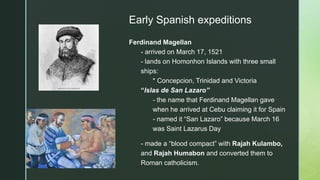
Ferdinand Magellan
- arrived on March 17, 1521
- lands on Homonhon Islands with three small
ships:
* Concepcion, Trinidad and Victoria
“Islas de San Lazaro”
- the name that Ferdinand Magellan gave
when he arrived at Cebu claiming it for Spain
- named it “San Lazaro” because March 16
was Saint Lazarus Day
- made a “blood compact” with Rajah Kulambo,
and Rajah Humabon and converted them to
Roman catholicism.
z
Early Spanish expeditions
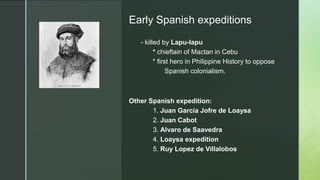
- killed by Lapu-lapu
* chieftain of Mactan in Cebu
* first hero in Philippine History to oppose
Spanish colonialism.
Other Spanish expedition:
1. Juan Garcia Jofre de Loaysa
2. Juan Cabot
3. Alvaro de Saavedra
4. Loaysa expedition
5. Ruy Lopez de Villalobos
z
Early Spanish expeditions
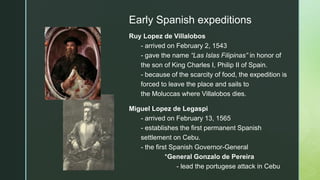
Ruy Lopez de Villalobos
- arrived on February 2, 1543
- gave the name “Las Islas Filipinas” in honor of
the son of King Charles I, Philip II of Spain.
- because of the scarcity of food, the expedition is
forced to leave the place and sails to
the Moluccas where Villalobos dies.
Miguel Lopez de Legaspi
- arrived on February 13, 1565
- establishes the first permanent Spanish
settlement on Cebu.
- the first Spanish Governor-General
*General Gonzalo de Pereira
- lead the portugese attack in Cebu
z
Early Spanish expeditions
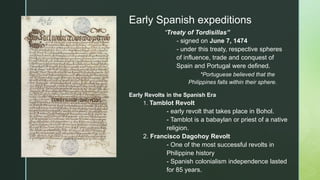
“Treaty of Tordisillas”
- signed on June 7, 1474
- under this treaty, respective spheres
of influence, trade and conquest of
Spain and Portugal were defined.
*Portuguese believed that the
Philippines falls within their sphere.
Early Revolts in the Spanish Era
1. Tamblot Revolt
- early revolt that takes place in Bohol.
- Tamblot is a babaylan or priest of a native
religion.
2. Francisco Dagohoy Revolt
- One of the most successful revolts in
Philippine history
- Spanish colonialism independence lasted
for 85 years.
z
Early Spanish expeditions
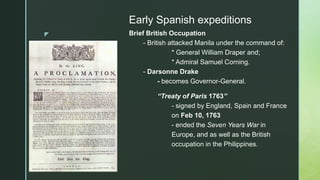
Brief British Occupation
- British attacked Manila under the command of:
* General William Draper and;
* Admiral Samuel Corning.
- Darsonne Drake
- becomes Governor-General.
“Treaty of Paris 1763”
- signed by England, Spain and France
on Feb 10, 1763
- ended the Seven Years War in
Europe, and as well as the British
occupation in the Philippines.
z
Reasons for Colonization
1. GOD
- conversion of natives to Christianity.
2. GOLD
- accumulation of gold and wealth.
3. GLORY
- supremacy of Spain over Portugal.
z
The Political Structure
Spain established a centralized colonial government in
the Philippines that was composed of:
a. National government
b. Local government
I. The Governor General
- King's representative and the highest-
ranking official.
- it saw to it that royal decrees and laws
emanating from Spain were implemented
- had the power to appoint and dismiss
public officials, except those personally
chosen by the King.
- supervised all government offices and the
collection of taxes.
- exercised certain legislative powers.
- issued proclamations to facilitate the
implementation of laws
z
The Political Structure
II. The Residencia
- was a special judicial court that
investigates the performance of a governor
general who was about to be replaced.
- one whom submitted a report of its findings
to the King.
III. The Visita
- a government official called the “Vistador
General”
- to observe conditions in the colony.
- reported his findings directly to the King.
IV. The Royal Audiencia
- served as an advisory body to the
Governor General and had the power
to check and a report on his abuses
z
The Political Structure
- also audited the expenditures of
the colonial government and sent a yearly
report to Spain.
V. The Provincial Government
- two types of local government units:
* the alcadia and;
* the corregimiento.
Alcadia
- led by the alcalde mayor
- governed the provinces that had
been fully subjugated.
Corregimiento
- headed by Corregidor
- governed the provinces that were
not yet entirely under Spanish
control
z
The Political Structure
“indulto de comercio”
- privileges enjoyed by the alcalde
mayor wherein they have the right
to participate in the galleon trade.
VI. The Municipal Government
- each province was divided into several
towns or pueblos headed by:
* Gobernadordcillos
- main concerns were efficient
governance and tax collection
- Four lieutenants aided the
Governardorcillo:
*Teniente Mayor (chief lieutenant)
*Teniente de Policia (police
lieutenant)
*Teniente de Sementeras
(lieutenant of the fields)
*Teniente de Ganados (lieutenant of
the livestock)
z
The Political Structure
VII. The Encomienda System
- Spain owed the colonization of the
Philippines to Miguel Lopez de
Legazpi, who valiantly and loyally
served the Spanish crown. To hasten
the subjugation of the country, King
Philip II instructed Legazpi to divide the
Philippines into large territories called
encomiendas, to be left to the
management of designated
encomenderos.
z
Rise of Filipino Nationalism
I. The Death of Gomburza
- Fathers Mariano Gomez, Jose Burgos and
Jocinto Zamora (Gomburza) was executed
on February 17, 1872, charged by
subversion.
II. Early Resistance to the Spanish Rule
a.) Revolts Caused by the Desire to Regain
Lost Freedom
1. Revolt of Lakan Dula and
Sulayman (1574)
2. First Pampanga Revolt (1585)
3. Tondo Conspiracy (1587-1588)
b.) Revolts Caused by Resistance to
Spanish-Imposed Institutions
1. Magalat’s Revolt (1596)
2. Revolt of the Irrayas (1621)
3. Sumuroy’s Rebellion(1649-1650)
z
Rise of Filipino Nationalism
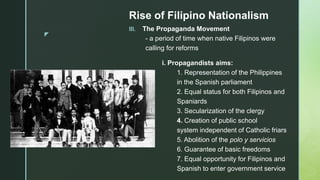
III. The Propaganda Movement
- a period of time when native Filipinos were
calling for reforms
i. Propagandists aims:
1. Representation of the Philippines
in the Spanish parliament
2. Equal status for both Filipinos and
Spaniards
3. Secularization of the clergy
4. Creation of public school
system independent of Catholic friars
5. Abolition of the polo y servicios
6. Guarantee of basic freedoms
7. Equal opportunity for Filipinos and
Spanish to enter government service
z
Rise of Filipino Nationalism
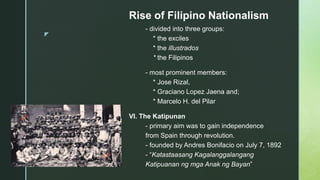
- divided into three groups:
* the exciles
* the illustrados
* the Filipinos
- most prominent members:
* Jose Rizal,
* Graciano Lopez Jaena and;
* Marcelo H. del Pilar
VI. The Katipunan
- primary aim was to gain independence
from Spain through revolution.
- founded by Andres Bonifacio on July 7, 1892
- “Katastaasang Kagalanggalangang
Katipuanan ng mga Anak ng Bayan”
z
Rise of Filipino Nationalism
- The KKK members agreed on the
following objectives:
▪ The political goal was to completely
separate the Philippines from Spain
after declaring the country’s
independence.
▪ The moral goal was to teach the
Filipinos good manners, cleanliness,
hygiene, fine morals, and how to
guard themselves against religious
fanaticism..
▪ The civic goal was to encourage
Filipinos to help themselves and to
defend the poor oppressed.
z
Rise of Filipino Nationalism
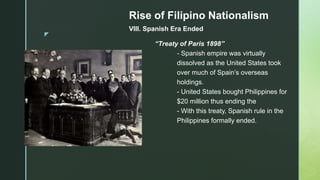
VIII. Spanish Era Ended
“Treaty of Paris 1898”
- Spanish empire was virtually
dissolved as the United States took
over much of Spain’s overseas
holdings.
- United States bought Philippines for
$20 million thus ending the
- With this treaty, Spanish rule in the
Philippines formally ended.

Spanish Colonization in the Philippines

  • 1.
    z SpanishColonization inthePhilippines (1521-1898) Group No:2 Members: Romero, Lovely Centeno, Janine Rapacon, Veronica Macalino, Christine Joy Quilacio, Vanessa Mae Talao, Marian Shiellin Morales, Christian Charles
  • 2.
    z Early Spanish expeditions FerdinandMagellan - arrived on March 17, 1521 - lands on Homonhon Islands with three small ships: * Concepcion, Trinidad and Victoria “Islas de San Lazaro” - the name that Ferdinand Magellan gave when he arrived at Cebu claiming it for Spain - named it “San Lazaro” because March 16 was Saint Lazarus Day - made a “blood compact” with Rajah Kulambo, and Rajah Humabon and converted them to Roman catholicism.
  • 3.
    z Early Spanish expeditions -killed by Lapu-lapu * chieftain of Mactan in Cebu * first hero in Philippine History to oppose Spanish colonialism. Other Spanish expedition: 1. Juan Garcia Jofre de Loaysa 2. Juan Cabot 3. Alvaro de Saavedra 4. Loaysa expedition 5. Ruy Lopez de Villalobos
  • 4.
    z Early Spanish expeditions RuyLopez de Villalobos - arrived on February 2, 1543 - gave the name “Las Islas Filipinas” in honor of the son of King Charles I, Philip II of Spain. - because of the scarcity of food, the expedition is forced to leave the place and sails to the Moluccas where Villalobos dies. Miguel Lopez de Legaspi - arrived on February 13, 1565 - establishes the first permanent Spanish settlement on Cebu. - the first Spanish Governor-General *General Gonzalo de Pereira - lead the portugese attack in Cebu
  • 5.
    z Early Spanish expeditions “Treatyof Tordisillas” - signed on June 7, 1474 - under this treaty, respective spheres of influence, trade and conquest of Spain and Portugal were defined. *Portuguese believed that the Philippines falls within their sphere. Early Revolts in the Spanish Era 1. Tamblot Revolt - early revolt that takes place in Bohol. - Tamblot is a babaylan or priest of a native religion. 2. Francisco Dagohoy Revolt - One of the most successful revolts in Philippine history - Spanish colonialism independence lasted for 85 years.
  • 6.
    z Early Spanish expeditions BriefBritish Occupation - British attacked Manila under the command of: * General William Draper and; * Admiral Samuel Corning. - Darsonne Drake - becomes Governor-General. “Treaty of Paris 1763” - signed by England, Spain and France on Feb 10, 1763 - ended the Seven Years War in Europe, and as well as the British occupation in the Philippines.
  • 7.
    z Reasons for Colonization 1.GOD - conversion of natives to Christianity. 2. GOLD - accumulation of gold and wealth. 3. GLORY - supremacy of Spain over Portugal.
  • 8.
    z The Political Structure Spainestablished a centralized colonial government in the Philippines that was composed of: a. National government b. Local government I. The Governor General - King's representative and the highest- ranking official. - it saw to it that royal decrees and laws emanating from Spain were implemented - had the power to appoint and dismiss public officials, except those personally chosen by the King. - supervised all government offices and the collection of taxes. - exercised certain legislative powers. - issued proclamations to facilitate the implementation of laws
  • 9.
    z The Political Structure II.The Residencia - was a special judicial court that investigates the performance of a governor general who was about to be replaced. - one whom submitted a report of its findings to the King. III. The Visita - a government official called the “Vistador General” - to observe conditions in the colony. - reported his findings directly to the King. IV. The Royal Audiencia - served as an advisory body to the Governor General and had the power to check and a report on his abuses
  • 10.
    z The Political Structure -also audited the expenditures of the colonial government and sent a yearly report to Spain. V. The Provincial Government - two types of local government units: * the alcadia and; * the corregimiento. Alcadia - led by the alcalde mayor - governed the provinces that had been fully subjugated. Corregimiento - headed by Corregidor - governed the provinces that were not yet entirely under Spanish control
  • 11.
    z The Political Structure “indultode comercio” - privileges enjoyed by the alcalde mayor wherein they have the right to participate in the galleon trade. VI. The Municipal Government - each province was divided into several towns or pueblos headed by: * Gobernadordcillos - main concerns were efficient governance and tax collection - Four lieutenants aided the Governardorcillo: *Teniente Mayor (chief lieutenant) *Teniente de Policia (police lieutenant) *Teniente de Sementeras (lieutenant of the fields) *Teniente de Ganados (lieutenant of the livestock)
  • 12.
    z The Political Structure VII.The Encomienda System - Spain owed the colonization of the Philippines to Miguel Lopez de Legazpi, who valiantly and loyally served the Spanish crown. To hasten the subjugation of the country, King Philip II instructed Legazpi to divide the Philippines into large territories called encomiendas, to be left to the management of designated encomenderos.
  • 13.
    z Rise of FilipinoNationalism I. The Death of Gomburza - Fathers Mariano Gomez, Jose Burgos and Jocinto Zamora (Gomburza) was executed on February 17, 1872, charged by subversion. II. Early Resistance to the Spanish Rule a.) Revolts Caused by the Desire to Regain Lost Freedom 1. Revolt of Lakan Dula and Sulayman (1574) 2. First Pampanga Revolt (1585) 3. Tondo Conspiracy (1587-1588) b.) Revolts Caused by Resistance to Spanish-Imposed Institutions 1. Magalat’s Revolt (1596) 2. Revolt of the Irrayas (1621) 3. Sumuroy’s Rebellion(1649-1650)
  • 14.
    z Rise of FilipinoNationalism III. The Propaganda Movement - a period of time when native Filipinos were calling for reforms i. Propagandists aims: 1. Representation of the Philippines in the Spanish parliament 2. Equal status for both Filipinos and Spaniards 3. Secularization of the clergy 4. Creation of public school system independent of Catholic friars 5. Abolition of the polo y servicios 6. Guarantee of basic freedoms 7. Equal opportunity for Filipinos and Spanish to enter government service
  • 15.
    z Rise of FilipinoNationalism - divided into three groups: * the exciles * the illustrados * the Filipinos - most prominent members: * Jose Rizal, * Graciano Lopez Jaena and; * Marcelo H. del Pilar VI. The Katipunan - primary aim was to gain independence from Spain through revolution. - founded by Andres Bonifacio on July 7, 1892 - “Katastaasang Kagalanggalangang Katipuanan ng mga Anak ng Bayan”
  • 16.
    z Rise of FilipinoNationalism - The KKK members agreed on the following objectives: ▪ The political goal was to completely separate the Philippines from Spain after declaring the country’s independence. ▪ The moral goal was to teach the Filipinos good manners, cleanliness, hygiene, fine morals, and how to guard themselves against religious fanaticism.. ▪ The civic goal was to encourage Filipinos to help themselves and to defend the poor oppressed.
  • 17.
    z Rise of FilipinoNationalism VIII. Spanish Era Ended “Treaty of Paris 1898” - Spanish empire was virtually dissolved as the United States took over much of Spain’s overseas holdings. - United States bought Philippines for $20 million thus ending the - With this treaty, Spanish rule in the Philippines formally ended.