SpanishPeriod inthe
Philippines
(1521-1898)
EDRALYN B. BALANTA
M
E
S
S
1
0
4
◤
Early Spanish Expeditions
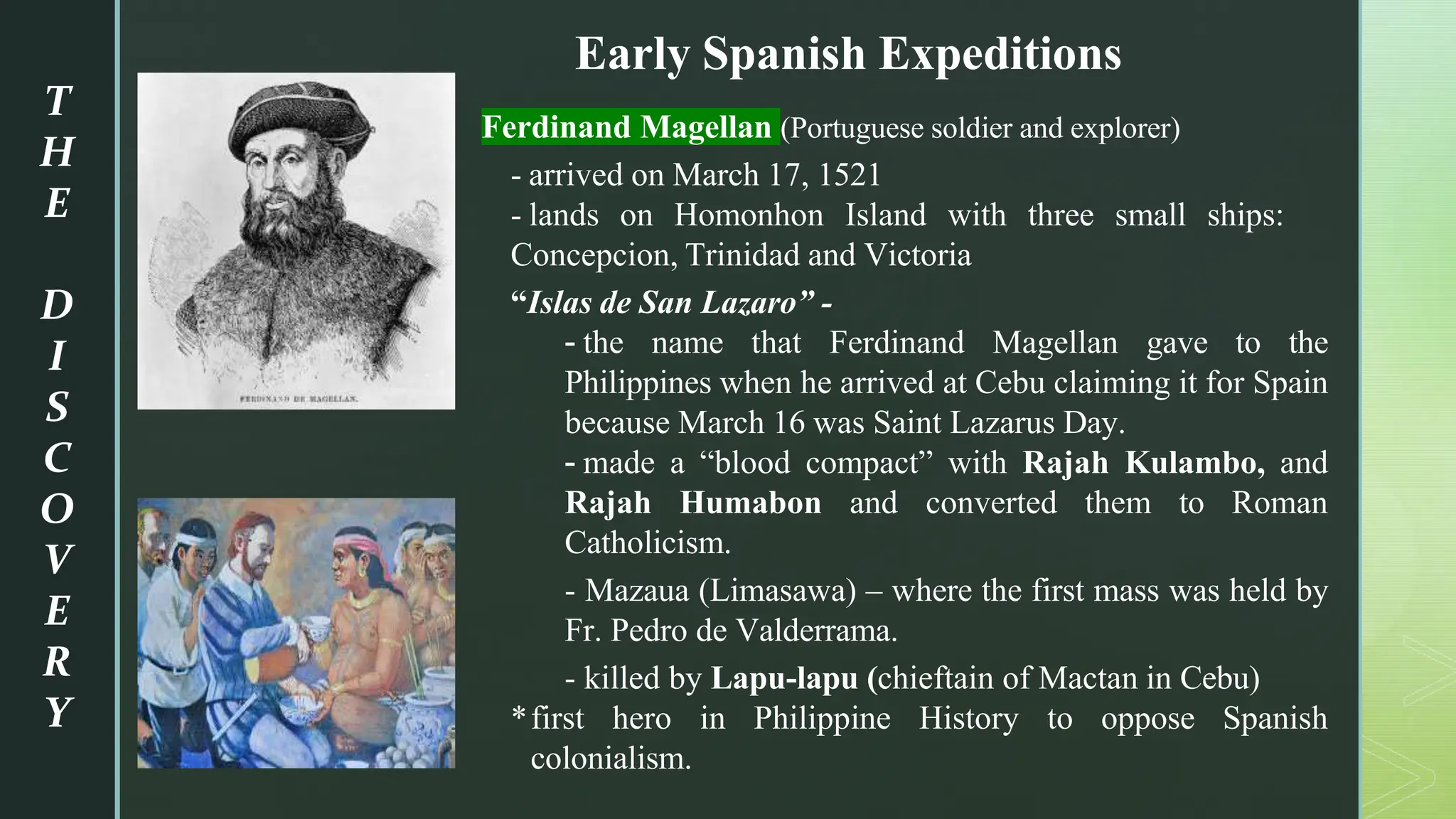
Ferdinand Magellan (Portuguese soldier and explorer)
- arrived on March 17, 1521
- lands on Homonhon Island with three small ships:
Concepcion, Trinidad and Victoria
“Islas de San Lazaro” -
- the name that Ferdinand Magellan gave to the
Philippines when he arrived at Cebu claiming it for Spain
because March 16 was Saint Lazarus Day.
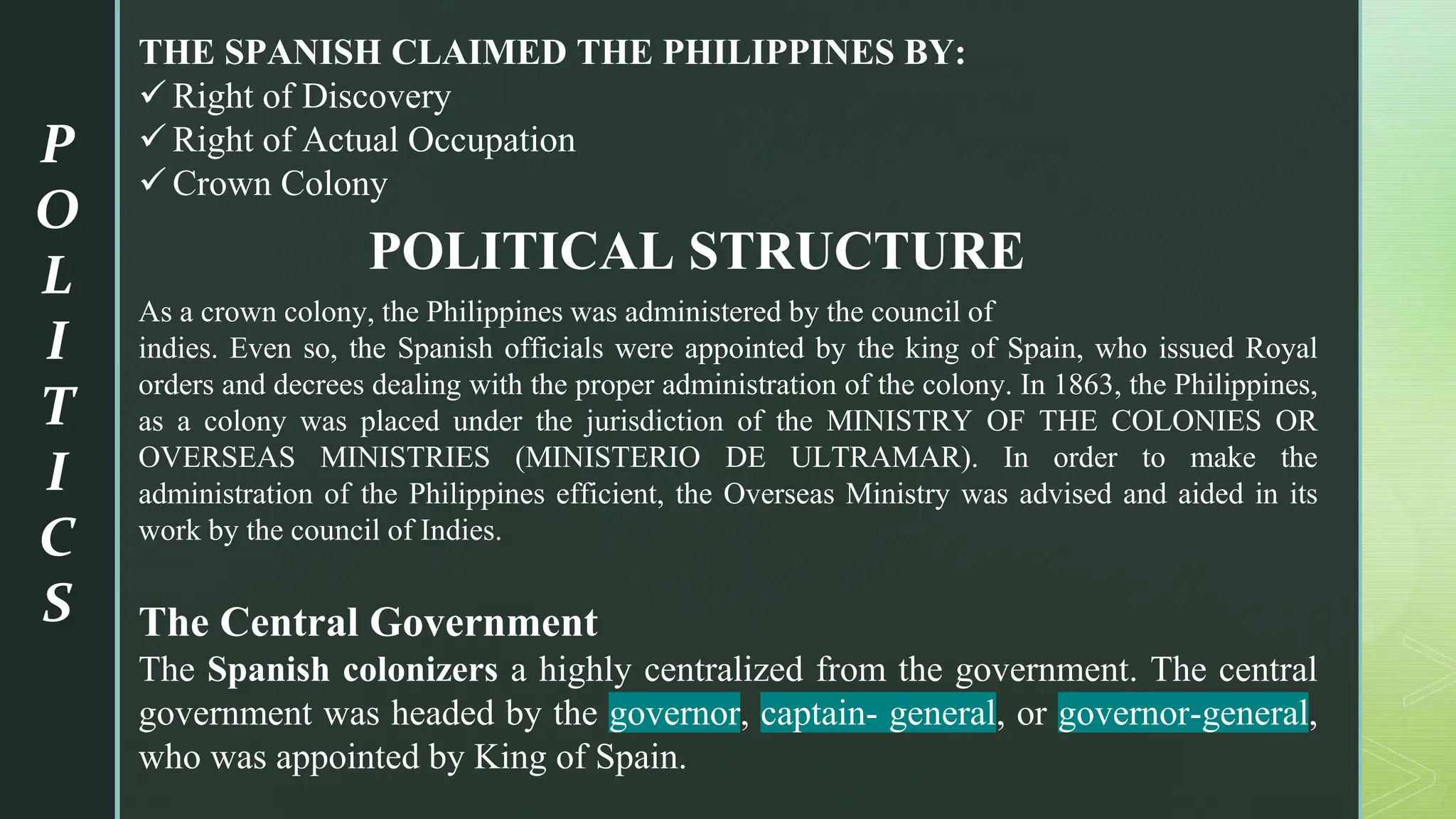
- made a “blood compact” with Rajah Kulambo, and
Rajah Humabon and converted them to Roman
Catholicism.
- Mazaua (Limasawa) – where the first mass was held by
Fr. Pedro de Valderrama.
- killed by Lapu-lapu (chieftain of Mactan in Cebu)
*first hero in Philippine History to oppose Spanish
colonialism.
T
H
E
D
I
S
C
O
V
E
R
Y
◤
Other Spanish expedition:
1. Juan Garcia Jofre de Loaysa (1525)
2. Juan Cabot (1526)
3. Alvaro de Saavedra (1527)
4. Ruy Lopez de Villalobos (1542)
o Give the name “Las Islas Filipinas” to the Philippines.
5. Lopez de Legazpi (1564)
o Had blood compact with Sikatuna and Sigala in Bohol
o Establish 1st Spanish Settlement
o Discovered route via Pacific to Mexico (Manila-
Acapulco Galleon Trade)
o First Gov-gen in the Phils.
Significant Results of Magellan’s Voyage:
• Proving the idea that the world is really round.
• Greatest oceans in the world are lying between Asia and
the New World. This motivated Europeans to conquer and
explore the Pacific Region.
Motives/Goals of Spanish
Colonization:
 Gold - accumulation of gold
and wealth.
 Gospel/God - conversion of
natives to Christianity.
 Glory – supremacy of Spain
over Portugal.
M
O
T
I
V
E
S
POLITICAL STRUCTURE
As a crown colony, the Philippines was administered by the council of
indies. Even so, the Spanish officials were appointed by the king of Spain, who issued Royal
orders and decrees dealing with the proper administration of the colony. In 1863, the Philippines,
as a colony was placed under the jurisdiction of the MINISTRY OF THE COLONIES OR
OVERSEAS MINISTRIES (MINISTERIO DE ULTRAMAR). In order to make the
administration of the Philippines efficient, the Overseas Ministry was advised and aided in its
work by the council of Indies.
THE SPANISH CLAIMED THE PHILIPPINES BY:
 Right of Discovery
 Right of Actual Occupation
 Crown Colony
The Central Government
The Spanish colonizers a highly centralized from the government. The central
government was headed by the governor, captain- general, or governor-general,
who was appointed by King of Spain.
P
O
L
I
T
I
C
S
Two Branches of Government
There was no legislature or congress because the Laws of the
Philippines were made by the Spaniards in Spain.
Corregimientos – unpacified
zones such as Panay, Mindoro,
and Mariveles.
Alcalde Mayor – has executive,
judicial and military functions
on the pacified places.
Eight (8) Ayuntamientos:
 Manila
 Iloilo
 Jaro
 Vigan
 Albay
 Cebu
 Batangas
 Nueva Caceras
Residencia – judicially
reviews an official at the
end of his term.
Vista – visits an
individual official or as a
general at any given time
within official’s term.
G
O
V
E
R
N
M
E
N
T
 Tributo/buwis – direct tax.
 Bandala – indirect tax; an enforced sale of
goods.
 Samboangan/Donativo de Zamboanga – tax to
crush Moro raids specifically used for the
conquest of Jolo.
 Cedula personal – replaced tribute; paid by
anyone who is over 18 yrs old.
 Diezmos Prediales- a tax which consisted of
one- tenth of the produce of the land.
 Vinta - tax paid by the people of some
provinces along the coast of Western Luzon for
the defense of the coasts from Muslim pirates.
Polo y Servicio (force labor)
• 16-60 yrs old males
• This is work without compensation
• Falla (money paid to be exempted from
polo)
• Worked for 40 days, then in 1884 was
reduced to 15 days.
• Male population declined.
E
C
O
N
O
M
I
C
Encomendero - the man who received the favor
(land/encomienda).
TWO KINDS OF ENCOMIENDA:
Encomienda de la real corona – lands reserve
for the Spanish monarchs.
Encomienda de particulares – lands for the
King’s loyal men.
POLO Y SERVICIO
1. That the Filipinos to be drafted for work must be paid for their work
2. That the Filipino laborers should not be made to work in distant places where they
could not return to their families
3. That the drafting of laborers should not coincide with the planting and harvest seasons
4. That men who are physically incapable should not be overworked
5. That forced labor should be resorted to only in cases of absolute necessity
6. That the number of laborers drafted should be diminished as soon as laborers from
other countries had volunteered to work
E
C
O
N
O
M
I
C
E
C
O
N
O
M
I
C
MANILA – ACAPULCO GALLEON TRADE
• Was the only regular fleet service in the Pacific Ocean
for 250 years; had two vessels.
• Only Filipino involvement was the construction of the
vessels/galleons.
• Positive results: Intercultural exchanges between
Philippines and Mexico.
• Annual subsidy/situado - subsidy sent by the Mexican
government to prevent the bankruptcy of the
Philippines. This subsidy amounted to 250,000 pesos.
• In 1811 -government’s monopoly of the galleon trade
came to an end.
PROVISIONS OF TOBACCO MONOPOLY
The cultivation of tobacco was prohibited except for the provinces selected to grow it;
Contraband sale of tobacco was forbidden;
The government had the exclusive right to purchase all tobacco products, to inspect and
classify the tobacco plant, and to prepare and manufacture cigar and cigarettes
The government had the right to prohibit the exportation or importation of tobacco by any
agency not connected with the government.
ECONOMIC SOCIETY OF FRIENDS OF THE COUNTRY
Established by Gov-Gen Basco; through this, the monopoly of tobacco
arises.
The society was divided into sections: (1) factories and manufacturers,
(2) industry and popular education, (3) natural history, (4) domestic and
foreign commerce, (5) agriculture and rural economy.
In 1784,the society was able to export indigo for the first time in
Philippine history.
In 1824,the society also founded the Academy of Drawing in Manila
In 1861,the society founded an agricultural school in Manila.
• The government had also
other monopolies, such as
wine and liquor, gun powder,
playing cards and buyo .
FERROCARIL DE MANILA
• Only railway line in the country; connects
Manila to Dagupan.
PUENTE COLGANTE (Quezon Bridge)
• First suspension bridge in the Far East.
OTHER INVENTIONS:
• Lamps were powered first by coconut oil.
E
C
O
N
O
M
I
C
For Boys:
• Colegio Maximo de San Ignacio – first college for
boys run by the Jesuits. (Colegio de Manila to
Universidad de San Ignacio)
• Colegio de Ildefonso – sole secondary school
outside Manila. (University of San Carlos)
• Colegio de Nuestra Senora del Santisimo Rosario –
presents-day UST (oldest university in the
Philippines).
• Escuela Pia – present-day ADMU.
• Colegio de San Juan de Letran – oldest college in
the Philippines, and oldest secondary in Asia.
For Girls:
• Colegios of Santa Potenciana – first school for
girls.
• Colegio de Santa Isabel – oldest college for girls
which operates up to the present.
E
D
U
C
A
T
I
O
N
Educational Decree of 1863
 Free, compulsory, public primary schools.
 At least two schools; one for boys, one for girls.
 Learners; 6-14 years old
 Required to teach Christian doctrine 1903
(Doctrina Christiana – first book published in the
phils.), Spanish History, reading and writing.
Universidad de San
Ignacio
University of San
Carlos
University of Sto
Tomas
Ateneo de Manila
University
Colegio de San Juan
de Letran
Real Colegio de
Santa Potenciana
University of Sta.
Isabel
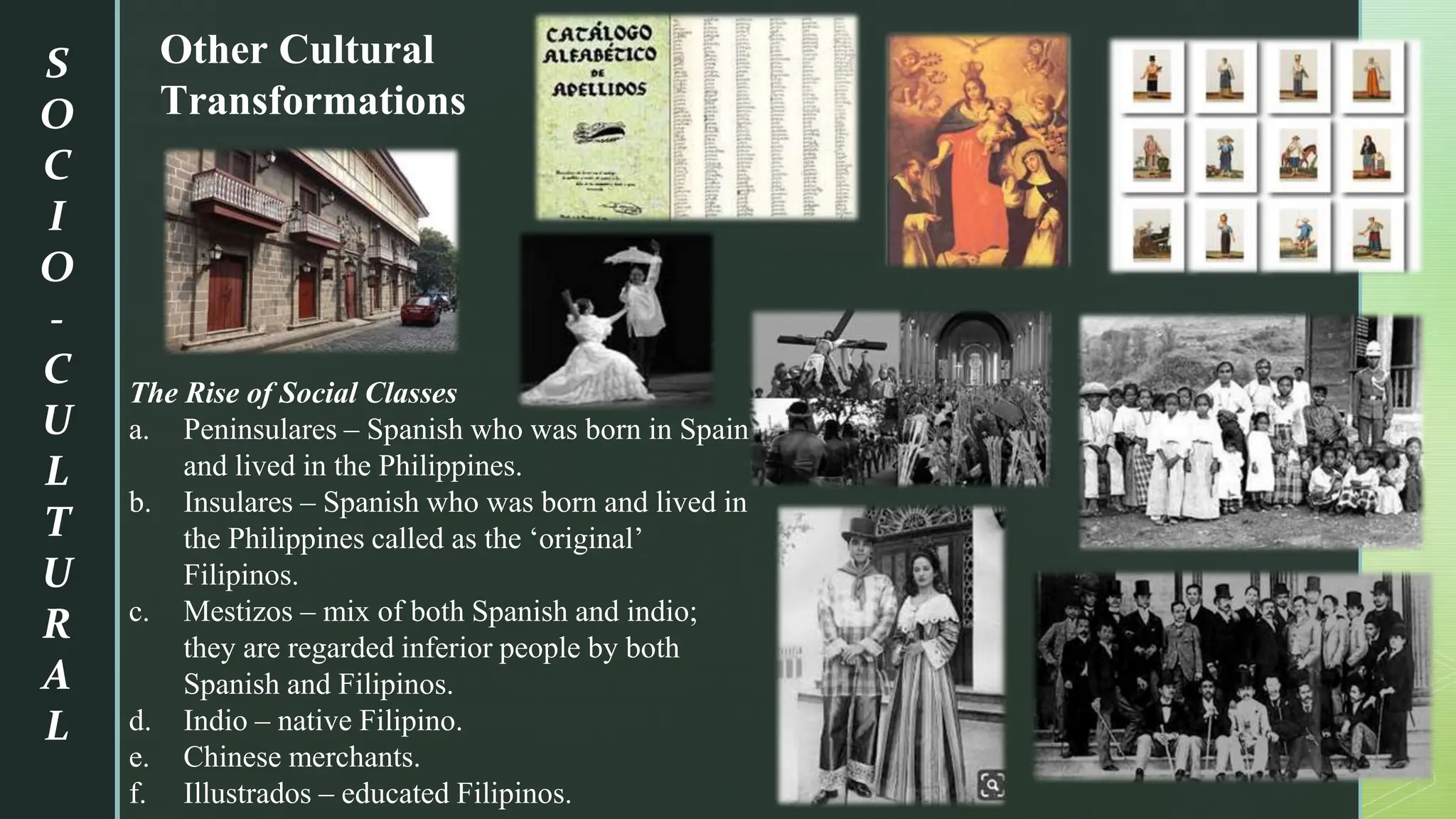
 Gov-Gen Narciso Claveria made the Filipinos
adopt Spanish surnames in his Catalogo
alfabetico de apellidos.
 Males are wearing barong tagalog or camisa
de chino, and trousers.
 Females have retained their baro and saya.
 Fiestas, which is a celebration of a saint, is
introduced.
 Dominican priests, headed by Fr. Francisco
Biancas de San Jose, introduced movable
block printing.
 Doctrina Christiana (1903) was the first book
published in the Philippines authored by Fray
Juan de Placensia.
 Fr Diego Cerra made the Las Pinas Bamboo
Organ in 1818, which up to the present, the
only one of its kind in the world.
 Museo-Biblioteca de Filipinas, the first
museum completed in 1892.
 Damian Domingo was known as “Father of
Filipino Painters”.
S
O
C
I
O
-
C
U
L
T
U
R
A
L
The Rise of Social Classes
a. Peninsulares – Spanish who was born in Spain
and lived in the Philippines.
b. Insulares – Spanish who was born and lived in
the Philippines called as the ‘original’
Filipinos.
c. Mestizos – mix of both Spanish and indio;
they are regarded inferior people by both
Spanish and Filipinos.
d. Indio – native Filipino.
e. Chinese merchants.
f. Illustrados – educated Filipinos.
S
O
C
I
O
-
C
U
L
T
U
R
A
L
Other Cultural
Transformations
U
P
R
I
S
I
N
G
&
R
E
V
O
L
T
S
LEADER PLACE REASON
Lakan Dula Manila Resisted Spanish-imposed taxes
Magat Salamat Manila Tried to get rid of Spaniards
Magalat Cagayan Resisted Spanish-imposed taxes
Bankaw Leyte Wanted to revert back to former beliefs
Tamblot Boho Wanted to revert back to former beliefs
Juan Ponce Sumuroy Samar
Resisted order of Gov. Fajardo to send Samarnons to Cavite to
construct ships.
Francisco Maniago Pampanga Unjust and delayed compensation
Andres Malong Pangasinan Abuse of Spanish officials
Tapar Panay Wanted to revert back to former beliefs
Francisco Dagohoy Bohol
Fr. Gaspar Morales refused to give his brother a
Chistian burial. (Longest revolt in the Philippines)
Diego & Gabriela Silang
Vigan, Ilocos
Sur
Resisted Spanish-imposed taxes.
Palaris Pangasinan
Resisted Spanish-imposed taxes.
Apolinario dela Cruz Quezon Spanish friars didn’t recognize his Confradia de San Jose.
First Filipinos to revolt were Lapu-lapu of Mactan (1521) & Dagami of Cebu (1567)
Reasons for the Failure of
Revolts
1) Lack of and weak weaponry –
their captors have guns and
cannons while our ancestors
only have spears and bolos.
2) Lack of Strategy and some
Filipinos worked for and with
the Spanish for benefits.
3) Lack of an excellent leader
4) Geographical setting – early
Filipinos were conditioned to
live separately from each other,
making uprisings small-scale
and easy to repress. This
caused a communication gap.
5) No lingua franca – there was
not even a national language
for the early Filipinos to unite
and to have a discourse to each
other smoothly.
U
P
R
I
S
I
N
G
&
R
E
V
O
L
T
S
Rise of Nationalism
1) Philippines opened to world commerce – mail services,
banking facilities and newspapers begin to surface and
to spread. The Suez Canal was opened, making the time
traveled from Europe to Asia much shorte.
2) Racial Discrimination – “The Spaniards will always be
a Spaniard and the Indio will always be an Indio.” – Fr.
Miguel Bustamante (Si Tandang Basio Macunat)
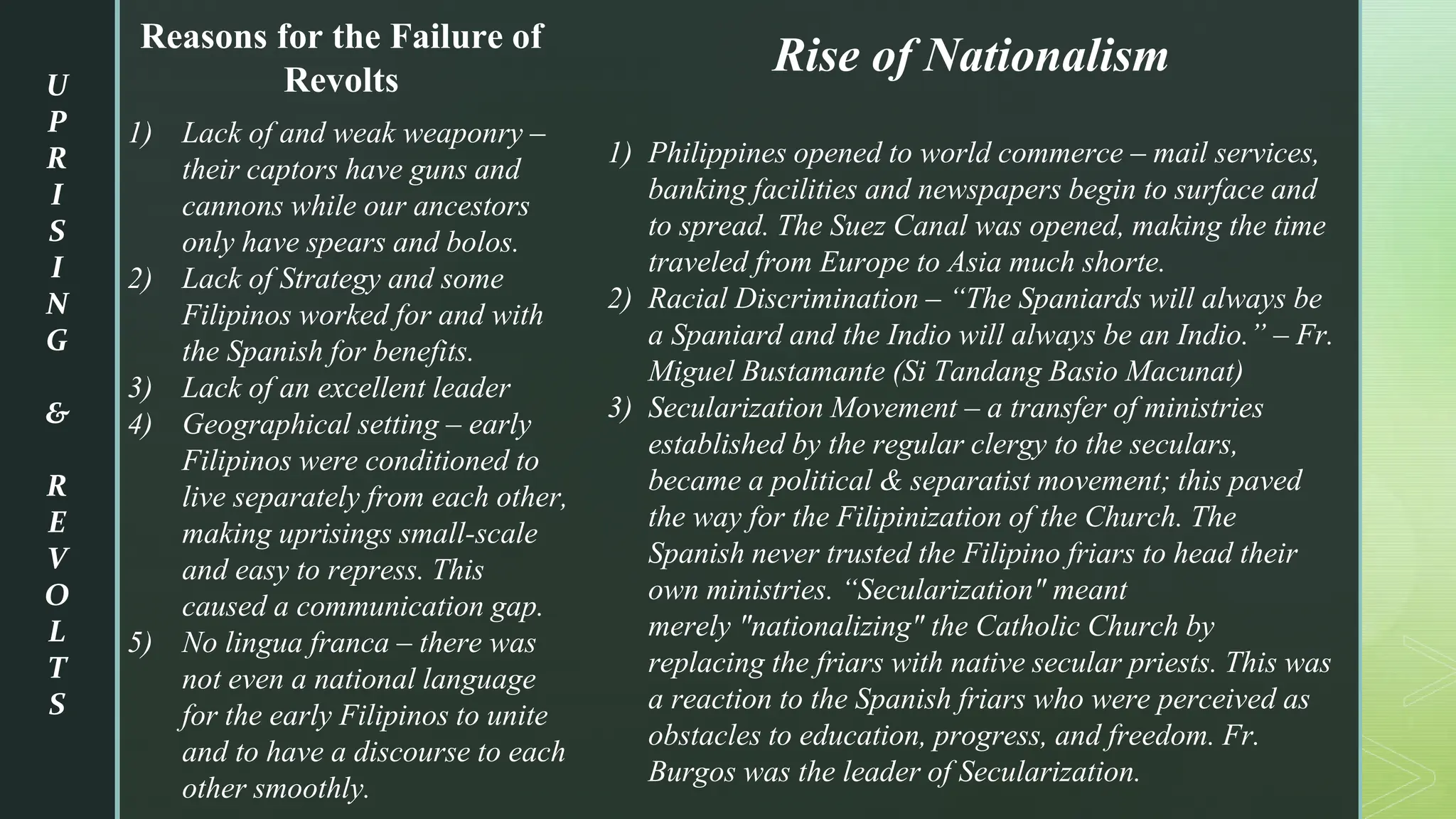
3) Secularization Movement – a transfer of ministries
established by the regular clergy to the seculars,
became a political & separatist movement; this paved
the way for the Filipinization of the Church. The
Spanish never trusted the Filipino friars to head their
own ministries. “Secularization" meant
merely "nationalizing" the Catholic Church by
replacing the friars with native secular priests. This was
a reaction to the Spanish friars who were perceived as
obstacles to education, progress, and freedom. Fr.
Burgos was the leader of Secularization.
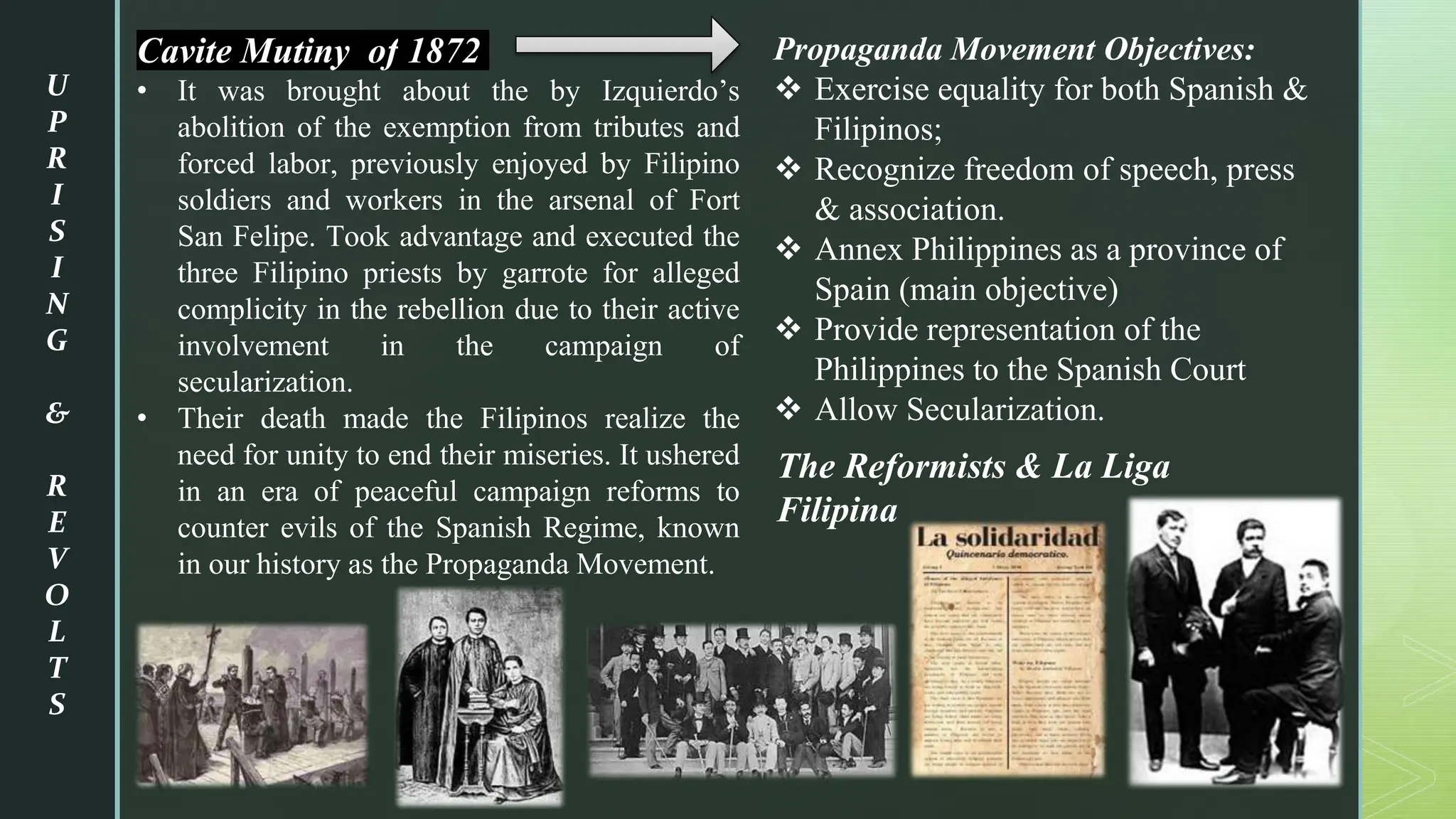
Cavite Mutiny of 1872
• It was brought about the by Izquierdo’s
abolition of the exemption from tributes and
forced labor, previously enjoyed by Filipino
soldiers and workers in the arsenal of Fort
San Felipe. Took advantage and executed the
three Filipino priests by garrote for alleged
complicity in the rebellion due to their active
involvement in the campaign of
secularization.
• Their death made the Filipinos realize the
need for unity to end their miseries. It ushered
in an era of peaceful campaign reforms to
counter evils of the Spanish Regime, known
in our history as the Propaganda Movement.
Propaganda Movement Objectives:
 Exercise equality for both Spanish &
Filipinos;
 Recognize freedom of speech, press
& association.
 Annex Philippines as a province of
Spain (main objective)
 Provide representation of the
Philippines to the Spanish Court
 Allow Secularization.
U
P
R
I
S
I
N
G
&
R
E
V
O
L
T
S
The Reformists & La Liga
Filipina
Spanish Era Ended
The Treaty of Paris of 1898 - was an agreement
made in 1898 that resulted in Spain surrendering
control of Cuba and ceding Puerto Rico, parts of the
West Indies, Guam, and the Philippines to the United
States. The cession of the Philippines involved a
payment of $20 million to Spain by the United
States. The treaty was signed on December 10, 1898,
and ended the Spanish-American War. It came into
effect on April 11, 1899, when the ratifications were
exchanged.
Failure of Propaganda Movement:
 Spain was very much preoccupied with her own internal problems & did not have time
to consider the colonial problems aired by the propagandists through the La Solidaridad.
 The friars countered all attacks of the reformists through their newspaper in the
Philippines entitled La Politica de Espana en Filipinas.
 Petty quarrels among the reformists made them disunited.
 Lack of finances to support the propaganda activities in Europe led to the failure of the
movement.
Insight about the Spanish Colonization
Growing up in the Philippines,
the legacy of Spanish colonization was
woven into the fabric of our identity. The
deeply ingrained Catholicism in our
culture, the Spanish loanwords sprinkled
throughout our language, and the
remnants of a feudal-like social structure
were all constant reminders of our
colonial past.
On one hand, the introduction of
Catholicism provided a sense of
community and shared values, shaping
our festivals, traditions, and family
structures. The majestic churches that dot
our landscapes stand as enduring symbols
of this cultural fusion.
Yet, the darker side of
colonization cannot be overlooked. The
exploitation of our ancestors through the
encomienda system, the economic disparities
that linger, and the scars of resistance and
uprisings tell a story of hardship and
resilience. The Philippines' journey to
independence was paved with the struggles
against Spanish rule, a testament to the
strong spirit of the Filipino people.
Despite the challenges, our history is
a testament to the resilience and adaptability
of the Filipino spirit. The echoes of Spanish
colonization still resonate in our daily lives,
encouraging us to reflect on our past,
appreciate our cultural diversity, and strive
for a future where the lessons learned from
history guide us toward a more just and
equitable society. Mabuhay Pilipinas!
R
E
F
L
E
C
T
I
O
N
ADVANCED ASIAN HISTORY: SPANISH-COLONIZATION.pptx

ADVANCED ASIAN HISTORY: SPANISH-COLONIZATION.pptx

  • 1.
  • 2.
    ◤ Early Spanish Expeditions FerdinandMagellan (Portuguese soldier and explorer) - arrived on March 17, 1521 - lands on Homonhon Island with three small ships: Concepcion, Trinidad and Victoria “Islas de San Lazaro” - - the name that Ferdinand Magellan gave to the Philippines when he arrived at Cebu claiming it for Spain because March 16 was Saint Lazarus Day. - made a “blood compact” with Rajah Kulambo, and Rajah Humabon and converted them to Roman Catholicism. - Mazaua (Limasawa) – where the first mass was held by Fr. Pedro de Valderrama. - killed by Lapu-lapu (chieftain of Mactan in Cebu) *first hero in Philippine History to oppose Spanish colonialism. T H E D I S C O V E R Y
  • 3.
    ◤ Other Spanish expedition: 1.Juan Garcia Jofre de Loaysa (1525) 2. Juan Cabot (1526) 3. Alvaro de Saavedra (1527) 4. Ruy Lopez de Villalobos (1542) o Give the name “Las Islas Filipinas” to the Philippines. 5. Lopez de Legazpi (1564) o Had blood compact with Sikatuna and Sigala in Bohol o Establish 1st Spanish Settlement o Discovered route via Pacific to Mexico (Manila- Acapulco Galleon Trade) o First Gov-gen in the Phils. Significant Results of Magellan’s Voyage: • Proving the idea that the world is really round. • Greatest oceans in the world are lying between Asia and the New World. This motivated Europeans to conquer and explore the Pacific Region. Motives/Goals of Spanish Colonization:  Gold - accumulation of gold and wealth.  Gospel/God - conversion of natives to Christianity.  Glory – supremacy of Spain over Portugal. M O T I V E S
  • 4.
    POLITICAL STRUCTURE As acrown colony, the Philippines was administered by the council of indies. Even so, the Spanish officials were appointed by the king of Spain, who issued Royal orders and decrees dealing with the proper administration of the colony. In 1863, the Philippines, as a colony was placed under the jurisdiction of the MINISTRY OF THE COLONIES OR OVERSEAS MINISTRIES (MINISTERIO DE ULTRAMAR). In order to make the administration of the Philippines efficient, the Overseas Ministry was advised and aided in its work by the council of Indies. THE SPANISH CLAIMED THE PHILIPPINES BY:  Right of Discovery  Right of Actual Occupation  Crown Colony The Central Government The Spanish colonizers a highly centralized from the government. The central government was headed by the governor, captain- general, or governor-general, who was appointed by King of Spain. P O L I T I C S
  • 5.
    Two Branches ofGovernment There was no legislature or congress because the Laws of the Philippines were made by the Spaniards in Spain. Corregimientos – unpacified zones such as Panay, Mindoro, and Mariveles. Alcalde Mayor – has executive, judicial and military functions on the pacified places. Eight (8) Ayuntamientos:  Manila  Iloilo  Jaro  Vigan  Albay  Cebu  Batangas  Nueva Caceras Residencia – judicially reviews an official at the end of his term. Vista – visits an individual official or as a general at any given time within official’s term. G O V E R N M E N T
  • 6.
     Tributo/buwis –direct tax.  Bandala – indirect tax; an enforced sale of goods.  Samboangan/Donativo de Zamboanga – tax to crush Moro raids specifically used for the conquest of Jolo.  Cedula personal – replaced tribute; paid by anyone who is over 18 yrs old.  Diezmos Prediales- a tax which consisted of one- tenth of the produce of the land.  Vinta - tax paid by the people of some provinces along the coast of Western Luzon for the defense of the coasts from Muslim pirates. Polo y Servicio (force labor) • 16-60 yrs old males • This is work without compensation • Falla (money paid to be exempted from polo) • Worked for 40 days, then in 1884 was reduced to 15 days. • Male population declined. E C O N O M I C
  • 7.
    Encomendero - theman who received the favor (land/encomienda). TWO KINDS OF ENCOMIENDA: Encomienda de la real corona – lands reserve for the Spanish monarchs. Encomienda de particulares – lands for the King’s loyal men. POLO Y SERVICIO 1. That the Filipinos to be drafted for work must be paid for their work 2. That the Filipino laborers should not be made to work in distant places where they could not return to their families 3. That the drafting of laborers should not coincide with the planting and harvest seasons 4. That men who are physically incapable should not be overworked 5. That forced labor should be resorted to only in cases of absolute necessity 6. That the number of laborers drafted should be diminished as soon as laborers from other countries had volunteered to work E C O N O M I C
  • 8.
    E C O N O M I C MANILA – ACAPULCOGALLEON TRADE • Was the only regular fleet service in the Pacific Ocean for 250 years; had two vessels. • Only Filipino involvement was the construction of the vessels/galleons. • Positive results: Intercultural exchanges between Philippines and Mexico. • Annual subsidy/situado - subsidy sent by the Mexican government to prevent the bankruptcy of the Philippines. This subsidy amounted to 250,000 pesos. • In 1811 -government’s monopoly of the galleon trade came to an end. PROVISIONS OF TOBACCO MONOPOLY The cultivation of tobacco was prohibited except for the provinces selected to grow it; Contraband sale of tobacco was forbidden; The government had the exclusive right to purchase all tobacco products, to inspect and classify the tobacco plant, and to prepare and manufacture cigar and cigarettes The government had the right to prohibit the exportation or importation of tobacco by any agency not connected with the government.
  • 9.
    ECONOMIC SOCIETY OFFRIENDS OF THE COUNTRY Established by Gov-Gen Basco; through this, the monopoly of tobacco arises. The society was divided into sections: (1) factories and manufacturers, (2) industry and popular education, (3) natural history, (4) domestic and foreign commerce, (5) agriculture and rural economy. In 1784,the society was able to export indigo for the first time in Philippine history. In 1824,the society also founded the Academy of Drawing in Manila In 1861,the society founded an agricultural school in Manila. • The government had also other monopolies, such as wine and liquor, gun powder, playing cards and buyo . FERROCARIL DE MANILA • Only railway line in the country; connects Manila to Dagupan. PUENTE COLGANTE (Quezon Bridge) • First suspension bridge in the Far East. OTHER INVENTIONS: • Lamps were powered first by coconut oil. E C O N O M I C
  • 10.
    For Boys: • ColegioMaximo de San Ignacio – first college for boys run by the Jesuits. (Colegio de Manila to Universidad de San Ignacio) • Colegio de Ildefonso – sole secondary school outside Manila. (University of San Carlos) • Colegio de Nuestra Senora del Santisimo Rosario – presents-day UST (oldest university in the Philippines). • Escuela Pia – present-day ADMU. • Colegio de San Juan de Letran – oldest college in the Philippines, and oldest secondary in Asia. For Girls: • Colegios of Santa Potenciana – first school for girls. • Colegio de Santa Isabel – oldest college for girls which operates up to the present. E D U C A T I O N Educational Decree of 1863  Free, compulsory, public primary schools.  At least two schools; one for boys, one for girls.  Learners; 6-14 years old  Required to teach Christian doctrine 1903 (Doctrina Christiana – first book published in the phils.), Spanish History, reading and writing. Universidad de San Ignacio University of San Carlos University of Sto Tomas Ateneo de Manila University Colegio de San Juan de Letran Real Colegio de Santa Potenciana University of Sta. Isabel
  • 11.
     Gov-Gen NarcisoClaveria made the Filipinos adopt Spanish surnames in his Catalogo alfabetico de apellidos.  Males are wearing barong tagalog or camisa de chino, and trousers.  Females have retained their baro and saya.  Fiestas, which is a celebration of a saint, is introduced.  Dominican priests, headed by Fr. Francisco Biancas de San Jose, introduced movable block printing.  Doctrina Christiana (1903) was the first book published in the Philippines authored by Fray Juan de Placensia.  Fr Diego Cerra made the Las Pinas Bamboo Organ in 1818, which up to the present, the only one of its kind in the world.  Museo-Biblioteca de Filipinas, the first museum completed in 1892.  Damian Domingo was known as “Father of Filipino Painters”. S O C I O - C U L T U R A L
  • 12.
    The Rise ofSocial Classes a. Peninsulares – Spanish who was born in Spain and lived in the Philippines. b. Insulares – Spanish who was born and lived in the Philippines called as the ‘original’ Filipinos. c. Mestizos – mix of both Spanish and indio; they are regarded inferior people by both Spanish and Filipinos. d. Indio – native Filipino. e. Chinese merchants. f. Illustrados – educated Filipinos. S O C I O - C U L T U R A L Other Cultural Transformations
  • 13.
    U P R I S I N G & R E V O L T S LEADER PLACE REASON LakanDula Manila Resisted Spanish-imposed taxes Magat Salamat Manila Tried to get rid of Spaniards Magalat Cagayan Resisted Spanish-imposed taxes Bankaw Leyte Wanted to revert back to former beliefs Tamblot Boho Wanted to revert back to former beliefs Juan Ponce Sumuroy Samar Resisted order of Gov. Fajardo to send Samarnons to Cavite to construct ships. Francisco Maniago Pampanga Unjust and delayed compensation Andres Malong Pangasinan Abuse of Spanish officials Tapar Panay Wanted to revert back to former beliefs Francisco Dagohoy Bohol Fr. Gaspar Morales refused to give his brother a Chistian burial. (Longest revolt in the Philippines) Diego & Gabriela Silang Vigan, Ilocos Sur Resisted Spanish-imposed taxes. Palaris Pangasinan Resisted Spanish-imposed taxes. Apolinario dela Cruz Quezon Spanish friars didn’t recognize his Confradia de San Jose. First Filipinos to revolt were Lapu-lapu of Mactan (1521) & Dagami of Cebu (1567)
  • 14.
    Reasons for theFailure of Revolts 1) Lack of and weak weaponry – their captors have guns and cannons while our ancestors only have spears and bolos. 2) Lack of Strategy and some Filipinos worked for and with the Spanish for benefits. 3) Lack of an excellent leader 4) Geographical setting – early Filipinos were conditioned to live separately from each other, making uprisings small-scale and easy to repress. This caused a communication gap. 5) No lingua franca – there was not even a national language for the early Filipinos to unite and to have a discourse to each other smoothly. U P R I S I N G & R E V O L T S Rise of Nationalism 1) Philippines opened to world commerce – mail services, banking facilities and newspapers begin to surface and to spread. The Suez Canal was opened, making the time traveled from Europe to Asia much shorte. 2) Racial Discrimination – “The Spaniards will always be a Spaniard and the Indio will always be an Indio.” – Fr. Miguel Bustamante (Si Tandang Basio Macunat) 3) Secularization Movement – a transfer of ministries established by the regular clergy to the seculars, became a political & separatist movement; this paved the way for the Filipinization of the Church. The Spanish never trusted the Filipino friars to head their own ministries. “Secularization" meant merely "nationalizing" the Catholic Church by replacing the friars with native secular priests. This was a reaction to the Spanish friars who were perceived as obstacles to education, progress, and freedom. Fr. Burgos was the leader of Secularization.
  • 15.
    Cavite Mutiny of1872 • It was brought about the by Izquierdo’s abolition of the exemption from tributes and forced labor, previously enjoyed by Filipino soldiers and workers in the arsenal of Fort San Felipe. Took advantage and executed the three Filipino priests by garrote for alleged complicity in the rebellion due to their active involvement in the campaign of secularization. • Their death made the Filipinos realize the need for unity to end their miseries. It ushered in an era of peaceful campaign reforms to counter evils of the Spanish Regime, known in our history as the Propaganda Movement. Propaganda Movement Objectives:  Exercise equality for both Spanish & Filipinos;  Recognize freedom of speech, press & association.  Annex Philippines as a province of Spain (main objective)  Provide representation of the Philippines to the Spanish Court  Allow Secularization. U P R I S I N G & R E V O L T S The Reformists & La Liga Filipina
  • 16.
    Spanish Era Ended TheTreaty of Paris of 1898 - was an agreement made in 1898 that resulted in Spain surrendering control of Cuba and ceding Puerto Rico, parts of the West Indies, Guam, and the Philippines to the United States. The cession of the Philippines involved a payment of $20 million to Spain by the United States. The treaty was signed on December 10, 1898, and ended the Spanish-American War. It came into effect on April 11, 1899, when the ratifications were exchanged. Failure of Propaganda Movement:  Spain was very much preoccupied with her own internal problems & did not have time to consider the colonial problems aired by the propagandists through the La Solidaridad.  The friars countered all attacks of the reformists through their newspaper in the Philippines entitled La Politica de Espana en Filipinas.  Petty quarrels among the reformists made them disunited.  Lack of finances to support the propaganda activities in Europe led to the failure of the movement.
  • 17.
    Insight about theSpanish Colonization Growing up in the Philippines, the legacy of Spanish colonization was woven into the fabric of our identity. The deeply ingrained Catholicism in our culture, the Spanish loanwords sprinkled throughout our language, and the remnants of a feudal-like social structure were all constant reminders of our colonial past. On one hand, the introduction of Catholicism provided a sense of community and shared values, shaping our festivals, traditions, and family structures. The majestic churches that dot our landscapes stand as enduring symbols of this cultural fusion. Yet, the darker side of colonization cannot be overlooked. The exploitation of our ancestors through the encomienda system, the economic disparities that linger, and the scars of resistance and uprisings tell a story of hardship and resilience. The Philippines' journey to independence was paved with the struggles against Spanish rule, a testament to the strong spirit of the Filipino people. Despite the challenges, our history is a testament to the resilience and adaptability of the Filipino spirit. The echoes of Spanish colonization still resonate in our daily lives, encouraging us to reflect on our past, appreciate our cultural diversity, and strive for a future where the lessons learned from history guide us toward a more just and equitable society. Mabuhay Pilipinas! R E F L E C T I O N