A
Presentation on
LI-FI TECHNOLOGY
for the partial fulfillment of the requirement
for the degree of
Bachelor of Technology
in
Computer Science And Engineering

By
Uzma Ruhy
Contents
Introduction
History
Present Scenario
Working Process
Li-Fi vs Wi-Fi
Applications
Challenges for Li-Fi
Conclusion
Introduction
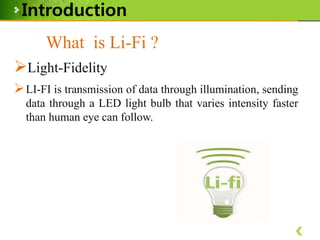
What is Li-Fi ?
Light-Fidelity
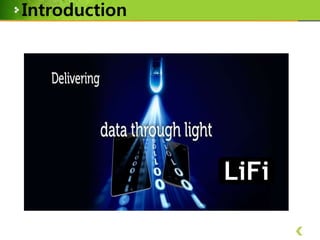
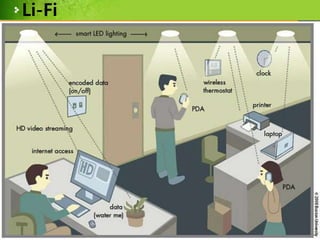
 LI-FI is transmission of data through illumination, sending
data through a LED light bulb that varies intensity faster
than human eye can follow.
Introduction
History of Li-Fi
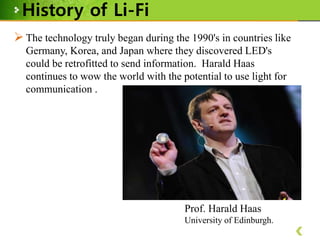
 The technology truly began during the 1990's in countries like
Germany, Korea, and Japan where they discovered LED's
could be retrofitted to send information. Harald Haas
continues to wow the world with the potential to use light for
communication .

Prof. Harald Haas
University of Edinburgh.
Li-Fi
Present Scenario


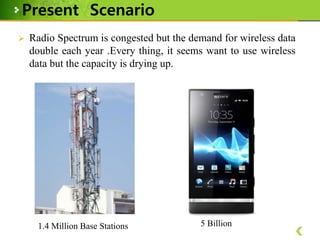
Radio Spectrum is congested but the demand for wireless data
double each year .Every thing, it seems want to use wireless
data but the capacity is drying up.

1.4 Million Base Stations

5 Billion
Radio Spectrum
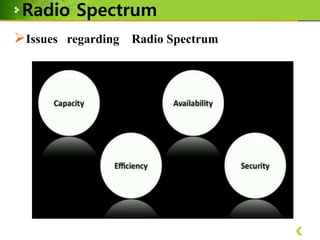
Issues regarding Radio Spectrum
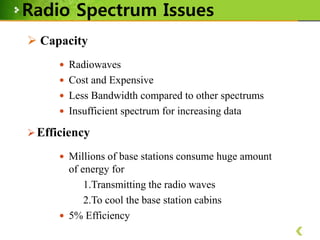
Radio Spectrum Issues
 Capacity
 Radiowaves
 Cost and Expensive
 Less Bandwidth compared to other spectrums
 Insufficient spectrum for increasing data

 Efficiency
 Millions of base stations consume huge amount

of energy for
1.Transmitting the radio waves
2.To cool the base station cabins
 5% Efficiency
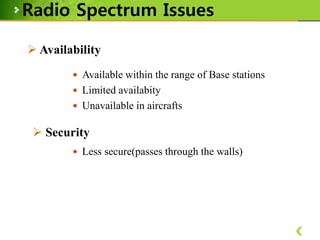
Radio Spectrum Issues
 Availability
 Available within the range of Base stations
 Limited availabity
 Unavailable in aircrafts

 Security
 Less secure(passes through the walls)
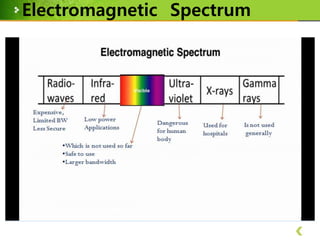
Electromagnetic Spectrum
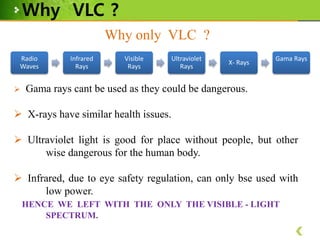
Why VLC ?
Why only VLC ?
Radio
Waves



Infrared
Rays

Visible
Rays

Ultraviolet
Rays

X- Rays

Gama Rays

Gama rays cant be used as they could be dangerous.

 X-rays have similar health issues.

 Ultraviolet light is good for place without people, but other
wise dangerous for the human body.
 Infrared, due to eye safety regulation, can only bse used with
low power.
HENCE WE LEFT WITH THE ONLY THE VISIBLE - LIGHT
SPECTRUM.
Li-Fi
Working Process
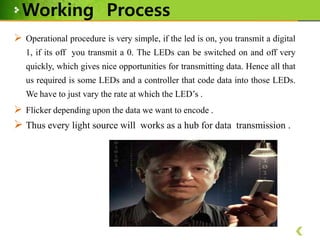
 Operational procedure is very simple, if the led is on, you transmit a digital
1, if its off you transmit a 0. The LEDs can be switched on and off very
quickly, which gives nice opportunities for transmitting data. Hence all that
us required is some LEDs and a controller that code data into those LEDs.
We have to just vary the rate at which the LED’s .

 Flicker depending upon the data we want to encode .

 Thus every light source will works as a hub for data transmission .
How Li-Fi Works ?
How Li-Fi Works ?

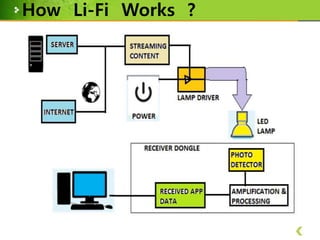
 On one end all the data on the internet will be streamed to a
lamp driver when the led is turned on the microchip converts
the digital data in form of light .

 A light sensitive device (photo detector) receives the signal
and converts it back into original data. This method of using
rapid pulses of light to transmit information wirelessly is
technically referred as Visible Light Communication .
Comparision between Li-Fi and Wi-Fi
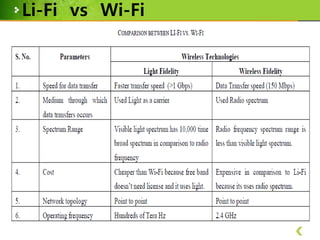
 Li-Fi can be thought of as a light-based Wi-Fi. That is, it uses
light instead of radio waves to transmit information.

 Instead of Wi-Fi modems, Li-Fi would use transceiver-fitted
LED lamps that can light a room as well as transmit and
receive information.

 WI-FI is great for general wireless coverage within buildings,
and li-fi is ideal for high density wireless data coverage in
confined area and for relieving radio interference issues .

 So the two technologies can be considered complimentary.
Li-Fi vs Wi-Fi
Application Areas
 Li Fi technology is still in its infancy .However some areas
where it seems perfectly applicable are:-

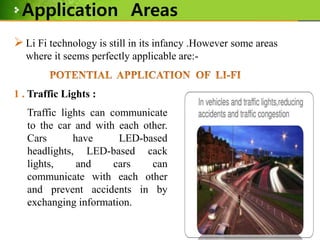
1 . Traffic Lights :
Traffic lights can communicate
to the car and with each other.
Cars
have
LED-based
headlights, LED-based cack
lights,
and
cars
can
communicate with each other
and prevent accidents in by
exchanging information.
Potential Application of Li-Fi
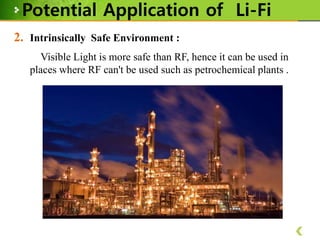
2. Intrinsically Safe Environment :
Visible Light is more safe than RF, hence it can be used in
places where RF can't be used such as petrochemical plants .
Potential Application of Li-Fi
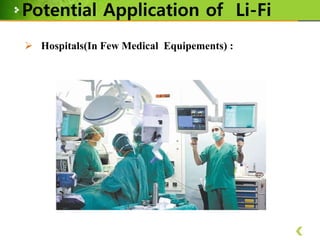
 Hospitals(In Few Medical Equipements) :
Potential Application of Li-Fi
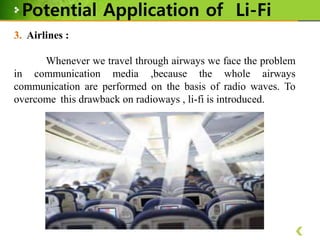
3. Airlines :
Whenever we travel through airways we face the problem
in communication media ,because the whole airways
communication are performed on the basis of radio waves. To
overcome this drawback on radioways , li-fi is introduced.
Potential Application of Li-Fi
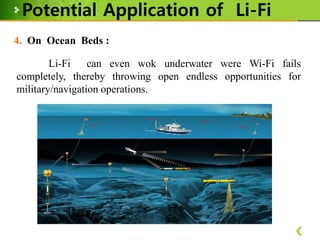
4. On Ocean Beds :
Li-Fi
can even wok underwater were Wi-Fi fails
completely, thereby throwing open endless opportunities for
military/navigation operations.
Application


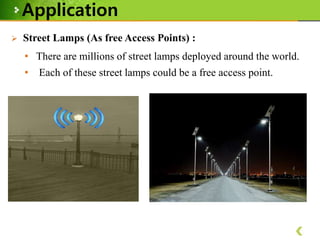
Street Lamps (As free Access Points) :
• There are millions of street lamps deployed around the world.
• Each of these street lamps could be a free access point.
Limitations or Challanges


Light can't pass through objects .

 Interferences from external light sources like sun light, normal
bulbs, and opaque materials in the path of transmission will cause
interruption in the communication.





Li-Fi requires line of sight.
High installation cost of the VLC systems .

A major challenge facing Li-Fi is how the receiving device
will transmit back to transmitter.
Conclusion
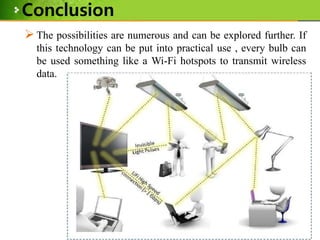
 The possibilities are numerous and can be explored further. If
this technology can be put into practical use , every bulb can
be used something like a Wi-Fi hotspots to transmit wireless
data.
Li-Fi

ANY QUERIES…..
Li-Fi

THANK YOU

Li-Fi Technology (Perfect slides)

  • 1.
    A Presentation on LI-FI TECHNOLOGY forthe partial fulfillment of the requirement for the degree of Bachelor of Technology in Computer Science And Engineering By Uzma Ruhy
  • 2.
    Contents Introduction History Present Scenario Working Process Li-Fivs Wi-Fi Applications Challenges for Li-Fi Conclusion
  • 3.
    Introduction What is Li-Fi? Light-Fidelity  LI-FI is transmission of data through illumination, sending data through a LED light bulb that varies intensity faster than human eye can follow.
  • 4.
  • 5.
    History of Li-Fi The technology truly began during the 1990's in countries like Germany, Korea, and Japan where they discovered LED's could be retrofitted to send information. Harald Haas continues to wow the world with the potential to use light for communication . Prof. Harald Haas University of Edinburgh.
  • 6.
  • 7.
    Present Scenario  Radio Spectrumis congested but the demand for wireless data double each year .Every thing, it seems want to use wireless data but the capacity is drying up. 1.4 Million Base Stations 5 Billion
  • 8.
  • 9.
    Radio Spectrum Issues Capacity  Radiowaves  Cost and Expensive  Less Bandwidth compared to other spectrums  Insufficient spectrum for increasing data  Efficiency  Millions of base stations consume huge amount of energy for 1.Transmitting the radio waves 2.To cool the base station cabins  5% Efficiency
  • 10.
    Radio Spectrum Issues Availability  Available within the range of Base stations  Limited availabity  Unavailable in aircrafts  Security  Less secure(passes through the walls)
  • 11.
  • 12.
    Why VLC ? Whyonly VLC ? Radio Waves  Infrared Rays Visible Rays Ultraviolet Rays X- Rays Gama Rays Gama rays cant be used as they could be dangerous.  X-rays have similar health issues.  Ultraviolet light is good for place without people, but other wise dangerous for the human body.  Infrared, due to eye safety regulation, can only bse used with low power. HENCE WE LEFT WITH THE ONLY THE VISIBLE - LIGHT SPECTRUM.
  • 14.
  • 15.
    Working Process  Operationalprocedure is very simple, if the led is on, you transmit a digital 1, if its off you transmit a 0. The LEDs can be switched on and off very quickly, which gives nice opportunities for transmitting data. Hence all that us required is some LEDs and a controller that code data into those LEDs. We have to just vary the rate at which the LED’s .  Flicker depending upon the data we want to encode .  Thus every light source will works as a hub for data transmission .
  • 16.
  • 17.
    How Li-Fi Works?  On one end all the data on the internet will be streamed to a lamp driver when the led is turned on the microchip converts the digital data in form of light .  A light sensitive device (photo detector) receives the signal and converts it back into original data. This method of using rapid pulses of light to transmit information wirelessly is technically referred as Visible Light Communication .
  • 18.
    Comparision between Li-Fiand Wi-Fi  Li-Fi can be thought of as a light-based Wi-Fi. That is, it uses light instead of radio waves to transmit information.  Instead of Wi-Fi modems, Li-Fi would use transceiver-fitted LED lamps that can light a room as well as transmit and receive information.  WI-FI is great for general wireless coverage within buildings, and li-fi is ideal for high density wireless data coverage in confined area and for relieving radio interference issues .  So the two technologies can be considered complimentary.
  • 19.
  • 20.
    Application Areas  LiFi technology is still in its infancy .However some areas where it seems perfectly applicable are:- 1 . Traffic Lights : Traffic lights can communicate to the car and with each other. Cars have LED-based headlights, LED-based cack lights, and cars can communicate with each other and prevent accidents in by exchanging information.
  • 21.
    Potential Application ofLi-Fi 2. Intrinsically Safe Environment : Visible Light is more safe than RF, hence it can be used in places where RF can't be used such as petrochemical plants .
  • 22.
    Potential Application ofLi-Fi  Hospitals(In Few Medical Equipements) :
  • 23.
    Potential Application ofLi-Fi 3. Airlines : Whenever we travel through airways we face the problem in communication media ,because the whole airways communication are performed on the basis of radio waves. To overcome this drawback on radioways , li-fi is introduced.
  • 24.
    Potential Application ofLi-Fi 4. On Ocean Beds : Li-Fi can even wok underwater were Wi-Fi fails completely, thereby throwing open endless opportunities for military/navigation operations.
  • 25.
    Application  Street Lamps (Asfree Access Points) : • There are millions of street lamps deployed around the world. • Each of these street lamps could be a free access point.
  • 26.
    Limitations or Challanges  Lightcan't pass through objects .  Interferences from external light sources like sun light, normal bulbs, and opaque materials in the path of transmission will cause interruption in the communication.    Li-Fi requires line of sight. High installation cost of the VLC systems . A major challenge facing Li-Fi is how the receiving device will transmit back to transmitter.
  • 27.
    Conclusion  The possibilitiesare numerous and can be explored further. If this technology can be put into practical use , every bulb can be used something like a Wi-Fi hotspots to transmit wireless data.
  • 28.
  • 29.