WELCOME
Content
01
02
03
04
05
06
07
08
09
10
11
12
Introduction
History
Principal of li-fi
How li-fi Works
Real time of usage of li-fi
How it is different
wifi vs li-fi
Application
Advantages
Disadvantages
Future development
Conclusion
Introduction
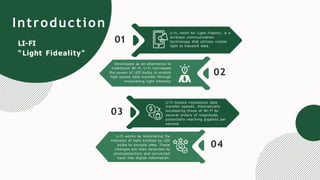
Li-Fi, short for Light Fidelity, is a
wireless communication
technology that utilizes visible
light to transmit data.
01
02
Li-Fi boasts impressive data
transfer speeds, theoretically
surpassing those of Wi-Fi by
several orders of magnitude,
potentially reaching gigabits per
second.
03
04
Developed as an alternative to
traditional Wi-Fi, Li-Fi harnesses
the power of LED bulbs to enable
high-speed data transfer through
modulating light intensity
Li-Fi works by modulating the
intensity of light emitted by LED
bulbs to encode data. These
changes are then detected by
photodetectors and converted
back into digital information.
LI-FI
“Light Fideality”
History
Professor Harald Haas, from the University of
Edinburgh in the UK, is widely recognised as the
original founder of Li-Fi.
He coined the term Li-Fi and is Chair of Mobile
Communications at the University of Edinburgh and
co- founder of pure LiFi.
Haas promoted this technology in his 2011 TED Global
talk and helped start a company to market it.
In October 2011, companies and industry groups
formed the Li-Fi Consortium, to promote high-speed
optical wireless systems.
The first Li-Fi smartphone prototype was presented at
the Consumer Electronics Show in Las Vegas from
January 7-10 in 2014.
Principal of li-fi
Heart of Li-Fi technology is high brightness LED's.
The LED bulb will hold a micro- chip that will do the
job of processing the data.
The on/off activity of LEDs enables data
transmission using binary codes.
Switching on an LED is a logical '1'; switching it off is
a logical '0'.
A light sensitive device (photo detector) receives
the signal and converts it back into original data.
How li-fi Works
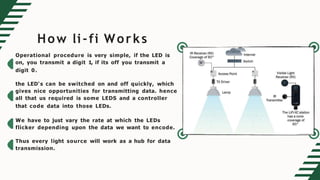
Operational procedure is very simple, if the LED is
on, you transmit a digit 1, if its off you transmit a
digit 0.
the LED's can be switched on and off quickly, which
gives nice opportunities for transmitting data. hence
all that us required is some LEDS and a controller
that code data into those LEDs.
We have to just vary the rate at which the LEDs
flicker depending upon the data we want to encode.
Thus every light source will work as a hub for data
transmission.
Target Audience #1 Target Audience #2
Office
Target Audience #3
Roadways House
Real time of u s a g e of li-fi
Howit is different
Li-Fi technology is
based onLEDsfor the
transfer of data.
That is, the light can
belong to the invisible,
ultraviolet or the
visible part of the
spectrum.
Thetransfer of the data
can be with the help of all
kinds of light, nomatter
the part of the spectrum
that they belong.
Wi-fi vs li-fi
Used for modern medical instruments.
In aircrafts, it can be used for data transmission.
Used in petroleum or chemical plants where other
transmission or frequencies can be hazardous.
In traffic signals, LI-FI can be used which will
communicate with the LED lights of the car and
number of accidents can be decreased.
Plant monitoring wing the light reflection
properties
Location based services:- GPS
Underwater communication.
RF Spectrum relief.
Li-Fi can be used effectively in the places where
it is difficult to lay the optical fiber cable.
Application
Advantages
01
Li-Fi can solve problems related to
the insufficiency of radio frequency
bandwidth because this technology
uses Visible light spectrum that has
still not been greatly utilized.
02
High data transmission rates of
up to 10Gbps can be achieved.
03
Since light cannot penetrate
walls, it provides privacy and
security that Wi-Fi cannot.
04
Li-Fi has low implementation and
maintenance costs.
Disadvantages
01
Light can' t pass through objects.
02
A major challenge facing Li-Fi is
how the receiving device will
transmit back to transmitter.
03
High installation cost of the
VLC systems.
04
Interferences from external light
sources like sun, light, normal
bulbs, opaque materials.
Future of li - fi
Efficient alternative to radio-based wireless.
Li-Fi is an emerging technology which is quick
and reliable.
Air waves are clogged so let' s use light
waves.
Hence, let' s proceed to Li-Fi for a
brighter, cheaper and greener future.
Conlusion
Overcomes the limitations of radio spectrum.
High speed of 10Gbps can be achieved.
The possibilities are numerous and can be explored further.
If this technology can be put into practical use, every bulb can be used something like a Wi- Fi
hotspot.
we will proceed toward the cleaner, greener, safer and brighter future.
This may solve issues such as the shortage of radio- frequency bandwidth.
Allows internet where traditional radio based wireless isn't allowed such as aircraft or hospitals
LI-FI is enabled by advance digital transmission technologies

LiFi Technology powerpoint for bca .pptx

  • 1.
  • 2.
    Content 01 02 03 04 05 06 07 08 09 10 11 12 Introduction History Principal of li-fi Howli-fi Works Real time of usage of li-fi How it is different wifi vs li-fi Application Advantages Disadvantages Future development Conclusion
  • 3.
    Introduction Li-Fi, short forLight Fidelity, is a wireless communication technology that utilizes visible light to transmit data. 01 02 Li-Fi boasts impressive data transfer speeds, theoretically surpassing those of Wi-Fi by several orders of magnitude, potentially reaching gigabits per second. 03 04 Developed as an alternative to traditional Wi-Fi, Li-Fi harnesses the power of LED bulbs to enable high-speed data transfer through modulating light intensity Li-Fi works by modulating the intensity of light emitted by LED bulbs to encode data. These changes are then detected by photodetectors and converted back into digital information. LI-FI “Light Fideality”
  • 4.
    History Professor Harald Haas,from the University of Edinburgh in the UK, is widely recognised as the original founder of Li-Fi. He coined the term Li-Fi and is Chair of Mobile Communications at the University of Edinburgh and co- founder of pure LiFi. Haas promoted this technology in his 2011 TED Global talk and helped start a company to market it. In October 2011, companies and industry groups formed the Li-Fi Consortium, to promote high-speed optical wireless systems. The first Li-Fi smartphone prototype was presented at the Consumer Electronics Show in Las Vegas from January 7-10 in 2014.
  • 5.
    Principal of li-fi Heartof Li-Fi technology is high brightness LED's. The LED bulb will hold a micro- chip that will do the job of processing the data. The on/off activity of LEDs enables data transmission using binary codes. Switching on an LED is a logical '1'; switching it off is a logical '0'. A light sensitive device (photo detector) receives the signal and converts it back into original data.
  • 6.
    How li-fi Works Operationalprocedure is very simple, if the LED is on, you transmit a digit 1, if its off you transmit a digit 0. the LED's can be switched on and off quickly, which gives nice opportunities for transmitting data. hence all that us required is some LEDS and a controller that code data into those LEDs. We have to just vary the rate at which the LEDs flicker depending upon the data we want to encode. Thus every light source will work as a hub for data transmission.
  • 7.
    Target Audience #1Target Audience #2 Office Target Audience #3 Roadways House Real time of u s a g e of li-fi
  • 8.
    Howit is different Li-Fitechnology is based onLEDsfor the transfer of data. That is, the light can belong to the invisible, ultraviolet or the visible part of the spectrum. Thetransfer of the data can be with the help of all kinds of light, nomatter the part of the spectrum that they belong.
  • 9.
  • 11.
    Used for modernmedical instruments. In aircrafts, it can be used for data transmission. Used in petroleum or chemical plants where other transmission or frequencies can be hazardous. In traffic signals, LI-FI can be used which will communicate with the LED lights of the car and number of accidents can be decreased. Plant monitoring wing the light reflection properties Location based services:- GPS Underwater communication. RF Spectrum relief. Li-Fi can be used effectively in the places where it is difficult to lay the optical fiber cable. Application
  • 13.
    Advantages 01 Li-Fi can solveproblems related to the insufficiency of radio frequency bandwidth because this technology uses Visible light spectrum that has still not been greatly utilized. 02 High data transmission rates of up to 10Gbps can be achieved. 03 Since light cannot penetrate walls, it provides privacy and security that Wi-Fi cannot. 04 Li-Fi has low implementation and maintenance costs.
  • 14.
    Disadvantages 01 Light can' tpass through objects. 02 A major challenge facing Li-Fi is how the receiving device will transmit back to transmitter. 03 High installation cost of the VLC systems. 04 Interferences from external light sources like sun, light, normal bulbs, opaque materials.
  • 15.
    Future of li- fi Efficient alternative to radio-based wireless. Li-Fi is an emerging technology which is quick and reliable. Air waves are clogged so let' s use light waves. Hence, let' s proceed to Li-Fi for a brighter, cheaper and greener future.
  • 16.
    Conlusion Overcomes the limitationsof radio spectrum. High speed of 10Gbps can be achieved. The possibilities are numerous and can be explored further. If this technology can be put into practical use, every bulb can be used something like a Wi- Fi hotspot. we will proceed toward the cleaner, greener, safer and brighter future. This may solve issues such as the shortage of radio- frequency bandwidth. Allows internet where traditional radio based wireless isn't allowed such as aircraft or hospitals LI-FI is enabled by advance digital transmission technologies