INTRODUCTION
ON
DATA
AND
INFORMATION
Uttar Tamang
MEANING OF DATA
 Set of value of qualitative and quantitative
data.
 Raw material or fact.
 Limitless and present everywhere in universe.
 Helps in production of information.
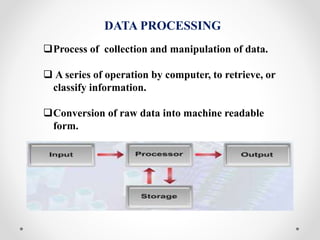
DATA PROCESSING
Process of collection and manipulation of data.
 A series of operation by computer, to retrieve, or
classify information.
Conversion of raw data into machine readable
form.
INFORMATION
 Processed form of interrelated data into meaningful
form.
 It is summarization of structured data.
 Information is used for management decision.
 Information should be always in the order.
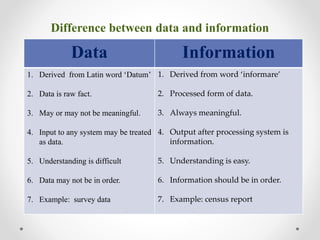
Difference between data and information
Data Information
1. Derived from Latin word ‘Datum’
2. Data is raw fact.
3. May or may not be meaningful.
4. Input to any system may be treated
as data.
5. Understanding is difficult
6. Data may not be in order.
7. Example: survey data
1. Derived from word ‘informare’
2. Processed form of data.
3. Always meaningful.
4. Output after processing system is
information.
5. Understanding is easy.
6. Information should be in order.
7. Example: census report
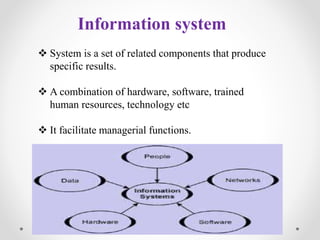
Information system
 System is a set of related components that produce
specific results.
 A combination of hardware, software, trained
human resources, technology etc
 It facilitate managerial functions.
Characteristics of Information System
1. Accuracy: MIS is key measure of effectiveness.
2. Timeliness: MIS has to make decision of future of organization
based on data of present.
3. Completeness: An effective MIS presents all the most relevant
and useful information for a particular decision.
4. Cost effectiveness: It must be understood by the receiver so
that he will interpret it correctly.
5. Understandable: It must be understood by the receiver so that
he will interpret it correctly.
Need of Information system
1. Provide efficiency
2. Accurate measurement
3. Better decision making
4. Competitive advantage
5. Operational excellence
6. Reduce operating cost
THANK
YOU!!!

Data and Information

  • 1.
  • 2.
    MEANING OF DATA Set of value of qualitative and quantitative data.  Raw material or fact.  Limitless and present everywhere in universe.  Helps in production of information.
  • 3.
    DATA PROCESSING Process ofcollection and manipulation of data.  A series of operation by computer, to retrieve, or classify information. Conversion of raw data into machine readable form.
  • 4.
    INFORMATION  Processed formof interrelated data into meaningful form.  It is summarization of structured data.  Information is used for management decision.  Information should be always in the order.
  • 6.
    Difference between dataand information Data Information 1. Derived from Latin word ‘Datum’ 2. Data is raw fact. 3. May or may not be meaningful. 4. Input to any system may be treated as data. 5. Understanding is difficult 6. Data may not be in order. 7. Example: survey data 1. Derived from word ‘informare’ 2. Processed form of data. 3. Always meaningful. 4. Output after processing system is information. 5. Understanding is easy. 6. Information should be in order. 7. Example: census report
  • 7.
    Information system  Systemis a set of related components that produce specific results.  A combination of hardware, software, trained human resources, technology etc  It facilitate managerial functions.
  • 8.
    Characteristics of InformationSystem 1. Accuracy: MIS is key measure of effectiveness. 2. Timeliness: MIS has to make decision of future of organization based on data of present. 3. Completeness: An effective MIS presents all the most relevant and useful information for a particular decision. 4. Cost effectiveness: It must be understood by the receiver so that he will interpret it correctly. 5. Understandable: It must be understood by the receiver so that he will interpret it correctly.
  • 9.
    Need of Informationsystem 1. Provide efficiency 2. Accurate measurement 3. Better decision making 4. Competitive advantage 5. Operational excellence 6. Reduce operating cost
  • 10.