Mendeley
22 September 2015
An Introduction to Text Mining
Research Papers
Petr Knoth
Phil Gooch
What is text mining?
‘the process of deriving high-quality information from text’ (Wikipedia)
‘the discovery by computer of new, previously unknown information, by
automatically extracting information from different written resources. A key
element is the linking ... of the extracted information ... to form new facts or
new hypotheses to be explored further’ (Hearst, 2003)
‘a burgeoning new field that attempts to glean meaningful information from
natural language text ... the process of analyzing text to extract information
that is useful for particular purposes’
(Witten, 2004)
Why text mine research papers?
“Research papers are the most complete representation of human knowledge.“
Why is it so much talked about now?
The idea is not new, but up until recently access to large amounts of research
papers was controlled by a handful of companies having bespoke
arrangements with publishers.
The Open Access movement has recently largely contributed to decreasing
the barriers to text-mining of research papers.
The availability of tools, developments in machine learning, and reduction in
the costs of computing power and storage, has removed some of the technical
and financial barriers.
What are the opportunities of text
mining research papers?
• Literature Based Discovery (LBD)
• Undiscovered Public Knowledge (Swanson, 1986).
• Mining relationships for which there is “hidden” evidence
in the research literature, yet they are not explicitly
stated, such as magnesium deficiency and migraine, fish
oil and Raynaud's disease.
• Swanson's discoveries simulated by automated
techniques (Weeber et al., 2001).
• Supporting exploratory access to research literature
• staying up-to-date with research
• analysing, comparing and contrasting research findings
• Summarisation of research findings
• Systematic literature review automation
• ‘snowballing’
• Question answering and semantic search from papers
• Understanding the research impact of articles, individuals,
institutions, countries, …
• Monitoring research trends
• Understanding how to direct research funding …
• Evidence of reuse and plagiarism detection …
Other use cases
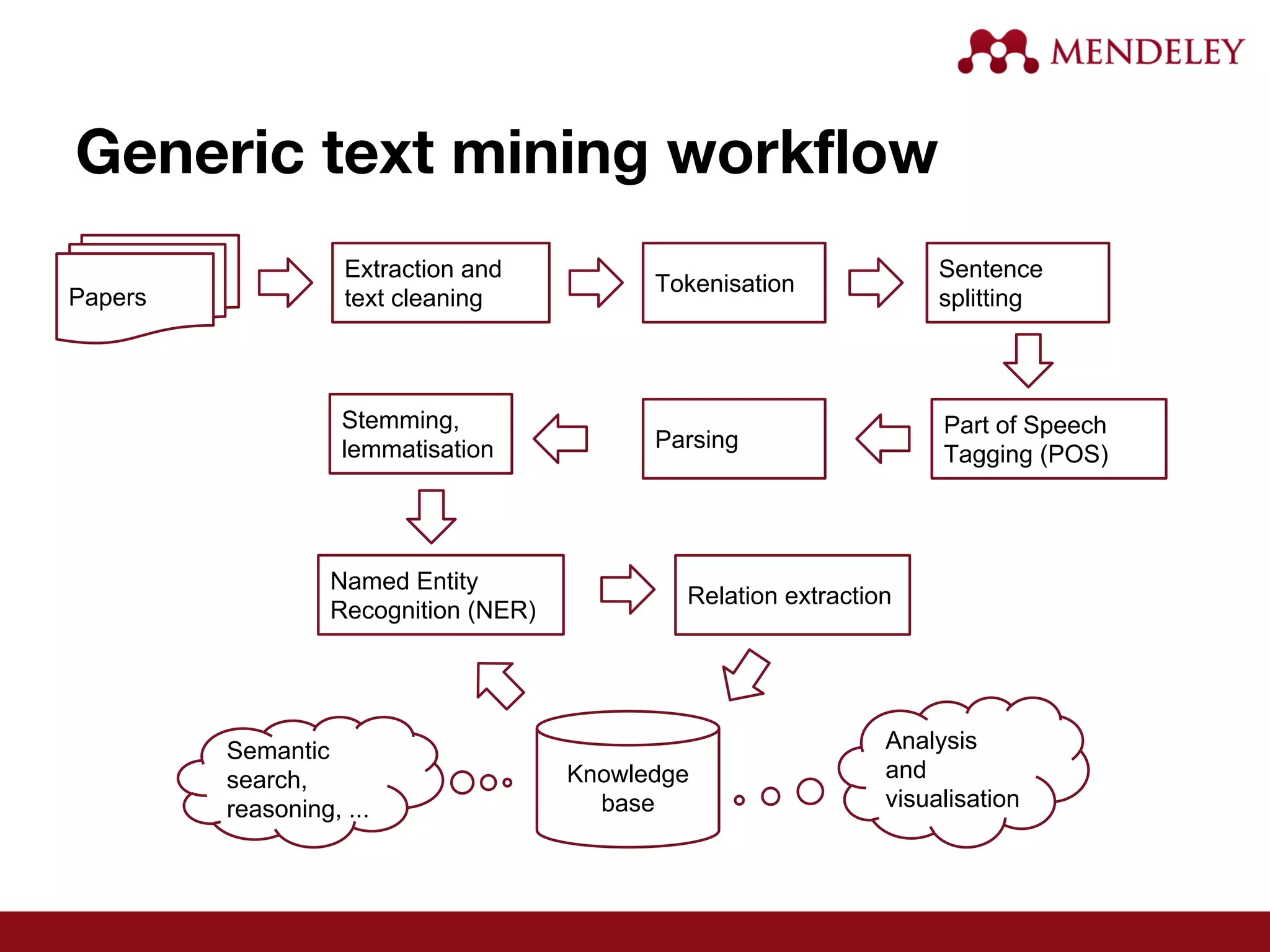
Generic text mining workflow
Papers
Extraction and
text cleaning
Tokenisation
Sentence
splitting
Stemming,
lemmatisation
Knowledge
base
Parsing
Part of Speech
Tagging (POS)
Named Entity
Recognition (NER)
Relation extraction
Analysis
and
visualisation
Semantic
search,
reasoning, ...
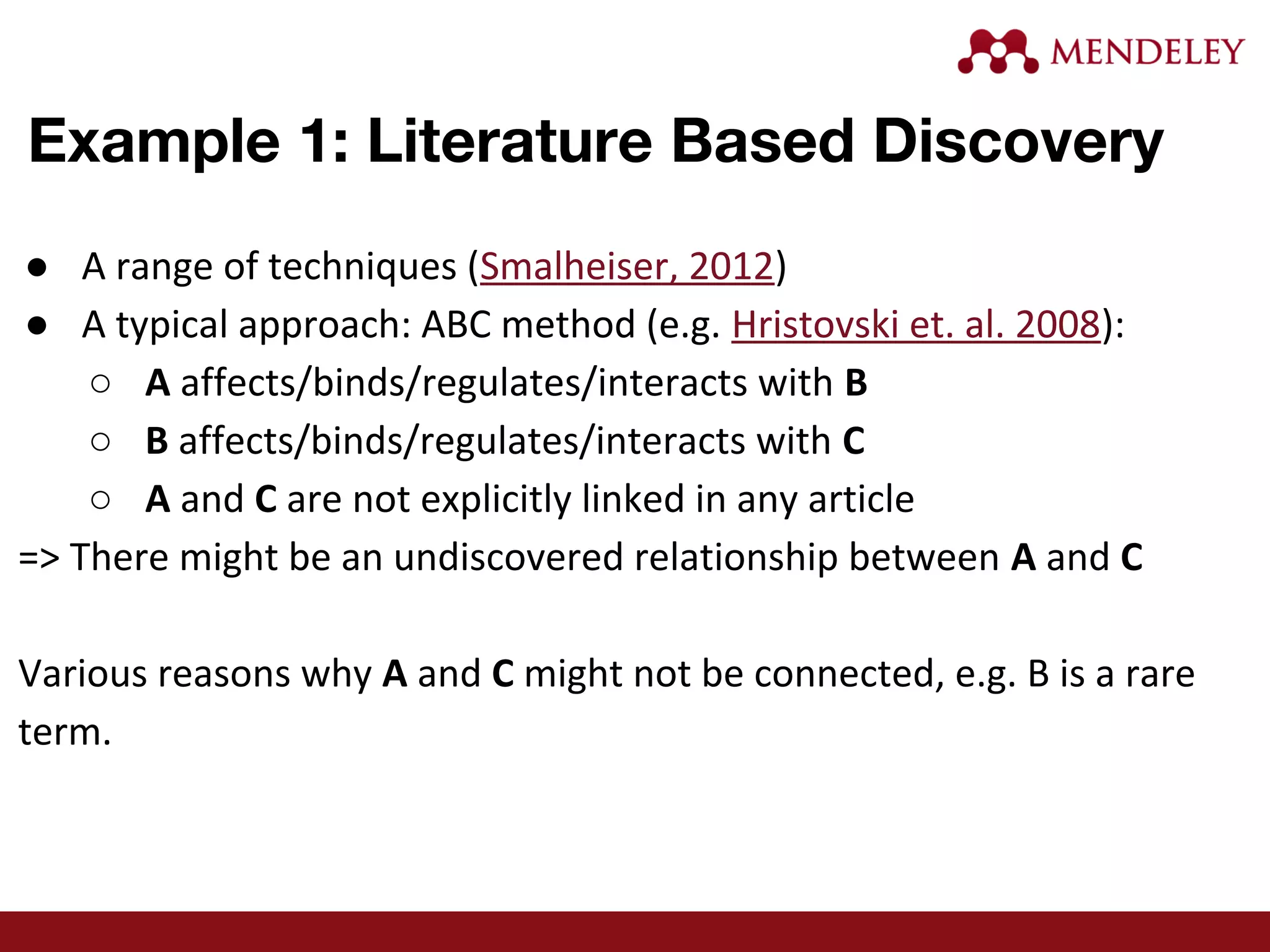
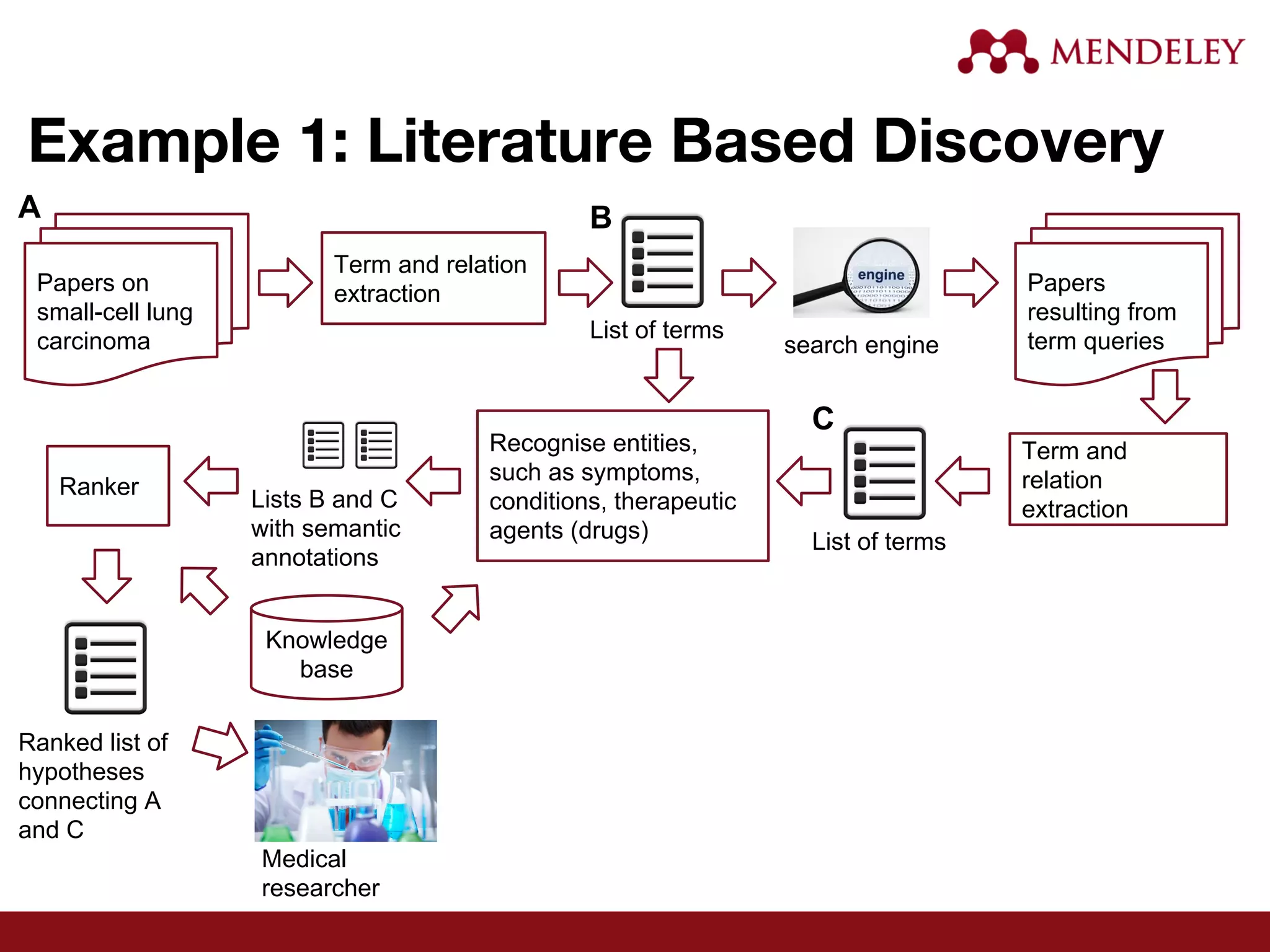
Example 1: Literature Based Discovery
● A range of techniques (Smalheiser, 2012)
● A typical approach: ABC method (e.g. Hristovski et. al. 2008):
○ A affects/binds/regulates/interacts with B
○ B affects/binds/regulates/interacts with C
○ A and C are not explicitly linked in any article
=> There might be an undiscovered relationship between A and C
Various reasons why A and C might not be connected, e.g. B is a rare
term.
Example 1: Literature Based Discovery
Papers on
small-cell lung
carcinoma
Term and relation
extraction
Knowledge
base
Recognise entities,
such as symptoms,
conditions, therapeutic
agents (drugs)
A B
search engine
Papers
resulting from
term queriesList of terms
Term and
relation
extraction
List of terms
C
Lists B and C
with semantic
annotations
Ranker
Ranked list of
hypotheses
connecting A
and C
Medical
researcher
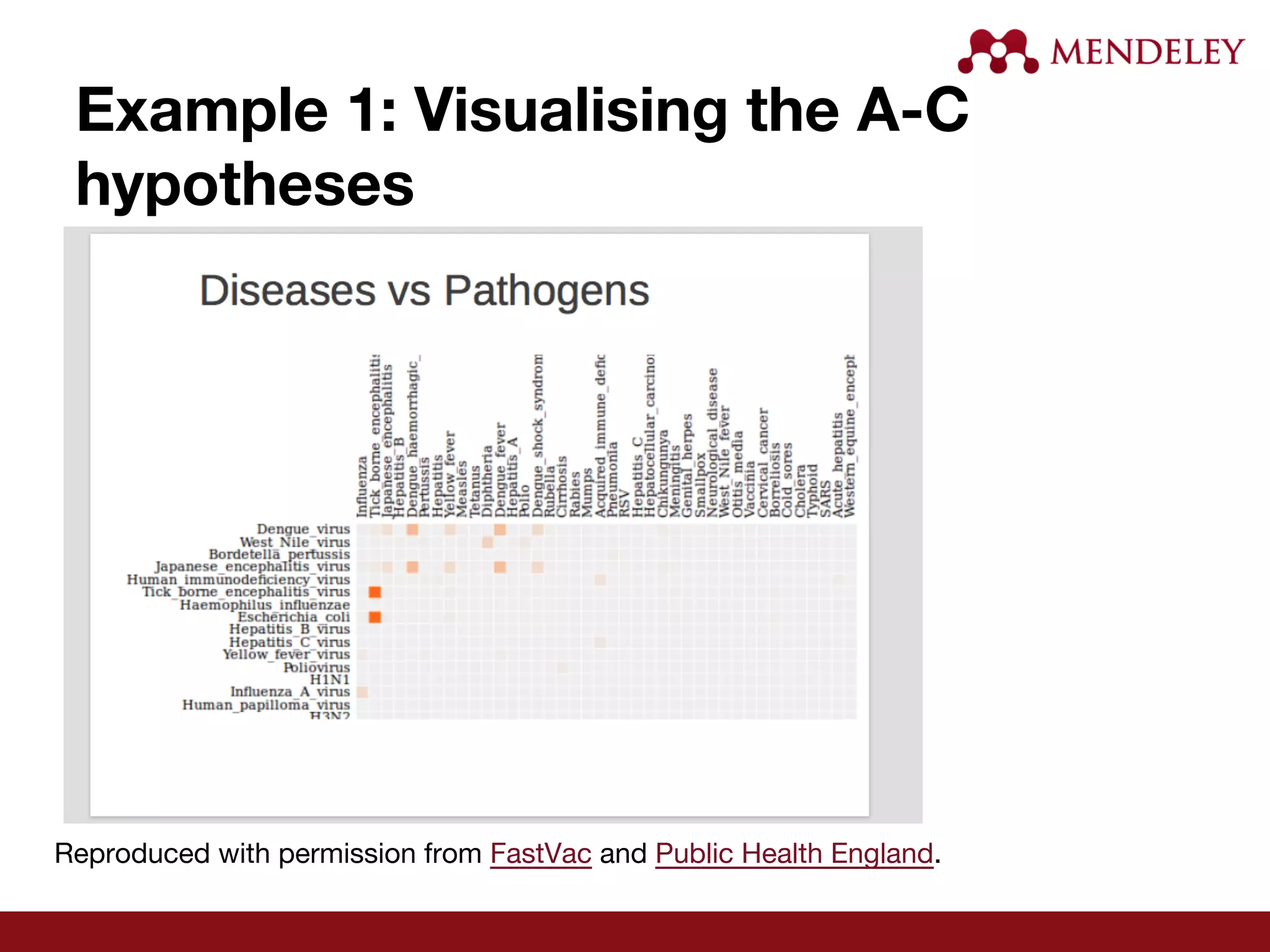
Example 1: Visualising the A-C
hypotheses
Reproduced with permission from FastVac and Public Health England.
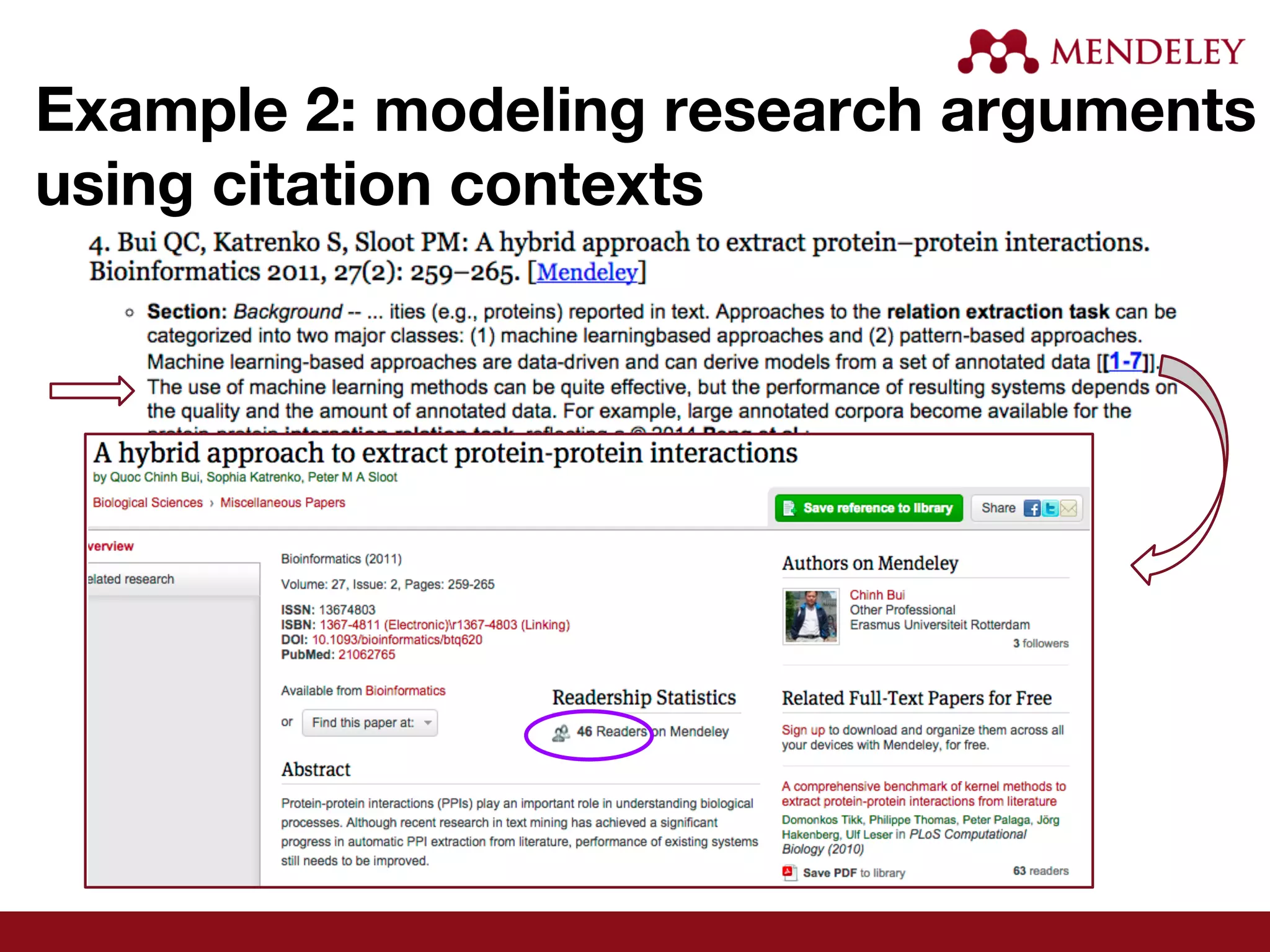
Example 2: modeling research arguments
using citation contexts
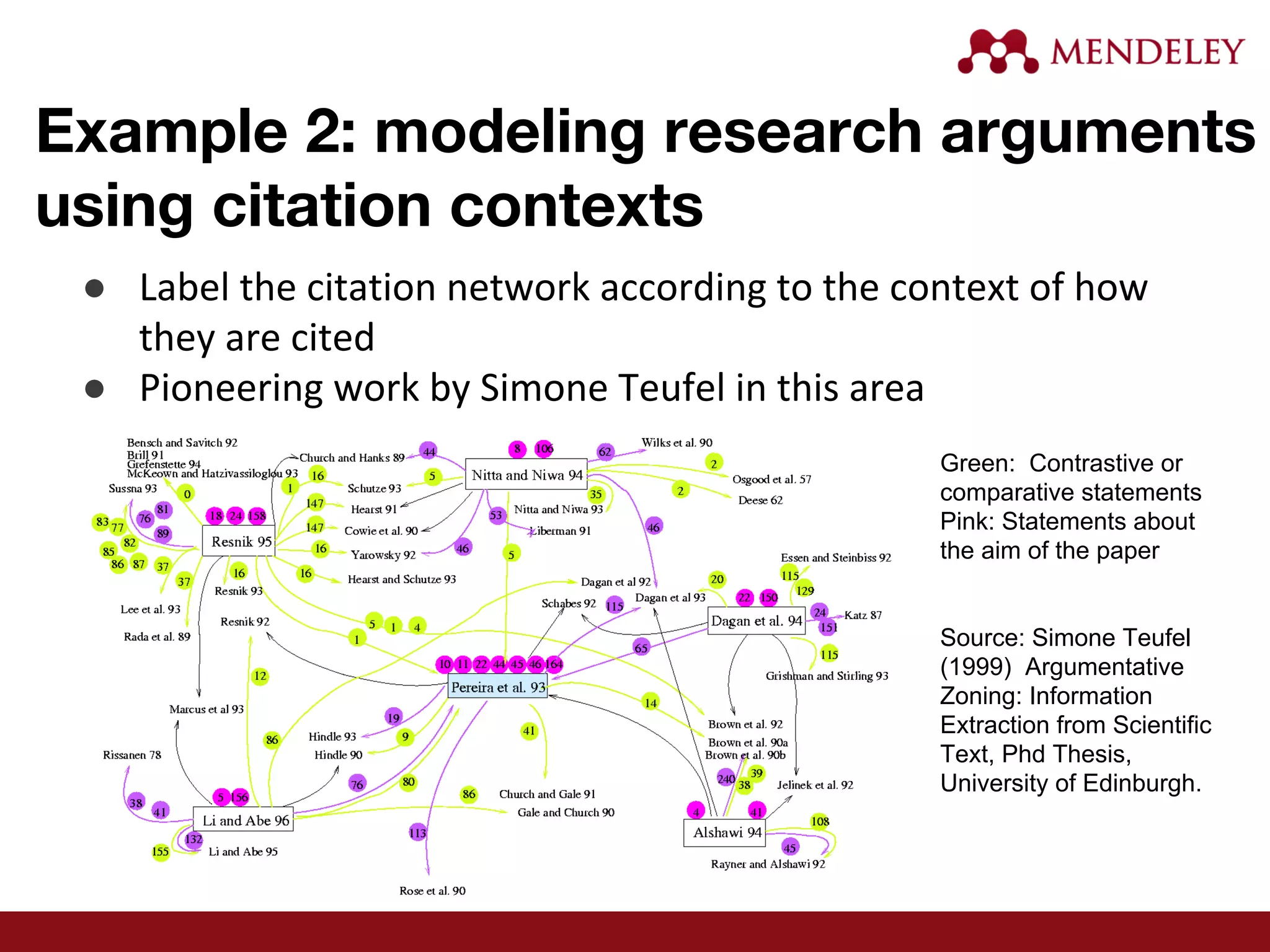
Example 2: modeling research arguments
using citation contexts
● Label the citation network according to the context of how
they are cited
● Pioneering work by Simone Teufel in this area
Green: Contrastive or
comparative statements
Pink: Statements about
the aim of the paper
Source: Simone Teufel
(1999) Argumentative
Zoning: Information
Extraction from Scientific
Text, Phd Thesis,
University of Edinburgh.
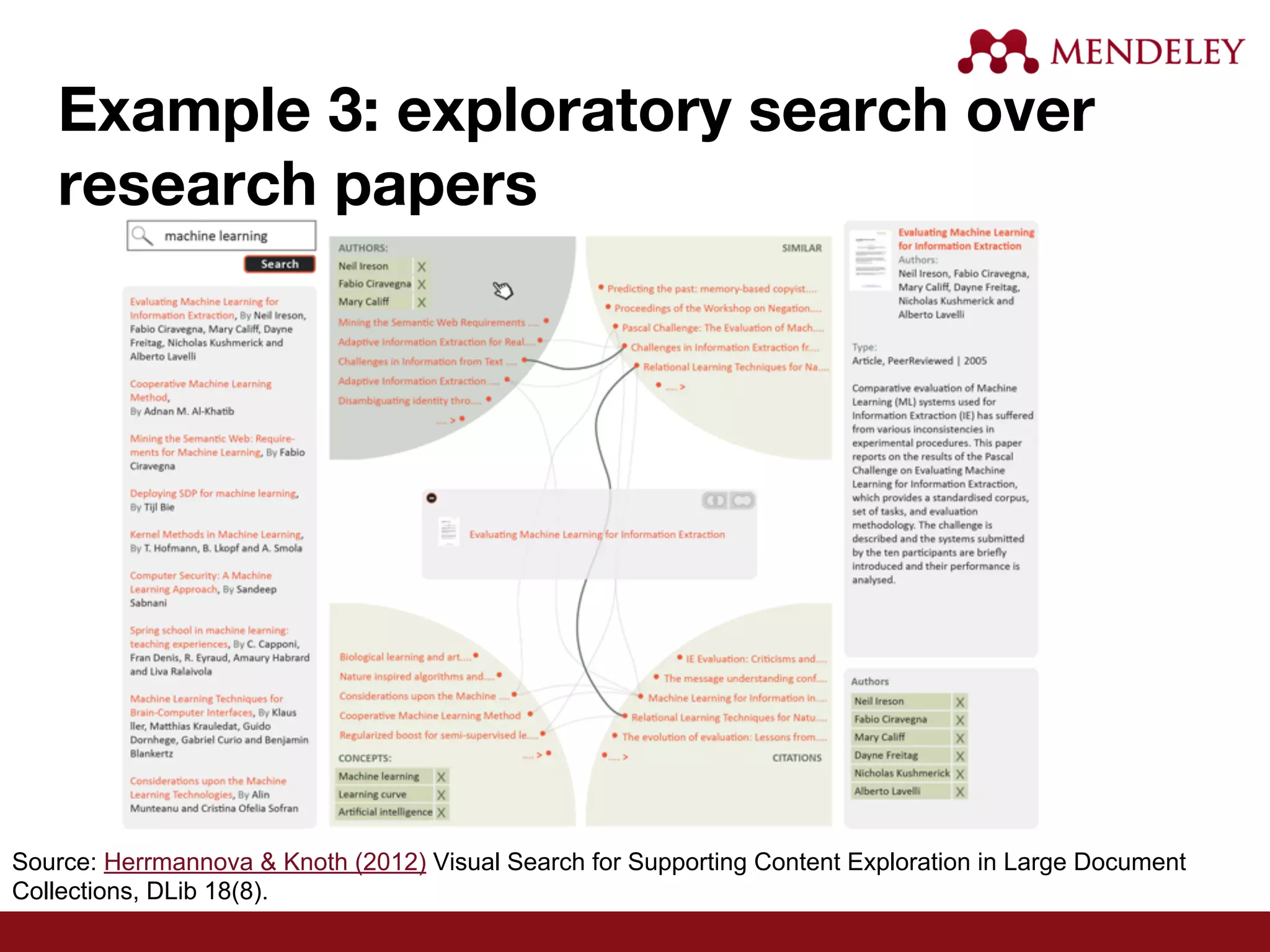
Example 3: exploratory search over
research papers
Source: Herrmannova & Knoth (2012) Visual Search for Supporting Content Exploration in Large Document
Collections, DLib 18(8).
How can I get started?
• Get the data
• Design/build your workflow
• Select a framework, tools, services to be used in implementing the
workflow
• Understand how to evaluate the performance of each component
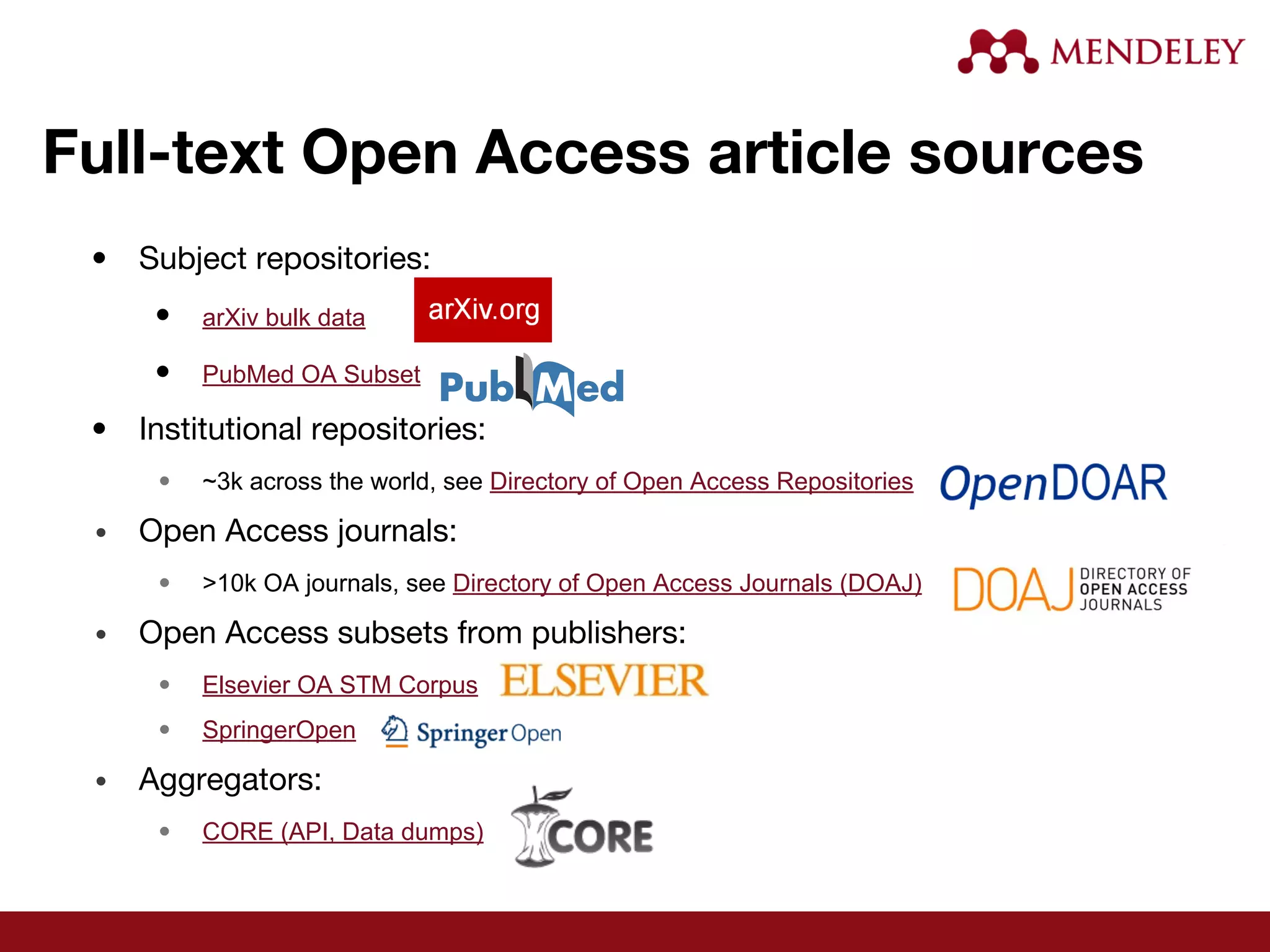
Full-text Open Access article sources
• Subject repositories:
• arXiv bulk data
• PubMed OA Subset
• Institutional repositories:
• ~3k across the world, see Directory of Open Access Repositories
• Open Access journals:
• >10k OA journals, see Directory of Open Access Journals (DOAJ)
• Open Access subsets from publishers:
• Elsevier OA STM Corpus
• SpringerOpen
• Aggregators:
• CORE (API, Data dumps)
Other full-text sources
Typically for non-commercial research only.
• Publisher full-text APIs:
• Elsevier’s Text and Data Mining API:
• (subscribed content on ScienceDirect)
• Domain specific corpuses:
• JSTOR Data For Research
• Full-text content from multiple publishers:
• CrossRef Text and Data Mining API (full-texts)
• Mendeley API (abstracts)
• Other useful scholarly resources:
• Microsoft Academic Graph (MAG)
• Clinical records
• i2b2 NLP Challenge Data Sets
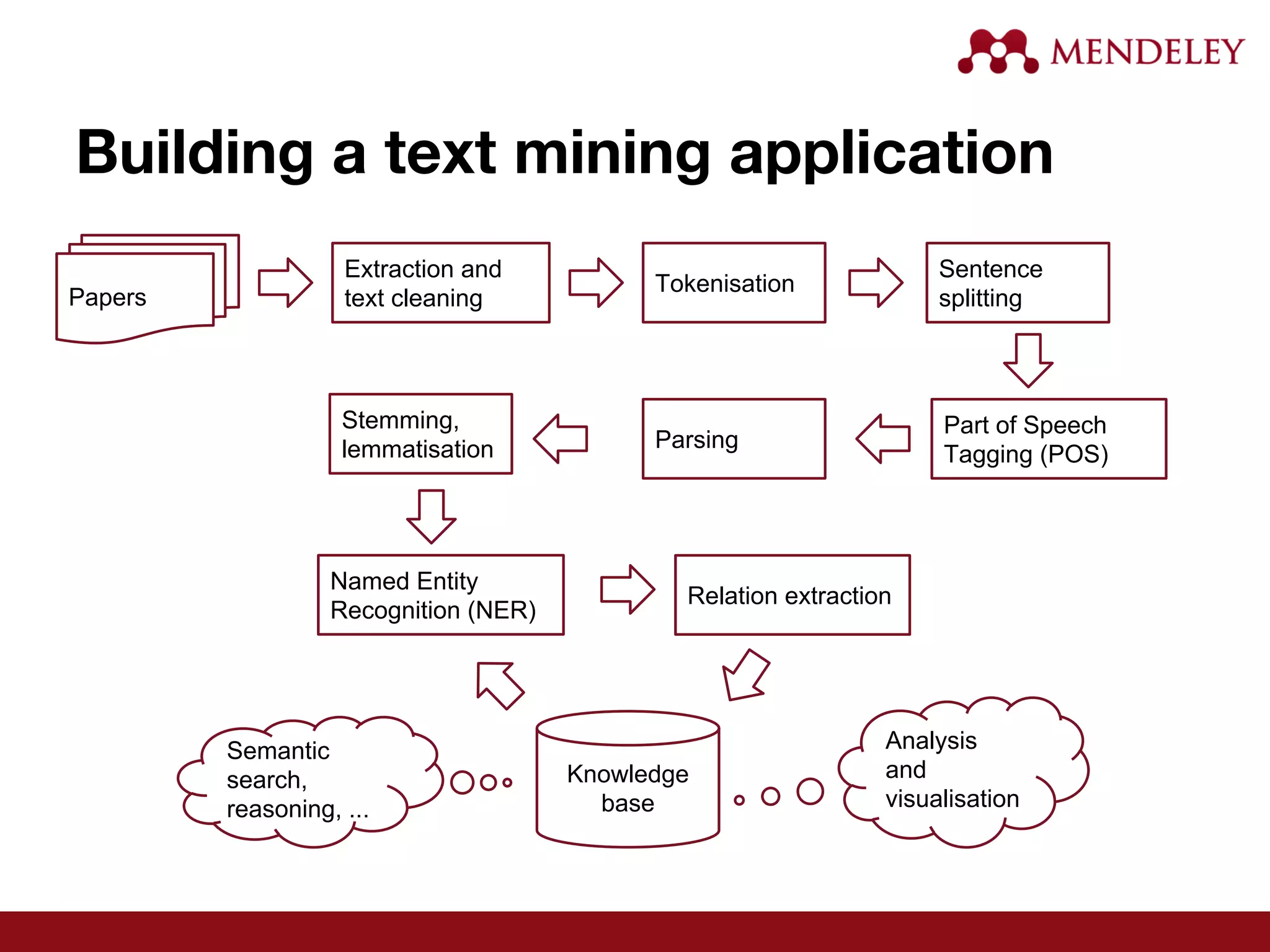
Building a text mining application
Papers
Extraction and
text cleaning
Tokenisation
Sentence
splitting
Stemming,
lemmatisation
Knowledge
base
Parsing
Part of Speech
Tagging (POS)
Named Entity
Recognition (NER)
Relation extraction
Analysis
and
visualisation
Semantic
search,
reasoning, ...
Example: Part of speech tagging
[Acute]JJ
[lymphoblastic]JJ
[leukemia]NN
([ALL]NN
) [leads]VB
[to]IN
[an]DT
[accumulation]NN
[of]IN
[immature]JJ
[lymphoid]JJ
[cells]NN
[into]IN
[the]DT
[bone]NN
[marrow]NN
, [blood]NN
[and]CC
[other]JJ
[organs]NN
.
[A]DT
[young]JJ
[patient]NN
[was]VB
[treated]VB
[unconventionally]RB
[for]IN
[Philadelphia]NN
[positive]NN
[ALL]NN
[and]CC
[Mucormycosis]NN
[with]IN
[Amphotericin]NN
[B]NN
.
[The]DT
[patient]NN
[achieved]VB
[a]DT
[disease-free]JJ
[survival]NN
[of]IN
[12]CD
[months]NN
[with]IN
[good]JJ
[quality]NN
[of]IN
[life]NN
.
Example: Parsing
[Acute lymphoblastic leukemia]NP
([ALL]NP
) [leads to]VP
[an]DT
[accumulation]NN
[of]IN
[immature lymphoid cells]NP
[into]IN
[the]DT
[bone marrow]NP
, [blood]NP
[and]CC
[other organs]NP
.
[A]DT
[young patient]NP
[was treated unconventionally for]VP
[Philadelphia
positive ALL]NP
[and]CC
[Mucormycosis]NP
[with]IN
[Amphotericin B]NP
.
[The]DT
[patient]NP
[achieved]VP
[a]DT
[disease-free survival]NP
[of]IN
[12 months]
NP
[with]IN
[good]JJ
[quality of life]PP
.
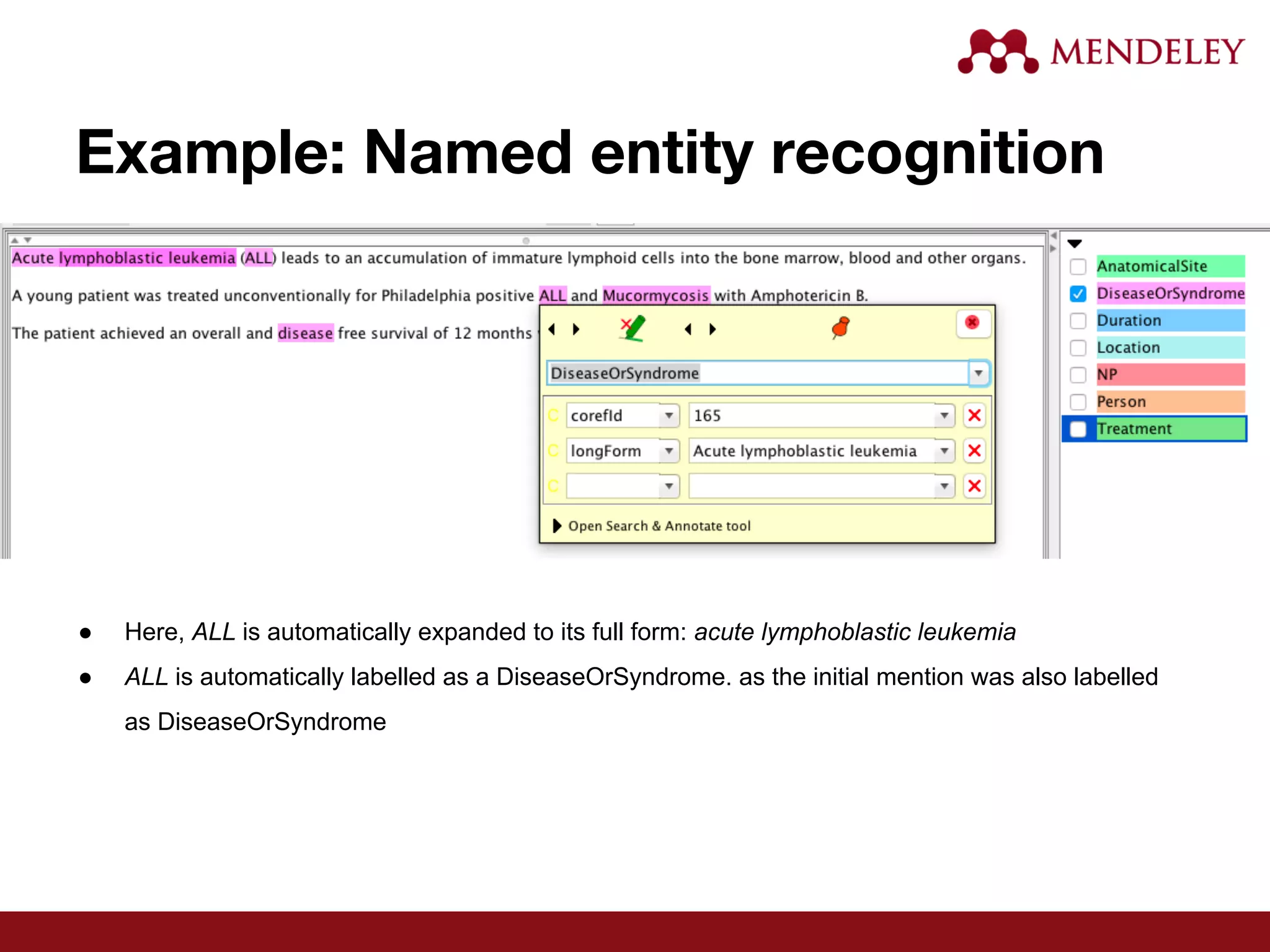
Example: Named entity recognition
[Acute lymphoblastic leukemia]Disease
([ALL]Disease
) [RESULT]VP
[accumulation]
NN
[of]IN
[immature lymphoid cells]AnatomicalSite
[into]IN
[the]DT
[bone marrow]
AnatomicalSite
, [blood]AnatomicalSite
[and]CC
[other organs]AnatomicalSite
.
[A]DT
[young patient]Person
[TREAT]VP
[Philadelphia positive ALL]Disease
[and]CC
[Mucormycosis]Disease
[with]IN
[Amphotericin B]Treatment
.
[The]DT
[patient]Person
[RESULT]VP
[disease-free survival]Outcome
[of]IN
[12 months]
Duration
[with]IN
[good quality of life]Outcome
.
Example: Named entity recognition
● Here, ALL is automatically expanded to its full form: acute lymphoblastic leukemia
● ALL is automatically labelled as a DiseaseOrSyndrome. as the initial mention was also labelled
as DiseaseOrSyndrome
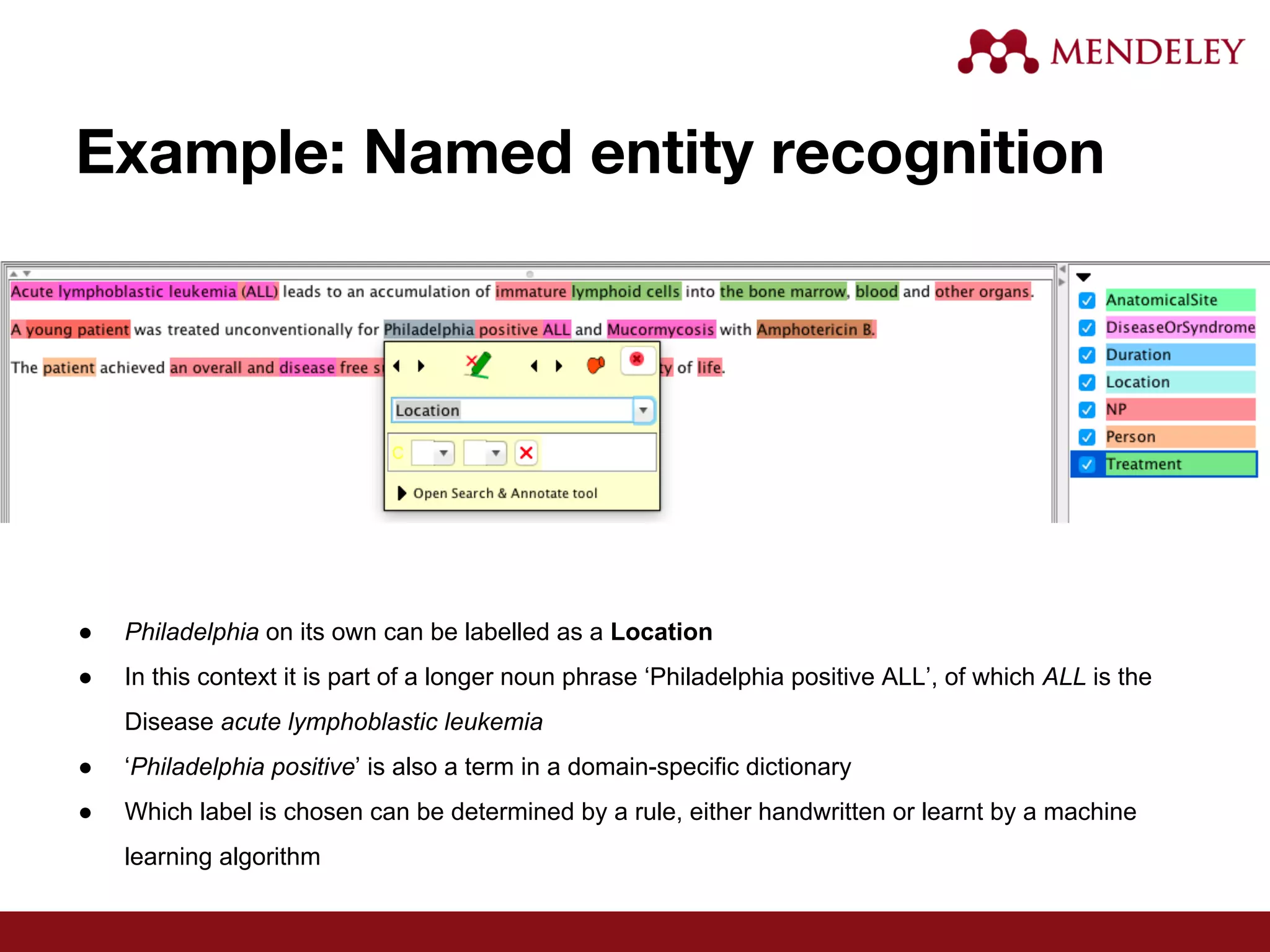
Example: Named entity recognition
● Philadelphia on its own can be labelled as a Location
● In this context it is part of a longer noun phrase ‘Philadelphia positive ALL’, of which ALL is the
Disease acute lymphoblastic leukemia
● ‘Philadelphia positive’ is also a term in a domain-specific dictionary
● Which label is chosen can be determined by a rule, either handwritten or learnt by a machine
learning algorithm
Frameworks
● General Architecture for Text Engineering (GATE)
● Apache UIMA
● Natural Language Toolkit (NLTK)
● OpenNLP
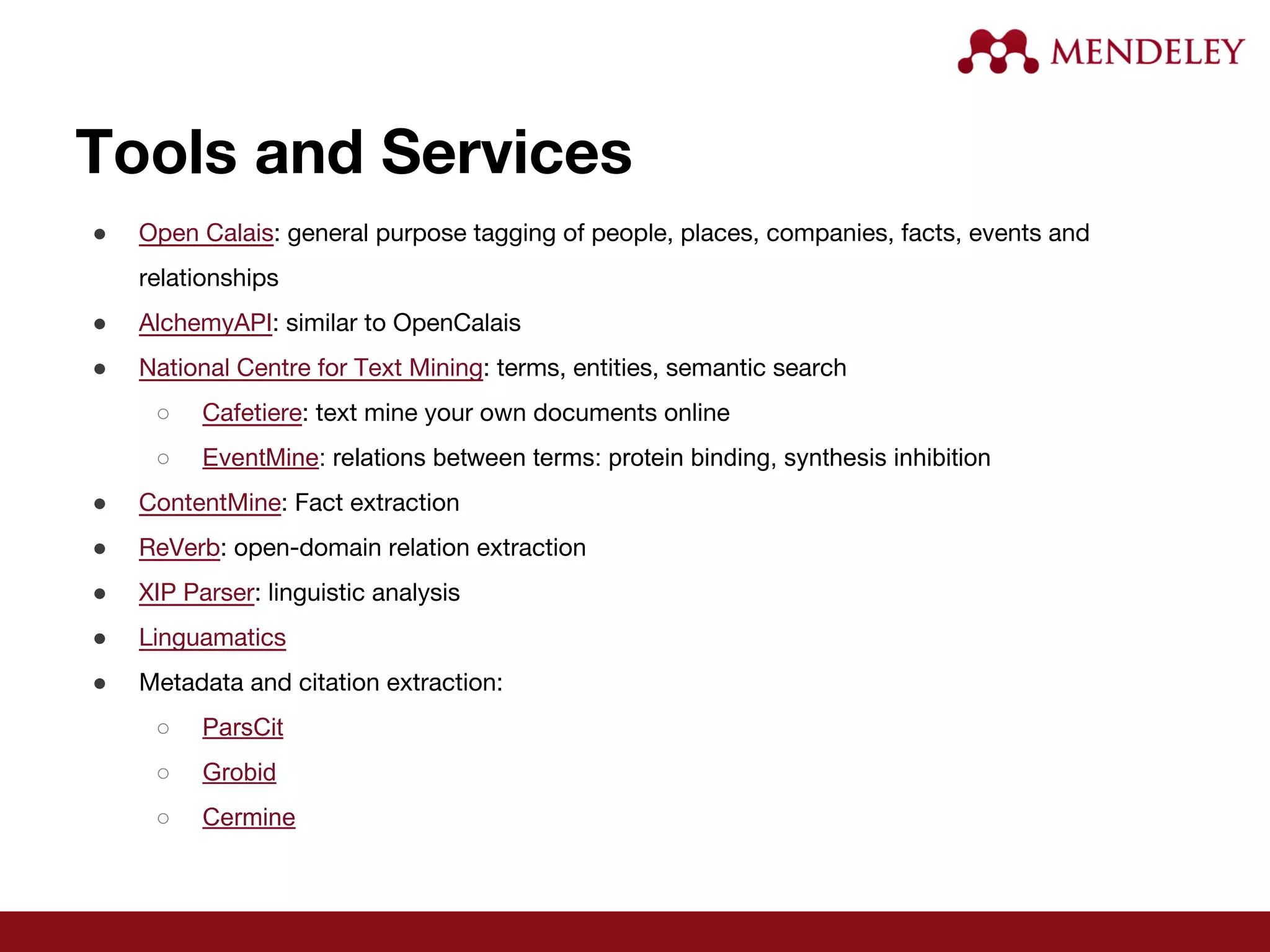
Tools and Services
● Open Calais: general purpose tagging of people, places, companies, facts, events and
relationships
● AlchemyAPI: similar to OpenCalais
● National Centre for Text Mining: terms, entities, semantic search
○ Cafetiere: text mine your own documents online
○ EventMine: relations between terms: protein binding, synthesis inhibition
● ContentMine: Fact extraction
● ReVerb: open-domain relation extraction
● XIP Parser: linguistic analysis
● Linguamatics
● Metadata and citation extraction:
○ ParsCit
○ Grobid
○ Cermine
Open source demos
● Mimir
○ analysing, comparing and contrasting research findings
● EEXCESS
○ Recommend related resources
○ Narrative paths between resources
Existing challenges
● Harmonising metadata formats across publishers, repositories, etc.
● Agreeing on standards/ontologies/formats used to share the outputs of
research publications text-mining tools and all their components.
● Integration of text-mining tools with content providers’ systems
● Building and maintaining text-mining web-services for research (building
blocks)
● Promoting and adopting end-user tools utilising text-mining in
researchers’ daily workflows
● Building gold standards for various text-mining tasks and sharing them
across researchers (issue of credit)
Events and initiatives
● Events
○ International Workshop on Mining Scientific Publications (WOSP)
○ Joint Conference on Digital Libraries (JCDL)
○ ACL, COLING, IJC-NLP, CoNLL, LREC, etc.
● Projects
○ OpenMinTeD (EC funded)
○ EEXCESS
○ OpenAIRE
Thanks for listening ...
datascience@mendeley.com

UKSG webinar - Introduction to Text-Mining Research Papers with Petr Knoth and Phil Gooch, both Mendeley Ltd.

  • 1.
    Mendeley 22 September 2015 AnIntroduction to Text Mining Research Papers Petr Knoth Phil Gooch
  • 2.
    What is textmining? ‘the process of deriving high-quality information from text’ (Wikipedia) ‘the discovery by computer of new, previously unknown information, by automatically extracting information from different written resources. A key element is the linking ... of the extracted information ... to form new facts or new hypotheses to be explored further’ (Hearst, 2003) ‘a burgeoning new field that attempts to glean meaningful information from natural language text ... the process of analyzing text to extract information that is useful for particular purposes’ (Witten, 2004)
  • 3.
    Why text mineresearch papers? “Research papers are the most complete representation of human knowledge.“
  • 4.
    Why is itso much talked about now? The idea is not new, but up until recently access to large amounts of research papers was controlled by a handful of companies having bespoke arrangements with publishers. The Open Access movement has recently largely contributed to decreasing the barriers to text-mining of research papers. The availability of tools, developments in machine learning, and reduction in the costs of computing power and storage, has removed some of the technical and financial barriers.
  • 5.
    What are theopportunities of text mining research papers? • Literature Based Discovery (LBD) • Undiscovered Public Knowledge (Swanson, 1986). • Mining relationships for which there is “hidden” evidence in the research literature, yet they are not explicitly stated, such as magnesium deficiency and migraine, fish oil and Raynaud's disease. • Swanson's discoveries simulated by automated techniques (Weeber et al., 2001).
  • 6.
    • Supporting exploratoryaccess to research literature • staying up-to-date with research • analysing, comparing and contrasting research findings • Summarisation of research findings • Systematic literature review automation • ‘snowballing’ • Question answering and semantic search from papers • Understanding the research impact of articles, individuals, institutions, countries, … • Monitoring research trends • Understanding how to direct research funding … • Evidence of reuse and plagiarism detection … Other use cases
  • 7.
    Generic text miningworkflow Papers Extraction and text cleaning Tokenisation Sentence splitting Stemming, lemmatisation Knowledge base Parsing Part of Speech Tagging (POS) Named Entity Recognition (NER) Relation extraction Analysis and visualisation Semantic search, reasoning, ...
  • 8.
    Example 1: LiteratureBased Discovery ● A range of techniques (Smalheiser, 2012) ● A typical approach: ABC method (e.g. Hristovski et. al. 2008): ○ A affects/binds/regulates/interacts with B ○ B affects/binds/regulates/interacts with C ○ A and C are not explicitly linked in any article => There might be an undiscovered relationship between A and C Various reasons why A and C might not be connected, e.g. B is a rare term.
  • 9.
    Example 1: LiteratureBased Discovery Papers on small-cell lung carcinoma Term and relation extraction Knowledge base Recognise entities, such as symptoms, conditions, therapeutic agents (drugs) A B search engine Papers resulting from term queriesList of terms Term and relation extraction List of terms C Lists B and C with semantic annotations Ranker Ranked list of hypotheses connecting A and C Medical researcher
  • 10.
    Example 1: Visualisingthe A-C hypotheses Reproduced with permission from FastVac and Public Health England.
  • 11.
    Example 2: modelingresearch arguments using citation contexts
  • 12.
    Example 2: modelingresearch arguments using citation contexts ● Label the citation network according to the context of how they are cited ● Pioneering work by Simone Teufel in this area Green: Contrastive or comparative statements Pink: Statements about the aim of the paper Source: Simone Teufel (1999) Argumentative Zoning: Information Extraction from Scientific Text, Phd Thesis, University of Edinburgh.
  • 13.
    Example 3: exploratorysearch over research papers Source: Herrmannova & Knoth (2012) Visual Search for Supporting Content Exploration in Large Document Collections, DLib 18(8).
  • 14.
    How can Iget started? • Get the data • Design/build your workflow • Select a framework, tools, services to be used in implementing the workflow • Understand how to evaluate the performance of each component
  • 15.
    Full-text Open Accessarticle sources • Subject repositories: • arXiv bulk data • PubMed OA Subset • Institutional repositories: • ~3k across the world, see Directory of Open Access Repositories • Open Access journals: • >10k OA journals, see Directory of Open Access Journals (DOAJ) • Open Access subsets from publishers: • Elsevier OA STM Corpus • SpringerOpen • Aggregators: • CORE (API, Data dumps)
  • 16.
    Other full-text sources Typicallyfor non-commercial research only. • Publisher full-text APIs: • Elsevier’s Text and Data Mining API: • (subscribed content on ScienceDirect) • Domain specific corpuses: • JSTOR Data For Research • Full-text content from multiple publishers: • CrossRef Text and Data Mining API (full-texts) • Mendeley API (abstracts) • Other useful scholarly resources: • Microsoft Academic Graph (MAG) • Clinical records • i2b2 NLP Challenge Data Sets
  • 17.
    Building a textmining application Papers Extraction and text cleaning Tokenisation Sentence splitting Stemming, lemmatisation Knowledge base Parsing Part of Speech Tagging (POS) Named Entity Recognition (NER) Relation extraction Analysis and visualisation Semantic search, reasoning, ...
  • 18.
    Example: Part ofspeech tagging [Acute]JJ [lymphoblastic]JJ [leukemia]NN ([ALL]NN ) [leads]VB [to]IN [an]DT [accumulation]NN [of]IN [immature]JJ [lymphoid]JJ [cells]NN [into]IN [the]DT [bone]NN [marrow]NN , [blood]NN [and]CC [other]JJ [organs]NN . [A]DT [young]JJ [patient]NN [was]VB [treated]VB [unconventionally]RB [for]IN [Philadelphia]NN [positive]NN [ALL]NN [and]CC [Mucormycosis]NN [with]IN [Amphotericin]NN [B]NN . [The]DT [patient]NN [achieved]VB [a]DT [disease-free]JJ [survival]NN [of]IN [12]CD [months]NN [with]IN [good]JJ [quality]NN [of]IN [life]NN .
  • 19.
    Example: Parsing [Acute lymphoblasticleukemia]NP ([ALL]NP ) [leads to]VP [an]DT [accumulation]NN [of]IN [immature lymphoid cells]NP [into]IN [the]DT [bone marrow]NP , [blood]NP [and]CC [other organs]NP . [A]DT [young patient]NP [was treated unconventionally for]VP [Philadelphia positive ALL]NP [and]CC [Mucormycosis]NP [with]IN [Amphotericin B]NP . [The]DT [patient]NP [achieved]VP [a]DT [disease-free survival]NP [of]IN [12 months] NP [with]IN [good]JJ [quality of life]PP .
  • 20.
    Example: Named entityrecognition [Acute lymphoblastic leukemia]Disease ([ALL]Disease ) [RESULT]VP [accumulation] NN [of]IN [immature lymphoid cells]AnatomicalSite [into]IN [the]DT [bone marrow] AnatomicalSite , [blood]AnatomicalSite [and]CC [other organs]AnatomicalSite . [A]DT [young patient]Person [TREAT]VP [Philadelphia positive ALL]Disease [and]CC [Mucormycosis]Disease [with]IN [Amphotericin B]Treatment . [The]DT [patient]Person [RESULT]VP [disease-free survival]Outcome [of]IN [12 months] Duration [with]IN [good quality of life]Outcome .
  • 21.
    Example: Named entityrecognition ● Here, ALL is automatically expanded to its full form: acute lymphoblastic leukemia ● ALL is automatically labelled as a DiseaseOrSyndrome. as the initial mention was also labelled as DiseaseOrSyndrome
  • 22.
    Example: Named entityrecognition ● Philadelphia on its own can be labelled as a Location ● In this context it is part of a longer noun phrase ‘Philadelphia positive ALL’, of which ALL is the Disease acute lymphoblastic leukemia ● ‘Philadelphia positive’ is also a term in a domain-specific dictionary ● Which label is chosen can be determined by a rule, either handwritten or learnt by a machine learning algorithm
  • 23.
    Frameworks ● General Architecturefor Text Engineering (GATE) ● Apache UIMA ● Natural Language Toolkit (NLTK) ● OpenNLP
  • 24.
    Tools and Services ●Open Calais: general purpose tagging of people, places, companies, facts, events and relationships ● AlchemyAPI: similar to OpenCalais ● National Centre for Text Mining: terms, entities, semantic search ○ Cafetiere: text mine your own documents online ○ EventMine: relations between terms: protein binding, synthesis inhibition ● ContentMine: Fact extraction ● ReVerb: open-domain relation extraction ● XIP Parser: linguistic analysis ● Linguamatics ● Metadata and citation extraction: ○ ParsCit ○ Grobid ○ Cermine
  • 25.
    Open source demos ●Mimir ○ analysing, comparing and contrasting research findings ● EEXCESS ○ Recommend related resources ○ Narrative paths between resources
  • 26.
    Existing challenges ● Harmonisingmetadata formats across publishers, repositories, etc. ● Agreeing on standards/ontologies/formats used to share the outputs of research publications text-mining tools and all their components. ● Integration of text-mining tools with content providers’ systems ● Building and maintaining text-mining web-services for research (building blocks) ● Promoting and adopting end-user tools utilising text-mining in researchers’ daily workflows ● Building gold standards for various text-mining tasks and sharing them across researchers (issue of credit)
  • 27.
    Events and initiatives ●Events ○ International Workshop on Mining Scientific Publications (WOSP) ○ Joint Conference on Digital Libraries (JCDL) ○ ACL, COLING, IJC-NLP, CoNLL, LREC, etc. ● Projects ○ OpenMinTeD (EC funded) ○ EEXCESS ○ OpenAIRE
  • 28.
    Thanks for listening... datascience@mendeley.com