•Evolution of 3G
•Basic of 3.5G
3G Overview
3G Overview
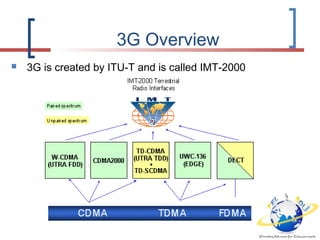
 3G is created by ITU-T and is called IMT-2000
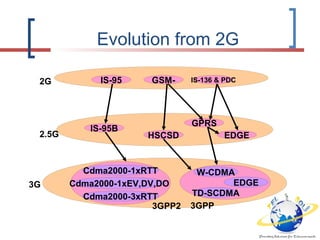
Evolution from 2G
IS-95 IS-136 & PDCGSM-
EDGE
GPRS
HSCSD
IS-95B
Cdma2000-1xRTT
Cdma2000-1xEV,DV,DO
Cdma2000-3xRTT
W-CDMA
EDGE
TD-SCDMA
2G
3G
2.5G
3GPP3GPP2
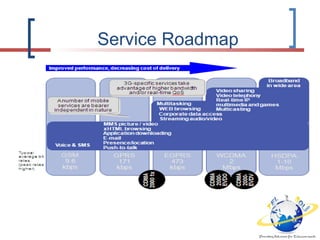
Service Roadmap
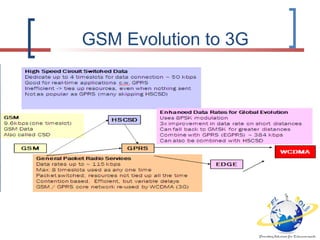
GSM Evolution to 3G
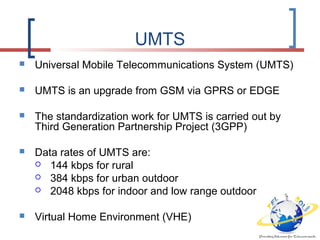
UMTS
 Universal Mobile Telecommunications System (UMTS)
 UMTS is an upgrade from GSM via GPRS or EDGE
 The standardization work for UMTS is carried out by
Third Generation Partnership Project (3GPP)
 Data rates of UMTS are:
 144 kbps for rural
 384 kbps for urban outdoor
 2048 kbps for indoor and low range outdoor
 Virtual Home Environment (VHE)
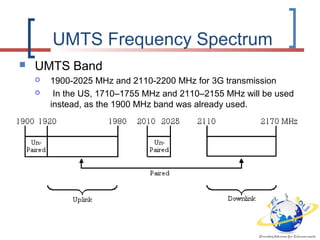
UMTS Frequency Spectrum
 UMTS Band
 1900-2025 MHz and 2110-2200 MHz for 3G transmission
 In the US, 1710–1755 MHz and 2110–2155 MHz will be used
instead, as the 1900 MHz band was already used.
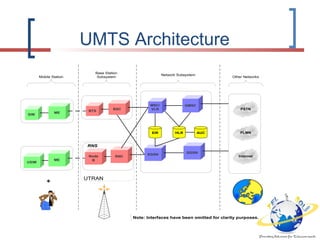
UMTS Architecture
Mobile Station
MSC/
VLR
Base Station
Subsystem
GMSC
Network Subsystem
AUCEIR HLR
Other Networks
Note: Interfaces have been omitted for clarity purposes.
GGSN
SGSN
BTS
BSC
Node
B
RNC
RNS
UTRAN
SIM
ME
USIM
ME
+
PSTN
PLMN
Internet
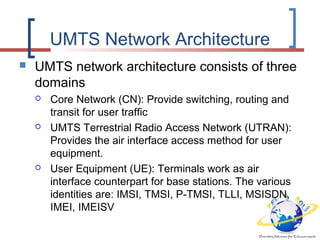
UMTS Network Architecture
 UMTS network architecture consists of three
domains
 Core Network (CN): Provide switching, routing and
transit for user traffic
 UMTS Terrestrial Radio Access Network (UTRAN):
Provides the air interface access method for user
equipment.
 User Equipment (UE): Terminals work as air
interface counterpart for base stations. The various
identities are: IMSI, TMSI, P-TMSI, TLLI, MSISDN,
IMEI, IMEISV
UTRAN
 Wide band CDMA technology is selected for UTRAN air interface
 WCDMA
 TD-SCDMA
 Base stations are referred to as Node-B and control equipment for Node-B
is called as Radio Network Controller (RNC).
 Functions of Node-B are
 Air Interface Tx/Rx
 Modulation/Demodulation
 Functions of RNC are:
 Radio Resource Control
 Channel Allocation
 Power Control Settings
 Handover Control
 Ciphering
 Segmentation and reassembly
3.5G (HSPA)
High Speed Packet Access (HSPA) is an amalgamation of two
mobile telephony protocols, High Speed Downlink Packet
Access (HSDPA) and High Speed Uplink Packet Access
(HSUPA), that extends and improves the performance of existing
WCDMA protocols
3.5G introduces many new features that will enhance the UMTS
technology in future. 1xEV-DV already supports most of the
features that will be provided in 3.5G. These include:
- Adaptive Modulation and Coding
- Fast Scheduling
- Backward compatibility with 3G
- Enhanced Air Interface
Thank You
www.telesol360.com

3G Basic Overview

  • 1.
    •Evolution of 3G •Basicof 3.5G 3G Overview
  • 2.
    3G Overview  3Gis created by ITU-T and is called IMT-2000
  • 3.
    Evolution from 2G IS-95IS-136 & PDCGSM- EDGE GPRS HSCSD IS-95B Cdma2000-1xRTT Cdma2000-1xEV,DV,DO Cdma2000-3xRTT W-CDMA EDGE TD-SCDMA 2G 3G 2.5G 3GPP3GPP2
  • 4.
  • 5.
  • 6.
    UMTS  Universal MobileTelecommunications System (UMTS)  UMTS is an upgrade from GSM via GPRS or EDGE  The standardization work for UMTS is carried out by Third Generation Partnership Project (3GPP)  Data rates of UMTS are:  144 kbps for rural  384 kbps for urban outdoor  2048 kbps for indoor and low range outdoor  Virtual Home Environment (VHE)
  • 7.
    UMTS Frequency Spectrum UMTS Band  1900-2025 MHz and 2110-2200 MHz for 3G transmission  In the US, 1710–1755 MHz and 2110–2155 MHz will be used instead, as the 1900 MHz band was already used.
  • 8.
    UMTS Architecture Mobile Station MSC/ VLR BaseStation Subsystem GMSC Network Subsystem AUCEIR HLR Other Networks Note: Interfaces have been omitted for clarity purposes. GGSN SGSN BTS BSC Node B RNC RNS UTRAN SIM ME USIM ME + PSTN PLMN Internet
  • 9.
    UMTS Network Architecture UMTS network architecture consists of three domains  Core Network (CN): Provide switching, routing and transit for user traffic  UMTS Terrestrial Radio Access Network (UTRAN): Provides the air interface access method for user equipment.  User Equipment (UE): Terminals work as air interface counterpart for base stations. The various identities are: IMSI, TMSI, P-TMSI, TLLI, MSISDN, IMEI, IMEISV
  • 10.
    UTRAN  Wide bandCDMA technology is selected for UTRAN air interface  WCDMA  TD-SCDMA  Base stations are referred to as Node-B and control equipment for Node-B is called as Radio Network Controller (RNC).  Functions of Node-B are  Air Interface Tx/Rx  Modulation/Demodulation  Functions of RNC are:  Radio Resource Control  Channel Allocation  Power Control Settings  Handover Control  Ciphering  Segmentation and reassembly
  • 11.
    3.5G (HSPA) High SpeedPacket Access (HSPA) is an amalgamation of two mobile telephony protocols, High Speed Downlink Packet Access (HSDPA) and High Speed Uplink Packet Access (HSUPA), that extends and improves the performance of existing WCDMA protocols 3.5G introduces many new features that will enhance the UMTS technology in future. 1xEV-DV already supports most of the features that will be provided in 3.5G. These include: - Adaptive Modulation and Coding - Fast Scheduling - Backward compatibility with 3G - Enhanced Air Interface
  • 12.