Research Questions, Objectives,
and Hypotheses
Dr. Khalid Rashid
Search and Research Differentiated
• Search is trying to find something by looking or otherwise seeking carefully and
thoroughly. “I searched among the rocks, but there was nothing”
• Research is "creative and systematic work undertaken to increase the stock of
knowledge". It involves the collection, organization, and analysis of information to
increase understanding of a topic or issue. A research project may be an expansion of
past work in the field.
• An understanding of the basic elements of research is essential for good research
practices. Among the most important elements to be considered are variables,
associations, sampling, random selection, random assignment, and blinding
(Thomas et al., 2022).
Elements of Research
• There are seven elements that our research plan should include: the project
background, research goals, research questions, key performance
indicators, methodology, participants, and the script or questions you'll ask
participants.
• Objectives and findings are the most important part of the research.
• The title and the abstract are yet another the most important parts of a research
paper which should be pleasant to read. The “title” should be descriptive, direct,
accurate, appropriate, interesting, concise, precise, unique, and should not
be misleading (Bell et al., 2022).
Where from a Research Problem
• A research problem is a theoretical or practical difficulty, issue, gap in
knowledge, or contradiction that an individual or a group of people
experience and to which they want to find an appropriate solution.
• The problem can exist in scholarly literature, in practice, or in theory, and
it often demands understanding and deliberate investigation.
• A research problem must be specified in kind and good enough to
contribute to change or expand existing knowledge.
• A research problem neither states how to do something nor poses a value
question. Rather, it presents a broad or vague proposition (Ferguson,
2020).
Elements of a Research Problem
 Objective or aim of the problem which is to be investigated. This
answers the question “Why?” Why is there a need for investigation,
inquiry or study?
 The topic or theme which needs to be investigated. This answers the
question “What?” What is to be researched or studied?” For example:
What would a rival company do if we decrease our prices by 25%? What
would sales be if prices were Rs. 89 ? Rs. 99 ? How would a rival firms
action influence our sales and profits? The right question needs to be
addressed if research is to help decision-makers.
The decision maker can’t acquire all the information, but it is often feasible
to identify the factors that are critical to the existing problem. These factors
are then included in the problem definition (Jaakkola, 2020).
Cont...
• The time dimension of a decision problem is always the future. The
period or time of the study when the data are to be gathered. This answers
the question “When?” When is the research to be performed?” Managers
frequently run the risk of making the correct decision at incorrect time. It is
essential that the decision maker as well as the researcher determine the
right time reference for-the decision.
• The area or location in which the study is to be conducted. This
answers the question “Where?” Where we need to conduct the study? The
space coordinates give you the geographic boundaries within which the
action is to be taken. In the problem definition, these lines are hardly ever
neat political divisions or subdivisions. The universe of interest should be
defined either conceptually or by enumeration.”
Cont...
 Population or universe from whom the data needs to be
gathered. This answers the question “Who ? or “from
whom?” Who are the respondents? From who are the data to
be collected?” They may include persons, groups of persons,
or business establishments.
Research Problem Defined
• Problem definition is the first step in research, a thorough knowledge of all
its elements is crucial to make the correct decision.
• In a real sense formulation of a problem is often a lot more crucial than its
solution. It is only by carefully detailing the research problem that we can
work out research design and can smoothly carry on all the consequential
steps involved while doing research.
• An appropriate definition of a research problem allows the investigator to be
on the right path, on the other hand, an ill-defined research problem may
create challenges. In fact, a problem clearly stated is a problem half solved
(Lien et al., 2020).
Footings of a Research
• The Project Background
• Research Goals
• Research Questions
• Key Performance Indicators
• Participants of Research
• Research Methodology
Project Background Depicted
• Typically, the background of a study includes a review of the existing literature on
the area of your research, leading up to your topic. Once you have discussed the
contribution of other researchers in the field, you can identify gaps in understanding,
that is, areas that have not been addressed in these studies.
• Background information expands upon the key points stated in the beginning
of your introduction but is not intended to be the main focus of the paper.
• It generally supports the question, what did we know about this topic before I did
this study?
• Sufficient background information helps your reader determine if you have a basic
understanding of the research problem being investigated and promotes confidence
in the overall quality of your analysis and findings.
• This information provides the reader with the essential context needed to understand
the research problem and its significance before moving on to the literature review
(Al-Ameen et al., 2020).
Contextualization
Depending on the problem being studied, forms of contextualization may include one
or more of the following:
• Cultural -- placed within the learned behavior of specific groups of people.
• Economic -- of or relating to systems of production and management of material
wealth and/or business activities.
• Gender -- located within the behavioral, cultural, or psychological traits typically
associated with being male or female.
• Historical -- the time in which something takes place or was created and how that
influences how you interpret it.
• Interdisciplinary -- explanation of theories, concepts, ideas, or methodologies
borrowed from other disciplines applied to the research problem rooted in another
discipline.
Cont...
• Philosophical -- clarification of the essential nature of being or of phenomena as it
relates to the research problem.
• Physical/Spatial -- reflects the space around something and how that influences
how you see it.
• Political -- concerns the environment in which something is produced indicating
it's public purpose or agenda.
• Social -- the environment of people that surrounds something's creation or
intended audience, reflecting how the people around something use and interpret
it.
• Temporal -- reflects issues or events of, relating to, or limited by time.
Characteristics of a Good Background
• The background should explain the meaning of the
concepts/variables; paying particular attention to the dependent
variable; state its importance; then linking or relating it to the
independent variables with appropriate references; but
proceeding from general to specifics, It is what gives the reader
the impression ...
Research Objectives
• The study objective is an active statement about how the study is going to
answer the specific research question.
• Objectives can (and often do) state exactly which outcome measures are
going to be used within their statements.
• Research objectives should be SMART—Specific, Measurable, Achievable,
Realistic, and Time-constrained.
Origination of Research Questions
• Interest in a particular topic usually begins the research process, but it is the
familiarity with the subject that helps define an appropriate research question
for a study.
• Questions then arise out of a perceived knowledge deficit within a subject area
or field of study. Indeed, Haynes suggests that it is important to know “where
the boundary between current knowledge and ignorance lies.”
• The challenge in developing an appropriate research question is in
determining which uncertainties could or should be studied and also
rationalizing the need for their investigation (Turner & Hagstrom-Schmidt,
2022)
Cont...
• Appropriate methods include systematically searching the literature, in-depth
interviews and focus groups with patients (and proxies) and interviews with experts
in the field.
• In addition, awareness of current trends and technological advances can assist with
the development of research questions.
• It is imperative to understand what has been studied about a topic to date in order to
further the knowledge that has been previously gathered on a topic. Indeed, some
granting institutions (e.g., HEC, World Bank, UNICEF, UNESCO) encourage
applicants to conduct a systematic review of the available evidence if a recent
review does not already exist and preferably a pilot or feasibility study before
applying for a grant for a full trial.
Cont...
• In-depth knowledge about a subject may generate a number of questions. It then becomes
necessary to ask whether these questions can be answered through one study or if more
than one study needed.
• Additional research questions can be developed, but several basic principles should be
taken into consideration.All questions, primary and secondary, should be developed at
the beginning and planning stages of a study.
• Any additional questions should never compromise the primary question because it is the
primary research question that forms the basis of the hypothesis and study objectives.
• It must be kept in mind that within the scope of one study, the presence of a number of
research questions will affect and potentially increase the complexity of both the study
design and subsequent statistical analyses, not to mention the actual feasibility of
answering every question.
• A sensible strategy is to establish a single primary research question around which to
focus the study plan.3 In a study, the primary research question should be clearly stated at
the end of the introduction of the grant proposal, and it usually specifies the population to
be studied, the intervention to be implemented and other circumstantial factors.
Developing Good Research Questions
• Hulley and colleagues have suggested the use of the FINER criteria in the
development of a good research question. The FINER criteria highlight useful
points that may increase the chances of developing a successful research project.
• A good research question should specify the population of interest, be of interest
to the scientific community and potentially to the public, have clinical relevance
and further current knowledge in the field (and of course be compliant with the
standards of ethical boards and national research standards).
Finer Criteria for Good research Questions
F Feasible •Adequate number of subjects
•Adequate technical expertise
•Affordable in time and money
•Manageable in scope
I Interesting •Getting the answer intrigues investigator, peers and community
N Novel •Confirms, refutes or extends previous findings
E Ethical •Amenable to a study that institutional review board will approve
R Relevant •To scientific knowledge
•To clinical and health policy
•To future research
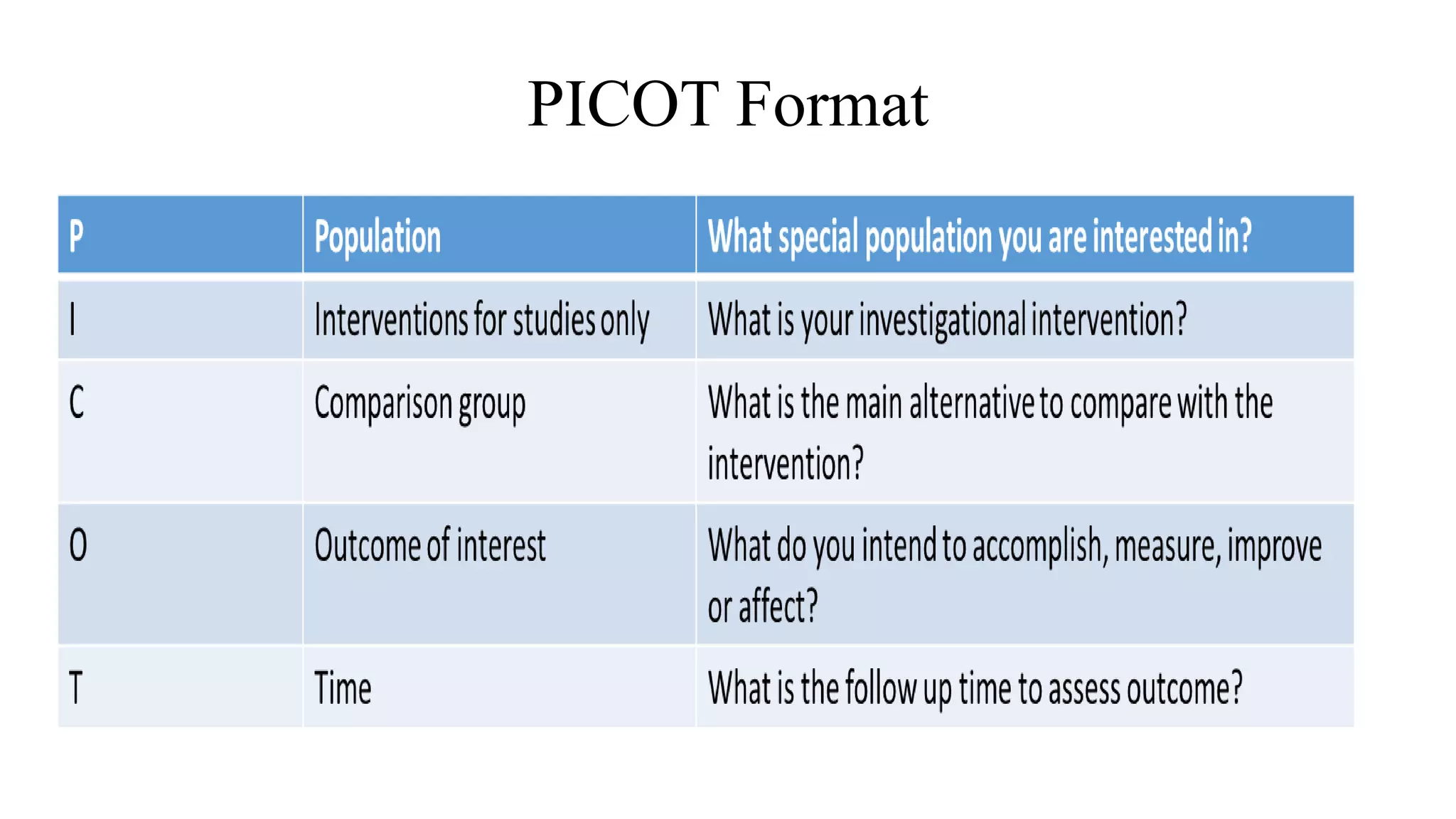
PICOT Approach
• FINER criteria outline the important aspects of the question in general, a
useful format to use in the development of a specific research question is the
PICO format — consider the;
• population (P) of interest, the intervention
• (I) being studied, the comparison
• (C) group (or to what is the intervention being compared) and the outcome of
interest
• (O). Often timing
• (T) is added to PICO
Cont...
• The PICOT approach helps generate a question that aids in constructing the framework of the
study and subsequently in protocol development by alluding to the inclusion and exclusion
criteria and identifying the groups of participants to be included.
• Knowing the specific population of interest, intervention (and comparator) and outcome of
interest may also help the researcher identify an appropriate outcome measurement tool.7 The
more defined the population of interest, and thus the more stringent the inclusion and exclusion
criteria, the greater the effect on the interpretation and subsequent applicability and
generalizability of the research findings.
• A restricted study population (and exclusion criteria) may limit bias and increase the internal
validity of the study; however, this approach will limit the external validity of the study and, thus,
the generalizability of the findings to the practical clinical setting. Conversely, a broadly defined
study population and inclusion criteria may be representative of practical practices but may
increase bias and reduce the internal validity of the study (Melnyk & Fineout-Overhold,
2022).
What Does PICOT Do?
• The PICOT approach helps generate a question that aids in constructing the framework of
the study and subsequently in protocol development by alluding to the inclusion and
exclusion criteria and identifying the groups of patients to be included.
• Knowing the specific population of interest, intervention (and comparator) and outcome of
interest may also help the researcher identify an appropriate outcome measurement tool.
• The more defined the population of interest, and thus the more stringent the inclusion and
exclusion criteria, the greater the effect on the interpretation and subsequent applicability
and generalizability of the research findings.
• A restricted study population (and exclusion criteria) may limit bias and increase the internal
validity of the study; however, this approach will limit external validity of the study and,
thus, the generalizability of the findings to the practical clinical setting.
• Conversely, a broadly defined study population and inclusion criteria may be representative
of practical clinical practice but may increase bias and reduce the internal validity of the
study (Melnyk & Fineout-Overhold, 2022).
PICOT Format
Types of Research Questions
• If you’re inquiring about meaning and experience, you’re using qualitative research.
• If you want to use empirical evidence to explain an occurrence, quantitative research is
your process. These types of research are useful in scientific, marketing, historical, and
psychological studies.
• Qualitative research is more concerned with understanding an event or phenomenon,
its open-ended questions focus more on a group’s experience than on statistics or
numbers.
• Qualitative research is primarily used in social sciences and includes surveys, case
studies, focus groups, and ethnography studies. Here are the three types of qualitative
questions for both research topics and survey questions (Goldschmidt & Matthews,
2022).
Qualitative Research Question Types
• Because qualitative research is more concerned with understanding an
event or phenomenon, its open-ended research questions focus more on a
group’s experience than on statistics or numbers.
• Qualitative research is primarily used in social sciences and includes
surveys, case studies, focus groups, and ethnography studies. Here are
the three types of qualitative questions for both research topics and
survey questions (Turner & Hagstrom-Schmidt, 2022).
Exploratory Questions
• Questions that are designed to understand more about a topic are exploratory
questions. The objective of asking an exploratory question is to learn more about a
topic without attributing bias or preconceived notions to it.
• Research Topic Example #1: What is the effect of personal technology on today’s
youth?
• Survey Question: Do you feel that personal technology has positively or negatively
affected you?
• Research Topic Example #2: How do students at our school spend their weekends?
• Survey Question: What do you do on a typical weekend?
Predictive Questions
• If you’re wondering about the future outcome of an action, you’ll use predictive
questions. These types of questions use past information to predict reactions to
hypothetical events.
• Research Topic Example #1: Are people more likely to buy a product after a
celebrity promotes it?
• Survey Question: Would you ever try a new product because a celebrity you respect
said that it worked for them?
• Research Topic Example #2: Would people in our town enjoy an ice-skating rink?
• Survey Question: How often would you visit a local ice-skating rink?
Interpretive Questions
• Interpretive research studies people in their natural settings. They interpret
how a group makes sense of shared experiences and attributes meaning to
various phenomena. These studies gather feedback on a group’s behavior
without affecting the outcome.
• Research Topic Example #1: How do preschoolers in a play-based program
handle transitions between activities?
• Survey Question: How do you feel when it’s time to put your toys away and
start the next activity?
• Research Topic Example #2: What is the historical significance of currency
to the Kalash Tribe?
• Survey Question: How do you attribute value to a good or service?
Quantitative Research Question Types
• Using measurable data answers a new set of research questions. These
types of quantitative research questions prove or disprove a researcher’s
hypothesis through descriptions, comparisons, and relationships.
Quantitative research questions are beneficial when choosing a research
topic or when posing follow-up questions that gather more information.
n.
Descriptive Questions
• As the most basic type of quantitative research question, descriptive questions seek to
explain when, where, why, or how something occurred. They use data and statistics
to describe an event or phenomenon.
• Research Topic Example #1: What percentage of college students have felt
depressed in the last year?
• Follow-Up Question: How often do students report their feelings of depression?
• Research Topic Example #2: How likely is it for mice with dominant traits to have
offspring with recessive traits?
• Follow-Up Question: How many generations of genes influence a future generation?
Comparative Questions
• Sometimes it’s beneficial to compare one occurrence with another.
Comparative questions are especially helpful when studying groups with
dependent variables.
• Research Topic Example #1: Why is it easier for men to lose weight than it is
for women?
• Follow-Up Question: Do men and women have comparable metabolisms?
• Research Topic Example #2: Which painkiller is more effective for
headaches?
• Follow-Up Question: Do Advil and Tylenol target pain in the same way?
Relationship-Based Questions
• If you’d like to know how one variable affects or influences another, use a
relationship-based question. These questions are common in quasi-experimental and
experimental studies.
• Research Topic Example #1: How does the number of drought days in a year affect
a region’s likelihood for wildfires?
• Follow-Up Question: What conditions are needed for a wildfire to become
uncontrollable?
• Research Topic Example #2: Do high school grades have an impact on future
success?
• Follow-Up Question: What are the relevant factors that affect one’s grades in high
school?
Ill Effects of Poorly Devised Research Question
• A poorly devised research question may affect the choice of study
design, potentially lead to futile situations and, thus, hamper the chance
of determining anything of significance, which will then affect the
potential for publication.
• Without devoting appropriate resources to developing the research
question, the quality of the study and subsequent results may be
compromised.
• During the initial stages of any research study, it is therefore imperative
to formulate a research question that is both research relevant and
answerable.
Questions Should Have Complex Answers
• A simple question gets a simple answer. And a simple answer will not be enough
information for a thesis. How you ask the question is important.Avoid questions that can
be answered with "yes" or "no" or a single word or phrase.
• Bad: Does owning a pet improve quality of life for older people?
• Good: In what ways does owning a pet improve quality of life for older people?
• With this "bad" question, the answer is a simple "yes" or "no." However, when you ask
about the specific ways a pet can improve the quality of life for its owner, you get a
much more detailed and interesting answer. This type of answer allows you create a
thesis statement.
Good Research Questions Need Focus
• A good research question should be focused on a single topic or on several closely
related ideas. If it isn't, you won't end up with a good thesis. If a question is too
general or doesn't stay on one topic, you can fix it by deciding which part of the topic
you want to research.
• Bad: Does medication help alleviate attention deficit hyperactivity disorder (ADHD)
symptoms? And do kids need more exercise?
• Good: How effective are the various types of medication in treating elementary
students with ADHD (Attention deficit hyperactivity disorder) ?
• Instead of covering both ADHD medication and exercise as topics, the good question
focuses on medication only. It's also more specific about the age of the students. The
answer to this question will provide a good thesis
You Can Answer a Good Question
• It's possible to ask a really interesting question and not be able to find the answer.
Don't forget that your reason for asking this question is to come up with a really great
answer - one on which you'll be able to build a paper or project. If you can't answer
it, you can't write a paper or do the project.
• Bad: Is there a higher power in the universe?
• Good: What factors affect people's belief in a higher power?
• You can keep the same topic but change the question to be something you have the
ability to answer within the time period and using the resources available to you.
Good Questions Don't Ask for Opinions
• As you write your question, think about the answer you want to
receive. An opinion or value judgement isn't a good start for a
strong research paper or project. Instead, you want to create a thesis
based on data and objective evidence.
• Bad: Which national park is the best?
• Good: What features do the most popular national parks have in
common?
• Asking which national park is the best does not provide a thesis that
can serve as the basis for a project or essay. It only asks for an
opinion. However, you can use visitor data and lists of park features
to answer a better version of this question.
Questions Should Be Specific
• As you write your question, make it as specific as possible. This will give you a more
detailed answer - one that is strong enough to be the topic of your project or paper.
• Bad: How do artificial sweeteners affect people?
• Good: How does aspartame affect post-menopausal women who suffer from
migraines?
• By specifying which artificial sweetener and which people, the question is easier to
answer with facts. These facts help form a strong, focused thesis and they also lend
support to your work.
Good Research Questions Are Original
• If you ask a question that's already been answered a thousand times before, you're
only doing research that someone else has already done. This doesn't provide you
with a good thesis. Instead, ask a question with an original slant to it.
• Bad: What are the advantages and disadvantages of cell phone use in schools?
• Good: How does restricting cell phone use in school affect student social interaction?
• Many people have studied the topic of cell phone use in schools, and it's easy to find
information about the advantages and disadvantages. A more interesting perspective
on the same topic is to examine how the restriction of cell phones affects students'
interactions with one another.
A Good Question Doesn't Ask Why
• If you're writing interview questions or planning to talk with a source for a feature
article, "why" questions are great because of how open-ended they are. However,
when you're writing a research question, that open-endedness is the opposite of what
you need. You need a question that has a clear and specific answer.
• Bad: Why do some corporations pollute the water if they aren't regulated?
• Good: How do government regulations prevent corporations from polluting the
water?
• By changing the "why" question to a "how" question, you're asking for specifics
instead of a vague opinion. This will help you create a much stronger thesis statement
for your research paper.
Great Questions Need Research
• If you can answer a research question without doing much research, it's a bad
question. It's better to formulate your question so that you need to dig a little to
answer it. If you can answer with a simple web search, you need a more complex
question.
• Bad: Has the population of the world increased in the past century?
• Good: What factors have influenced population growth in the fastest growing
countries?
• A quick search can answer the initial question here. The revised question, by contrast,
requires more digging around to find an adequate answer.
Good Research Questions Are Open to Debate
• It's easy to write a research paper or do a project about something that isn't
controversial, but you likely won't be creating anything new. Instead, ask a research
question about something that has multiple sides. That way, the research you do and
details you include will have more impact.
• Bad: Are illicit drugs bad for kids?
• Good: Which effective education strategies prevent drug abuse in teens?
• Everyone knows illicit drugs are bad for kids, but people will disagree about which
education strategies actually help. You'll need to dig for data to back up your answer
to this question, since some people will not agree with you.
Answer Questions With Sources
• A good research question can be answered with primary sources or secondary
sources. It doesn't ask for an opinion or requires a guess. If you look for support for
the answer, the research is out there.
• Bad: Are white mice better than gray mice?
• Good: When tested for intelligence and longevity, how do white mice and gray mice
compare?
• Testing mice for intelligence will give you a primary source for answering this
question, and looking at records summarizing longevity will provide a secondary
source. Because the question is specific, you can answer it with good research
sources.
What are Hypotheses?
Characteristics of Hypothesis: A hypothesis is an assumption that is made based on some evidence. This is
the initial point of any investigation that translates the research questions into predictions. It includes
components like variables, population and the relation between the variables. A research hypothesis is a
hypothesis that is used to test the relationship between two or more variables.
Following are the characteristics of the hypothesis:
• The hypothesis should be clear and precise to consider it to be reliable.
• If the hypothesis is a relational hypothesis, then it should be stating the relationship between variables.
• The hypothesis must be specific and should have scope for conducting more tests.
• The way of explanation of the hypothesis must be very simple and it should also be understood that the simplicity
of the hypothesis is not related to its significance.
Sources of Hypothesis
Following are the sources of the hypothesis:
• The resemblance between the phenomenon.
• Observations from past studies, present-day experiences and from the competitors.
• Scientific theories.
• General patterns that influence the thinking process of people.
Types of Hypothesis
There are six forms of hypothesis and they are:
• Simple hypothesis
• Complex hypothesis
• Directional hypothesis
• Non-directional hypothesis
• Null hypothesis
• Associative and casual hypothesis
Types of Hypotheses Discussed
Simple Hypothesis
• It shows a relationship between one dependent variable and a single independent variable. For
example – If you eat more vegetables, you will lose weight faster. Here, eating more vegetables
is an independent variable, while losing weight is the dependent variable.
Complex Hypothesis
• It shows the relationship between two or more dependent variables and two or more
independent variables. Eating more vegetables and fruit leads to weight loss, glowing skin, and
reduces the risk of many diseases such as heart disease.
Directional Hypothesis
• It shows how a researcher is intellectual and committed to a particular outcome. The
relationship between the variables can also predict its nature. For example- children aged four
years eating proper food over a five-year period are having higher IQ levels than children not
having a proper meal. This shows the effect and direction of the effect.
Cont...
Non-directional Hypothesis
• It is used when there is no theory involved. It is a statement that a relationship exists
between two variables, without predicting the exact nature (direction) of the
relationship.
Null Hypothesis
• It provides a statement that is contrary to the hypothesis. It’s a negative statement,
and there is no relationship between independent and dependent variables. The
symbol is denoted by “H0”.
Associative and Causal Hypothesis
• Associative hypothesis occurs when there is a change in one variable resulting in a
change in the other variable. Whereas, the causal hypothesis proposes a cause and
effect interaction between two or more variables.
Research Hypothesis
• The primary research question should be driven by the hypothesis rather than the data.
• That is, the research question and hypothesis should be developed before the start of the
study.
• This sounds intuitive; however, if we take, for example, a database of information, it is
potentially possible to perform multiple statistical comparisons of groups within the
database to find a statistically significant association.
• This could then lead one to work backward from the data and develop the “question.”
• This is counter intuitive to the process because the question is asked specifically to then
find the answer, thus collecting data along the way (i.e., in a prospective manner).
• Multiple statistical testing of associations from data previously collected could
potentially lead to spuriously positive findings of the association through chance alone.2
• Therefore, a good hypothesis must be based on a good research question at the start of a
trial and, indeed, drive data collection for the study.
Examples of Hypothesis
Following are the examples of hypotheses based on their types:
• Consumption of sugary drinks every day leads to obesity is an example of a simple hypothesis.
• All lilies have the same number of petals is an example of a null hypothesis.
• If a person gets 7 hours of sleep, then he will feel less fatigue than if he sleeps less. It is an example
of a directional hypothesis.
Functions of Hypothesis
Following are the functions performed by the hypothesis:
• Hypothesis helps in making an observation and experiments possible.
• It becomes the start point for the investigation.
• Hypothesis helps in verifying the observations.
• It helps in directing the inquiries in the right direction.
Hypothesis Help in the Scientific Method
Researchers use hypotheses to put down their thoughts directing how the
experiment would take place. Following are the steps that are involved in the
scientific method:
• Formation of question
• Doing background research
• Creation of hypothesis
• Designing an experiment
• Collection of data
• Result analysis
• Summarizing the experiment
• Communicating the results
Hypothesis Development
• The research hypothesis is developed from the research question and then the main
elements of the study — sampling strategy, intervention (if applicable), comparison
and outcome variables — are summarized in a form that establishes the basis for
testing, statistical and ultimately clinical significance.3
• For example, in a research study comparing computer-assisted acetabular component
insertion versus freehand acetabular component placement in patients in need of total
hip arthroplasty, the experimental group would be computer-assisted insertion and
the control/conventional group would be free-hand placement.
• The investigative team would first state a research hypothesis. This could be
expressed as a single outcome (e.g., computer-assisted acetabular component
placement leads to improved functional outcome) or potentially as a
complex/composite outcome; that is, more than one outcome (e.g., computer-assisted
acetabular component placement leads to both improved radiographic cup placement
and improved functional outcome).
Examples of Hypothesis
Following are the examples of hypotheses based on their types:
• Consumption of sugary drinks every day leads to obesity is an example
of a simple hypothesis.
• All lilies have the same number of petals is an example of a null
hypothesis.
• If a person gets 7 hours of sleep, then he will feel less fatigue than if he
sleeps less. It is an example of a directional hypothesis.
Statistical Significance
• When formally testing statistical significance, the hypothesis should be stated as a “null” hypothesis.
• The purpose of hypothesis testing is to make an inference about the population of interest on the basis of a
random sample taken from that population.
• The null hypothesis for the preceding research hypothesis then would be that there is no difference in mean
functional outcome between the computer-assisted insertion and free-hand placement techniques.
• After forming the null hypothesis, the researchers would form an alternate hypothesis stating the nature of
the difference, if it should appear. The alternate hypothesis would be that there is a difference in mean
functional outcome between these techniques.
• At the end of the study, the null hypothesis is then tested statistically. If the findings of the study are not
statistically significant (i.e., there is no difference in functional outcome between the groups in a statistical
sense), we cannot reject the null hypothesis, whereas if the findings were significant, we can reject the null
hypothesis and accept the alternate hypothesis (i.e., there is a difference in mean functional outcome between
the study groups), errors in testing notwithstanding. In other words, hypothesis testing confirms or refutes the
statement that the observed findings did not occur by chance alone but rather occurred because there was a
true difference in outcomes between these surgical procedures.
One or Two Sided Hypothesis
• Another important concept inherent in hypothesis testing is whether the hypotheses will be
1-sided or 2-sided. A 2-sided hypothesis states that there is a difference between the
experimental group and the control group, but it does not specify in advance the expected
direction of the difference.
• For example, we asked whether there is there an improvement in outcomes with computer-
assisted teaching or whether the outcomes worse with computer-assisted teaching.
• We presented a 2-sided test in the above example because we did not specify the direction of
the difference.
• A 1-sided hypothesis states a specific direction (e.g., there is an improvement in outcomes
with computer-assisted teaching).
• A 2-sided hypothesis should be used unless there is a good justification for using a 1-sided
hypothesis. As Bland and Atlman 8 stated, “One-sided hypothesis testing should never be
used as a device to make a conventionally non-significant difference significant.”
Cont...
• The research hypothesis should be stated at the beginning of the study to guide
the objectives for research. Whereas the investigators may state the hypothesis as
being 1-sided (there is an improvement with treatment), the study and
investigators must adhere to the concept of clinical equipoise.
• According to this principle, a clinical (or surgical) trial is ethical only if the
expert community is uncertain about the relative therapeutic merits of the
experimental and control groups being evaluated. It means there must exist an
honest and professional disagreement among expert clinicians about the preferred
treatment.
• Designing a research hypothesis is supported by a good research question and
will influence the type of research design for the study. Acting on the principles
of appropriate hypothesis development, the study can then confidently proceed to
the development of the research objective.
Research Objectives
• There are two types of research objectives; primary and secondary objectives.
• Research objectives describe what the researcher wants to achieve from the research/study.
• They are formulated after the research problem is finalized.
• They provide meaning and defines the research to the readers.
• Their purpose is to find answers to the research problem.
The Importance of Research Objectives
• They define the research since it provides meaning to the research.
• Research is meaningless without research objectives as is the same for any other task.
• They aid in the formulation of hypothesis.
• They are a guideline on which the researcher conducts the study. In every step of research,
the researcher uses objectives to be more specific.
• It also helps in narrowing down the research and provides a focal point.
• The development of research methodology also depends on them.
• They also guide the conduction of a valid and reliable research study.
• They also summarize the research to the readers and to the researcher. The researcher and the
reader know by reading the research objectives what the author wants to accomplish.
• It also saves the time of the researcher because he/she avoids collection of unnecessary data.
• They also provide a step-by-step guideline that makes the research well-planned and
sequential
Types of Research Objectives
• There are two types of research objectives, namely, general objectives and specific
objectives. Some researchers use the terms primary objectives and secondary
objectives regardless of the name the purpose is same. Primary objectives are same
as specific objectives while secondary objectives are same as general objectives. Not
every research has secondary or general objectives but every research has a specific
objective.
• General objectives
• General or secondary objectives provide a detailed view of the aims of the study.
They provide a general overview of the study usually, there is one general objective
in each study.
• Specific objectives
• The specific or broad objectives define what is the main aim of the study. There can
be many specific objectives because every “what”, “where” and “how” of the
research should be provided in the specific objectives. The specific objective is the
essence of the study and it gives the main idea since they provide focus to the study.
Research Objectives
• The primary objective should be coupled with the hypothesis of the study. Study objectives
define the specific aims of the study and should be clearly stated in the introduction of the
research protocol.
• From our previous example and using the investigative hypothesis that there is a difference
in functional outcomes between computer-assisted acetabular component placement and
free-hand placement, the primary objective can be stated as follows: this study will compare
the functional outcomes of computer-assisted acetabular component insertion versus free-
hand placement in patients undergoing total hip arthroplasty.
• Note that the study objective is an active statement about how the study is going to answer
the specific research question. Objectives can (and often do) state exactly which outcome
measures are going to be used within their statements. They are important because they not
only help guide the development of the protocol and design of study but also play a role in
sample size calculations and determining the power of the study.7 These concepts will be
discussed in other articles in this series.
Cont...
• It is important for the study objectives to be focused on outcomes that are important to
patients and clinically relevant. For example, the most methodologically sound randomized
controlled trial comparing 2 techniques of distal radial fixation would have little or no
clinical impact if the primary objective was to determine the effect of treatment A as
compared to treatment B on intraoperative fluoroscopy time.
• However, if the objective was to determine the effect of treatment A as compared to
treatment B on patient functional outcome at 1 year, this would have a much more significant
impact on clinical decision-making.
• Second, more meaningful surgeon–patient discussions could ensue, incorporating patient
values and preferences with the results from this study. It is the precise objective and what
the investigator is trying to measure that is of clinical relevance in the practical setting.
• The following is an example from the literature about the relation between the research
question, hypothesis and study objectives:
Example
• Study: Warden SJ, Metcalf BR, Kiss ZS, et al. Low-intensity pulsed ultrasound for
chronic patellar tendinopathy: a randomized, double-blind, placebo-controlled trial.
Rheumatology 2008;47:467–71.
• Research question: How does low-intensity pulsed ultrasound (LIPUS) compare
with a placebo device in managing the symptoms of skeletally mature patients with
patellar tendinopathy?
• Research hypothesis: Pain levels are reduced in patients who receive daily active-
LIPUS (treatment) for 12 weeks compared with individuals who receive inactive-
LIPUS (placebo).
• Objective: To investigate the clinical efficacy of LIPUS in the management of
patellar tendinopathy symptoms.
Tips for Developing Research Questions,
Hypotheses, and Objectives for Research Studies
• Perform a systematic literature review (if one has not been done) to increase
knowledge and familiarity with the topic and to assist with research development.
• Learn about current trends and technological advances on the topic.
• Seek careful input from experts, mentors, colleagues and collaborators to refine
your research question as this will aid in developing the research question and
guide the research study.
• Use the FINER criteria in the development of the research question.
• Ensure that the research question follows PICOT format.
• Develop a research hypothesis from the research question.
• Develop clear and well-defined primary and secondary (if needed) objectives.
• Ensure that the research question and objectives are answerable, feasible and
clinically relevant
References
Al-Ameen, M. N., Tamanna, T., Nandy, S., Ahsan, M. M., Chandra, P., & Ahmed, S. I. (2020). We don't give a second
thought before providing our information: Understanding users' perceptions of information collection by apps in
Urban Bangladesh. In Proceedings of the 3rd ACM SIGCAS Conference on Computing and Sustainable Societies (pp.
32-43).
Bell, E., Bryman, A., & Harley, B. (2022). Business research methods. Oxford university press.
Ferguson, C. J. (2020). Aggressive video games research emerges from its replication crisis (sort of). Current Opinion in
Psychology, 36(1), 1-6.
Goldschmidt, G., & Matthews, B. (2022). Formulating design research questions: A framework. Design Studies, 78(4),
101-162.
Jaakkola, E. (2020). Designing conceptual articles: Four approaches. AMS review, 10(1), 18-26.
Lien, Y. C. N., Wu, W. J., & Lu, Y. L. (2020). How well do teachers predict students’ actions in solving an ill-defined
problem in stem education: a solution using sequential pattern mining. IEEE Access, 8(6), 134976-134986.
Melnyk, B. M., & Fineout-Overhold, E. (2022). Evidence-based practice in nursing healthcare: A guide to best practice.
Lippincott Williams & Wilkins.
Thomas, J. R., Martin, P., Etnier, J., & Silverman, S. J. (2022). Research methods in physical activity. Human kinetics.
Turner III, D. W., & Hagstrom-Schmidt, N. (2022). Qualitative interview design. Sage.

Presentation on Research Questions.pptx

  • 1.
    Research Questions, Objectives, andHypotheses Dr. Khalid Rashid
  • 2.
    Search and ResearchDifferentiated • Search is trying to find something by looking or otherwise seeking carefully and thoroughly. “I searched among the rocks, but there was nothing” • Research is "creative and systematic work undertaken to increase the stock of knowledge". It involves the collection, organization, and analysis of information to increase understanding of a topic or issue. A research project may be an expansion of past work in the field. • An understanding of the basic elements of research is essential for good research practices. Among the most important elements to be considered are variables, associations, sampling, random selection, random assignment, and blinding (Thomas et al., 2022).
  • 3.
    Elements of Research •There are seven elements that our research plan should include: the project background, research goals, research questions, key performance indicators, methodology, participants, and the script or questions you'll ask participants. • Objectives and findings are the most important part of the research. • The title and the abstract are yet another the most important parts of a research paper which should be pleasant to read. The “title” should be descriptive, direct, accurate, appropriate, interesting, concise, precise, unique, and should not be misleading (Bell et al., 2022).
  • 4.
    Where from aResearch Problem • A research problem is a theoretical or practical difficulty, issue, gap in knowledge, or contradiction that an individual or a group of people experience and to which they want to find an appropriate solution. • The problem can exist in scholarly literature, in practice, or in theory, and it often demands understanding and deliberate investigation. • A research problem must be specified in kind and good enough to contribute to change or expand existing knowledge. • A research problem neither states how to do something nor poses a value question. Rather, it presents a broad or vague proposition (Ferguson, 2020).
  • 5.
    Elements of aResearch Problem  Objective or aim of the problem which is to be investigated. This answers the question “Why?” Why is there a need for investigation, inquiry or study?  The topic or theme which needs to be investigated. This answers the question “What?” What is to be researched or studied?” For example: What would a rival company do if we decrease our prices by 25%? What would sales be if prices were Rs. 89 ? Rs. 99 ? How would a rival firms action influence our sales and profits? The right question needs to be addressed if research is to help decision-makers. The decision maker can’t acquire all the information, but it is often feasible to identify the factors that are critical to the existing problem. These factors are then included in the problem definition (Jaakkola, 2020).
  • 6.
    Cont... • The timedimension of a decision problem is always the future. The period or time of the study when the data are to be gathered. This answers the question “When?” When is the research to be performed?” Managers frequently run the risk of making the correct decision at incorrect time. It is essential that the decision maker as well as the researcher determine the right time reference for-the decision. • The area or location in which the study is to be conducted. This answers the question “Where?” Where we need to conduct the study? The space coordinates give you the geographic boundaries within which the action is to be taken. In the problem definition, these lines are hardly ever neat political divisions or subdivisions. The universe of interest should be defined either conceptually or by enumeration.”
  • 7.
    Cont...  Population oruniverse from whom the data needs to be gathered. This answers the question “Who ? or “from whom?” Who are the respondents? From who are the data to be collected?” They may include persons, groups of persons, or business establishments.
  • 8.
    Research Problem Defined •Problem definition is the first step in research, a thorough knowledge of all its elements is crucial to make the correct decision. • In a real sense formulation of a problem is often a lot more crucial than its solution. It is only by carefully detailing the research problem that we can work out research design and can smoothly carry on all the consequential steps involved while doing research. • An appropriate definition of a research problem allows the investigator to be on the right path, on the other hand, an ill-defined research problem may create challenges. In fact, a problem clearly stated is a problem half solved (Lien et al., 2020).
  • 9.
    Footings of aResearch • The Project Background • Research Goals • Research Questions • Key Performance Indicators • Participants of Research • Research Methodology
  • 10.
    Project Background Depicted •Typically, the background of a study includes a review of the existing literature on the area of your research, leading up to your topic. Once you have discussed the contribution of other researchers in the field, you can identify gaps in understanding, that is, areas that have not been addressed in these studies. • Background information expands upon the key points stated in the beginning of your introduction but is not intended to be the main focus of the paper. • It generally supports the question, what did we know about this topic before I did this study? • Sufficient background information helps your reader determine if you have a basic understanding of the research problem being investigated and promotes confidence in the overall quality of your analysis and findings. • This information provides the reader with the essential context needed to understand the research problem and its significance before moving on to the literature review (Al-Ameen et al., 2020).
  • 11.
    Contextualization Depending on theproblem being studied, forms of contextualization may include one or more of the following: • Cultural -- placed within the learned behavior of specific groups of people. • Economic -- of or relating to systems of production and management of material wealth and/or business activities. • Gender -- located within the behavioral, cultural, or psychological traits typically associated with being male or female. • Historical -- the time in which something takes place or was created and how that influences how you interpret it. • Interdisciplinary -- explanation of theories, concepts, ideas, or methodologies borrowed from other disciplines applied to the research problem rooted in another discipline.
  • 12.
    Cont... • Philosophical --clarification of the essential nature of being or of phenomena as it relates to the research problem. • Physical/Spatial -- reflects the space around something and how that influences how you see it. • Political -- concerns the environment in which something is produced indicating it's public purpose or agenda. • Social -- the environment of people that surrounds something's creation or intended audience, reflecting how the people around something use and interpret it. • Temporal -- reflects issues or events of, relating to, or limited by time.
  • 13.
    Characteristics of aGood Background • The background should explain the meaning of the concepts/variables; paying particular attention to the dependent variable; state its importance; then linking or relating it to the independent variables with appropriate references; but proceeding from general to specifics, It is what gives the reader the impression ...
  • 14.
    Research Objectives • Thestudy objective is an active statement about how the study is going to answer the specific research question. • Objectives can (and often do) state exactly which outcome measures are going to be used within their statements. • Research objectives should be SMART—Specific, Measurable, Achievable, Realistic, and Time-constrained.
  • 15.
    Origination of ResearchQuestions • Interest in a particular topic usually begins the research process, but it is the familiarity with the subject that helps define an appropriate research question for a study. • Questions then arise out of a perceived knowledge deficit within a subject area or field of study. Indeed, Haynes suggests that it is important to know “where the boundary between current knowledge and ignorance lies.” • The challenge in developing an appropriate research question is in determining which uncertainties could or should be studied and also rationalizing the need for their investigation (Turner & Hagstrom-Schmidt, 2022)
  • 16.
    Cont... • Appropriate methodsinclude systematically searching the literature, in-depth interviews and focus groups with patients (and proxies) and interviews with experts in the field. • In addition, awareness of current trends and technological advances can assist with the development of research questions. • It is imperative to understand what has been studied about a topic to date in order to further the knowledge that has been previously gathered on a topic. Indeed, some granting institutions (e.g., HEC, World Bank, UNICEF, UNESCO) encourage applicants to conduct a systematic review of the available evidence if a recent review does not already exist and preferably a pilot or feasibility study before applying for a grant for a full trial.
  • 17.
    Cont... • In-depth knowledgeabout a subject may generate a number of questions. It then becomes necessary to ask whether these questions can be answered through one study or if more than one study needed. • Additional research questions can be developed, but several basic principles should be taken into consideration.All questions, primary and secondary, should be developed at the beginning and planning stages of a study. • Any additional questions should never compromise the primary question because it is the primary research question that forms the basis of the hypothesis and study objectives. • It must be kept in mind that within the scope of one study, the presence of a number of research questions will affect and potentially increase the complexity of both the study design and subsequent statistical analyses, not to mention the actual feasibility of answering every question. • A sensible strategy is to establish a single primary research question around which to focus the study plan.3 In a study, the primary research question should be clearly stated at the end of the introduction of the grant proposal, and it usually specifies the population to be studied, the intervention to be implemented and other circumstantial factors.
  • 18.
    Developing Good ResearchQuestions • Hulley and colleagues have suggested the use of the FINER criteria in the development of a good research question. The FINER criteria highlight useful points that may increase the chances of developing a successful research project. • A good research question should specify the population of interest, be of interest to the scientific community and potentially to the public, have clinical relevance and further current knowledge in the field (and of course be compliant with the standards of ethical boards and national research standards).
  • 19.
    Finer Criteria forGood research Questions F Feasible •Adequate number of subjects •Adequate technical expertise •Affordable in time and money •Manageable in scope I Interesting •Getting the answer intrigues investigator, peers and community N Novel •Confirms, refutes or extends previous findings E Ethical •Amenable to a study that institutional review board will approve R Relevant •To scientific knowledge •To clinical and health policy •To future research
  • 20.
    PICOT Approach • FINERcriteria outline the important aspects of the question in general, a useful format to use in the development of a specific research question is the PICO format — consider the; • population (P) of interest, the intervention • (I) being studied, the comparison • (C) group (or to what is the intervention being compared) and the outcome of interest • (O). Often timing • (T) is added to PICO
  • 21.
    Cont... • The PICOTapproach helps generate a question that aids in constructing the framework of the study and subsequently in protocol development by alluding to the inclusion and exclusion criteria and identifying the groups of participants to be included. • Knowing the specific population of interest, intervention (and comparator) and outcome of interest may also help the researcher identify an appropriate outcome measurement tool.7 The more defined the population of interest, and thus the more stringent the inclusion and exclusion criteria, the greater the effect on the interpretation and subsequent applicability and generalizability of the research findings. • A restricted study population (and exclusion criteria) may limit bias and increase the internal validity of the study; however, this approach will limit the external validity of the study and, thus, the generalizability of the findings to the practical clinical setting. Conversely, a broadly defined study population and inclusion criteria may be representative of practical practices but may increase bias and reduce the internal validity of the study (Melnyk & Fineout-Overhold, 2022).
  • 22.
    What Does PICOTDo? • The PICOT approach helps generate a question that aids in constructing the framework of the study and subsequently in protocol development by alluding to the inclusion and exclusion criteria and identifying the groups of patients to be included. • Knowing the specific population of interest, intervention (and comparator) and outcome of interest may also help the researcher identify an appropriate outcome measurement tool. • The more defined the population of interest, and thus the more stringent the inclusion and exclusion criteria, the greater the effect on the interpretation and subsequent applicability and generalizability of the research findings. • A restricted study population (and exclusion criteria) may limit bias and increase the internal validity of the study; however, this approach will limit external validity of the study and, thus, the generalizability of the findings to the practical clinical setting. • Conversely, a broadly defined study population and inclusion criteria may be representative of practical clinical practice but may increase bias and reduce the internal validity of the study (Melnyk & Fineout-Overhold, 2022).
  • 23.
  • 24.
    Types of ResearchQuestions • If you’re inquiring about meaning and experience, you’re using qualitative research. • If you want to use empirical evidence to explain an occurrence, quantitative research is your process. These types of research are useful in scientific, marketing, historical, and psychological studies. • Qualitative research is more concerned with understanding an event or phenomenon, its open-ended questions focus more on a group’s experience than on statistics or numbers. • Qualitative research is primarily used in social sciences and includes surveys, case studies, focus groups, and ethnography studies. Here are the three types of qualitative questions for both research topics and survey questions (Goldschmidt & Matthews, 2022).
  • 25.
    Qualitative Research QuestionTypes • Because qualitative research is more concerned with understanding an event or phenomenon, its open-ended research questions focus more on a group’s experience than on statistics or numbers. • Qualitative research is primarily used in social sciences and includes surveys, case studies, focus groups, and ethnography studies. Here are the three types of qualitative questions for both research topics and survey questions (Turner & Hagstrom-Schmidt, 2022).
  • 26.
    Exploratory Questions • Questionsthat are designed to understand more about a topic are exploratory questions. The objective of asking an exploratory question is to learn more about a topic without attributing bias or preconceived notions to it. • Research Topic Example #1: What is the effect of personal technology on today’s youth? • Survey Question: Do you feel that personal technology has positively or negatively affected you? • Research Topic Example #2: How do students at our school spend their weekends? • Survey Question: What do you do on a typical weekend?
  • 27.
    Predictive Questions • Ifyou’re wondering about the future outcome of an action, you’ll use predictive questions. These types of questions use past information to predict reactions to hypothetical events. • Research Topic Example #1: Are people more likely to buy a product after a celebrity promotes it? • Survey Question: Would you ever try a new product because a celebrity you respect said that it worked for them? • Research Topic Example #2: Would people in our town enjoy an ice-skating rink? • Survey Question: How often would you visit a local ice-skating rink?
  • 28.
    Interpretive Questions • Interpretiveresearch studies people in their natural settings. They interpret how a group makes sense of shared experiences and attributes meaning to various phenomena. These studies gather feedback on a group’s behavior without affecting the outcome. • Research Topic Example #1: How do preschoolers in a play-based program handle transitions between activities? • Survey Question: How do you feel when it’s time to put your toys away and start the next activity? • Research Topic Example #2: What is the historical significance of currency to the Kalash Tribe? • Survey Question: How do you attribute value to a good or service?
  • 29.
    Quantitative Research QuestionTypes • Using measurable data answers a new set of research questions. These types of quantitative research questions prove or disprove a researcher’s hypothesis through descriptions, comparisons, and relationships. Quantitative research questions are beneficial when choosing a research topic or when posing follow-up questions that gather more information. n.
  • 30.
    Descriptive Questions • Asthe most basic type of quantitative research question, descriptive questions seek to explain when, where, why, or how something occurred. They use data and statistics to describe an event or phenomenon. • Research Topic Example #1: What percentage of college students have felt depressed in the last year? • Follow-Up Question: How often do students report their feelings of depression? • Research Topic Example #2: How likely is it for mice with dominant traits to have offspring with recessive traits? • Follow-Up Question: How many generations of genes influence a future generation?
  • 31.
    Comparative Questions • Sometimesit’s beneficial to compare one occurrence with another. Comparative questions are especially helpful when studying groups with dependent variables. • Research Topic Example #1: Why is it easier for men to lose weight than it is for women? • Follow-Up Question: Do men and women have comparable metabolisms? • Research Topic Example #2: Which painkiller is more effective for headaches? • Follow-Up Question: Do Advil and Tylenol target pain in the same way?
  • 32.
    Relationship-Based Questions • Ifyou’d like to know how one variable affects or influences another, use a relationship-based question. These questions are common in quasi-experimental and experimental studies. • Research Topic Example #1: How does the number of drought days in a year affect a region’s likelihood for wildfires? • Follow-Up Question: What conditions are needed for a wildfire to become uncontrollable? • Research Topic Example #2: Do high school grades have an impact on future success? • Follow-Up Question: What are the relevant factors that affect one’s grades in high school?
  • 33.
    Ill Effects ofPoorly Devised Research Question • A poorly devised research question may affect the choice of study design, potentially lead to futile situations and, thus, hamper the chance of determining anything of significance, which will then affect the potential for publication. • Without devoting appropriate resources to developing the research question, the quality of the study and subsequent results may be compromised. • During the initial stages of any research study, it is therefore imperative to formulate a research question that is both research relevant and answerable.
  • 34.
    Questions Should HaveComplex Answers • A simple question gets a simple answer. And a simple answer will not be enough information for a thesis. How you ask the question is important.Avoid questions that can be answered with "yes" or "no" or a single word or phrase. • Bad: Does owning a pet improve quality of life for older people? • Good: In what ways does owning a pet improve quality of life for older people? • With this "bad" question, the answer is a simple "yes" or "no." However, when you ask about the specific ways a pet can improve the quality of life for its owner, you get a much more detailed and interesting answer. This type of answer allows you create a thesis statement.
  • 35.
    Good Research QuestionsNeed Focus • A good research question should be focused on a single topic or on several closely related ideas. If it isn't, you won't end up with a good thesis. If a question is too general or doesn't stay on one topic, you can fix it by deciding which part of the topic you want to research. • Bad: Does medication help alleviate attention deficit hyperactivity disorder (ADHD) symptoms? And do kids need more exercise? • Good: How effective are the various types of medication in treating elementary students with ADHD (Attention deficit hyperactivity disorder) ? • Instead of covering both ADHD medication and exercise as topics, the good question focuses on medication only. It's also more specific about the age of the students. The answer to this question will provide a good thesis
  • 36.
    You Can Answera Good Question • It's possible to ask a really interesting question and not be able to find the answer. Don't forget that your reason for asking this question is to come up with a really great answer - one on which you'll be able to build a paper or project. If you can't answer it, you can't write a paper or do the project. • Bad: Is there a higher power in the universe? • Good: What factors affect people's belief in a higher power? • You can keep the same topic but change the question to be something you have the ability to answer within the time period and using the resources available to you.
  • 37.
    Good Questions Don'tAsk for Opinions • As you write your question, think about the answer you want to receive. An opinion or value judgement isn't a good start for a strong research paper or project. Instead, you want to create a thesis based on data and objective evidence. • Bad: Which national park is the best? • Good: What features do the most popular national parks have in common? • Asking which national park is the best does not provide a thesis that can serve as the basis for a project or essay. It only asks for an opinion. However, you can use visitor data and lists of park features to answer a better version of this question.
  • 38.
    Questions Should BeSpecific • As you write your question, make it as specific as possible. This will give you a more detailed answer - one that is strong enough to be the topic of your project or paper. • Bad: How do artificial sweeteners affect people? • Good: How does aspartame affect post-menopausal women who suffer from migraines? • By specifying which artificial sweetener and which people, the question is easier to answer with facts. These facts help form a strong, focused thesis and they also lend support to your work.
  • 39.
    Good Research QuestionsAre Original • If you ask a question that's already been answered a thousand times before, you're only doing research that someone else has already done. This doesn't provide you with a good thesis. Instead, ask a question with an original slant to it. • Bad: What are the advantages and disadvantages of cell phone use in schools? • Good: How does restricting cell phone use in school affect student social interaction? • Many people have studied the topic of cell phone use in schools, and it's easy to find information about the advantages and disadvantages. A more interesting perspective on the same topic is to examine how the restriction of cell phones affects students' interactions with one another.
  • 40.
    A Good QuestionDoesn't Ask Why • If you're writing interview questions or planning to talk with a source for a feature article, "why" questions are great because of how open-ended they are. However, when you're writing a research question, that open-endedness is the opposite of what you need. You need a question that has a clear and specific answer. • Bad: Why do some corporations pollute the water if they aren't regulated? • Good: How do government regulations prevent corporations from polluting the water? • By changing the "why" question to a "how" question, you're asking for specifics instead of a vague opinion. This will help you create a much stronger thesis statement for your research paper.
  • 41.
    Great Questions NeedResearch • If you can answer a research question without doing much research, it's a bad question. It's better to formulate your question so that you need to dig a little to answer it. If you can answer with a simple web search, you need a more complex question. • Bad: Has the population of the world increased in the past century? • Good: What factors have influenced population growth in the fastest growing countries? • A quick search can answer the initial question here. The revised question, by contrast, requires more digging around to find an adequate answer.
  • 42.
    Good Research QuestionsAre Open to Debate • It's easy to write a research paper or do a project about something that isn't controversial, but you likely won't be creating anything new. Instead, ask a research question about something that has multiple sides. That way, the research you do and details you include will have more impact. • Bad: Are illicit drugs bad for kids? • Good: Which effective education strategies prevent drug abuse in teens? • Everyone knows illicit drugs are bad for kids, but people will disagree about which education strategies actually help. You'll need to dig for data to back up your answer to this question, since some people will not agree with you.
  • 43.
    Answer Questions WithSources • A good research question can be answered with primary sources or secondary sources. It doesn't ask for an opinion or requires a guess. If you look for support for the answer, the research is out there. • Bad: Are white mice better than gray mice? • Good: When tested for intelligence and longevity, how do white mice and gray mice compare? • Testing mice for intelligence will give you a primary source for answering this question, and looking at records summarizing longevity will provide a secondary source. Because the question is specific, you can answer it with good research sources.
  • 44.
    What are Hypotheses? Characteristicsof Hypothesis: A hypothesis is an assumption that is made based on some evidence. This is the initial point of any investigation that translates the research questions into predictions. It includes components like variables, population and the relation between the variables. A research hypothesis is a hypothesis that is used to test the relationship between two or more variables. Following are the characteristics of the hypothesis: • The hypothesis should be clear and precise to consider it to be reliable. • If the hypothesis is a relational hypothesis, then it should be stating the relationship between variables. • The hypothesis must be specific and should have scope for conducting more tests. • The way of explanation of the hypothesis must be very simple and it should also be understood that the simplicity of the hypothesis is not related to its significance. Sources of Hypothesis Following are the sources of the hypothesis: • The resemblance between the phenomenon. • Observations from past studies, present-day experiences and from the competitors. • Scientific theories. • General patterns that influence the thinking process of people.
  • 45.
    Types of Hypothesis Thereare six forms of hypothesis and they are: • Simple hypothesis • Complex hypothesis • Directional hypothesis • Non-directional hypothesis • Null hypothesis • Associative and casual hypothesis
  • 46.
    Types of HypothesesDiscussed Simple Hypothesis • It shows a relationship between one dependent variable and a single independent variable. For example – If you eat more vegetables, you will lose weight faster. Here, eating more vegetables is an independent variable, while losing weight is the dependent variable. Complex Hypothesis • It shows the relationship between two or more dependent variables and two or more independent variables. Eating more vegetables and fruit leads to weight loss, glowing skin, and reduces the risk of many diseases such as heart disease. Directional Hypothesis • It shows how a researcher is intellectual and committed to a particular outcome. The relationship between the variables can also predict its nature. For example- children aged four years eating proper food over a five-year period are having higher IQ levels than children not having a proper meal. This shows the effect and direction of the effect.
  • 47.
    Cont... Non-directional Hypothesis • Itis used when there is no theory involved. It is a statement that a relationship exists between two variables, without predicting the exact nature (direction) of the relationship. Null Hypothesis • It provides a statement that is contrary to the hypothesis. It’s a negative statement, and there is no relationship between independent and dependent variables. The symbol is denoted by “H0”. Associative and Causal Hypothesis • Associative hypothesis occurs when there is a change in one variable resulting in a change in the other variable. Whereas, the causal hypothesis proposes a cause and effect interaction between two or more variables.
  • 48.
    Research Hypothesis • Theprimary research question should be driven by the hypothesis rather than the data. • That is, the research question and hypothesis should be developed before the start of the study. • This sounds intuitive; however, if we take, for example, a database of information, it is potentially possible to perform multiple statistical comparisons of groups within the database to find a statistically significant association. • This could then lead one to work backward from the data and develop the “question.” • This is counter intuitive to the process because the question is asked specifically to then find the answer, thus collecting data along the way (i.e., in a prospective manner). • Multiple statistical testing of associations from data previously collected could potentially lead to spuriously positive findings of the association through chance alone.2 • Therefore, a good hypothesis must be based on a good research question at the start of a trial and, indeed, drive data collection for the study.
  • 49.
    Examples of Hypothesis Followingare the examples of hypotheses based on their types: • Consumption of sugary drinks every day leads to obesity is an example of a simple hypothesis. • All lilies have the same number of petals is an example of a null hypothesis. • If a person gets 7 hours of sleep, then he will feel less fatigue than if he sleeps less. It is an example of a directional hypothesis. Functions of Hypothesis Following are the functions performed by the hypothesis: • Hypothesis helps in making an observation and experiments possible. • It becomes the start point for the investigation. • Hypothesis helps in verifying the observations. • It helps in directing the inquiries in the right direction.
  • 50.
    Hypothesis Help inthe Scientific Method Researchers use hypotheses to put down their thoughts directing how the experiment would take place. Following are the steps that are involved in the scientific method: • Formation of question • Doing background research • Creation of hypothesis • Designing an experiment • Collection of data • Result analysis • Summarizing the experiment • Communicating the results
  • 51.
    Hypothesis Development • Theresearch hypothesis is developed from the research question and then the main elements of the study — sampling strategy, intervention (if applicable), comparison and outcome variables — are summarized in a form that establishes the basis for testing, statistical and ultimately clinical significance.3 • For example, in a research study comparing computer-assisted acetabular component insertion versus freehand acetabular component placement in patients in need of total hip arthroplasty, the experimental group would be computer-assisted insertion and the control/conventional group would be free-hand placement. • The investigative team would first state a research hypothesis. This could be expressed as a single outcome (e.g., computer-assisted acetabular component placement leads to improved functional outcome) or potentially as a complex/composite outcome; that is, more than one outcome (e.g., computer-assisted acetabular component placement leads to both improved radiographic cup placement and improved functional outcome).
  • 52.
    Examples of Hypothesis Followingare the examples of hypotheses based on their types: • Consumption of sugary drinks every day leads to obesity is an example of a simple hypothesis. • All lilies have the same number of petals is an example of a null hypothesis. • If a person gets 7 hours of sleep, then he will feel less fatigue than if he sleeps less. It is an example of a directional hypothesis.
  • 53.
    Statistical Significance • Whenformally testing statistical significance, the hypothesis should be stated as a “null” hypothesis. • The purpose of hypothesis testing is to make an inference about the population of interest on the basis of a random sample taken from that population. • The null hypothesis for the preceding research hypothesis then would be that there is no difference in mean functional outcome between the computer-assisted insertion and free-hand placement techniques. • After forming the null hypothesis, the researchers would form an alternate hypothesis stating the nature of the difference, if it should appear. The alternate hypothesis would be that there is a difference in mean functional outcome between these techniques. • At the end of the study, the null hypothesis is then tested statistically. If the findings of the study are not statistically significant (i.e., there is no difference in functional outcome between the groups in a statistical sense), we cannot reject the null hypothesis, whereas if the findings were significant, we can reject the null hypothesis and accept the alternate hypothesis (i.e., there is a difference in mean functional outcome between the study groups), errors in testing notwithstanding. In other words, hypothesis testing confirms or refutes the statement that the observed findings did not occur by chance alone but rather occurred because there was a true difference in outcomes between these surgical procedures.
  • 54.
    One or TwoSided Hypothesis • Another important concept inherent in hypothesis testing is whether the hypotheses will be 1-sided or 2-sided. A 2-sided hypothesis states that there is a difference between the experimental group and the control group, but it does not specify in advance the expected direction of the difference. • For example, we asked whether there is there an improvement in outcomes with computer- assisted teaching or whether the outcomes worse with computer-assisted teaching. • We presented a 2-sided test in the above example because we did not specify the direction of the difference. • A 1-sided hypothesis states a specific direction (e.g., there is an improvement in outcomes with computer-assisted teaching). • A 2-sided hypothesis should be used unless there is a good justification for using a 1-sided hypothesis. As Bland and Atlman 8 stated, “One-sided hypothesis testing should never be used as a device to make a conventionally non-significant difference significant.”
  • 55.
    Cont... • The researchhypothesis should be stated at the beginning of the study to guide the objectives for research. Whereas the investigators may state the hypothesis as being 1-sided (there is an improvement with treatment), the study and investigators must adhere to the concept of clinical equipoise. • According to this principle, a clinical (or surgical) trial is ethical only if the expert community is uncertain about the relative therapeutic merits of the experimental and control groups being evaluated. It means there must exist an honest and professional disagreement among expert clinicians about the preferred treatment. • Designing a research hypothesis is supported by a good research question and will influence the type of research design for the study. Acting on the principles of appropriate hypothesis development, the study can then confidently proceed to the development of the research objective.
  • 56.
    Research Objectives • Thereare two types of research objectives; primary and secondary objectives. • Research objectives describe what the researcher wants to achieve from the research/study. • They are formulated after the research problem is finalized. • They provide meaning and defines the research to the readers. • Their purpose is to find answers to the research problem.
  • 57.
    The Importance ofResearch Objectives • They define the research since it provides meaning to the research. • Research is meaningless without research objectives as is the same for any other task. • They aid in the formulation of hypothesis. • They are a guideline on which the researcher conducts the study. In every step of research, the researcher uses objectives to be more specific. • It also helps in narrowing down the research and provides a focal point. • The development of research methodology also depends on them. • They also guide the conduction of a valid and reliable research study. • They also summarize the research to the readers and to the researcher. The researcher and the reader know by reading the research objectives what the author wants to accomplish. • It also saves the time of the researcher because he/she avoids collection of unnecessary data. • They also provide a step-by-step guideline that makes the research well-planned and sequential
  • 58.
    Types of ResearchObjectives • There are two types of research objectives, namely, general objectives and specific objectives. Some researchers use the terms primary objectives and secondary objectives regardless of the name the purpose is same. Primary objectives are same as specific objectives while secondary objectives are same as general objectives. Not every research has secondary or general objectives but every research has a specific objective. • General objectives • General or secondary objectives provide a detailed view of the aims of the study. They provide a general overview of the study usually, there is one general objective in each study. • Specific objectives • The specific or broad objectives define what is the main aim of the study. There can be many specific objectives because every “what”, “where” and “how” of the research should be provided in the specific objectives. The specific objective is the essence of the study and it gives the main idea since they provide focus to the study.
  • 59.
    Research Objectives • Theprimary objective should be coupled with the hypothesis of the study. Study objectives define the specific aims of the study and should be clearly stated in the introduction of the research protocol. • From our previous example and using the investigative hypothesis that there is a difference in functional outcomes between computer-assisted acetabular component placement and free-hand placement, the primary objective can be stated as follows: this study will compare the functional outcomes of computer-assisted acetabular component insertion versus free- hand placement in patients undergoing total hip arthroplasty. • Note that the study objective is an active statement about how the study is going to answer the specific research question. Objectives can (and often do) state exactly which outcome measures are going to be used within their statements. They are important because they not only help guide the development of the protocol and design of study but also play a role in sample size calculations and determining the power of the study.7 These concepts will be discussed in other articles in this series.
  • 60.
    Cont... • It isimportant for the study objectives to be focused on outcomes that are important to patients and clinically relevant. For example, the most methodologically sound randomized controlled trial comparing 2 techniques of distal radial fixation would have little or no clinical impact if the primary objective was to determine the effect of treatment A as compared to treatment B on intraoperative fluoroscopy time. • However, if the objective was to determine the effect of treatment A as compared to treatment B on patient functional outcome at 1 year, this would have a much more significant impact on clinical decision-making. • Second, more meaningful surgeon–patient discussions could ensue, incorporating patient values and preferences with the results from this study. It is the precise objective and what the investigator is trying to measure that is of clinical relevance in the practical setting. • The following is an example from the literature about the relation between the research question, hypothesis and study objectives:
  • 61.
    Example • Study: WardenSJ, Metcalf BR, Kiss ZS, et al. Low-intensity pulsed ultrasound for chronic patellar tendinopathy: a randomized, double-blind, placebo-controlled trial. Rheumatology 2008;47:467–71. • Research question: How does low-intensity pulsed ultrasound (LIPUS) compare with a placebo device in managing the symptoms of skeletally mature patients with patellar tendinopathy? • Research hypothesis: Pain levels are reduced in patients who receive daily active- LIPUS (treatment) for 12 weeks compared with individuals who receive inactive- LIPUS (placebo). • Objective: To investigate the clinical efficacy of LIPUS in the management of patellar tendinopathy symptoms.
  • 62.
    Tips for DevelopingResearch Questions, Hypotheses, and Objectives for Research Studies • Perform a systematic literature review (if one has not been done) to increase knowledge and familiarity with the topic and to assist with research development. • Learn about current trends and technological advances on the topic. • Seek careful input from experts, mentors, colleagues and collaborators to refine your research question as this will aid in developing the research question and guide the research study. • Use the FINER criteria in the development of the research question. • Ensure that the research question follows PICOT format. • Develop a research hypothesis from the research question. • Develop clear and well-defined primary and secondary (if needed) objectives. • Ensure that the research question and objectives are answerable, feasible and clinically relevant
  • 63.
    References Al-Ameen, M. N.,Tamanna, T., Nandy, S., Ahsan, M. M., Chandra, P., & Ahmed, S. I. (2020). We don't give a second thought before providing our information: Understanding users' perceptions of information collection by apps in Urban Bangladesh. In Proceedings of the 3rd ACM SIGCAS Conference on Computing and Sustainable Societies (pp. 32-43). Bell, E., Bryman, A., & Harley, B. (2022). Business research methods. Oxford university press. Ferguson, C. J. (2020). Aggressive video games research emerges from its replication crisis (sort of). Current Opinion in Psychology, 36(1), 1-6. Goldschmidt, G., & Matthews, B. (2022). Formulating design research questions: A framework. Design Studies, 78(4), 101-162. Jaakkola, E. (2020). Designing conceptual articles: Four approaches. AMS review, 10(1), 18-26. Lien, Y. C. N., Wu, W. J., & Lu, Y. L. (2020). How well do teachers predict students’ actions in solving an ill-defined problem in stem education: a solution using sequential pattern mining. IEEE Access, 8(6), 134976-134986. Melnyk, B. M., & Fineout-Overhold, E. (2022). Evidence-based practice in nursing healthcare: A guide to best practice. Lippincott Williams & Wilkins. Thomas, J. R., Martin, P., Etnier, J., & Silverman, S. J. (2022). Research methods in physical activity. Human kinetics. Turner III, D. W., & Hagstrom-Schmidt, N. (2022). Qualitative interview design. Sage.

Editor's Notes

  • #4 Bell, E., Bryman, A., & Harley, B. (2022). Business research methods. Oxford university press.
  • #5 Ferguson, C. J. (2020). Aggressive video games research emerges from its replication crisis (sort of). Current opinion in psychology, 36, 1-6.
  • #6 Jaakkola, E. (2020). Designing conceptual articles: four approaches. AMS review, 10(1), 18-26.
  • #9 Lien, Y. C. N., Wu, W. J., & Lu, Y. L. (2020). How well do teachers predict students’ actions in solving an ill-defined problem in stem education: a solution using sequential pattern mining. IEEE Access, 8, 134976-134986.
  • #11 Al-Ameen, M. N., Tamanna, T., Nandy, S., Ahsan, M. M., Chandra, P., & Ahmed, S. I. (2020, June). We don't give a second thought before providing our information: understanding users' perceptions of information collection by apps in Urban Bangladesh. In Proceedings of the 3rd ACM SIGCAS Conference on Computing and Sustainable Societies (pp. 32-43).
  • #14 Al-Ameen, M. N., Tamanna, T., Nandy, S., Ahsan, M. M., Chandra, P., & Ahmed, S. I. (2020, June). We don't give a second thought before providing our information: understanding users' perceptions of information collection by apps in Urban Bangladesh. In Proceedings of the 3rd ACM SIGCAS Conference on Computing and Sustainable Societies (pp. 32-43).
  • #16 Turner III, D. W., & Hagstrom-Schmidt, N. (2022). Qualitative interview design. Howdy or Hello? Technical and Professional Communication.
  • #19 Turner III, D. W., & Hagstrom-Schmidt, N. (2022). Qualitative interview design. Howdy or Hello? Technical and Professional Communication.
  • #22 Melnyk, B. M., & Fineout-Overhold, E. (2022). Evidence-based practice in nursing healthcare: A guide to best practice. Lippincott Williams & Wilkins.
  • #23 Melnyk, B. M., & Fineout-Overhold, E. (2022). Evidence-based practice in nursing & healthcare: A guide to best practice. Lippincott Williams & Wilkins.
  • #25 Goldschmidt, G., & Matthews, B. (2022). Formulating design research questions: A framework. Design Studies, 78, 101062.
  • #26 Turner III, D. W., & Hagstrom-Schmidt, N. (2022). Qualitative interview design. Howdy or Hello? Technical and Professional Communication
  • #27 Nakash, M., Baruchson‐Arbib, S., & Bouhnik, D. (2022). A holistic model of the role, development, and future of knowledge management: Proposal for exploratory research. Knowledge and Process Management, 29(1), 23-30.
  • #28 Cai, Y., Yang, Y., & Shi, W. (2022). A predictive model of the knowledge-sharing intentions of social Q&A community members: A regression tree approach. International Journal of Human–Computer Interaction, 38(4), 324-338.
  • #29 Cai, Y., Yang, Y., & Shi, W. (2022). A predictive model of the knowledge-sharing intentions of social Q&A community members: A regression tree approach. International Journal of Human–Computer Interaction, 38(4), 324-338.
  • #30 Bosnjak, M., Fiebach, C. J., Mellor, D., Mueller, S., O'Connor, D. B., Oswald, F. L., & Sokol, R. I. (2022). A template for preregistration of quantitative research in psychology: Report of the joint psychological societies preregistration task force. American Psychologist, 77(4), 602.
  • #31 Lengkoan, F., Andries, F. A., & Tatipang, D. P. (2022). A STUDY ON LISTENING PROBLEMS FACED BY STUDENTS OF HIGHER EDUCATION. Globish: An English-Indonesian Journal for English, Education, and Culture, 11(1), 41-50.
  • #32 Lind, F., Eberl, J. M., Eisele, O., Heidenreich, T., Galyga, S., & Boomgaarden, H. G. (2022). Building the bridge: topic modeling for comparative research. Communication Methods and Measures, 16(2), 96-114.
  • #33 Nordesjö, K., Scaramuzzino, G., & Ulmestig, R. (2022). The social worker-client relationship in the digital era: a configurative literature review. European Journal of Social Work, 25(2), 303-315.
  • #35 Goldschmidt, G., & Matthews, B. (2022). Formulating design research questions: A framework. Design Studies, 78, 101062.
  • #45 Ryan, O., Bringmann, L. F., & Schuurman, N. K. (2022). The challenge of generating causal hypotheses using network models. Structural Equation Modeling: A Multidisciplinary Journal, 1-18.
  • #47 Mishra, S. B., & Alok, S. (2022). Handbook of research methodology.
  • #48 Mishra, S. B., & Alok, S. (2022). Handbook of research methodology.
  • #50 Hertanto, H., Mulyaningsih, H., Suripto, S., & Sudarman, S. (2022). The relationship between different social factors and the intensity of student radicalism. Journal of Social Studies Education Research, 13(2), 288-319.
  • #51 Sulasmi, E. (2022). Primary School Teachers’ Digital Literacy: An Analysis On Teachers’ Skills In Using Technological Devices. Journal of Innovation in Educational and Cultural Research, 3(2), 140-145.
  • #52 Thomas, J. R., Martin, P., Etnier, J., & Silverman, S. J. (2022). Research methods in physical activity. Human kinetics.
  • #54 Shirilla, P., Solid, C., & Graham, S. E. (2022). The benefits of longitudinal data and multilevel modeling to measure change in adventure education research. Journal of Experiential Education, 45(1), 88-109.
  • #58 Khasawneh, M. (2022). The Relationship of Curriculum, Teaching Methods, Assessment Methods, and School and Home Environment with Learning Difficulties in English Language from the Studetns’ Perspectives. Journal of Innovation in Educational and Cultural Research, 3(1), 41-48.
  • #61 Khasawneh, M. (2022). The Relationship of Curriculum, Teaching Methods, Assessment Methods, and School and Home Environment with Learning Difficulties in English Language from the Studetns’ Perspectives. Journal of Innovation in Educational and Cultural Research, 3(1), 41-48.