Data, Information &
Knowledge
The old adage / saying goes along the lines that
knowledge can be defined as knowing a tomato
is a fruit…
And that wisdom is therefore knowing that you
don't add a tomato to a fruit salad...
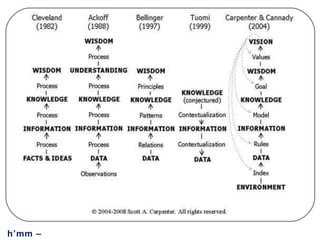
There are a number of models and frameworks
that investigate the data-information-knowledge-
wisdom continuum
h’mm –
h’mm –
h’mm –
Data
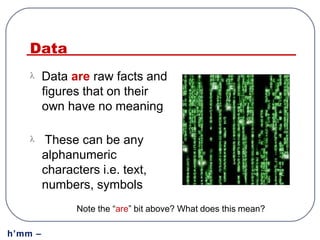
 Data are raw facts and
figures that on their
own have no meaning
 These can be any
alphanumeric
characters i.e. text,
numbers, symbols
Note the “are” bit above? What does this mean?
h’mm –
Data Examples
h’mm –
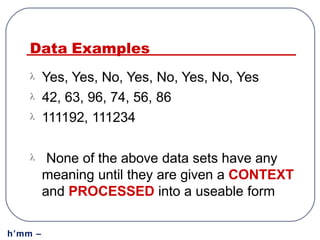
 Yes, Yes, No, Yes, No, Yes, No, Yes
 42, 63, 96, 74, 56, 86
 111192, 111234
 None of the above data sets have any
meaning until they are given a CONTEXT
and PROCESSED into a useable form
Data Into Information
h’mm –
 To achieve its aims the organisation will
need to process data into information.
 Data needs to be turned into meaningful
information and presented in its most
useful format
 Data must be processed in a context in
order to give it meaning
Information
h’mm –
 Data that has been processed within a
context to give it meaning
OR
 Data that has been processed into a
form that gives it meaning
Examples
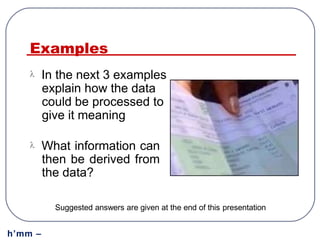
 In the next 3 examples
explain how the data
could be processed to
give it meaning
 What information can
then be derived from
the data?
Suggested answers are given at the end of this presentation
h’mm –
Example 1
Yes, Yes, No, Yes, No, Yes,
No, Yes, No, Yes, Yes
Raw Data
Context
Responses to the market
research question – “Would
you buy brand x at price y?”
Information ???
h’mm –
Processing
Example 2
Raw Data
Context
Information
42, 63, 96, 74, 56, 86
Jayne’s scores in the six
AS/A2 ICT modules
???
Processing
h’mm –
Example 3
Raw Data
Context
Information
111192, 111234
The previous and current
readings of a customer’s
gas meter
???
h’mm –
Processing
Encoding Information
h’mm –
• Processing turns data into information
• Sometimes you might want to turn information
into data – i.e. to store it – this is called
encoding
• How do you code information to make it easy
to re-process, without losing it’s meaning?
Sources of Data
h’mm –
Internal or External?
• Internal communication is communication with people inside the
same organisation or company
• External communication is with people outside the company, such
as suppliers or customers.
Direct or Indirect?
• Direct data are collected for the purpose of the processing being
undertaken – e.g. time cards for pay
• Indirect data are originally collected for another purpose, but is now
being processed to provide extra information - e.g. spending patterns
from credit cards
Information Channels
h’mm –
Formal or Informal?
• Formal channels are the official (or reliable!) ones,
such as memos, letters, the company noticeboard,
etc.
• Informal channels are the unofficial ones, such as
office gossip, informal meetings and rumours –
these can often be unreliable.
The Value of Information
h’mm –
• It is often said that we are in the information age, and that information
is a valuable commodity.
• Why is information valuable? Because:
•It allows us to plan how to run our business more effectively – e.g.
shops can stock what customers want, when they want it, and
manufacturers can anticipate demand
• Marketing materials can be targeted at people and customersthat
you know could be interested in your products and services
• This can lead to increased customer satisfaction andtherefore
profit
Good Quality Information
• The characteristics of good quality information – it should be:
•Accurate
•Up-to-date
•Relevant
•Complete
•On-time
• Appropriatelypresented
Collecting Information
h’mm –
How is information about people collected?
1. Obviously you can ask people questions about their spending
habits, etc. (but they might not like it!)
2. Or you can use a more indirect approach:
•
•
• Supermarket loyalty cards
- e.g. easily identify vegetarians!
Credit card transactions
- amounts and locations
- can help prevent fraud, too!
ATMs, CCTV, till transactions, etc.
Coding Information
h’mm –
•
•
•
Information stored in a computer is often coded
Coding categorises information and can replace
long, description strings with a few letters or
numbers (or both!)
You are probably familiar with examples such as F
for female and M for male
Coding - Advantages
h’mm –
Information is often coded because:
•
•
•
•
•
It is quicker to enter into the computer
It require less disc space to store, and less memory to process
It can make processing easier – or possible – as there will be
fewer responses
It improves the consistency of the data as spelling mistakes are
less likely
Validation is easier to apply
Coding - Disadvantages
h’mm –
Coding also has some negative effects :
•
• Information is coarsened by forcing it all into
categories – there might not be a category that
matches what you want to record – e.g. hair colour
The same can be true of rounding numbers – the
intervals(An Interval is all the numbers between two given numbers. Showing if the beginning and end number are
included is important. There are three main ways to show intervals:) or numbers of
categories, this needs to be chosen carefully to
maintain the quality of the information
Exam Tip
 You’ll nearly always be asked to give
examples of data processed into
information
 Don’t use:
• Traffic lights
• Dates of birth
h’mm –
Knowledge
h’mm –
 Knowledge is the understanding of rules
needed to interpret information
“…the capability of understanding the
relationship between pieces of
information and what to actually do
with the information”
Knowledge
h’mm –
•
•
•
•
•
Data and information deal with facts and figures
Knowing what to do with them requires knowledge
Knowledge = information + rules
Rules tell us the likely effect of something
For example: you are more likely to pass your A
level IF you do your coursework and revise for your
exam!
Knowledge Examples
h’mm –
 Using the 3 previousexamples:
• A Marketing Manager could use this information to
decide whether or not to raise or lower price y
• teacher could analyse the results to determine
whether it would be worth her re-sitting a module
• Looking at the pattern of the customer’s previous gas
bills may identify that the figure is abnormally low and
they are fiddling the gas meter!!!
Knowledge Workers
h’mm –
 Knowledge workers have specialist
knowledge that makes them “experts”
• Based on formal and informal rules they have
learned through training and experience
 Examples include doctors, managers,
librarians, scientists…
Expert Systems
 Because many rules are based
on probabilities computers can
be programmed with “subject
knowledge” to mimic the role
of experts

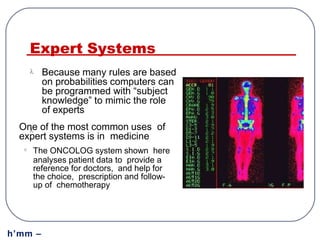
One of the most common uses of
expert systems is in medicine
• The ONCOLOG system shown here
analyses patient data to provide a
reference for doctors, and help for
the choice, prescription and follow-
up of chemotherapy
h’mm –
Summary
Information Data Context Meaning
= +
+
Processing
h’mm –
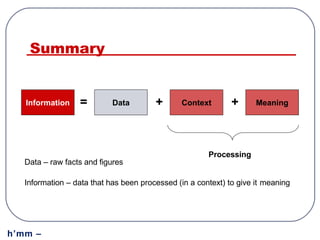
Data – raw facts and figures
Information – data that has been processed (in a context) to give it meaning

Unit 2. Data, Knowledge, Information.pptx

  • 1.
  • 2.
    The old adage/ saying goes along the lines that knowledge can be defined as knowing a tomato is a fruit… And that wisdom is therefore knowing that you don't add a tomato to a fruit salad... There are a number of models and frameworks that investigate the data-information-knowledge- wisdom continuum h’mm –
  • 3.
  • 4.
  • 5.
    Data  Data areraw facts and figures that on their own have no meaning  These can be any alphanumeric characters i.e. text, numbers, symbols Note the “are” bit above? What does this mean? h’mm –
  • 6.
    Data Examples h’mm – Yes, Yes, No, Yes, No, Yes, No, Yes  42, 63, 96, 74, 56, 86  111192, 111234  None of the above data sets have any meaning until they are given a CONTEXT and PROCESSED into a useable form
  • 7.
    Data Into Information h’mm–  To achieve its aims the organisation will need to process data into information.  Data needs to be turned into meaningful information and presented in its most useful format  Data must be processed in a context in order to give it meaning
  • 8.
    Information h’mm –  Datathat has been processed within a context to give it meaning OR  Data that has been processed into a form that gives it meaning
  • 9.
    Examples  In thenext 3 examples explain how the data could be processed to give it meaning  What information can then be derived from the data? Suggested answers are given at the end of this presentation h’mm –
  • 10.
    Example 1 Yes, Yes,No, Yes, No, Yes, No, Yes, No, Yes, Yes Raw Data Context Responses to the market research question – “Would you buy brand x at price y?” Information ??? h’mm – Processing
  • 11.
    Example 2 Raw Data Context Information 42,63, 96, 74, 56, 86 Jayne’s scores in the six AS/A2 ICT modules ??? Processing h’mm –
  • 12.
    Example 3 Raw Data Context Information 111192,111234 The previous and current readings of a customer’s gas meter ??? h’mm – Processing
  • 13.
    Encoding Information h’mm – •Processing turns data into information • Sometimes you might want to turn information into data – i.e. to store it – this is called encoding • How do you code information to make it easy to re-process, without losing it’s meaning?
  • 14.
    Sources of Data h’mm– Internal or External? • Internal communication is communication with people inside the same organisation or company • External communication is with people outside the company, such as suppliers or customers. Direct or Indirect? • Direct data are collected for the purpose of the processing being undertaken – e.g. time cards for pay • Indirect data are originally collected for another purpose, but is now being processed to provide extra information - e.g. spending patterns from credit cards
  • 15.
    Information Channels h’mm – Formalor Informal? • Formal channels are the official (or reliable!) ones, such as memos, letters, the company noticeboard, etc. • Informal channels are the unofficial ones, such as office gossip, informal meetings and rumours – these can often be unreliable.
  • 16.
    The Value ofInformation h’mm – • It is often said that we are in the information age, and that information is a valuable commodity. • Why is information valuable? Because: •It allows us to plan how to run our business more effectively – e.g. shops can stock what customers want, when they want it, and manufacturers can anticipate demand • Marketing materials can be targeted at people and customersthat you know could be interested in your products and services • This can lead to increased customer satisfaction andtherefore profit
  • 17.
    Good Quality Information •The characteristics of good quality information – it should be: •Accurate •Up-to-date •Relevant •Complete •On-time • Appropriatelypresented
  • 18.
    Collecting Information h’mm – Howis information about people collected? 1. Obviously you can ask people questions about their spending habits, etc. (but they might not like it!) 2. Or you can use a more indirect approach: • • • Supermarket loyalty cards - e.g. easily identify vegetarians! Credit card transactions - amounts and locations - can help prevent fraud, too! ATMs, CCTV, till transactions, etc.
  • 19.
    Coding Information h’mm – • • • Informationstored in a computer is often coded Coding categorises information and can replace long, description strings with a few letters or numbers (or both!) You are probably familiar with examples such as F for female and M for male
  • 20.
    Coding - Advantages h’mm– Information is often coded because: • • • • • It is quicker to enter into the computer It require less disc space to store, and less memory to process It can make processing easier – or possible – as there will be fewer responses It improves the consistency of the data as spelling mistakes are less likely Validation is easier to apply
  • 21.
    Coding - Disadvantages h’mm– Coding also has some negative effects : • • Information is coarsened by forcing it all into categories – there might not be a category that matches what you want to record – e.g. hair colour The same can be true of rounding numbers – the intervals(An Interval is all the numbers between two given numbers. Showing if the beginning and end number are included is important. There are three main ways to show intervals:) or numbers of categories, this needs to be chosen carefully to maintain the quality of the information
  • 22.
    Exam Tip  You’llnearly always be asked to give examples of data processed into information  Don’t use: • Traffic lights • Dates of birth h’mm –
  • 23.
    Knowledge h’mm –  Knowledgeis the understanding of rules needed to interpret information “…the capability of understanding the relationship between pieces of information and what to actually do with the information”
  • 24.
    Knowledge h’mm – • • • • • Data andinformation deal with facts and figures Knowing what to do with them requires knowledge Knowledge = information + rules Rules tell us the likely effect of something For example: you are more likely to pass your A level IF you do your coursework and revise for your exam!
  • 25.
    Knowledge Examples h’mm – Using the 3 previousexamples: • A Marketing Manager could use this information to decide whether or not to raise or lower price y • teacher could analyse the results to determine whether it would be worth her re-sitting a module • Looking at the pattern of the customer’s previous gas bills may identify that the figure is abnormally low and they are fiddling the gas meter!!!
  • 26.
    Knowledge Workers h’mm – Knowledge workers have specialist knowledge that makes them “experts” • Based on formal and informal rules they have learned through training and experience  Examples include doctors, managers, librarians, scientists…
  • 27.
    Expert Systems  Becausemany rules are based on probabilities computers can be programmed with “subject knowledge” to mimic the role of experts  One of the most common uses of expert systems is in medicine • The ONCOLOG system shown here analyses patient data to provide a reference for doctors, and help for the choice, prescription and follow- up of chemotherapy h’mm –
  • 28.
    Summary Information Data ContextMeaning = + + Processing h’mm – Data – raw facts and figures Information – data that has been processed (in a context) to give it meaning