



Your systems. Working as one.
Sumant Tambe, PhD
Principal Research Engineer and Microsoft VC++ MVP
Real-Time Innovations, Inc.
@sutambe
Oct. 3, 2015
10/4/2015 © 2015 RTI 2
LEESA 2008 Rx4DDS 2014 RefleX 2015
Alternative Title
10/4/2015 © 2015 RTI 3
Author
Blogger Open-Source
LEESA
(C++)
Rx4DDS
(C++11, C#, JavaScript)
(C++11)
Why should you care?
• If you write software for living and if you are
serious about any of the following
– Bug-free, Expressive code
– Productivity
• Modularity
• Reusability
• Extensibility
• Maintainability
– Performance/latency
• Multi-core scalability
– and having fun while doing that!
10/4/2015 © 2015 RTI 4
Agenda
• Property-based Testing
• The need for composable generators
• Design/Implementation of the generator library
• Mathematics of API design
– Functor, Monoid, and Monad
• Generators at compile-time (type generators)
10/4/2015 © 2015 RTI 5
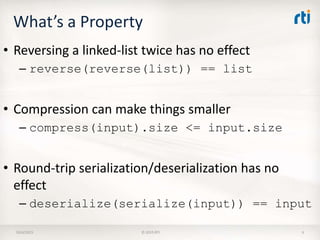
What’s a Property
• Reversing a linked-list twice has no effect
– reverse(reverse(list)) == list
• Compression can make things smaller
– compress(input).size <= input.size
• Round-trip serialization/deserialization has no
effect
– deserialize(serialize(input)) == input
10/4/2015 © 2015 RTI 6
Testing RefleX
• RefleX is short for Reflection for DDS-Xtypes
• Serialization and Deserialization
– Serializes types and data
– Works off of C++ struct/classes directly
• C++11/14
• Link
10/4/2015 © 2015 RTI 7
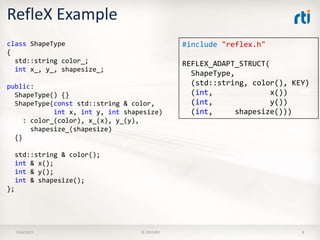
RefleX Example
10/4/2015 © 2015 RTI 8
class ShapeType
{
std::string color_;
int x_, y_, shapesize_;
public:
ShapeType() {}
ShapeType(const std::string & color,
int x, int y, int shapesize)
: color_(color), x_(x), y_(y),
shapesize_(shapesize)
{}
std::string & color();
int & x();
int & y();
int & shapesize();
};
#include "reflex.h"
REFLEX_ADAPT_STRUCT(
ShapeType,
(std::string, color(), KEY)
(int, x())
(int, y())
(int, shapesize()))
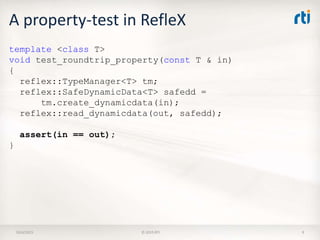
A property-test in RefleX
10/4/2015 © 2015 RTI 9
template <class T>
void test_roundtrip_property(const T & in)
{
reflex::TypeManager<T> tm;
reflex::SafeDynamicData<T> safedd =
tm.create_dynamicdata(in);
reflex::read_dynamicdata(out, safedd);
assert(in == out);
}
Property-based Testing
• Complementary to traditional example-based testing
• Specify post-conditions that must hold no matter
what
• Encourages the programmer to think harder about
the code
• More declarative
• Need data generators to produce inputs
• Free reproducers!
– Good property-based testing frameworks shrink inputs to
minimal automatically
• Famous: Haskell’s QuickCheck, Scala’s ScalaTest
10/4/2015 © 2015 RTI 10
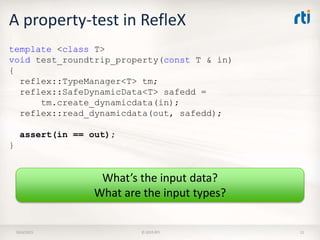
A property-test in RefleX
10/4/2015 © 2015 RTI 11
template <class T>
void test_roundtrip_property(const T & in)
{
reflex::TypeManager<T> tm;
reflex::SafeDynamicData<T> safedd =
tm.create_dynamicdata(in);
reflex::read_dynamicdata(out, safedd);
assert(in == out);
}
What’s the input data?
What are the input types?
10/4/2015 © 2015 RTI 12
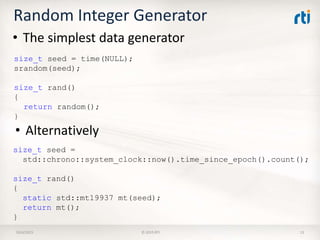
Random Integer Generator
10/4/2015 © 2015 RTI 13
• The simplest data generator
size_t seed = time(NULL);
srandom(seed);
size_t rand()
{
return random();
}
• Alternatively
size_t seed =
std::chrono::system_clock::now().time_since_epoch().count();
size_t rand()
{
static std::mt19937 mt(seed);
return mt();
}
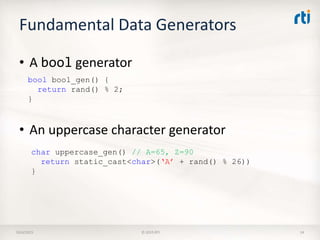
Fundamental Data Generators
10/4/2015 © 2015 RTI 14
• A bool generator
bool bool_gen() {
return rand() % 2;
}
• An uppercase character generator
char uppercase_gen() // A=65, Z=90
return static_cast<char>(‘A’ + rand() % 26))
}
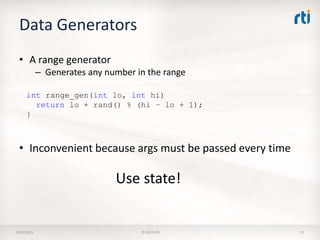
Data Generators
10/4/2015 © 2015 RTI 15
• A range generator
– Generates any number in the range
int range_gen(int lo, int hi)
return lo + rand() % (hi – lo + 1);
}
• Inconvenient because args must be passed every time
Use state!
Closure as generator
10/4/2015 © 2015 RTI 16
• A stateful range generator
– Generates a random number in the given range
auto make_range_gen(int lo, int hi)
return [lo, hi]() {
return lo + rand() % (hi – lo + 1);
}
}
auto r = range_gen(20, 25);
std::cout << r(); // one of 20, 21, 22, 23, 24, 25
Closure as generator
10/4/2015 © 2015 RTI 17
• The oneof generator
template <class T>
auto make_oneof_gen(std::initializer_list<T> list)
{
return [options = std::vector<T>(list)]() {
return *(options.begin() + rand() % options.size());
};
}
auto days = { “Sun”, “Mon”, “Tue”, “Wed”, “Thu”, “Fri”, “Sat” }
auto gen = make_oneof_gen(days);
std::cout << gen(); // one of Sun, Mon, Tue, Wed, Thu, Fri, Sat
10/4/2015 © 2015 RTI 18
“Closures are poor man's
objects; Objects are poor
man's closure”
-- The venerable master Qc Na
Source Google images
Closure vs Object
• Is function/closure a sufficient abstraction for
any generator?
[]() {
return blah;
}
• Answer depends upon your language
– No. In C++
10/4/2015 © 2015 RTI 19
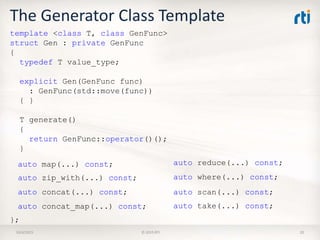
The Generator Class Template
10/4/2015 © 2015 RTI 20
template <class T, class GenFunc>
struct Gen : private GenFunc
{
typedef T value_type;
explicit Gen(GenFunc func)
: GenFunc(std::move(func))
{ }
T generate()
{
return GenFunc::operator()();
}
auto map(...) const;
auto zip_with(...) const;
auto concat(...) const;
auto take(...) const;auto concat_map(...) const;
auto reduce(...) const;
auto where(...) const;
auto scan(...) const;
};
Creating Gen<T> from lambdas
template <class GenFunc>
auto make_gen_from(GenFunc&& func)
{
return Gen<decltype(func()), GenFunc>
(std::forward<GenFunc>(func));
}
template <class Integer>
auto make_range_gen(Integer lo, Integer hi)
{
return make_gen_from([lo, hi]() {
return static_cast<Integer>(lo + rand() % (hi - lo));
});
}
10/4/2015 © 2015 RTI 21
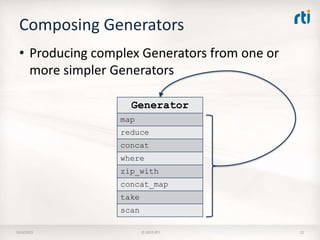
Composing Generators
• Producing complex Generators from one or
more simpler Generators
10/4/2015 © 2015 RTI 22
Generator
map
reduce
concat
where
zip_with
concat_map
take
scan
Mapping over a generator
10/4/2015 © 2015 RTI 23
vector<string> days = { “Sun”, “Mon”, “Tue”, “Wed”,
“Thu”, “Fri”, “Sat” };
auto range_gen = gen::make_range_gen(0,6);
// random numbers in range 0..6
auto day_gen = range_gen.map([&](int i) { return days[i]; });
// random days in range “Sun” to “Sat”
while(true)
std::cout << day_gen.generate();
// random days in range “Sun” to “Sat”
Gen<int>  Gen<string>
f(int  string)
std::function<string(int)>
10/4/2015 © 2015 RTI 24
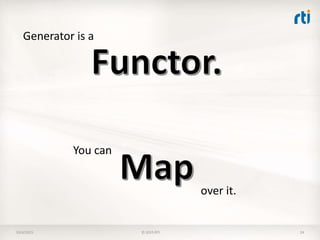
Generator is a
You can
over it.
Functor Laws
• Composition Law
gen.map(f).map(g) == gen.map(g o f)
10/4/2015 © 2015 RTI 25
auto DAY_gen = range_gen
.map([&](int i) { return days[i]; });
.map([](const string & str) {
return std::toupper(str, std::locale());
});
auto DAY_gen = range_gen.map([&](int i) {
return std::to_upper(days[i], std::locale());
});
Functor Laws
• Identity Law
gen.map(a -> a) == gen
10/4/2015 © 2015 RTI 26
auto gen2 == gen.map([](auto a) { return a; });
• Both gen and gen2 will generate the same data
– Their identities are different but they are still the same
Implementing map
template <class T>
template <class Func>
auto Gen<T>::map(Func&& func) const
{
return make_gen_from(
[self = *this,
func = std::forward<Func>(func)]() mutable {
return func(self.generate());
});
}
10/4/2015 © 2015 RTI 27
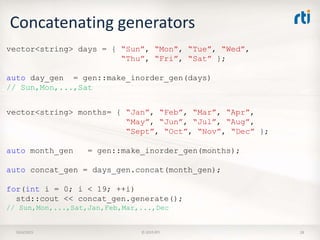
Concatenating generators
10/4/2015 © 2015 RTI 28
vector<string> days = { “Sun”, “Mon”, “Tue”, “Wed”,
“Thu”, “Fri”, “Sat” };
auto day_gen = gen::make_inorder_gen(days)
// Sun,Mon,...,Sat
vector<string> months= { “Jan”, “Feb”, “Mar”, “Apr”,
“May”, “Jun”, “Jul”, “Aug”,
“Sept”, “Oct”, “Nov”, “Dec” };
auto month_gen = gen::make_inorder_gen(months);
auto concat_gen = days_gen.concat(month_gen);
for(int i = 0; i < 19; ++i)
std::cout << concat_gen.generate();
// Sun,Mon,...,Sat,Jan,Feb,Mar,...,Dec
10/4/2015 © 2015 RTI 29
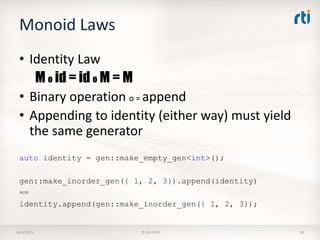
Generator is a
Monoid Laws
• Identity Law
M o id = id o M = M
• Binary operation o = append
• Appending to identity (either way) must yield
the same generator
10/4/2015 © 2015 RTI 30
auto identity = gen::make_empty_gen<int>();
gen::make_inorder_gen({ 1, 2, 3}).append(identity)
==
identity.append(gen::make_inorder_gen({ 1, 2, 3});
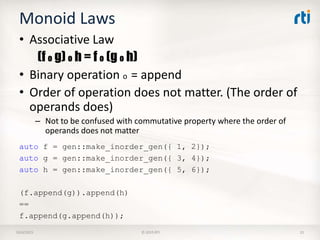
Monoid Laws
• Associative Law
(f o g) o h = f o (g o h)
• Binary operation o = append
• Order of operation does not matter. (The order of
operands does)
– Not to be confused with commutative property where the order of
operands does not matter
10/4/2015 © 2015 RTI 31
auto f = gen::make_inorder_gen({ 1, 2});
auto g = gen::make_inorder_gen({ 3, 4});
auto h = gen::make_inorder_gen({ 5, 6});
(f.append(g)).append(h)
==
f.append(g.append(h));
Generator Identity make_empty_gen
template <class T>
auto make_empty_gen()
{
return make_gen_from([]() {
throw std::out_of_range("empty generator!");
return std::declval<T>();
});
}
10/4/2015 © 2015 RTI 32
Zipping Generators
10/4/2015 © 2015 RTI 33
auto x_gen = gen::make_stepper_gen(0,100);
auto y_gen = gen::make_stepper_gen(0,200,2);
auto point_gen =
x_gen.zip_with([](int x, int y)
return std::make_pair(x, y);
}, y_gen);
for(auto _: { 1,2,3 })
std::cout << point_gen.generate(); // {0,0}, {1,2}, {3,4}
end
Implementing zip_with
template <class T>
template <class Zipper, class... GenList>
auto Gen<T>::zip_with(Zipper&& func, GenList&&... genlist) const
{
return make_gen_from(
[self = *this,
genlist...,
func = std::forward<Zipper>(func)]() mutable {
return func(self.generate(), genlist.generate()...);
});
}
10/4/2015 © 2015 RTI 34
10/4/2015 © 2015 RTI 35
Generator is a
Dependent Generators (concat_map)
auto triangle_gen =
gen::make_inorder_gen({1,2,3,4,5,4,3,2,1})
.concat_map([](int i) {
std::cout << "n";
return gen::make_stepper_gen(1, i);
});
try {
while(true)
std::cout << triangle_gen.generate();
}
catch(std::out_of_range &) {
}
10/4/2015 © 2015 RTI 36
1
12
123
1234
12345
1234
123
12
1
Monad Laws
auto f = [](int i) { return gen::make_stepper_gen(1, i); };
auto g = [](int i) { return gen::make_stepper_gen(i, 1, -1); };
auto M = gen::make_single_gen(300);
// left identity
is_same(M.concat_map(f), f(300));
// right identity
is_same(M.concat_map([](int i) {
return gen::make_single_gen(i);
}), M);
// associativity
is_same(M.concat_map(f).concat_map(g),
M.concat_map([f,g](int i) mutable {
return f(i).concat_map(g);
}));
10/4/2015 © 2015 RTI 37
10/4/2015 © 2015 RTI 38
The Mathematics of the Generator API
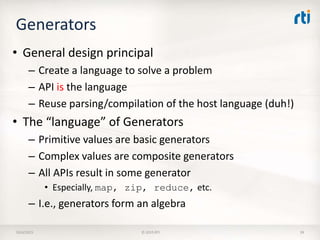
Generators
• General design principal
– Create a language to solve a problem
– API is the language
– Reuse parsing/compilation of the host language (duh!)
• The “language” of Generators
– Primitive values are basic generators
– Complex values are composite generators
– All APIs result in some generator
• Especially, map, zip, reduce, etc.
– I.e., generators form an algebra
10/4/2015 © 2015 RTI 39
Algebra
A first-class abstraction
+
Compositional* API
10/4/2015 © 2015 RTI 40
*Composition based on mathematical concepts
10/4/2015 © 2015 RTI 41
What Math Concepts?
• Algebraic Structures from Category Theory
–Monoid
–Functor
–Monad
–Applicative
• Where to begin?
–Haskell
–But innocent should start with Scala perhaps
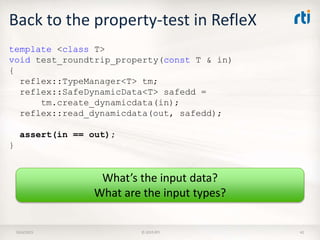
Back to the property-test in RefleX
10/4/2015 © 2015 RTI 42
template <class T>
void test_roundtrip_property(const T & in)
{
reflex::TypeManager<T> tm;
reflex::SafeDynamicData<T> safedd =
tm.create_dynamicdata(in);
reflex::read_dynamicdata(out, safedd);
assert(in == out);
}
What’s the input data?
What are the input types?
10/4/2015 © 2015 RTI 43
if we can generate
we can generate
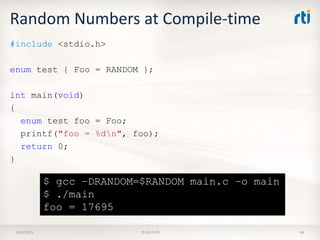
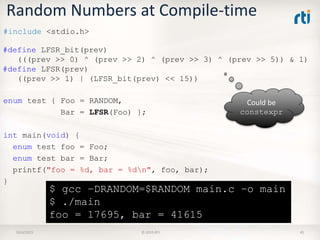
Random Numbers at Compile-time
#include <stdio.h>
enum test { Foo = RANDOM };
int main(void)
{
enum test foo = Foo;
printf("foo = %dn", foo);
return 0;
}
10/4/2015 © 2015 RTI 44
$ gcc –DRANDOM=$RANDOM main.c –o main
$ ./main
foo = 17695
Random Numbers at Compile-time
#include <stdio.h>
enum test { Foo = RANDOM,
Bar = LFSR(Foo) };
int main(void) {
enum test foo = Foo;
enum test bar = Bar;
printf("foo = %d, bar = %dn", foo, bar);
}
10/4/2015 © 2015 RTI 45
#define LFSR_bit(prev)
(((prev >> 0) ^ (prev >> 2) ^ (prev >> 3) ^ (prev >> 5)) & 1)
#define LFSR(prev)
((prev >> 1) | (LFSR_bit(prev) << 15))
$ gcc –DRANDOM=$RANDOM main.c –o main
$ ./main
foo = 17695, bar = 41615
Could be
constexpr
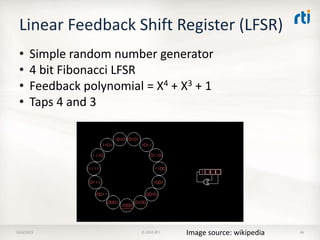
Linear Feedback Shift Register (LFSR)
• Simple random number generator
• 4 bit Fibonacci LFSR
• Feedback polynomial = X4 + X3 + 1
• Taps 4 and 3
10/4/2015 © 2015 RTI 46Image source: wikipedia
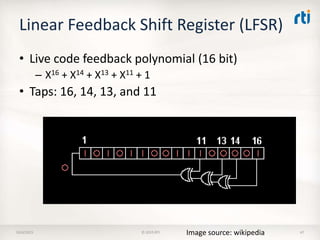
Linear Feedback Shift Register (LFSR)
• Live code feedback polynomial (16 bit)
– X16 + X14 + X13 + X11 + 1
• Taps: 16, 14, 13, and 11
10/4/2015 © 2015 RTI 47Image source: wikipedia
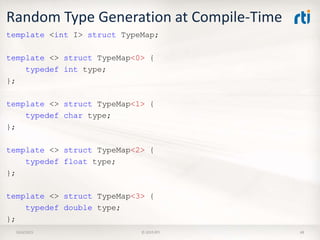
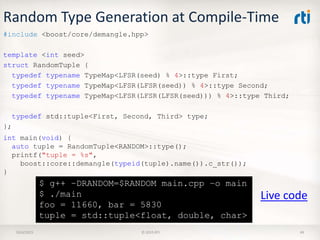
Random Type Generation at Compile-Time
template <int I> struct TypeMap;
template <> struct TypeMap<0> {
typedef int type;
};
template <> struct TypeMap<1> {
typedef char type;
};
template <> struct TypeMap<2> {
typedef float type;
};
template <> struct TypeMap<3> {
typedef double type;
};
10/4/2015 © 2015 RTI 48
Random Type Generation at Compile-Time
#include <boost/core/demangle.hpp>
template <int seed>
struct RandomTuple {
typedef typename TypeMap<LFSR(seed) % 4>::type First;
typedef typename TypeMap<LFSR(LFSR(seed)) % 4>::type Second;
typedef typename TypeMap<LFSR(LFSR(LFSR(seed))) % 4>::type Third;
typedef std::tuple<First, Second, Third> type;
};
10/4/2015 © 2015 RTI 49
$ g++ –DRANDOM=$RANDOM main.cpp –o main
$ ./main
foo = 11660, bar = 5830
tuple = std::tuple<float, double, char>
int main(void) {
auto tuple = RandomTuple<RANDOM>::type();
printf("tuple = %s",
boost::core::demangle(typeid(tuple).name()).c_str());
}
Live code
Tuple Value Generator (zip)
template <class... Args>
struct GenFactory<std::tuple<Args...>>
{
static auto make()
{
return make_zip_gen([](auto&&... args) {
return std::make_tuple(std::forward<decltype(args)>(args)...);
},
GenFactory<Args>::make()...);
}
};
int main(void) {
auto tuple_gen = GenFactory<RandomTuple<RANDOM>::type>::make();
auto tuple = tuple_gen.generate();
}
10/4/2015 © 2015 RTI 50
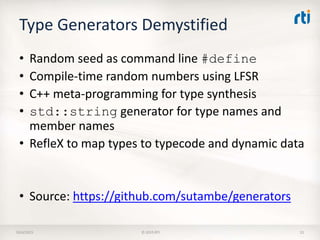
Type Generators Demystified
• Random seed as command line #define
• Compile-time random numbers using LFSR
• C++ meta-programming for type synthesis
• std::string generator for type names and
member names
• RefleX to map types to typecode and dynamic data
• Source: https://github.com/sutambe/generators
10/4/2015 © 2015 RTI 51
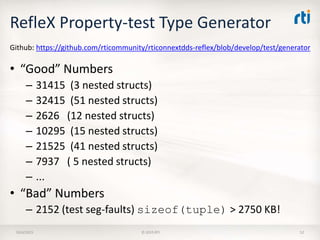
RefleX Property-test Type Generator
• “Good” Numbers
– 31415 (3 nested structs)
– 32415 (51 nested structs)
– 2626 (12 nested structs)
– 10295 (15 nested structs)
– 21525 (41 nested structs)
– 7937 ( 5 nested structs)
– ...
• “Bad” Numbers
– 2152 (test seg-faults) sizeof(tuple) > 2750 KB!
10/4/2015 © 2015 RTI 52
Github: https://github.com/rticommunity/rticonnextdds-reflex/blob/develop/test/generator
10/4/2015 © 2015 RTI 53
Thank You!

C++ Generators and Property-based Testing

  • 1.
    Your systems. Workingas one. Sumant Tambe, PhD Principal Research Engineer and Microsoft VC++ MVP Real-Time Innovations, Inc. @sutambe Oct. 3, 2015
  • 2.
    10/4/2015 © 2015RTI 2 LEESA 2008 Rx4DDS 2014 RefleX 2015 Alternative Title
  • 3.
    10/4/2015 © 2015RTI 3 Author Blogger Open-Source LEESA (C++) Rx4DDS (C++11, C#, JavaScript) (C++11)
  • 4.
    Why should youcare? • If you write software for living and if you are serious about any of the following – Bug-free, Expressive code – Productivity • Modularity • Reusability • Extensibility • Maintainability – Performance/latency • Multi-core scalability – and having fun while doing that! 10/4/2015 © 2015 RTI 4
  • 5.
    Agenda • Property-based Testing •The need for composable generators • Design/Implementation of the generator library • Mathematics of API design – Functor, Monoid, and Monad • Generators at compile-time (type generators) 10/4/2015 © 2015 RTI 5
  • 6.
    What’s a Property •Reversing a linked-list twice has no effect – reverse(reverse(list)) == list • Compression can make things smaller – compress(input).size <= input.size • Round-trip serialization/deserialization has no effect – deserialize(serialize(input)) == input 10/4/2015 © 2015 RTI 6
  • 7.
    Testing RefleX • RefleXis short for Reflection for DDS-Xtypes • Serialization and Deserialization – Serializes types and data – Works off of C++ struct/classes directly • C++11/14 • Link 10/4/2015 © 2015 RTI 7
  • 8.
    RefleX Example 10/4/2015 ©2015 RTI 8 class ShapeType { std::string color_; int x_, y_, shapesize_; public: ShapeType() {} ShapeType(const std::string & color, int x, int y, int shapesize) : color_(color), x_(x), y_(y), shapesize_(shapesize) {} std::string & color(); int & x(); int & y(); int & shapesize(); }; #include "reflex.h" REFLEX_ADAPT_STRUCT( ShapeType, (std::string, color(), KEY) (int, x()) (int, y()) (int, shapesize()))
  • 9.
    A property-test inRefleX 10/4/2015 © 2015 RTI 9 template <class T> void test_roundtrip_property(const T & in) { reflex::TypeManager<T> tm; reflex::SafeDynamicData<T> safedd = tm.create_dynamicdata(in); reflex::read_dynamicdata(out, safedd); assert(in == out); }
  • 10.
    Property-based Testing • Complementaryto traditional example-based testing • Specify post-conditions that must hold no matter what • Encourages the programmer to think harder about the code • More declarative • Need data generators to produce inputs • Free reproducers! – Good property-based testing frameworks shrink inputs to minimal automatically • Famous: Haskell’s QuickCheck, Scala’s ScalaTest 10/4/2015 © 2015 RTI 10
  • 11.
    A property-test inRefleX 10/4/2015 © 2015 RTI 11 template <class T> void test_roundtrip_property(const T & in) { reflex::TypeManager<T> tm; reflex::SafeDynamicData<T> safedd = tm.create_dynamicdata(in); reflex::read_dynamicdata(out, safedd); assert(in == out); } What’s the input data? What are the input types?
  • 12.
  • 13.
    Random Integer Generator 10/4/2015© 2015 RTI 13 • The simplest data generator size_t seed = time(NULL); srandom(seed); size_t rand() { return random(); } • Alternatively size_t seed = std::chrono::system_clock::now().time_since_epoch().count(); size_t rand() { static std::mt19937 mt(seed); return mt(); }
  • 14.
    Fundamental Data Generators 10/4/2015© 2015 RTI 14 • A bool generator bool bool_gen() { return rand() % 2; } • An uppercase character generator char uppercase_gen() // A=65, Z=90 return static_cast<char>(‘A’ + rand() % 26)) }
  • 15.
    Data Generators 10/4/2015 ©2015 RTI 15 • A range generator – Generates any number in the range int range_gen(int lo, int hi) return lo + rand() % (hi – lo + 1); } • Inconvenient because args must be passed every time Use state!
  • 16.
    Closure as generator 10/4/2015© 2015 RTI 16 • A stateful range generator – Generates a random number in the given range auto make_range_gen(int lo, int hi) return [lo, hi]() { return lo + rand() % (hi – lo + 1); } } auto r = range_gen(20, 25); std::cout << r(); // one of 20, 21, 22, 23, 24, 25
  • 17.
    Closure as generator 10/4/2015© 2015 RTI 17 • The oneof generator template <class T> auto make_oneof_gen(std::initializer_list<T> list) { return [options = std::vector<T>(list)]() { return *(options.begin() + rand() % options.size()); }; } auto days = { “Sun”, “Mon”, “Tue”, “Wed”, “Thu”, “Fri”, “Sat” } auto gen = make_oneof_gen(days); std::cout << gen(); // one of Sun, Mon, Tue, Wed, Thu, Fri, Sat
  • 18.
    10/4/2015 © 2015RTI 18 “Closures are poor man's objects; Objects are poor man's closure” -- The venerable master Qc Na Source Google images
  • 19.
    Closure vs Object •Is function/closure a sufficient abstraction for any generator? []() { return blah; } • Answer depends upon your language – No. In C++ 10/4/2015 © 2015 RTI 19
  • 20.
    The Generator ClassTemplate 10/4/2015 © 2015 RTI 20 template <class T, class GenFunc> struct Gen : private GenFunc { typedef T value_type; explicit Gen(GenFunc func) : GenFunc(std::move(func)) { } T generate() { return GenFunc::operator()(); } auto map(...) const; auto zip_with(...) const; auto concat(...) const; auto take(...) const;auto concat_map(...) const; auto reduce(...) const; auto where(...) const; auto scan(...) const; };
  • 21.
    Creating Gen<T> fromlambdas template <class GenFunc> auto make_gen_from(GenFunc&& func) { return Gen<decltype(func()), GenFunc> (std::forward<GenFunc>(func)); } template <class Integer> auto make_range_gen(Integer lo, Integer hi) { return make_gen_from([lo, hi]() { return static_cast<Integer>(lo + rand() % (hi - lo)); }); } 10/4/2015 © 2015 RTI 21
  • 22.
    Composing Generators • Producingcomplex Generators from one or more simpler Generators 10/4/2015 © 2015 RTI 22 Generator map reduce concat where zip_with concat_map take scan
  • 23.
    Mapping over agenerator 10/4/2015 © 2015 RTI 23 vector<string> days = { “Sun”, “Mon”, “Tue”, “Wed”, “Thu”, “Fri”, “Sat” }; auto range_gen = gen::make_range_gen(0,6); // random numbers in range 0..6 auto day_gen = range_gen.map([&](int i) { return days[i]; }); // random days in range “Sun” to “Sat” while(true) std::cout << day_gen.generate(); // random days in range “Sun” to “Sat” Gen<int>  Gen<string> f(int  string) std::function<string(int)>
  • 24.
    10/4/2015 © 2015RTI 24 Generator is a You can over it.
  • 25.
    Functor Laws • CompositionLaw gen.map(f).map(g) == gen.map(g o f) 10/4/2015 © 2015 RTI 25 auto DAY_gen = range_gen .map([&](int i) { return days[i]; }); .map([](const string & str) { return std::toupper(str, std::locale()); }); auto DAY_gen = range_gen.map([&](int i) { return std::to_upper(days[i], std::locale()); });
  • 26.
    Functor Laws • IdentityLaw gen.map(a -> a) == gen 10/4/2015 © 2015 RTI 26 auto gen2 == gen.map([](auto a) { return a; }); • Both gen and gen2 will generate the same data – Their identities are different but they are still the same
  • 27.
    Implementing map template <classT> template <class Func> auto Gen<T>::map(Func&& func) const { return make_gen_from( [self = *this, func = std::forward<Func>(func)]() mutable { return func(self.generate()); }); } 10/4/2015 © 2015 RTI 27
  • 28.
    Concatenating generators 10/4/2015 ©2015 RTI 28 vector<string> days = { “Sun”, “Mon”, “Tue”, “Wed”, “Thu”, “Fri”, “Sat” }; auto day_gen = gen::make_inorder_gen(days) // Sun,Mon,...,Sat vector<string> months= { “Jan”, “Feb”, “Mar”, “Apr”, “May”, “Jun”, “Jul”, “Aug”, “Sept”, “Oct”, “Nov”, “Dec” }; auto month_gen = gen::make_inorder_gen(months); auto concat_gen = days_gen.concat(month_gen); for(int i = 0; i < 19; ++i) std::cout << concat_gen.generate(); // Sun,Mon,...,Sat,Jan,Feb,Mar,...,Dec
  • 29.
    10/4/2015 © 2015RTI 29 Generator is a
  • 30.
    Monoid Laws • IdentityLaw M o id = id o M = M • Binary operation o = append • Appending to identity (either way) must yield the same generator 10/4/2015 © 2015 RTI 30 auto identity = gen::make_empty_gen<int>(); gen::make_inorder_gen({ 1, 2, 3}).append(identity) == identity.append(gen::make_inorder_gen({ 1, 2, 3});
  • 31.
    Monoid Laws • AssociativeLaw (f o g) o h = f o (g o h) • Binary operation o = append • Order of operation does not matter. (The order of operands does) – Not to be confused with commutative property where the order of operands does not matter 10/4/2015 © 2015 RTI 31 auto f = gen::make_inorder_gen({ 1, 2}); auto g = gen::make_inorder_gen({ 3, 4}); auto h = gen::make_inorder_gen({ 5, 6}); (f.append(g)).append(h) == f.append(g.append(h));
  • 32.
    Generator Identity make_empty_gen template<class T> auto make_empty_gen() { return make_gen_from([]() { throw std::out_of_range("empty generator!"); return std::declval<T>(); }); } 10/4/2015 © 2015 RTI 32
  • 33.
    Zipping Generators 10/4/2015 ©2015 RTI 33 auto x_gen = gen::make_stepper_gen(0,100); auto y_gen = gen::make_stepper_gen(0,200,2); auto point_gen = x_gen.zip_with([](int x, int y) return std::make_pair(x, y); }, y_gen); for(auto _: { 1,2,3 }) std::cout << point_gen.generate(); // {0,0}, {1,2}, {3,4} end
  • 34.
    Implementing zip_with template <classT> template <class Zipper, class... GenList> auto Gen<T>::zip_with(Zipper&& func, GenList&&... genlist) const { return make_gen_from( [self = *this, genlist..., func = std::forward<Zipper>(func)]() mutable { return func(self.generate(), genlist.generate()...); }); } 10/4/2015 © 2015 RTI 34
  • 35.
    10/4/2015 © 2015RTI 35 Generator is a
  • 36.
    Dependent Generators (concat_map) autotriangle_gen = gen::make_inorder_gen({1,2,3,4,5,4,3,2,1}) .concat_map([](int i) { std::cout << "n"; return gen::make_stepper_gen(1, i); }); try { while(true) std::cout << triangle_gen.generate(); } catch(std::out_of_range &) { } 10/4/2015 © 2015 RTI 36 1 12 123 1234 12345 1234 123 12 1
  • 37.
    Monad Laws auto f= [](int i) { return gen::make_stepper_gen(1, i); }; auto g = [](int i) { return gen::make_stepper_gen(i, 1, -1); }; auto M = gen::make_single_gen(300); // left identity is_same(M.concat_map(f), f(300)); // right identity is_same(M.concat_map([](int i) { return gen::make_single_gen(i); }), M); // associativity is_same(M.concat_map(f).concat_map(g), M.concat_map([f,g](int i) mutable { return f(i).concat_map(g); })); 10/4/2015 © 2015 RTI 37
  • 38.
    10/4/2015 © 2015RTI 38 The Mathematics of the Generator API
  • 39.
    Generators • General designprincipal – Create a language to solve a problem – API is the language – Reuse parsing/compilation of the host language (duh!) • The “language” of Generators – Primitive values are basic generators – Complex values are composite generators – All APIs result in some generator • Especially, map, zip, reduce, etc. – I.e., generators form an algebra 10/4/2015 © 2015 RTI 39
  • 40.
    Algebra A first-class abstraction + Compositional*API 10/4/2015 © 2015 RTI 40 *Composition based on mathematical concepts
  • 41.
    10/4/2015 © 2015RTI 41 What Math Concepts? • Algebraic Structures from Category Theory –Monoid –Functor –Monad –Applicative • Where to begin? –Haskell –But innocent should start with Scala perhaps
  • 42.
    Back to theproperty-test in RefleX 10/4/2015 © 2015 RTI 42 template <class T> void test_roundtrip_property(const T & in) { reflex::TypeManager<T> tm; reflex::SafeDynamicData<T> safedd = tm.create_dynamicdata(in); reflex::read_dynamicdata(out, safedd); assert(in == out); } What’s the input data? What are the input types?
  • 43.
    10/4/2015 © 2015RTI 43 if we can generate we can generate
  • 44.
    Random Numbers atCompile-time #include <stdio.h> enum test { Foo = RANDOM }; int main(void) { enum test foo = Foo; printf("foo = %dn", foo); return 0; } 10/4/2015 © 2015 RTI 44 $ gcc –DRANDOM=$RANDOM main.c –o main $ ./main foo = 17695
  • 45.
    Random Numbers atCompile-time #include <stdio.h> enum test { Foo = RANDOM, Bar = LFSR(Foo) }; int main(void) { enum test foo = Foo; enum test bar = Bar; printf("foo = %d, bar = %dn", foo, bar); } 10/4/2015 © 2015 RTI 45 #define LFSR_bit(prev) (((prev >> 0) ^ (prev >> 2) ^ (prev >> 3) ^ (prev >> 5)) & 1) #define LFSR(prev) ((prev >> 1) | (LFSR_bit(prev) << 15)) $ gcc –DRANDOM=$RANDOM main.c –o main $ ./main foo = 17695, bar = 41615 Could be constexpr
  • 46.
    Linear Feedback ShiftRegister (LFSR) • Simple random number generator • 4 bit Fibonacci LFSR • Feedback polynomial = X4 + X3 + 1 • Taps 4 and 3 10/4/2015 © 2015 RTI 46Image source: wikipedia
  • 47.
    Linear Feedback ShiftRegister (LFSR) • Live code feedback polynomial (16 bit) – X16 + X14 + X13 + X11 + 1 • Taps: 16, 14, 13, and 11 10/4/2015 © 2015 RTI 47Image source: wikipedia
  • 48.
    Random Type Generationat Compile-Time template <int I> struct TypeMap; template <> struct TypeMap<0> { typedef int type; }; template <> struct TypeMap<1> { typedef char type; }; template <> struct TypeMap<2> { typedef float type; }; template <> struct TypeMap<3> { typedef double type; }; 10/4/2015 © 2015 RTI 48
  • 49.
    Random Type Generationat Compile-Time #include <boost/core/demangle.hpp> template <int seed> struct RandomTuple { typedef typename TypeMap<LFSR(seed) % 4>::type First; typedef typename TypeMap<LFSR(LFSR(seed)) % 4>::type Second; typedef typename TypeMap<LFSR(LFSR(LFSR(seed))) % 4>::type Third; typedef std::tuple<First, Second, Third> type; }; 10/4/2015 © 2015 RTI 49 $ g++ –DRANDOM=$RANDOM main.cpp –o main $ ./main foo = 11660, bar = 5830 tuple = std::tuple<float, double, char> int main(void) { auto tuple = RandomTuple<RANDOM>::type(); printf("tuple = %s", boost::core::demangle(typeid(tuple).name()).c_str()); } Live code
  • 50.
    Tuple Value Generator(zip) template <class... Args> struct GenFactory<std::tuple<Args...>> { static auto make() { return make_zip_gen([](auto&&... args) { return std::make_tuple(std::forward<decltype(args)>(args)...); }, GenFactory<Args>::make()...); } }; int main(void) { auto tuple_gen = GenFactory<RandomTuple<RANDOM>::type>::make(); auto tuple = tuple_gen.generate(); } 10/4/2015 © 2015 RTI 50
  • 51.
    Type Generators Demystified •Random seed as command line #define • Compile-time random numbers using LFSR • C++ meta-programming for type synthesis • std::string generator for type names and member names • RefleX to map types to typecode and dynamic data • Source: https://github.com/sutambe/generators 10/4/2015 © 2015 RTI 51
  • 52.
    RefleX Property-test TypeGenerator • “Good” Numbers – 31415 (3 nested structs) – 32415 (51 nested structs) – 2626 (12 nested structs) – 10295 (15 nested structs) – 21525 (41 nested structs) – 7937 ( 5 nested structs) – ... • “Bad” Numbers – 2152 (test seg-faults) sizeof(tuple) > 2750 KB! 10/4/2015 © 2015 RTI 52 Github: https://github.com/rticommunity/rticonnextdds-reflex/blob/develop/test/generator
  • 53.
    10/4/2015 © 2015RTI 53 Thank You!

Editor's Notes

  • #7 Incompressible strings of every length exist.