Undefined behaviour in
the Standard Template
Library
Sandor DARGO
16th June 2020
C++ On Sea
@SandorDargo
2
Who Am I?
Sándor DARGÓ
Software developer in Amadeus
Enthusiastic blogger http://sandordargo.com
Passionate traveller
Curious home baker
Happy father of two
@SandorDargo
Agenda
Vocabulary
Reasons of undefined behaviour (in the STL)
Types of UB in the STL
Countermeasures
Let’s agree on a
common vocabulary!
@SandorDargo
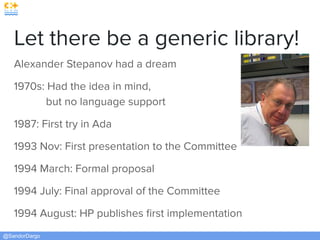
Let there be a generic library!
Alexander Stepanov had a dream
1970s: Had the idea in mind,
but no language support
1987: First try in Ada
1993 Nov: First presentation to the Committee
1994 March: Formal proposal
1994 July: Final approval of the Committee
1994 August: HP publishes first implementation
@SandorDargo
What is included in the STL?
There is no such “library” as the STL
Set of template classes and functions to provide solution for
common problems
Algorithms (std::rotate, std::find_if)
Containers (std::vector<T>, std::list<T>)
Function objects (std::greater<T>, std::logical_and<T>)
Iterators (std::iterator, std::back_inserter)
@SandorDargo
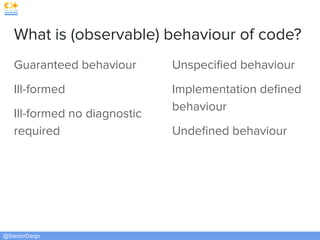
What is (observable) behaviour of code?
Guaranteed behaviour
Ill-formed
Ill-formed no diagnostic
required
Unspecified behaviour
Implementation defined
behaviour
Undefined behaviour
@SandorDargo
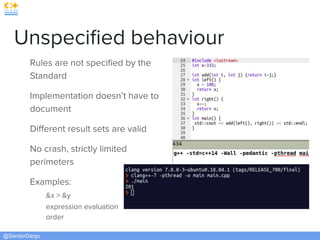
Unspecified behaviour
Rules are not specified by the
Standard
Implementation doesn’t have to
document
Different result sets are valid
No crash, strictly limited
perimeters
Examples:
&x > &y
expression evaluation
order
@SandorDargo
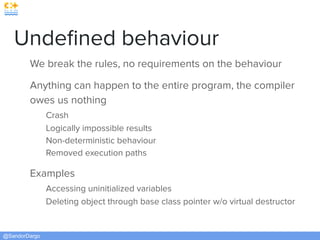
Implementation defined behaviour
Like unspecified behaviour
But implementation must document the result
Examples:
Default integer types
Number of bits in a byte
ORDER BY on NULLs
@SandorDargo
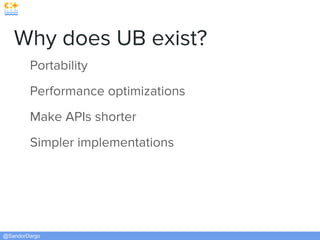
Undefined behaviour
We break the rules, no requirements on the behaviour
Anything can happen to the entire program, the compiler
owes us nothing
Crash
Logically impossible results
Non-deterministic behaviour
Removed execution paths
Examples
Accessing uninitialized variables
Deleting object through base class pointer w/o virtual destructor
@SandorDargo
Why does UB exist?
Portability
Performance optimizations
Make APIs shorter
Simpler implementations
@SandorDargo
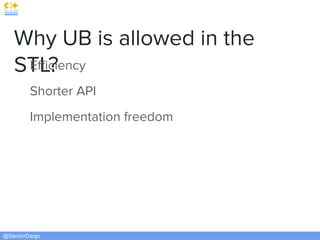
Why UB is allowed in the
STL?Efficiency
Shorter API
Implementation freedom
@SandorDargo
Types of UBs in the STL
Pointing beyond the limits of a container
Inconsistent iterators
Unsorted data
And the others
Beyond the limits
@SandorDargo
operator[] vs at()
Pay for what you use
No bound checks vs throwing
exception
Potentially significant
performance overhead (250%) if
not optimized
Both O(1) Complexity
Don’t rely on optimizations,
choose what you need, but at()
is rarely needed
@SandorDargo
front()/back() et al.
Getting an item from an empty container is UB
back()
front()
pop_back()
pop_front()
Possible outcomes:
Segmentation fault
Double free
Random value
@SandorDargo
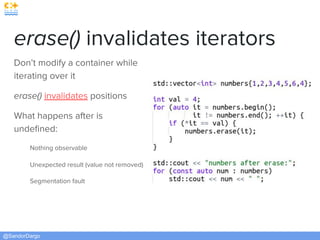
erase() invalidates iterators
Don’t modify a container while
iterating over it
erase() invalidates positions
What happens after is
undefined:
Nothing observable
Unexpected result (value not removed)
Segmentation fault
Inconsistent iterators
@SandorDargo
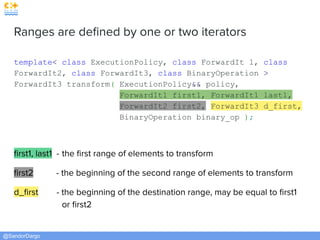
Ranges are defined by one or two iterators
template< class ExecutionPolicy, class ForwardIt 1, class
ForwardIt2, class ForwardIt3, class BinaryOperation >
ForwardIt3 transform( ExecutionPolicy&& policy,
ForwardIt1 first1, ForwardIt1 last1,
ForwardIt2 first2, ForwardIt3 d_first,
BinaryOperation binary_op );
first1, last1 - the first range of elements to transform
first2 - the beginning of the second range of elements to transform
d_first - the beginning of the destination range, may be equal to first1
or first2
@SandorDargo
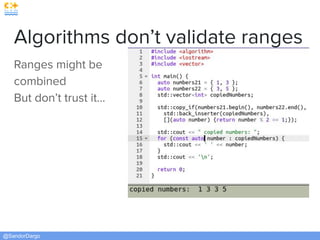
Algorithms don’t validate ranges
Ranges might be
combined
But don’t trust it...
@SandorDargo
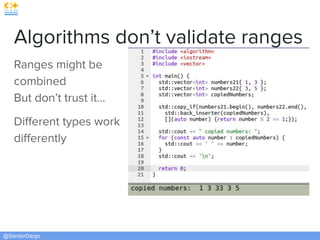
Algorithms don’t validate ranges
Ranges might be
combined
But don’t trust it...
Different types work
differently
@SandorDargo
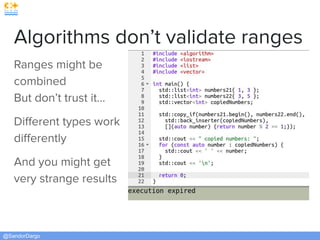
Algorithms don’t validate ranges
Ranges might be
combined
But don’t trust it...
Different types work
differently
And you might get
very strange results
@SandorDargo
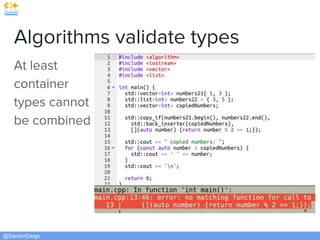
Algorithms validate types
At least
container
types cannot
be combined
@SandorDargo
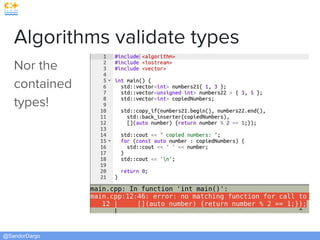
Algorithms validate types
Nor the
contained
types!
@SandorDargo
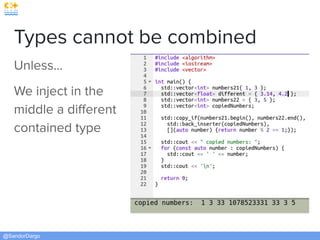
Types cannot be combined
Unless…
We inject in the
middle a different
contained type
@SandorDargo
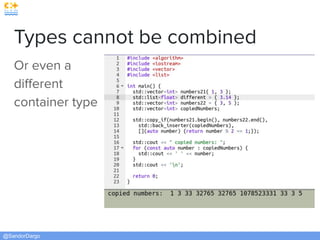
Types cannot be combined
Or even a
different
container type
@SandorDargo
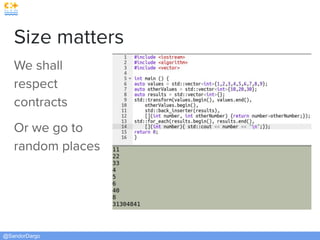
Size matters
We shall
respect
contracts
Or we go to
random places
@SandorDargo
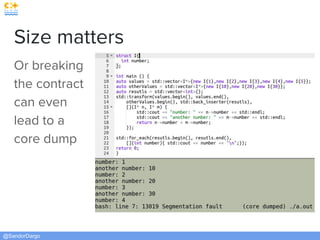
Size matters
Or breaking
the contract
can even
lead to a
core dump
@SandorDargo
What’s going on?
Container overhead is on
the stack and data is on the
heap
Iterators are just advanced
by one
STACK
myVector
begin()
end()
end_capacity()
...
HEAP
myVector[0]
myVector[1]
...
myVector[n]
...
mV.end_capacity()
...
@SandorDargo
What’s going on?
Container overhead is on
the stack and data is on the
heap
Iterators are just advanced
by one
Sometimes to the next
container
Sometimes to uncharted
territories
STACK
myVector
begin()
end()
end_capacity()
myOtherVector
HEAP
myVector[0]
myVector[1]
...
myVector[n]
...
mV.end_capacity()
myOtherVector[0]
myOtherVector[1]
...
@SandorDargo
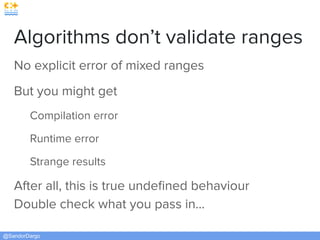
Algorithms don’t validate ranges
No explicit error of mixed ranges
But you might get
Compilation error
Runtime error
Strange results
After all, this is true undefined behaviour
Double check what you pass in...
Unsorted data
@SandorDargo
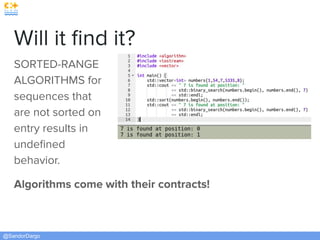
Will it find it?
SORTED-RANGE
ALGORITHMS for
sequences that
are not sorted on
entry results in
undefined
behavior.
Algorithms come with their contracts!
@SandorDargo
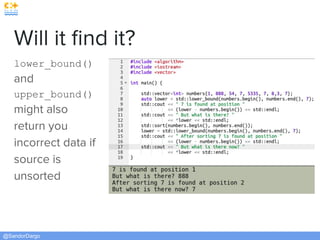
Will it find it?
lower_bound()
and
upper_bound()
might also
return you
incorrect data if
source is
unsorted
@SandorDargo
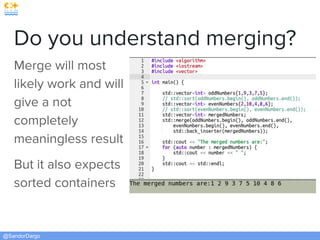
Do you understand merging?
Merge will most
likely work and will
give a not
completely
meaningless result
But it also expects
sorted containers
@SandorDargo
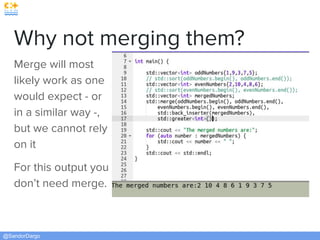
Why not merging them?
Merge will most
likely work as one
would expect - or
in a similar way -,
but we cannot rely
on it
For this output you
don’t need merge.
Others
@SandorDargo
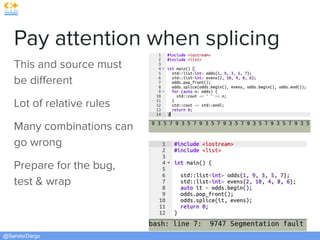
Pay attention when splicing
This and source must
be different
Lot of relative rules
Many combinations can
go wrong
Prepare for the bug,
test & wrap
@SandorDargo
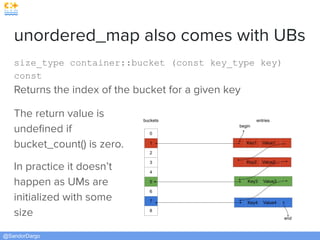
unordered_map also comes with UBs
size_type container::bucket (const key_type key)
const
Returns the index of the bucket for a given key
The return value is
undefined if
bucket_count() is zero.
In practice it doesn’t
happen as UMs are
initialized with some
size
@SandorDargo
bucket_size is similar to operator[]
Returns the
number of
elements in the
bucket with index
bucketIdx.
If bucketIdx is not
valid, the effect is
undefined.
What can we do?
@SandorDargo
What shall we do?
Try-catch blocks?
No, there are no exceptions…
Explicit checks?
Cannot protect against typos
Reimplement the STL
Sometimes maybe…
@SandorDargo
Automate and Educate
Listen to the compiler (-Wall -Wextra -Wpedantic)
Use a sanitizer (g++/clang)
Follow coding/naming guidelines
Understand the concepts
Practice contractual programming
Share knowledge
Knowledge Sharing sessions
Code reviews
@SandorDargo
Conclusion
The STL is “full of” UB by design
Respect the contracts
Automation and education is key
Undefined behaviour in
the Standard Template
Library
Sandor DARGO
16th June 2020
C++ On Sea

Undefined behaviour in the standard template library

  • 1.
    Undefined behaviour in theStandard Template Library Sandor DARGO 16th June 2020 C++ On Sea
  • 2.
    @SandorDargo 2 Who Am I? SándorDARGÓ Software developer in Amadeus Enthusiastic blogger http://sandordargo.com Passionate traveller Curious home baker Happy father of two
  • 3.
    @SandorDargo Agenda Vocabulary Reasons of undefinedbehaviour (in the STL) Types of UB in the STL Countermeasures
  • 4.
    Let’s agree ona common vocabulary!
  • 5.
    @SandorDargo Let there bea generic library! Alexander Stepanov had a dream 1970s: Had the idea in mind, but no language support 1987: First try in Ada 1993 Nov: First presentation to the Committee 1994 March: Formal proposal 1994 July: Final approval of the Committee 1994 August: HP publishes first implementation
  • 6.
    @SandorDargo What is includedin the STL? There is no such “library” as the STL Set of template classes and functions to provide solution for common problems Algorithms (std::rotate, std::find_if) Containers (std::vector<T>, std::list<T>) Function objects (std::greater<T>, std::logical_and<T>) Iterators (std::iterator, std::back_inserter)
  • 7.
    @SandorDargo What is (observable)behaviour of code? Guaranteed behaviour Ill-formed Ill-formed no diagnostic required Unspecified behaviour Implementation defined behaviour Undefined behaviour
  • 8.
    @SandorDargo Unspecified behaviour Rules arenot specified by the Standard Implementation doesn’t have to document Different result sets are valid No crash, strictly limited perimeters Examples: &x > &y expression evaluation order
  • 9.
    @SandorDargo Implementation defined behaviour Likeunspecified behaviour But implementation must document the result Examples: Default integer types Number of bits in a byte ORDER BY on NULLs
  • 10.
    @SandorDargo Undefined behaviour We breakthe rules, no requirements on the behaviour Anything can happen to the entire program, the compiler owes us nothing Crash Logically impossible results Non-deterministic behaviour Removed execution paths Examples Accessing uninitialized variables Deleting object through base class pointer w/o virtual destructor
  • 11.
    @SandorDargo Why does UBexist? Portability Performance optimizations Make APIs shorter Simpler implementations
  • 12.
    @SandorDargo Why UB isallowed in the STL?Efficiency Shorter API Implementation freedom
  • 13.
    @SandorDargo Types of UBsin the STL Pointing beyond the limits of a container Inconsistent iterators Unsorted data And the others
  • 14.
  • 15.
    @SandorDargo operator[] vs at() Payfor what you use No bound checks vs throwing exception Potentially significant performance overhead (250%) if not optimized Both O(1) Complexity Don’t rely on optimizations, choose what you need, but at() is rarely needed
  • 16.
    @SandorDargo front()/back() et al. Gettingan item from an empty container is UB back() front() pop_back() pop_front() Possible outcomes: Segmentation fault Double free Random value
  • 17.
    @SandorDargo erase() invalidates iterators Don’tmodify a container while iterating over it erase() invalidates positions What happens after is undefined: Nothing observable Unexpected result (value not removed) Segmentation fault
  • 18.
  • 19.
    @SandorDargo Ranges are definedby one or two iterators template< class ExecutionPolicy, class ForwardIt 1, class ForwardIt2, class ForwardIt3, class BinaryOperation > ForwardIt3 transform( ExecutionPolicy&& policy, ForwardIt1 first1, ForwardIt1 last1, ForwardIt2 first2, ForwardIt3 d_first, BinaryOperation binary_op ); first1, last1 - the first range of elements to transform first2 - the beginning of the second range of elements to transform d_first - the beginning of the destination range, may be equal to first1 or first2
  • 20.
    @SandorDargo Algorithms don’t validateranges Ranges might be combined But don’t trust it...
  • 21.
    @SandorDargo Algorithms don’t validateranges Ranges might be combined But don’t trust it... Different types work differently
  • 22.
    @SandorDargo Algorithms don’t validateranges Ranges might be combined But don’t trust it... Different types work differently And you might get very strange results
  • 23.
    @SandorDargo Algorithms validate types Atleast container types cannot be combined
  • 24.
  • 25.
    @SandorDargo Types cannot becombined Unless… We inject in the middle a different contained type
  • 26.
    @SandorDargo Types cannot becombined Or even a different container type
  • 27.
  • 28.
    @SandorDargo Size matters Or breaking thecontract can even lead to a core dump
  • 29.
    @SandorDargo What’s going on? Containeroverhead is on the stack and data is on the heap Iterators are just advanced by one STACK myVector begin() end() end_capacity() ... HEAP myVector[0] myVector[1] ... myVector[n] ... mV.end_capacity() ...
  • 30.
    @SandorDargo What’s going on? Containeroverhead is on the stack and data is on the heap Iterators are just advanced by one Sometimes to the next container Sometimes to uncharted territories STACK myVector begin() end() end_capacity() myOtherVector HEAP myVector[0] myVector[1] ... myVector[n] ... mV.end_capacity() myOtherVector[0] myOtherVector[1] ...
  • 31.
    @SandorDargo Algorithms don’t validateranges No explicit error of mixed ranges But you might get Compilation error Runtime error Strange results After all, this is true undefined behaviour Double check what you pass in...
  • 32.
  • 33.
    @SandorDargo Will it findit? SORTED-RANGE ALGORITHMS for sequences that are not sorted on entry results in undefined behavior. Algorithms come with their contracts!
  • 34.
    @SandorDargo Will it findit? lower_bound() and upper_bound() might also return you incorrect data if source is unsorted
  • 35.
    @SandorDargo Do you understandmerging? Merge will most likely work and will give a not completely meaningless result But it also expects sorted containers
  • 36.
    @SandorDargo Why not mergingthem? Merge will most likely work as one would expect - or in a similar way -, but we cannot rely on it For this output you don’t need merge.
  • 37.
  • 38.
    @SandorDargo Pay attention whensplicing This and source must be different Lot of relative rules Many combinations can go wrong Prepare for the bug, test & wrap
  • 39.
    @SandorDargo unordered_map also comeswith UBs size_type container::bucket (const key_type key) const Returns the index of the bucket for a given key The return value is undefined if bucket_count() is zero. In practice it doesn’t happen as UMs are initialized with some size
  • 40.
    @SandorDargo bucket_size is similarto operator[] Returns the number of elements in the bucket with index bucketIdx. If bucketIdx is not valid, the effect is undefined.
  • 41.
  • 42.
    @SandorDargo What shall wedo? Try-catch blocks? No, there are no exceptions… Explicit checks? Cannot protect against typos Reimplement the STL Sometimes maybe…
  • 43.
    @SandorDargo Automate and Educate Listento the compiler (-Wall -Wextra -Wpedantic) Use a sanitizer (g++/clang) Follow coding/naming guidelines Understand the concepts Practice contractual programming Share knowledge Knowledge Sharing sessions Code reviews
  • 44.
    @SandorDargo Conclusion The STL is“full of” UB by design Respect the contracts Automation and education is key
  • 45.
    Undefined behaviour in theStandard Template Library Sandor DARGO 16th June 2020 C++ On Sea