
FISH FINSBy Suman Deyashi
1
•What are fish Fins ?
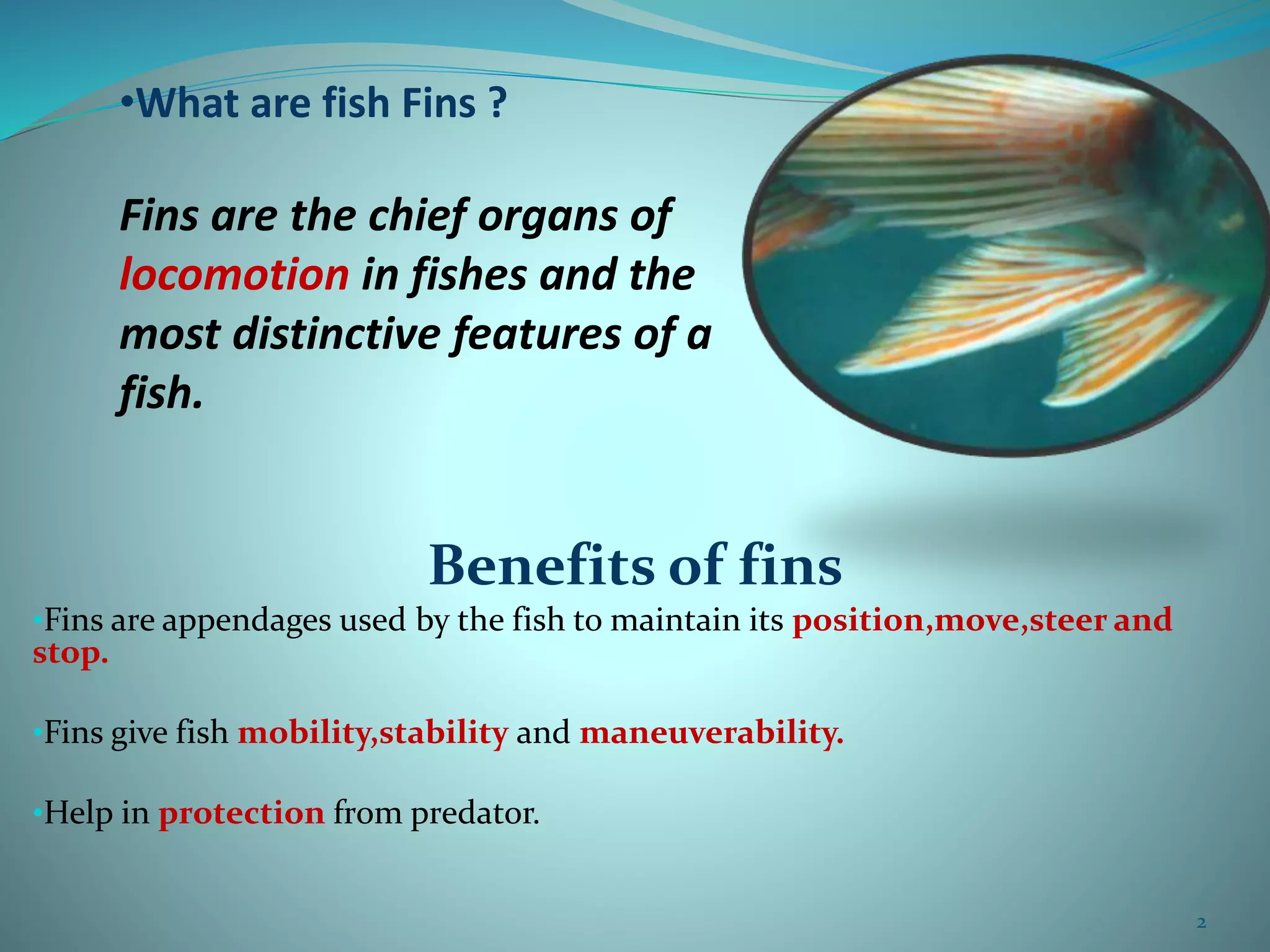
Fins are the chief organs of
locomotion in fishes and the
most distinctive features of a
fish.
Benefits of fins
•Fins are appendages used by the fish to maintain its position,move,steer and
stop.
•Fins give fish mobility,stability and maneuverability.
•Help in protection from predator.
2
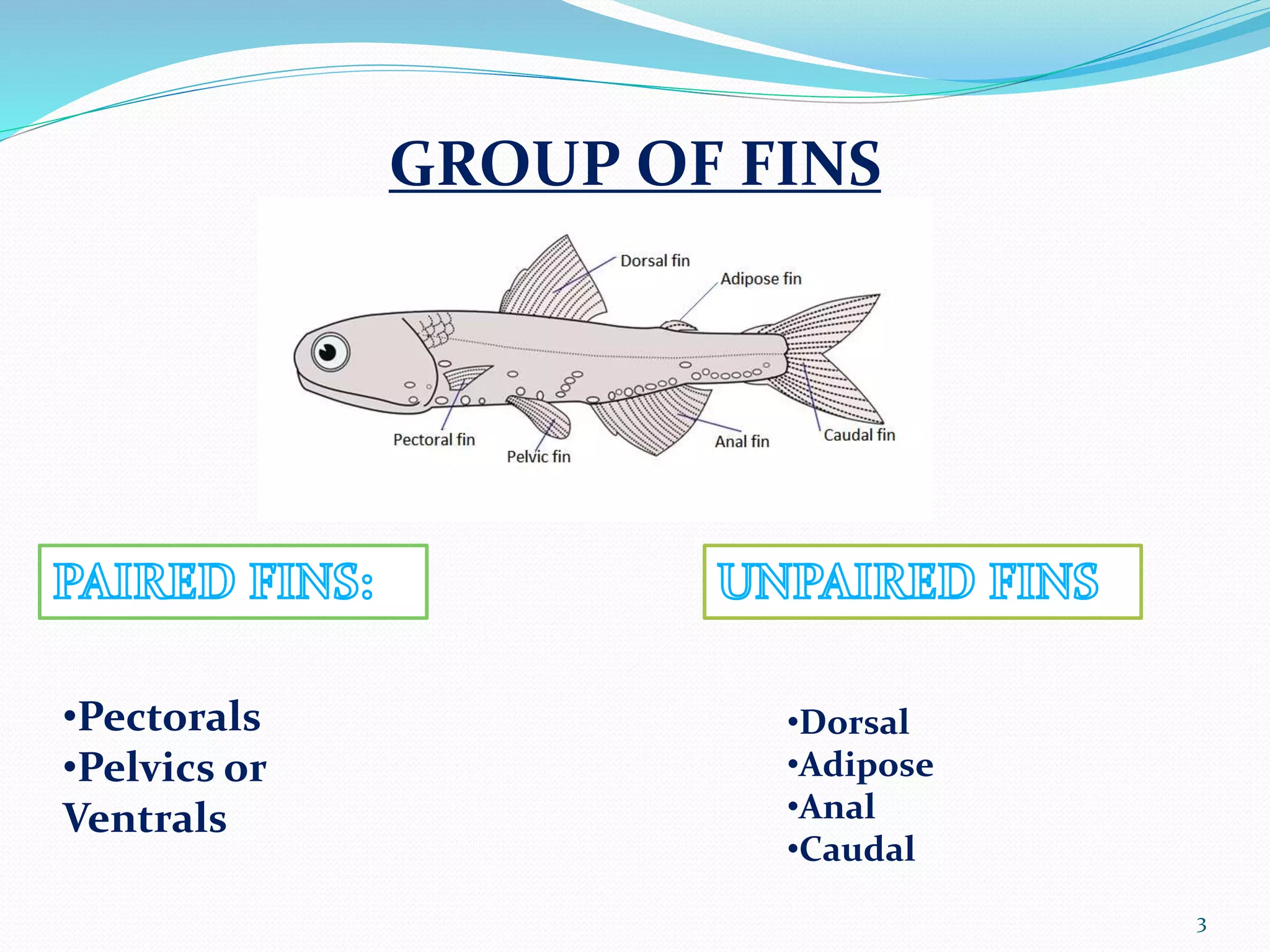
GROUP OF FINS
•Pectorals
•Pelvics or
Ventrals
•Dorsal
•Adipose
•Anal
•Caudal
3
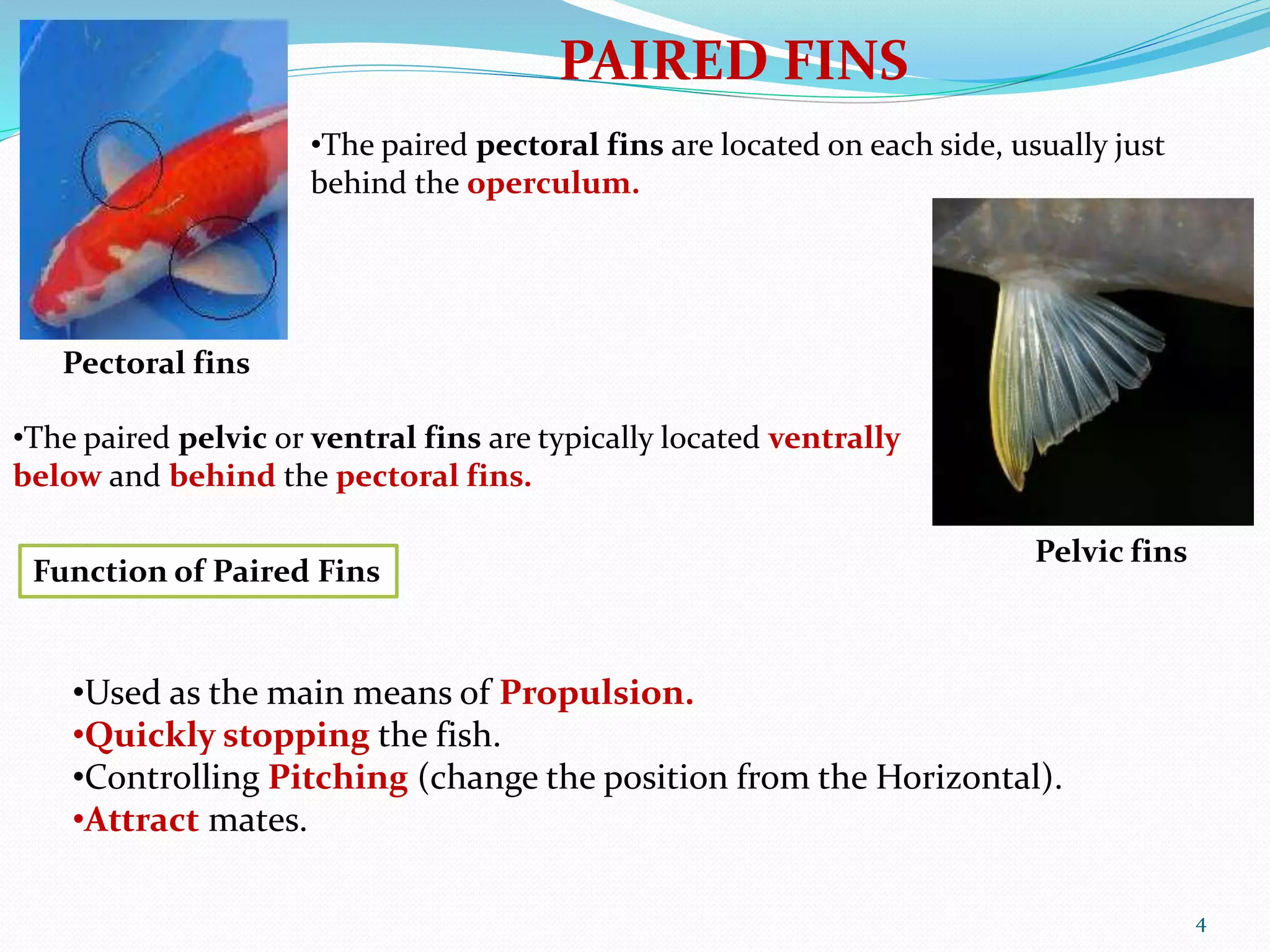
Pectoral fins
•The paired pectoral fins are located on each side, usually just
behind the operculum.
PAIRED FINS
Pelvic fins
•The paired pelvic or ventral fins are typically located ventrally
below and behind the pectoral fins.
Function of Paired Fins
•Used as the main means of Propulsion.
•Quickly stopping the fish.
•Controlling Pitching (change the position from the Horizontal).
•Attract mates.
4
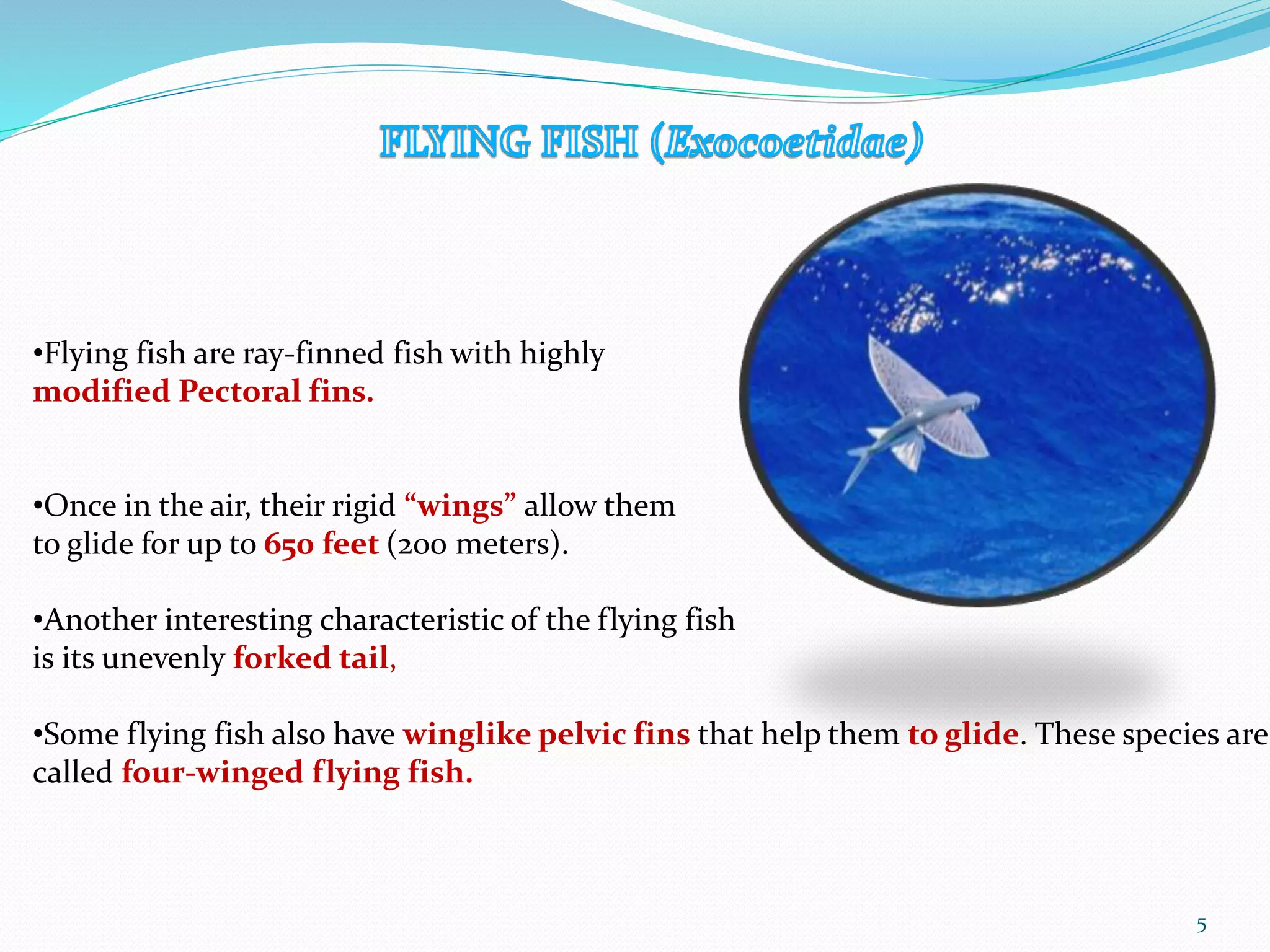
•Flying fish are ray-finned fish with highly
modified Pectoral fins.
•Once in the air, their rigid “wings” allow them
to glide for up to 650 feet (200 meters).
•Another interesting characteristic of the flying fish
is its unevenly forked tail,
•Some flying fish also have winglike pelvic fins that help them to glide. These species are
called four-winged flying fish.
5
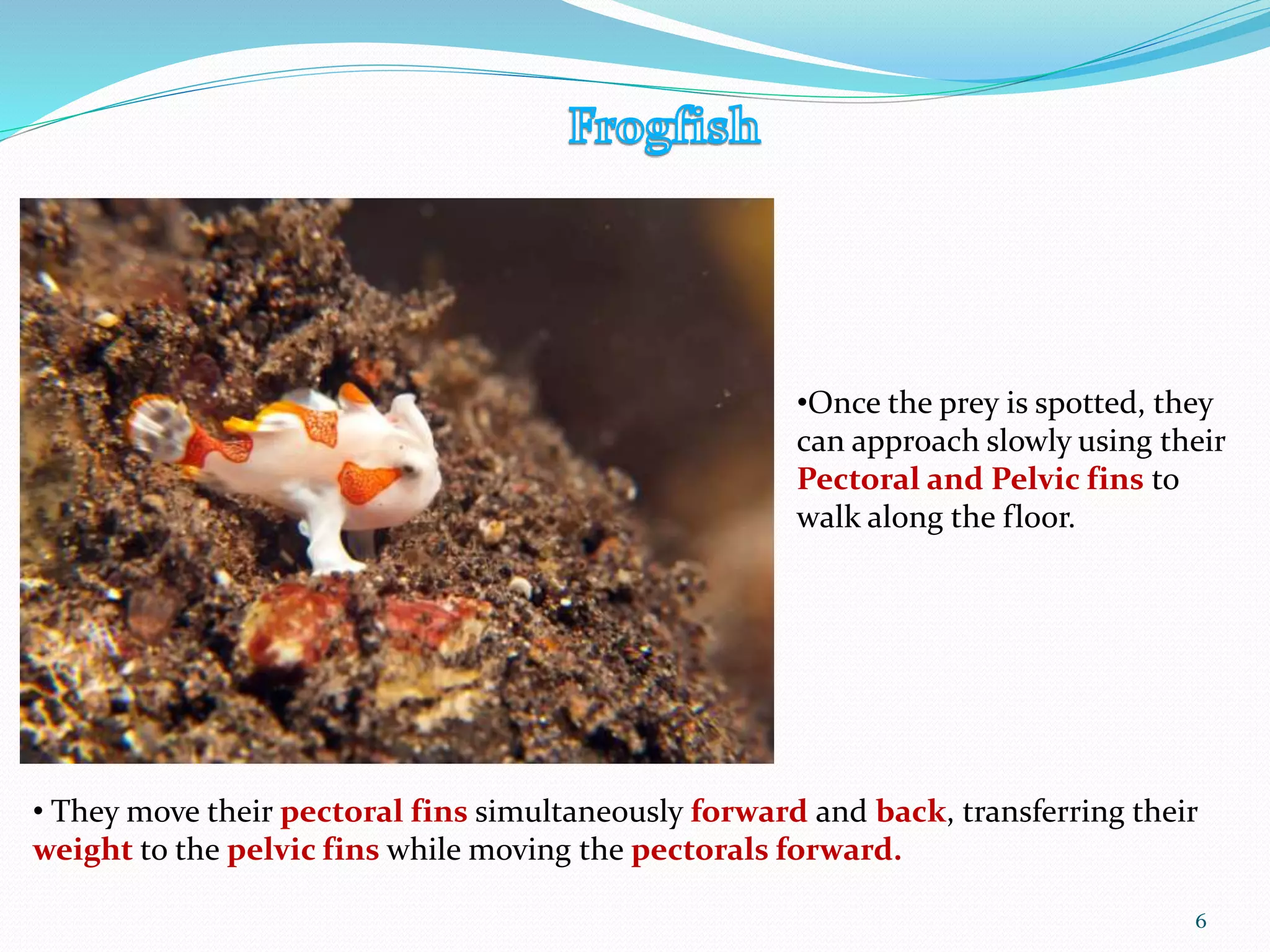
•Once the prey is spotted, they
can approach slowly using their
Pectoral and Pelvic fins to
walk along the floor.
• They move their pectoral fins simultaneously forward and back, transferring their
weight to the pelvic fins while moving the pectorals forward.
6
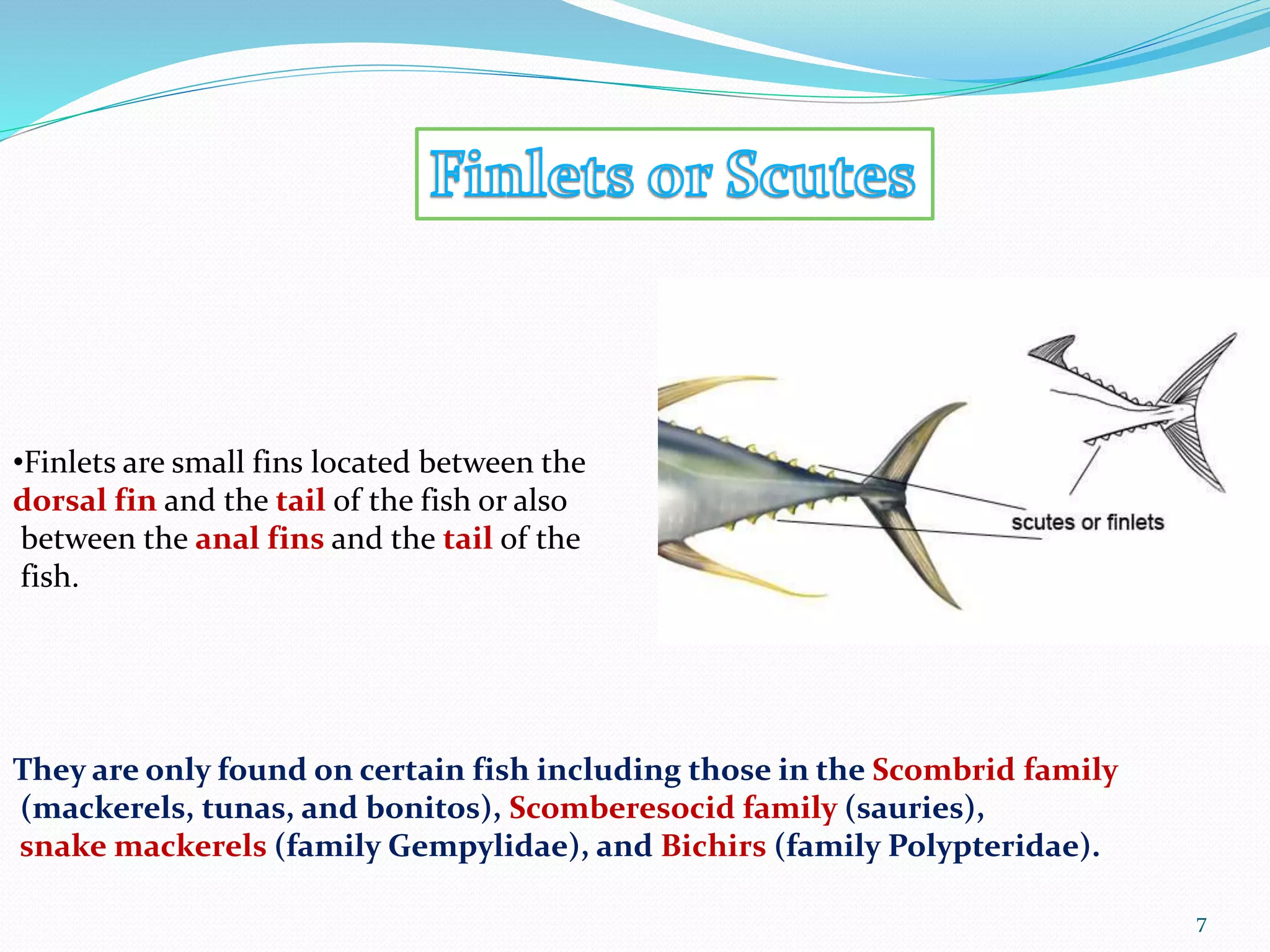
•Finlets are small fins located between the
dorsal fin and the tail of the fish or also
between the anal fins and the tail of the
fish.
They are only found on certain fish including those in the Scombrid family
(mackerels, tunas, and bonitos), Scomberesocid family (sauries),
snake mackerels (family Gempylidae), and Bichirs (family Polypteridae).
7
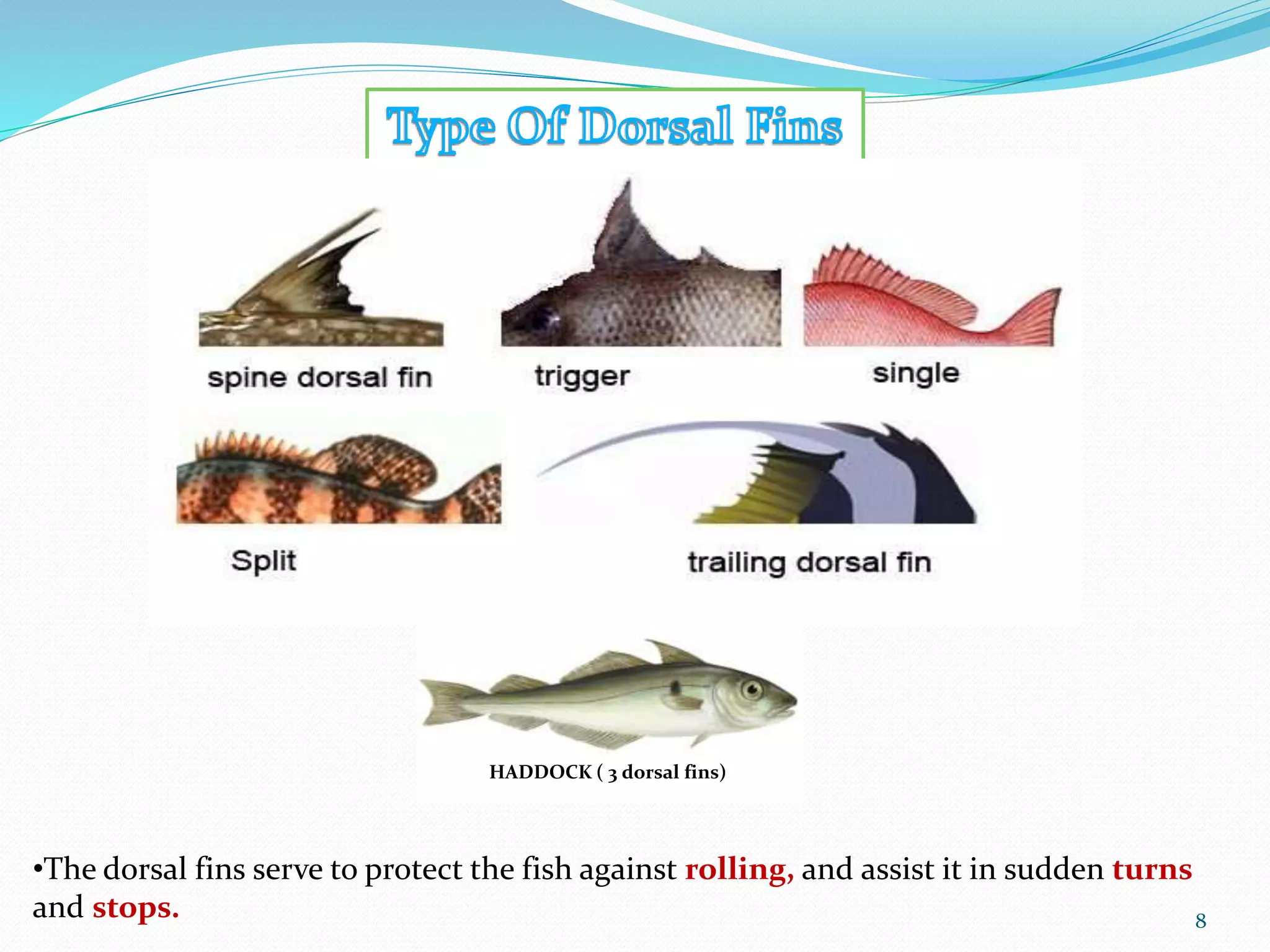
•The dorsal fins serve to protect the fish against rolling, and assist it in sudden turns
and stops.
HADDOCK ( 3 dorsal fins)
8
9
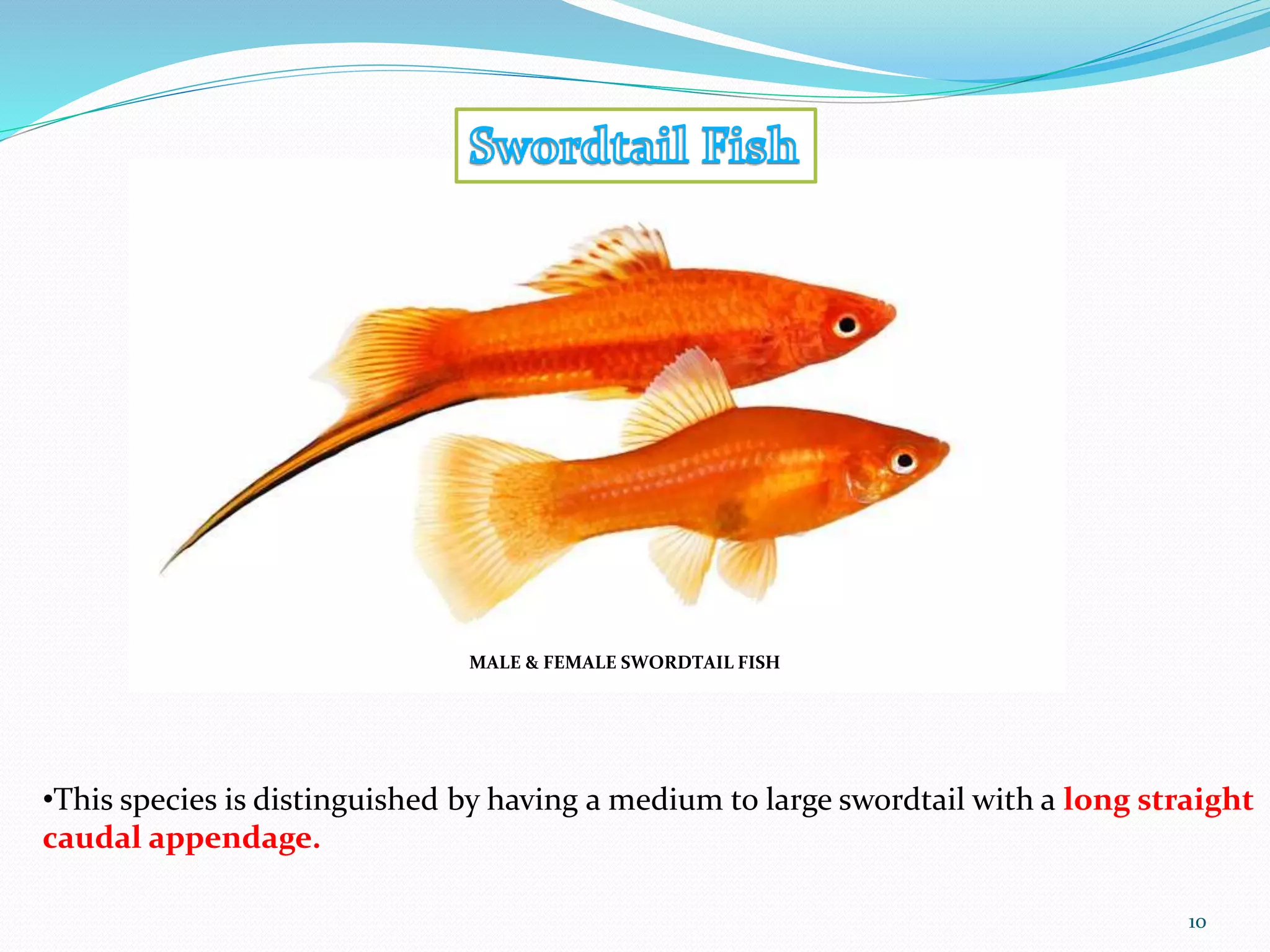
MALE & FEMALE SWORDTAIL FISH
•This species is distinguished by having a medium to large swordtail with a long straight
caudal appendage.
10
•The anal is located on the ventral surface
behind the Anus.
•used to stabilize the fish while swimming.
11
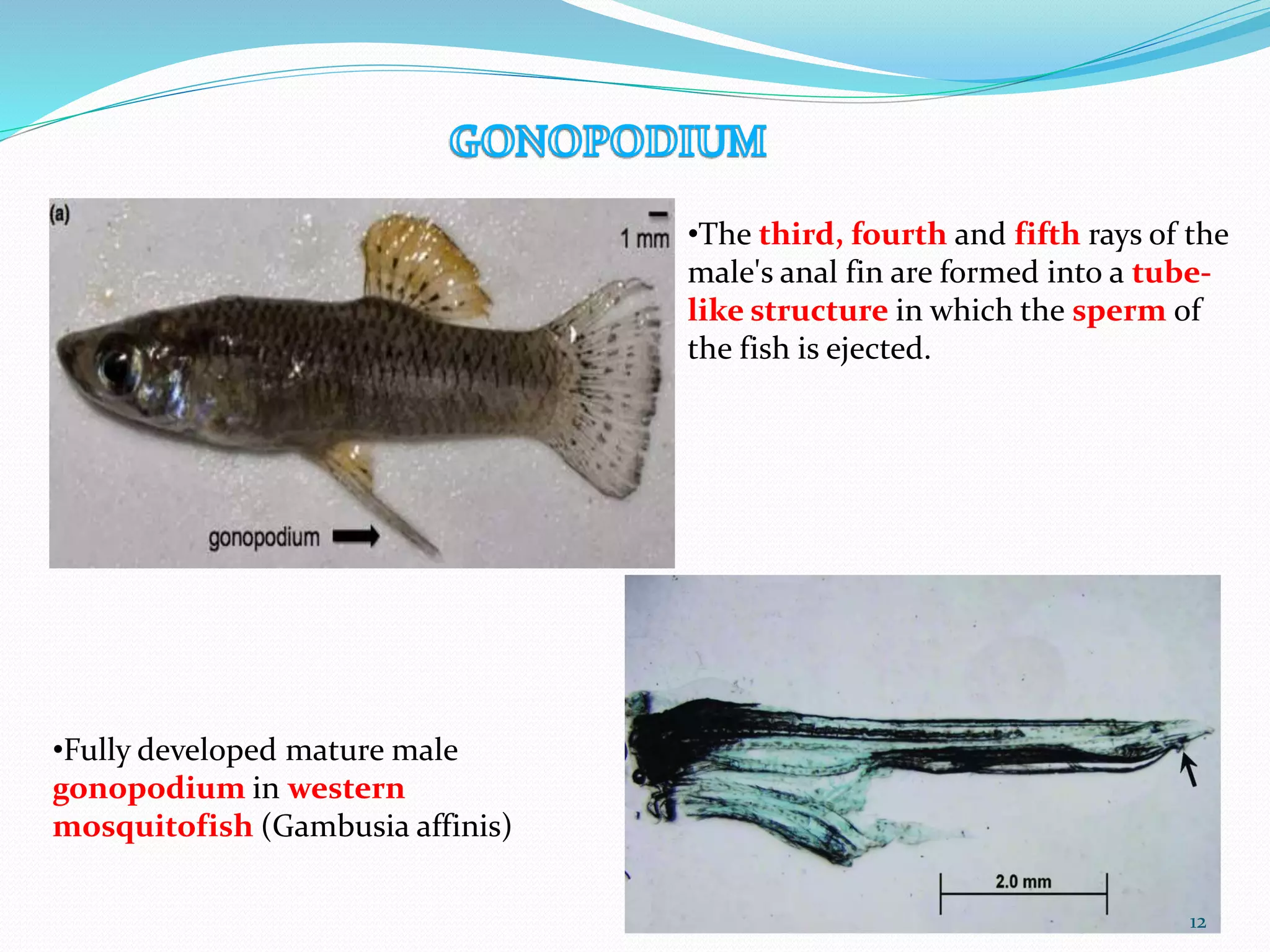
•Fully developed mature male
gonopodium in western
mosquitofish (Gambusia affinis)
•The third, fourth and fifth rays of the
male's anal fin are formed into a tube-
like structure in which the sperm of
the fish is ejected.
12
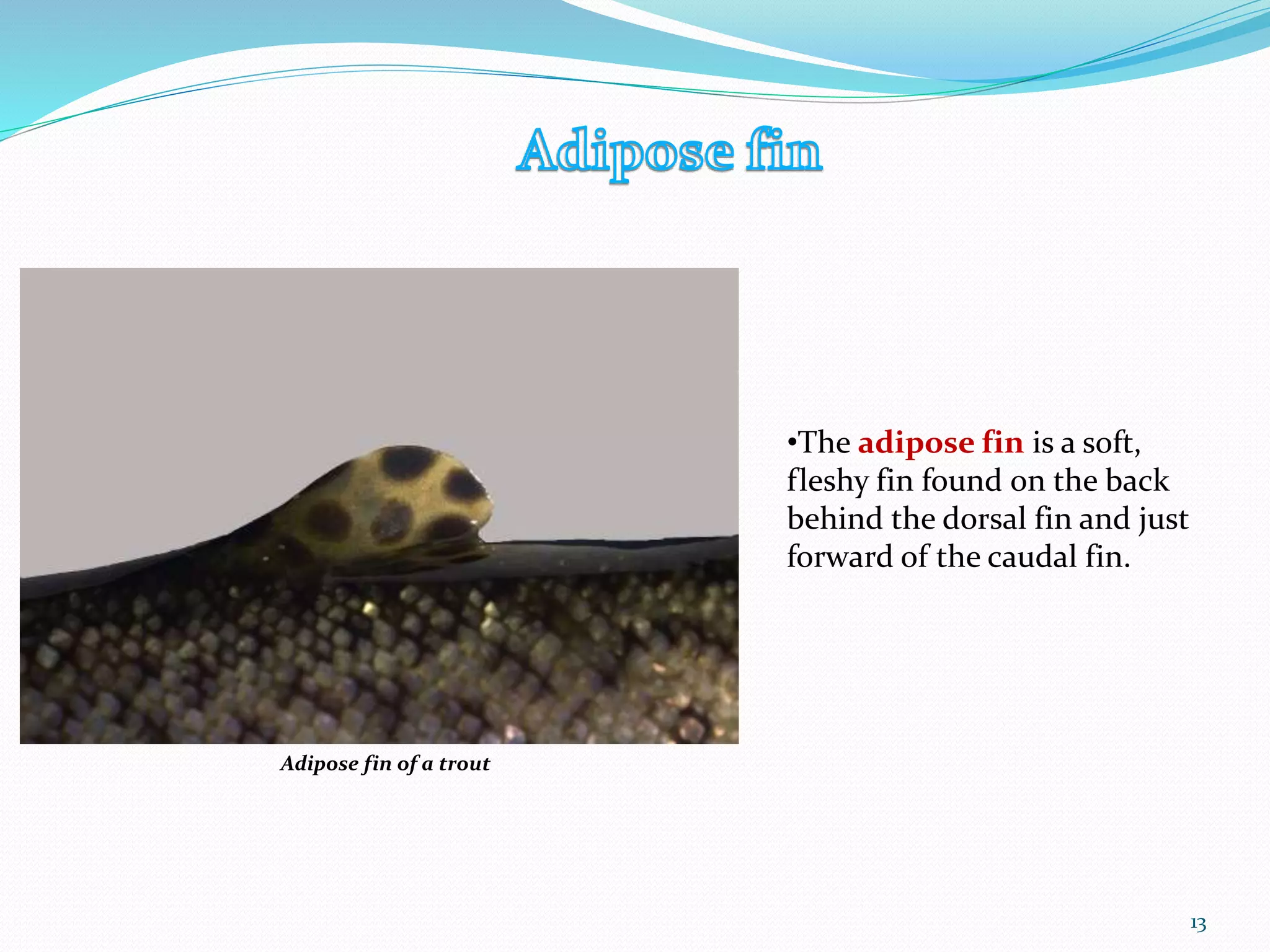
•The adipose fin is a soft,
fleshy fin found on the back
behind the dorsal fin and just
forward of the caudal fin.
Adipose fin of a trout
13
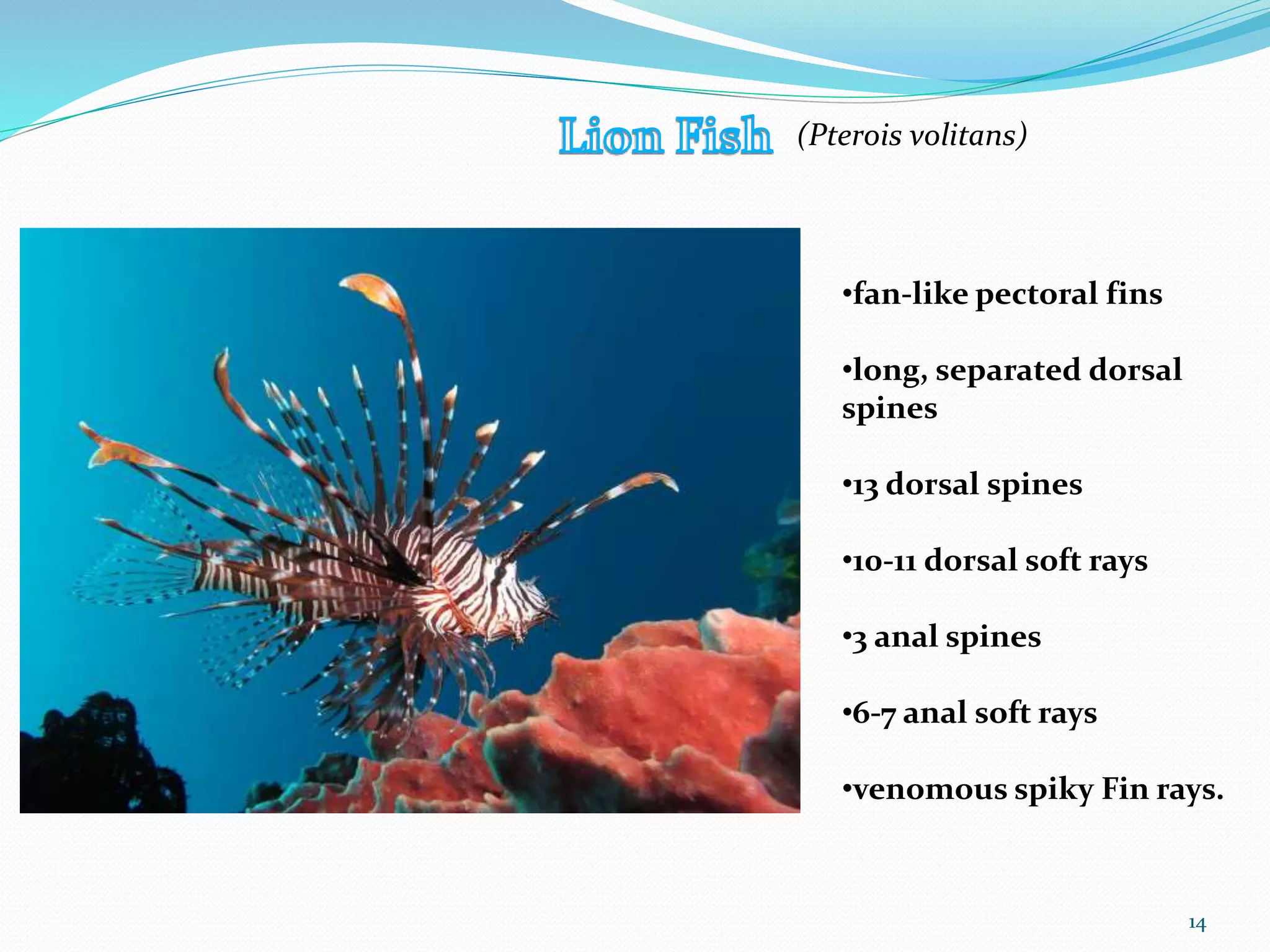
•fan-like pectoral fins
•long, separated dorsal
spines
•13 dorsal spines
•10-11 dorsal soft rays
•3 anal spines
•6-7 anal soft rays
•venomous spiky Fin rays.
(Pterois volitans)
14
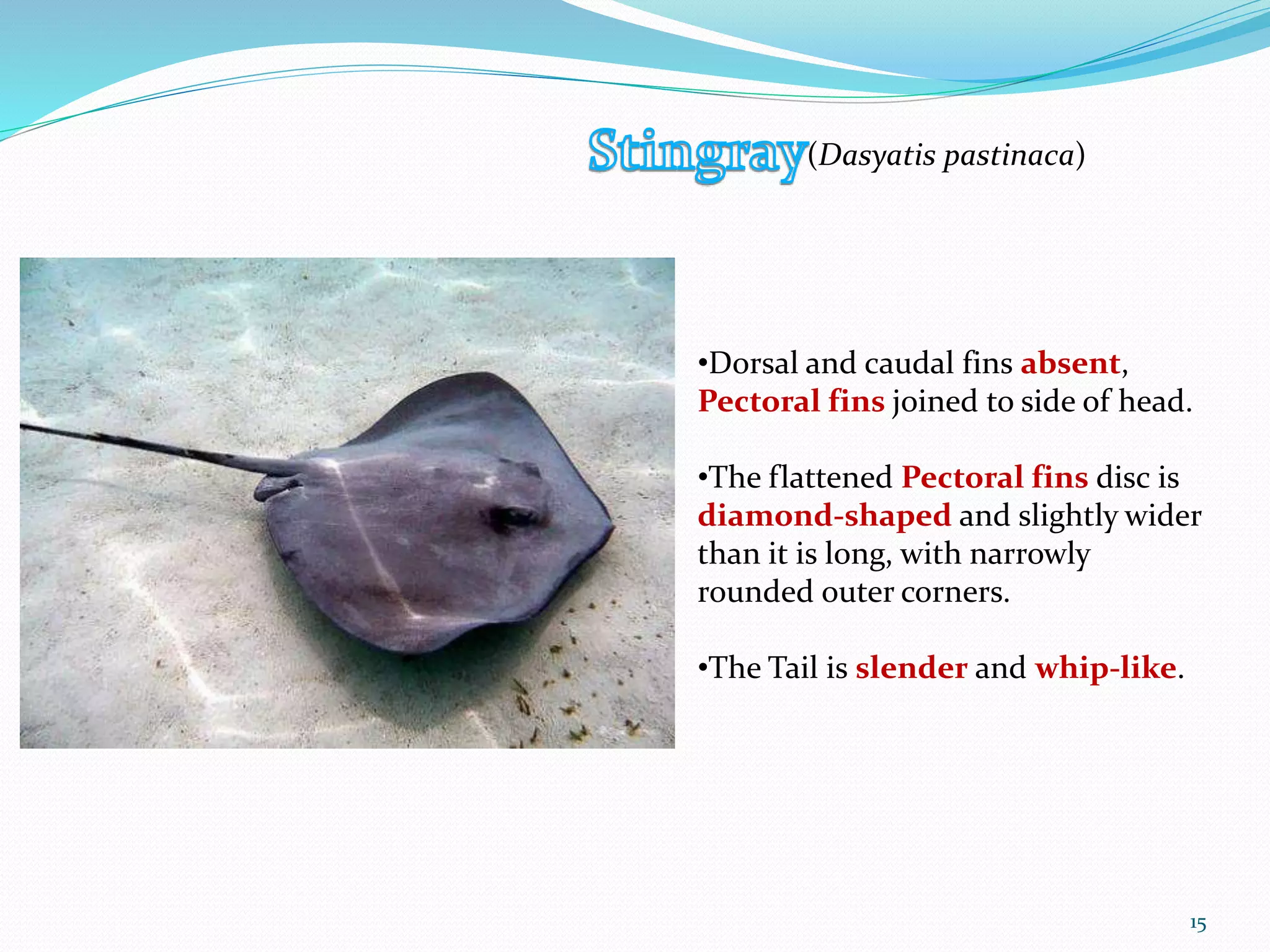
•Dorsal and caudal fins absent,
Pectoral fins joined to side of head.
•The flattened Pectoral fins disc is
diamond-shaped and slightly wider
than it is long, with narrowly
rounded outer corners.
•The Tail is slender and whip-like.
(Dasyatis pastinaca)
15
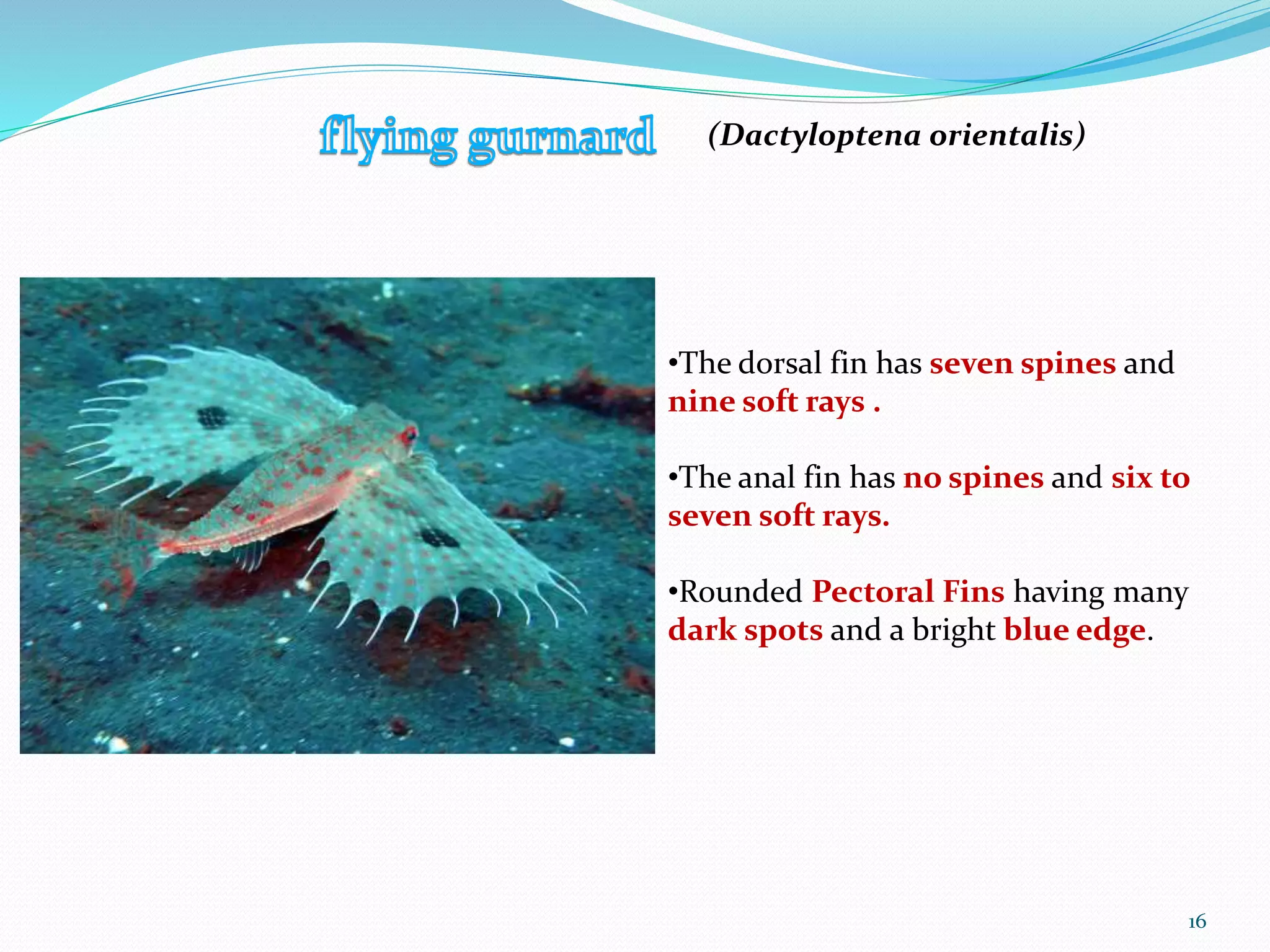
•The dorsal fin has seven spines and
nine soft rays .
•The anal fin has no spines and six to
seven soft rays.
•Rounded Pectoral Fins having many
dark spots and a bright blue edge.
(Dactyloptena orientalis)
16
• Abby , April 25, 2014 (https://fishionary.fisheries.org/finlets/)
• Aquaviews, Fish Identification Guide: Fish Anatomy (Part I)
(https://www.leisurepro.com/blog/explore-the-blue/fish-identification-guide-fish-anatomy-part/)
• Slide share, Published on Jul 22, 2016, Fish fins (https://www.slideshare.net/aminajann/fish-fins)
•The National Wildlife Federation, Flying Fish, (https://www.nwf.org/Educational-
Resources/Wildlife-Guide/Fish/Flying-Fish)
•Kapoor BG and Khanna B (2004) Ichthyology Handbook pp. 497–498, Springer Science & Business
Media. ISBN 9783540428541.
• Frogfish Factsheet Archived 2007-10-11 at the Wayback Machine Shedd Aquarium Explore by Animal
2009
17
THANK YOU FOR YOUR ATTENTION
18

Fish morphology - fish fins

  • 1.
  • 2.
    •What are fishFins ? Fins are the chief organs of locomotion in fishes and the most distinctive features of a fish. Benefits of fins •Fins are appendages used by the fish to maintain its position,move,steer and stop. •Fins give fish mobility,stability and maneuverability. •Help in protection from predator. 2
  • 3.
    GROUP OF FINS •Pectorals •Pelvicsor Ventrals •Dorsal •Adipose •Anal •Caudal 3
  • 4.
    Pectoral fins •The pairedpectoral fins are located on each side, usually just behind the operculum. PAIRED FINS Pelvic fins •The paired pelvic or ventral fins are typically located ventrally below and behind the pectoral fins. Function of Paired Fins •Used as the main means of Propulsion. •Quickly stopping the fish. •Controlling Pitching (change the position from the Horizontal). •Attract mates. 4
  • 5.
    •Flying fish areray-finned fish with highly modified Pectoral fins. •Once in the air, their rigid “wings” allow them to glide for up to 650 feet (200 meters). •Another interesting characteristic of the flying fish is its unevenly forked tail, •Some flying fish also have winglike pelvic fins that help them to glide. These species are called four-winged flying fish. 5
  • 6.
    •Once the preyis spotted, they can approach slowly using their Pectoral and Pelvic fins to walk along the floor. • They move their pectoral fins simultaneously forward and back, transferring their weight to the pelvic fins while moving the pectorals forward. 6
  • 7.
    •Finlets are smallfins located between the dorsal fin and the tail of the fish or also between the anal fins and the tail of the fish. They are only found on certain fish including those in the Scombrid family (mackerels, tunas, and bonitos), Scomberesocid family (sauries), snake mackerels (family Gempylidae), and Bichirs (family Polypteridae). 7
  • 8.
    •The dorsal finsserve to protect the fish against rolling, and assist it in sudden turns and stops. HADDOCK ( 3 dorsal fins) 8
  • 9.
  • 10.
    MALE & FEMALESWORDTAIL FISH •This species is distinguished by having a medium to large swordtail with a long straight caudal appendage. 10
  • 11.
    •The anal islocated on the ventral surface behind the Anus. •used to stabilize the fish while swimming. 11
  • 12.
    •Fully developed maturemale gonopodium in western mosquitofish (Gambusia affinis) •The third, fourth and fifth rays of the male's anal fin are formed into a tube- like structure in which the sperm of the fish is ejected. 12
  • 13.
    •The adipose finis a soft, fleshy fin found on the back behind the dorsal fin and just forward of the caudal fin. Adipose fin of a trout 13
  • 14.
    •fan-like pectoral fins •long,separated dorsal spines •13 dorsal spines •10-11 dorsal soft rays •3 anal spines •6-7 anal soft rays •venomous spiky Fin rays. (Pterois volitans) 14
  • 15.
    •Dorsal and caudalfins absent, Pectoral fins joined to side of head. •The flattened Pectoral fins disc is diamond-shaped and slightly wider than it is long, with narrowly rounded outer corners. •The Tail is slender and whip-like. (Dasyatis pastinaca) 15
  • 16.
    •The dorsal finhas seven spines and nine soft rays . •The anal fin has no spines and six to seven soft rays. •Rounded Pectoral Fins having many dark spots and a bright blue edge. (Dactyloptena orientalis) 16
  • 17.
    • Abby ,April 25, 2014 (https://fishionary.fisheries.org/finlets/) • Aquaviews, Fish Identification Guide: Fish Anatomy (Part I) (https://www.leisurepro.com/blog/explore-the-blue/fish-identification-guide-fish-anatomy-part/) • Slide share, Published on Jul 22, 2016, Fish fins (https://www.slideshare.net/aminajann/fish-fins) •The National Wildlife Federation, Flying Fish, (https://www.nwf.org/Educational- Resources/Wildlife-Guide/Fish/Flying-Fish) •Kapoor BG and Khanna B (2004) Ichthyology Handbook pp. 497–498, Springer Science & Business Media. ISBN 9783540428541. • Frogfish Factsheet Archived 2007-10-11 at the Wayback Machine Shedd Aquarium Explore by Animal 2009 17
  • 18.
    THANK YOU FORYOUR ATTENTION 18