“ Never let what you cannot do interfere with what you can do” CRITICAL CONDITIONS Sherry L. Knowles, RN, CCRN, CRNI
OBJECTIVES Recognize the signs & symptoms of several common (critical) medical conditions. Describe the current treatment modalities of those common (critical) medical conditions. Discuss the overall management of select (critical) medical conditions. Identify the nursing interventions of several common (critical) medical conditions. CRITICAL CONDITIONS
Respiratory Failure ARDS Acute MI CHF CRITICAL CONDITIONS GI Bleed DKA Shock Sepsis
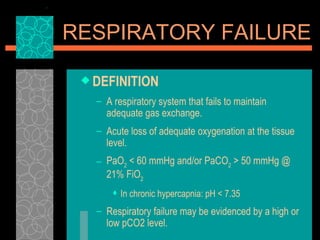
DEFINITION A respiratory system that fails to maintain adequate gas exchange.   Acute loss of adequate oxygenation at the tissue level.  PaO 2  < 60 mmHg and/or PaCO 2  > 50 mmHg @ 21% FiO 2 In chronic hypercapnia: pH < 7.35 Respiratory failure may be evidenced by a high or low pCO2 level. RESPIRATORY FAILURE
TYPES OF FAILURE Hypercapnic Respiratory Failure  is ineffective ventilation (increased PaCO 2 ), with normal oxygenation (normal alveolar-arterial O2 gradient). Hypoxemic Respiratory Failure  is characterized by low PaO 2 , markedly elevated P(A-a)O 2  gradient, and usually low PaCO 2 , reflecting adequate ventilation, but inadequate gas exchange.  RESPIRATORY FAILURE
SIGNS & SYMPTOMS Neurological Restlessness, Agitation, Headache Disorientation, Seizures,    LOC Cardiovascular    Heart Rate, Hypertension (early), Hypotension (late), Chest Pain , Dysrhythmias Respiratory    Respirations,    Respiratory Effort RESPIRATORY FAILURE
CAUSES V/Q Mismatch Ventilation / Perfusion Mismatch    V/Q ratio =    ventilation to perfusion Intrapulmonary Shunt Perfusion without ventilation Cardiac Failure May result in pulmonary congestion RESPIRATORY FAILURE
SIGNS & SYMPTOMS Renal    UOP, Edema   Gastrointestinal    Bowel Sounds, Nausea/Vomiting, Abd Distention, Bleeding Integumentary Cool, clammy, pale skin, Decreased Capillary Refill RESPIRATORY FAILURE
TREATMENT Protect the Airway Intubation (if needed) Bronchodilators Hydration (as appropriate) Mucolytic (if appropriate) RESPIRATORY FAILURE
TREATMENT Correct the Acid-Base Imbalance ABG’s Bronchodilators Mechanical or non-invasive ventilation Treat the Cause Reduce sedation Add sedation Bring fever down RESPIRATORY FAILURE
TREATMENT    FiO 2 Ineffective with shunting Prolonged O2 > 40% may cause O2 toxicity (lung damage) Must use caution with CO2 retainers Chronic hypercapnia causes CO2 retainers to use hypoxic  (O 2 ) drive Too much O2 can depress respirations RESPIRATORY FAILURE
NURSING INTERVENTIONS Monitor the Patient Monitor ABG’s Monitor respiratory status Monitor response to therapies Report Changes Watch for improvement Keep respiratory status well documented Treat Causes Antibiotics Diuretics Mucolytics RESPIRATORY FAILURE
DEFINITION Syndrome that causes damage to the alveolar-capillary interface. Causes an acute lung injury that causes    pulmonary capillary permeability and alveolar flooding. Characterized by non-cardiogenic pulmonary edema, respiratory distress, and hypoxemia. ARDS
CAUSES Aspiration Injuries Sepsis Multiple Blood Transfusions DIC Shock States Severe Pancreatitis Embolism ARDS
SIGNS & SYMPTOMS Dyspnea Low Pa O2 Intrapulmonary Shunting Low  Pa O2  despite high FiO 2 Pulmonary Crackles Diffuse bilateral alveolar infiltrates   Low or normal PAWP ARDS
SIGNS & SYMPTOMS Early Irritability, confusion, hyperventilation, tachypnea, dyspnea, tachycardia Late Increasing respiratory insufficiency,    pulmonary compliance (   pulmonary vascular resistance), PCO 2  retention, frothy sputum, pulmonary crackles ARDS
COMPLICATIONS Barotrauma Pulmonary Fibrosis Pulmonary Emboli    Cardiac Output Renal Failure Nosocomial Pneumonia Sepsis DIC ARDS
TREATMENT Maintain Oxygenation BiPAP, CPAP Intubation PEEP ABG Monitoring Maintain Vascular Volume IVF Fluid Restriction Treat the Cause Antibiotics ARDS
DEFINITION Infarction occurs due to mechanical obstruction of a coronary artery (or branch) caused by a thrombus, plaque rupture, coronary spasm and/or dissection. ACUTE MI
SIGNS & SYMPTOMS Complains vary and may include crushing chest pain (which may or may not radiate), back, neck, jaw, teeth and/or epigastric pain, nausea/vomiting and dizziness. ST elevations on ECG Elevated cardiac enzymes ACUTE MI
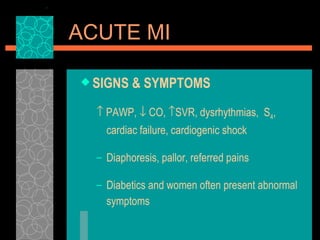
SIGNS & SYMPTOMS    PAWP,    CO,   SVR, dysrhythmias,  S 4 , cardiac failure, cardiogenic shock Diaphoresis, pallor, referred pains Diabetics and women often present abnormal symptoms ACUTE MI
COMPLICATIONS Dysrhythmias, heart failure, pericarditis, ventricular aneurysms, ventricular thrombus, VSD, mitral regurgitation, papillary muscle (or chordae tendineae) rupture, pericardial effusions, pericarditis ACUTE MI
TREATMENT Time Is Heart Muscle The goal of treatment for an AMI is to relieve pain, limit the size of the infarction and to prevent complications, primarily lethal dysrhythmias Prompt ECG ACUTE MI
TREATMENT Usual medications include O 2 , NTG, MSO 4 , aspirin, heparin, beta-blockers, and ace inhibitors. May also include thrombolytics or Gp2a3b inhibitors Cardiac Catheterization (with angioplasty, atherectomy and/or stent) IABP, CABG, Education ACUTE MI
TREATMENT IWMI Fluids Inotropics Afterload reducing medications AWMI Diuretics Inotropics Afterload reducing medications ACUTE MI
NURSING INTERVENTIONS O 2 Bedrest Serial ECG’s Serial cardiac enzymes Keep pain free (NTG. MSO 4 ) Aspirin, heparin, beta-blockers, ace inhibitors, Gp2a3b inhibitors, thrombolytics, PTCA, IABP, CABG  ACUTE MI
DEFINITION CHF A condition in which the heart cannot pump sufficient blood to meet the metabolic needs of the body. Pulmonary (LVF) and/or systemic (RVF) congestion is present. CHF
DEFINITION Pulmonary Edema Fluid in the alveolus that impairs gas exchange by   altering the diffusion between alveolus and   capillary; acute left ventricular failure causes cardiogenic pulmonary edema. Non-cardiogenic pulmonary edema is a synonym for Adult Respiratory Distress Syndrome (ARDS). CHF
SIGNS & SYMPTOMS Sympaththetic nervous system stimulation Tachycardia Vasoconstriction and increased SVR Renin-angiotensin-aldosterone system activation Hypo perfusion to the kidneys (rennin) Vasoconstriction (angiotension) Sodium and water retention (kidneys) Ventricular dilation See Handout CHF
FUNCTIONAL CLASSIFICATIONS Class I Class II Class III Class IV CHF
COMPLICATIONS Respiratory Failure Dysrhythmias Hypotension Progressive Deterioration Acute Renal Failure Fluid & Electrolyte Imbalances CHF
TREATMENT Improve Oxygenation Decrease Myocardial Oxygen Demand Decrease Preload Decrease Afterload Increase Contractility Manage Dysrhythmias CHF
CAUSES PUD Stress Ulcers Esophageal Varicies Portal Hypertension Mallory Weiss Syndrome GI BLEED
SIGNS & SYMPTOMS Hematemesis Hematochezia    BP    H & H    BUN Weakness Dizziness Syncope GI BLEED
TREATMENT Hemodynamic Stabilization Blood, IVF, NGT, antacids, H 2  blockers, antibiotics, serial H & H’s and clotting factors Vasopressin (Pitressin) Sengstaken-Blakemore or Minnesota Tube Sclerotherapy Laser Electorcautery Surgery GI BLEED
NURSING INTERVENTIONS Large Bore IV’s Type & Cross Match Blood Serial H & H’s (q4hr) Monitor Clotting Factors Watch for Complications ARF, ARDS, DIC Maintain Tubes NG, Blakemore or Minnesota Tube GI BLEED
DEFINITION Serious or life-threatening complication usually from diabetes mellitus type I. Results from relative or absolute insulin deficiency.  DKA
CAUSES Type I DM Insufficient Insulin Dosing Poor Compliance Malfunctioning Insulin Pump Phenytoin (Dilantin) Thiazide/Sulfonamide Diuretics Stress New Onset DM  DKA
SIGNS & SYMPTOMS   Sudden Onset (hours) Serum Glucose 300-800 Ketones  Strongly Positive Serum pH < 7.3 (Ketoacidosis) Fruity Acetone Breath (Ketones)  Kussmaul Respirations  Serum Osmolarity < 350  DKA
SIGNS & SYMPTOMS   Thirst (polydipsia) Dry Mouth Dry Skin Weakness Kussmaul Respirations Polyuria  DKA Hypotension Tachycardia Mental confusion Changes in LOC Mental confusion Changes in LOC
TREATMENT Reverse Dehydration   Rapid IVF Replacement  NS, then ½ NS Continue NS If Needed Prevent Hypoglycemia D5½ NS when Glu 250 DKA
TREATMENT Restore Normal Glucose Levels Give Rapid Acting Insulin Frequent Glu Monitoring (q ½ - 1 hr) Monitor Serum and Urine Ketones DKA
TREATMENT Replenish Electrolytes Watch for Dilution Monitor Electrolytes Frequently Insulin Lowers Serum K DKA
ADDITIONAL INTERVENTIONS Monitor Frequent Accuchecks (q1hr) Monitor Serial Serum Glucose (q4hr) Monitor Serial Electrolytes (4hr) Monitor Anion Gap (q4hr) Monitor Serum & Urine Ketones DKA
DEFINITION Inadequate perfusion to the body tissues Low blood pressure with impaired perfusion to the end organs May result in multiple organ dysfunction SHOCK
TYPES OF SHOCK Hypovolemic Shock Cardiogenic Shock Distributive Shock  Obstructive Shock SHOCK
SIGNS & SYMPTOMS The body attempts to compensate for shock: Tachycardia Attempts to deliver more blood to the tissues Vasoconstriction Attempts to maintain adequate BP in order to adequately perfuse the body tissues Increased ADH Secretion ADH makes the body hold onto water in an effort to maintain volume and thus enough blood pressure to perfuse the body tissues SHOCK
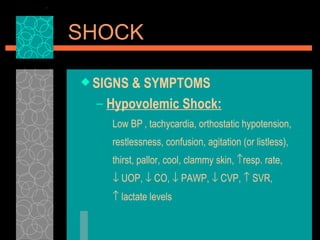
SIGNS & SYMPTOMS Hypovolemic Shock: Low BP , tachycardia, orthostatic hypotension, restlessness, confusion, agitation (or listless), thirst, pallor, cool, clammy skin,   resp. rate,    UOP,    CO,    PAWP,    CVP,    SVR,    lactate levels    SHOCK
SIGNS & SYMPTOMS Cardiogenic Shock: Low BP , tachycardia, restlessness, confusion, agitation (or listless), thirst, pallor, cool, clammy skin,    resp. rate,    UOP,    CO,    PAWP (low with RVF),    CVP,    SVR, JVD, peripheral edema, ventricular gallop, dyspnea, pulmonary crackles,    lactate levels     SHOCK
SIGNS & SYMPTOMS Anaphylactic Shock: Low BP , tachycardia, orthostatic hypotension, restlessness, confusion, agitation (or listless), thirst, pallor, warm feeling, pruritus, hives, angioedema, bronchoconstriction, wheezing, laryngoedema, dyspnea, cool, clammy skin,    UOP,    CO,    PAWP,    CVP,    SVR,     lactate levels    SHOCK
SIGNS & SYMPTOMS Obstructive Shock: Low BP, tachycardia, restlessness, confusion, agitation (or listless), pallor, cool, clammy skin,   UOP,    CO, symptoms related to cause   SHOCK
SIGNS & SYMPTOMS Septic Shock: Early Stage (Hyper-dynamic, Warm Phase) Normal BP, tachycardia, confusion, agitation (or listless),    resp. rate,    temp, normal color, normal or    UOP,    CO, normal PAWP,    CO,    SVR,     SHOCK
SIGNS & SYMPTOMS Septic Shock: Late Stage (Hypo-dynamic, Cold Phase) Low BP, tachycardia, orthostatic hypotension, restlessness, confusion, agitation (or listless), thirst, pallor, cool, clammy skin,    UOP,    CO,    PAWP,    CVP,    SVR,    lactate levels   SHOCK
TREATMENTS Hypovolemic Shock: Volume (IVF, Blood) Cardiogenic Shock:    CO    Preload & Afterload    Myocardial Demand   SHOCK
TREATMENTS Anaphylactic Shock: Epinephrine IVF Vasoconstrictors Support/Maintain Airway Obstructive Shock: Treat the Cause   SHOCK
TREATMENTS Septic Shock: IVF (150cc/hr or wide open) Treat Cause (pan culture, antibiotics) Vasoconstrictors in warm phase Treat temp if needed   SHOCK
DEFINITION SIRS Systemic Inflammatory Response Manifested by two or more of the following: Temp > 38C or < 36C, HR > 90/min, RR > 20/min, CO2 < 32 mmHg, WBC > 12,000 or < 4,000 or > 10% (immature) bands Sepsis Inadequate perfusion to the body tissues due to bacteremia. SEPSIS
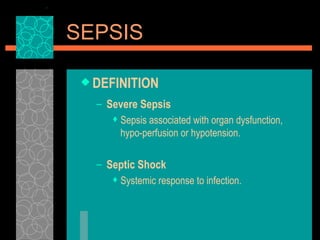
DEFINITION Severe Sepsis Sepsis associated with organ dysfunction, hypo-perfusion or hypotension. Septic Shock Systemic response to infection. SEPSIS
SIGNS & SYMPTOMS Early Stage (Hyper-dynamic, Warm Phase) Normal BP, tachycardia, confusion, agitation (or listless),    resp. rate,    temp, normal color, normal or    UOP,    CO, normal PAWP,    CO,    SVR,   SEPSIS
SIGNS & SYMPTOMS Late Stage (Hypo-dynamic, Cold Phase) Low BP, tachycardia, orthostatic hypotension, restlessness, confusion, agitation (or listless), thirst, pallor, cool, clammy skin,    UOP,    CO,    PAWP,    CVP,    SVR,    lactate levels   SEPSIS
COMPLICATIONS Acute Renal Failure Multiple Organ Failure Disseminated Intravascular Coagulation Death SEPSIS
TREATMENT Give IVF (150cc/hr or wide open) Treat the Cause (Pan culture, antibiotics,) Give Vasoconstrictors in warm phase (vasoconstrictors are contraindicated in cold phase). Treat Temperature as needed Consider Protein Activated C (Xigris) SEPSIS
THE END CRITICAL CONDITIONS
THANK YOU CRITICAL CONDITIONS
Johanson WG and Peters JI. &quot;Respiratory Failure.&quot; IN:  Textbook of Respiratory Medicine , Murray and Nadel, eds.; 1988.  Morris AH. &quot;Acute Respiratory Failure.&quot; IN:  Therapeutic Strategies in Current Therapy in Critical Care Medicine , JE Parrillo, ed.; 1987.  Pontoppidan H, Geffin B and Lowenstein E. Acute respiratory failure in the adult, Parts I-III. N Engl J Med 287:690-698, 743-752, 799-806, 1972.  Pingleton SK. Complications of acute respiratory failure. Am Rev Respir Dis 137:1463-1493, 1988.  Heffner JE. Tracheal intubation in mechanically ventilated patients. Clin Chest Med 9:23-35, 1988.  Stauffer JL. Medical Management of the Airway. Clin Chest Med 12:449-482.  Bone RC. Symposium on Respiratory Failure. Med Clinics of N Amer 67:551-750, 1983.  REFERENCES

Common Critical Conditions

  • 1.
    “ Never letwhat you cannot do interfere with what you can do” CRITICAL CONDITIONS Sherry L. Knowles, RN, CCRN, CRNI
  • 2.
    OBJECTIVES Recognize thesigns & symptoms of several common (critical) medical conditions. Describe the current treatment modalities of those common (critical) medical conditions. Discuss the overall management of select (critical) medical conditions. Identify the nursing interventions of several common (critical) medical conditions. CRITICAL CONDITIONS
  • 3.
    Respiratory Failure ARDSAcute MI CHF CRITICAL CONDITIONS GI Bleed DKA Shock Sepsis
  • 4.
    DEFINITION A respiratorysystem that fails to maintain adequate gas exchange. Acute loss of adequate oxygenation at the tissue level. PaO 2 < 60 mmHg and/or PaCO 2 > 50 mmHg @ 21% FiO 2 In chronic hypercapnia: pH < 7.35 Respiratory failure may be evidenced by a high or low pCO2 level. RESPIRATORY FAILURE
  • 5.
    TYPES OF FAILUREHypercapnic Respiratory Failure is ineffective ventilation (increased PaCO 2 ), with normal oxygenation (normal alveolar-arterial O2 gradient). Hypoxemic Respiratory Failure is characterized by low PaO 2 , markedly elevated P(A-a)O 2 gradient, and usually low PaCO 2 , reflecting adequate ventilation, but inadequate gas exchange. RESPIRATORY FAILURE
  • 6.
    SIGNS & SYMPTOMSNeurological Restlessness, Agitation, Headache Disorientation, Seizures,  LOC Cardiovascular  Heart Rate, Hypertension (early), Hypotension (late), Chest Pain , Dysrhythmias Respiratory  Respirations,  Respiratory Effort RESPIRATORY FAILURE
  • 7.
    CAUSES V/Q MismatchVentilation / Perfusion Mismatch  V/Q ratio =  ventilation to perfusion Intrapulmonary Shunt Perfusion without ventilation Cardiac Failure May result in pulmonary congestion RESPIRATORY FAILURE
  • 8.
    SIGNS & SYMPTOMSRenal  UOP, Edema Gastrointestinal  Bowel Sounds, Nausea/Vomiting, Abd Distention, Bleeding Integumentary Cool, clammy, pale skin, Decreased Capillary Refill RESPIRATORY FAILURE
  • 9.
    TREATMENT Protect theAirway Intubation (if needed) Bronchodilators Hydration (as appropriate) Mucolytic (if appropriate) RESPIRATORY FAILURE
  • 10.
    TREATMENT Correct theAcid-Base Imbalance ABG’s Bronchodilators Mechanical or non-invasive ventilation Treat the Cause Reduce sedation Add sedation Bring fever down RESPIRATORY FAILURE
  • 11.
    TREATMENT  FiO 2 Ineffective with shunting Prolonged O2 > 40% may cause O2 toxicity (lung damage) Must use caution with CO2 retainers Chronic hypercapnia causes CO2 retainers to use hypoxic (O 2 ) drive Too much O2 can depress respirations RESPIRATORY FAILURE
  • 12.
    NURSING INTERVENTIONS Monitorthe Patient Monitor ABG’s Monitor respiratory status Monitor response to therapies Report Changes Watch for improvement Keep respiratory status well documented Treat Causes Antibiotics Diuretics Mucolytics RESPIRATORY FAILURE
  • 13.
    DEFINITION Syndrome thatcauses damage to the alveolar-capillary interface. Causes an acute lung injury that causes  pulmonary capillary permeability and alveolar flooding. Characterized by non-cardiogenic pulmonary edema, respiratory distress, and hypoxemia. ARDS
  • 14.
    CAUSES Aspiration InjuriesSepsis Multiple Blood Transfusions DIC Shock States Severe Pancreatitis Embolism ARDS
  • 15.
    SIGNS & SYMPTOMSDyspnea Low Pa O2 Intrapulmonary Shunting Low Pa O2 despite high FiO 2 Pulmonary Crackles Diffuse bilateral alveolar infiltrates Low or normal PAWP ARDS
  • 16.
    SIGNS & SYMPTOMSEarly Irritability, confusion, hyperventilation, tachypnea, dyspnea, tachycardia Late Increasing respiratory insufficiency,  pulmonary compliance (  pulmonary vascular resistance), PCO 2 retention, frothy sputum, pulmonary crackles ARDS
  • 17.
    COMPLICATIONS Barotrauma PulmonaryFibrosis Pulmonary Emboli  Cardiac Output Renal Failure Nosocomial Pneumonia Sepsis DIC ARDS
  • 18.
    TREATMENT Maintain OxygenationBiPAP, CPAP Intubation PEEP ABG Monitoring Maintain Vascular Volume IVF Fluid Restriction Treat the Cause Antibiotics ARDS
  • 19.
    DEFINITION Infarction occursdue to mechanical obstruction of a coronary artery (or branch) caused by a thrombus, plaque rupture, coronary spasm and/or dissection. ACUTE MI
  • 20.
    SIGNS & SYMPTOMSComplains vary and may include crushing chest pain (which may or may not radiate), back, neck, jaw, teeth and/or epigastric pain, nausea/vomiting and dizziness. ST elevations on ECG Elevated cardiac enzymes ACUTE MI
  • 21.
    SIGNS & SYMPTOMS PAWP,  CO,  SVR, dysrhythmias, S 4 , cardiac failure, cardiogenic shock Diaphoresis, pallor, referred pains Diabetics and women often present abnormal symptoms ACUTE MI
  • 22.
    COMPLICATIONS Dysrhythmias, heartfailure, pericarditis, ventricular aneurysms, ventricular thrombus, VSD, mitral regurgitation, papillary muscle (or chordae tendineae) rupture, pericardial effusions, pericarditis ACUTE MI
  • 23.
    TREATMENT Time IsHeart Muscle The goal of treatment for an AMI is to relieve pain, limit the size of the infarction and to prevent complications, primarily lethal dysrhythmias Prompt ECG ACUTE MI
  • 24.
    TREATMENT Usual medicationsinclude O 2 , NTG, MSO 4 , aspirin, heparin, beta-blockers, and ace inhibitors. May also include thrombolytics or Gp2a3b inhibitors Cardiac Catheterization (with angioplasty, atherectomy and/or stent) IABP, CABG, Education ACUTE MI
  • 25.
    TREATMENT IWMI FluidsInotropics Afterload reducing medications AWMI Diuretics Inotropics Afterload reducing medications ACUTE MI
  • 26.
    NURSING INTERVENTIONS O2 Bedrest Serial ECG’s Serial cardiac enzymes Keep pain free (NTG. MSO 4 ) Aspirin, heparin, beta-blockers, ace inhibitors, Gp2a3b inhibitors, thrombolytics, PTCA, IABP, CABG ACUTE MI
  • 27.
    DEFINITION CHF Acondition in which the heart cannot pump sufficient blood to meet the metabolic needs of the body. Pulmonary (LVF) and/or systemic (RVF) congestion is present. CHF
  • 28.
    DEFINITION Pulmonary EdemaFluid in the alveolus that impairs gas exchange by altering the diffusion between alveolus and capillary; acute left ventricular failure causes cardiogenic pulmonary edema. Non-cardiogenic pulmonary edema is a synonym for Adult Respiratory Distress Syndrome (ARDS). CHF
  • 29.
    SIGNS & SYMPTOMSSympaththetic nervous system stimulation Tachycardia Vasoconstriction and increased SVR Renin-angiotensin-aldosterone system activation Hypo perfusion to the kidneys (rennin) Vasoconstriction (angiotension) Sodium and water retention (kidneys) Ventricular dilation See Handout CHF
  • 30.
    FUNCTIONAL CLASSIFICATIONS ClassI Class II Class III Class IV CHF
  • 31.
    COMPLICATIONS Respiratory FailureDysrhythmias Hypotension Progressive Deterioration Acute Renal Failure Fluid & Electrolyte Imbalances CHF
  • 32.
    TREATMENT Improve OxygenationDecrease Myocardial Oxygen Demand Decrease Preload Decrease Afterload Increase Contractility Manage Dysrhythmias CHF
  • 33.
    CAUSES PUD StressUlcers Esophageal Varicies Portal Hypertension Mallory Weiss Syndrome GI BLEED
  • 34.
    SIGNS & SYMPTOMSHematemesis Hematochezia  BP  H & H  BUN Weakness Dizziness Syncope GI BLEED
  • 35.
    TREATMENT Hemodynamic StabilizationBlood, IVF, NGT, antacids, H 2 blockers, antibiotics, serial H & H’s and clotting factors Vasopressin (Pitressin) Sengstaken-Blakemore or Minnesota Tube Sclerotherapy Laser Electorcautery Surgery GI BLEED
  • 36.
    NURSING INTERVENTIONS LargeBore IV’s Type & Cross Match Blood Serial H & H’s (q4hr) Monitor Clotting Factors Watch for Complications ARF, ARDS, DIC Maintain Tubes NG, Blakemore or Minnesota Tube GI BLEED
  • 37.
    DEFINITION Serious orlife-threatening complication usually from diabetes mellitus type I. Results from relative or absolute insulin deficiency. DKA
  • 38.
    CAUSES Type IDM Insufficient Insulin Dosing Poor Compliance Malfunctioning Insulin Pump Phenytoin (Dilantin) Thiazide/Sulfonamide Diuretics Stress New Onset DM DKA
  • 39.
    SIGNS & SYMPTOMS  Sudden Onset (hours) Serum Glucose 300-800 Ketones Strongly Positive Serum pH < 7.3 (Ketoacidosis) Fruity Acetone Breath (Ketones) Kussmaul Respirations Serum Osmolarity < 350 DKA
  • 40.
    SIGNS & SYMPTOMS  Thirst (polydipsia) Dry Mouth Dry Skin Weakness Kussmaul Respirations Polyuria DKA Hypotension Tachycardia Mental confusion Changes in LOC Mental confusion Changes in LOC
  • 41.
    TREATMENT Reverse Dehydration Rapid IVF Replacement NS, then ½ NS Continue NS If Needed Prevent Hypoglycemia D5½ NS when Glu 250 DKA
  • 42.
    TREATMENT Restore NormalGlucose Levels Give Rapid Acting Insulin Frequent Glu Monitoring (q ½ - 1 hr) Monitor Serum and Urine Ketones DKA
  • 43.
    TREATMENT Replenish ElectrolytesWatch for Dilution Monitor Electrolytes Frequently Insulin Lowers Serum K DKA
  • 44.
    ADDITIONAL INTERVENTIONS MonitorFrequent Accuchecks (q1hr) Monitor Serial Serum Glucose (q4hr) Monitor Serial Electrolytes (4hr) Monitor Anion Gap (q4hr) Monitor Serum & Urine Ketones DKA
  • 45.
    DEFINITION Inadequate perfusionto the body tissues Low blood pressure with impaired perfusion to the end organs May result in multiple organ dysfunction SHOCK
  • 46.
    TYPES OF SHOCKHypovolemic Shock Cardiogenic Shock Distributive Shock Obstructive Shock SHOCK
  • 47.
    SIGNS & SYMPTOMSThe body attempts to compensate for shock: Tachycardia Attempts to deliver more blood to the tissues Vasoconstriction Attempts to maintain adequate BP in order to adequately perfuse the body tissues Increased ADH Secretion ADH makes the body hold onto water in an effort to maintain volume and thus enough blood pressure to perfuse the body tissues SHOCK
  • 48.
    SIGNS & SYMPTOMSHypovolemic Shock: Low BP , tachycardia, orthostatic hypotension, restlessness, confusion, agitation (or listless), thirst, pallor, cool, clammy skin,  resp. rate,  UOP,  CO,  PAWP,  CVP,  SVR,  lactate levels SHOCK
  • 49.
    SIGNS & SYMPTOMSCardiogenic Shock: Low BP , tachycardia, restlessness, confusion, agitation (or listless), thirst, pallor, cool, clammy skin,  resp. rate,  UOP,  CO,  PAWP (low with RVF),  CVP,  SVR, JVD, peripheral edema, ventricular gallop, dyspnea, pulmonary crackles,  lactate levels SHOCK
  • 50.
    SIGNS & SYMPTOMSAnaphylactic Shock: Low BP , tachycardia, orthostatic hypotension, restlessness, confusion, agitation (or listless), thirst, pallor, warm feeling, pruritus, hives, angioedema, bronchoconstriction, wheezing, laryngoedema, dyspnea, cool, clammy skin,  UOP,  CO,  PAWP,  CVP,  SVR,  lactate levels SHOCK
  • 51.
    SIGNS & SYMPTOMSObstructive Shock: Low BP, tachycardia, restlessness, confusion, agitation (or listless), pallor, cool, clammy skin,  UOP,  CO, symptoms related to cause SHOCK
  • 52.
    SIGNS & SYMPTOMSSeptic Shock: Early Stage (Hyper-dynamic, Warm Phase) Normal BP, tachycardia, confusion, agitation (or listless),  resp. rate,  temp, normal color, normal or  UOP,  CO, normal PAWP,  CO,  SVR,  SHOCK
  • 53.
    SIGNS & SYMPTOMSSeptic Shock: Late Stage (Hypo-dynamic, Cold Phase) Low BP, tachycardia, orthostatic hypotension, restlessness, confusion, agitation (or listless), thirst, pallor, cool, clammy skin,  UOP,  CO,  PAWP,  CVP,  SVR,  lactate levels SHOCK
  • 54.
    TREATMENTS Hypovolemic Shock:Volume (IVF, Blood) Cardiogenic Shock:  CO  Preload & Afterload  Myocardial Demand SHOCK
  • 55.
    TREATMENTS Anaphylactic Shock:Epinephrine IVF Vasoconstrictors Support/Maintain Airway Obstructive Shock: Treat the Cause SHOCK
  • 56.
    TREATMENTS Septic Shock:IVF (150cc/hr or wide open) Treat Cause (pan culture, antibiotics) Vasoconstrictors in warm phase Treat temp if needed SHOCK
  • 57.
    DEFINITION SIRS SystemicInflammatory Response Manifested by two or more of the following: Temp > 38C or < 36C, HR > 90/min, RR > 20/min, CO2 < 32 mmHg, WBC > 12,000 or < 4,000 or > 10% (immature) bands Sepsis Inadequate perfusion to the body tissues due to bacteremia. SEPSIS
  • 58.
    DEFINITION Severe SepsisSepsis associated with organ dysfunction, hypo-perfusion or hypotension. Septic Shock Systemic response to infection. SEPSIS
  • 59.
    SIGNS & SYMPTOMSEarly Stage (Hyper-dynamic, Warm Phase) Normal BP, tachycardia, confusion, agitation (or listless),  resp. rate,  temp, normal color, normal or  UOP,  CO, normal PAWP,  CO,  SVR,  SEPSIS
  • 60.
    SIGNS & SYMPTOMSLate Stage (Hypo-dynamic, Cold Phase) Low BP, tachycardia, orthostatic hypotension, restlessness, confusion, agitation (or listless), thirst, pallor, cool, clammy skin,  UOP,  CO,  PAWP,  CVP,  SVR,  lactate levels SEPSIS
  • 61.
    COMPLICATIONS Acute RenalFailure Multiple Organ Failure Disseminated Intravascular Coagulation Death SEPSIS
  • 62.
    TREATMENT Give IVF(150cc/hr or wide open) Treat the Cause (Pan culture, antibiotics,) Give Vasoconstrictors in warm phase (vasoconstrictors are contraindicated in cold phase). Treat Temperature as needed Consider Protein Activated C (Xigris) SEPSIS
  • 63.
    THE END CRITICALCONDITIONS
  • 64.
  • 65.
    Johanson WG andPeters JI. &quot;Respiratory Failure.&quot; IN: Textbook of Respiratory Medicine , Murray and Nadel, eds.; 1988. Morris AH. &quot;Acute Respiratory Failure.&quot; IN: Therapeutic Strategies in Current Therapy in Critical Care Medicine , JE Parrillo, ed.; 1987. Pontoppidan H, Geffin B and Lowenstein E. Acute respiratory failure in the adult, Parts I-III. N Engl J Med 287:690-698, 743-752, 799-806, 1972. Pingleton SK. Complications of acute respiratory failure. Am Rev Respir Dis 137:1463-1493, 1988. Heffner JE. Tracheal intubation in mechanically ventilated patients. Clin Chest Med 9:23-35, 1988. Stauffer JL. Medical Management of the Airway. Clin Chest Med 12:449-482. Bone RC. Symposium on Respiratory Failure. Med Clinics of N Amer 67:551-750, 1983. REFERENCES