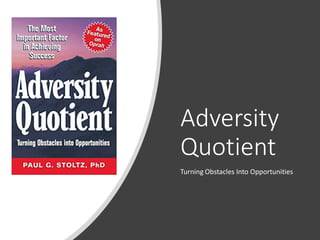
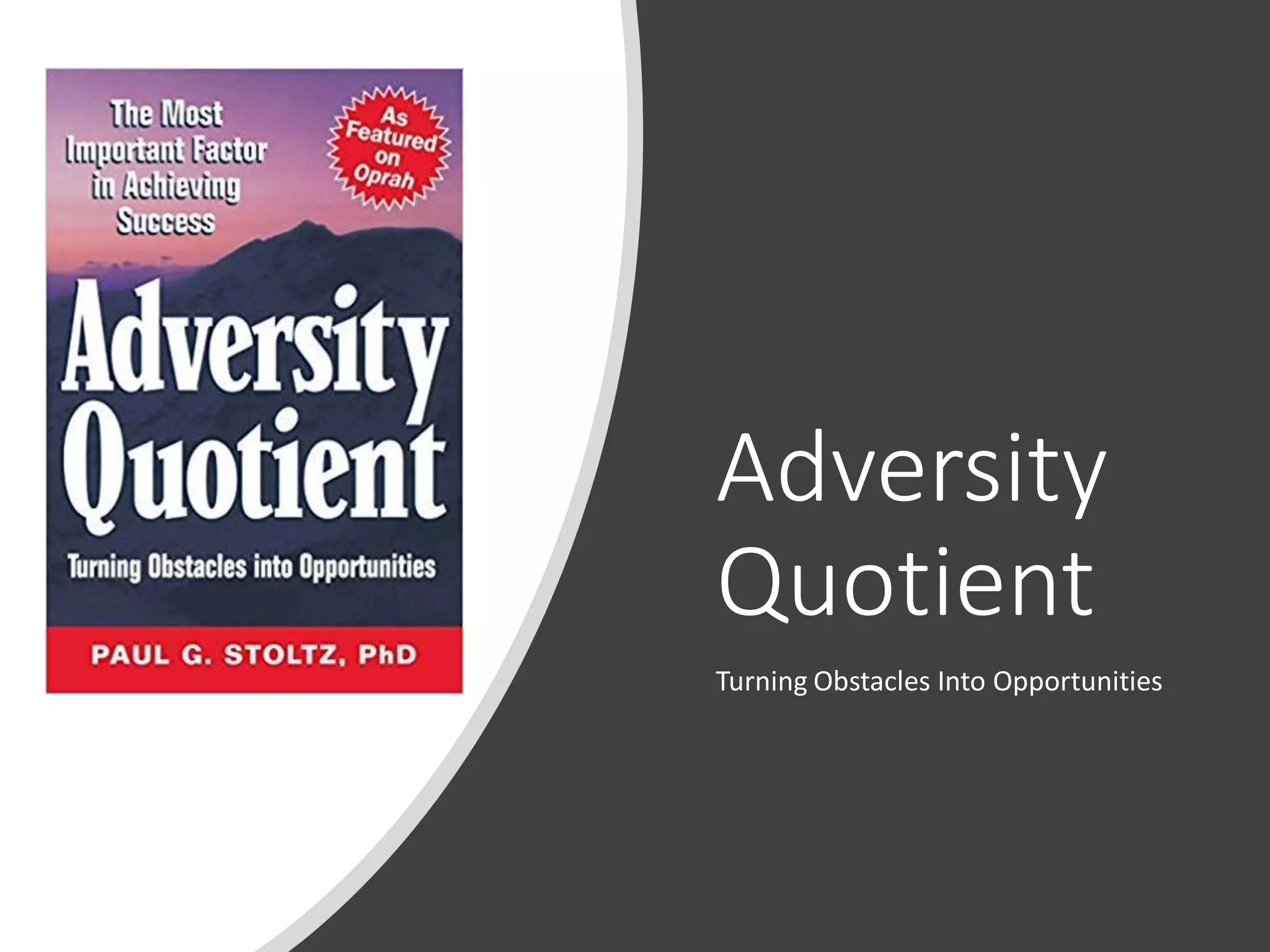

Adversity
Quotient
Turning Obstacles Into Opportunities
Paul G. Stoltz, Ph.D.
• Founder and CEO, PEAK Learning, Inc.
• PhD from University of Minnesota-Twin
Cities
• Founded PEAK Learning in 1987
• Wrote “Adversity Quotient” in 1997
• Other books:
• Adversity Quotient at Work (2000)
• The Adversity Advantage (2007)
• Put Your Mindset To Work (2011) – Co-
Author
• Grit (2015)
Adversity
Quotient
Is a Score that
measure the ability
of a person to deal
with adversities in life
Also known as
‘science of resilience’
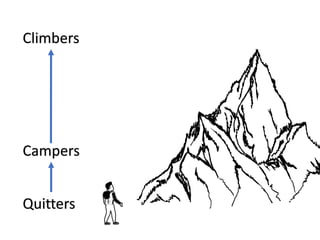
Quitters
Campers
Climbers
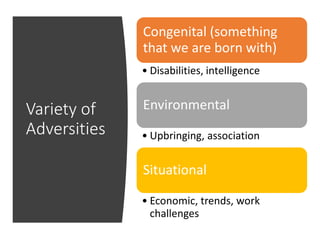
Variety of
Adversities
Congenital (something
that we are born with)
• Disabilities, intelligence
Environmental
• Upbringing, association
Situational
• Economic, trends, work
challenges
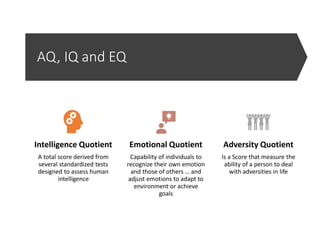
AQ, IQ and EQ
Intelligence Quotient
A total score derived from
several standardized tests
designed to assess human
intelligence
Emotional Quotient
Capability of individuals to
recognize their own emotion
and those of others … and
adjust emotions to adapt to
environment or achieve
goals
Adversity Quotient
Is a Score that measure the
ability of a person to deal
with adversities in life
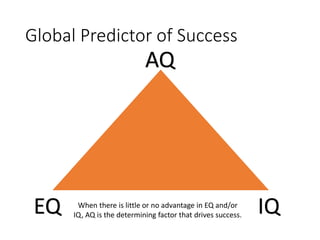
Global Predictor of Success
AQ
EQ IQWhen there is little or no advantage in EQ and/or
IQ, AQ is the determining factor that drives success.
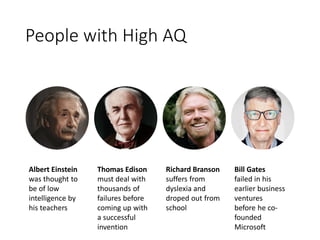
People with High AQ
Albert Einstein
was thought to
be of low
intelligence by
his teachers
Thomas Edison
must deal with
thousands of
failures before
coming up with
a successful
invention
Richard Branson
suffers from
dyslexia and
droped out from
school
Bill Gates
failed in his
earlier business
ventures
before he co-
founded
Microsoft
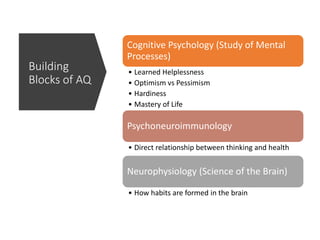
Building
Blocks of AQ
Cognitive Psychology (Study of Mental
Processes)
• Learned Helplessness
• Optimism vs Pessimism
• Hardiness
• Mastery of Life
Psychoneuroimmunology
• Direct relationship between thinking and health
Neurophysiology (Science of the Brain)
• How habits are formed in the brain
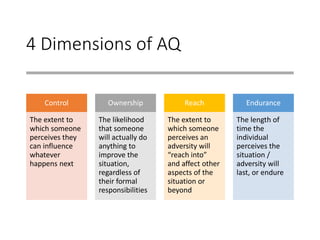
4 Dimensions of AQ
Control
The extent to
which someone
perceives they
can influence
whatever
happens next
Ownership
The likelihood
that someone
will actually do
anything to
improve the
situation,
regardless of
their formal
responsibilities
Reach
The extent to
which someone
perceives an
adversity will
“reach into”
and affect other
aspects of the
situation or
beyond
Endurance
The length of
time the
individual
perceives the
situation /
adversity will
last, or endure
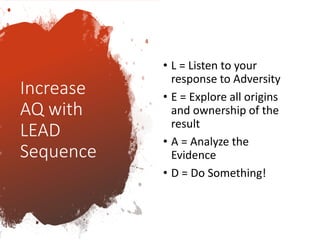
Increase
AQ with
LEAD
Sequence
• L = Listen to your
response to Adversity
• E = Explore all origins
and ownership of the
result
• A = Analyze the
Evidence
• D = Do Something!
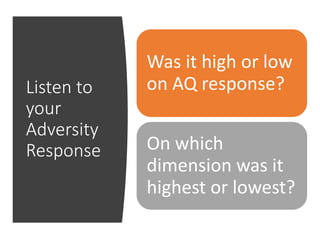
Listen to
your
Adversity
Response
Was it high or low
on AQ response?
On which
dimension was it
highest or lowest?
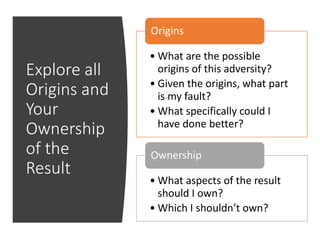
Explore all
Origins and
Your
Ownership
of the
Result
• What are the possible
origins of this adversity?
• Given the origins, what part
is my fault?
• What specifically could I
have done better?
Origins
• What aspects of the result
should I own?
• Which I shouldn’t own?
Ownership
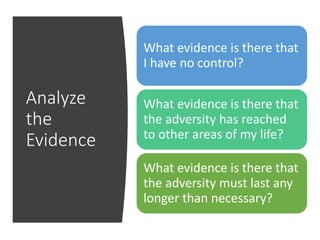
Analyze
the
Evidence
What evidence is there that
I have no control?
What evidence is there that
the adversity has reached
to other areas of my life?
What evidence is there that
the adversity must last any
longer than necessary?
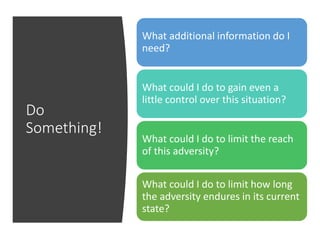
Do
Something!
What additional information do I
need?
What could I do to gain even a
little control over this situation?
What could I do to limit the reach
of this adversity?
What could I do to limit how long
the adversity endures in its current
state?
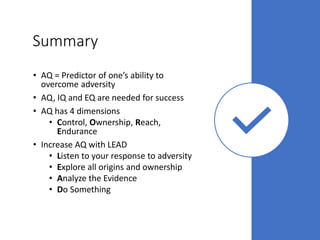
Summary
• AQ = Predictor of one’s ability to
overcome adversity
• AQ, IQ and EQ are needed for success
• AQ has 4 dimensions
• Control, Ownership, Reach,
Endurance
• Increase AQ with LEAD
• Listen to your response to adversity
• Explore all origins and ownership
• Analyze the Evidence
• Do Something
Copyright
Notes
• Summary made by
Stephen Siregar
• All rights to content belong to Paul G.
Stoltz, Ph.D.
• Summary author makes no claim of the
content in this material

Adversity Quotient-Book Summary

  • 1.
  • 2.
    Paul G. Stoltz,Ph.D. • Founder and CEO, PEAK Learning, Inc. • PhD from University of Minnesota-Twin Cities • Founded PEAK Learning in 1987 • Wrote “Adversity Quotient” in 1997 • Other books: • Adversity Quotient at Work (2000) • The Adversity Advantage (2007) • Put Your Mindset To Work (2011) – Co- Author • Grit (2015)
  • 3.
    Adversity Quotient Is a Scorethat measure the ability of a person to deal with adversities in life Also known as ‘science of resilience’
  • 4.
  • 5.
    Variety of Adversities Congenital (something thatwe are born with) • Disabilities, intelligence Environmental • Upbringing, association Situational • Economic, trends, work challenges
  • 6.
    AQ, IQ andEQ Intelligence Quotient A total score derived from several standardized tests designed to assess human intelligence Emotional Quotient Capability of individuals to recognize their own emotion and those of others … and adjust emotions to adapt to environment or achieve goals Adversity Quotient Is a Score that measure the ability of a person to deal with adversities in life
  • 7.
    Global Predictor ofSuccess AQ EQ IQWhen there is little or no advantage in EQ and/or IQ, AQ is the determining factor that drives success.
  • 8.
    People with HighAQ Albert Einstein was thought to be of low intelligence by his teachers Thomas Edison must deal with thousands of failures before coming up with a successful invention Richard Branson suffers from dyslexia and droped out from school Bill Gates failed in his earlier business ventures before he co- founded Microsoft
  • 9.
    Building Blocks of AQ CognitivePsychology (Study of Mental Processes) • Learned Helplessness • Optimism vs Pessimism • Hardiness • Mastery of Life Psychoneuroimmunology • Direct relationship between thinking and health Neurophysiology (Science of the Brain) • How habits are formed in the brain
  • 10.
    4 Dimensions ofAQ Control The extent to which someone perceives they can influence whatever happens next Ownership The likelihood that someone will actually do anything to improve the situation, regardless of their formal responsibilities Reach The extent to which someone perceives an adversity will “reach into” and affect other aspects of the situation or beyond Endurance The length of time the individual perceives the situation / adversity will last, or endure
  • 11.
    Increase AQ with LEAD Sequence • L= Listen to your response to Adversity • E = Explore all origins and ownership of the result • A = Analyze the Evidence • D = Do Something!
  • 12.
    Listen to your Adversity Response Was ithigh or low on AQ response? On which dimension was it highest or lowest?
  • 13.
    Explore all Origins and Your Ownership ofthe Result • What are the possible origins of this adversity? • Given the origins, what part is my fault? • What specifically could I have done better? Origins • What aspects of the result should I own? • Which I shouldn’t own? Ownership
  • 14.
    Analyze the Evidence What evidence isthere that I have no control? What evidence is there that the adversity has reached to other areas of my life? What evidence is there that the adversity must last any longer than necessary?
  • 15.
    Do Something! What additional informationdo I need? What could I do to gain even a little control over this situation? What could I do to limit the reach of this adversity? What could I do to limit how long the adversity endures in its current state?
  • 16.
    Summary • AQ =Predictor of one’s ability to overcome adversity • AQ, IQ and EQ are needed for success • AQ has 4 dimensions • Control, Ownership, Reach, Endurance • Increase AQ with LEAD • Listen to your response to adversity • Explore all origins and ownership • Analyze the Evidence • Do Something
  • 17.
    Copyright Notes • Summary madeby Stephen Siregar • All rights to content belong to Paul G. Stoltz, Ph.D. • Summary author makes no claim of the content in this material